×
Request Free Sample ×

Kindly complete the form below to receive a free sample of this Report

* Please use a valid business email

Leading companies partner with us for data-driven Insights

clients tt-cursor
Hero Background

South Korea Bone Biopsy Market

ID: MRFR/HC/51038-HCR
200 Pages
Rahul Gotadki
February 2026

South Korea Bone Biopsy Market Research Report: Size, Share, Trend Analysis By Types (Needle Biopsy, Open Biopsy), By Guided (MRI-Guided, CT-Guided) and By End Users (Hospitals and amp; Clinics, Surgical Centers, Others) - Growth Outlook & Industry Forecast 2025 To 2035

Share:
Download PDF ×

We do not share your information with anyone. However, we may send you emails based on your report interest from time to time. You may contact us at any time to opt-out.

South Korea Bone Biopsy Market Infographic
Purchase Options

South Korea Bone Biopsy Market Summary

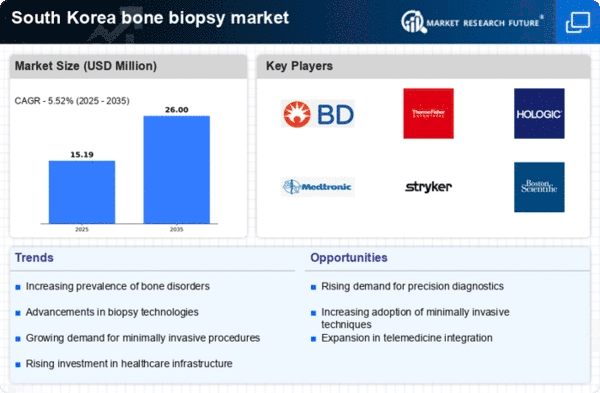
As per Market Research Future analysis, the South Korea bone biopsy market size was estimated at 14.4 USD Million in 2024. The South Korea bone biopsy market is projected to grow from 15.19 USD Million in 2025 to 26.0 USD Million by 2035, exhibiting a compound annual growth rate (CAGR) of 5.5% during the forecast period 2025 - 2035

Key Market Trends & Highlights

The South Korea bone biopsy market is experiencing robust growth driven by technological advancements and increasing healthcare expenditure.

  • Technological advancements are enhancing the precision and efficiency of bone biopsy procedures.
  • Minimally invasive procedures are gaining traction, appealing to both patients and healthcare providers.
  • The largest segment in the market is the diagnostic segment, while the fastest-growing segment is the therapeutic segment.
  • Rising incidence of bone disorders and increased healthcare expenditure are key drivers propelling market growth.

Market Size & Forecast

2024 Market Size 14.4 (USD Million)
2035 Market Size 26.0 (USD Million)
CAGR (2025 - 2035) 5.52%

Major Players

BD (US), Thermo Fisher Scientific (US), Hologic (US), Medtronic (IE), Stryker (US), Boston Scientific (US), Cook Medical (US), Cardinal Health (US)

Our Impact
Enabled $4.3B Revenue Impact for Fortune 500 and Leading Multinationals
Partnering with 2000+ Global Organizations Each Year
30K+ Citations by Top-Tier Firms in the Industry

South Korea Bone Biopsy Market Trends

The bone biopsy market in South Korea is currently experiencing notable advancements, driven by increasing incidences of bone-related diseases and a growing emphasis on early diagnosis. The healthcare sector is witnessing a shift towards minimally invasive procedures, which are perceived to enhance patient recovery times and reduce hospital stays. This trend is further supported by technological innovations in imaging and biopsy techniques, which are making procedures safer and more efficient. Additionally, the rising awareness among healthcare professionals regarding the importance of accurate diagnosis is likely to propel the demand for bone biopsy procedures. Moreover, the regulatory environment in South Korea appears to be evolving, with government initiatives aimed at improving healthcare access and quality. This includes investments in medical technology and training for healthcare providers, which may contribute to the expansion of the bone biopsy market. As the population ages, the prevalence of conditions such as osteoporosis and bone cancers is expected to rise, further driving the need for effective diagnostic solutions. Overall, the landscape of the bone biopsy market is poised for growth, influenced by both technological advancements and demographic shifts.

Technological Advancements

Innovations in imaging and biopsy techniques are enhancing the safety and efficiency of procedures. New technologies are enabling more precise targeting of bone lesions, which may lead to improved diagnostic accuracy and patient outcomes.

Minimally Invasive Procedures

There is a growing preference for minimally invasive techniques within the healthcare community. These procedures are associated with shorter recovery times and reduced complications, making them more appealing to both patients and healthcare providers.

Regulatory Support and Investment

The South Korean government is actively investing in healthcare infrastructure and technology. This support is likely to facilitate the growth of the bone biopsy market by improving access to advanced diagnostic tools and training for medical professionals.

South Korea Bone Biopsy Market Drivers

Increased Healthcare Expenditure

The rising healthcare expenditure in South Korea is a significant factor propelling the bone biopsy market. With the government and private sectors investing more in healthcare infrastructure, there is a growing availability of advanced diagnostic tools and procedures. Reports indicate that healthcare spending in South Korea has increased by approximately 7% annually, reflecting a commitment to improving patient care. This financial support enables hospitals and clinics to acquire state-of-the-art equipment for bone biopsies, thus enhancing the overall quality of care. As healthcare budgets expand, the bone biopsy market is poised for growth, driven by the demand for more accurate and efficient diagnostic solutions.

Supportive Regulatory Environment

The regulatory landscape in South Korea is becoming increasingly supportive of innovations in the bone biopsy market. Government initiatives aimed at streamlining the approval process for new medical devices and procedures are fostering an environment conducive to market growth. Recent policy changes have reduced the time required for regulatory approvals, allowing for quicker access to advanced biopsy technologies. This supportive framework is likely to encourage investment in research and development within the bone biopsy market. As a result, manufacturers may introduce novel products that enhance diagnostic capabilities, thereby expanding the market. The proactive stance of regulatory bodies indicates a commitment to improving healthcare outcomes, which could further stimulate demand for bone biopsy procedures.

Advancements in Imaging Techniques

Innovations in imaging technologies are significantly influencing the bone biopsy market. Enhanced imaging modalities, such as MRI and CT scans, allow for more precise localization of lesions, improving the accuracy of biopsies. These advancements facilitate minimally invasive procedures, which are increasingly preferred by both patients and healthcare providers. The integration of advanced imaging techniques into the biopsy process is likely to enhance diagnostic outcomes, thereby driving market growth. In South Korea, the adoption of these technologies is on the rise, with a reported increase of 15% in imaging equipment investments over the past year. This trend suggests that the bone biopsy market will continue to benefit from technological improvements that enhance procedural efficacy and patient safety.

Rising Incidence of Bone Disorders

The increasing prevalence of bone disorders in South Korea is a primary driver for the bone biopsy market. Conditions such as osteoporosis and bone tumors are becoming more common, leading to a heightened demand for diagnostic procedures. According to recent health statistics, approximately 30% of the population over 50 years old is affected by osteoporosis, necessitating effective diagnostic tools. This trend indicates a growing need for bone biopsies, as they provide critical information for treatment planning. The bone biopsy market is likely to expand as healthcare providers seek to address these rising incidences through advanced diagnostic techniques. Furthermore, the aging population in South Korea is expected to contribute to this trend, as older individuals are more susceptible to bone-related health issues.

Growing Awareness of Early Diagnosis

There is a notable increase in awareness regarding the importance of early diagnosis of bone-related diseases in South Korea. Educational campaigns and healthcare initiatives are emphasizing the need for timely interventions, which is likely to boost the demand for bone biopsies. As patients become more informed about their health, they are more inclined to seek diagnostic procedures that can lead to early detection of conditions such as cancer or osteoporosis. This shift in patient behavior is expected to positively impact the bone biopsy market, as healthcare providers adapt to meet the rising demand for early diagnostic services. The trend suggests a potential increase in the volume of biopsies performed, further driving market growth.


Market Segment Insights

By Type: Needle Biopsy (Largest) vs. Open Biopsy (Fastest-Growing)

In the South Korea bone biopsy market, Needle Biopsy holds the largest market share due to its minimally invasive nature and widespread acceptance among healthcare providers. This technique allows for precise sampling with lower complication rates, making it a preferred choice for both clinicians and patients. On the other hand, Open Biopsy, while currently smaller in share, is gaining traction due to its effectiveness in specific cases where larger tissue samples are necessary. The growth trends in this segment indicate a shift towards innovative technologies that enhance efficiency and patient safety. The rising preference for Needle Biopsy can be attributed to technological advancements that improve accuracy and reduce recovery times. Meanwhile, Open Biopsy is experiencing growth from an increasing demand for comprehensive diagnostic capabilities in complex cases, particularly in oncology settings. This demand reflects the evolving landscape of biopsy techniques, focusing on both accessibility and efficacy.

Needle Biopsy (Dominant) vs. Open Biopsy (Emerging)

Needle Biopsy is the dominant technique in the South Korea bone biopsy market, characterized by its less invasive procedure that typically involves the aspiration of bone marrow or tissue through a fine needle. Its advantages include shorter recovery times and minimal discomfort for patients, which contributes to its widespread use. Conversely, Open Biopsy, classified as an emerging technique, is preferred when a larger sample size is required for accurate diagnosis, despite being more invasive. Recent advancements in surgical techniques and improved post-operative care are enhancing its appeal. Together, these methods offer a comprehensive approach to bone biopsies, catering to varying clinical needs while driving market dynamics.

By Guided: MRI-Guided (Largest) vs. CT-Guided (Fastest-Growing)

The South Korea bone biopsy market segmentation reveals that MRI-Guided procedures hold a significant share, primarily due to their enhanced imaging capabilities that facilitate accurate needle placement. This segment dominates the market as medical professionals increasingly prefer MRI for its superior diagnostic quality and patient safety. Conversely, CT-Guided procedures, while currently smaller in market share, are rapidly gaining traction as advancements in technology improve their efficacy and accessibility, appealing to a broader range of healthcare providers. Growth in the guided segment is largely driven by the rising incidence of bone-related diseases and the increasing preference for minimally invasive procedures. MRI-Guided techniques are witnessing a surge in adoption due to their precise diagnosis and lower complication rates. On the other hand, the growing interest and advancements in CT technology are catalyzing the rapid growth of CT-Guided procedures, making them a formidable contender in this evolving market landscape.

Guided Techniques: MRI-Guided (Dominant) vs. CT-Guided (Emerging)

MRI-Guided techniques, as the dominant segment, are characterized by their ability to provide highly detailed images of bone structures, enabling accurate needle guidance during biopsies. This method is favored for its non-invasive nature and reduced risk of complications, which is crucial for patient safety. Facilities that offer MRI services often see higher patient satisfaction rates and lower procedural times. In contrast, CT-Guided procedures serve as an emerging alternative, particularly in facilities with established CT equipment. This method is gaining momentum due to improved imaging technology that enhances precision and expands access to a wider patient demographic, indicating a promising future for CT-Guided techniques in the South Korea bone biopsy market.

By End User: Hospitals and Clinics (Largest) vs. Surgical Centers (Fastest-Growing)

In the South Korea bone biopsy market, the end user segment is predominantly composed of hospitals and clinics, which hold a significant share due to their established infrastructures and advanced facilities. This segment is favored for its ability to cater to a high volume of patients needing diagnostic procedures. Surgical centers, while smaller in share, are quickly gaining traction as they often offer specialized services and shorter wait times, attracting more patients seeking efficient care. The growth trends in this segment indicate a rising demand for bone biopsy procedures, driven by factors such as increasing incidence rates of bone-related conditions and advancements in medical technology. Surgical centers are particularly demonstrating rapid growth, benefitting from a shift towards outpatient services and the desire for minimally invasive procedures. As healthcare providers continue to innovate and improve patient experiences, both hospitals and surgical centers are likely to expand their roles in this market.

Hospitals and Clinics (Dominant) vs. Surgical Centers (Emerging)

Hospitals and clinics serve as the dominant players in the South Korea bone biopsy market, characterized by comprehensive patient care and diagnostic capabilities. They are typically equipped with advanced imaging technologies and skilled professionals that ensure accurate diagnoses and treatment plans. In contrast, surgical centers are emerging as an important alternative, often focusing on outpatient services that provide convenience and efficiency. These centers attract patients looking for specialized procedures without the need for overnight stays. The growing preference for less invasive techniques among patients is contributing to the rapid expansion of surgical centers, making them a noteworthy segment in the evolving landscape of bone biopsy services.

Get more detailed insights about South Korea Bone Biopsy Market

Key Players and Competitive Insights

The bone biopsy market is currently characterized by a dynamic competitive landscape, driven by advancements in technology and increasing demand for minimally invasive procedures. Key players such as BD (US), Thermo Fisher Scientific (US), and Hologic (US) are at the forefront, each adopting distinct strategies to enhance their market presence. BD (US) focuses on innovation in biopsy devices, emphasizing the development of advanced imaging technologies to improve accuracy and patient outcomes. Meanwhile, Thermo Fisher Scientific (US) is leveraging its extensive portfolio to integrate digital solutions into its offerings, thereby enhancing operational efficiency and customer engagement. Hologic (US) appears to be concentrating on strategic partnerships to expand its product range and market reach, which collectively shapes a competitive environment that is increasingly reliant on technological advancements and collaborative efforts.In terms of business tactics, companies are increasingly localizing manufacturing to reduce costs and improve supply chain efficiency. This approach is particularly relevant in a moderately fragmented market where several players vie for market share. The collective influence of these key players is significant, as they not only drive innovation but also set industry standards that smaller companies must adhere to in order to remain competitive.

In October BD (US) announced the launch of a new line of biopsy needles designed to enhance precision and reduce patient discomfort. This strategic move is indicative of BD's commitment to innovation and aligns with the growing trend towards patient-centered care. By focusing on product development that addresses specific patient needs, BD is likely to strengthen its market position and attract a broader customer base.

In September Thermo Fisher Scientific (US) unveiled a new digital platform aimed at streamlining the biopsy process through enhanced data analytics. This initiative not only reflects the company's focus on digital transformation but also positions it to capitalize on the increasing demand for data-driven healthcare solutions. The integration of such technology could potentially lead to improved diagnostic accuracy and operational efficiencies, thereby enhancing Thermo Fisher's competitive edge.

In August Hologic (US) entered into a strategic partnership with a leading healthcare provider to co-develop innovative biopsy solutions tailored for specific patient demographics. This collaboration underscores Hologic's strategy of leveraging partnerships to expand its product offerings and enhance its market presence. By aligning with healthcare providers, Hologic is likely to gain valuable insights into patient needs, which could inform future product development and marketing strategies.

As of November the competitive trends in the bone biopsy market are increasingly defined by digitalization, sustainability, and the integration of artificial intelligence (AI). Strategic alliances are becoming more prevalent, as companies recognize the value of collaboration in driving innovation and expanding market reach. Looking ahead, it appears that competitive differentiation will increasingly hinge on factors such as technological innovation, supply chain reliability, and the ability to deliver tailored solutions, rather than solely on price. This shift suggests a more sophisticated competitive landscape where companies must continuously adapt to evolving market demands.

Key Companies in the South Korea Bone Biopsy Market include

Industry Developments

The South Korea Bone Biopsy Market has seen significant developments recently, particularly with advancements in technology and increased investment in medical infrastructure. Siemens Healthineers and GE Healthcare are notable players actively enhancing their product offerings. In terms of market valuation, there has been a discernible growth associated with the rising incidence of bone-related diseases, driving demand for biopsy procedures. 

Major happenings include the introduction of next-generation imaging systems and minimally invasive biopsy techniques, which have been influential in boosting procedure efficiency and patient comfort. In a critical development, in September 2023, Boston Scientific announced an expansion of its operations in South Korea, aimed at improving local access to its innovative biopsy devices. 

Additionally, in July 2023, Smith and Nephew unveiled a partnership with local health institutions to support educational programs about bone health and related biopsy techniques. Moreover, the ongoing collaboration between Thermo Fisher Scientific and local research institutes is expected to foster innovative solutions in biopsy diagnostics. Overall, the South Korea Bone Biopsy Market is experiencing an upward trajectory, backed by technological advancements, strategic partnerships, and an increasing focus on bone health management.

Future Outlook

South Korea Bone Biopsy Market Future Outlook

The Bone Biopsy Market in South Korea is projected to grow at 5.52% CAGR from 2025 to 2035, driven by technological advancements and increasing prevalence of bone disorders.

New opportunities lie in:

  • Development of minimally invasive biopsy devices for outpatient settings.
  • Expansion of telemedicine platforms for remote biopsy consultations.
  • Partnerships with hospitals for integrated biopsy service packages.

By 2035, the market is expected to achieve substantial growth, reflecting evolving healthcare needs.

Market Segmentation

South Korea Bone Biopsy Market Type Outlook

  • Needle Biopsy
  • Open Biopsy

South Korea Bone Biopsy Market Guided Outlook

  • MRI-Guided
  • CT-Guided

South Korea Bone Biopsy Market End User Outlook

  • Hospitals and Clinics
  • Surgical Centers
  • Others

Report Scope

MARKET SIZE 2024 14.4(USD Million)
MARKET SIZE 2025 15.19(USD Million)
MARKET SIZE 2035 26.0(USD Million)
COMPOUND ANNUAL GROWTH RATE (CAGR) 5.52% (2025 - 2035)
REPORT COVERAGE Revenue Forecast, Competitive Landscape, Growth Factors, and Trends
BASE YEAR 2024
Market Forecast Period 2025 - 2035
Historical Data 2019 - 2024
Market Forecast Units USD Million
Key Companies Profiled BD (US), Thermo Fisher Scientific (US), Hologic (US), Medtronic (IE), Stryker (US), Boston Scientific (US), Cook Medical (US), Cardinal Health (US)
Segments Covered Type, Guided, End User
Key Market Opportunities Advancements in minimally invasive techniques enhance patient outcomes in the bone biopsy market.
Key Market Dynamics Technological advancements and regulatory changes drive growth in the bone biopsy market in South Korea.
Countries Covered South Korea
Leave a Comment

FAQs

What is the expected market size of the South Korea Bone Biopsy Market in 2024?

The South Korea Bone Biopsy Market is expected to be valued at 14.4 million USD in 2024.

What will be the market size of the South Korea Bone Biopsy Market by 2035?

By 2035, the market is anticipated to grow to 28.8 million USD.

What is the expected CAGR for the South Korea Bone Biopsy Market from 2025 to 2035?

The expected CAGR for the South Korea Bone Biopsy Market from 2025 to 2035 is 6.504%.

Which type of bone biopsy is expected to have a larger market share in 2024?

Needle biopsy is expected to dominate the market with a value of 8.4 million USD in 2024.

What will be the market value for Open Biopsy in 2035?

The market value for Open Biopsy is expected to reach 12.0 million USD by 2035.

Who are the major players in the South Korea Bone Biopsy Market?

Key players in the market include Siemens Healthineers, Philips Healthcare, and Boston Scientific.

What growth opportunities exist in the South Korea Bone Biopsy Market?

Emerging trends and technological advancements present growth opportunities in the market.

What are the expected applications of the South Korea Bone Biopsy Market?

The main applications include diagnostic procedures and treatment planning for bone-related conditions.

How is the bone biopsy market outlook affected by regional factors?

Regional healthcare developments and investment in medical technology significantly influence the market outlook.

What challenges does the South Korea Bone Biopsy Market currently face?

Challenges include regulatory hurdles and high costs associated with advanced biopsy equipment.

Download Free Sample

Kindly complete the form below to receive a free sample of this Report

Compare Licence

×
Features License Type
Single User Multiuser License Enterprise User
Price $4,950 $5,950 $7,250
Maximum User Access Limit 1 User Upto 10 Users Unrestricted Access Throughout the Organization
Free Customization
Direct Access to Analyst
Deliverable Format
Platform Access
Discount on Next Purchase 10% 15% 15%
Printable Versions