×
Request Free Sample ×

Kindly complete the form below to receive a free sample of this Report

* Please use a valid business email

Leading companies partner with us for data-driven Insights

clients tt-cursor
Hero Background

South Korea Body Worn Camera Market

ID: MRFR/ICT/63965-HCR
200 Pages
Garvit Vyas
February 2026

South Korea Body-Worn Camera Market Size, Share and Trends Analysis Report By Operation (Recording Type, Live Streaming & Recording), By Resolution (4K, Full HD, HD, Others) and By End User (Law Enforcement, Military, Transportation, Sports & Leisure, Others) - Forecast to 2035

Share:
Download PDF ×

We do not share your information with anyone. However, we may send you emails based on your report interest from time to time. You may contact us at any time to opt-out.

South Korea Body Worn Camera Market Infographic
Purchase Options

South Korea Body Worn Camera Market Summary

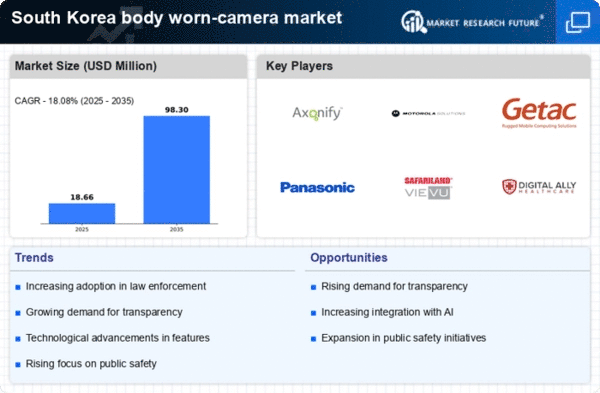
As per Market Research Future analysis, the South Korea body worn-camera market size was estimated at 15.8 USD Million in 2024. The South Korea body worn-camera market is projected to grow from 18.66 USD Million in 2025 to 98.3 USD Million by 2035, exhibiting a compound annual growth rate (CAGR) of 18.0% during the forecast period 2025 - 2035

Key Market Trends & Highlights

The South Korea body worn-camera market is experiencing robust growth driven by technological advancements and increasing demand for accountability.

  • Technological advancements are enhancing the functionality and usability of body worn cameras, making them more appealing to various sectors.
  • The law enforcement segment remains the largest, while the private security segment is emerging as the fastest-growing in the South Korea body worn-camera market.
  • Regulatory support is fostering a favorable environment for the adoption of body worn cameras across multiple industries.
  • Enhanced security concerns and public demand for transparency are key drivers propelling the growth of the body worn-camera market.

Market Size & Forecast

2024 Market Size 15.8 (USD Million)
2035 Market Size 98.3 (USD Million)
CAGR (2025 - 2035) 18.08%

Major Players

Axon (US), Motorola Solutions (US), Getac (TW), Panasonic (JP), Vievu (US), Digital Ally (US), BodyWorn (US), Reveal Media (GB), Taser International (US)

Our Impact
Enabled $4.3B Revenue Impact for Fortune 500 and Leading Multinationals
Partnering with 2000+ Global Organizations Each Year
30K+ Citations by Top-Tier Firms in the Industry

South Korea Body Worn Camera Market Trends

The body worn-camera market in South Korea is experiencing notable growth, driven by increasing demand for enhanced security and accountability in various sectors. Law enforcement agencies are adopting these devices to improve transparency and build trust within communities. The integration of advanced technologies, such as artificial intelligence and cloud storage, is further enhancing the functionality of body worn cameras, making them more appealing to users. Additionally, the government is actively promoting the use of these devices to ensure public safety and support law enforcement efforts. This trend indicates a shift towards more technologically advanced solutions in the security landscape. Moreover, the rising awareness of civil rights and the need for accountability in law enforcement practices are propelling the adoption of body worn cameras. As incidents of misconduct and public scrutiny increase, agencies are recognizing the importance of having reliable documentation of interactions. This growing emphasis on transparency is likely to drive further investments in body worn-camera technology. Furthermore, the collaboration between manufacturers and law enforcement agencies is fostering innovation, leading to the development of more user-friendly and efficient devices. Overall, the body worn-camera market is poised for continued expansion in South Korea, reflecting broader societal trends towards accountability and safety.

Technological Advancements

The body worn-camera market is witnessing rapid technological advancements, particularly in areas such as video quality, battery life, and data storage solutions. Innovations like high-definition recording and cloud integration are enhancing the usability and effectiveness of these devices. As technology evolves, manufacturers are likely to introduce features that cater to the specific needs of law enforcement and security personnel.

Regulatory Support

Government initiatives and regulations are playing a crucial role in the growth of the body worn-camera market. Authorities are implementing policies that encourage the adoption of these devices among law enforcement agencies. This regulatory support not only promotes accountability but also ensures that the use of body worn cameras aligns with privacy and civil rights considerations.

Increased Demand for Accountability

There is a growing demand for accountability in law enforcement practices, which is significantly influencing the body worn-camera market. Public awareness regarding civil rights and the need for transparency is prompting agencies to adopt these devices. This trend suggests that body worn cameras are becoming essential tools for fostering trust between law enforcement and the communities they serve.

South Korea Body Worn Camera Market Drivers

Rising Crime Rates

The rising crime rates in urban areas of South Korea are contributing to the growth of the body worn-camera market. As law enforcement agencies face challenges in managing public safety, the adoption of body worn cameras is seen as a strategic response to enhance surveillance and evidence collection. The market is projected to expand by 18% as agencies invest in these devices to deter criminal activity and improve incident documentation. This trend underscores the critical role that body worn cameras play in modern policing strategies, as they provide essential tools for law enforcement to address increasing security challenges.

Enhanced Security Concerns

The body worn-camera market is experiencing growth due to heightened security concerns across various sectors in South Korea. With increasing incidents of crime and public safety issues, law enforcement agencies are adopting body worn cameras to enhance accountability and transparency. The South Korean government has recognized the importance of these devices in improving public trust, leading to a projected market growth of approximately 15% annually. This trend indicates a shift towards proactive measures in crime prevention and evidence collection, thereby solidifying the role of body worn cameras in law enforcement operations.

Government Funding Initiatives

Government funding initiatives aimed at enhancing public safety are playing a crucial role in the body worn-camera market. In South Korea, various local and national programs are allocating budgets specifically for the procurement of body worn cameras for law enforcement agencies. This financial support not only facilitates the acquisition of advanced technology but also encourages the widespread adoption of these devices. The body worn-camera market is anticipated to benefit from these initiatives, with an expected increase in market size by 20% as agencies leverage government resources to improve their operational capabilities.

Public Demand for Transparency

There is a rising public demand for transparency in law enforcement practices, which is significantly influencing the body worn-camera market. Citizens in South Korea are increasingly advocating for the use of body worn cameras to ensure accountability among police officers. This societal pressure has led to various municipalities implementing policies that require the use of these devices during interactions with the public. As a result, the market is projected to grow by 12% over the next few years, as more agencies recognize the necessity of adopting body worn cameras to foster trust and transparency in their operations.

Integration with Smart Technologies

The integration of body worn cameras with smart technologies is driving innovation within the body worn-camera market. In South Korea, advancements in artificial intelligence and cloud computing are enabling real-time data analysis and storage solutions. This integration allows law enforcement agencies to access footage instantly, improving response times and operational efficiency. The market is expected to reach a valuation of $200 million by 2026, reflecting a growing reliance on technology to enhance policing methods. As agencies seek to modernize their operations, the demand for technologically advanced body worn cameras is likely to increase.


Market Segment Insights

By Operation: Live Streaming (Largest) vs. Recording (Fastest-Growing)

The Operation segment of the South Korea body worn-camera market is marked by distinct preferences for live streaming and recording capabilities. Live streaming holds a significant share due to its real-time application in law enforcement and security sectors. Conversely, recording functionalities are increasingly gaining traction as users seek more robust solutions for documentation and evidence collection. The ongoing competition drives innovation and refinement within these operational capabilities. Analyzing growth trends reveals a notable shift towards recording functionalities, driven by technological advancements and heightened awareness of the significance of accurate documentation. Additionally, as governmental and private sectors implement stricter regulations on video evidence, the demand for recording options is projected to rise. This trend is further bolstered by emerging technologies that enhance camera durability, battery life, and video quality, making them more appealing to users.

Live Streaming (Dominant) vs. Recording (Emerging)

In the South Korea body worn-camera market, live streaming is the dominant operation mode, prized for its ability to transmit footage in real-time. This functionality is essential for officers on duty, enabling immediate communication with control centers and improving situational awareness. The advantages of live streaming include enhanced surveillance capabilities and quicker response times. However, the emerging recording segment is rapidly gaining relevance as it offers a reliable method for preserving crucial video evidence. Its appeal lies in the ability to review and analyze footage post-incident. As a result, manufacturers are focusing on enhancing recording technologies, integrating features such as extended storage options and superior image resolution, thus inviting a broader customer base.

By Resolution: 4K (Largest) vs. Full HD (Fastest-Growing)

In the South Korea body worn-camera market, the resolution segment showcases a diverse distribution with 4K leading in market share. Full HD follows closely, demonstrating robust adoption among consumers who prioritize quality. The HD segment holds a smaller share, mainly appealing to cost-sensitive buyers. Meanwhile, 'Others' encapsulate various niche resolutions that cater to specific needs, contributing to the overall landscape.

4K (Dominant) vs. Full HD (Emerging)

The 4K resolution segment stands as a dominant force in the South Korea body worn-camera market, favored for its superior image clarity and detail, which are critical in surveillance and law enforcement applications. It appeals particularly to professional users who require high-quality footage for evidence and documentation. On the other hand, Full HD is emerging rapidly due to its balance between quality and affordability, making it increasingly popular among various sectors, including private security and personal use. This growing trend is fueled by advancements in technology, which have made Full HD cameras both accessible and capable of delivering satisfactory performance for everyday applications.

By End User: Law Enforcement (Largest) vs. Military (Fastest-Growing)

In the South Korea body worn-camera market, the law enforcement segment dominates, capturing a significant share due to an increasing emphasis on accountability and transparency in policing. This demand has been driven by various policy changes and societal expectations, pushing law enforcement agencies to equip officers with body cameras extensively. Meanwhile, the military segment is emerging as the fastest-growing area as defense forces recognize the importance of situational awareness and capturing critical events during operations. Growth trends are significantly influenced by advancements in technology and increasing security concerns. The push for enhanced safety measures across various sectors, including transportation and sports, is encouraging adoption. The rising popularity of body worn cameras in the military is also attributed to the integration of advanced features like live streaming and facial recognition, further bolstering their appeal.

Law Enforcement: Dominant vs. Military (Emerging)

The law enforcement segment is characterized by its robust market presence, thanks to continual investments in technology and training. This segment's dominance is fueled by government initiatives aimed at increasing police accountability and community trust. Body worn cameras are becoming standard equipment for officers, facilitating evidence collection and enhancing operational transparency. In contrast, the military segment, though currently smaller, shows immense potential for growth. Increasing defense budgets and a shift towards modernized warfare are driving militaries to adopt body worn cameras for tactical advantages. This segment is also beginning to integrate advanced capabilities like night vision and real-time data transmission, positioning it as a critical player for the future of operational efficiency in defense.

Get more detailed insights about South Korea Body Worn Camera Market

Key Players and Competitive Insights

The body worn-camera market in South Korea is characterized by a dynamic competitive landscape, driven by technological advancements and increasing demand for accountability in law enforcement. Key players such as Axon (US), Motorola Solutions (US), and Getac (TW) are at the forefront, each adopting distinct strategies to enhance their market presence. Axon (US) focuses on innovation through continuous product development, emphasizing integrated software solutions that complement their hardware offerings. Meanwhile, Motorola Solutions (US) leverages its extensive experience in communications technology to provide comprehensive solutions that include body worn cameras as part of a broader public safety ecosystem. Getac (TW), on the other hand, emphasizes ruggedness and durability in its products, catering to sectors that require robust equipment in challenging environments. Collectively, these strategies contribute to a competitive environment that is increasingly centered around technological integration and user-centric design.
In terms of business tactics, companies are increasingly localizing manufacturing to reduce costs and enhance supply chain efficiency. This approach not only mitigates risks associated with The body worn-camera market demands. The competitive structure of the market appears moderately fragmented, with several players vying for market share, yet dominated by a few key firms that hold substantial influence. This fragmentation fosters innovation as companies strive to differentiate their offerings in a crowded marketplace.
In October 2025, Axon (US) announced a strategic partnership with a leading South Korean technology firm to enhance its software capabilities, aiming to integrate advanced AI features into its body worn cameras. This move is significant as it positions Axon (US) to leverage local expertise in AI, potentially improving the functionality and appeal of its products in the South Korean market. Such partnerships may also facilitate faster adaptation to local regulatory requirements and user preferences.
In September 2025, Motorola Solutions (US) launched a new line of body worn cameras specifically designed for urban law enforcement agencies, featuring enhanced video quality and real-time data transmission capabilities. This strategic initiative underscores Motorola's commitment to addressing the unique challenges faced by urban law enforcement, thereby solidifying its market position. The introduction of these advanced features is likely to attract new clients seeking state-of-the-art technology to improve operational efficiency.
In August 2025, Getac (TW) expanded its product line to include body worn cameras with integrated biometric authentication features, enhancing security and user verification. This strategic development reflects Getac's focus on addressing growing concerns regarding data security and privacy in law enforcement applications. By incorporating such features, Getac (TW) not only differentiates its products but also aligns with increasing regulatory demands for secure data handling.
As of November 2025, the competitive trends in the body worn-camera market are increasingly defined by digitalization, sustainability, and the integration of AI technologies. Strategic alliances are becoming more prevalent, as companies recognize the value of collaboration in enhancing product offerings and market reach. Looking ahead, competitive differentiation is likely to evolve from traditional price-based competition towards a focus on innovation, technological advancements, and the reliability of supply chains. This shift suggests that companies that prioritize R&D and strategic partnerships will be better positioned to thrive in an increasingly complex market.

Key Companies in the South Korea Body Worn Camera Market include

Industry Developments

In the South Korea Body-Worn Camera Market, recent developments reflect a growing emphasis on technology and public safety. The government has been actively increasing the adoption of body-worn cameras among law enforcement agencies to enhance transparency and accountability, which has been supported by policies encouraging police modernization as noted in official statements published in September 2023. Companies like Axon and Motorola Solutions are reportedly expanding their presence, as these organizations recognize the market's potential granted by increased funding and focus on public safety initiatives.

Additionally, Honeywell and Panasonic have announced collaborations with local governments to integrate advanced features into body-worn cameras, enhancing functionality and data storage capabilities sought by law enforcement agencies. Moreover, there were significant movements noted in the M&A front with Ambarella, as they seek to strengthen their position in the Asian market through acquisitions that were publicly disclosed in July 2023. The valuation of enterprises in this segment continues to rise, attributed to escalating demand for secure and efficient surveillance solutions, positively influencing overall market growth in the region.


Future Outlook

South Korea Body Worn Camera Market Future Outlook

The body worn-camera market is projected to grow at 18.08% CAGR from 2025 to 2035, driven by technological advancements, increasing demand for security, and regulatory support.

New opportunities lie in:

  • Integration of AI analytics for real-time data processing
  • Development of subscription-based cloud storage solutions
  • Expansion into private security and corporate sectors

By 2035, the market is expected to achieve substantial growth, driven by innovation and diverse applications.

Market Segmentation

South Korea Body Worn Camera Market End User Outlook

  • Law Enforcement
  • Military
  • Transportation
  • Sports & Leisure
  • Others

South Korea Body Worn Camera Market Operation Outlook

  • Recording Type
  • Live Streaming & Recording

South Korea Body Worn Camera Market Resolution Outlook

  • 4K
  • Full HD
  • HD
  • Others

Report Scope

MARKET SIZE 2024 15.8(USD Million)
MARKET SIZE 2025 18.66(USD Million)
MARKET SIZE 2035 98.3(USD Million)
COMPOUND ANNUAL GROWTH RATE (CAGR) 18.08% (2025 - 2035)
REPORT COVERAGE Revenue Forecast, Competitive Landscape, Growth Factors, and Trends
BASE YEAR 2024
Market Forecast Period 2025 - 2035
Historical Data 2019 - 2024
Market Forecast Units USD Million
Key Companies Profiled Axon (US), Motorola Solutions (US), Getac (TW), Panasonic (JP), Vievu (US), Digital Ally (US), BodyWorn (US), Reveal Media (GB), Taser International (US)
Segments Covered Operation, Resolution, End User
Key Market Opportunities Integration of advanced AI analytics in the body worn-camera market enhances law enforcement efficiency and accountability.
Key Market Dynamics Rising demand for body worn cameras driven by enhanced law enforcement accountability and regulatory support in South Korea.
Countries Covered South Korea
Leave a Comment

FAQs

What is the expected market size of the South Korea Body-Worn Camera Market in 2024?

The South Korea Body-Worn Camera Market is expected to be valued at 0.02 USD Billion in 2024.

How much is the South Korea Body-Worn Camera Market projected to grow by 2035?

By 2035, the South Korea Body-Worn Camera Market is projected to be valued at 0.1 USD Billion.

What is the forecasted CAGR for the South Korea Body-Worn Camera Market from 2025 to 2035?

The expected CAGR for the South Korea Body-Worn Camera Market from 2025 to 2035 is 16.39%.

Who are the key players in the South Korea Body-Worn Camera Market?

Key players include Vievu, Honeywell, Ambarella, Axon, Dahua Technology, and Samsung among others.

What are the main operation segments in the South Korea Body-Worn Camera Market?

The main operation segments are Recording Type and Live Streaming & Recording.

What is the market value for Recording Type in 2024?

The market value for Recording Type is expected to be 0.01 USD Billion in 2024.

What market value is Live Streaming & Recording expected to reach by 2035?

Live Streaming & Recording is expected to reach a market value of 0.05 USD Billion by 2035.

How do the market values of Recording Type and Live Streaming compare in 2024?

Both the Recording Type and Live Streaming & Recording segments are expected to be valued at 0.01 USD Billion in 2024.

What key trends are influencing the South Korea Body-Worn Camera Market?

Emerging trends include advancements in technology, increasing demand for security, and the need for accountability in law enforcement.

What growth drivers are identified for the South Korea Body-Worn Camera Market?

Growth drivers encompass rising public safety concerns, regulatory requirements, and advancements in camera technology.

Download Free Sample

Kindly complete the form below to receive a free sample of this Report

Compare Licence

×
Features License Type
Single User Multiuser License Enterprise User
Price $4,950 $5,950 $7,250
Maximum User Access Limit 1 User Upto 10 Users Unrestricted Access Throughout the Organization
Free Customization
Direct Access to Analyst
Deliverable Format
Platform Access
Discount on Next Purchase 10% 15% 15%
Printable Versions