×
Request Free Sample ×

Kindly complete the form below to receive a free sample of this Report

* Please use a valid business email

Leading companies partner with us for data-driven Insights

clients tt-cursor
Hero Background

South Korea Biosurgery Market

ID: MRFR/HC/54739-HCR
200 Pages
Rahul Gotadki
February 2026

South Korea Biosurgery Market Research Report: Size, Share, Trend Analysis By Product Type (Surgical Sealants, Hemostats, Tissue Adhesives, Bone Grafts, Wound Closure Products), By Applications (Cardiac Surgery, Orthopedic Surgery, Neurosurgery, General Surgery, Plastic and Reconstructive Surgery), By End Users (Hospitals, Ambulatory Surgical Centers, Specialty Clinics) and By Distribution Channel (Direct Sales, Distributors, Online Sales) - Growth Outlook & Industry Forecast 2025 To 2035

Share:
Download PDF ×

We do not share your information with anyone. However, we may send you emails based on your report interest from time to time. You may contact us at any time to opt-out.

South Korea Biosurgery Market Infographic
Purchase Options

South Korea Biosurgery Market Summary

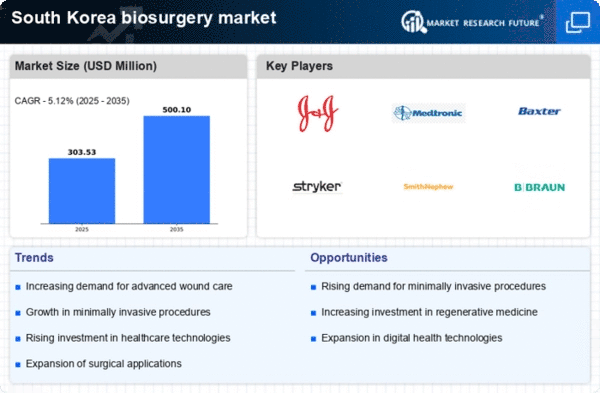
As per Market Research Future analysis, the South Korea biosurgery market Size was estimated at 288.75 USD Million in 2024. The South Korea biosurgery market is projected to grow from 303.53 USD Million in 2025 to 500.1 USD Million by 2035, exhibiting a compound annual growth rate (CAGR) of 5.1% during the forecast period 2025 - 2035

Key Market Trends & Highlights

The South Korea biosurgery market is poised for substantial growth driven by technological advancements and demographic shifts.

  • Technological advancements in biosurgery are enhancing surgical outcomes and patient recovery times.
  • The aging population in South Korea is contributing to an increased demand for surgical procedures, particularly in orthopedics and wound care.
  • Government support for R&D is fostering innovation and expanding the biosurgery product portfolio.
  • Rising surgical procedures and growing awareness of minimally invasive techniques are key drivers propelling market growth.

Market Size & Forecast

2024 Market Size 288.75 (USD Million)
2035 Market Size 500.1 (USD Million)
CAGR (2025 - 2035) 5.12%

Major Players

Johnson & Johnson (US), Medtronic (US), Baxter International (US), Stryker Corporation (US), Smith & Nephew (GB), B. Braun Melsungen AG (DE), Coloplast A/S (DK), Integra LifeSciences (US), Mölnlycke Health Care (SE)

Our Impact
Enabled $4.3B Revenue Impact for Fortune 500 and Leading Multinationals
Partnering with 2000+ Global Organizations Each Year
30K+ Citations by Top-Tier Firms in the Industry

South Korea Biosurgery Market Trends

The biosurgery market in South Korea is currently experiencing notable growth, driven by advancements in surgical techniques and an increasing demand for minimally invasive procedures. The integration of innovative technologies, such as bioactive materials and regenerative medicine, appears to enhance surgical outcomes and reduce recovery times. Furthermore, the aging population in South Korea is likely to contribute to a rising incidence of chronic diseases, thereby increasing the need for surgical interventions. This demographic shift may further stimulate the biosurgery market as healthcare providers seek effective solutions to manage complex medical conditions. In addition, the South Korean government is actively promoting research and development in the healthcare sector, which may lead to the introduction of novel biosurgical products. Regulatory frameworks are evolving to facilitate faster approvals for innovative therapies, potentially enhancing market dynamics. As healthcare professionals increasingly adopt biosurgical techniques, the market is expected to expand, reflecting a shift towards more efficient and patient-centered care. Overall, the biosurgery market in South Korea seems poised for continued growth, driven by technological advancements and demographic trends.

Technological Advancements

The biosurgery market is witnessing a surge in technological innovations, particularly in the development of bioactive materials and advanced surgical tools. These advancements are likely to improve surgical precision and patient outcomes, making procedures safer and more effective.

Aging Population

The demographic shift towards an older population in South Korea is contributing to an increased prevalence of chronic diseases. This trend is expected to drive demand for surgical interventions, thereby expanding the biosurgery market as healthcare providers adapt to the needs of this demographic.

Government Support for R&D

The South Korean government is actively investing in research and development initiatives within the healthcare sector. This support may lead to the emergence of new biosurgical products and technologies, fostering innovation and enhancing the overall market landscape.

South Korea Biosurgery Market Drivers

Rising Surgical Procedures

The increasing number of surgical procedures in South Korea is a pivotal driver for the biosurgery market. As the population ages and the prevalence of chronic diseases rises, the demand for surgical interventions escalates. In 2025, it is estimated that surgical procedures will reach approximately 1.5 million annually, reflecting a growth of around 10% from previous years. This surge necessitates advanced surgical solutions, including biosurgical products that enhance healing and reduce complications. The biosurgery market is likely to benefit from this trend, as healthcare providers seek innovative solutions to improve patient outcomes and operational efficiency.

Increase in Sports Injuries

The rising incidence of sports-related injuries in South Korea is a significant factor influencing the biosurgery market. With a growing interest in sports and fitness, the number of injuries requiring surgical intervention is on the rise. In 2025, it is projected that sports injuries will account for approximately 20% of all surgical procedures. This trend creates a demand for biosurgical products that aid in faster recovery and improved healing. As athletes and active individuals seek effective treatment options, the biosurgery market is poised to expand, catering to the needs of this demographic.

Focus on Research and Development

The emphasis on research and development (R&D) within the South Korean healthcare sector is a vital driver for the biosurgery market. With an increase in funding for medical research, particularly in the field of regenerative medicine and biosurgical innovations, the market is likely to see significant advancements. In 2025, R&D investments are expected to reach $500 million, fostering the development of new biosurgical products and techniques. This focus on innovation not only enhances the quality of care but also positions the biosurgery market for sustained growth as new solutions emerge to meet evolving healthcare needs.

Investment in Healthcare Infrastructure

The South Korean government is actively investing in healthcare infrastructure, which serves as a crucial driver for the biosurgery market. With an allocation of approximately $2 billion for healthcare improvements in 2025, the focus is on enhancing surgical facilities and integrating advanced technologies. This investment is likely to create a conducive environment for the adoption of biosurgical products, as hospitals and clinics upgrade their capabilities. Enhanced infrastructure not only supports the implementation of innovative biosurgery solutions but also improves patient access to these advanced treatments, thereby expanding the market.

Growing Awareness of Minimally Invasive Techniques

There is a notable shift towards minimally invasive surgical techniques in South Korea, which significantly influences the biosurgery market. Patients and healthcare professionals increasingly recognize the benefits of these techniques, such as reduced recovery times and lower risk of complications. This trend is supported by a 15% increase in the adoption of minimally invasive procedures over the past few years. As a result, biosurgical products that facilitate these techniques are gaining traction, leading to a more robust market. The demand for biosurgery solutions that align with this preference is expected to grow, further propelling the market forward.


Market Segment Insights

By Type: Surgical Sealants (Largest) vs. Hemostats (Fastest-Growing)

In the South Korea biosurgery market, the distribution of market share among the segment values highlights Surgical Sealants as the dominant player, capturing a significant portion of the market. Following closely are Hemostats, Tissue Adhesives, Bone Grafts, and Wound Closure Products. Each segment plays a crucial role within the realm of biosurgery, contributing to varied surgical applications and innovations. Growth trends in the South Korea biosurgery market indicate a rising demand for advanced surgical solutions, particularly driven by technological advancements and increasing preference for minimally invasive procedures. Hemostats are recognized for their rapid growth, attributed to the rising number of surgeries and a focus on efficient hemostasis in surgical procedures. Furthermore, the continual introduction of innovative products enhances the overall market landscape.

Surgical Sealants (Dominant) vs. Hemostats (Emerging)

Surgical Sealants are recognized as the dominant segment in the South Korea biosurgery market, widely used to secure tissue and prevent fluid leakage during surgeries. Their extensive application across various surgical specialties has solidified their market position. In contrast, Hemostats are emerging as a vital segment, gaining traction due to their ability to control bleeding effectively in surgical settings. Both segments reflect the industry's shift towards advanced materials and techniques designed to improve surgical outcomes, with Hemostats expected to become increasingly important as the demand for quick and efficient surgical interventions rises.

By Application: Orthopedic Surgery (Largest) vs. Cardiac Surgery (Fastest-Growing)

In the South Korea biosurgery market, the application segment showcases a diverse distribution with orthopedic surgery holding the largest market share, while cardiac surgery is gaining traction as the fastest-growing segment. The strong demand for innovative surgical solutions in orthopedic procedures reflects the increasing incidence of musculoskeletal disorders, which drives the orthopedic surgery market forward. In contrast, cardiac surgery is on an upward trajectory as advancements in surgical techniques and growing awareness about cardiovascular diseases enhance its market presence. Growth trends within the application segment are influenced by factors such as technological advancements, an expanding aging population, and increasing healthcare spending. The rise in minimally invasive surgical techniques across various specialties, including neurosurgery and plastic surgery, also contributes to market expansion. Furthermore, the ongoing research and development activities aimed at improving surgical outcomes are expected to propel growth in these applications, particularly in areas like orthopedic and plastic surgery.

Orthopedic Surgery (Dominant) vs. Cardiac Surgery (Emerging)

Orthopedic surgery serves as the dominant application within the South Korea biosurgery market, reflecting a robust demand driven by the rising prevalence of orthopedic conditions. This segment is characterized by innovative products such as biocompatible materials and advanced surgical adhesives which improve patient recovery times and surgical success rates. Conversely, cardiac surgery, while currently emerging, shows significant potential for growth due to technological advancements such as robotic-assisted surgeries and improved biomaterials. With rising awareness of cardiac health and increasing incidences of heart-related issues, this segment is rapidly evolving and requires not only precision in surgical procedures but also effective and efficient biosurgical tools to support cardiac interventions.

By End User: Hospitals (Largest) vs. Ambulatory Surgical Centers (Fastest-Growing)

In the South Korea biosurgery market, hospitals hold the largest share among end user segments. They are the primary facilities for complex surgeries and attract a significant portion of the biosurgery procedures, supported by advanced medical technology and comprehensive patient care services. Meanwhile, ambulatory surgical centers are gaining traction due to their cost-effectiveness and convenience, appealing particularly to patients seeking minor surgical procedures. Specialty clinics, while contributing to the overall market, represent a smaller share as they focus on niche medical offerings. Growth trends indicate a notable shift towards minimally invasive surgeries, propelling the demand within the ambulatory surgical center segment to new heights. Factors such as increasing healthcare expenditure, an aging population, and a rising preference for outpatient procedures are driving this evolution. As hospitals continue to innovate and expand their capabilities in biosurgery, ambulatory surgical centers are poised to capitalize on the changing landscape, emerging as a pivotal sector within the market.

Hospitals (Dominant) vs. Ambulatory Surgical Centers (Emerging)

Hospitals are characterized by their ability to provide comprehensive surgical services, including biosurgery, with a focus on complex procedures that require advanced capabilities and multi-disciplinary care teams. Their established infrastructure, trained personnel, and integration with various medical specialties position them as a dominant force in the market. On the other hand, ambulatory surgical centers represent an emerging segment, delivering a growing range of surgical options in an outpatient setting. These centers prioritize patient convenience and cost efficiency, leading to a swift uptick in their utilization. Patients are increasingly drawn to the shorter waiting times and lower costs associated with these facilities, which are projected to grow as they adapt to the evolving healthcare landscape.

By Distribution Channel: Direct Sales (Largest) vs. Online Sales (Fastest-Growing)

The South Korea biosurgery market shows a significant distribution among its channels, with direct sales leading the segment. This traditional approach allows manufacturers to establish stronger relationships with healthcare providers while ensuring product quality and support. Online sales, however, are becoming increasingly prominent, catering to a tech-savvy audience and facilitating quick access to products. Growth trends indicate a shift towards online platforms, attributed to the rising demand for convenience and accessibility in healthcare procurement. The expanding digital landscape in South Korea has prompted companies to enhance their online presence, tapping into a younger demographic that prefers online shopping. As these trends continue, online sales are positioned to become the fastest-growing segment within the distribution channels of the biosurgery market.

Direct Sales (Dominant) vs. Online Sales (Emerging)

Direct sales exhibit a dominant position in the South Korea biosurgery market due to their ability to provide tailored services and direct engagement with healthcare facilities. This channel fosters loyalty among healthcare providers and ensures immediate support and information exchange. Conversely, online sales are emerging rapidly as they offer users the advantage of convenience and speed, especially in accessing and ordering specialized biosurgical products. The shift towards digital platforms is driven by changing consumer behavior, where healthcare professionals increasingly seek efficient and seamless procurement processes. Companies are now focusing on developing robust online strategies to cater to this growing market segment, ensuring that their offerings are easily accessible while maintaining high standards of product quality and service.

Get more detailed insights about South Korea Biosurgery Market

Key Players and Competitive Insights

The biosurgery market in South Korea is characterized by a dynamic competitive landscape, driven by innovation, technological advancements, and strategic partnerships. Key players such as Johnson & Johnson (US), Medtronic (US), and Baxter International (US) are at the forefront, each employing distinct strategies to enhance their market presence. Johnson & Johnson (US) focuses on expanding its product portfolio through continuous innovation, while Medtronic (US) emphasizes strategic acquisitions to bolster its capabilities in advanced surgical solutions. Baxter International (US) is actively pursuing regional expansion, particularly in Asia, to tap into the growing demand for biosurgical products. Collectively, these strategies contribute to a competitive environment that is increasingly shaped by technological integration and market responsiveness.
In terms of business tactics, companies are localizing manufacturing and optimizing supply chains to enhance efficiency and reduce costs. The competitive structure of the biosurgery market appears moderately fragmented, with several key players exerting influence over market dynamics. This fragmentation allows for a diverse range of products and solutions, catering to various surgical needs and preferences across the region.
In October 2025, Medtronic (US) announced the launch of a new biosurgical product line aimed at enhancing wound healing in surgical patients. This strategic move is significant as it not only expands Medtronic's product offerings but also positions the company to capture a larger share of the growing demand for advanced wound care solutions in South Korea. The introduction of this product line is likely to strengthen Medtronic's competitive edge in the biosurgery market.
In September 2025, Baxter International (US) entered into a partnership with a local South Korean firm to co-develop innovative biosurgical products tailored to the specific needs of the regional market. This collaboration is indicative of Baxter's commitment to understanding local market dynamics and leveraging regional expertise to enhance product relevance. Such partnerships may facilitate faster market entry and improved customer engagement, thereby enhancing Baxter's competitive positioning.
In August 2025, Johnson & Johnson (US) completed the acquisition of a South Korean startup specializing in digital health solutions for surgical procedures. This acquisition underscores Johnson & Johnson's strategic focus on integrating digital technologies into its biosurgical offerings, potentially leading to improved surgical outcomes and patient experiences. The incorporation of digital health solutions is likely to resonate well with healthcare providers seeking to enhance operational efficiencies and patient care.
As of November 2025, current trends in the biosurgery market are increasingly defined by digitalization, sustainability, and the integration of artificial intelligence (AI) into surgical practices. Strategic alliances are playing a crucial role in shaping the competitive landscape, enabling companies to pool resources and expertise for innovation. Looking ahead, competitive differentiation is expected to evolve, with a notable shift from price-based competition towards a focus on innovation, technological advancements, and supply chain reliability. This transition may redefine how companies position themselves in the market, emphasizing the importance of delivering superior value through cutting-edge solutions.

Key Companies in the South Korea Biosurgery Market include

Industry Developments

The South Korea Biosurgery Market has recently shown dynamic developments, with significant growth attributed to increasing surgical procedures and a rising demand for innovative wound care products. KCI Medical and Smith and Nephew have been at the forefront, leading advancements in vacuum-assisted closure systems, which are gaining popularity in wound management.

In October 2023, Terumo Corporation announced a new collaboration with local hospitals to enhance the application of their biosurgical products in minimally invasive surgeries. Additionally, B. Braun Melsungen and Integra LifeSciences are investing in Research and Development initiatives aimed at improving surgical outcomes through advanced biomaterials.

In terms of mergers and acquisitions, KCI Medical was reported to be in talks with a local firm for potential collaboration aimed at expanding its market presence in September 2023. Market valuation for companies like Baxter International and Abbott Laboratories has shown an upward trend, positively impacting the overall industry landscape in South Korea. Notably, in the last two years, companies have embraced digital transformation, moving towards telehealth solutions integrated with biosurgical services, enhancing patient engagement and facilitating remote monitoring.

Future Outlook

South Korea Biosurgery Market Future Outlook

The Biosurgery Market in South Korea is projected to grow at a 5.12% CAGR from 2025 to 2035, driven by technological advancements, increasing surgical procedures, and rising healthcare expenditure.

New opportunities lie in:

  • Development of biodegradable surgical adhesives for minimally invasive procedures.
  • Expansion of telemedicine platforms for remote surgical consultations.
  • Investment in R&D for innovative hemostatic agents targeting trauma care.

By 2035, the biosurgery market is expected to achieve substantial growth, reflecting evolving healthcare needs.

Market Segmentation

South Korea Biosurgery Market Type Outlook

  • Surgical Sealants
  • Hemostats
  • Tissue Adhesives
  • Bone Grafts
  • Wound Closure Products

South Korea Biosurgery Market End User Outlook

  • Hospitals
  • Ambulatory Surgical Centers
  • Specialty Clinics

South Korea Biosurgery Market Application Outlook

  • Cardiac Surgery
  • Orthopedic Surgery
  • Neurosurgery
  • General Surgery
  • Plastic and Reconstructive Surgery

South Korea Biosurgery Market Distribution Channel Outlook

  • Direct Sales
  • Distributors
  • Online Sales

Report Scope

MARKET SIZE 2024 288.75(USD Million)
MARKET SIZE 2025 303.53(USD Million)
MARKET SIZE 2035 500.1(USD Million)
COMPOUND ANNUAL GROWTH RATE (CAGR) 5.12% (2025 - 2035)
REPORT COVERAGE Revenue Forecast, Competitive Landscape, Growth Factors, and Trends
BASE YEAR 2024
Market Forecast Period 2025 - 2035
Historical Data 2019 - 2024
Market Forecast Units USD Million
Key Companies Profiled Johnson & Johnson (US), Medtronic (US), Baxter International (US), Stryker Corporation (US), Smith & Nephew (GB), B. Braun Melsungen AG (DE), Coloplast A/S (DK), Integra LifeSciences (US), Mölnlycke Health Care (SE)
Segments Covered Type, Application, End User, Distribution Channel
Key Market Opportunities Emergence of innovative biomaterials enhancing surgical outcomes in the biosurgery market.
Key Market Dynamics Rising demand for advanced wound care products drives innovation in the biosurgery market in South Korea.
Countries Covered South Korea
Leave a Comment

FAQs

What is the expected market size of the South Korea Biosurgery Market in 2024?

The South Korea Biosurgery Market is expected to be valued at 231.0 million USD in 2024.

What is the projected value of the South Korea Biosurgery Market by 2035?

By 2035, the South Korea Biosurgery Market is projected to reach a value of 500.0 million USD.

What is the expected CAGR for the South Korea Biosurgery Market from 2025 to 2035?

The expected compound annual growth rate for the South Korea Biosurgery Market from 2025 to 2035 is 7.272%.

Which product type is anticipated to dominate the South Korea Biosurgery Market in 2024?

In 2024, Hemostats are anticipated to dominate the South Korea Biosurgery Market with a valuation of 70.0 million USD.

What will be the market size for Surgical Sealants in 2035?

The market size for Surgical Sealants in the South Korea Biosurgery Market is expected to be 100.0 million USD by 2035.

Who are the major players in the South Korea Biosurgery Market?

Major players in the South Korea Biosurgery Market include KCI Medical, Smith & Nephew, Terumo Corporation, B. Braun Melsungen, and Integra LifeSciences.

What is the market value for Wound Closure Products in 2024?

The market value for Wound Closure Products in the South Korea Biosurgery Market is expected to be 41.0 million USD in 2024.

How much is the market expected to grow for Bone Grafts between 2024 and 2035?

The market for Bone Grafts is expected to grow from 30.0 million USD in 2024 to 70.0 million USD by 2035.

What is the potential market size for Tissue Adhesives in 2035?

The potential market size for Tissue Adhesives in the South Korea Biosurgery Market is projected to be 90.0 million USD in 2035.

What key trends are driving growth in the South Korea Biosurgery Market?

Key trends driving growth in the South Korea Biosurgery Market include advancements in surgical technologies and increasing demand for minimally invasive surgeries.

Download Free Sample

Kindly complete the form below to receive a free sample of this Report

Compare Licence

×
Features License Type
Single User Multiuser License Enterprise User
Price $4,950 $5,950 $7,250
Maximum User Access Limit 1 User Upto 10 Users Unrestricted Access Throughout the Organization
Free Customization
Direct Access to Analyst
Deliverable Format
Platform Access
Discount on Next Purchase 10% 15% 15%
Printable Versions