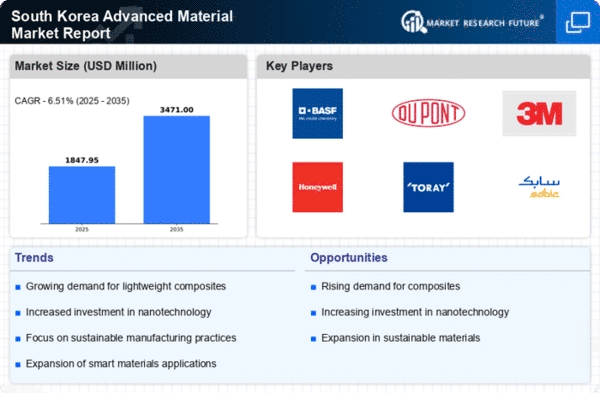
The advanced material market in South Korea is characterized by a dynamic competitive landscape, driven by innovation, sustainability, and technological advancements. Key players such as BASF (Germany), DuPont (US), and LG Chem (South Korea) are actively shaping the market through strategic initiatives. BASF (Germany) focuses on enhancing its product portfolio with sustainable materials, while DuPont (US) emphasizes innovation in high-performance polymers. LG Chem (South Korea) is investing heavily in R&D to develop advanced materials for electric vehicle batteries, indicating a strong alignment with the growing demand for sustainable energy solutions. Collectively, these strategies foster a competitive environment that prioritizes technological advancement and sustainability.In terms of business tactics, companies are increasingly localizing manufacturing to enhance supply chain efficiency and reduce costs. The market structure appears moderately fragmented, with several key players exerting significant influence. This fragmentation allows for a diverse range of products and innovations, yet the presence of major corporations like 3M (US) and Honeywell (US) suggests a competitive edge in terms of resources and market reach. The collective influence of these players shapes the market dynamics, pushing for continuous improvement and adaptation to consumer needs.
In October BASF (Germany) announced a partnership with a leading South Korean automotive manufacturer to develop lightweight composite materials aimed at reducing vehicle weight and enhancing fuel efficiency. This collaboration underscores BASF's commitment to sustainability and innovation, positioning the company as a leader in the automotive materials sector. The strategic importance of this partnership lies in its potential to significantly impact the automotive industry's shift towards more sustainable practices.
In September DuPont (US) launched a new line of bio-based polymers designed for use in packaging applications. This initiative reflects DuPont's strategic focus on sustainability and its response to increasing regulatory pressures for environmentally friendly materials. The introduction of these polymers not only enhances DuPont's product offerings but also aligns with global trends towards reducing plastic waste, thereby strengthening its market position.
In August LG Chem (South Korea) expanded its production capacity for advanced battery materials by investing $500 million in a new facility. This expansion is crucial as it positions LG Chem to meet the surging demand for electric vehicle batteries, which is expected to grow exponentially in the coming years. The strategic importance of this investment lies in its potential to solidify LG Chem's leadership in the battery materials market, particularly as the automotive industry increasingly shifts towards electrification.
As of November current competitive trends in the advanced material market are heavily influenced by digitalization, sustainability, and the integration of AI technologies. Strategic alliances are becoming increasingly vital, as companies seek to leverage complementary strengths to enhance their market offerings. The competitive differentiation is likely to evolve from traditional price-based competition towards a focus on innovation, technological advancements, and supply chain reliability. This shift indicates a future where companies that prioritize sustainable practices and advanced technologies will likely emerge as leaders in the advanced material market.