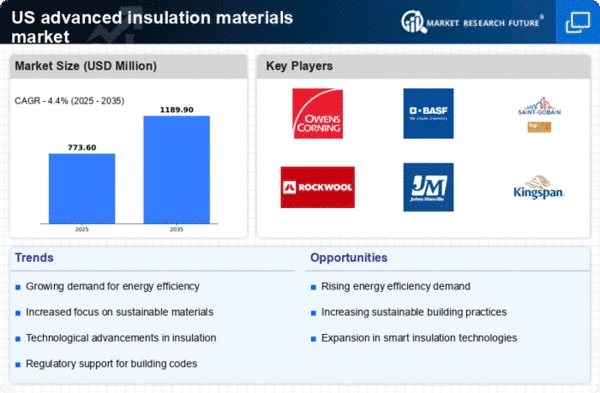
The advanced insulation-material market is currently characterized by a dynamic competitive landscape, driven by increasing demand for energy-efficient solutions and stringent regulatory frameworks aimed at reducing carbon footprints. Key players such as Owens Corning (US), BASF (DE), and Rockwool International (DK) are strategically positioned to leverage innovation and sustainability in their operations. Owens Corning (US) focuses on enhancing its product portfolio through advanced materials technology, while BASF (DE) emphasizes its commitment to sustainable practices and circular economy principles. Rockwool International (DK) is actively expanding its manufacturing capabilities to meet growing market demands, thereby shaping a competitive environment that prioritizes innovation and operational efficiency.In terms of business tactics, companies are increasingly localizing manufacturing to reduce lead times and optimize supply chains. The market structure appears moderately fragmented, with several key players exerting influence over specific segments. This fragmentation allows for niche players to thrive, while larger corporations consolidate their market positions through strategic partnerships and acquisitions, enhancing their competitive edge.
In October Owens Corning (US) announced the launch of a new line of eco-friendly insulation products designed to meet the latest energy efficiency standards. This strategic move not only aligns with the growing consumer preference for sustainable building materials but also positions the company as a leader in environmentally responsible insulation solutions. The introduction of these products is likely to enhance Owens Corning's market share and reinforce its commitment to sustainability.
In September BASF (DE) unveiled a partnership with a leading construction firm to develop innovative insulation solutions that integrate smart technology. This collaboration is indicative of BASF's strategy to incorporate digitalization into its product offerings, potentially enhancing energy efficiency and user experience. Such initiatives may provide BASF with a competitive advantage in a market increasingly focused on technological integration.
In August Rockwool International (DK) expanded its production facility in the US, aiming to increase output capacity by 30%. This expansion reflects Rockwool's proactive approach to meeting rising demand and underscores its commitment to maintaining a robust supply chain. By enhancing production capabilities, Rockwool is likely to solidify its position in the market and respond effectively to customer needs.
As of November current competitive trends indicate a strong emphasis on digitalization, sustainability, and the integration of artificial intelligence in product development. Strategic alliances are increasingly shaping the landscape, allowing companies to pool resources and expertise. The competitive differentiation is expected to evolve from traditional price-based competition towards innovation, technology, and supply chain reliability, suggesting that companies that prioritize these aspects will likely emerge as leaders in the advanced insulation-material market.