×
Request Free Sample ×

Kindly complete the form below to receive a free sample of this Report

* Please use a valid business email

Leading companies partner with us for data-driven Insights

clients tt-cursor
Hero Background

South America B2C E commerce Market

ID: MRFR/ICT/57447-HCR
200 Pages
Aarti Dhapte
February 2026

South America B2C E-commerce Market Research Report By Type (B2C Retailers, Classifieds), By Application (Automotive, Beauty & Personal Care, Books & Stationery, Consumer Electronics, Clothing & Footwear, Home Décor & Electronics, Sports & Leisure, Media & Entertainment, Information Technology, Others), and By Regional (Brazil, Mexico, Argentina, Rest of South America)- Forecast to 2035

Share:
Download PDF ×

We do not share your information with anyone. However, we may send you emails based on your report interest from time to time. You may contact us at any time to opt-out.

South America B2C E commerce Market Infographic
Purchase Options

South America B2C E commerce Market Summary

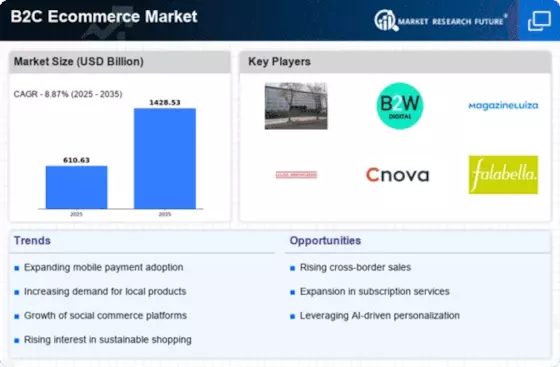
As per MRFR analysis, the South America B2C Ecommerce Market is projected to grow from USD 560.88 Billion in 2024 to USD 1,428.53 Billion by 2035, exhibiting a compound annual growth rate (CAGR) of 8.87% during the forecast period (2025 - 2035).

Key Market Trends & Highlights

The South America B2C Ecommerce Market is experiencing robust growth driven by technological advancements and changing consumer behaviors.

  • Mobile commerce is witnessing a notable rise, particularly in Brazil, as consumers increasingly prefer shopping via smartphones.
  • Local payment solutions are expanding rapidly, facilitating smoother transactions and enhancing consumer trust in Mexico's burgeoning market.
  • Social commerce is gaining traction, with brands leveraging social media platforms to engage younger consumers in both fashion and electronics segments.
  • The increasing internet penetration and adoption of digital payment solutions are key drivers propelling the market forward, particularly in the fashion sector.

Market Size & Forecast

2024 Market Size 560.88 (USD Billion)
2035 Market Size 1428.53 (USD Billion)
CAGR (2025 - 2035) 8.87%

Major Players

Mercado Libre (AR), B2W Digital (BR), Magazine Luiza (BR), Lojas Americanas (BR), Cnova (BR), Falabella (CL), Linio (PE), Dafiti (BR), Netshoes (BR)

Our Impact
Enabled $4.3B Revenue Impact for Fortune 500 and Leading Multinationals
Partnering with 2000+ Global Organizations Each Year
30K+ Citations by Top-Tier Firms in the Industry

South America B2C E commerce Market Trends

The South America B2C Ecommerce Market is currently experiencing a dynamic evolution, characterized by a growing number of consumers embracing online shopping. This shift is largely driven by increased internet penetration and the proliferation of mobile devices, which facilitate easier access to e-commerce platforms. Additionally, the region's diverse population is beginning to exhibit a preference for digital transactions, as they seek convenience and a wider array of product offerings. Retailers are responding to this trend by enhancing their online presence and optimizing their platforms to cater to local preferences and payment methods. Moreover, the South America B2C Ecommerce Market is witnessing a surge in the adoption of social commerce, where social media platforms serve as vital channels for product discovery and sales. This trend appears to be particularly pronounced among younger demographics, who are more inclined to engage with brands through social media. As businesses adapt to these changes, they are likely to invest in innovative marketing strategies and technologies to capture the attention of this digitally savvy audience. Overall, the landscape of e-commerce in South America is poised for continued growth, driven by technological advancements and shifting consumer behaviors.

Rise of Mobile Commerce

The South America B2C Ecommerce Market is seeing a notable increase in mobile commerce, as consumers increasingly utilize smartphones for shopping. This trend suggests that businesses must prioritize mobile-friendly websites and applications to enhance user experience and drive sales.

Growth of Local Payment Solutions

There is a growing emphasis on local payment methods within the South America B2C Ecommerce Market. Consumers prefer payment options that are familiar and secure, prompting retailers to integrate diverse payment solutions that cater to regional preferences.

Expansion of Social Commerce

Social media platforms are becoming essential for e-commerce in South America, as brands leverage these channels for marketing and sales. This trend indicates a shift in how consumers discover and purchase products, highlighting the importance of social engagement in driving online sales.

South America B2C E commerce Market Drivers

Increasing Internet Penetration

The South America B2C Ecommerce Market is experiencing a notable surge in internet penetration, which is a critical driver for online shopping. As of January 2026, approximately 75% of the population in South America has access to the internet, a significant increase from previous years. This growing connectivity facilitates easier access to e-commerce platforms, enabling consumers to shop online with greater convenience. Moreover, the proliferation of affordable smartphones has further contributed to this trend, allowing a broader demographic to engage in e-commerce activities. The rise in internet users is expected to continue, potentially reaching 80% by 2027, thereby expanding the customer base for the South America B2C Ecommerce Market.

Influence of Social Media Marketing

The influence of social media marketing is a significant driver for the South America B2C Ecommerce Market. As of January 2026, over 60% of consumers in the region report discovering new products through social media platforms. This trend is particularly pronounced among younger demographics, who are increasingly using platforms like Instagram and Facebook for shopping inspiration. Brands are leveraging social media to engage with consumers, offering targeted advertisements and promotions that resonate with local preferences. The integration of social commerce features, such as shoppable posts, is likely to enhance the shopping experience, further driving sales in the South America B2C Ecommerce Market.

Adoption of Digital Payment Solutions

The South America B2C Ecommerce Market is witnessing a rapid adoption of digital payment solutions, which is transforming the way consumers transact online. As of January 2026, digital payment methods account for over 50% of all online transactions in the region. This shift is largely driven by the increasing trust in online payment systems and the convenience they offer. Local payment solutions, such as Boleto Bancario in Brazil and MercadoPago in Argentina, have gained popularity, catering to the unique preferences of South American consumers. The growth of these payment options is likely to enhance the overall shopping experience, thereby encouraging more consumers to participate in the e-commerce landscape.

Expansion of Logistics and Delivery Services

The South America B2C Ecommerce Market is benefiting from the expansion of logistics and delivery services, which is crucial for meeting consumer expectations. As of January 2026, several logistics companies are investing heavily in infrastructure improvements to enhance delivery speed and reliability. This includes the establishment of fulfillment centers in key urban areas, which allows for faster order processing and shipping. Additionally, the rise of same-day delivery options is becoming more prevalent, catering to the growing demand for quick service. Such advancements in logistics are likely to play a pivotal role in attracting more consumers to the e-commerce sector, thereby driving growth in the South America B2C Ecommerce Market.

Rising Consumer Confidence in Online Shopping

Consumer confidence in online shopping is steadily rising within the South America B2C Ecommerce Market. Recent surveys indicate that approximately 65% of consumers in the region feel secure making purchases online, a marked improvement compared to previous years. This increase in confidence can be attributed to enhanced security measures implemented by e-commerce platforms, as well as positive experiences shared by peers. As consumers become more comfortable with online transactions, the market is likely to see a corresponding increase in sales. Furthermore, the growing presence of reputable international brands in South America is expected to bolster consumer trust, further propelling the growth of the B2C Ecommerce Market.


Market Segment Insights

By Product Category: Fashion (Largest) vs. Electronics (Fastest-Growing)

In the South American B2C Ecommerce market, fashion is the largest category, commanding a significant market share. It thrives on the region's cultural affinity for style and brand consciousness. The rise of online fashion retailers and the expansion of local brands have made this sector vibrant, appealing to a varied demographic. Electronics, while currently smaller in share, is witnessing rapid growth due to increased internet penetration and consumer interest in technological gadgets, driving an overall uptick in online purchases. The growth trends for these categories are driven by changing consumer behaviors and preferences, notably through younger demographics increasingly shifting towards online shopping. The swift advancement in mobile technology and improved logistics networks further boost electronics sales, making it the fastest-growing segment. Online promotions, seasonal discounts, and a rich assortment of electronics are incentivizing consumers to embrace this shift, indicating a dynamic and evolving market landscape.

Fashion: Apparel (Dominant) vs. Electronics: Gadgets (Emerging)

In the South American B2C Ecommerce market, Fashion, particularly the apparel sector, stands as the dominant player, capitalizing on a rich culture of style and expression. Fast fashion retailers, coupled with unique local brands, cater to a wide range of consumer preferences, ensuring broad appeal. On the other hand, Electronics, specifically gadgets, are emerging with great potential. This segment is characterized by consumers’ rising interest in smart home devices, wearable technology, and personal electronics. With a tech-savvy population and increasing mobile penetration, the market for electronic gadgets is set to expand rapidly, driven by innovative offerings and competitive pricing.

By Consumer Demographics: Age Group (Largest) vs. Income Level (Fastest-Growing)

In the South America B2C Ecommerce Market, the age group segment reveals a significant distribution of consumers, with the largest share belonging to the 25-34 age bracket, which demonstrates a strong affinity for online shopping. Following closely are the 18-24 and 35-44 age groups, reflecting the increasing penetration of the internet and mobile technology in these demographics. The income level segment, while more diversified, shows a growing trend among middle-income consumers, indicating an expanding customer base willing to engage in ecommerce services. As the ecommerce landscape evolves, various factors drive growth trends in the consumer demographics segment. The rise of social media platforms and targeted advertising has contributed to a burgeoning interest in the younger demographics, particularly among millennials and Gen Z. Additionally, as more individuals from the emerging middle-class segment have access to smartphones and the internet, this trend underscores a promising trajectory for income levels, especially in the context of increased disposable income for online shopping experiences.

Age Group (Dominant) vs. Income Level (Emerging)

The age group of 25-34 is considered dominant in the South America B2C Ecommerce Market, characterized by tech-savvy consumers who are frequently engaged in online purchases. This demographic is drawn to the convenience of ecommerce and often seeks a mix of quality and affordability. In contrast, the emerging income level segment, particularly the growing middle-income populace, shows potential for further expansion, demonstrating a willingness to explore digital shopping avenues. As this segment gains economic stability, it increasingly participates in the market, leading to diverse purchasing behaviors influenced by a range of factors from fashion to electronics, highlighting the necessity for businesses to tailor their offerings to meet these evolving consumer expectations.

By Shopping Behavior: Online Shopping Frequency (Largest) vs. Preferred Payment Method (Fastest-Growing)

In the South America B2C Ecommerce Market, online shopping frequency remains the largest segment, reflecting the increasing number of consumers who regularly engage with digital retail platforms. Meanwhile, the preferred payment method is evolving rapidly, with alternate payment solutions gaining traction. This shift suggests that consumers are becoming more comfortable with various payment options as they navigate their online shopping journeys, influencing overall ecommerce dynamics.

Online Shopping Frequency: Regular (Dominant) vs. Occasional (Emerging)

Regular online shoppers dominate the South American eCommerce landscape, significantly impacting sales and marketing strategies. These consumers often exhibit high purchase frequencies, leading retailers to enhance their engagement through tailored marketing campaigns and loyalty programs. On the other hand, occasional shoppers are emerging, driven by growing internet accessibility and improved delivery services. This segment shows potential for growth as convenience and trust in online shopping increase, presenting opportunities for businesses to convert infrequent buyers into regular patrons.

By Sales Channel: Mobile Commerce (Largest) vs. Marketplaces (Fastest-Growing)

In the South America B2C Ecommerce Market, the distribution of sales channels shows that Mobile Commerce holds the largest market share, driven by the widespread adoption of smartphones and improved internet connectivity across the region. This dominance is further enhanced by user-friendly mobile interfaces and various app-based shopping solutions that cater to consumer preferences. Meanwhile, Marketplaces are experiencing rapid growth, fueled by the increasing trend of consumers opting for convenience and variety in online shopping. This platform appeals particularly to price-sensitive customers looking for competitive offers. Growth trends in the South American ecommerce landscape indicate a shift towards more integrated shopping experiences, blending mobile and social media engagements to enhance customer interaction. Brands are increasingly investing in building their direct-to-consumer channels, recognizing the potential for greater customer loyalty and engagement. Social Media Commerce is also on the rise, supported by influencer marketing and social proof, enabling users to make purchases seamlessly through platforms they already use, thus complementing traditional website commerce.

Mobile Commerce (Dominant) vs. Direct-to-Consumer (Emerging)

Mobile Commerce is a dominant force within the South American B2C ecommerce landscape due to its seamless user experience, enabling consumers to shop on-the-go. The accessibility of mobile payment solutions and apps enhances consumer confidence and willingness to buy online. In contrast, Direct-to-Consumer (DTC) is emerging, appealing to brands aiming for a closer relationship with their customers, bypassing traditional retail channels. DTC offers personalized shopping experiences, direct feedback from consumers, and better profit margins, growing in popularity as companies leverage data analytics to understand consumer preferences. Together, these segments illustrate the dynamic nature of sales channels in a region increasingly driven by digital innovation.

Get more detailed insights about South America B2C E commerce Market

Regional Insights

Brazil : Leading the South American Charge

Brazil holds a commanding market share of 280.0, representing approximately 50% of South America's B2C ecommerce landscape. Key growth drivers include a burgeoning middle class, increased internet penetration, and a shift towards online shopping. Government initiatives aimed at digital transformation and improved logistics infrastructure further bolster this growth. The rise of mobile commerce and social media shopping trends are also significant, reflecting changing consumer preferences.

Mexico : Emerging Trends and Opportunities

With a market value of 120.0, Mexico accounts for about 21% of South America's B2C ecommerce. The growth is fueled by increasing smartphone usage and a young, tech-savvy population. Demand for online grocery shopping and home delivery services has surged, particularly post-pandemic. Regulatory support for digital payments and consumer protection laws are enhancing market confidence, while logistics improvements are addressing delivery challenges.

Argentina : Navigating Economic Challenges

Argentina's B2C ecommerce market is valued at 80.0, representing around 14% of the regional share. Economic volatility has led to a cautious consumer base, yet the demand for online shopping continues to grow, driven by convenience and competitive pricing. Government policies promoting digital commerce and tax incentives for startups are encouraging innovation. The rise of local marketplaces is also reshaping the competitive landscape.

Rest of South America : Opportunities Beyond Major Players

The Rest of South America, with a market value of 80.88, showcases diverse ecommerce landscapes across countries like Chile, Peru, and Colombia. Growth is driven by increasing internet access and mobile commerce adoption. Local players like Falabella and Linio are significant, but competition is intensifying from global giants. Each country presents unique challenges and opportunities, influenced by local regulations and consumer behavior.

Key Players and Competitive Insights

The B2C Ecommerce Market in South America is characterized by a dynamic competitive landscape, driven by rapid digital transformation and evolving consumer preferences. Key players such as Mercado Libre (AR), B2W Digital (BR), and Magazine Luiza (BR) are at the forefront, each adopting distinct strategies to enhance their market positioning. Mercado Libre (AR) continues to innovate with its logistics and payment solutions, aiming to streamline the shopping experience. B2W Digital (BR) focuses on expanding its product offerings and enhancing customer engagement through personalized marketing. Meanwhile, Magazine Luiza (BR) emphasizes omnichannel retailing, integrating online and offline experiences to capture a broader customer base. Collectively, these strategies contribute to a competitive environment that is increasingly focused on customer-centric solutions and technological advancements.

In terms of business tactics, companies are increasingly localizing their operations and optimizing supply chains to respond to regional demands. The market structure appears moderately fragmented, with several players vying for market share, yet the influence of major companies remains substantial. This competitive structure fosters innovation and encourages smaller players to adopt unique strategies to differentiate themselves.

In December 2025, Mercado Libre (AR) announced a partnership with a leading logistics firm to enhance its delivery capabilities across Brazil. This strategic move is likely to improve delivery times and customer satisfaction, reinforcing Mercado Libre's position as a market leader. The partnership underscores the importance of logistics in the B2C ecommerce sector, where timely delivery is a critical factor for consumer loyalty.

In November 2025, B2W Digital (BR) launched a new AI-driven recommendation engine aimed at personalizing the shopping experience for its users. This initiative is expected to increase conversion rates and customer retention by providing tailored product suggestions. The integration of AI technology reflects a broader trend within the market, where data-driven insights are becoming essential for competitive differentiation.

In October 2025, Magazine Luiza (BR) expanded its physical store network by opening new locations in underserved regions. This expansion strategy not only enhances its omnichannel approach but also allows the company to tap into new customer segments. By bridging the gap between online and offline shopping, Magazine Luiza is likely to strengthen its market presence and drive sales growth.

As of January 2026, the competitive trends in the B2C Ecommerce Market are increasingly defined by digitalization, sustainability, and the integration of AI technologies. Strategic alliances are becoming more prevalent, as companies recognize the value of collaboration in enhancing their service offerings. Looking ahead, competitive differentiation is expected to evolve, shifting from price-based competition to a focus on innovation, technology, and supply chain reliability. This transition may redefine how companies engage with consumers, emphasizing the importance of creating unique value propositions in a crowded marketplace.

Key Companies in the South America B2C E commerce Market include

Industry Developments

In March 2024, it was predicted that the digital commerce industry in Latin America would reach €850 billion by 2026, with real-time payment transactions reaching over 100 billion by 2027. This development would be fuelled by the rapid expansion of Buy Now Pay Later services and the widespread use of mobile shopping.

With 44% of the market in September 2024, Brazil's rapid payment system Pix was poised to surpass credit cards as the most popular online payment option by the end of 2025. In response to pressure from rivals, Brazil's MercadoLibre introduced a free-shipping policy in its biggest market in February 2025, dropping the minimum threshold to 19 reais (USD 3.40). This significantly reduced seller freight expenses.

In addition to a USD 2.6 billion investment in Argentina, MercadoLibre announced in April 2025 a record BRL 34 billion (USD 5.8 billion) investment in Brazil for 2025, with an emphasis on employment, technology, logistics, loyalty, and entertainment.

With revenues expected to reach USD 14.6 billion in 2025, the social commerce industry also experienced strong development, growing by 20.1% year through 2030. These advancements highlight the region's thriving e-commerce scene, which is characterised by dynamic payment networks, substantial investment, and calculated moves from top platforms.

South America B2C E-commerce

Future Outlook

South America B2C E commerce Market Future Outlook

The South America B2C Ecommerce Market is projected to grow at an 8.87% CAGR from 2025 to 2035, driven by increased internet penetration, mobile commerce, and evolving consumer preferences.

New opportunities lie in:

  • Expansion of localized payment solutions to enhance customer trust and convenience.
  • Development of AI-driven personalized shopping experiences to boost customer engagement.
  • Implementation of sustainable logistics practices to reduce costs and attract eco-conscious consumers.

By 2035, the South America B2C Ecommerce Market is expected to be robust, reflecting substantial growth and innovation.

Market Segmentation

South America B2C E commerce Market Sales Channel Outlook

  • Mobile Commerce
  • Social Media Commerce
  • Website Commerce
  • Marketplaces
  • Direct-to-Consumer

South America B2C E commerce Market Product Category Outlook

  • Electronics
  • Fashion
  • Home Goods
  • Health and Beauty
  • Food and Beverage

South America B2C E commerce Market Shopping Behavior Outlook

  • Online Shopping Frequency
  • Preferred Payment Method
  • Return Policy Preference
  • Brand Loyalty
  • Discount Sensitivity

South America B2C E commerce Market Consumer Demographics Outlook

  • Age Group
  • Income Level
  • Gender
  • Education Level
  • Occupation

Report Scope

MARKET SIZE 2024560.88(USD Billion)
MARKET SIZE 2025615.85(USD Billion)
MARKET SIZE 20351428.53(USD Billion)
COMPOUND ANNUAL GROWTH RATE (CAGR)8.87% (2024 - 2035)
REPORT COVERAGERevenue Forecast, Competitive Landscape, Growth Factors, and Trends
BASE YEAR2024
Market Forecast Period2025 - 2035
Historical Data2019 - 2024
Market Forecast UnitsUSD Billion
Key Companies ProfiledMercado Libre (AR), B2W Digital (BR), Magazine Luiza (BR), Lojas Americanas (BR), Cnova (BR), Falabella (CL), Linio (PE), Dafiti (BR), Netshoes (BR)
Segments CoveredProduct Category, Consumer Demographics, Shopping Behavior, Sales Channel
Key Market OpportunitiesExpansion of mobile payment solutions enhances accessibility in the South America B2C Ecommerce Market.

Key Market DynamicsRapid digital payment adoption drives growth in South America's B2C Ecommerce landscape, reshaping consumer purchasing behavior.
Countries CoveredBrazil, Mexico, Argentina, Rest of South America
Leave a Comment

FAQs

What is the current valuation of the South America B2C Ecommerce Market?

The market valuation was 560.88 USD Billion in 2024.

What is the projected market size for the South America B2C Ecommerce Market by 2035?

The market is expected to reach 1428.53 USD Billion by 2035.

What is the expected CAGR for the South America B2C Ecommerce Market during the forecast period 2025 - 2035?

The expected CAGR is 8.87% during the forecast period 2025 - 2035.

Which product category generated the highest revenue in the South America B2C Ecommerce Market?

The Fashion category generated 350.0 USD Billion, indicating strong consumer interest.

How does the Electronics segment perform in the South America B2C Ecommerce Market?

The Electronics segment reached a valuation of 280.0 USD Billion, reflecting its significant market presence.

What are the key demographics influencing the South America B2C Ecommerce Market?

The Income Level segment is projected to reach 420.0 USD Billion, highlighting its importance in consumer spending.

Which sales channel is expected to dominate the South America B2C Ecommerce Market?

Marketplaces are anticipated to lead with a projected valuation of 570.88 USD Billion by 2035.

What role do key players like Mercado Libre and B2W Digital play in the market?

Key players such as Mercado Libre and B2W Digital are pivotal, driving innovation and competition in the market.

How does consumer behavior impact the South America B2C Ecommerce Market?

Discount Sensitivity is projected to reach 558.94 USD Billion, indicating a strong influence on purchasing decisions.

What trends are emerging in mobile commerce within the South America B2C Ecommerce Market?

Mobile Commerce is expected to grow to 142.85 USD Billion, reflecting the increasing reliance on mobile devices for shopping.

Download Free Sample

Kindly complete the form below to receive a free sample of this Report

Compare Licence

×
Features License Type
Single User Multiuser License Enterprise User
Price $4,950 $5,950 $7,250
Maximum User Access Limit 1 User Upto 10 Users Unrestricted Access Throughout the Organization
Free Customization
Direct Access to Analyst
Deliverable Format
Platform Access
Discount on Next Purchase 10% 15% 15%
Printable Versions