×
Request Free Sample ×

Kindly complete the form below to receive a free sample of this Report

* Please use a valid business email

Leading companies partner with us for data-driven Insights

clients tt-cursor
Hero Background
English
Chinese
French
Japanese
Korean
German
Spanish

Sodium Starch Glycolate Market Trends

ID: MRFR/CnM/4315-HCR
100 Pages
Anshula Mandaokar
October 2025

Sodium Starch Glycolate Market information: by product (potato, corn, wheat, and others), by application (pharmaceuticals, food ingredients, adhesives, textile, and others), and by region- Forecast till 2035

Share:
Download PDF ×

We do not share your information with anyone. However, we may send you emails based on your report interest from time to time. You may contact us at any time to opt-out.

Sodium Starch Glycolate Market Infographic
Purchase Options

Market Trends

Key Emerging Trends in the Sodium Starch Glycolate Market

The sodium starch glycolate market is experiencing notable trends and developments, influenced by various factors shaping the industry landscape. Here's a detailed overview of the market trends in a paragraph form with pointer format:

Increasing Pharmaceutical Industry Demand: The pharmaceutical sector is a major driver of the sodium starch glycolate market, with a growing demand for excipients in drug formulation. Sodium starch glycolate is widely used as a superdisintegrant in tablets, facilitating rapid disintegration and dissolution, which is crucial for drug efficacy and bioavailability. As the pharmaceutical industry continues to expand globally, especially in emerging markets, the demand for sodium starch glycolate is expected to rise consistently.

Focus on Controlled-Release Formulations: With the rising demand for controlled-release drug formulations to improve patient compliance and therapeutic outcomes, there is a growing need for excipients like sodium starch glycolate that can support such formulations. Manufacturers are investing in research and development to enhance the functionality of sodium starch glycolate, making it suitable for use in sustained and targeted drug delivery systems.

Technological Advancements in Production: Technological advancements in the production of sodium starch glycolate are driving market growth. Innovations in manufacturing processes, such as spray drying and granulation techniques, are improving the quality, purity, and performance characteristics of sodium starch glycolate, meeting the stringent requirements of pharmaceutical applications.

Growing Adoption in Nutraceuticals: Beyond pharmaceuticals, sodium starch glycolate is finding increased adoption in the nutraceutical industry. It is utilized as a disintegrant in the formulation of dietary supplements and functional foods, where rapid disintegration and release of active ingredients are essential for bioavailability and efficacy. The expanding nutraceutical market, driven by growing consumer awareness of health and wellness, is contributing to the demand for sodium starch glycolate.

Regulatory Compliance and Quality Assurance: Compliance with regulatory standards and ensuring product quality and safety are paramount in the sodium starch glycolate market. Manufacturers are focusing on adherence to Good Manufacturing Practices (GMP) and obtaining necessary regulatory approvals to meet the stringent requirements of the pharmaceutical and nutraceutical industries. Quality assurance measures, including rigorous testing and certification, are essential to maintain consumer confidence and market competitiveness.

Market Consolidation and Strategic Alliances: The market for sodium starch glycolate is characterized by a degree of consolidation, with major players dominating the industry landscape. Companies are engaging in strategic alliances, partnerships, and acquisitions to strengthen their market position, expand their product portfolios, and enhance their global presence. Collaborations between manufacturers, distributors, and research institutions are facilitating innovation and market growth.

Focus on Cost-Effective Solutions: Amidst increasing competition and pricing pressures, there is a growing emphasis on cost-effective solutions in the sodium starch glycolate market. Manufacturers are striving to optimize production processes, improve efficiency, and reduce manufacturing costs without compromising product quality. This focus on cost-effectiveness is driving innovation in production technologies and supply chain management practices.

Environmental Sustainability: Environmental sustainability is gaining prominence in the sodium starch glycolate market, with a growing focus on eco-friendly manufacturing processes and sustainable sourcing of raw materials. Manufacturers are exploring greener alternatives and adopting renewable energy sources to reduce their environmental footprint. Additionally, there is a growing demand for bio-based and biodegradable excipients, including sodium starch glycolate, aligning with global sustainability goals.


Author
Anshula Mandaokar
Team Lead - Research

Anshula Mandaokar holds an academic degree in Chemical Engineering and has been contributing to the field for more than 5 years. She has expertise in Market Research and Business Consulting and serves as a Team Lead for a reputed Market Research firm under the Chemicals and Materials domain spectrum. She has worked on multiple projects, generating explicit results in a quick turnaround time. Her understanding of data interpretation justifies her role as a leader.

Leave a Comment

FAQs

What is sodium starch glycolate?

Sodium starch glycolate is a starch derivative obtained by carboxymethylating starch from potato, corn, rice, wheat, or other sources.

What is sodium starch glycolate used for?

Sodium starch glycolate is mainly used as a disintegrant in the formulation of pharmaceutical tablets, as well as a thickener and stabilizer in various industrial formulations, including paints and coatings.

What is the major driver for the market?

The growing demand from the pharmaceutical industry is the major driver for the sodium starch glycolate market.

Which is the leading regional market?

North America is the leading regional market for sodium starch glycolate.

What are the key players in the market?

Leading players in the market include DFE Pharma, Roquette, and Prachin Chemical, among others.

Market Summary

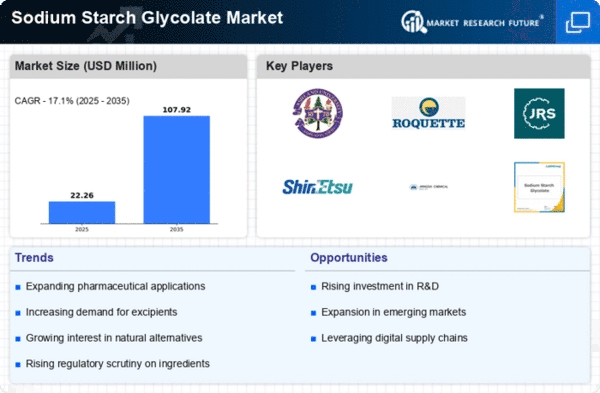
As per MRFR analysis, the Sodium Starch Glycolate Market Size was estimated at 19.01 USD Million in 2024. The Sodium Starch Glycolate industry is projected to grow from 22.26 USD Million in 2025 to 107.92 USD Million by 2035, exhibiting a compound annual growth rate (CAGR) of 17.1 during the forecast period 2025 - 2035.

Key Market Trends & Highlights

The Sodium Starch Glycolate Market is poised for substantial growth driven by diverse applications and evolving consumer preferences.

  • The market experiences rising demand in pharmaceuticals, particularly in tablet formulation, which remains the largest segment.
  • Asia-Pacific emerges as the fastest-growing region, reflecting a notable expansion in food applications and clean label products.
  • The food industry is witnessing rapid growth, with sodium starch glycolate increasingly utilized in capsule formulation.
  • Key market drivers include the rising demand in nutraceuticals and regulatory support for pharmaceutical applications.

Market Size & Forecast

2024 Market Size 19.01 (USD Million)
2035 Market Size 107.92 (USD Million)
CAGR (2025 - 2035) 17.1%
Largest Regional Market Share in 2024 North America

Major Players

Ashland (US), Roquette Freres (FR), JRS PHarma (DE), Shin-Etsu Chemical (JP), Mingtai Chemical (CN), Sodium Starch Glycolate Co. (IN), Liaoning Daxin Pharmaceutical (CN), Huzhou Zhenhua Chemical (CN)

Market Trends

The Sodium Starch Glycolate Market is currently experiencing notable growth, driven by its increasing application in the pharmaceutical sector as a disintegrant in tablet formulations. This compound, derived from starch, is valued for its ability to enhance the dissolution rate of active ingredients, thereby improving bioavailability. As the demand for effective drug delivery systems rises, manufacturers are focusing on developing innovative formulations that incorporate Sodium Starch Glycolate. Furthermore, the rising trend of personalized medicine is likely to propel the market forward, as tailored therapies often require specialized excipients to ensure optimal performance. In addition to pharmaceuticals, the Sodium Starch Glycolate Market is witnessing expansion in the food industry, where it serves as a thickening agent and stabilizer. The growing consumer preference for clean-label products is prompting food manufacturers to seek natural and safe additives, positioning Sodium Starch Glycolate as a favorable option. Moreover, the increasing awareness regarding health and wellness is influencing product formulations, leading to a surge in demand for Sodium Starch Glycolate in various food applications. Overall, the market appears poised for continued growth, driven by diverse applications and evolving consumer preferences.

Rising Demand in Pharmaceuticals

The Sodium Starch Glycolate Market is seeing heightened interest from pharmaceutical companies, as this excipient plays a crucial role in enhancing drug formulations. Its ability to improve the disintegration and dissolution of tablets is particularly appealing, especially in the context of developing more effective medications.

Expansion in Food Applications

There is a growing trend of utilizing Sodium Starch Glycolate in the food industry, where it is employed as a thickening and stabilizing agent. This shift is largely influenced by consumer demand for natural ingredients, prompting food manufacturers to incorporate this compound into their products.

Focus on Clean Label Products

The Sodium Starch Glycolate Market is benefiting from the increasing consumer preference for clean label products. As health-conscious consumers seek transparency in ingredient lists, manufacturers are likely to adopt Sodium Starch Glycolate due to its natural origins and safety profile.

Sodium Starch Glycolate Market Market Drivers

Market Growth Projections

The Global Sodium Starch Glycolate Market Industry is projected to experience substantial growth in the coming years. With a market valuation of 92.7 USD Million in 2024, it is anticipated to reach 174.2 USD Million by 2035. This growth trajectory indicates a robust demand for sodium starch glycolate, driven by its applications in pharmaceuticals and food industries. The expected CAGR of 5.9% from 2025 to 2035 further underscores the compound's potential in various sectors, reflecting its importance in enhancing product formulations and meeting consumer needs.

Rising Popularity in Food Industry

The Global Sodium Starch Glycolate Market Industry is also experiencing growth due to its application in the food sector, where it serves as a stabilizer and thickening agent. As consumer preferences shift towards processed foods that require improved texture and shelf-life, sodium starch glycolate becomes increasingly relevant. The compound's ability to enhance food quality while maintaining safety standards aligns with the global trend towards healthier eating. This trend is expected to contribute to the market's expansion, potentially leading to a valuation of 174.2 USD Million by 2035.

Regulatory Support and Safety Approvals

The Global Sodium Starch Glycolate Market Industry benefits from favorable regulatory frameworks that support the use of this compound in various applications. Regulatory bodies have recognized sodium starch glycolate as safe for use in pharmaceuticals and food products, which encourages manufacturers to incorporate it into their formulations. This regulatory backing not only enhances consumer confidence but also stimulates market growth. As safety standards continue to evolve, the industry is likely to see increased adoption of sodium starch glycolate, further solidifying its market position.

Technological Advancements in Production

Technological innovations in the production of sodium starch glycolate are driving efficiency and cost-effectiveness within the Global Sodium Starch Glycolate Market Industry. Advanced manufacturing techniques enable producers to optimize yield and reduce waste, which is crucial in meeting the growing demand. These advancements may also lead to improved product quality, enhancing the compound's performance in various applications. As production processes become more streamlined, the market is expected to grow at a CAGR of 5.9% from 2025 to 2035, reflecting the positive impact of technology on the industry.

Increasing Awareness of Health and Wellness

The Global Sodium Starch Glycolate Market Industry is influenced by a growing awareness of health and wellness among consumers. As individuals become more health-conscious, there is a rising demand for products that are not only effective but also safe and natural. Sodium starch glycolate, being derived from natural sources, aligns with this trend, making it an attractive ingredient for manufacturers in both the pharmaceutical and food sectors. This shift in consumer behavior is likely to propel market growth, as companies strive to meet the evolving preferences of health-oriented consumers.

Growing Demand in Pharmaceutical Applications

The Global Sodium Starch Glycolate Market Industry is witnessing a surge in demand primarily due to its extensive use as a disintegrant in pharmaceutical formulations. This compound enhances the dissolution rate of tablets and capsules, which is crucial for effective drug delivery. As the global pharmaceutical industry continues to expand, driven by increasing healthcare needs and innovations in drug development, the demand for sodium starch glycolate is projected to rise. In 2024, the market is valued at 92.7 USD Million, reflecting the compound's essential role in modern pharmaceuticals.

Market Segment Insights

By Application: Pharmaceuticals (Largest) vs. Food Industry (Fastest-Growing)

The Sodium Starch Glycolate Market is diversified across several application segments, with pharmaceuticals holding the largest share. This segment leverages the excipient properties of Sodium Starch Glycolate, primarily as a disintegrant in tablets and capsules. Following pharmaceuticals, the food industry is witnessing a significant uptake due to the increasing demand for natural food additives and stabilizers, contributing to the growth of Sodium Starch Glycolate applications. As more manufacturers emphasize product quality, there is an increasing reliance on versatile ingredients like Sodium Starch Glycolate to enhance texture and shelf life in food products. In terms of growth trends, the pharmaceuticals segment is poised for steady expansion, driven by the ongoing development of novel drug formulations. Additionally, regulatory support for cleaner labeling in the food industry is propelling the adoption of Sodium Starch Glycolate as consumers become more health-conscious. The cosmetic sector is also emerging as a potential player, indicating that Sodium Starch Glycolate is gaining traction as an ingredient in skin and hair care formulations, enhancing its market breadth during the forecast period.

Pharmaceuticals: Dominant vs. Food Industry: Emerging

Pharmaceuticals represent a dominant application segment for Sodium Starch Glycolate, characterized by its key role as a disintegrant in various solid dosage forms. This segment benefits from stringent quality control measures and the necessity for excipients that meet regulatory standards. On the other hand, the food industry is emerging as a dynamic application area, where Sodium Starch Glycolate is appreciated for its ability to improve mouthfeel and stability in food products. As consumers continue to seek clean label options, the food industry's demand for natural additives is on the rise. Together, these segments occupy significant positions, highlighting the adaptability of Sodium Starch Glycolate across different industries.

By End Use: Tablet Formulation (Largest) vs. Capsule Formulation (Fastest-Growing)

In the Sodium Starch Glycolate market, the end-use segment displays a diverse range of applications, with Tablet Formulation taking the lead in market share. This segment benefits from the increasing demand for solid dosage forms, which are preferred for their convenience and ease of consumption. Following closely, Capsule Formulation is emerging as a significant player, fueled by consumer preference for softgels and hard capsules that enhance bioavailability. Granulation and Coating are also noteworthy in this segment, albeit with smaller shares.

Tablet Formulation (Dominant) vs. Capsule Formulation (Emerging)

Tablet Formulation remains dominant in the Sodium Starch Glycolate market, primarily due to its widespread use in pharmaceuticals. This segment benefits from the formulation's ability to deliver active ingredients effectively while ensuring stability and controlled release. In contrast, Capsule Formulation is considered an emerging segment characterized by its growing popularity attributed to enhanced patient adherence and ease of swallowing. The versatility in design and customization of capsules caters to diverse therapeutic needs, contributing to its rapid growth in recent years.

By Functionality: Disintegrant (Largest) vs. Binder (Fastest-Growing)

The Sodium Starch Glycolate Market is segmented by functionality into several key categories. Among these, disintegrants hold the largest market share, primarily due to their essential role in pharmaceutical formulations, where they facilitate the rapid breakup of tablets and capsules. This characteristic significantly enhances patient compliance and overall drug efficacy, reinforcing the disintegrant's predominance in the market. Conversely, binders represent the fastest-growing segment, driven by increasing demand in the formulation of controlled-release and modified-release dosage forms, which require more sophisticated binding agents to ensure optimal performance. Growth trends within the Sodium Starch Glycolate Market indicate a robust increase in the utilization of both disintegrants and binders, spurred by innovations in drug formulation technologies and rising investments in pharmaceutical research. The popularity of oral dosage forms, along with the increasing consumer preference for faster-acting medications, drives the development of disintegrant products. At the same time, the expansion of generic drug production prompts higher reliance on advanced binders, contributing to their rapid growth and highlighting the evolving dynamics within the functionality segment.

Disintegrant (Dominant) vs. Binder (Emerging)

Disintegrants, particularly those based on sodium starch glycolate, are characterized by their ability to swell and facilitate the breakup of tablets in gastrointestinal fluids. This property is critical in ensuring the effective release of the active pharmaceutical ingredients (APIs), making disintegrants a cornerstone in tablet formulation. Their dominant presence in the market is supported by the growing need for rapid disintegration in various therapeutic areas. Conversely, binders, while considered emerging in this context, are essential for providing cohesiveness to the formulation, ensuring the integrity of the tablets before they are consumed. As the pharmaceutical landscape shifts towards more complex formulations aimed at improved bioavailability and patient adherence, the role of binders is becoming increasingly significant, paving the way for a promising growth trajectory.

By Formulation Type: Immediate Release (Largest) vs. Controlled Release (Fastest-Growing)

In the Sodium Starch Glycolate Market, the formulation type segment showcases a diverse distribution among its categories, primarily Immediate Release, Controlled Release, and Sustained Release. Immediate Release formulations dominate the market share due to their widespread application and effectiveness in delivering medications quickly. On the other hand, while Controlled Release formulations currently hold a smaller share, they are gaining traction rapidly in response to evolving consumer needs and preferences for more efficient drug delivery systems. The growth trends within the formulation type segment are largely influenced by the increasing demand for advanced pharmaceutical formulations that enhance drug bioavailability and therapeutic efficacy. Meanwhile, the rising adoption of Controlled Release formulations is attributed to their ability to minimize side effects and improve patient compliance. These trends reflect a notable shift toward innovative drug delivery solutions in the Sodium Starch Glycolate Market, driven by ongoing research and development efforts that address specific medical needs.

Immediate Release (Dominant) vs. Controlled Release (Emerging)

Immediate Release formulations are characterized by their rapid disintegration and dispersion, facilitating quick drug release and absorption for immediate therapeutic effect. This formulation type is widely utilized in various pharmaceutical applications due to its efficiency in situations where fast onset of action is critical. Conversely, Controlled Release formulations are emerging as a competitive alternative in the market, designed to release the active pharmaceutical ingredient at a predetermined rate. This innovative approach not only enhances the therapeutic effect but also reduces dosing frequency, which is particularly beneficial for chronic conditions. The growing focus on patient-centered care is propelling the demand for Controlled Release solutions, solidifying their position in the Sodium Starch Glycolate Market as a promising alternative to traditional formulations.

By Source: Natural Starch (Largest) vs. Modified Starch (Fastest-Growing)

In the Sodium Starch Glycolate Market, the source segment reveals a diverse distribution with Natural Starch holding the largest market share. This dominance can be attributed to its natural origin and the growing consumer preference for clean label products. Modified Starch, on the other hand, is rapidly gaining traction due to its versatility and improved functionalities, making it appealing for various applications across pharmaceuticals and food industries. As the market evolves, the share disparity between these sources is poised to create a competitive landscape that drives innovation. Market dynamics are further influenced by trends towards health-conscious consumption and sustainable sourcing. Natural Starch benefits from its established reputation, while Modified Starch is experiencing increased investment in research and development to enhance its capabilities. Synthetic Starch, while present, is focusing on niche applications as manufacturers increasingly explore more sustainable and natural alternatives. The growth of Modified Starch indicates a shift in market preferences, suggesting potential future challenges for Natural Starch if it does not evolve alongside emerging trends.

Natural Starch (Dominant) vs. Modified Starch (Emerging)

Natural Starch is a primary source in the Sodium Starch Glycolate Market, characterized by its organic origins and acceptance in the clean-label movement. Its widespread use in various pharmaceutical formulations and food products drives its dominant position. Conversely, Modified Starch is emerging as a significant player due to advancements in processing techniques that enhance its functionality, stability, and shelf life. This segment is gaining traction particularly in specialized applications requiring specific textural or binding properties. Enhanced by innovation and changing consumer preferences, Modified Starch is positioned to capture a larger market share going forward, particularly as manufacturers seek to balance functionality with natural sourcing. The distinction between these two sources highlights a critical evolution in market dynamics.

Get more detailed insights about Sodium Starch Glycolate Market Research Report - Forecast to 2035

Regional Insights

North America : Market Leader in Innovation

North America is poised to maintain its leadership in the Sodium Starch Glycolate market, holding a significant share of 9.5 in 2024. The region's growth is driven by increasing demand in the pharmaceutical and food industries, alongside stringent regulatory frameworks that promote quality and safety. The presence of advanced manufacturing facilities and a robust supply chain further catalyze market expansion. The United States stands out as the leading country, hosting major players like Ashland and JRS Pharma. The competitive landscape is characterized by innovation and strategic partnerships, enabling companies to enhance product offerings. With a focus on research and development, North American firms are well-positioned to meet evolving consumer needs and regulatory standards.

Europe : Emerging Market with Potential

Europe is witnessing a growing interest in Sodium Starch Glycolate, with a market size of 4.5 in 2024. The region benefits from a strong regulatory environment that encourages the use of excipients in pharmaceuticals, driving demand. Additionally, the increasing focus on natural and plant-based ingredients aligns with consumer preferences, further propelling market growth. Germany and France are key players in this market, with companies like Roquette Freres and JRS Pharma leading the charge. The competitive landscape is marked by innovation and sustainability initiatives, as firms strive to meet both regulatory requirements and consumer expectations. The European market is expected to continue evolving, driven by advancements in technology and product development.

Asia-Pacific : Rapidly Growing Market

Asia-Pacific is emerging as a significant player in the Sodium Starch Glycolate market, with a size of 3.5 in 2024. The region's growth is fueled by increasing pharmaceutical production and a rising demand for excipients in drug formulations. Additionally, favorable government policies and investments in healthcare infrastructure are expected to further enhance market dynamics. China and India are at the forefront of this growth, with companies like Mingtai Chemical and Sodium Starch Glycolate Co. leading the market. The competitive landscape is characterized by a mix of local and international players, all vying for market share. As the region continues to develop, the focus on quality and compliance with international standards will be crucial for sustained growth.

Middle East and Africa : Emerging Market Opportunities

The Middle East and Africa region is gradually emerging in the Sodium Starch Glycolate market, with a size of 1.51 in 2024. The growth is driven by increasing pharmaceutical manufacturing and a rising awareness of the importance of excipients in drug formulations. Additionally, government initiatives aimed at improving healthcare infrastructure are expected to support market expansion. Countries like South Africa and the UAE are leading the charge, with a growing number of local manufacturers entering the market. The competitive landscape is evolving, with both regional and international players seeking to establish a foothold. As the market matures, the focus on quality and regulatory compliance will be essential for attracting investment and fostering growth.

Key Players and Competitive Insights

The Sodium Starch Glycolate Market is characterized by a competitive landscape that is increasingly shaped by innovation and strategic partnerships. Key players such as Ashland (US), Roquette Freres (FR), and JRS PHarma (DE) are actively pursuing growth through various operational strategies. Ashland (US) focuses on enhancing its product portfolio through research and development, aiming to meet the evolving demands of the pharmaceutical industry. Meanwhile, Roquette Freres (FR) emphasizes sustainability in its operations, aligning its product offerings with environmentally friendly practices. JRS Pharma (DE) appears to be concentrating on expanding its global footprint, particularly in emerging markets, thereby enhancing its competitive positioning. Collectively, these strategies indicate a market that is not only competitive but also responsive to the changing dynamics of consumer preferences and regulatory requirements.In terms of business tactics, companies are increasingly localizing manufacturing to reduce lead times and optimize supply chains. This approach is particularly relevant in a market that is moderately fragmented, where the influence of key players is significant but not overwhelming. The collective actions of these companies suggest a trend towards greater collaboration and efficiency, which may enhance overall market stability and growth potential.

In November Ashland (US) announced a strategic partnership with a leading pharmaceutical manufacturer to co-develop innovative formulations utilizing Sodium Starch Glycolate. This collaboration is expected to leverage Ashland's expertise in excipients and the partner's market reach, potentially leading to enhanced product offerings and increased market share. The strategic importance of this partnership lies in its potential to accelerate product development cycles and improve customer satisfaction through tailored solutions.

In October Roquette Freres (FR) launched a new line of Sodium Starch Glycolate products designed specifically for the nutraceutical sector. This move is indicative of Roquette's strategy to diversify its product applications and cater to the growing demand for health supplements. By targeting this niche market, Roquette may enhance its competitive edge and capitalize on the increasing consumer focus on health and wellness.

In September JRS Pharma (DE) expanded its manufacturing capabilities in Asia, aiming to better serve the regional market. This expansion is strategically significant as it positions JRS to respond more effectively to local demand and reduce logistical challenges. The investment in local production facilities may also lead to cost efficiencies and improved supply chain reliability, which are critical in maintaining competitiveness in the Sodium Starch Glycolate Market.

As of December the competitive trends in the Sodium Starch Glycolate Market are increasingly defined by digitalization, sustainability, and the integration of advanced technologies such as AI. Strategic alliances are becoming more prevalent, as companies recognize the value of collaboration in driving innovation and enhancing operational efficiencies. Looking ahead, it is likely that competitive differentiation will evolve from traditional price-based strategies to a focus on innovation, technological advancements, and supply chain reliability. This shift may redefine the competitive landscape, compelling companies to adapt and innovate continuously.

Key Companies in the Sodium Starch Glycolate Market include

Industry Developments

DEF pharma's Primojel, an SSG, is commonly utilized in the production of tablets and capsules. The presence of large biotech and pharmaceutical companies in the United States is anticipated to boost demand for the product. The Sodium Starch Glycolate Market is growing due to increased demand for adhesives from the automotive and packaging industries. Roquette Co. announced the development of a new SSG product for the cosmetics sector under the brand Beauty by Roquette. Modified starches, which are utilized in adhesives, have also been introduced. Globally, rising consumer expenditure on food is likely to propel the Sodium Starch Glycolate Market forward.

Intended Audience

    • Sodium starch glycolate Manufacturers
    • Traders and distributors of sodium starch glycolate
    • Research and development institutes
    • Potential investors
    • Raw material suppliers
    • Nationalized laboratory

Future Outlook

Sodium Starch Glycolate Market Future Outlook

The Sodium Starch Glycolate Market is projected to grow at a 17.1% CAGR from 2025 to 2035, driven by increasing demand in pharmaceuticals and food industries.

New opportunities lie in:

  • Expansion into emerging markets with tailored formulations.
  • Development of eco-friendly production processes to attract sustainability-focused clients.
  • Strategic partnerships with pharmaceutical companies for innovative drug delivery systems.

By 2035, the Sodium Starch Glycolate Market is expected to achieve robust growth and enhanced market presence.

Market Segmentation

Sodium Starch Glycolate Market Source Outlook

  • Natural Starch
  • Modified Starch
  • Synthetic Starch

Sodium Starch Glycolate Market End Use Outlook

  • Tablet Formulation
  • Capsule Formulation
  • Granulation
  • Coating

Sodium Starch Glycolate Market Application Outlook

  • Pharmaceuticals
  • Food Industry
  • Cosmetics
  • Agriculture

Sodium Starch Glycolate Market Functionality Outlook

  • Disintegrant
  • Binder
  • Thickening Agent
  • Stabilizer

Sodium Starch Glycolate Market Formulation Type Outlook

  • Immediate Release
  • Controlled Release
  • Sustained Release

Report Scope

MARKET SIZE 202419.01(USD Million)
MARKET SIZE 202522.26(USD Million)
MARKET SIZE 2035107.92(USD Million)
COMPOUND ANNUAL GROWTH RATE (CAGR)17.1% (2025 - 2035)
REPORT COVERAGERevenue Forecast, Competitive Landscape, Growth Factors, and Trends
BASE YEAR2024
Market Forecast Period2025 - 2035
Historical Data2019 - 2024
Market Forecast UnitsUSD Million
Key Companies ProfiledAshland (US), Roquette Freres (FR), JRS PHarma (DE), Shin-Etsu Chemical (JP), Mingtai Chemical (CN), Sodium Starch Glycolate Co. (IN), Liaoning Daxin Pharmaceutical (CN), Huzhou Zhenhua Chemical (CN)
Segments CoveredApplication, End Use, Functionality, Formulation Type, Source
Key Market OpportunitiesGrowing demand for excipients in pharmaceuticals drives innovation in the Sodium Starch Glycolate Market.
Key Market DynamicsRising demand for sodium starch glycolate in pharmaceuticals drives innovation and competition among manufacturers.
Countries CoveredNorth America, Europe, APAC, South America, MEA

FAQs

What is sodium starch glycolate?

Sodium starch glycolate is a starch derivative obtained by carboxymethylating starch from potato, corn, rice, wheat, or other sources.

What is sodium starch glycolate used for?

Sodium starch glycolate is mainly used as a disintegrant in the formulation of pharmaceutical tablets, as well as a thickener and stabilizer in various industrial formulations, including paints and coatings.

What is the major driver for the market?

The growing demand from the pharmaceutical industry is the major driver for the sodium starch glycolate market.

Which is the leading regional market?

North America is the leading regional market for sodium starch glycolate.

What are the key players in the market?

Leading players in the market include DFE Pharma, Roquette, and Prachin Chemical, among others.

  1. SECTION I: EXECUTIVE SUMMARY AND KEY HIGHLIGHTS
    1. | 1.1 EXECUTIVE SUMMARY
    2. | 1.1.1 Market Overview
    3. | 1.1.2 Key Findings
    4. | 1.1.3 Market Segmentation
    5. | 1.1.4 Competitive Landscape
    6. | 1.1.5 Challenges and Opportunities
    7. | 1.1.6 Future Outlook
  2. SECTION II: SCOPING, METHODOLOGY AND MARKET STRUCTURE
    1. | 2.1 MARKET INTRODUCTION
    2. | 2.1.1 Definition
    3. | 2.1.2 Scope of the study
    4. |-- 2.1.2.1 Research Objective
    5. |-- 2.1.2.2 Assumption
    6. |-- 2.1.2.3 Limitations
    7. | 2.2 RESEARCH METHODOLOGY
    8. | 2.2.1 Overview
    9. | 2.2.2 Data Mining
    10. | 2.2.3 Secondary Research
    11. | 2.2.4 Primary Research
    12. |-- 2.2.4.1 Primary Interviews and Information Gathering Process
    13. |-- 2.2.4.2 Breakdown of Primary Respondents
    14. | 2.2.5 Forecasting Model
    15. | 2.2.6 Market Size Estimation
    16. |-- 2.2.6.1 Bottom-Up Approach
    17. |-- 2.2.6.2 Top-Down Approach
    18. | 2.2.7 Data Triangulation
    19. | 2.2.8 Validation
  3. SECTION III: QUALITATIVE ANALYSIS
    1. | 3.1 MARKET DYNAMICS
    2. | 3.1.1 Overview
    3. | 3.1.2 Drivers
    4. | 3.1.3 Restraints
    5. | 3.1.4 Opportunities
    6. | 3.2 MARKET FACTOR ANALYSIS
    7. | 3.2.1 Value chain Analysis
    8. | 3.2.2 Porter's Five Forces Analysis
    9. |-- 3.2.2.1 Bargaining Power of Suppliers
    10. |-- 3.2.2.2 Bargaining Power of Buyers
    11. |-- 3.2.2.3 Threat of New Entrants
    12. |-- 3.2.2.4 Threat of Substitutes
    13. |-- 3.2.2.5 Intensity of Rivalry
    14. | 3.2.3 COVID-19 Impact Analysis
    15. |-- 3.2.3.1 Market Impact Analysis
    16. |-- 3.2.3.2 Regional Impact
    17. |-- 3.2.3.3 Opportunity and Threat Analysis
  4. SECTION IV: QUANTITATIVE ANALYSIS
    1. | 4.1 Chemicals and Materials, BY Application (USD Million)
    2. | 4.1.1 Pharmaceuticals
    3. | 4.1.2 Food Industry
    4. | 4.1.3 Cosmetics
    5. | 4.1.4 Agriculture
    6. | 4.2 Chemicals and Materials, BY End Use (USD Million)
    7. | 4.2.1 Tablet Formulation
    8. | 4.2.2 Capsule Formulation
    9. | 4.2.3 Granulation
    10. | 4.2.4 Coating
    11. | 4.3 Chemicals and Materials, BY Functionality (USD Million)
    12. | 4.3.1 Disintegrant
    13. | 4.3.2 Binder
    14. | 4.3.3 Thickening Agent
    15. | 4.3.4 Stabilizer
    16. | 4.4 Chemicals and Materials, BY Formulation Type (USD Million)
    17. | 4.4.1 Immediate Release
    18. | 4.4.2 Controlled Release
    19. | 4.4.3 Sustained Release
    20. | 4.5 Chemicals and Materials, BY Source (USD Million)
    21. | 4.5.1 Natural Starch
    22. | 4.5.2 Modified Starch
    23. | 4.5.3 Synthetic Starch
    24. | 4.6 Chemicals and Materials, BY Region (USD Million)
    25. | 4.6.1 North America
    26. |-- 4.6.1.1 US
    27. |-- 4.6.1.2 Canada
    28. | 4.6.2 Europe
    29. |-- 4.6.2.1 Germany
    30. |-- 4.6.2.2 UK
    31. |-- 4.6.2.3 France
    32. |-- 4.6.2.4 Russia
    33. |-- 4.6.2.5 Italy
    34. |-- 4.6.2.6 Spain
    35. |-- 4.6.2.7 Rest of Europe
    36. | 4.6.3 APAC
    37. |-- 4.6.3.1 China
    38. |-- 4.6.3.2 India
    39. |-- 4.6.3.3 Japan
    40. |-- 4.6.3.4 South Korea
    41. |-- 4.6.3.5 Malaysia
    42. |-- 4.6.3.6 Thailand
    43. |-- 4.6.3.7 Indonesia
    44. |-- 4.6.3.8 Rest of APAC
    45. | 4.6.4 South America
    46. |-- 4.6.4.1 Brazil
    47. |-- 4.6.4.2 Mexico
    48. |-- 4.6.4.3 Argentina
    49. |-- 4.6.4.4 Rest of South America
    50. | 4.6.5 MEA
    51. |-- 4.6.5.1 GCC Countries
    52. |-- 4.6.5.2 South Africa
    53. |-- 4.6.5.3 Rest of MEA
  5. SECTION V: COMPETITIVE ANALYSIS
    1. | 5.1 Competitive Landscape
    2. | 5.1.1 Overview
    3. | 5.1.2 Competitive Analysis
    4. | 5.1.3 Market share Analysis
    5. | 5.1.4 Major Growth Strategy in the Chemicals and Materials
    6. | 5.1.5 Competitive Benchmarking
    7. | 5.1.6 Leading Players in Terms of Number of Developments in the Chemicals and Materials
    8. | 5.1.7 Key developments and growth strategies
    9. |-- 5.1.7.1 New Product Launch/Service Deployment
    10. |-- 5.1.7.2 Merger & Acquisitions
    11. |-- 5.1.7.3 Joint Ventures
    12. | 5.1.8 Major Players Financial Matrix
    13. |-- 5.1.8.1 Sales and Operating Income
    14. |-- 5.1.8.2 Major Players R&D Expenditure. 2023
    15. | 5.2 Company Profiles
    16. | 5.2.1 Ashland (US)
    17. |-- 5.2.1.1 Financial Overview
    18. |-- 5.2.1.2 Products Offered
    19. |-- 5.2.1.3 Key Developments
    20. |-- 5.2.1.4 SWOT Analysis
    21. |-- 5.2.1.5 Key Strategies
    22. | 5.2.2 Roquette Freres (FR)
    23. |-- 5.2.2.1 Financial Overview
    24. |-- 5.2.2.2 Products Offered
    25. |-- 5.2.2.3 Key Developments
    26. |-- 5.2.2.4 SWOT Analysis
    27. |-- 5.2.2.5 Key Strategies
    28. | 5.2.3 JRS PHarma (DE)
    29. |-- 5.2.3.1 Financial Overview
    30. |-- 5.2.3.2 Products Offered
    31. |-- 5.2.3.3 Key Developments
    32. |-- 5.2.3.4 SWOT Analysis
    33. |-- 5.2.3.5 Key Strategies
    34. | 5.2.4 Shin-Etsu Chemical (JP)
    35. |-- 5.2.4.1 Financial Overview
    36. |-- 5.2.4.2 Products Offered
    37. |-- 5.2.4.3 Key Developments
    38. |-- 5.2.4.4 SWOT Analysis
    39. |-- 5.2.4.5 Key Strategies
    40. | 5.2.5 Mingtai Chemical (CN)
    41. |-- 5.2.5.1 Financial Overview
    42. |-- 5.2.5.2 Products Offered
    43. |-- 5.2.5.3 Key Developments
    44. |-- 5.2.5.4 SWOT Analysis
    45. |-- 5.2.5.5 Key Strategies
    46. | 5.2.6 Sodium Starch Glycolate Co. (IN)
    47. |-- 5.2.6.1 Financial Overview
    48. |-- 5.2.6.2 Products Offered
    49. |-- 5.2.6.3 Key Developments
    50. |-- 5.2.6.4 SWOT Analysis
    51. |-- 5.2.6.5 Key Strategies
    52. | 5.2.7 Liaoning Daxin Pharmaceutical (CN)
    53. |-- 5.2.7.1 Financial Overview
    54. |-- 5.2.7.2 Products Offered
    55. |-- 5.2.7.3 Key Developments
    56. |-- 5.2.7.4 SWOT Analysis
    57. |-- 5.2.7.5 Key Strategies
    58. | 5.2.8 Huzhou Zhenhua Chemical (CN)
    59. |-- 5.2.8.1 Financial Overview
    60. |-- 5.2.8.2 Products Offered
    61. |-- 5.2.8.3 Key Developments
    62. |-- 5.2.8.4 SWOT Analysis
    63. |-- 5.2.8.5 Key Strategies
    64. | 5.3 Appendix
    65. | 5.3.1 References
    66. | 5.3.2 Related Reports

Chemicals and Materials Market Segmentation

Chemicals and Materials By Application (USD Million, 2025-2035)

  • Pharmaceuticals
  • Food Industry
  • Cosmetics
  • Agriculture

Chemicals and Materials By End Use (USD Million, 2025-2035)

  • Tablet Formulation
  • Capsule Formulation
  • Granulation
  • Coating

Chemicals and Materials By Functionality (USD Million, 2025-2035)

  • Disintegrant
  • Binder
  • Thickening Agent
  • Stabilizer

Chemicals and Materials By Formulation Type (USD Million, 2025-2035)

  • Immediate Release
  • Controlled Release
  • Sustained Release

Chemicals and Materials By Source (USD Million, 2025-2035)

  • Natural Starch
  • Modified Starch
  • Synthetic Starch
Infographic

Free Sample Request

Kindly complete the form below to receive a free sample of this Report

Get Free Sample

Customer Strories

Compare Licence

×
Features License Type
Single User Multiuser License Enterprise User
Price $4,950 $5,950 $7,250
Maximum User Access Limit 1 User Upto 10 Users Unrestricted Access Throughout the Organization
Free Customization
Direct Access to Analyst
Deliverable Format
Platform Access
Discount on Next Purchase 10% 15% 15%
Printable Versions