×
Request Free Sample ×

Kindly complete the form below to receive a free sample of this Report

* Please use a valid business email

Leading companies partner with us for data-driven Insights

clients tt-cursor
Hero Background

Slideway Oil Market

ID: MRFR/CnM/28438-HCR
100 Pages
Priya Nagrale
February 2026

Slideway Oil Market Research Report: By Application (Industrial Machinery, Automotive, Wind Turbines, Power Generation, Marine, Aerospace), By Form (Synthetic, Mineral, Semi-Synthetic), By Additives (Anti-Wear, Anti-Corrosion, Anti-Foaming, Anti-Oxidation, Viscosity Modifiers), By Viscosity Grades (ISO 32, ISO 68, ISO 100, ISO 150, ISO 220, ISO 320, ISO 460), By Function (Lubrication, Heat Dissipation, Corrosion Protection, Wear Reduction, Sealing) and By Regional (North America, Europe, South America, Asia Pacific, Middle East and Africa) - Forecast to 2035

Share:
Download PDF ×

We do not share your information with anyone. However, we may send you emails based on your report interest from time to time. You may contact us at any time to opt-out.

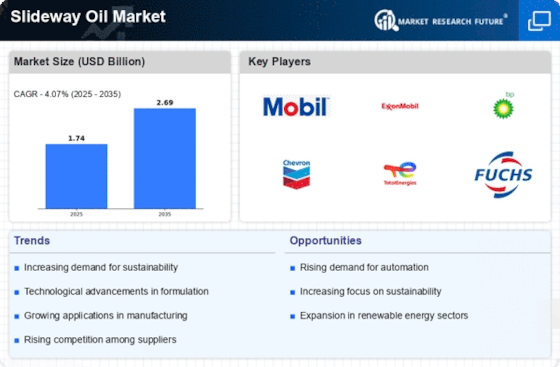
Slideway Oil Market Infographic
Purchase Options

Slideway Oil Market Summary

As per Market Research Future analysis, the Slideway Oil Market Size was estimated at 1.736 USD Billion in 2024. The Slideway Oil industry is projected to grow from 1.807 USD Billion in 2025 to 2.693 USD Billion by 2035, exhibiting a compound annual growth rate (CAGR) of 4.07% during the forecast period 2025 - 2035

Key Market Trends & Highlights

The Slideway Oil Market is currently experiencing a dynamic shift towards sustainability and technological innovation.

  • North America remains the largest market for slideway oil, driven by robust manufacturing activities.
  • Asia-Pacific is emerging as the fastest-growing region, fueled by rapid industrialization and economic expansion.
  • The industrial machinery segment dominates the market, while the automotive segment is witnessing the highest growth rates.
  • Rising demand from the manufacturing sector and technological innovations in lubrication are key drivers propelling market growth.

Market Size & Forecast

2024 Market Size 1.736 (USD Billion)
2035 Market Size 2.693 (USD Billion)
CAGR (2025 - 2035) 4.07%

Major Players

Mobil Oil (US), Shell Oil (GB), ExxonMobil (US), BP (GB), Chevron (US), TotalEnergies (FR), Fuchs Petrolub (DE), Castrol (GB), Kluber Lubrication (DE), Cargill (US)

Our Impact
Enabled $4.3B Revenue Impact for Fortune 500 and Leading Multinationals
Partnering with 2000+ Global Organizations Each Year
30K+ Citations by Top-Tier Firms in the Industry

Slideway Oil Market Trends

The Slideway Oil Market is currently experiencing a dynamic phase characterized by evolving consumer preferences and technological advancements. As industries increasingly prioritize efficiency and sustainability, the demand for high-performance slideway oils is on the rise. These lubricants are essential for ensuring the smooth operation of machinery, particularly in metalworking and manufacturing sectors. The market appears to be influenced by a growing emphasis on reducing environmental impact, prompting manufacturers to innovate and develop eco-friendly formulations. This shift not only aligns with regulatory requirements but also caters to the preferences of environmentally conscious consumers. Moreover, the competitive landscape of the Slideway Oil Market is becoming more intricate, with numerous players striving to differentiate their products through enhanced performance characteristics. The introduction of synthetic and bio-based oils is indicative of a broader trend towards sustainable solutions. As companies invest in research and development, the market is likely to witness a surge in innovative products that offer superior lubrication properties and longer service life. This evolution suggests that the Slideway Oil Market is poised for growth, driven by both technological advancements and a commitment to sustainability.

Sustainability Initiatives

The Slideway Oil Market is increasingly influenced by sustainability initiatives, as manufacturers seek to develop eco-friendly lubricants. This trend reflects a broader commitment to reducing environmental impact, aligning with regulatory standards and consumer expectations.

Technological Advancements

Technological advancements are reshaping the Slideway Oil Market, with innovations in formulation and application methods. These developments enhance the performance of slideway oils, leading to improved efficiency and reduced wear in machinery.

Customization and Specialization

There is a growing trend towards customization and specialization within the Slideway Oil Market. Manufacturers are tailoring products to meet specific industry needs, ensuring optimal performance in diverse applications.

Slideway Oil Market Drivers

Increased Focus on Machine Efficiency

The Slideway Oil Market is witnessing a heightened focus on machine efficiency, which is driving demand for specialized lubricants. As industries strive to optimize production processes and reduce downtime, the role of slideway oils becomes increasingly critical. Enhanced lubrication not only improves machine performance but also minimizes energy consumption, aligning with broader industry goals of sustainability and cost-effectiveness. The market is expected to see a growth rate of approximately 4% as companies invest in high-quality slideway oils that promise better efficiency and reliability. This trend indicates a shift towards more strategic procurement of lubricants, where the Slideway Oil Market must adapt to meet the evolving needs of its customers.

Rising Demand from Manufacturing Sector

The Slideway Oil Market is experiencing a notable increase in demand driven by the manufacturing sector. As industries ramp up production capabilities, the need for high-performance lubricants, such as slideway oils, becomes paramount. This sector's growth is reflected in the projected increase in production output, which is expected to rise by approximately 4% annually over the next five years. The Slideway Oil Market is thus positioned to benefit from this trend, as manufacturers seek to enhance machine efficiency and reduce wear and tear. Furthermore, the emphasis on operational efficiency and cost reduction in manufacturing processes further propels the demand for specialized slideway oils, which are designed to provide superior lubrication and protection. Consequently, this driver is likely to shape the market dynamics significantly.

Technological Innovations in Lubrication

Technological advancements are playing a crucial role in the evolution of the Slideway Oil Market. Innovations in formulation and application techniques are leading to the development of high-performance slideway oils that offer enhanced properties such as improved thermal stability and reduced friction. The introduction of synthetic slideway oils, which can withstand extreme conditions, is particularly noteworthy. These advancements not only improve the operational efficiency of machinery but also extend the lifespan of equipment, thereby reducing maintenance costs. The Slideway Oil Market is likely to see a shift towards these advanced products, as manufacturers increasingly prioritize technology-driven solutions to meet their lubrication needs. This trend is expected to contribute to a compound annual growth rate of around 5% in the segment over the next few years.

Expansion of Automotive and Aerospace Industries

The expansion of the automotive and aerospace industries is a significant driver for the Slideway Oil Market. As these sectors continue to grow, the demand for high-quality lubricants, including slideway oils, is expected to rise correspondingly. The automotive industry alone is projected to grow at a rate of 3% annually, while the aerospace sector is anticipated to expand even more rapidly, potentially reaching a growth rate of 5% over the next few years. This growth is likely to create new opportunities for the Slideway Oil Market, as manufacturers seek specialized lubricants that can withstand the unique challenges posed by these industries. Consequently, the interplay between these expanding sectors and the slideway oil market could lead to increased sales and innovation in product offerings.

Regulatory Compliance and Environmental Standards

The Slideway Oil Market is significantly influenced by the increasing stringency of regulatory compliance and environmental standards. Governments and regulatory bodies are imposing stricter guidelines on the use of lubricants, pushing manufacturers to adopt eco-friendly formulations. This shift is prompting the development of biodegradable slideway oils that meet environmental regulations while maintaining performance standards. The market is projected to grow as companies seek to align with these regulations, which could account for a market share increase of approximately 10% in the eco-friendly segment by 2026. As a result, the Slideway Oil Market is likely to witness a transformation, with a growing emphasis on sustainability and compliance driving product innovation and market expansion.


Market Segment Insights

By Application: Industrial Machinery (Largest) vs. Automotive (Fastest-Growing)

In the Slideway Oil Market, the application segment showcases a diversified distribution among various industries. Industrial Machinery takes the lead, driven largely by manufacturing demands, whereas Automotive follows closely, capitalizing on advancements in vehicle lubrication technologies. The Wind Turbines and Power Generation applications contribute significantly, with their specialized oil needs making a mark on market trends. Marine and Aerospace sectors, though smaller, display a steady consumption pattern due to stringent performance requirements.

Industrial Machinery (Dominant) vs. Automotive (Emerging)

Industrial Machinery holds a dominant position in the Slideway Oil Market, largely due to its extensive use in manufacturing processes where precision and reliability are crucial. This segment demands high-quality slideway oils that ensure optimal performance and minimal wear. On the other hand, the Automotive segment is emerging rapidly, fueled by innovations such as electric vehicles and changing lubrication standards. As vehicles become more sophisticated, there's a growing need for specialized oils that enhance performance and longevity. This sector's dynamic nature is attracting significant attention from oil manufacturers looking to adapt their products to meet the evolving demands.

By Form: Synthetic (Largest) vs. Semi-Synthetic (Fastest-Growing)

In the Slideway Oil Market, the distribution of market share among the different forms reveals that Synthetic oils hold a commanding lead, reflecting their widespread acceptance due to superior performance characteristics. On the other hand, Semi-Synthetic oils are gaining traction, attracting users looking for a cost-effective alternative without compromising on quality, thus carving out a noticeable share. Mineral oils, while historically significant, are showing a decline in preference as modern machinery requires more advanced lubrication solutions.

Synthetic (Dominant) vs. Semi-Synthetic (Emerging)

Synthetic oils are recognized as the dominant players in the Slideway Oil Market, valued for their high thermal stability, enhanced lubricating properties, and longer service life. They are particularly favored in high-performance applications where durability is essential. Conversely, Semi-Synthetic oils represent an emerging segment, combining the benefits of synthetic and mineral oils. They are positioned for users who seek improved performance over traditional mineral oils while still being conscious of budget constraints. This blend attracts both industrial and maintenance applications, making Semi-Synthetic oils increasingly popular among a broader customer base.

By Additives: Anti-Wear (Largest) vs. Anti-Corrosion (Fastest-Growing)

In the Slideway Oil Market, additives play a crucial role in enhancing performance and protecting equipment. Among the various types of additives, Anti-Wear additives command the largest market share, as they are essential for reducing friction and wear in machinery. This segment significantly influences the overall reliability and longevity of slideway oils, making it a critical component for industries relying on heavy machinery. Conversely, Anti-Corrosion additives represent the fastest-growing segment, driven by the increasing demand for equipment protection in adverse conditions, thus gaining traction in recent years. Growth trends for the Additives segment are primarily influenced by advancements in formulation technologies and rising standards for equipment efficiency. Manufacturers are focusing on developing high-performance additives that not only enhance the functionality of slideway oils but also meet strict environmental regulations. The drive towards sustainability and the need for longer-lasting oils is pushing the market towards innovative additive solutions, fostering growth across various additive types. This dynamic landscape highlights the importance of strategic development in the Additives segment of the Slideway Oil Market.

Anti-Wear (Dominant) vs. Anti-Foaming (Emerging)

Anti-Wear additives are the dominant force in the Slideway Oil Market due to their pivotal role in minimizing wear and tear on machinery components. They are designed to provide a protective film that reduces metal-to-metal contact, thereby extending the service life of machinery. In contrast, Anti-Foaming additives, while currently an emerging segment, are gaining importance as industries seek to enhance the stability and performance of slideway oils. Their primary function is to prevent foam formation, which can impede lubrication and lead to operational inefficiencies. The rising focus on optimizing equipment performance drives the need for effective Anti-Foaming solutions, positioning them as a critical area of innovation within the additives market.

By Viscosity Grades: ISO 68 (Largest) vs. ISO 32 (Fastest-Growing)

In the Slideway Oil Market, viscosity grades play a crucial role in defining the performance characteristics of the oils used in various industrial applications. The dominant segment, ISO 68, holds a significant market share due to its versatility and effectiveness in a wide range of operating conditions. In contrast, ISO 32 is gaining traction as industries seek oils that offer superior flow properties at lower temperatures, catering to specific equipment requirements that demand lower viscosity levels. As technology advances and machinery becomes more sophisticated, the demand for precise viscosity tailored to operational needs is increasing. ISO 32 is experiencing robust growth as manufacturers invest in optimizing their processes, thereby propelling this grade to become the fastest-growing within the segment. This shift is driven by the need for improved energy efficiency and enhanced performance in manufacturing operations, making ISO 32 increasingly popular among end-users.

ISO 68 (Dominant) vs. ISO 32 (Emerging)

ISO 68 stands out as a dominant viscosity grade in the Slideway Oil Market, appreciated for its balanced properties that ensure stable lubrication across various machinery. Its ability to maintain viscosity in a broad range of temperatures makes it the preferred choice for many industrial applications. On the other hand, ISO 32 is emerging as a significant contender owing to its enhanced low-temperature performance, making it suitable for modern machinery that operates in variable environmental conditions. The growing awareness of energy efficiency and optimized operational effectiveness aligns with ISO 32’s rapid adoption in industries, positioning it as a key player that complements the traditional dominance of ISO 68.

By Function: Lubrication (Largest) vs. Corrosion Protection (Fastest-Growing)

The Slideway Oil Market is characterized by a diverse range of functions, with lubrication holding the largest market share. This segment has established itself as a key player, being integral for machinery operation and efficiency. Conversely, corrosion protection is rapidly gaining traction, reflecting a new focus on the longevity and maintenance of machinery. As industries evolve, the demand for lubrication remains paramount, however, the significance of corrosion protection is becoming increasingly recognized. Market trends indicate a shift towards higher-performance lubrication oils that enhance machine productivity and reduce wear and tear. Additionally, technological advancements are driving growth in corrosion protection, as manufacturers seek to mitigate equipment degradation. The rising emphasis on sustainability also propels new developments that prioritize environmentally-friendly lubricants and protective oils, positioning corrosion protection as a vital emerging segment within the Slideway Oil Market.

Lubrication (Dominant) vs. Heat Dissipation (Emerging)

Lubrication remains the dominant function within the Slideway Oil Market, essential for reducing friction and wear in machinery operations. It is characterized by its ability to enhance the performance and lifespan of equipment, making it a preferred choice among manufacturers. On the other hand, heat dissipation represents an emerging segment as it focuses on maintaining optimal operational temperatures in machinery. This function is gaining attention due to its importance in preventing overheating, which can drastically reduce machinery efficiency. Advances in thermal management technologies are pushing the boundary for efficient heat dissipation solutions. As both functions evolve, lubrication continues to lead, while heat dissipation carves its niche as a critical component for enhanced machine performance.

Get more detailed insights about Slideway Oil Market

Regional Insights

North America : Innovation and Demand Growth

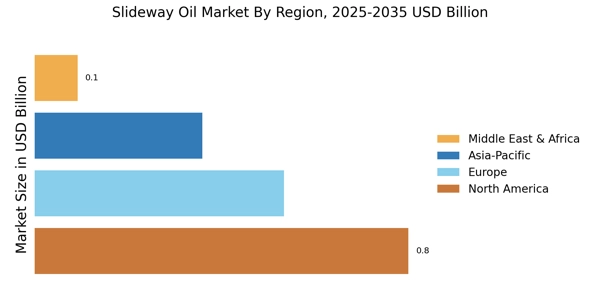
North America is the largest market for slideway oil, accounting for approximately 45% of the global market share. The region's growth is driven by the increasing demand from the manufacturing sector, particularly in the United States and Canada. Regulatory support for advanced manufacturing technologies and sustainability initiatives further catalyzes market expansion. The presence of major players like Mobil Oil and ExxonMobil enhances competitive dynamics, fostering innovation and product development. The United States leads the market, followed by Canada, both benefiting from robust industrial activities and technological advancements. Key players such as Shell Oil and Chevron are investing in R&D to develop high-performance slideway oils. The competitive landscape is characterized by strategic partnerships and mergers, aimed at enhancing product offerings and market reach. This dynamic environment positions North America as a pivotal region in the slideway oil market.

Europe : Regulatory Framework and Innovation

Europe is witnessing significant growth in the slideway oil market, holding approximately 30% of the global share. The region's growth is propelled by stringent environmental regulations and a shift towards sustainable manufacturing practices. Countries like Germany and France are at the forefront, driving demand through innovation in lubrication technologies. The European Union's regulations on industrial lubricants are pivotal in shaping market dynamics, encouraging the development of eco-friendly products. Germany stands out as the leading country in this market, followed closely by France and the UK. The competitive landscape is marked by the presence of key players such as TotalEnergies and Fuchs Petrolub, who are actively investing in sustainable solutions. The market is characterized by a focus on high-quality products that meet regulatory standards, fostering a competitive environment that encourages innovation and collaboration among industry stakeholders.

Asia-Pacific : Rapid Industrialization and Growth

Asia-Pacific is rapidly emerging as a significant player in the slideway oil market, accounting for approximately 20% of the global share. The region's growth is driven by rapid industrialization, particularly in countries like China and India, where manufacturing activities are surging. The increasing focus on enhancing operational efficiency and reducing downtime in manufacturing processes is propelling the demand for high-quality slideway oils. Government initiatives to boost manufacturing capabilities further support market growth. China is the largest market in the region, followed by India, both of which are witnessing substantial investments in industrial infrastructure. The competitive landscape features key players like Castrol and Kluber Lubrication, who are expanding their presence through strategic partnerships and localized production. This dynamic environment is fostering innovation and enhancing the availability of advanced lubrication solutions tailored to the needs of the growing manufacturing sector.

Middle East and Africa : Resource-Rich and Growing Demand

The Middle East and Africa region is gradually emerging in the slideway oil market, holding approximately 5% of the global share. The growth is primarily driven by increasing industrial activities and the need for efficient lubrication solutions in manufacturing processes. Countries like South Africa and the UAE are witnessing a rise in demand for slideway oils, supported by government initiatives aimed at diversifying economies and enhancing industrial capabilities. The region's rich natural resources also play a crucial role in the availability of base oils for lubrication. South Africa leads the market in this region, followed by the UAE, both benefiting from investments in industrial infrastructure and manufacturing capabilities. The competitive landscape is characterized by the presence of both local and international players, including Cargill and BP, who are focusing on expanding their market presence. This growing demand for high-quality lubrication solutions presents significant opportunities for market players to innovate and cater to the evolving needs of the manufacturing sector.

Slideway Oil Market Regional Image

Key Players and Competitive Insights

The Slideway Oil Market is currently characterized by a dynamic competitive landscape, driven by increasing demand for high-performance lubricants across various industrial applications. Key players such as Mobil Oil (US), Shell Oil (GB), and ExxonMobil (US) are strategically positioned to leverage their extensive distribution networks and technological advancements. Mobil Oil (US) focuses on innovation in product formulations, aiming to enhance the efficiency and longevity of their slideway oils. Meanwhile, Shell Oil (GB) emphasizes sustainability in its operations, aligning its product development with environmental regulations and customer expectations. ExxonMobil (US) appears to be concentrating on digital transformation initiatives, integrating advanced analytics into its supply chain to optimize production and distribution processes. Collectively, these strategies contribute to a competitive environment that is increasingly focused on technological advancement and sustainability.In terms of business tactics, companies are localizing manufacturing to better serve regional markets, which enhances responsiveness to customer needs. The Slideway Oil Market is moderately fragmented, with several key players holding substantial market shares. This fragmentation allows for a diverse range of products and innovations, while the collective influence of major companies shapes market trends and customer preferences.

In August Shell Oil (GB) announced a partnership with a leading technology firm to develop a new line of eco-friendly slideway oils. This strategic move is significant as it not only reinforces Shell's commitment to sustainability but also positions the company to capture a growing segment of environmentally conscious consumers. The collaboration is expected to yield products that meet stringent environmental standards, thereby enhancing Shell's competitive edge in the market.

In September ExxonMobil (US) launched a new digital platform aimed at streamlining the procurement process for industrial lubricants, including slideway oils. This initiative is crucial as it reflects the company's commitment to digitalization, potentially improving customer engagement and operational efficiency. By leveraging technology, ExxonMobil seeks to enhance its service offerings and maintain a competitive advantage in a rapidly evolving market.

In July Fuchs Petrolub (DE) expanded its production capacity in Asia to meet the rising demand for high-performance lubricants. This expansion is indicative of Fuchs' strategic focus on regional growth and its intent to strengthen its market presence in Asia. By increasing production capabilities, Fuchs aims to enhance its supply chain reliability and responsiveness to local market demands, which is essential in a competitive landscape.

As of October the Slideway Oil Market is witnessing trends that emphasize digitalization, sustainability, and the integration of artificial intelligence in operations. Strategic alliances are becoming increasingly important, as companies collaborate to enhance product offerings and market reach. Looking ahead, competitive differentiation is likely to evolve from traditional price-based competition to a focus on innovation, technological advancements, and supply chain reliability. This shift suggests that companies that prioritize these aspects will be better positioned to thrive in the future.

Key Companies in the Slideway Oil Market include

Industry Developments

The Slideway Oil Market is anticipated to reach a valuation of USD 2.3 billion by 2032, expanding at a CAGR of 4.07% from 2024 to 2032. Rising demand for slideway oils in various industries, such as automotive, aerospace, and manufacturing, is driving market growth. Technological advancements and the development of eco-friendly slideway oils are further propelling market expansion. Strategic collaborations and acquisitions among key players are shaping the competitive landscape. Recent developments include the launch of high-performance slideway oils by major manufacturers, catering to the evolving needs of end-use industries.

The market is expected to witness significant growth in emerging economies, driven by rapid industrialization and infrastructure development.

Future Outlook

Slideway Oil Market Future Outlook

The Slideway Oil Market is projected to grow at a 4.07% CAGR from 2025 to 2035, driven by increasing industrial automation and demand for high-performance lubricants.

New opportunities lie in:

  • Development of biodegradable slideway oils for eco-conscious industries.
  • Expansion into emerging markets with tailored product offerings.
  • Investment in advanced distribution networks to enhance supply chain efficiency.

By 2035, the Slideway Oil Market is expected to achieve robust growth, reflecting evolving industry needs.

Market Segmentation

Slideway Oil Market Form Outlook

  • Synthetic
  • Mineral
  • Semi-Synthetic

Slideway Oil Market Function Outlook

  • Lubrication
  • Heat Dissipation
  • Corrosion Protection
  • Wear Reduction
  • Sealing

Slideway Oil Market Additives Outlook

  • Anti-Wear
  • Anti-Corrosion
  • Anti-Foaming
  • Anti-Oxidation
  • Viscosity Modifiers

Slideway Oil Market Application Outlook

  • Industrial Machinery
  • Automotive
  • Wind Turbines
  • Power Generation
  • Marine
  • Aerospace

Slideway Oil Market Viscosity Grades Outlook

  • ISO 32
  • ISO 68
  • ISO 100
  • ISO 150
  • ISO 220
  • ISO 320
  • ISO 460

Report Scope

MARKET SIZE 20241.736(USD Billion)
MARKET SIZE 20251.807(USD Billion)
MARKET SIZE 20352.693(USD Billion)
COMPOUND ANNUAL GROWTH RATE (CAGR)4.07% (2025 - 2035)
REPORT COVERAGERevenue Forecast, Competitive Landscape, Growth Factors, and Trends
BASE YEAR2024
Market Forecast Period2025 - 2035
Historical Data2019 - 2024
Market Forecast UnitsUSD Billion
Key Companies ProfiledMobil Oil (US), Shell Oil (GB), ExxonMobil (US), BP (GB), Chevron (US), TotalEnergies (FR), Fuchs Petrolub (DE), Castrol (GB), Kluber Lubrication (DE), Cargill (US)
Segments CoveredApplication, Form, Additives, Viscosity Grades, Function, Regional
Key Market OpportunitiesGrowing demand for environmentally friendly lubricants in the Slideway Oil Market presents significant opportunities.
Key Market DynamicsRising demand for high-performance lubricants drives innovation and competition in the Slideway Oil Market.
Countries CoveredNorth America, Europe, APAC, South America, MEA
Leave a Comment

FAQs

What is the current valuation of the Slideway Oil Market as of 2024?

The Slideway Oil Market was valued at 1.736 USD Billion in 2024.

What is the projected market valuation for the Slideway Oil Market in 2035?

The market is projected to reach a valuation of 2.693 USD Billion by 2035.

What is the expected CAGR for the Slideway Oil Market during the forecast period 2025 - 2035?

The expected CAGR for the Slideway Oil Market during 2025 - 2035 is 4.07%.

Which companies are considered key players in the Slideway Oil Market?

Key players in the market include Mobil Oil, Shell Oil, ExxonMobil, BP, Chevron, TotalEnergies, Fuchs Petrolub, Castrol, Kluber Lubrication, and Cargill.

What are the main application segments of the Slideway Oil Market?

The main application segments include Industrial Machinery, Automotive, Wind Turbines, Power Generation, Marine, and Aerospace.

How does the valuation of the Synthetic form of Slideway Oil compare to Mineral and Semi-Synthetic forms?

In 2024, the valuation for Synthetic Slideway Oil was 0.522 USD Billion, while Mineral was 0.872 USD Billion and Semi-Synthetic was 0.342 USD Billion.

What are the key functions of Slideway Oil as identified in the market?

Key functions of Slideway Oil include Lubrication, Heat Dissipation, Corrosion Protection, Wear Reduction, and Sealing.

What is the valuation range for the Anti-Wear additive segment in the Slideway Oil Market?

The Anti-Wear additive segment was valued between 0.52 and 0.78 USD Billion in 2024.

What viscosity grades are available in the Slideway Oil Market and their respective valuations?

Available viscosity grades include ISO 32, ISO 68, ISO 100, ISO 150, ISO 220, ISO 320, and ISO 460, with valuations ranging from 0.1 to 0.6 USD Billion.

Download Free Sample

Kindly complete the form below to receive a free sample of this Report

Compare Licence

×
Features License Type
Single User Multiuser License Enterprise User
Price $4,950 $5,950 $7,250
Maximum User Access Limit 1 User Upto 10 Users Unrestricted Access Throughout the Organization
Free Customization
Direct Access to Analyst
Deliverable Format
Platform Access
Discount on Next Purchase 10% 15% 15%
Printable Versions