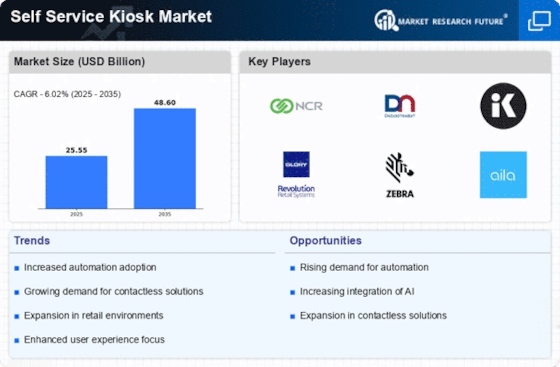
The Self Service Kiosk Market is currently experiencing a notable transformation, driven by advancements in technology and changing consumer preferences. As businesses increasingly seek to enhance operational efficiency and customer engagement, self-service kiosks are becoming integral to various sectors, including retail, healthcare, and hospitality. These kiosks offer a range of functionalities, from order placement to information dissemination, thereby streamlining processes and improving user experiences. The growing demand for contactless solutions further propels the adoption of these systems, as consumers favor convenience and speed in their interactions.
Moreover, the Self Service Kiosk Market appears to be influenced by the rising trend of digitalization across industries. Organizations are investing in innovative kiosk designs that incorporate touchless interfaces, artificial intelligence, and data analytics. This evolution not only caters to the immediate needs of consumers but also aligns with broader trends towards automation and efficiency. As the market continues to evolve, it is likely that self-service kiosks will play an increasingly pivotal role in shaping customer interactions and operational strategies across diverse sectors.
The kiosk self service industry is witnessing steady expansion as digital transformation accelerates across retail, healthcare, and transportation, positioning the global kiosk market as a key component of the broader self service market. Self-service kiosks are automated systems that enable users to complete transactions, access information, and perform services independently, making self service kiosks a vital solution for improving operational efficiency and customer experience. Key self service trends include the adoption of cloud connectivity, AI-driven interfaces, and touchless interaction technologies. The emergence of kiosk as a service models allows organizations to deploy kiosks with lower upfront costs through subscription-based offerings. The self ordering kiosk cost varies based on hardware configuration, software integration, and deployment scale. Similarly, self checkout kiosk cost structures depend on payment technology, security features, and maintenance requirements. Overall, self service kiosk cost optimization remains a key focus for enterprises seeking scalable automation solutions.
Integration of Advanced Technologies
The Self Service Kiosk Market is witnessing a surge in the integration of advanced technologies such as artificial intelligence and machine learning. These innovations enhance user interactions, enabling kiosks to provide personalized experiences and improve service efficiency.
Growth in the kiosk management system market is supporting centralized control, real-time monitoring, and remote updates of self-service kiosks. Advanced kiosk reporting capabilities enable businesses to analyze user behavior, transaction volume, and system performance. The automated airport kiosk market continues to support demand for self-service kiosks in passenger check-in, boarding, and wayfinding applications. A growing kiosk marketplace is enabling vendors to offer hardware, software, and analytics solutions through integrated platforms. Strategic kiosk marketing initiatives help businesses maximize kiosk utilization and customer engagement. Self serving kiosks are increasingly deployed in high-traffic environments to reduce wait times and labor dependency.
Focus on Contactless Solutions
There is a growing emphasis on contactless solutions within the Self Service Kiosk Market. Businesses are adopting kiosks that facilitate touchless transactions, catering to consumer preferences for safety and convenience in their purchasing processes.
Customization and Flexibility
The trend towards customization and flexibility is becoming increasingly prominent in the Self Service Kiosk Market. Companies are seeking kiosks that can be tailored to specific business needs, allowing for a more adaptable approach to customer service.