×
Request Free Sample ×

Kindly complete the form below to receive a free sample of this Report

* Please use a valid business email

Leading companies partner with us for data-driven Insights

clients tt-cursor
Hero Background
English
Chinese
French
Japanese
Korean
German
Spanish

Self-adhesive Labels Market Size

ID: MRFR/PCM/0825-HCR
111 Pages
Snehal Singh
October 2025

Self-Adhesive Labels Market Research Report By Application (Packaging, Shipping, Retail, Healthcare, Industrial), By Product Type (Paper Labels, Film Labels, Foil Labels, Vinyl Labels), By Printing Technology (Flexographic Printing, Digital Printing, Lithographic Printing, Screen Printing), By End Use Industry (Food and Beverage, Personal Care, Pharmaceutical, Electronics) and By Regional (North America, Europe, South America, Asia Pacific, Middle East and Africa) - Forecast to 2035

Share:
Download PDF ×

We do not share your information with anyone. However, we may send you emails based on your report interest from time to time. You may contact us at any time to opt-out.

Self-adhesive Labels Market Infographic
×
Self-adhesive Labels Market Infographic Full View
Purchase Options

Self Adhesive Labels Size

Self-adhesive Labels Market Growth Projections and Opportunities

The self-adhesive labels market is driven by various market factors that shape its growth and evolution. One of the primary factors contributing to the expansion of this market is the increasing demand across various industries for labeling solutions that offer convenience, efficiency, and versatility. Self-adhesive labels, also known as pressure-sensitive labels, are widely preferred by manufacturers due to their ease of application, compatibility with a wide range of surfaces, and ability to accommodate various printing and decorative techniques. This versatility makes self-adhesive labels suitable for a diverse range of products, including consumer goods, food and beverages, pharmaceuticals, cosmetics, and industrial products, driving their adoption across different sectors.

Self-adhesive labels are normally used to fix on packaging. These labels show the essential information about the product. They are also used for decorative purposes to grasp the attention and attract consumers. These labels are multifaceted systems, and contain information printed on the surface. Self-adhesive Labels are made up of three layers, namely release liner, a layer of adhesive, and the face material.

Furthermore, the growing trend of product customization and branding strategies adopted by companies to differentiate their products in the market is fueling the demand for self-adhesive labels. Manufacturers are increasingly focusing on creating visually appealing and unique label designs that resonate with consumers and enhance brand recognition. Self-adhesive labels offer flexibility in terms of design, color, shape, and size, allowing companies to create customized labels that reflect their brand identity and messaging. Additionally, advancements in printing technologies such as digital printing and flexographic printing enable high-quality, cost-effective customization of self-adhesive labels, further driving their popularity among brand owners and manufacturers.

Moreover, the stringent regulatory requirements imposed by governments and industry bodies for labeling and product identification purposes are driving the demand for self-adhesive labels. Regulatory compliance is essential across various industries, including food and beverages, pharmaceuticals, and healthcare, where accurate and clear labeling is crucial for ensuring product safety, traceability, and consumer information. Self-adhesive labels with features such as barcodes, QR codes, product information, and warning labels help manufacturers meet regulatory standards and provide essential information to consumers, enhancing transparency and compliance with labeling regulations.

Additionally, the increasing adoption of automation and digitalization in manufacturing processes is driving the demand for self-adhesive labels. With the rise of Industry 4.0 and smart manufacturing initiatives, manufacturers are seeking labeling solutions that integrate seamlessly with automated packaging and labeling equipment. Self-adhesive labels are well-suited for automated labeling systems due to their ease of application and compatibility with high-speed labeling machines. This trend is particularly evident in industries such as logistics, e-commerce, and retail, where efficient labeling and tracking of products are essential for inventory management, supply chain optimization, and order fulfillment.

Furthermore, the growing emphasis on sustainability and environmental conservation is influencing the self-adhesive labels market. Manufacturers and consumers are increasingly concerned about the environmental impact of packaging materials and are seeking sustainable alternatives. Self-adhesive labels made from eco-friendly materials such as recycled paper, biodegradable films, and compostable adhesives are gaining traction as companies strive to reduce their carbon footprint and meet sustainability goals. Additionally, initiatives promoting recycling and circular economy practices are driving the adoption of self-adhesive labels that are compatible with recycling processes and support the closed-loop recycling of packaging materials.

Self-adhesive Labels Market Size Graph
Author
Snehal Singh
Assistant Manager - Research

High acumen in analyzing complex macro & micro markets with more than 6 years of work experience in the field of market research. By implementing her analytical skills in forecasting and estimation into market research reports, she has expertise in Packaging, Construction, and Equipment domains. She handles a team size of 20-25 resources and ensures smooth running of the projects, associated marketing activities, and client servicing.

Leave a Comment

FAQs

What is the expected market size of the Self-Adhesive Labels Market in 2024?

The Self-Adhesive Labels Market is expected to be valued at 37.05 USD billion in 2024.

What is the expected CAGR for the Self-Adhesive Labels Market from 2025 to 2035?

Self-adhesive Labels Market is projected to register a CAGR of 6.02% from 2025-2035

Which application segment is expected to dominate the Self-Adhesive Labels Market in 2024?

The Packaging application segment is valued at 15.0 USD Billion in 2024, making it the largest segment.

What will be the value of the Shipping application segment in the Self-Adhesive Labels Market by 2035?

The Shipping application segment is expected to be valued at 11.8 USD billion by 2035.

Which region is anticipated to have the largest market share in the Self-Adhesive Labels Market in 2024?

North America is anticipated to hold the largest market share valued at 10.99 USD billion in 2024.

What is the expected market size for the European region in the Self-Adhesive Labels Market by 2035?

The European market for Self-Adhesive Labels is expected to reach 14.9 USD billion by 2035.

Who are the key competitors in the Self-Adhesive Labels Market?

Key players in the market include Avery Dennison, Domino Printing Sciences, and CCL Industries.

What is the anticipated market size for the Healthcare application segment in 2024?

The Healthcare application segment is expected to be valued at 4.0 USD Billion in 2024.

What challenges may impact the growth of the Self-Adhesive Labels Market?

Potential challenges may include fluctuating raw material costs and increasing competition among major players.

Market Summary

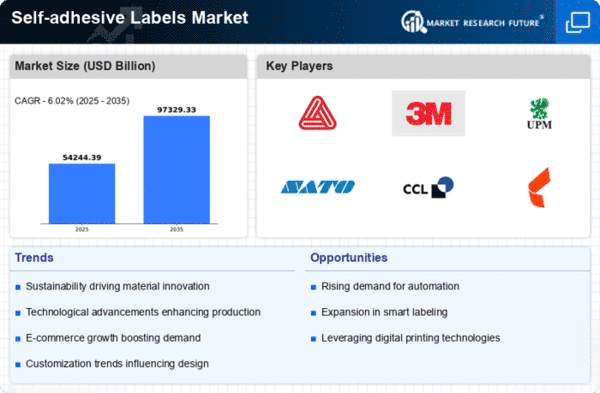
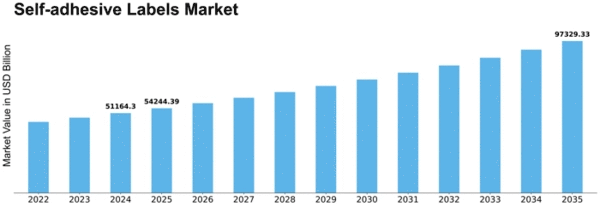
As per MRFR analysis, the Self-adhesive Labels Market Size was estimated at 51164.3 USD Billion in 2024. The Self-adhesive Labels industry is projected to grow from 54244.51 in 2025 to 97329.33 by 2035, exhibiting a compound annual growth rate (CAGR) of 6.02 during the forecast period 2025 - 2035.

Key Market Trends & Highlights

The self-adhesive labels market is poised for robust growth driven by customization and sustainability trends.

  • Customization and personalization are increasingly influencing consumer preferences in the self-adhesive labels market.
  • Sustainability initiatives are becoming a focal point, with manufacturers adopting eco-friendly materials and practices.
  • Technological advancements are enhancing label functionality, particularly in the product labeling segment.
  • Rising demand in e-commerce and regulatory compliance are key drivers propelling market expansion, especially in North America and the fast-growing Asia-Pacific region.

Market Size & Forecast

2024 Market Size 51164.3 (USD Billion)
2035 Market Size 97329.33 (USD Billion)
CAGR (2025 - 2035) 6.02%
Largest Regional Market Share in 2024 North America

Major Players

Avery Dennison (US), 3M (US), UPM Raflatac (FI), SATO Holdings (JP), CCL Industries (CA), Mondi Group (GB), Labelmakers (AU), Schreiner Group (DE), Herma GmbH (DE)

Market Trends

The Self-adhesive Labels Market is currently experiencing a dynamic evolution, driven by various factors that influence consumer preferences and technological advancements. The increasing demand for customized labeling solutions across diverse industries, such as food and beverage, pharmaceuticals, and retail, appears to be a primary catalyst for growth. Additionally, the rise of e-commerce has necessitated efficient packaging solutions, further propelling the need for self-adhesive labels. As businesses seek to enhance brand visibility and streamline operations, the market is likely to witness a surge in innovative products that cater to specific requirements. Moreover, sustainability concerns are becoming increasingly prominent within the Self-adhesive Labels Market. Manufacturers are exploring eco-friendly materials and production processes to meet the growing consumer demand for environmentally responsible products. This shift towards sustainable practices not only aligns with global environmental goals but also enhances brand reputation among eco-conscious consumers. As the market continues to adapt to these trends, it is poised for substantial growth, with opportunities for new entrants and established players alike to capitalize on emerging consumer needs and preferences.

Customization and Personalization

The trend towards customization in the Self-adhesive Labels Market is gaining momentum, as businesses seek to differentiate their products. Tailored labels that reflect brand identity and resonate with target audiences are becoming increasingly popular. This shift allows companies to enhance customer engagement and loyalty, ultimately driving sales.

Sustainability Initiatives

Sustainability is a key focus in the Self-adhesive Labels Market, with manufacturers prioritizing eco-friendly materials and processes. The growing awareness of environmental issues is prompting companies to adopt sustainable practices, which not only meet regulatory requirements but also appeal to environmentally conscious consumers.

Technological Advancements

Technological innovations are reshaping the Self-adhesive Labels Market, with advancements in printing techniques and materials. Digital printing technology, for instance, enables faster production and greater flexibility in design. This evolution allows businesses to respond swiftly to market demands and enhance operational efficiency.

Self-adhesive Labels Market Market Drivers

Regulatory Compliance

Regulatory compliance is a significant driver influencing the Global Self-Adhesive Labels Market Industry. Various sectors, including pharmaceuticals, food and beverage, and chemicals, are subject to stringent labeling regulations to ensure consumer safety and product traceability. Self-adhesive labels are essential for conveying critical information, such as ingredients, usage instructions, and safety warnings. As regulatory frameworks evolve, businesses are compelled to adopt compliant labeling solutions, thereby increasing the demand for self-adhesive labels. This trend is expected to continue, as adherence to regulations remains a priority for companies aiming to maintain market access.

Market Growth Projections

The Global Self-Adhesive Labels Market Industry is poised for substantial growth, with projections indicating a market size of 97329.33 USD Billion by 2035. This growth trajectory reflects a compound annual growth rate (CAGR) of 6.02% from 2025 to 2035. Factors contributing to this expansion include increased demand across various sectors, technological advancements, and a heightened focus on sustainability. As businesses continue to recognize the value of self-adhesive labels in enhancing brand visibility and compliance, the market is likely to witness sustained growth in the coming years.

Sustainability Initiatives

Sustainability is becoming a pivotal driver in the Global Self-Adhesive Labels Market Industry. With increasing environmental awareness, manufacturers are focusing on eco-friendly materials and production processes. The shift towards sustainable packaging solutions is influencing the demand for self-adhesive labels made from recyclable or biodegradable materials. Companies are adopting these practices to meet regulatory requirements and consumer preferences for greener products. This trend is expected to contribute to the market's growth, as businesses seek to enhance their brand image while complying with sustainability standards.

Technological Advancements

Technological innovations play a crucial role in shaping the Global Self-Adhesive Labels Market Industry. Advancements in printing technologies, such as digital printing and inkjet systems, enable high-quality label production with greater customization options. These technologies allow for shorter production runs and faster turnaround times, catering to the diverse needs of various industries. As businesses increasingly seek personalized labeling solutions, the market is poised for growth. The integration of smart labels, which incorporate RFID and NFC technologies, further enhances functionality, making self-adhesive labels more versatile and appealing to consumers.

Rising Demand in E-commerce

The Global Self-Adhesive Labels Market Industry experiences a notable surge in demand due to the rapid growth of e-commerce. As online shopping continues to expand, businesses require efficient labeling solutions for packaging and shipping. Self-adhesive labels provide a practical means for product identification, tracking, and branding. In 2024, the market is projected to reach 37.0 USD Billion, reflecting the increasing reliance on these labels in logistics and supply chain management. This trend is likely to persist as e-commerce sales are expected to grow, further driving the need for innovative labeling solutions.

Growth in the Food and Beverage Sector

The food and beverage sector significantly contributes to the Global Self-Adhesive Labels Market Industry. With the increasing demand for packaged food products, the need for effective labeling solutions has surged. Self-adhesive labels provide essential information regarding nutritional content, expiration dates, and ingredient lists, which are crucial for consumer decision-making. The market is projected to grow from 37.0 USD Billion in 2024 to 50.8 USD Billion by 2035, with a CAGR of 2.91% from 2025 to 2035. This growth is indicative of the sector's reliance on self-adhesive labels to enhance product visibility and compliance.

Market Segment Insights

By Application: Product Labeling (Largest) vs. Retail and Point of Sale (Fastest-Growing)

The self-adhesive labels market shows a diverse application landscape, predominantly driven by product labeling. This segment commands the largest share, catering to various industries by ensuring effective branding and information dissemination. Notably, logistics and shipping applications also hold significant traction, facilitating tracking and inventory management. Meanwhile, food and beverage packaging and pharmaceutical packaging make substantial contributions, enhancing product identification and regulatory compliance. Collectively, these applications reflect the growing need for easily customizable labeling solutions in various sectors.

Logistics and Shipping (Dominant) vs. Food and Beverage Packaging (Emerging)

Logistics and shipping represent a dominant application segment in the self-adhesive labels market, where labels play a crucial role in ensuring efficient supply chain operations. These labels are integral for barcoding, tracking, and providing essential information during transportation and storage. Conversely, food and beverage packaging is an emerging segment, responding to increasing consumer demand for traceability and brand communication. This application focuses on compliance with stringent regulations and enhancing the consumer experience through innovative designs. Both segments require advanced adhesive technologies to withstand various environmental conditions, ensuring durability and clarity.

By End Use: Food and Beverage (Largest) vs. Healthcare (Fastest-Growing)

The Self-adhesive Labels Market is predominantly driven by the Food and Beverage sector, which commands the largest market share due to its extensive application in product labeling. The need for compliance, traceability, and branding in food products makes self-adhesive labels indispensable. Following closely, the Healthcare sector has gained substantial traction, attributed to increasing regulations and the necessity for clear labeling of pharmaceutical products, medical devices, and health supplements.

Food and Beverage: Dominant vs. Healthcare: Emerging

In the Self-adhesive Labels Market, the Food and Beverage sector stands out as a dominant force, characterized by its prevalent use of vibrant packaging and compliance with strict labeling regulations. This segment relies on self-adhesive labels for product differentiation and consumer communication, ensuring that branding aligns with safety standards. Conversely, the Healthcare segment is emerging rapidly as a result of heightened focus on health and safety, leading to increased demand for precise labeling in pharmaceuticals and medical devices. The evolution of regulatory requirements and innovation in labeling technologies is driving growth in this sector, positioning it as a critical component of the overall market.

By Material Type: Paper (Largest) vs. Polyester (Fastest-Growing)

In the Self-adhesive Labels Market, the distribution of market share among material types showcases paper as the largest segment, appreciated for its versatility and affordability. Paper labels are dominant across various end-user industries such as food and beverage, retail, and logistics, thanks to their eco-friendliness and ease of printing. In contrast, materials like plastic and vinyl also hold significant market share but do not surpass the established position of paper labels in overall consumption. Looking ahead, the growth trends in material types indicate a notable rise in the demand for polyester labels, which have been recognized as the fastest-growing segment due to their durability and resistance to environmental factors. As companies prioritize product longevity and shelf appeal, polyester is likely to see increased adoption, especially in specialized sectors such as cosmetics and chemicals where resistance to moisture and chemicals is critical.

Paper (Dominant) vs. Polyester (Emerging)

Paper labels remain the dominant choice in the self-adhesive labels market, favored for their cost-effectiveness and wide availability in various finishes and types. They offer excellent printability and are ideal for a range of applications from shipping to product labeling. In contrast, polyester labels are emerging as a strong competitor, particularly in industries requiring high-quality and durable labels. With their ability to withstand extreme conditions, they are increasingly adopted in sectors such as pharmaceuticals and industrial applications. The growing sustainability trends are also influencing polyester's market position, as they can be produced with recycled materials, equating to lower environmental impact compared to traditional paper labels.

By Printing Technology: Flexographic Printing (Largest) vs. Digital Printing (Fastest-Growing)

In the Self-adhesive Labels Market, Flexographic Printing holds the largest market share, attributed to its efficiency in high-volume production and versatility in printing on various materials. Meanwhile, Digital Printing is emerging as the fastest-growing segment due to advancements in digital technology, allowing for quick turnaround times and customization. Offset and Screen Printing also contribute to the market but are gradually losing their share compared to the more flexible options of Flexographic and Digital technologies. As businesses seek faster and more tailored printing solutions, these traditional methods face challenges in adapting to evolving customer demands. The growth trends in this segment are driven by the rising demand for customized labels and shorter production runs, particularly in the retail and packaging sectors. Flexographic Printing remains essential for larger production volumes, while Digital Printing caters to brands seeking unique design elements and rapid production capabilities. Additionally, eco-friendly inks and materials are becoming a vital consideration, pushing printers towards sustainable practices, which in turn are expected to enhance the appeal of both Flexographic and Digital Printing methods over the coming years.

Flexographic Printing (Dominant) vs. Digital Printing (Emerging)

Flexographic Printing has established itself as the dominant technology in the Self-adhesive Labels Market because it is ideally suited for high-speed printing and can handle a wide range of substrates. This type of printing is favored for its ability to produce large volumes with consistent quality, making it indispensable for mass labeling requirements. It also allows the use of various ink types, including water-based and UV inks, catering to different market demands. On the other hand, Digital Printing is rapidly emerging as a significant player in this segment due to its advantages in customization and short-run production benefits. Brands are increasingly adopting Digital Printing for its ability to provide personalized labels, rapid prototyping, and adjustments without the need for extensive setup, making it an attractive option for businesses focusing on innovation and consumer engagement.

By Adhesive Type: Permanent Adhesive (Largest) vs. Removable Adhesive (Fastest-Growing)

In the Self-adhesive Labels Market, Permanent Adhesive holds a significant share, being the preferred choice among consumers for various labeling needs. This segment benefits from its strong bond and durability, making it ideal for applications that require long-lasting adherence. On the other hand, Removable Adhesive, though smaller in market share, is rapidly gaining traction due to its versatility and convenience, catering to the growing demand for labels that can be easily rearranged or removed without leaving residue. The growth in the Removable Adhesive segment is driven by increasing applications in retail, packaging, and promotional label markets, where temporary labeling solutions are essential. Furthermore, advancements in adhesive technology are enhancing the performance and usability of removable options, contributing to their fast-paced growth. This trend is aligned with consumer preferences for flexibility and ease of use, indicating a dynamic shift in adhesive type preferences within the self-adhesive labels landscape.

Permanent Adhesive (Dominant) vs. Removable Adhesive (Emerging)

Permanent Adhesive is characterized by its strong bonding capabilities and long-term reliability. It is predominantly used in situations where labels must withstand environmental challenges and retain adherence over time, making it a staple in industries such as logistics, food & beverage, and pharmaceutical sectors. In contrast, Removable Adhesive is emerging as a popular choice for companies seeking flexibility in labeling. Its ability to be repositioned and removed without damage is appealing to sectors focusing on branding and marketing, where labels may need to change frequently. This contrast highlights the evolving needs of consumers in the self-adhesive labels market, with Permanent Adhesive providing stability while Removable Adhesive caters to a more temporary and adaptable labeling solution.

Get more detailed insights about Self-Adhesive Labels Market Research Report - Forecast by 2035

Regional Insights

North America : Market Leader in Innovation

North America continues to lead the self-adhesive labels market, holding a significant share of 25600.0. The region's growth is driven by increasing demand in various sectors, including food and beverage, pharmaceuticals, and retail. Regulatory support for sustainable packaging and labeling solutions further fuels market expansion. The trend towards automation and digital printing technologies is also enhancing production efficiency and customization options. The competitive landscape in North America is robust, featuring key players such as Avery Dennison and 3M, which are at the forefront of innovation. The U.S. remains the largest market, supported by a strong manufacturing base and advanced technological capabilities. Canada is also emerging as a significant player, with companies like CCL Industries contributing to the market's growth. The presence of these industry leaders ensures a dynamic and competitive environment.

Europe : Emerging Market with Growth Potential

Europe's self-adhesive labels market is valued at 15300.0, reflecting a growing trend towards sustainability and eco-friendly labeling solutions. Regulatory frameworks, such as the EU's Green Deal, are pushing companies to adopt more sustainable practices, which is driving demand for innovative labeling solutions. The increasing focus on product traceability and compliance with labeling regulations is also a significant growth driver in the region. Leading countries in Europe include Germany, France, and the UK, where major players like UPM Raflatac and Mondi Group are actively innovating. The competitive landscape is characterized by a mix of established companies and emerging startups focusing on sustainable materials. The presence of these key players, along with supportive regulations, positions Europe as a promising market for self-adhesive labels.

Asia-Pacific : Rapid Growth in Emerging Markets

The Asia-Pacific region, with a market size of 8000.0, is witnessing rapid growth in the self-adhesive labels sector. This growth is driven by increasing urbanization, rising disposable incomes, and a booming e-commerce industry. Countries like China and India are leading the charge, with a growing demand for packaging solutions in various sectors, including food, pharmaceuticals, and consumer goods. Regulatory initiatives aimed at improving product safety and labeling standards are also contributing to market expansion. China stands out as the largest market in the region, supported by a strong manufacturing base and a growing consumer market. Key players such as SATO Holdings and Labelmakers are capitalizing on this growth, focusing on innovative solutions to meet the diverse needs of consumers. The competitive landscape is evolving, with both local and international companies vying for market share, making it a dynamic environment for self-adhesive labels.

Middle East and Africa : Niche Market with Growth Opportunities

The Middle East and Africa (MEA) region, with a market size of 264.3, presents unique opportunities in the self-adhesive labels market. The growth is primarily driven by increasing demand in the retail and logistics sectors, where labeling plays a crucial role in product identification and compliance. Regulatory frameworks are gradually evolving, promoting better labeling practices and product safety, which is expected to boost market growth in the coming years. Countries like South Africa and the UAE are leading the market, with a growing number of local manufacturers entering the space. The competitive landscape is characterized by a mix of established players and new entrants, focusing on innovative labeling solutions. The presence of key players, along with increasing investments in infrastructure, is likely to enhance the market's growth potential in the region.

Key Players and Competitive Insights

The Self-adhesive Labels Market is currently characterized by a dynamic competitive landscape, driven by innovation, sustainability, and technological advancements. Key players such as Avery Dennison (US), 3M (US), and UPM Raflatac (FI) are actively shaping the market through strategic initiatives. Avery Dennison (US) focuses on enhancing its product portfolio with sustainable materials, while 3M (US) emphasizes digital transformation and automation in its manufacturing processes. UPM Raflatac (FI) is investing in eco-friendly label solutions, which aligns with the growing consumer demand for sustainable products. Collectively, these strategies foster a competitive environment that prioritizes innovation and sustainability, thereby influencing market growth.In terms of business tactics, companies are increasingly localizing manufacturing to reduce lead times and optimize supply chains. This approach not only enhances operational efficiency but also allows for better responsiveness to regional market demands. The competitive structure of the Self-adhesive Labels Market appears moderately fragmented, with several key players holding substantial market shares. The collective influence of these companies is significant, as they drive trends and set benchmarks for quality and innovation within the industry.In November 2025, Avery Dennison (US) announced the launch of a new line of biodegradable labels, which is expected to cater to the rising demand for sustainable packaging solutions. This strategic move not only reinforces the company's commitment to environmental responsibility but also positions it favorably against competitors who may not yet offer such products. The introduction of biodegradable labels could potentially attract a new customer base that prioritizes sustainability in their purchasing decisions.In October 2025, 3M (US) unveiled a state-of-the-art digital printing technology that enhances label customization capabilities. This innovation is likely to provide clients with more flexibility and speed in label production, thereby improving customer satisfaction. By investing in advanced printing technologies, 3M (US) aims to solidify its market position and respond effectively to the increasing demand for personalized labeling solutions.In September 2025, UPM Raflatac (FI) entered into a strategic partnership with a leading packaging company to develop innovative label solutions tailored for the food and beverage sector. This collaboration is indicative of UPM Raflatac's strategy to leverage partnerships for expanding its market reach and enhancing product offerings. Such alliances are crucial in a competitive landscape where adaptability and responsiveness to market trends are essential for success.As of December 2025, the Self-adhesive Labels Market is witnessing trends that emphasize digitalization, sustainability, and the integration of AI technologies. Strategic alliances among key players are increasingly shaping the competitive landscape, allowing for shared resources and expertise. Looking ahead, it is anticipated that competitive differentiation will evolve, shifting from price-based competition to a focus on innovation, technology, and supply chain reliability. This transition underscores the importance of adaptability and forward-thinking strategies in maintaining a competitive edge in the market.

Key Companies in the Self-adhesive Labels Market include

Industry Developments

  • Q2 2024: Avery Dennison launches AD Circular program for self-adhesive label recycling in North America Avery Dennison announced the launch of its AD Circular recycling program in North America, enabling the collection and recycling of used self-adhesive label liners from customers to promote sustainability in label production.
  • Q2 2024: UPM Raflatac opens new self-adhesive label materials slitting and distribution terminal in India UPM Raflatac inaugurated a new slitting and distribution terminal for self-adhesive label materials in India, expanding its footprint and improving supply chain efficiency for customers in the region.
  • Q2 2024: Mondi launches new sustainable self-adhesive label range made from recycled materials Mondi introduced a new line of self-adhesive labels made from recycled materials, targeting FMCG and logistics sectors seeking eco-friendly packaging solutions.
  • Q1 2024: LINTEC Corporation announces partnership with Japanese e-commerce giant for smart self-adhesive label solutions LINTEC Corporation entered into a partnership with a major Japanese e-commerce company to supply smart self-adhesive label solutions featuring RFID technology for improved inventory management.
  • Q2 2024: HERMA opens new production facility for self-adhesive label materials in Germany HERMA inaugurated a new manufacturing facility dedicated to self-adhesive label materials in Germany, increasing its production capacity to meet growing demand in Europe.
  • Q1 2024: Optimum Group acquires UK-based self-adhesive label producer CS Labels Optimum Group completed the acquisition of CS Labels, a UK-based manufacturer specializing in self-adhesive labels, expanding its product portfolio and market presence in the UK.
  • Q2 2024: Avery Dennison appoints new Vice President of Global Label and Packaging Materials Avery Dennison announced the appointment of a new Vice President to lead its Global Label and Packaging Materials division, aiming to drive innovation and growth in the self-adhesive labels sector.
  • Q1 2024: UPM Raflatac receives FSC certification for new self-adhesive label product line UPM Raflatac obtained Forest Stewardship Council (FSC) certification for its latest self-adhesive label product line, supporting responsible sourcing and environmental stewardship.
  • Q2 2024: Mondi partners with European beverage company to supply recyclable self-adhesive labels Mondi entered into a partnership with a leading European beverage company to supply recyclable self-adhesive labels for their product packaging, advancing sustainability goals.
  • Q1 2024: HERMA launches ultra-clear self-adhesive label for premium packaging applications HERMA introduced an ultra-clear self-adhesive label designed for premium packaging, offering enhanced transparency and adhesion for high-end consumer goods.
  • Q2 2024: LINTEC Corporation unveils new water-resistant self-adhesive label for outdoor applications LINTEC Corporation launched a new water-resistant self-adhesive label product aimed at outdoor and industrial applications, providing improved durability and performance.
  • Q1 2024: Optimum Group secures multi-year contract to supply self-adhesive labels to European pharmaceutical company Optimum Group signed a multi-year contract to supply self-adhesive labels to a major European pharmaceutical company, strengthening its position in the healthcare packaging market.

Future Outlook

Self-adhesive Labels Market Future Outlook

The Self-adhesive Labels Market is projected to grow at a 6.02% CAGR from 2024 to 2035, driven by e-commerce expansion, sustainability trends, and technological advancements.

New opportunities lie in:

  • Integration of smart label technology for inventory management
  • Development of eco-friendly adhesive materials
  • Expansion into emerging markets with tailored product offerings

By 2035, the market is expected to achieve robust growth, driven by innovation and strategic expansion.

Market Segmentation

Self-adhesive Labels Market End Use Outlook

  • Food and Beverage
  • Healthcare
  • Consumer Goods
  • Electronics
  • Automotive

Self-adhesive Labels Market Application Outlook

  • Product Labeling
  • Logistics and Shipping
  • Retail and Point of Sale
  • Food and Beverage Packaging
  • Pharmaceutical Packaging

Self-adhesive Labels Market Adhesive Type Outlook

  • Permanent Adhesive
  • Removable Adhesive
  • Repositionable Adhesive
  • Hot Melt Adhesive
  • Water-Based Adhesive

Self-adhesive Labels Market Material Type Outlook

  • Paper
  • Plastic
  • Vinyl
  • Polyester
  • Polypropylene

Self-adhesive Labels Market Printing Technology Outlook

  • Flexographic Printing
  • Digital Printing
  • Offset Printing
  • Screen Printing
  • Letterpress Printing

Report Scope

MARKET SIZE 202451164.3(USD Billion)
MARKET SIZE 202554244.51(USD Billion)
MARKET SIZE 203597329.33(USD Billion)
COMPOUND ANNUAL GROWTH RATE (CAGR)6.02% (2025 - 2035)
REPORT COVERAGERevenue Forecast, Competitive Landscape, Growth Factors, and Trends
BASE YEAR2024
Market Forecast Period2025 - 2035
Historical Data2019 - 2024
Market Forecast UnitsUSD Billion
Key Companies ProfiledAvery Dennison (US), 3M (US), UPM Raflatac (FI), SATO Holdings (JP), CCL Industries (CA), Mondi Group (GB), Labelmakers (AU), Schreiner Group (DE), Herma GmbH (DE)
Segments CoveredApplication, End Use, Material Type, Printing Technology, Adhesive Type
Key Market OpportunitiesIntegration of smart technology in Self-adhesive Labels Market enhances tracking and consumer engagement.
Key Market DynamicsRising demand for sustainable packaging drives innovation in self-adhesive label materials and production processes.
Countries CoveredNorth America, Europe, APAC, South America, MEA

FAQs

What is the expected market size of the Self-Adhesive Labels Market in 2024?

The Self-Adhesive Labels Market is expected to be valued at 37.05 USD billion in 2024.

What is the expected CAGR for the Self-Adhesive Labels Market from 2025 to 2035?

Self-adhesive Labels Market is projected to register a CAGR of 6.02% from 2025-2035

Which application segment is expected to dominate the Self-Adhesive Labels Market in 2024?

The Packaging application segment is valued at 15.0 USD Billion in 2024, making it the largest segment.

What will be the value of the Shipping application segment in the Self-Adhesive Labels Market by 2035?

The Shipping application segment is expected to be valued at 11.8 USD billion by 2035.

Which region is anticipated to have the largest market share in the Self-Adhesive Labels Market in 2024?

North America is anticipated to hold the largest market share valued at 10.99 USD billion in 2024.

What is the expected market size for the European region in the Self-Adhesive Labels Market by 2035?

The European market for Self-Adhesive Labels is expected to reach 14.9 USD billion by 2035.

Who are the key competitors in the Self-Adhesive Labels Market?

Key players in the market include Avery Dennison, Domino Printing Sciences, and CCL Industries.

What is the anticipated market size for the Healthcare application segment in 2024?

The Healthcare application segment is expected to be valued at 4.0 USD Billion in 2024.

What challenges may impact the growth of the Self-Adhesive Labels Market?

Potential challenges may include fluctuating raw material costs and increasing competition among major players.

  1. SECTION I: EXECUTIVE SUMMARY AND KEY HIGHLIGHTS
    1. | 1.1 EXECUTIVE SUMMARY
  2. SECTION II: SCOPING, METHODOLOGY AND MARKET STRUCTURE
    1. | 2.1 MARKET INTRODUCTION
    2. | 2.2 RESEARCH METHODOLOGY
  3. SECTION III: QUALITATIVE ANALYSIS
    1. | 3.1 MARKET DYNAMICS
    2. | 3.2 MARKET FACTOR ANALYSIS
  4. SECTION IV: QUANTITATIVE ANALYSIS
    1. | 4.1 Packaging & Transport, BY Application (USD Billion)
    2. | 4.2 Packaging & Transport, BY End Use (USD Billion)
    3. | 4.3 Packaging & Transport, BY Material Type (USD Billion)
    4. | 4.4 Packaging & Transport, BY Printing Technology (USD Billion)
    5. | 4.5 Packaging & Transport, BY Adhesive Type (USD Billion)
    6. | 4.6 Packaging & Transport, BY Region (USD Billion)
  5. SECTION V: COMPETITIVE ANALYSIS
    1. | 5.1 Competitive Landscape
    2. | 5.2 Company Profiles
    3. | 5.3 Appendix

Self-Adhesive Labels Market Segmentation

Market Segmentation Overview

  • Detailed segmentation data will be available in the full report
  • Comprehensive analysis by multiple parameters
  • Regional and country-level breakdowns
  • Market size forecasts by segment
Infographic

Free Sample Request

Kindly complete the form below to receive a free sample of this Report

Get Free Sample

Customer Strories

Compare Licence

×
Features License Type
Single User Multiuser License Enterprise User
Price $4,950 $5,950 $7,250
Maximum User Access Limit 1 User Upto 10 Users Unrestricted Access Throughout the Organization
Free Customization
Direct Access to Analyst
Deliverable Format
Platform Access
Discount on Next Purchase 10% 15% 15%
Printable Versions