×
Request Free Sample ×

Kindly complete the form below to receive a free sample of this Report

* Please use a valid business email

Leading companies partner with us for data-driven Insights

clients tt-cursor
Hero Background

India Self Adhesive Labels Market

ID: MRFR/PCM/55388-HCR
200 Pages
Snehal Singh
February 2026

India Self-Adhesive Labels Market Research Report By Compositions (Release liner, adhesive layer, and face stock) - Forecast to 2035

Share:
Download PDF ×

We do not share your information with anyone. However, we may send you emails based on your report interest from time to time. You may contact us at any time to opt-out.

India Self Adhesive Labels Market Infographic
Purchase Options

India Self Adhesive Labels Market Summary

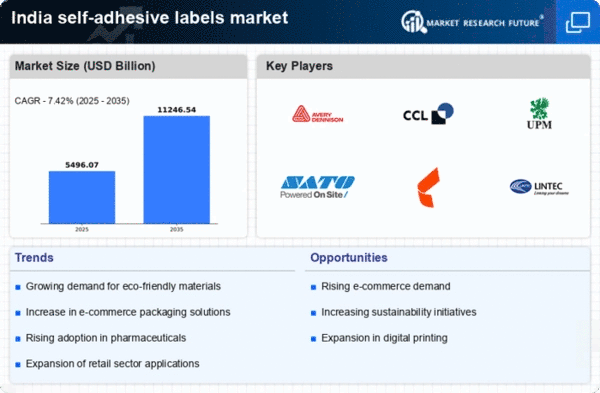
As per Market Research Future analysis, the India Self Adhesive Labels Market size was estimated at 5116.43 USD Billion in 2024. The Self Adhesive-labels market is projected to grow from 5496.07 USD Billion in 2025 to 11246.54 USD Billion by 2035, exhibiting a compound annual growth rate (CAGR) of 7.4% during the forecast period 2025 - 2035

Key Market Trends & Highlights

The India self adhesive-labels market is poised for substantial growth driven by sustainability and technological advancements.

  • Sustainability initiatives are increasingly influencing the self adhesive-labels market, reflecting a broader trend towards eco-friendly products.
  • Technological advancements in labeling are enhancing efficiency and customization, appealing to diverse consumer needs.
  • The e-commerce sector is rapidly expanding, driving demand for innovative labeling solutions to enhance product visibility.
  • Rising demand in the retail sector and pharmaceutical sector expansion are key drivers propelling market growth.

Market Size & Forecast

2024 Market Size 5116.43 (USD Billion)
2035 Market Size 11246.54 (USD Billion)
CAGR (2025 - 2035) 7.42%

Major Players

Avery Dennison Corporation (US), CCL Industries Inc. (CA), UPM Raflatac (FI), SATO Holdings Corporation (JP), Mondi Group (GB), LINTEC Corporation (JP), 3M Company (US), Herma GmbH (DE), Schreiner Group GmbH & Co. KG (DE)

Our Impact
Enabled $4.3B Revenue Impact for Fortune 500 and Leading Multinationals
Partnering with 2000+ Global Organizations Each Year
30K+ Citations by Top-Tier Firms in the Industry

India Self Adhesive Labels Market Trends

The India Self Adhesive Labels Market is currently experiencing notable growth, driven by various factors including the rise in e-commerce and retail sectors. As businesses increasingly seek efficient labeling solutions, the demand for self adhesive labels has surged. These labels offer convenience and versatility, making them suitable for a wide range of applications, from packaging to product identification. Furthermore, advancements in printing technology have enhanced the quality and customization options available, appealing to a diverse clientele. The market appears to be evolving, with a focus on sustainability and eco-friendly materials, reflecting a broader trend towards environmental responsibility in manufacturing processes. In addition, the self adhesive-labels market is likely to benefit from the increasing emphasis on branding and product differentiation. Companies are recognizing the importance of attractive packaging and labeling in capturing consumer attention. This trend suggests that businesses may invest more in innovative label designs and materials to stand out in a competitive landscape. Overall, the self adhesive-labels market is poised for continued expansion, driven by technological advancements and changing consumer preferences.

Sustainability Initiatives

There is a growing trend towards the use of eco-friendly materials in the self adhesive-labels market. Manufacturers are increasingly adopting sustainable practices, such as utilizing biodegradable and recyclable materials. This shift not only meets consumer demand for environmentally responsible products but also aligns with regulatory pressures aimed at reducing waste and promoting sustainability.

Technological Advancements

Innovations in printing technology are transforming the self adhesive-labels market. Digital printing techniques allow for greater customization and shorter production runs, enabling businesses to respond quickly to market demands. This trend enhances the ability to produce high-quality labels with intricate designs, catering to the diverse needs of various industries.

E-commerce Growth

The rise of e-commerce is significantly impacting the self adhesive-labels market. As online shopping continues to expand, the need for efficient labeling solutions for packaging and shipping is increasing. Businesses are seeking reliable labeling options that ensure products are easily identifiable and compliant with shipping regulations, driving demand for self adhesive labels.

India Self Adhesive Labels Market Drivers

Rising Demand in Retail Sector

The retail sector in India is experiencing a notable surge in demand for self adhesive-labels, driven by the increasing need for efficient product identification and branding. As retailers strive to enhance customer experience, the use of self adhesive-labels for pricing, promotions, and product information has become essential. The self adhesive-labels market is projected to grow at a CAGR of approximately 8% over the next few years, reflecting the sector's robust expansion. This growth is further fueled by the rise of organized retail formats, which require standardized labeling solutions to maintain consistency across various outlets. Consequently, the self adhesive-labels market is poised to benefit significantly from this trend, as retailers increasingly adopt innovative labeling solutions to attract and retain customers.

Pharmaceutical Sector Expansion

The pharmaceutical industry in India is witnessing rapid growth, which is positively impacting the self adhesive-labels market. With the increasing production of medicines and healthcare products, the need for accurate labeling has become paramount. Self adhesive-labels are crucial for providing essential information such as dosage, ingredients, and expiration dates. The self adhesive-labels market is expected to see a substantial increase in demand from this sector, as regulatory requirements for labeling become more stringent. Furthermore, the pharmaceutical market in India is projected to reach $55 billion by 2025, indicating a significant opportunity for self adhesive-labels manufacturers to cater to this expanding market. This growth underscores the importance of reliable labeling solutions in ensuring compliance and enhancing product safety.

Growth in Food and Beverage Sector

The food and beverage sector in India is experiencing a transformation, leading to increased demand for self adhesive-labels. As consumer preferences shift towards packaged and processed foods, manufacturers are increasingly utilizing self adhesive-labels for branding, nutritional information, and compliance with food safety regulations. The self adhesive-labels market is likely to benefit from this trend, as the sector is projected to grow at a CAGR of around 10% over the next few years. This growth is driven by rising disposable incomes and changing lifestyles, which are prompting consumers to seek convenient food options. Consequently, the demand for high-quality, attractive self adhesive-labels is expected to rise, providing manufacturers with opportunities to innovate and differentiate their products in a competitive market.

Technological Innovations in Labeling

Technological advancements in printing and labeling technologies are significantly influencing the self adhesive-labels market. Innovations such as digital printing and smart labels are enhancing the efficiency and quality of label production. These technologies allow for customization and quick turnaround times, which are essential for businesses looking to adapt to changing market demands. The self adhesive-labels market is likely to see increased adoption of these technologies, as companies seek to improve operational efficiency and reduce costs. Moreover, the integration of QR codes and NFC technology into self adhesive-labels is providing additional value by enabling interactive consumer engagement. This trend suggests a promising future for the self adhesive-labels market, as businesses leverage technology to enhance their labeling solutions.

Regulatory Compliance and Safety Standards

The increasing emphasis on regulatory compliance and safety standards in various industries is driving the demand for self adhesive-labels in India. Industries such as chemicals, cosmetics, and food are subject to stringent labeling regulations that require accurate and clear information on products. The self adhesive-labels market is likely to experience growth as companies prioritize compliance to avoid penalties and ensure consumer safety. This trend is particularly relevant in the context of the Food Safety and Standards Authority of India (FSSAI) regulations, which mandate specific labeling requirements for food products. As businesses strive to meet these standards, the demand for high-quality self adhesive-labels that convey essential information is expected to rise, presenting opportunities for manufacturers to expand their offerings.

Market Segment Insights

By Application: Packaging (Largest) vs. Healthcare (Fastest-Growing)

The India self adhesive-labels market is characterized by a diverse application landscape, with Packaging being the largest segment due to its extensive use in food, beverages, and consumer goods. Following closely are the Shipping and Retail segments, which leverage self adhesive labels for efficient labeling and branding. The Healthcare segment is gaining traction, driven by the increased demand for accurate labeling in pharmaceuticals and medical devices. Growth trends in the market reflect the rising e-commerce activities, leading to increased demand for Shipping labels, while Retail is adapting to modern branding needs. Healthcare is emerging rapidly, propelled by regulatory requirements and growing awareness of the importance of proper labeling in patient safety. Industrial applications also show steady growth, emphasizing the need for durable and reliable labels in various manufacturing processes.

Retail: Packaging (Dominant) vs. Healthcare (Emerging)

In the India self adhesive-labels market, Packaging remains the dominant application segment, widely adopted for its versatility across various industries including food and consumer products. This segment is characterized by its diverse label types, including decorative, informational, and functional designs that enhance product visibility on shelves. On the other hand, Healthcare is an emerging segment, driven by the increasing need for compliance and traceability in medical labeling. The Healthcare sector's labels must adhere to stringent regulations, ensuring they provide crucial information and maintain patient safety. As a result, manufacturers are innovating to develop specialized labels that cater to the unique challenges within this sector, presenting significant growth opportunities.

By Product Type: Paper Labels (Largest) vs. Film Labels (Fastest-Growing)

In the India self adhesive-labels market, Paper Labels hold the largest market share due to their versatility and cost-effectiveness in various applications. They are prevalent in sectors such as retail, food packaging, and logistics, making them a preferred choice among businesses. Film Labels also have a significant presence, particularly in industries requiring durability and water resistance, appealing to manufacturers looking for high-performance labeling solutions. Growth trends indicate that while Paper Labels maintain dominance, Film Labels are emerging as the fastest-growing segment, driven by increasing demand for high-quality packaging solutions. Factors such as the expansion of e-commerce, where effective branding and labeling are crucial, fuel this rise. Additionally, advancements in printing technologies enhance the capability and appeal of Film Labels, contributing to their rapid growth in the market.

Paper Labels (Dominant) vs. Film Labels (Emerging)

Paper Labels are characterized by their adaptability to various printing techniques and applications, making them the dominant choice in many commercial sectors. Their environmentally friendly nature also appeals to many businesses striving for sustainability. Film Labels, on the other hand, are becoming an emerging favorite due to their superior moisture resistance and durability, which are essential for products in challenging conditions. The transition from traditional labels to more advanced Film Labels is influenced by the need for enhanced performance in packaging and branding, appealing to manufacturers seeking innovative solutions for consumer goods. Both segments showcase strong development potential, yet they cater to distinct market needs.

By Printing Technology: Flexographic Printing (Largest) vs. Digital Printing (Fastest-Growing)

The distribution of market share among printing technologies in the India self adhesive-labels market showcases Flexographic Printing as the leading segment due to its cost-effectiveness and efficiency in high-volume production. Digital Printing is gaining traction, appealing to niche markets that prioritize customization and shorter runs, which enhances its appeal in a diverse marketplace. Other technologies, such as Lithographic and Screen Printing, hold smaller shares, serving specific applications but lacking the broader applicability of the top contenders. Growth trends indicate a shift towards digital solutions as brands demand more tailored labeling options. The rising emphasis on sustainability and eco-friendliness also drives investment into printing technologies that minimize waste, such as Digital Printing. With advancements in technology and increased consumer preference for personalized products, Digital Printing is expected to continue its rapid growth trajectory, while Flexographic Printing remains a staple for traditional large-scale applications.

Flexographic Printing (Dominant) vs. Digital Printing (Emerging)

Flexographic Printing has established itself as the dominant force in the India self adhesive-labels market, primarily due to its efficiency in high-speed printing on a variety of substrates, making it ideal for large-volume production runs. Its adaptability in print quality and finishing options further cements its market position. On the other hand, Digital Printing is emerging rapidly, driven by changing consumer preferences for customization and the ability to produce smaller runs without significant setup costs. This technology caters effectively to brands looking to innovate their labeling without the traditional constraints of bulk orders, thus appealing to both large corporations and smaller enterprises.

By End Use Industry: Food and Beverage (Largest) vs. Personal Care (Fastest-Growing)

In the India self adhesive-labels market, the Food and Beverage segment holds the largest share, driven by the increasing demand for packaged products and the need for attractive labeling to enhance brand visibility. This segment significantly influences the overall market dynamics as companies continuously innovate their packaging designs and labeling techniques to meet consumer preferences. In contrast, the Personal Care segment is emerging rapidly, reflecting changing consumer habits and a growing inclination towards aesthetically pleasing product packaging. This shift is leading to a notable increase in the adoption of self-adhesive labels in cosmetics and personal hygiene products. Growth trends indicate a robust future for both segments, with factors like urbanization and rising disposable incomes fueling demand. The Food and Beverage sector is expected to maintain its dominance, while the Personal Care segment is anticipated to expand at a faster rate. The increasing focus on sustainability has prompted manufacturers to explore eco-friendly labeling options, further driving the growth of the self-adhesive labels market. Additionally, digital printing technology is revolutionizing the sector by enabling customized labels that cater to specific marketing needs, paving the way for enhanced customer engagement.

Food and Beverage (Dominant) vs. Personal Care (Emerging)

The Food and Beverage segment is dominant in the India self adhesive-labels market, characterized by a vast array of label applications ranging from nutritional information to branding and promotional designs. This segment benefits from the growing trend toward on-the-go consumption and convenience in packaging, which necessitates clear and eye-catching labels. On the other hand, the Personal Care segment is emerging, propelled by a shift in consumer behaviors that favor unique and customized packaging solutions. This segment often emphasizes aesthetic appeal and branding consistency, as personal care products require labels that convey quality and attract consumer attention. As the market continues to evolve, both segments are adapting to technological advancements and changing consumer preferences.

Get more detailed insights about India Self Adhesive Labels Market

Key Players and Competitive Insights

The self adhesive-labels market in India is characterized by a dynamic competitive landscape, driven by increasing demand across various sectors such as food and beverage, pharmaceuticals, and logistics. Key players are actively engaging in strategies that emphasize innovation, sustainability, and regional expansion. For instance, Avery Dennison Corporation (US) has positioned itself as a leader in sustainable labeling solutions, focusing on eco-friendly materials and technologies. Similarly, CCL Industries Inc. (CA) is enhancing its operational capabilities through strategic acquisitions and partnerships, thereby strengthening its market presence. These strategies collectively contribute to a competitive environment that is increasingly focused on meeting diverse customer needs while adhering to sustainability goals.In terms of business tactics, companies are localizing manufacturing to reduce lead times and optimize supply chains. This approach is particularly relevant in a moderately fragmented market where several players vie for market share. The collective influence of key players, including UPM Raflatac (FI) and SATO Holdings Corporation (JP), is shaping the market structure, as they leverage their global expertise to cater to local demands effectively.
In October UPM Raflatac (FI) announced the launch of a new line of recyclable label materials aimed at reducing plastic waste. This strategic move underscores the company's commitment to sustainability and positions it favorably in a market increasingly driven by eco-conscious consumers. The introduction of these materials is likely to enhance UPM Raflatac's competitive edge, as businesses seek to align with environmental regulations and consumer preferences.
In September SATO Holdings Corporation (JP) expanded its operations in India by establishing a new manufacturing facility in Gujarat. This expansion is significant as it not only increases production capacity but also enhances the company's ability to serve the growing demand for self adhesive labels in the region. By localizing production, SATO aims to improve supply chain efficiency and reduce costs, thereby strengthening its market position.
In August 3M Company (US) launched an innovative digital labeling solution that integrates AI technology to streamline label design and production processes. This development reflects a broader trend towards digitalization in the self adhesive-labels market, where companies are increasingly adopting advanced technologies to enhance operational efficiency and customer engagement. The integration of AI is expected to provide 3M with a competitive advantage, as it allows for greater customization and faster turnaround times.
As of November the competitive trends in the self adhesive-labels market are heavily influenced by digitalization, sustainability, and technological integration. Strategic alliances are becoming more prevalent, as companies recognize the need to collaborate in order to innovate and meet evolving market demands. The shift from price-based competition to a focus on innovation, technology, and supply chain reliability is evident, suggesting that future competitive differentiation will hinge on the ability to adapt to these trends.

Key Companies in the India Self Adhesive Labels Market include

Industry Developments

In recent developments within the India Self-Adhesive Labels Market, the sector has shown significant growth, driven by increasing demand from end-use industries such as pharmaceuticals, food and beverage, and personal care. In October 2023, UFlex launched new eco-friendly self-adhesive label solutions, highlighting sustainability trends in the market. Additionally, in September 2023, Resource International expanded its production capacity to meet rising demands, indicating a robust market outlook. Major players like Avery Dennison and 3M India are also investing in Research and Development for innovative label solutions tailored to consumer preferences. 

Notably, in July 2023, Bharat Labels announced a strategic alliance with Tafetta to explore joint production opportunities, enhancing their competitive positioning. The overall market valuation has seen a considerable uptick, attributed to the rising consumer goods market in India, which was valued at over USD 1 trillion in 2022 and is expected to reach USD 1.7 trillion by 2026, reflecting a favorable environment for self-adhesive label manufacturers. Major happenings over the past few years include the rise of digital label printing technologies and a heightened focus on environmentally sustainable products.


Future Outlook

India Self Adhesive Labels Market Future Outlook

The self adhesive-labels market in India is projected to grow at 7.42% CAGR from 2025 to 2035, driven by e-commerce expansion, technological advancements, and increasing demand for sustainable packaging solutions.

New opportunities lie in:

  • Development of eco-friendly label materials for sustainability-focused brands. Integration of smart labels with RFID technology for inventory management. Expansion of customized label solutions for niche markets and industries.

By 2035, the self adhesive-labels market is expected to achieve substantial growth and innovation.

Market Segmentation

India Self Adhesive Labels Market Application Outlook

  • Packaging
  • Shipping
  • Retail
  • Healthcare
  • Industrial

India Self Adhesive Labels Market Product Type Outlook

  • Paper Labels
  • Film Labels
  • Foil Labels
  • Vinyl Labels

India Self Adhesive Labels Market End Use Industry Outlook

  • Food and Beverage
  • Personal Care
  • Pharmaceutical
  • Electronics

India Self Adhesive Labels Market Printing Technology Outlook

  • Flexographic Printing
  • Digital Printing
  • Lithographic Printing
  • Screen Printing

Report Scope

MARKET SIZE 2024 5116.43(USD Billion)
MARKET SIZE 2025 5496.07(USD Billion)
MARKET SIZE 2035 11246.54(USD Billion)
COMPOUND ANNUAL GROWTH RATE (CAGR) 7.42% (2025 - 2035)
REPORT COVERAGE Revenue Forecast, Competitive Landscape, Growth Factors, and Trends
BASE YEAR 2024
Market Forecast Period 2025 - 2035
Historical Data 2019 - 2024
Market Forecast Units USD Billion
Key Companies Profiled Avery Dennison Corporation (US), CCL Industries Inc. (CA), UPM Raflatac (FI), SATO Holdings Corporation (JP), Mondi Group (GB), LINTEC Corporation (JP), 3M Company (US), Herma GmbH (DE), Schreiner Group GmbH & Co. KG (DE)
Segments Covered Application, Product Type, Printing Technology, End Use Industry
Key Market Opportunities Growing demand for sustainable materials in the self adhesive-labels market presents significant opportunities for innovation.
Key Market Dynamics Rising demand for eco-friendly materials drives innovation in the self adhesive-labels market.
Countries Covered India
Leave a Comment

FAQs

What is the market size of the India Self-Adhesive Labels Market in 2024?

In 2024, the India Self-Adhesive Labels Market is expected to be valued at 4.5 USD Billion.

What is the expected market growth rate for the India Self-Adhesive Labels Market from 2025 to 2035?

The expected CAGR for the India Self-Adhesive Labels Market from 2025 to 2035 is 6.504 %.

What will the market size of the India Self-Adhesive Labels Market be by 2035?

By 2035, the India Self-Adhesive Labels Market is anticipated to reach a valuation of 9.0 USD Billion.

Which composition segment will hold the largest market share in 2024?

In 2024, the Release liner segment will hold the largest market share at 1.5 USD Billion.

How much is the adhesive layer composition segment valued at in 2024?

The adhesive layer composition segment is valued at 1.2 USD Billion in 2024.

What will be the market value of the face stock segment by 2035?

By 2035, the face stock segment is projected to be valued at 3.6 USD Billion.

Who are the key players in the India Self-Adhesive Labels Market?

Key players in the market include S.P. Sethi & Sons, Avery Dennison, 3M India, and UFlex.

What is the expected market size for the adhesive layer by 2035?

The adhesive layer segment is expected to grow to 2.4 USD Billion by 2035.

What opportunities are present in the India Self-Adhesive Labels Market?

Emerging trends such as eco-friendly materials and automation present opportunities in the market.

What challenges does the India Self-Adhesive Labels Market face?

Challenges include competition from digital labeling alternatives and fluctuating raw material prices.

Download Free Sample

Kindly complete the form below to receive a free sample of this Report

Compare Licence

×
Features License Type
Single User Multiuser License Enterprise User
Price $4,950 $5,950 $7,250
Maximum User Access Limit 1 User Upto 10 Users Unrestricted Access Throughout the Organization
Free Customization
Direct Access to Analyst
Deliverable Format
Platform Access
Discount on Next Purchase 10% 15% 15%
Printable Versions