×
Request Free Sample ×

Kindly complete the form below to receive a free sample of this Report

* Please use a valid business email

Leading companies partner with us for data-driven Insights

clients tt-cursor
Hero Background
English
Chinese
French
Japanese
Korean
German
Spanish

Savory Yogurt Foods Market Trends

ID: MRFR/FnB/0687-HCR
115 Pages
Varsha More
February 2026

Savory Yogurt Foods Market Size, Share, Industry Trend & Analysis Research Report By Product Type (Dips, Spreads, Savory Yogurt Bowls, Savory Yogurt Dressings), By Flavor Profile (Herb, Spicy, Savory, Garlic, Onion), By Packaging Type (Pouches, Tubs, Bottles, Cups), By Distribution Channel (Supermarkets, Online Retail, Convenience Stores, Health Food Stores) andBy Regional (North America, Europe, South America, Asia Pacific, Middle East and Africa)- Forecast to 2035.

Share:
Download PDF ×

We do not share your information with anyone. However, we may send you emails based on your report interest from time to time. You may contact us at any time to opt-out.

Savory Yogurt Foods Market Infographic
Purchase Options

Market Trends

Key Emerging Trends in the Savory Yogurt Foods Market

The Savory Yogurt Foods Market experiences important trends that suggest changes in consumer preferences and industry dynamics. One major trend shaping the market is stable demand due to changes in eating habits. Among them, fruit-flavored beverages are the dominant trend, having the largest market share. The Savory Yogurt Foods Market will continue to exhibit steady developments throughout the forecast period. This stability owes to a transition towards more healthy lifestyle choices, such as food consumption patterns, which encourage customers' preference for this product (Aydemir & Demirel 2014). However, numerous challenges hinder its growth curve. Lactose intolerance can be cited as one of these inhibiting factors with regard to yogurt's expansion. High prevalence rates of lactose intolerance amongst consumers restrict acceptance of yogurts, typically leading to low-level demand for traditional alternatives. There are promising growth opportunities in these challenges due to the increasing awareness of Savory Yogurt products. The rising health consciousness among consumers, as well as their growing appreciation for the flexibility of Savory Yogurt varieties, provides a favorable market environment for its growth. The other major trend that affects market dynamics is the prevalence of low-fat yogurts. Increasingly, individuals focus on weight and adopt healthier lifestyles, leading to demand for low-fat yogurts. However, one main challenge stands in the way of this market—lactose intolerance. Certain groups of consumers cannot buy traditional yogurt types due to lactose intolerance. Another issue facing Savory Yogurt Market is artificial flavors in them. Many customers today prefer clean-label products with all-natural ingredients. Amidst these challenges, the market is buoyed by promising growth opportunities rooted in rising awareness. Consumers are becoming more enlightened about the health benefits of savory yogurt, which has influenced its positive reception in many markets globally. The trends also show potential for expansion into developing regions, especially the Asia Pacific region. Increased consumer awareness and a shift towards healthier dietary choices create lucrative prospects for players within these areas. Also, it leads to varied product offerings following innovation in low-fat yogurt varieties preferred by health-conscious customers.


Author
Varsha More
Research Analyst

Experienced business professional with a demonstrated history of working in the CFnB industry. Skilled in market research, and market estimation. Strong professional with a Masters focused in marketing management.

Leave a Comment

FAQs

What is the current valuation of the Savory Yogurt Foods Market as of 2024?

<p>The Savory Yogurt Foods Market was valued at 3.549 USD Billion in 2024.</p>

What is the projected market valuation for the Savory Yogurt Foods Market in 2035?

<p>The market is projected to reach a valuation of 6.483 USD Billion by 2035.</p>

What is the expected CAGR for the Savory Yogurt Foods Market during the forecast period 2025 - 2035?

<p>The expected CAGR for the Savory Yogurt Foods Market during the forecast period 2025 - 2035 is 5.63%.</p>

Which segments are included in the Savory Yogurt Foods Market?

<p>The market includes segments such as Dips, Spreads, Savory Yogurt Bowls, and Savory Yogurt Dressings.</p>

What are the projected values for Savory Yogurt Bowls from 2024 to 2035?

<p>The projected values for Savory Yogurt Bowls are expected to grow from 1.2 USD Billion in 2024 to 2.2 USD Billion by 2035.</p>

How do flavor profiles impact the Savory Yogurt Foods Market?

<p>Flavor profiles such as Herb, Spicy, and Garlic are projected to see significant growth, with Savory expected to rise from 1.2 USD Billion to 2.2 USD Billion.</p>

What packaging types are prevalent in the Savory Yogurt Foods Market?

<p>Common packaging types include Pouches, Tubs, Bottles, and Cups, with Cups projected to grow from 1.389 USD Billion to 2.733 USD Billion.</p>

Which distribution channels are most significant for the Savory Yogurt Foods Market?

<p>Supermarkets and Online Retail are key distribution channels, with Supermarkets projected to grow from 1.424 USD Billion to 2.563 USD Billion.</p>

Who are the key players in the Savory Yogurt Foods Market?

<p>Key players include Danone, Nestle, Yoplait, Chobani, Fage, Stonyfield Farm, Oikos, and Siggi's.</p>

What trends are influencing the growth of the Savory Yogurt Foods Market?

<p>Trends such as increasing consumer preference for savory flavors and convenient packaging options are likely driving market growth.</p>

Market Summary

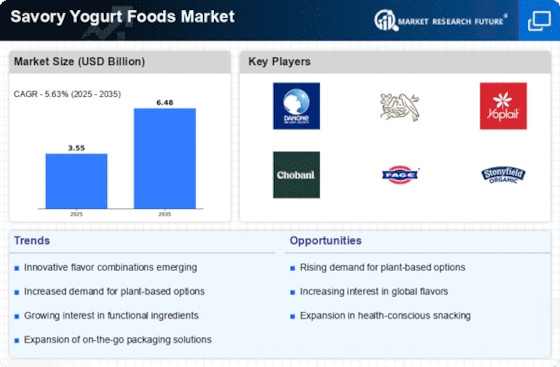
As per Market Research Future analysis, the Savory Yogurt Foods Market Size was estimated at 3.549 USD Billion in 2024. The Savory Yogurt Foods industry is projected to grow from 3.749 USD Billion in 2025 to 6.483 USD Billion by 2035, exhibiting a compound annual growth rate (CAGR) of 5.63% during the forecast period 2025 - 2035

Key Market Trends & Highlights

The Savory Yogurt Foods Market is experiencing a dynamic shift towards health-conscious and innovative culinary options.

  • Health-conscious consumers are increasingly opting for savory yogurt as a nutritious alternative to traditional snacks. North America remains the largest market, while the Asia-Pacific region is emerging as the fastest-growing area for savory yogurt products. Dips represent the largest segment, whereas savory yogurt bowls are witnessing the fastest growth in consumer interest. The health benefits of savory yogurt and the rise of plant-based alternatives are driving market expansion.

Market Size & Forecast

2024 Market Size 3.549 (USD Billion)
2035 Market Size 6.483 (USD Billion)
CAGR (2025 - 2035) 5.63%
Largest Regional Market Share in 2024 North America

Major Players

Danone (FR), Nestle (CH), Yoplait (FR), Chobani (US), Fage (GR), Stonyfield Farm (US), Oikos (US), Siggi's (US)

Market Trends

The Savory Yogurt Foods Market is currently experiencing a notable transformation, driven by evolving consumer preferences and an increasing inclination towards healthier dietary options. This segment of the food industry appears to be gaining traction as individuals seek alternatives to traditional sweet yogurts. The rise in demand for savory flavors, coupled with a growing awareness of the nutritional benefits associated with yogurt, suggests a shift in consumption patterns. Consumers are increasingly drawn to products that offer unique taste experiences while also providing health advantages, such as probiotics and lower sugar content. Moreover, the Savory Yogurt Foods Market seems to be influenced by culinary trends that emphasize global flavors and innovative pairings. As chefs and food enthusiasts experiment with diverse ingredients, the market is likely to see an influx of new product offerings that cater to adventurous palates. This trend indicates a potential for growth as brands strive to differentiate themselves in a competitive landscape. The combination of health consciousness and culinary exploration may well define the future trajectory of this market, positioning savory yogurt as a staple in modern diets.

Health-Conscious Choices

Consumers are increasingly prioritizing health and wellness, leading to a surge in demand for savory yogurt options that offer nutritional benefits. This trend reflects a broader shift towards foods that support a balanced lifestyle.

Culinary Innovation

The Savory Yogurt Foods Market is witnessing a wave of creativity as brands experiment with unique flavor combinations and ingredients. This innovation caters to adventurous consumers seeking novel taste experiences.

Sustainable Practices

There is a growing emphasis on sustainability within the food industry, prompting brands to adopt eco-friendly practices. This trend resonates with consumers who are more inclined to support products that align with their environmental values.

Savory Yogurt Foods Market Market Drivers

Culinary Versatility

The culinary versatility of savory yogurt is another significant driver in the Savory Yogurt Foods Market. This product can be utilized in a myriad of dishes, ranging from dips and dressings to marinades and soups. The ability to incorporate savory yogurt into various cuisines enhances its appeal to a diverse consumer base. Market data indicates that the use of savory yogurt in cooking is on the rise, as chefs and home cooks alike experiment with its unique flavor profile. This trend not only broadens the application of savory yogurt but also encourages consumers to explore new culinary experiences. As the Savory Yogurt Foods Market continues to evolve, the emphasis on innovative recipes and culinary applications is likely to attract a wider audience, further driving market growth.

Health Benefits of Savory Yogurt

The increasing awareness of health benefits associated with savory yogurt is a pivotal driver in the Savory Yogurt Foods Market. Savory yogurt is often rich in probiotics, which are known to enhance gut health and boost the immune system. As consumers become more health-conscious, they are gravitating towards products that offer nutritional advantages. According to recent data, the demand for probiotic-rich foods has surged, with savory yogurt emerging as a preferred choice. This trend is likely to continue, as consumers seek alternatives to traditional sweet yogurts, thereby expanding the market. The Savory Yogurt Foods Market is thus positioned to benefit from this shift towards healthier eating habits, as manufacturers innovate to meet the growing demand for nutritious and flavorful options.

Rise of Plant-Based Alternatives

The rise of plant-based alternatives is reshaping the landscape of the Savory Yogurt Foods Market. As more consumers adopt plant-based diets for health, ethical, or environmental reasons, the demand for plant-based savory yogurt options is increasing. This shift is supported by market data showing a significant uptick in sales of plant-based dairy alternatives, which includes savory yogurt. Manufacturers are responding by developing innovative products that cater to this growing demographic, thus expanding their market reach. The Savory Yogurt Foods Market is likely to see a surge in plant-based offerings, which could attract not only traditional yogurt consumers but also those seeking dairy-free options. This trend indicates a potential for substantial growth as the market adapts to changing consumer preferences.

Cultural Influences and Global Flavors

Cultural influences and The Savory Yogurt Foods Industry. As globalization continues to shape consumer tastes, there is a growing interest in international cuisines that incorporate savory yogurt. This trend is evident in the increasing popularity of Mediterranean and Middle Eastern dishes, which often feature yogurt as a key ingredient. Market data indicates that consumers are more willing to experiment with flavors from different cultures, leading to a rise in demand for diverse savory yogurt products. The Savory Yogurt Foods Market is thus likely to benefit from this cultural exchange, as manufacturers introduce new flavors and formulations that cater to adventurous palates. This emphasis on global flavors may not only enhance product offerings but also attract a broader consumer base.

Increased Focus on Clean Label Products

The increased focus on clean label products is a notable driver in the Savory Yogurt Foods Market. Consumers are becoming more discerning about the ingredients in their food, favoring products that are free from artificial additives and preservatives. This trend is reflected in the growing demand for savory yogurt that emphasizes natural ingredients and transparency in labeling. Market data suggests that products marketed as clean label are experiencing higher sales growth compared to conventional options. As a result, manufacturers in the Savory Yogurt Foods Market are reformulating their products to meet these consumer expectations, which may lead to enhanced brand loyalty and market share. This focus on clean labels is likely to shape the future of the industry, as consumers increasingly prioritize health and quality.

Market Segment Insights

By Type: Dips (Largest) vs. Savory Yogurt Bowls (Fastest-Growing)

<p>The Savory Yogurt Foods Market is segmented into four key categories: Dips, Spreads, Savory Yogurt Bowls, and Savory Yogurt Dressings. Among these, Dips hold the largest market share, capturing the attention of consumers seeking convenient and flavorful options for snacking and entertaining. Savory Yogurt Bowls, meanwhile, have emerged as a rapidly growing segment, appealing to health-conscious consumers looking for nutritious meal alternatives that are both satisfying and convenient. The growth trends in this segment are fueled by the increasing consumer preference for savory snacks and meal options that offer unique flavors and health benefits. As more individuals move towards on-the-go meal solutions, Savory Yogurt Bowls are well-positioned to meet this demand, while Dips continue to thrive due to their versatility and popularity at social gatherings. The combination of health trends and flavorful innovations propels this segment forward, creating ample opportunities for further development in the market.</p>

<p>Dips (Dominant) vs. Savory Yogurt Dressings (Emerging)</p>

<p>Dips are currently the dominant product offering in the Savory Yogurt Foods Market, known for their rich flavors and variety, ideal for both casual snacking and party occasions. This segment's success is attributed to the broad range of varieties, including options infused with herbs, spices, and other flavor enhancers that cater to diverse consumer tastes. Dips are often marketed as healthier alternatives to traditional spreads, helping to solidify their position in the market. In contrast, Savory Yogurt Dressings are an emerging segment, gaining traction amongst health-conscious consumers looking for lighter and more nutritious dressing options. As these dressings often incorporate yogurt as a base, they appeal due to their lower calorie counts while providing a creamy texture and complex flavor profiles. The rising trend towards health-oriented eating is propelling Savory Yogurt Dressings into a favorable position, allowing them to carve out a niche in a competitive landscape.</p>

By Flavor Profile: Herb (Largest) vs. Spicy (Fastest-Growing)

<p>In the Savory Yogurt Foods Market, the flavor profile segment exhibits a diverse range of preferences, with Herb emerging as the most popular choice among consumers. This reflects a growing inclination towards fresh and natural flavors, which often signify clean-label products. Following closely, Spicy flavors are gaining traction, catering to adventurous palates and a rising trend for more bold and exciting dining experiences. Other flavor profiles like Garlic, Onion, and Savory also contribute significantly, but they hold smaller shares within the overall market landscape.</p>

<p>Flavor Profile: Herb (Dominant) vs. Spicy (Emerging)</p>

<p>Herb as a dominant flavor profile showcases a strong market presence, often associated with health-conscious choices and the use of natural ingredients. Consumers are gravitating towards savory yogurts that are infused with fresh herbs, which can enhance the product's perceived quality and nutritional value. In contrast, Spicy flavors represent an emerging trend, attracting a younger demographic that seeks innovative flavor experiences. These yogurts often incorporate various chili types and spices, appealing to consumers’ desire for excitement and experimentation in their food choices. As a result, these two profiles exemplify the current diversity and evolving palate preferences in the savory yogurt sector.</p>

By Packaging Type: Pouches (Largest) vs. Tubs (Fastest-Growing)

<p>In the Savory Yogurt Foods Market, packaging types are essential in determining consumer preferences and product outreach. Currently, pouches hold the largest share, driven by their convenience and portability, allowing consumers to enjoy savory yogurt on-the-go. Tubs, while also popular, are increasingly being overshadowed by the rise of pouches as consumers shift towards on-the-go lifestyles. Bottles and cups, while present, occupy a smaller portion of the market, reflecting specific consumer habits and preferences.</p>

<p>Pouches (Dominant) vs. Tubs (Emerging)</p>

<p>Pouches have emerged as the dominant packaging type in the Savory Yogurt Foods Market due to their practical design that caters to today's fast-paced lifestyle. They provide ease of use, minimizing spillage and enhancing convenience. On the other hand, tubs represent the emerging packaging segment, appealing to consumers seeking larger quantities and a more traditional eating experience. Although they are witnessing a slower growth trajectory, tubs are adapting with innovative designs and sustainability efforts to capture more market share. The contrasting characteristics of pouches as grab-and-go solutions and tubs for family and bulk servings position them uniquely within the market.</p>

By Distribution Channel: Supermarkets (Largest) vs. Online Retail (Fastest-Growing)

<p>The Savory Yogurt Foods Market is significantly influenced by the distribution channels utilized to reach consumers. Among these, supermarkets dominate, holding a substantial share due to their extensive reach and established customer bases. However, online retail is rapidly gaining traction, increasingly appealing to tech-savvy consumers who appreciate convenience and variety. Convenience stores and health food stores also play vital roles, albeit to a lesser extent, providing niche offerings that cater to specific dietary needs and preferences.</p>

<p>Supermarkets: Dominant vs. Online Retail: Emerging</p>

<p>Supermarkets remain the dominant distribution channel in the Savory Yogurt Foods Market, offering a wide range of products and attracting consumers looking for convenience in their shopping experiences. They provide the advantage of in-person browsing and impulse purchases, supported by promotional activities and in-store sampling. Conversely, online retail is emerging as a vital player, driven by increased internet accessibility and changing shopping behaviors, especially among millennials and health-conscious consumers. This channel allows for easy comparison of products and ingredients, catering to the growing demand for transparency in food choices. Each distribution channel plays a distinct role, contributing to a dynamic and diversified market landscape.</p>

Get more detailed insights about Savory Yogurt Foods Market Research Report - Forecast to 2035

Regional Insights

North America : Market Leader in Savory Yogurt

North America is the largest market for savory yogurt foods, holding approximately 45% of the global market share. The region's growth is driven by increasing health consciousness among consumers, leading to a rising demand for nutritious and convenient food options. Regulatory support for dairy products and innovations in flavors and formulations further catalyze market expansion. The U.S. and Canada are the primary contributors to this growth, with a strong focus on organic and natural ingredients. The competitive landscape in North America is robust, featuring key players such as Danone, Chobani, and Stonyfield Farm. These companies are investing in product development and marketing strategies to capture the growing consumer interest in savory yogurt. The presence of established brands and a well-developed distribution network enhance market accessibility, making it easier for consumers to find diverse savory yogurt options. The trend towards plant-based alternatives is also gaining traction, adding to the competitive dynamics.

Europe : Emerging Market with Growth Potential

Europe is witnessing a significant rise in the savory yogurt foods market, accounting for approximately 30% of the global share. The region's growth is fueled by increasing consumer interest in healthy snacking options and the incorporation of savory flavors into yogurt products. Regulatory frameworks promoting dairy consumption and food safety standards are also pivotal in shaping market dynamics. Countries like Germany and France are leading this trend, with a growing preference for locally sourced ingredients and innovative flavors. The competitive landscape in Europe is characterized by a mix of established brands and emerging players. Key companies such as Yoplait and Fage are actively expanding their product lines to cater to evolving consumer preferences. The market is also seeing a rise in artisanal and niche brands that focus on unique flavor profiles and high-quality ingredients. This diversity in offerings enhances consumer choice and drives market growth, positioning Europe as a vibrant player in the savory yogurt segment.

Asia-Pacific : Rapid Growth in Savory Yogurt

The Asia-Pacific region is emerging as a significant player in the savory yogurt foods market, holding about 20% of the global market share. The growth is driven by changing dietary habits, urbanization, and a growing middle class seeking convenient and healthy food options. Countries like China and India are at the forefront of this trend, with increasing awareness of the health benefits associated with yogurt consumption. Regulatory initiatives promoting dairy consumption are also contributing to market expansion. The competitive landscape in Asia-Pacific is evolving, with both local and international brands vying for market share. Key players such as Nestle and Chobani are expanding their presence in the region, adapting their products to local tastes and preferences. The rise of e-commerce and modern retail formats is enhancing product accessibility, allowing consumers to explore a variety of savory yogurt options. This dynamic environment is expected to drive further growth in the coming years.

Middle East and Africa : Untapped Potential in Savory Yogurt

The Middle East and Africa region is gradually emerging in the savory yogurt foods market, currently holding about 5% of the global market share. The growth is primarily driven by increasing urbanization, changing consumer lifestyles, and a rising demand for healthy snack alternatives. Countries like South Africa and the UAE are leading this trend, with a growing interest in dairy products and innovative flavors. Regulatory support for food safety and quality standards is also enhancing market prospects. The competitive landscape in this region is characterized by a mix of local and international brands. Key players are beginning to recognize the potential of the market, with companies exploring partnerships and product innovations to cater to local tastes. The presence of traditional yogurt products is also influencing consumer preferences, creating opportunities for savory yogurt to gain traction. As awareness of health benefits grows, the market is poised for significant expansion in the coming years.

Key Players and Competitive Insights

The  Savory Yogurt Foods Market has been witnessing significant growth, driven by the increasing consumer inclination towards healthier snacking options. This market is characterized by its diverse range of flavors and innovative product offerings designed to cater to varied palates. Competitive insights reveal a landscape filled with key players striving to enhance their market presence by focusing on product differentiation and unique positioning strategies. Health-conscious consumers are shifting away from traditional sweet yogurts, leading to the emergence of savory variants that include herbs, spices, and vegetables.
Competitors are also leveraging sustainability and organic ingredients as critical selling points in a market that increasingly favors transparency and ethical sourcing. The ability to adapt to changing consumer preferences while maintaining high standards of quality and nutrition is a vital factor for success in this evolving market.
Danone has established a robust presence in the  Savory Yogurt Foods Market, leveraging its extensive experience and brand recognition to promote savory yogurt products. The company's strengths lie in its research and development capabilities, which enable it to innovate continuously and respond to shifting consumer demands. Danone's commitment to health and wellness resonates well with health-conscious consumers, and its high-quality ingredients and sustainable practices enhance its reputation in this competitive space. The brand's established distribution channels allow for wide availability of its savory yogurt offerings, facilitating easy access for consumers and helping to capture a significant market share.
Moreover, Danone's strategic partnerships and marketing campaigns effectively promote the unique attributes of its savory yogurt products, contributing to brand loyalty and consumer engagement.
Dairy Farmers of America has also made significant strides in the  Savory Yogurt Foods Market by focusing on quality and product diversity. Known for its cooperative nature, Dairy Farmers of America benefits from a network of dairy producers that ensure fresh, high-quality milk sourcing, which is essential in yogurt production. The company's strengths are evident in its ability to produce a broad range of savory yogurt options appealing to different consumer segments. Its commitment to innovation has led to the development of savory yogurt lines with unique flavor profiles, which helps to differentiate its offerings in a crowded marketplace.
Furthermore, the efficient supply chain management of Dairy Farmers of America ensures the consistent availability of products, providing a competitive advantage. Through strategic marketing efforts and an emphasis on community engagement, Dairy Farmers of America fosters a strong connection with its consumers while promoting their savory yogurt products.

Key Companies in the Savory Yogurt Foods Market include

Industry Developments

The  Savory Yogurt Foods Market has witnessed notable developments recently, particularly with companies like Danone, Dairy Farmers of America, Yoplait, and Chobani expanding their product lines to incorporate new flavor profiles, catering to shifting consumer tastes. There is a marked emphasis on health benefits, with many brands, including Fage and Oikos, promoting the probiotic attributes of their savory yogurt selections. Market valuations for these companies have shown significant growth, driven by heightened consumer interest in functional and savory dairy products, thus positively impacting overall market dynamics.

Moreover, mergers and acquisitions have stirred the landscape; for instance, acquisitions involving brands like Stonyfield Farm and Unilever showcase strategies aimed at enhancing market reach and diversification. Companies like Kraft Heinz and Nestle continue to focus on innovative approaches to product development in response to increasing health-consciousness among consumers. The incorporation of clean-label ingredients and sustainable practices is becoming a priority, aligning with broader trends in consumer preferences and environmental awareness. As these developments unfold, they are pivotal in shaping the trajectory of the savory yogurt segment within the  dairy industry.

  •  

Future Outlook

Savory Yogurt Foods Market Future Outlook

The Savory Yogurt Foods Market is projected to grow at a 5.63% CAGR from 2025 to 2035, driven by increasing consumer demand for healthy, savory snacks and innovative product offerings.

New opportunities lie in:

  • Expansion into plant-based savory yogurt alternatives
  • Development of gourmet savory yogurt flavors for culinary applications
  • Partnerships with <a href="https://www.marketresearchfuture.com/reports/food-service-market-11595" target="_blank">food service</a> providers for exclusive savory yogurt dishes

By 2035, the Savory Yogurt Foods Market is expected to achieve robust growth and diversification.

Market Segmentation

Savory Yogurt Foods Market Type Outlook

  • Dips
  • Spreads
  • Savory Yogurt Bowls
  • Savory Yogurt Dressings

Savory Yogurt Foods Market Flavor Profile Outlook

  • Herb
  • Spicy
  • Savory
  • Garlic
  • Onion

Savory Yogurt Foods Market Packaging Type Outlook

  • Pouches
  • Tubs
  • Bottles
  • Cups

Savory Yogurt Foods Market Distribution Channel Outlook

  • Supermarkets
  • Online Retail
  • Convenience Stores
  • Health Food Stores

Report Scope

MARKET SIZE 2024 3.549(USD Billion)
MARKET SIZE 2025 3.749(USD Billion)
MARKET SIZE 2035 6.483(USD Billion)
COMPOUND ANNUAL GROWTH RATE (CAGR) 5.63% (2025 - 2035)
REPORT COVERAGE Revenue Forecast, Competitive Landscape, Growth Factors, and Trends
BASE YEAR 2024
Market Forecast Period 2025 - 2035
Historical Data 2019 - 2024
Market Forecast Units USD Billion
Key Companies Profiled Danone (FR), Nestle (CH), Yoplait (FR), Chobani (US), Fage (GR), Stonyfield Farm (US), Oikos (US), Siggi's (US)
Segments Covered Product Type, Flavor Profile, Packaging Type, Distribution Channel, Regional
Key Market Opportunities Growing consumer preference for healthy, savory snacks presents opportunities in the Savory Yogurt Foods Market.
Key Market Dynamics Rising consumer preference for savory yogurt is reshaping product innovation and competitive strategies in the market.
Countries Covered North America, Europe, APAC, South America, MEA

FAQs

What is the current valuation of the Savory Yogurt Foods Market as of 2024?

<p>The Savory Yogurt Foods Market was valued at 3.549 USD Billion in 2024.</p>

What is the projected market valuation for the Savory Yogurt Foods Market in 2035?

<p>The market is projected to reach a valuation of 6.483 USD Billion by 2035.</p>

What is the expected CAGR for the Savory Yogurt Foods Market during the forecast period 2025 - 2035?

<p>The expected CAGR for the Savory Yogurt Foods Market during the forecast period 2025 - 2035 is 5.63%.</p>

Which segments are included in the Savory Yogurt Foods Market?

<p>The market includes segments such as Dips, Spreads, Savory Yogurt Bowls, and Savory Yogurt Dressings.</p>

What are the projected values for Savory Yogurt Bowls from 2024 to 2035?

<p>The projected values for Savory Yogurt Bowls are expected to grow from 1.2 USD Billion in 2024 to 2.2 USD Billion by 2035.</p>

How do flavor profiles impact the Savory Yogurt Foods Market?

<p>Flavor profiles such as Herb, Spicy, and Garlic are projected to see significant growth, with Savory expected to rise from 1.2 USD Billion to 2.2 USD Billion.</p>

What packaging types are prevalent in the Savory Yogurt Foods Market?

<p>Common packaging types include Pouches, Tubs, Bottles, and Cups, with Cups projected to grow from 1.389 USD Billion to 2.733 USD Billion.</p>

Which distribution channels are most significant for the Savory Yogurt Foods Market?

<p>Supermarkets and Online Retail are key distribution channels, with Supermarkets projected to grow from 1.424 USD Billion to 2.563 USD Billion.</p>

Who are the key players in the Savory Yogurt Foods Market?

<p>Key players include Danone, Nestle, Yoplait, Chobani, Fage, Stonyfield Farm, Oikos, and Siggi's.</p>

What trends are influencing the growth of the Savory Yogurt Foods Market?

<p>Trends such as increasing consumer preference for savory flavors and convenient packaging options are likely driving market growth.</p>

  1. SECTION I: EXECUTIVE SUMMARY AND KEY HIGHLIGHTS
    1. | 1.1 EXECUTIVE SUMMARY
    2. | | 1.1.1 Market Overview
    3. | | 1.1.2 Key Findings
    4. | | 1.1.3 Market Segmentation
    5. | | 1.1.4 Competitive Landscape
    6. | | 1.1.5 Challenges and Opportunities
    7. | | 1.1.6 Future Outlook
  2. SECTION II: SCOPING, METHODOLOGY AND MARKET STRUCTURE
    1. | 2.1 MARKET INTRODUCTION
    2. | | 2.1.1 Definition
    3. | | 2.1.2 Scope of the study
    4. | | | 2.1.2.1 Research Objective
    5. | | | 2.1.2.2 Assumption
    6. | | | 2.1.2.3 Limitations
    7. | 2.2 RESEARCH METHODOLOGY
    8. | | 2.2.1 Overview
    9. | | 2.2.2 Data Mining
    10. | | 2.2.3 Secondary Research
    11. | | 2.2.4 Primary Research
    12. | | | 2.2.4.1 Primary Interviews and Information Gathering Process
    13. | | | 2.2.4.2 Breakdown of Primary Respondents
    14. | | 2.2.5 Forecasting Model
    15. | | 2.2.6 Market Size Estimation
    16. | | | 2.2.6.1 Bottom-Up Approach
    17. | | | 2.2.6.2 Top-Down Approach
    18. | | 2.2.7 Data Triangulation
    19. | | 2.2.8 Validation
  3. SECTION III: QUALITATIVE ANALYSIS
    1. | 3.1 MARKET DYNAMICS
    2. | | 3.1.1 Overview
    3. | | 3.1.2 Drivers
    4. | | 3.1.3 Restraints
    5. | | 3.1.4 Opportunities
    6. | 3.2 MARKET FACTOR ANALYSIS
    7. | | 3.2.1 Value chain Analysis
    8. | | 3.2.2 Porter's Five Forces Analysis
    9. | | | 3.2.2.1 Bargaining Power of Suppliers
    10. | | | 3.2.2.2 Bargaining Power of Buyers
    11. | | | 3.2.2.3 Threat of New Entrants
    12. | | | 3.2.2.4 Threat of Substitutes
    13. | | | 3.2.2.5 Intensity of Rivalry
    14. | | 3.2.3 COVID-19 Impact Analysis
    15. | | | 3.2.3.1 Market Impact Analysis
    16. | | | 3.2.3.2 Regional Impact
    17. | | | 3.2.3.3 Opportunity and Threat Analysis
  4. SECTION IV: QUANTITATIVE ANALYSIS
    1. | 4.1 Food, Beverages & Nutrition, BY Type (USD Billion)
    2. | | 4.1.1 Dips
    3. | | 4.1.2 Spreads
    4. | | 4.1.3 Savory Yogurt Bowls
    5. | | 4.1.4 Savory Yogurt Dressings
    6. | 4.2 Food, Beverages & Nutrition, BY Flavor Profile (USD Billion)
    7. | | 4.2.1 Herb
    8. | | 4.2.2 Spicy
    9. | | 4.2.3 Savory
    10. | | 4.2.4 Garlic
    11. | | 4.2.5 Onion
    12. | 4.3 Food, Beverages & Nutrition, BY Packaging Type (USD Billion)
    13. | | 4.3.1 Pouches
    14. | | 4.3.2 Tubs
    15. | | 4.3.3 Bottles
    16. | | 4.3.4 Cups
    17. | 4.4 Food, Beverages & Nutrition, BY Distribution Channel (USD Billion)
    18. | | 4.4.1 Supermarkets
    19. | | 4.4.2 Online Retail
    20. | | 4.4.3 Convenience Stores
    21. | | 4.4.4 Health Food Stores
    22. | 4.5 Food, Beverages & Nutrition, BY Region (USD Billion)
    23. | | 4.5.1 North America
    24. | | | 4.5.1.1 US
    25. | | | 4.5.1.2 Canada
    26. | | 4.5.2 Europe
    27. | | | 4.5.2.1 Germany
    28. | | | 4.5.2.2 UK
    29. | | | 4.5.2.3 France
    30. | | | 4.5.2.4 Russia
    31. | | | 4.5.2.5 Italy
    32. | | | 4.5.2.6 Spain
    33. | | | 4.5.2.7 Rest of Europe
    34. | | 4.5.3 APAC
    35. | | | 4.5.3.1 China
    36. | | | 4.5.3.2 India
    37. | | | 4.5.3.3 Japan
    38. | | | 4.5.3.4 South Korea
    39. | | | 4.5.3.5 Malaysia
    40. | | | 4.5.3.6 Thailand
    41. | | | 4.5.3.7 Indonesia
    42. | | | 4.5.3.8 Rest of APAC
    43. | | 4.5.4 South America
    44. | | | 4.5.4.1 Brazil
    45. | | | 4.5.4.2 Mexico
    46. | | | 4.5.4.3 Argentina
    47. | | | 4.5.4.4 Rest of South America
    48. | | 4.5.5 MEA
    49. | | | 4.5.5.1 GCC Countries
    50. | | | 4.5.5.2 South Africa
    51. | | | 4.5.5.3 Rest of MEA
  5. SECTION V: COMPETITIVE ANALYSIS
    1. | 5.1 Competitive Landscape
    2. | | 5.1.1 Overview
    3. | | 5.1.2 Competitive Analysis
    4. | | 5.1.3 Market share Analysis
    5. | | 5.1.4 Major Growth Strategy in the Food, Beverages & Nutrition
    6. | | 5.1.5 Competitive Benchmarking
    7. | | 5.1.6 Leading Players in Terms of Number of Developments in the Food, Beverages & Nutrition
    8. | | 5.1.7 Key developments and growth strategies
    9. | | | 5.1.7.1 New Product Launch/Service Deployment
    10. | | | 5.1.7.2 Merger & Acquisitions
    11. | | | 5.1.7.3 Joint Ventures
    12. | | 5.1.8 Major Players Financial Matrix
    13. | | | 5.1.8.1 Sales and Operating Income
    14. | | | 5.1.8.2 Major Players R&D Expenditure. 2023
    15. | 5.2 Company Profiles
    16. | | 5.2.1 Danone (FR)
    17. | | | 5.2.1.1 Financial Overview
    18. | | | 5.2.1.2 Products Offered
    19. | | | 5.2.1.3 Key Developments
    20. | | | 5.2.1.4 SWOT Analysis
    21. | | | 5.2.1.5 Key Strategies
    22. | | 5.2.2 Nestle (CH)
    23. | | | 5.2.2.1 Financial Overview
    24. | | | 5.2.2.2 Products Offered
    25. | | | 5.2.2.3 Key Developments
    26. | | | 5.2.2.4 SWOT Analysis
    27. | | | 5.2.2.5 Key Strategies
    28. | | 5.2.3 Yoplait (FR)
    29. | | | 5.2.3.1 Financial Overview
    30. | | | 5.2.3.2 Products Offered
    31. | | | 5.2.3.3 Key Developments
    32. | | | 5.2.3.4 SWOT Analysis
    33. | | | 5.2.3.5 Key Strategies
    34. | | 5.2.4 Chobani (US)
    35. | | | 5.2.4.1 Financial Overview
    36. | | | 5.2.4.2 Products Offered
    37. | | | 5.2.4.3 Key Developments
    38. | | | 5.2.4.4 SWOT Analysis
    39. | | | 5.2.4.5 Key Strategies
    40. | | 5.2.5 Fage (GR)
    41. | | | 5.2.5.1 Financial Overview
    42. | | | 5.2.5.2 Products Offered
    43. | | | 5.2.5.3 Key Developments
    44. | | | 5.2.5.4 SWOT Analysis
    45. | | | 5.2.5.5 Key Strategies
    46. | | 5.2.6 Stonyfield Farm (US)
    47. | | | 5.2.6.1 Financial Overview
    48. | | | 5.2.6.2 Products Offered
    49. | | | 5.2.6.3 Key Developments
    50. | | | 5.2.6.4 SWOT Analysis
    51. | | | 5.2.6.5 Key Strategies
    52. | | 5.2.7 Oikos (US)
    53. | | | 5.2.7.1 Financial Overview
    54. | | | 5.2.7.2 Products Offered
    55. | | | 5.2.7.3 Key Developments
    56. | | | 5.2.7.4 SWOT Analysis
    57. | | | 5.2.7.5 Key Strategies
    58. | | 5.2.8 Siggi's (US)
    59. | | | 5.2.8.1 Financial Overview
    60. | | | 5.2.8.2 Products Offered
    61. | | | 5.2.8.3 Key Developments
    62. | | | 5.2.8.4 SWOT Analysis
    63. | | | 5.2.8.5 Key Strategies
    64. | 5.3 Appendix
    65. | | 5.3.1 References
    66. | | 5.3.2 Related Reports
  6. LIST OF FIGURES
    1. | 6.1 MARKET SYNOPSIS
    2. | 6.2 NORTH AMERICA MARKET ANALYSIS
    3. | 6.3 US MARKET ANALYSIS BY TYPE
    4. | 6.4 US MARKET ANALYSIS BY FLAVOR PROFILE
    5. | 6.5 US MARKET ANALYSIS BY PACKAGING TYPE
    6. | 6.6 US MARKET ANALYSIS BY DISTRIBUTION CHANNEL
    7. | 6.7 CANADA MARKET ANALYSIS BY TYPE
    8. | 6.8 CANADA MARKET ANALYSIS BY FLAVOR PROFILE
    9. | 6.9 CANADA MARKET ANALYSIS BY PACKAGING TYPE
    10. | 6.10 CANADA MARKET ANALYSIS BY DISTRIBUTION CHANNEL
    11. | 6.11 EUROPE MARKET ANALYSIS
    12. | 6.12 GERMANY MARKET ANALYSIS BY TYPE
    13. | 6.13 GERMANY MARKET ANALYSIS BY FLAVOR PROFILE
    14. | 6.14 GERMANY MARKET ANALYSIS BY PACKAGING TYPE
    15. | 6.15 GERMANY MARKET ANALYSIS BY DISTRIBUTION CHANNEL
    16. | 6.16 UK MARKET ANALYSIS BY TYPE
    17. | 6.17 UK MARKET ANALYSIS BY FLAVOR PROFILE
    18. | 6.18 UK MARKET ANALYSIS BY PACKAGING TYPE
    19. | 6.19 UK MARKET ANALYSIS BY DISTRIBUTION CHANNEL
    20. | 6.20 FRANCE MARKET ANALYSIS BY TYPE
    21. | 6.21 FRANCE MARKET ANALYSIS BY FLAVOR PROFILE
    22. | 6.22 FRANCE MARKET ANALYSIS BY PACKAGING TYPE
    23. | 6.23 FRANCE MARKET ANALYSIS BY DISTRIBUTION CHANNEL
    24. | 6.24 RUSSIA MARKET ANALYSIS BY TYPE
    25. | 6.25 RUSSIA MARKET ANALYSIS BY FLAVOR PROFILE
    26. | 6.26 RUSSIA MARKET ANALYSIS BY PACKAGING TYPE
    27. | 6.27 RUSSIA MARKET ANALYSIS BY DISTRIBUTION CHANNEL
    28. | 6.28 ITALY MARKET ANALYSIS BY TYPE
    29. | 6.29 ITALY MARKET ANALYSIS BY FLAVOR PROFILE
    30. | 6.30 ITALY MARKET ANALYSIS BY PACKAGING TYPE
    31. | 6.31 ITALY MARKET ANALYSIS BY DISTRIBUTION CHANNEL
    32. | 6.32 SPAIN MARKET ANALYSIS BY TYPE
    33. | 6.33 SPAIN MARKET ANALYSIS BY FLAVOR PROFILE
    34. | 6.34 SPAIN MARKET ANALYSIS BY PACKAGING TYPE
    35. | 6.35 SPAIN MARKET ANALYSIS BY DISTRIBUTION CHANNEL
    36. | 6.36 REST OF EUROPE MARKET ANALYSIS BY TYPE
    37. | 6.37 REST OF EUROPE MARKET ANALYSIS BY FLAVOR PROFILE
    38. | 6.38 REST OF EUROPE MARKET ANALYSIS BY PACKAGING TYPE
    39. | 6.39 REST OF EUROPE MARKET ANALYSIS BY DISTRIBUTION CHANNEL
    40. | 6.40 APAC MARKET ANALYSIS
    41. | 6.41 CHINA MARKET ANALYSIS BY TYPE
    42. | 6.42 CHINA MARKET ANALYSIS BY FLAVOR PROFILE
    43. | 6.43 CHINA MARKET ANALYSIS BY PACKAGING TYPE
    44. | 6.44 CHINA MARKET ANALYSIS BY DISTRIBUTION CHANNEL
    45. | 6.45 INDIA MARKET ANALYSIS BY TYPE
    46. | 6.46 INDIA MARKET ANALYSIS BY FLAVOR PROFILE
    47. | 6.47 INDIA MARKET ANALYSIS BY PACKAGING TYPE
    48. | 6.48 INDIA MARKET ANALYSIS BY DISTRIBUTION CHANNEL
    49. | 6.49 JAPAN MARKET ANALYSIS BY TYPE
    50. | 6.50 JAPAN MARKET ANALYSIS BY FLAVOR PROFILE
    51. | 6.51 JAPAN MARKET ANALYSIS BY PACKAGING TYPE
    52. | 6.52 JAPAN MARKET ANALYSIS BY DISTRIBUTION CHANNEL
    53. | 6.53 SOUTH KOREA MARKET ANALYSIS BY TYPE
    54. | 6.54 SOUTH KOREA MARKET ANALYSIS BY FLAVOR PROFILE
    55. | 6.55 SOUTH KOREA MARKET ANALYSIS BY PACKAGING TYPE
    56. | 6.56 SOUTH KOREA MARKET ANALYSIS BY DISTRIBUTION CHANNEL
    57. | 6.57 MALAYSIA MARKET ANALYSIS BY TYPE
    58. | 6.58 MALAYSIA MARKET ANALYSIS BY FLAVOR PROFILE
    59. | 6.59 MALAYSIA MARKET ANALYSIS BY PACKAGING TYPE
    60. | 6.60 MALAYSIA MARKET ANALYSIS BY DISTRIBUTION CHANNEL
    61. | 6.61 THAILAND MARKET ANALYSIS BY TYPE
    62. | 6.62 THAILAND MARKET ANALYSIS BY FLAVOR PROFILE
    63. | 6.63 THAILAND MARKET ANALYSIS BY PACKAGING TYPE
    64. | 6.64 THAILAND MARKET ANALYSIS BY DISTRIBUTION CHANNEL
    65. | 6.65 INDONESIA MARKET ANALYSIS BY TYPE
    66. | 6.66 INDONESIA MARKET ANALYSIS BY FLAVOR PROFILE
    67. | 6.67 INDONESIA MARKET ANALYSIS BY PACKAGING TYPE
    68. | 6.68 INDONESIA MARKET ANALYSIS BY DISTRIBUTION CHANNEL
    69. | 6.69 REST OF APAC MARKET ANALYSIS BY TYPE
    70. | 6.70 REST OF APAC MARKET ANALYSIS BY FLAVOR PROFILE
    71. | 6.71 REST OF APAC MARKET ANALYSIS BY PACKAGING TYPE
    72. | 6.72 REST OF APAC MARKET ANALYSIS BY DISTRIBUTION CHANNEL
    73. | 6.73 SOUTH AMERICA MARKET ANALYSIS
    74. | 6.74 BRAZIL MARKET ANALYSIS BY TYPE
    75. | 6.75 BRAZIL MARKET ANALYSIS BY FLAVOR PROFILE
    76. | 6.76 BRAZIL MARKET ANALYSIS BY PACKAGING TYPE
    77. | 6.77 BRAZIL MARKET ANALYSIS BY DISTRIBUTION CHANNEL
    78. | 6.78 MEXICO MARKET ANALYSIS BY TYPE
    79. | 6.79 MEXICO MARKET ANALYSIS BY FLAVOR PROFILE
    80. | 6.80 MEXICO MARKET ANALYSIS BY PACKAGING TYPE
    81. | 6.81 MEXICO MARKET ANALYSIS BY DISTRIBUTION CHANNEL
    82. | 6.82 ARGENTINA MARKET ANALYSIS BY TYPE
    83. | 6.83 ARGENTINA MARKET ANALYSIS BY FLAVOR PROFILE
    84. | 6.84 ARGENTINA MARKET ANALYSIS BY PACKAGING TYPE
    85. | 6.85 ARGENTINA MARKET ANALYSIS BY DISTRIBUTION CHANNEL
    86. | 6.86 REST OF SOUTH AMERICA MARKET ANALYSIS BY TYPE
    87. | 6.87 REST OF SOUTH AMERICA MARKET ANALYSIS BY FLAVOR PROFILE
    88. | 6.88 REST OF SOUTH AMERICA MARKET ANALYSIS BY PACKAGING TYPE
    89. | 6.89 REST OF SOUTH AMERICA MARKET ANALYSIS BY DISTRIBUTION CHANNEL
    90. | 6.90 MEA MARKET ANALYSIS
    91. | 6.91 GCC COUNTRIES MARKET ANALYSIS BY TYPE
    92. | 6.92 GCC COUNTRIES MARKET ANALYSIS BY FLAVOR PROFILE
    93. | 6.93 GCC COUNTRIES MARKET ANALYSIS BY PACKAGING TYPE
    94. | 6.94 GCC COUNTRIES MARKET ANALYSIS BY DISTRIBUTION CHANNEL
    95. | 6.95 SOUTH AFRICA MARKET ANALYSIS BY TYPE
    96. | 6.96 SOUTH AFRICA MARKET ANALYSIS BY FLAVOR PROFILE
    97. | 6.97 SOUTH AFRICA MARKET ANALYSIS BY PACKAGING TYPE
    98. | 6.98 SOUTH AFRICA MARKET ANALYSIS BY DISTRIBUTION CHANNEL
    99. | 6.99 REST OF MEA MARKET ANALYSIS BY TYPE
    100. | 6.100 REST OF MEA MARKET ANALYSIS BY FLAVOR PROFILE
    101. | 6.101 REST OF MEA MARKET ANALYSIS BY PACKAGING TYPE
    102. | 6.102 REST OF MEA MARKET ANALYSIS BY DISTRIBUTION CHANNEL
    103. | 6.103 KEY BUYING CRITERIA OF FOOD, BEVERAGES & NUTRITION
    104. | 6.104 RESEARCH PROCESS OF MRFR
    105. | 6.105 DRO ANALYSIS OF FOOD, BEVERAGES & NUTRITION
    106. | 6.106 DRIVERS IMPACT ANALYSIS: FOOD, BEVERAGES & NUTRITION
    107. | 6.107 RESTRAINTS IMPACT ANALYSIS: FOOD, BEVERAGES & NUTRITION
    108. | 6.108 SUPPLY / VALUE CHAIN: FOOD, BEVERAGES & NUTRITION
    109. | 6.109 FOOD, BEVERAGES & NUTRITION, BY TYPE, 2024 (% SHARE)
    110. | 6.110 FOOD, BEVERAGES & NUTRITION, BY TYPE, 2024 TO 2035 (USD Billion)
    111. | 6.111 FOOD, BEVERAGES & NUTRITION, BY FLAVOR PROFILE, 2024 (% SHARE)
    112. | 6.112 FOOD, BEVERAGES & NUTRITION, BY FLAVOR PROFILE, 2024 TO 2035 (USD Billion)
    113. | 6.113 FOOD, BEVERAGES & NUTRITION, BY PACKAGING TYPE, 2024 (% SHARE)
    114. | 6.114 FOOD, BEVERAGES & NUTRITION, BY PACKAGING TYPE, 2024 TO 2035 (USD Billion)
    115. | 6.115 FOOD, BEVERAGES & NUTRITION, BY DISTRIBUTION CHANNEL, 2024 (% SHARE)
    116. | 6.116 FOOD, BEVERAGES & NUTRITION, BY DISTRIBUTION CHANNEL, 2024 TO 2035 (USD Billion)
    117. | 6.117 BENCHMARKING OF MAJOR COMPETITORS
  7. LIST OF TABLES
    1. | 7.1 LIST OF ASSUMPTIONS
    2. | | 7.1.1
    3. | 7.2 North America MARKET SIZE ESTIMATES; FORECAST
    4. | | 7.2.1 BY TYPE, 2025-2035 (USD Billion)
    5. | | 7.2.2 BY FLAVOR PROFILE, 2025-2035 (USD Billion)
    6. | | 7.2.3 BY PACKAGING TYPE, 2025-2035 (USD Billion)
    7. | | 7.2.4 BY DISTRIBUTION CHANNEL, 2025-2035 (USD Billion)
    8. | 7.3 US MARKET SIZE ESTIMATES; FORECAST
    9. | | 7.3.1 BY TYPE, 2025-2035 (USD Billion)
    10. | | 7.3.2 BY FLAVOR PROFILE, 2025-2035 (USD Billion)
    11. | | 7.3.3 BY PACKAGING TYPE, 2025-2035 (USD Billion)
    12. | | 7.3.4 BY DISTRIBUTION CHANNEL, 2025-2035 (USD Billion)
    13. | 7.4 Canada MARKET SIZE ESTIMATES; FORECAST
    14. | | 7.4.1 BY TYPE, 2025-2035 (USD Billion)
    15. | | 7.4.2 BY FLAVOR PROFILE, 2025-2035 (USD Billion)
    16. | | 7.4.3 BY PACKAGING TYPE, 2025-2035 (USD Billion)
    17. | | 7.4.4 BY DISTRIBUTION CHANNEL, 2025-2035 (USD Billion)
    18. | 7.5 Europe MARKET SIZE ESTIMATES; FORECAST
    19. | | 7.5.1 BY TYPE, 2025-2035 (USD Billion)
    20. | | 7.5.2 BY FLAVOR PROFILE, 2025-2035 (USD Billion)
    21. | | 7.5.3 BY PACKAGING TYPE, 2025-2035 (USD Billion)
    22. | | 7.5.4 BY DISTRIBUTION CHANNEL, 2025-2035 (USD Billion)
    23. | 7.6 Germany MARKET SIZE ESTIMATES; FORECAST
    24. | | 7.6.1 BY TYPE, 2025-2035 (USD Billion)
    25. | | 7.6.2 BY FLAVOR PROFILE, 2025-2035 (USD Billion)
    26. | | 7.6.3 BY PACKAGING TYPE, 2025-2035 (USD Billion)
    27. | | 7.6.4 BY DISTRIBUTION CHANNEL, 2025-2035 (USD Billion)
    28. | 7.7 UK MARKET SIZE ESTIMATES; FORECAST
    29. | | 7.7.1 BY TYPE, 2025-2035 (USD Billion)
    30. | | 7.7.2 BY FLAVOR PROFILE, 2025-2035 (USD Billion)
    31. | | 7.7.3 BY PACKAGING TYPE, 2025-2035 (USD Billion)
    32. | | 7.7.4 BY DISTRIBUTION CHANNEL, 2025-2035 (USD Billion)
    33. | 7.8 France MARKET SIZE ESTIMATES; FORECAST
    34. | | 7.8.1 BY TYPE, 2025-2035 (USD Billion)
    35. | | 7.8.2 BY FLAVOR PROFILE, 2025-2035 (USD Billion)
    36. | | 7.8.3 BY PACKAGING TYPE, 2025-2035 (USD Billion)
    37. | | 7.8.4 BY DISTRIBUTION CHANNEL, 2025-2035 (USD Billion)
    38. | 7.9 Russia MARKET SIZE ESTIMATES; FORECAST
    39. | | 7.9.1 BY TYPE, 2025-2035 (USD Billion)
    40. | | 7.9.2 BY FLAVOR PROFILE, 2025-2035 (USD Billion)
    41. | | 7.9.3 BY PACKAGING TYPE, 2025-2035 (USD Billion)
    42. | | 7.9.4 BY DISTRIBUTION CHANNEL, 2025-2035 (USD Billion)
    43. | 7.10 Italy MARKET SIZE ESTIMATES; FORECAST
    44. | | 7.10.1 BY TYPE, 2025-2035 (USD Billion)
    45. | | 7.10.2 BY FLAVOR PROFILE, 2025-2035 (USD Billion)
    46. | | 7.10.3 BY PACKAGING TYPE, 2025-2035 (USD Billion)
    47. | | 7.10.4 BY DISTRIBUTION CHANNEL, 2025-2035 (USD Billion)
    48. | 7.11 Spain MARKET SIZE ESTIMATES; FORECAST
    49. | | 7.11.1 BY TYPE, 2025-2035 (USD Billion)
    50. | | 7.11.2 BY FLAVOR PROFILE, 2025-2035 (USD Billion)
    51. | | 7.11.3 BY PACKAGING TYPE, 2025-2035 (USD Billion)
    52. | | 7.11.4 BY DISTRIBUTION CHANNEL, 2025-2035 (USD Billion)
    53. | 7.12 Rest of Europe MARKET SIZE ESTIMATES; FORECAST
    54. | | 7.12.1 BY TYPE, 2025-2035 (USD Billion)
    55. | | 7.12.2 BY FLAVOR PROFILE, 2025-2035 (USD Billion)
    56. | | 7.12.3 BY PACKAGING TYPE, 2025-2035 (USD Billion)
    57. | | 7.12.4 BY DISTRIBUTION CHANNEL, 2025-2035 (USD Billion)
    58. | 7.13 APAC MARKET SIZE ESTIMATES; FORECAST
    59. | | 7.13.1 BY TYPE, 2025-2035 (USD Billion)
    60. | | 7.13.2 BY FLAVOR PROFILE, 2025-2035 (USD Billion)
    61. | | 7.13.3 BY PACKAGING TYPE, 2025-2035 (USD Billion)
    62. | | 7.13.4 BY DISTRIBUTION CHANNEL, 2025-2035 (USD Billion)
    63. | 7.14 China MARKET SIZE ESTIMATES; FORECAST
    64. | | 7.14.1 BY TYPE, 2025-2035 (USD Billion)
    65. | | 7.14.2 BY FLAVOR PROFILE, 2025-2035 (USD Billion)
    66. | | 7.14.3 BY PACKAGING TYPE, 2025-2035 (USD Billion)
    67. | | 7.14.4 BY DISTRIBUTION CHANNEL, 2025-2035 (USD Billion)
    68. | 7.15 India MARKET SIZE ESTIMATES; FORECAST
    69. | | 7.15.1 BY TYPE, 2025-2035 (USD Billion)
    70. | | 7.15.2 BY FLAVOR PROFILE, 2025-2035 (USD Billion)
    71. | | 7.15.3 BY PACKAGING TYPE, 2025-2035 (USD Billion)
    72. | | 7.15.4 BY DISTRIBUTION CHANNEL, 2025-2035 (USD Billion)
    73. | 7.16 Japan MARKET SIZE ESTIMATES; FORECAST
    74. | | 7.16.1 BY TYPE, 2025-2035 (USD Billion)
    75. | | 7.16.2 BY FLAVOR PROFILE, 2025-2035 (USD Billion)
    76. | | 7.16.3 BY PACKAGING TYPE, 2025-2035 (USD Billion)
    77. | | 7.16.4 BY DISTRIBUTION CHANNEL, 2025-2035 (USD Billion)
    78. | 7.17 South Korea MARKET SIZE ESTIMATES; FORECAST
    79. | | 7.17.1 BY TYPE, 2025-2035 (USD Billion)
    80. | | 7.17.2 BY FLAVOR PROFILE, 2025-2035 (USD Billion)
    81. | | 7.17.3 BY PACKAGING TYPE, 2025-2035 (USD Billion)
    82. | | 7.17.4 BY DISTRIBUTION CHANNEL, 2025-2035 (USD Billion)
    83. | 7.18 Malaysia MARKET SIZE ESTIMATES; FORECAST
    84. | | 7.18.1 BY TYPE, 2025-2035 (USD Billion)
    85. | | 7.18.2 BY FLAVOR PROFILE, 2025-2035 (USD Billion)
    86. | | 7.18.3 BY PACKAGING TYPE, 2025-2035 (USD Billion)
    87. | | 7.18.4 BY DISTRIBUTION CHANNEL, 2025-2035 (USD Billion)
    88. | 7.19 Thailand MARKET SIZE ESTIMATES; FORECAST
    89. | | 7.19.1 BY TYPE, 2025-2035 (USD Billion)
    90. | | 7.19.2 BY FLAVOR PROFILE, 2025-2035 (USD Billion)
    91. | | 7.19.3 BY PACKAGING TYPE, 2025-2035 (USD Billion)
    92. | | 7.19.4 BY DISTRIBUTION CHANNEL, 2025-2035 (USD Billion)
    93. | 7.20 Indonesia MARKET SIZE ESTIMATES; FORECAST
    94. | | 7.20.1 BY TYPE, 2025-2035 (USD Billion)
    95. | | 7.20.2 BY FLAVOR PROFILE, 2025-2035 (USD Billion)
    96. | | 7.20.3 BY PACKAGING TYPE, 2025-2035 (USD Billion)
    97. | | 7.20.4 BY DISTRIBUTION CHANNEL, 2025-2035 (USD Billion)
    98. | 7.21 Rest of APAC MARKET SIZE ESTIMATES; FORECAST
    99. | | 7.21.1 BY TYPE, 2025-2035 (USD Billion)
    100. | | 7.21.2 BY FLAVOR PROFILE, 2025-2035 (USD Billion)
    101. | | 7.21.3 BY PACKAGING TYPE, 2025-2035 (USD Billion)
    102. | | 7.21.4 BY DISTRIBUTION CHANNEL, 2025-2035 (USD Billion)
    103. | 7.22 South America MARKET SIZE ESTIMATES; FORECAST
    104. | | 7.22.1 BY TYPE, 2025-2035 (USD Billion)
    105. | | 7.22.2 BY FLAVOR PROFILE, 2025-2035 (USD Billion)
    106. | | 7.22.3 BY PACKAGING TYPE, 2025-2035 (USD Billion)
    107. | | 7.22.4 BY DISTRIBUTION CHANNEL, 2025-2035 (USD Billion)
    108. | 7.23 Brazil MARKET SIZE ESTIMATES; FORECAST
    109. | | 7.23.1 BY TYPE, 2025-2035 (USD Billion)
    110. | | 7.23.2 BY FLAVOR PROFILE, 2025-2035 (USD Billion)
    111. | | 7.23.3 BY PACKAGING TYPE, 2025-2035 (USD Billion)
    112. | | 7.23.4 BY DISTRIBUTION CHANNEL, 2025-2035 (USD Billion)
    113. | 7.24 Mexico MARKET SIZE ESTIMATES; FORECAST
    114. | | 7.24.1 BY TYPE, 2025-2035 (USD Billion)
    115. | | 7.24.2 BY FLAVOR PROFILE, 2025-2035 (USD Billion)
    116. | | 7.24.3 BY PACKAGING TYPE, 2025-2035 (USD Billion)
    117. | | 7.24.4 BY DISTRIBUTION CHANNEL, 2025-2035 (USD Billion)
    118. | 7.25 Argentina MARKET SIZE ESTIMATES; FORECAST
    119. | | 7.25.1 BY TYPE, 2025-2035 (USD Billion)
    120. | | 7.25.2 BY FLAVOR PROFILE, 2025-2035 (USD Billion)
    121. | | 7.25.3 BY PACKAGING TYPE, 2025-2035 (USD Billion)
    122. | | 7.25.4 BY DISTRIBUTION CHANNEL, 2025-2035 (USD Billion)
    123. | 7.26 Rest of South America MARKET SIZE ESTIMATES; FORECAST
    124. | | 7.26.1 BY TYPE, 2025-2035 (USD Billion)
    125. | | 7.26.2 BY FLAVOR PROFILE, 2025-2035 (USD Billion)
    126. | | 7.26.3 BY PACKAGING TYPE, 2025-2035 (USD Billion)
    127. | | 7.26.4 BY DISTRIBUTION CHANNEL, 2025-2035 (USD Billion)
    128. | 7.27 MEA MARKET SIZE ESTIMATES; FORECAST
    129. | | 7.27.1 BY TYPE, 2025-2035 (USD Billion)
    130. | | 7.27.2 BY FLAVOR PROFILE, 2025-2035 (USD Billion)
    131. | | 7.27.3 BY PACKAGING TYPE, 2025-2035 (USD Billion)
    132. | | 7.27.4 BY DISTRIBUTION CHANNEL, 2025-2035 (USD Billion)
    133. | 7.28 GCC Countries MARKET SIZE ESTIMATES; FORECAST
    134. | | 7.28.1 BY TYPE, 2025-2035 (USD Billion)
    135. | | 7.28.2 BY FLAVOR PROFILE, 2025-2035 (USD Billion)
    136. | | 7.28.3 BY PACKAGING TYPE, 2025-2035 (USD Billion)
    137. | | 7.28.4 BY DISTRIBUTION CHANNEL, 2025-2035 (USD Billion)
    138. | 7.29 South Africa MARKET SIZE ESTIMATES; FORECAST
    139. | | 7.29.1 BY TYPE, 2025-2035 (USD Billion)
    140. | | 7.29.2 BY FLAVOR PROFILE, 2025-2035 (USD Billion)
    141. | | 7.29.3 BY PACKAGING TYPE, 2025-2035 (USD Billion)
    142. | | 7.29.4 BY DISTRIBUTION CHANNEL, 2025-2035 (USD Billion)
    143. | 7.30 Rest of MEA MARKET SIZE ESTIMATES; FORECAST
    144. | | 7.30.1 BY TYPE, 2025-2035 (USD Billion)
    145. | | 7.30.2 BY FLAVOR PROFILE, 2025-2035 (USD Billion)
    146. | | 7.30.3 BY PACKAGING TYPE, 2025-2035 (USD Billion)
    147. | | 7.30.4 BY DISTRIBUTION CHANNEL, 2025-2035 (USD Billion)
    148. | 7.31 PRODUCT LAUNCH/PRODUCT DEVELOPMENT/APPROVAL
    149. | | 7.31.1
    150. | 7.32 ACQUISITION/PARTNERSHIP
    151. | | 7.32.1

Food, Beverages & Nutrition Market Segmentation

Food, Beverages & Nutrition By Type (USD Billion, 2025-2035)

  • Dips
  • Spreads
  • Savory Yogurt Bowls
  • Savory Yogurt Dressings

Food, Beverages & Nutrition By Flavor Profile (USD Billion, 2025-2035)

  • Herb
  • Spicy
  • Savory
  • Garlic
  • Onion

Food, Beverages & Nutrition By Packaging Type (USD Billion, 2025-2035)

  • Pouches
  • Tubs
  • Bottles
  • Cups

Food, Beverages & Nutrition By Distribution Channel (USD Billion, 2025-2035)

  • Supermarkets
  • Online Retail
  • Convenience Stores
  • Health Food Stores
Infographic

Free Sample Request

Kindly complete the form below to receive a free sample of this Report

Get Free Sample

Customer Strories

Compare Licence

×
Features License Type
Single User Multiuser License Enterprise User
Price $4,950 $5,950 $7,250
Maximum User Access Limit 1 User Upto 10 Users Unrestricted Access Throughout the Organization
Free Customization
Direct Access to Analyst
Deliverable Format
Platform Access
Discount on Next Purchase 10% 15% 15%
Printable Versions