×
Request Free Sample ×

Kindly complete the form below to receive a free sample of this Report

* Please use a valid business email

Leading companies partner with us for data-driven Insights

clients tt-cursor
Hero Background

Russia Coconut Milk Market

ID: MRFR/FnB/47112-HCR
128 Pages
Sakshi Gupta
February 2026

Russia Coconut Milk Market Size, Share, Industry Trend & Analysis Research Report By Category (Conventional, Organic), By Form (Powder, Liquid), By Packaging Type (Bottles, Cans, Pouches, Others) and By Distribution Channel (Store-Based, Non-Store-Based) - Forecast to 2035

Share:
Download PDF ×

We do not share your information with anyone. However, we may send you emails based on your report interest from time to time. You may contact us at any time to opt-out.

Russia Coconut Milk Market Infographic
Purchase Options

Russia Coconut Milk Market Summary

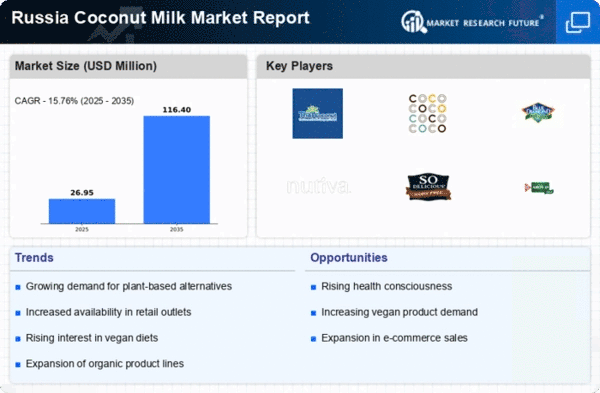
As per Market Research Future analysis, the Russia Coconut Milk Market size was estimated at 23.28 $ Million in 2024. The Coconut Milk market is projected to grow from 26.95 $ Million in 2025 to 116.4 $ Million by 2035, exhibiting a compound annual growth rate (CAGR) of 15.7% during the forecast period 2025 - 2035

Key Market Trends & Highlights

The Russia coconut milk market is experiencing a notable shift towards plant-based alternatives driven by health and sustainability trends.

  • The demand for dairy alternatives, particularly coconut milk, is on the rise as consumers seek healthier options.
  • Innovative product offerings are emerging, catering to diverse culinary applications and preferences.
  • Sustainability and ethical consumption are becoming increasingly important to consumers, influencing purchasing decisions.
  • Health consciousness and the culinary versatility of coconut milk are key drivers propelling market growth.

Market Size & Forecast

2024 Market Size 23.28 (USD Million)
2035 Market Size 116.4 (USD Million)
CAGR (2025 - 2035) 15.76%

Major Players

Thai Coconut Public Company Limited (TH), Coconut Dream (US), Blue Diamond Growers (US), Nutiva (US), So Delicious Dairy Free (US), Aroy-D (TH), Coco Lopez (PR), Nature's Charm (TH)

Our Impact
Enabled $4.3B Revenue Impact for Fortune 500 and Leading Multinationals
Partnering with 2000+ Global Organizations Each Year
30K+ Citations by Top-Tier Firms in the Industry

Russia Coconut Milk Market Trends

The Russia Coconut Milk Market is experiencing notable growth, driven by increasing consumer awareness regarding health benefits and a shift towards plant-based diets. This trend appears to be influenced by a rising demand for dairy alternatives, as more individuals seek lactose-free options. The versatility of coconut milk in culinary applications, ranging from beverages to cooking ingredients, further enhances its appeal. Additionally, the market is witnessing a surge in innovative product offerings, including flavored and fortified varieties, which cater to diverse consumer preferences. Moreover, the coconut milk market is likely benefiting from the growing trend of sustainability and ethical consumption. Consumers are becoming more conscious of their purchasing decisions, favoring products that align with their values. This shift may lead to an increase in demand for organic and responsibly sourced coconut milk. As the market evolves, it seems poised for continued expansion, with potential for new entrants and product innovations that could reshape the landscape.

Rising Demand for Dairy Alternatives

The Russia coconut milk market trends show a strong shift toward plant-based and health-oriented dairy alternatives, with coconut milk gaining traction as consumers seek lactose-free, nutritious options and innovative flavored or fortified variants. Coconut milk import & demand Russia has been influenced by both rising local consumption and evolving plant-based tastes, supported by increased retail availability and a broader trend toward healthier beverages and dairy substitutes, while domestic production gradually replaces some imports. In the plant-based milk market Russia, products like oat, soy, almond, and coconut milks are seeing growing popularity among urban, health-conscious buyers, contributing to overall dairy alternative adoption and category growth. Coconut milk growth forecast Russia points to rapid expansion, with the coconut milk segment expected to register significant CAGR through the late 2020s as wellness and sustainability trends persist. More broadly, the Russia dairy alternative market is expanding solidly, with plant-based dairy substitutes gaining shelf space and consumer interest against traditional dairy, driven by lifestyle changes, lactose intolerance considerations, and wider availability across retail and online channels. 

The coconut milk market is witnessing a significant increase in demand as consumers increasingly seek alternatives to traditional dairy products. This trend is likely driven by health-conscious individuals who are looking for lactose-free options. The versatility of coconut milk in various culinary applications, such as smoothies, soups, and desserts, further supports its growing popularity.

Innovative Product Offerings

Innovation plays a crucial role in the coconut milk market, with manufacturers introducing a variety of new products to attract consumers. Flavored coconut milk, fortified versions with added nutrients, and ready-to-drink options are becoming more prevalent. These innovations cater to diverse consumer preferences and dietary needs, potentially expanding the market reach.

Sustainability and Ethical Consumption

There is a noticeable trend towards sustainability within the coconut milk market, as consumers increasingly prioritize products that are ethically sourced and environmentally friendly. This shift may lead to a rise in demand for organic coconut milk and brands that emphasize sustainable practices. As awareness of environmental issues grows, this trend could significantly influence purchasing decisions.


Russia Coconut Milk Market Drivers

Culinary Versatility of Coconut Milk

Coconut milk's versatility in culinary applications is another compelling driver for the coconut milk market. It is increasingly utilized in various cuisines, from traditional Russian dishes to international recipes, enhancing flavors and providing a creamy texture. The rise of cooking shows and social media platforms has further popularized the use of coconut milk in home cooking. As consumers experiment with diverse recipes, the demand for coconut milk has seen a notable increase. The coconut milk market benefits from this trend, as it caters to both amateur cooks and professional chefs looking for innovative ingredients to elevate their dishes.

Health Consciousness Among Consumers

The increasing awareness of health and wellness among consumers in Russia appears to be a significant driver for the coconut milk market. As individuals seek healthier dietary options, the demand for plant-based alternatives to dairy products has surged. Coconut milk, known for its low calorie content and absence of lactose, aligns well with the preferences of health-conscious consumers. Reports indicate that the market for dairy alternatives in Russia has grown by approximately 20% in recent years, with coconut milk being a prominent choice. This trend suggests that the coconut milk market is likely to continue expanding as more consumers prioritize nutrition and health benefits in their food choices.

Growth of Vegan and Plant-Based Diets

The shift towards vegan and plant-based diets in Russia is a crucial factor influencing the coconut milk market. As more individuals adopt these lifestyles for ethical, environmental, or health reasons, the demand for plant-based milk alternatives has risen sharply. Coconut milk, being a staple in vegan cooking, is well-positioned to meet this growing demand. Market analysis indicates that the plant-based milk segment is projected to grow by 15% annually, with coconut milk capturing a significant share. This trend suggests that the coconut milk market will likely thrive as it aligns with the evolving dietary preferences of the population.

Increased Availability in Retail Channels

The expansion of retail channels offering coconut milk products is a notable driver for the coconut milk market. Supermarkets, health food stores, and online platforms are increasingly stocking a variety of coconut milk brands and products, making them more accessible to consumers. This increased availability is likely to boost sales and encourage trial among new customers. Data shows that the retail distribution of coconut milk has expanded by over 30% in the last few years, indicating a growing recognition of its popularity. The coconut milk market stands to benefit from this trend as it enhances consumer access and convenience.

Rising Interest in Ethnic and Exotic Foods

The growing interest in ethnic and exotic foods among Russian consumers is driving the coconut milk market. As culinary exploration becomes more prevalent, consumers are increasingly seeking out ingredients that offer unique flavors and textures. Coconut milk, often associated with tropical cuisines, is gaining traction as a key ingredient in various dishes. This trend is reflected in the rising number of restaurants and food products featuring coconut milk in their offerings. The coconut milk market is likely to capitalize on this interest, as it aligns with the broader trend of consumers seeking diverse and authentic culinary experiences.

Market Segment Insights

By Category: Organic (Largest) vs. Conventional (Fastest-Growing)

In the Russia coconut milk market, the segment distribution reveals that organic coconut milk holds the largest market share due to its increasing consumer preference for healthier and more sustainable products. Conversely, conventional coconut milk, while currently smaller in share, is rapidly gaining momentum as it appeals to cost-sensitive consumers seeking affordable options. This dynamic landscape showcases a diverse consumer demand, with organic products leading in value but conventional offerings filling a crucial niche. The growth trends in this segment are driven by rising awareness of the health benefits associated with coconut milk, combined with a broader shift towards organic and natural food products. As consumers become more health-conscious, they are opting for organic variants, which are perceived as beneficial and environmentally friendly. The increasing availability of coconut milk in retail outlets further fuels this surge, while conventional coconut milk finds traction due to its affordability, especially in economically challenging times.

Organic: Dominant vs. Conventional: Emerging

Organic coconut milk stands out as the dominant segment in the Russia coconut milk market, characterized by its premium pricing and strong consumer loyalty. This segment appeals to health-conscious consumers who prioritize organic certifications and sustainable sourcing. The rising trend of plant-based diets further bolsters its market position. On the other hand, conventional coconut milk is emerging rapidly due to its accessibility and cost-effectiveness, attracting a broader consumer base. This segment is favored by those who seek value for money without compromising on the coconut flavor. Both segments offer unique attributes, allowing for diverse product offerings that cater to varying consumer needs.

By Form: Liquid (Largest) vs. Powder (Fastest-Growing)

In the Russia coconut milk market, the distribution of market share between the liquid and powder segments showcases that liquid coconut milk holds a dominant position due to its widespread consumption and versatile applications in various culinary contexts. This segment appeals to a broader audience, making it the preferred choice among consumers and retailers alike. On the other hand, the powder segment is identified as the fastest-growing area in the market. This growth is driven by increasing consumer interest in convenient, shelf-stable products that require minimal preparation. Heightened awareness regarding dietary preferences and the convenience of using powder in recipes has further propelled its acceptance among health-conscious consumers.

Form: Liquid (Dominant) vs. Powder (Emerging)

The liquid segment in the Russia coconut milk market is characterized by its robust presence, appealing to consumers for its ease of use and versatility in diverse culinary applications. Liquid coconut milk is commonly used in various dishes ranging from desserts to savory meals, thereby solidifying its dominant position. Conversely, the powder segment is emerging rapidly, driven by lifestyle changes that favor convenience. Coconut milk powder offers longer shelf life and portability, making it a popular choice among consumers seeking quick meal solutions. As awareness about health benefits grows, both segments are poised to evolve further, catering to changing consumer demands.

By Packaging Type: Bottles (Largest) vs. Cans (Fastest-Growing)

In the Russia coconut milk market, the distribution among packaging types shows that bottles hold the largest market share, primarily due to their convenience and consumer preference for this format. Cans follow closely, gaining traction among budget-conscious consumers looking for longer shelf life, while pouches and other formats occupy a smaller share of the market. This variety in packaging types caters to different consumer needs and preferences, ensuring a comprehensive range of options. Growth trends in the packaging segment are being shaped by increasing consumer demand for convenience and sustainability. Bottles remain dominant, but pouches are emerging as popular alternatives, particularly among health-conscious consumers seeking lightweight and portable options. Cans are witnessing significant growth, driven by their affordability and durability. As manufacturers innovate, the packaging sector is expected to diversify further, aligning with evolving consumer preferences.

Bottles (Dominant) vs. Pouches (Emerging)

Bottles are the dominant packaging type in the Russia coconut milk market, providing consumers with a familiar and practical choice that appeals to the broader market segment. Their robust design not only emphasizes convenience but also aids in preservation, making them a preferred option for both retail and home use. Conversely, pouches are emerging as a trendy alternative, especially among health-focused consumers who favor their lightweight and resealable features, enhancing portability and ease of use. The increasing focus on eco-friendly packaging is further propelling pouch adoption, as they often use less material and are perceived as more sustainable. This dynamic between bottles and pouches reflects changing consumer attitudes and a drive towards innovative solutions in food packaging.

By Distribution Channel: Store-based (Largest) vs. Non-store-based (Fastest-Growing)

In the Russia coconut milk market, the distribution share is predominantly held by store-based channels, which account for a significant portion of the market. Supermarkets and hypermarkets are key players that contribute to the strong performance of this channel, as they offer customers a convenient shopping experience and access to various brands. Non-store-based channels, while smaller in share, are gaining traction, particularly with the rise of e-commerce platforms that cater to the growing preference for online shopping. The growth trends in this segment are driven by evolving consumer preferences and the increasing popularity of healthy beverage options. The convenience offered by non-store-based channels, especially during the recent pandemic, has accelerated their adoption among consumers. This shift reflects a broader trend towards digitalization in retailing, where traditional store-based channels must adapt to maintain their market presence. As more retailers integrate online services, the competition between these channels is expected to intensify, influencing pricing and product offerings.

Store-based (Dominant) vs. Non-store-based (Emerging)

Store-based distribution channels in the Russia coconut milk market remain dominant due to their established presence and consumer trust. Retailers like major grocery chains provide customers with a wide selection of products, making it convenient for them to purchase coconut milk alongside other grocery items. This channel benefits from in-store promotions and the ability to offer customers immediate access to products. Conversely, non-store-based channels are emerging rapidly, primarily due to the increase in online shopping habits influenced by the pandemic. These channels, including e-commerce platforms, provide flexibility and access to a broader range of products that might not be available in physical stores. The growing reliance on technology and home delivery services is shifting consumer behavior, positioning non-store-based channels as a key area of growth within the market.

Get more detailed insights about Russia Coconut Milk Market

Key Players and Competitive Insights

The coconut milk market in Russia exhibits a dynamic competitive landscape, characterized by a blend of local and international players vying for market share. Key growth drivers include the rising consumer preference for plant-based alternatives, health consciousness, and the increasing popularity of vegan diets. Major companies such as Thai Coconut Public Company Limited (TH), Aroy-D (TH), and Nutiva (US) are strategically positioned to leverage these trends. Thai Coconut Public Company Limited (TH) focuses on innovation in product development, introducing new flavors and organic options to cater to health-conscious consumers. Aroy-D (TH) emphasizes regional expansion, enhancing its distribution networks to penetrate deeper into the Russian market. Nutiva (US) adopts a digital transformation strategy, utilizing e-commerce platforms to reach a broader audience, thereby shaping a competitive environment that is increasingly reliant on innovation and consumer engagement.Key business tactics within the coconut milk market include localizing manufacturing and optimizing supply chains to enhance efficiency and reduce costs. The market structure appears moderately fragmented, with several key players holding substantial market shares while smaller brands also contribute to the diversity of offerings. The collective influence of these major companies fosters a competitive atmosphere where innovation and consumer preferences dictate market dynamics.
In October Thai Coconut Public Company Limited (TH) announced a partnership with a local distributor to enhance its market presence in Russia. This strategic move is likely to facilitate better access to retail channels, thereby increasing product availability and brand visibility among Russian consumers. Such partnerships may prove crucial in navigating the complexities of local market dynamics and consumer preferences.
In September Aroy-D (TH) launched a new line of organic coconut milk products specifically tailored for the Russian market. This initiative reflects a growing trend towards organic and health-oriented products, suggesting that Aroy-D (TH) is keen on aligning its offerings with consumer demands for healthier alternatives. The introduction of organic products could potentially enhance brand loyalty and attract a niche segment of health-conscious consumers.
In August Nutiva (US) expanded its e-commerce capabilities by launching a dedicated online platform for the Russian market. This strategic action indicates a shift towards digitalization, allowing Nutiva (US) to engage directly with consumers and streamline its distribution process. The emphasis on e-commerce may enhance customer experience and drive sales growth, particularly among younger, tech-savvy consumers.
As of November current competitive trends in the coconut milk market are increasingly defined by digitalization, sustainability, and the integration of advanced technologies. Strategic alliances among key players are shaping the landscape, fostering innovation and enhancing supply chain reliability. The competitive differentiation appears to be shifting from price-based competition to a focus on innovation, technology, and sustainability. Companies that can effectively leverage these trends are likely to secure a competitive edge in the evolving market.

Key Companies in the Russia Coconut Milk Market include

Industry Developments

The Russia Coconut Milk Market has experienced significant developments in recent months, with a notable shift towards health-conscious products and plant-based alternatives, spurred by changing consumer preferences. Companies like Thai Agri Foods Public Company Limited and Daiya Foods Inc have begun to invest more heavily in eco-friendly packaging and organic sources, aligning with environmental sustainability trends reported by the Russian government. In September 2023, Tropicana Food announced new partnerships to improve product distribution within Russia, enhancing market accessibility. Furthermore, there have been no recent mergers or acquisitions reported within the focused companies such as Chaokoh and Coconut Merchant.

In the last two years, the market valuation has exhibited steady growth, driven by increased demand for dairy alternatives, with sales rising by approximately 20% between late 2021 to early 2023. Consumers are increasingly turning to brands like Vitasoy International Holdings Limited and Koko Dairy Free for their coconut milk options, further solidifying the market's trajectory. As the Russian economy continues to navigate complexities, the coconut milk segment appears resilient and dynamic, responding swiftly to both local and international market conditions.


Future Outlook

Russia Coconut Milk Market Future Outlook

The Coconut Milk Market is projected to grow at a 15.76% CAGR from 2025 to 2035, driven by rising health consciousness and demand for plant-based alternatives.

New opportunities lie in:

  • Expansion of coconut milk product lines in retail chains Development of premium organic coconut milk variants Investment in sustainable sourcing and eco-friendly packaging solutions

By 2035, the coconut milk market is expected to achieve substantial growth and increased market penetration.

Market Segmentation

Russia Coconut Milk Market Form Outlook

  • Powder
  • Liquid

Russia Coconut Milk Market Category Outlook

  • Conventional
  • Organic

Russia Coconut Milk Market Packaging Type Outlook

  • Bottles
  • Cans
  • Pouches
  • Others

Russia Coconut Milk Market Distribution Channel Outlook

  • Store-based
  • Non-store-based

Report Scope

MARKET SIZE 2024 23.28(USD Million)
MARKET SIZE 2025 26.95(USD Million)
MARKET SIZE 2035 116.4(USD Million)
COMPOUND ANNUAL GROWTH RATE (CAGR) 15.76% (2025 - 2035)
REPORT COVERAGE Revenue Forecast, Competitive Landscape, Growth Factors, and Trends
BASE YEAR 2024
Market Forecast Period 2025 - 2035
Historical Data 2019 - 2024
Market Forecast Units USD Million
Key Companies Profiled Thai Coconut Public Company Limited (TH), Coconut Dream (US), Blue Diamond Growers (US), Nutiva (US), So Delicious Dairy Free (US), Aroy-D (TH), Coco Lopez (PR), Nature's Charm (TH)
Segments Covered Category, Form, Packaging Type, Distribution Channel
Key Market Opportunities Growing demand for plant-based alternatives drives innovation in the coconut milk market.
Key Market Dynamics Rising consumer demand for plant-based alternatives drives growth in the coconut milk market amid evolving regulatory frameworks.
Countries Covered Russia
Leave a Comment

FAQs

How are regional dynamics influencing the coconut milk market?

Regional dynamics are significantly impacting market developments, with increasing consumer adoption in urban areas.

Download Free Sample

Kindly complete the form below to receive a free sample of this Report

Compare Licence

×
Features License Type
Single User Multiuser License Enterprise User
Price $4,950 $5,950 $7,250
Maximum User Access Limit 1 User Upto 10 Users Unrestricted Access Throughout the Organization
Free Customization
Direct Access to Analyst
Deliverable Format
Platform Access
Discount on Next Purchase 10% 15% 15%
Printable Versions