×
Request Free Sample ×

Kindly complete the form below to receive a free sample of this Report

* Please use a valid business email

Leading companies partner with us for data-driven Insights

clients tt-cursor
Hero Background

Retinal Surgery Device Market

ID: MRFR/HC/41847-HCR
111 Pages
Rahul Gotadki
February 2026

Retinal Surgery Device Market Research Report: Size, Share, Trend Analysis By Device Type (Vitrectomy Devices, Retinal Lasers, Pneumatic Retinopexy Devices, Scleral Buckling Devices), By Procedure Type (Vitrectomy, Laser Photocoagulation, Retinal Detachment Surgery, Macular Hole Surgery), By End Users (Hospitals, Ambulatory Surgical Centers, Ophthalmology Clinics), By Technology (Digital Imaging Technology, Robotic-Assisted Technology, Laser Technology) and By Regional (North America, Europe, South America, Asia-Pacific, Middle East and Africa) - Growth Outlook & Industry Forecast 2025 To 2035

Share:
Download PDF ×

We do not share your information with anyone. However, we may send you emails based on your report interest from time to time. You may contact us at any time to opt-out.

Retinal Surgery Device Market Infographic
Purchase Options

Retinal Surgery Device Market Summary

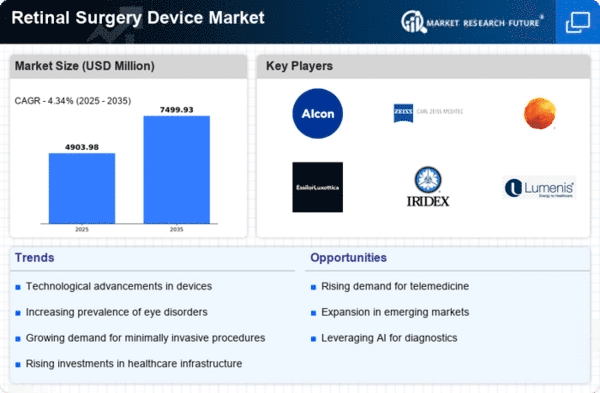
As per MRFR analysis, the Retinal Surgery Device Market was estimated at 4700.0 USD Million in 2024. The retinal surgery device industry is projected to grow from 4903.98 USD Million in 2025 to 7499.93 USD Million by 2035, exhibiting a compound annual growth rate (CAGR) of 4.34 during the forecast period 2025 - 2035.

Key Market Trends & Highlights

The Retinal Surgery Device Market is poised for substantial growth driven by technological advancements and increasing healthcare demands.

  • Technological advancements in surgical devices are enhancing the precision and efficacy of retinal surgeries.
  • North America remains the largest market, while the Asia-Pacific region is emerging as the fastest-growing market for retinal surgery devices.
  • The vitrectomy segment holds the largest market share, whereas diabetic retinopathy surgery is experiencing the fastest growth.
  • Key market drivers include the increasing prevalence of eye disorders and rising healthcare expenditure, which are propelling market expansion.

Market Size & Forecast

2024 Market Size 4700.0 (USD Million)
2035 Market Size 7499.93 (USD Million)
CAGR (2025 - 2035) 4.34%

Major Players

Alcon (CH), Bausch + Lomb (US), Carl Zeiss Meditec (DE), CooperVision (US), EssilorLuxottica (FR), IRIDEX Corporation (US), Lumenis (IL), Nidek (JP), Optos (GB), Topcon Corporation (JP)

Our Impact
Enabled $4.3B Revenue Impact for Fortune 500 and Leading Multinationals
Partnering with 2000+ Global Organizations Each Year
30K+ Citations by Top-Tier Firms in the Industry

Retinal Surgery Device Market Trends

The Retinal Surgery Device Market is currently experiencing a transformative phase, characterized by rapid advancements in technology and an increasing prevalence of retinal disorders. Innovations in surgical instruments, imaging systems, and minimally invasive techniques are reshaping the landscape of retinal surgery. As healthcare providers strive to enhance patient outcomes, the integration of artificial intelligence and robotics into surgical procedures appears to be gaining traction. This trend suggests a shift towards more precise and efficient surgical interventions, potentially reducing recovery times and improving overall patient satisfaction. Furthermore, the growing geriatric population, coupled with rising awareness regarding eye health, is likely to drive demand for advanced retinal surgical solutions. In addition to technological advancements, the Retinal Surgery Device Market is witnessing a surge in collaborative efforts among key stakeholders. Partnerships between device manufacturers, healthcare institutions, and research organizations seem to be fostering innovation and accelerating the development of new products. This collaborative approach may enhance the availability of cutting-edge devices, ultimately benefiting patients and healthcare providers alike. Moreover, regulatory bodies are increasingly focusing on streamlining approval processes for novel retinal devices, which could further stimulate market growth. Overall, the Retinal Surgery Device Market appears poised for substantial expansion in the coming years, driven by innovation, collaboration, and a heightened focus on patient-centric care.

Technological Advancements

The Retinal Surgery Device Market is witnessing a wave of technological innovations, particularly in the development of advanced surgical instruments and imaging systems. These innovations are enhancing the precision and effectiveness of retinal surgeries, leading to improved patient outcomes. The integration of artificial intelligence and robotics into surgical procedures is becoming more prevalent, suggesting a future where surgeries are not only more efficient but also safer for patients.

Collaborative Efforts

There is a noticeable increase in collaboration among various stakeholders within the Retinal Surgery Device Market. Partnerships between device manufacturers, healthcare providers, and research institutions are fostering innovation and expediting the development of new surgical solutions. This collaborative environment may lead to the introduction of more effective devices, ultimately benefiting both patients and healthcare professionals.

Regulatory Developments

Regulatory bodies are actively working to streamline the approval processes for new retinal surgical devices. This focus on efficiency could facilitate quicker access to innovative products in the market. As regulations evolve, they may encourage manufacturers to invest in research and development, further propelling the growth of the Retinal Surgery Device Market.

Retinal Surgery Device Market Drivers

Market Growth Projections

The Global Retinal Surgery Device Market Industry is poised for substantial growth, with projections indicating a market value of 4.7 USD Billion in 2024 and an anticipated increase to 7.5 USD Billion by 2035. This growth trajectory reflects a compound annual growth rate of 4.34% from 2025 to 2035, driven by various factors including technological advancements, increasing prevalence of eye disorders, and rising healthcare expenditures. The market dynamics suggest a robust future for retinal surgery devices, as stakeholders adapt to evolving healthcare needs and patient demands.

Rising Healthcare Expenditure

The Global Retinal Surgery Device Market Industry is benefiting from increasing healthcare expenditure across various regions. Governments and private sectors are investing more in healthcare infrastructure, which includes the procurement of advanced surgical devices. This trend is particularly evident in developing nations, where improving healthcare access is a priority. Enhanced funding allows for the acquisition of cutting-edge retinal surgery devices, thus facilitating better treatment options for patients. As healthcare spending continues to rise, the market is likely to see sustained growth, aligning with the projected increase in market value.

Increasing Prevalence of Eye Disorders

The Global Retinal Surgery Device Market Industry is experiencing growth due to the rising incidence of eye disorders such as diabetic retinopathy and age-related macular degeneration. As populations age and lifestyle factors contribute to these conditions, the demand for surgical interventions increases. For instance, the World Health Organization indicates that the prevalence of diabetic retinopathy is expected to rise significantly, necessitating advanced surgical devices. This trend is reflected in the market's projected value of 4.7 USD Billion in 2024, with expectations to reach 7.5 USD Billion by 2035, indicating a robust growth trajectory.

Aging Population and Demographic Shifts

The demographic shift towards an aging population is a significant factor influencing the Global Retinal Surgery Device Market Industry. As individuals age, they become more susceptible to various eye disorders, thereby increasing the demand for surgical interventions. The United Nations projects that the global population aged 60 years and older will double by 2050, further amplifying the need for effective retinal surgeries. This demographic trend is expected to drive market growth, as healthcare systems adapt to accommodate the rising number of patients requiring retinal surgery.

Growing Awareness and Screening Programs

Awareness campaigns and screening programs for eye health are crucial drivers of the Global Retinal Surgery Device Market Industry. Initiatives aimed at educating the public about the importance of early detection of retinal diseases are leading to increased patient referrals for surgical interventions. Organizations are implementing community outreach programs that promote regular eye examinations, thereby identifying conditions that require surgical treatment. This proactive approach not only enhances patient outcomes but also stimulates demand for retinal surgery devices, contributing to the overall market growth.

Technological Advancements in Surgical Devices

Innovations in retinal surgery devices are propelling the Global Retinal Surgery Device Market Industry forward. Enhanced imaging technologies, such as optical coherence tomography, and minimally invasive surgical techniques are improving patient outcomes and operational efficiency. These advancements not only facilitate more precise surgeries but also reduce recovery times. As a result, healthcare providers are increasingly adopting these state-of-the-art devices, contributing to market growth. The anticipated compound annual growth rate of 4.34% from 2025 to 2035 underscores the potential for continued innovation and market expansion.


Market Segment Insights

By Application: Vitrectomy (Largest) vs. Diabetic Retinopathy Surgery (Fastest-Growing)

In the Retinal Surgery Device Market, Vitrectomy serves as the largest application segment, capturing a significant portion of the overall demand. This procedure is widely adopted for various retinal disorders, contributing to its prominence. On the other hand, Diabetic Retinopathy Surgery is witnessing rapid growth, driven by the increasing prevalence of diabetes and its associated eye conditions, leading to a heightened demand for effective surgical interventions. The growth trends within this segment illustrate a shift in focus towards advanced surgical techniques and improving patient outcomes. Factors such as technological advancements in device design, the rising incidence of diabetic eye diseases, and the growing awareness of retinal health among patients play pivotal roles in the expansion of these applications. The market is responding to the demand for innovative solutions, ensuring that both Vitrectomy and Diabetic Retinopathy Surgery stay relevant and increasingly effective.

Vitrectomy (Dominant) vs. Diabetic Retinopathy Surgery (Emerging)

Vitrectomy is the dominant procedure within the application segment, primarily due to its effective approach to addressing numerous retinal conditions, such as retinal detachment and macular holes. It entails the removal of the vitreous gel from the eye, allowing for direct access to the retina and facilitating more precise surgical intervention. Its established methodology and successful outcomes have cemented its position in the market. In contrast, Diabetic Retinopathy Surgery is emerging rapidly as a critical component in managing the complications arising from diabetes. This surgery focuses on preventing vision loss among diabetic patients, an important indication given the increasing diabetes prevalence globally. As healthcare providers seek to enhance the quality of care for diabetic patients, innovations in Diabetic Retinopathy devices are becoming crucial, strengthening its growth trajectory within the market.

By Device Type: Surgical Lasers (Largest) vs. Vitrectomy Machines (Fastest-Growing)

In the Retinal Surgery Device Market, Surgical Lasers currently dominate the segment, representing the largest share due to their established usage in various retinal procedures. Their ability to perform precision tasks with minimal invasiveness positions them as the preferred choice among surgeons. In contrast, Vitrectomy Machines are seeing a rapid increase in adoption rates, thanks to their technological advancements and improved patient outcomes. This rise is making them a vital competitor in the market, particularly as more complex retinal surgeries are conducted.

Surgical Lasers (Dominant) vs. Vitrectomy Machines (Emerging)

Surgical lasers have become a staple in retinal surgeries due to their non-invasive nature and speed, allowing for quicker recovery times and higher success rates. These devices harness light energy to perform delicate procedures, thus reducing collateral damage to surrounding tissues, which is crucial for maintaining patient eyesight. In contrast, Vitrectomy Machines, though newer to the market, are emerging rapidly, driven by innovations such as enhanced visualization and automated techniques. Their ability to handle complex vitreoretinal surgeries positions them as an exciting option for ophthalmic surgeons, attracting increasing investment and interest in clinical applications.

By End User: Hospitals (Largest) vs. Ambulatory Surgical Centers (Fastest-Growing)

The retinal surgery device market exhibits a varied distribution among its end-user segments, with hospitals holding the largest share. Hospitals account for a significant proportion of the market due to their extensive infrastructure, advanced technology, and ability to manage complex retinal surgeries. This segment benefits from the availability of comprehensive care services and is preferred for more intricate surgical procedures requiring specialized equipment. On the other hand, ambulatory surgical centers (ASCs) are recognized as the fastest-growing segment within this market. The increase in minimally invasive surgical procedures and a shift towards outpatient care have bolstered the ASC's prominence. This growth is driven by patient demand for convenience, shorter recovery times, and cost-effectiveness, making ASCs a more attractive option for both patients and healthcare providers.

Hospitals (Dominant) vs. Ambulatory Surgical Centers (Emerging)

Hospitals remain the dominant players in the retinal surgery device market due to their established infrastructure and technological advancement. They provide a wide range of surgical services, including advanced retinal surgeries that require complex equipment and skilled personnel. In contrast, ambulatory surgical centers are emerging rapidly, capitalizing on the growing trend of outpatient surgeries. ASCs focus on efficiency and patient experience, offering a streamlined approach with less overhead costs. They provide an array of retinal surgeries in a patient-friendly environment, increasing their appeal. The competitive dynamics between hospitals and ASCs highlight a shift in patient preferences towards faster, more convenient surgical options.

Get more detailed insights about Retinal Surgery Device Market

Regional Insights

North America : Market Leader in Innovation

North America is poised to maintain its leadership in the retinal surgery device market, holding a significant share of 2350.0M in 2024. The region's growth is driven by advanced healthcare infrastructure, increasing prevalence of retinal diseases, and a strong focus on research and development. Regulatory support from agencies like the FDA further catalyzes innovation, ensuring rapid market entry for new technologies and devices. The competitive landscape in North America is robust, featuring key players such as Alcon, Bausch + Lomb, and IRIDEX Corporation. The U.S. stands out as the largest market, supported by high healthcare expenditure and a growing aging population. The presence of leading companies fosters a dynamic environment for technological advancements, ensuring that North America remains at the forefront of retinal surgery innovations.

Europe : Emerging Market with Growth Potential

Europe's retinal surgery device market is valued at 1300.0M, reflecting a growing demand for innovative solutions. Factors such as an aging population, rising awareness of eye health, and supportive regulatory frameworks contribute to this growth. The European Medicines Agency (EMA) plays a crucial role in facilitating the approval of new devices, enhancing market dynamics and ensuring patient safety. Leading countries in this region include Germany, France, and the UK, where significant investments in healthcare technology are evident. Major players like Carl Zeiss Meditec and EssilorLuxottica are actively expanding their portfolios to meet the increasing demand. The competitive landscape is characterized by collaborations and partnerships aimed at enhancing product offerings and market reach, positioning Europe as a key player in The Retinal Surgery Device.

Asia-Pacific : Rapidly Growing Market Segment

The Asia-Pacific region is witnessing rapid growth in the retinal surgery device market, currently valued at 800.0M. This growth is fueled by increasing healthcare investments, rising awareness of eye diseases, and a growing population. Governments are implementing policies to improve healthcare access, which is expected to further drive demand for retinal surgery devices across the region. Countries like Japan, China, and India are leading the charge, with significant contributions from local manufacturers and international players. Companies such as Nidek and Topcon Corporation are expanding their presence, enhancing competition. The region's diverse market landscape presents opportunities for innovation and collaboration, making Asia-Pacific a vital area for future growth in retinal surgery devices.

Middle East and Africa : Emerging Market with Challenges

The Middle East and Africa (MEA) region, with a market size of 250.0M, is gradually emerging in the retinal surgery device sector. Growth is driven by increasing healthcare investments and a rising prevalence of eye diseases. However, regulatory challenges and varying healthcare standards across countries pose significant hurdles. Governments are working to improve healthcare infrastructure, which is expected to enhance market conditions in the coming years. Leading countries in this region include South Africa and the UAE, where healthcare reforms are paving the way for advanced medical technologies. The presence of key players is limited, but companies are beginning to explore opportunities in this untapped market. As the region continues to develop, it presents a unique landscape for growth in retinal surgery devices.

Key Players and Competitive Insights

The Retinal Surgery Device Market is characterized by a dynamic competitive landscape, driven by technological advancements and an increasing prevalence of retinal diseases. Key players such as Alcon (CH), Bausch + Lomb (US), and Carl Zeiss Meditec (DE) are at the forefront, each adopting distinct strategies to enhance their market positioning. Alcon (CH) focuses on innovation, particularly in developing advanced surgical instruments and devices that improve patient outcomes. Bausch + Lomb (US) emphasizes strategic partnerships to expand its product offerings and market reach, while Carl Zeiss Meditec (DE) invests heavily in digital transformation to streamline operations and enhance customer engagement. Collectively, these strategies contribute to a competitive environment that is increasingly centered around technological innovation and patient-centric solutions.In terms of business tactics, companies are localizing manufacturing to reduce costs and improve supply chain efficiency. This approach is particularly relevant in a moderately fragmented market where several players vie for market share. The collective influence of these key players shapes a competitive structure that encourages innovation while also fostering collaboration through strategic alliances and partnerships.

In November Alcon (CH) announced the launch of a new retinal surgery device that integrates artificial intelligence (AI) to assist surgeons in real-time during procedures. This strategic move not only positions Alcon as a leader in technological innovation but also addresses the growing demand for precision in surgical interventions. The integration of AI is likely to enhance surgical outcomes and reduce recovery times, thereby attracting more healthcare providers to adopt their technology.

In October Bausch + Lomb (US) entered into a partnership with a leading telemedicine platform to enhance remote patient monitoring capabilities for retinal disease management. This collaboration is significant as it reflects a shift towards digital health solutions, allowing for better patient engagement and timely interventions. By leveraging telemedicine, Bausch + Lomb aims to improve patient outcomes while expanding its market presence in the digital health space.

In September Carl Zeiss Meditec (DE) acquired a small but innovative startup specializing in retinal imaging technology. This acquisition is indicative of Carl Zeiss Meditec's commitment to enhancing its product portfolio and staying ahead of competitors. By integrating cutting-edge imaging solutions, the company is likely to strengthen its position in the market and offer more comprehensive solutions to healthcare providers.

As of December current competitive trends in the Retinal Surgery Device Market are increasingly defined by digitalization, sustainability, and AI integration. Strategic alliances are becoming more prevalent, allowing companies to pool resources and expertise to drive innovation. The competitive differentiation is expected to evolve from traditional price-based competition to a focus on technological advancements, reliability in supply chains, and enhanced patient outcomes. This shift underscores the importance of innovation and strategic partnerships in navigating the complexities of the market.

Key Companies in the Retinal Surgery Device Market include

Industry Developments

  • Q2 2024: Alcon Launches New NGENUITY 3D Visualization System for Retinal Surgery Alcon announced the commercial launch of its next-generation NGENUITY 3D Visualization System, designed to enhance visualization and workflow in retinal surgery procedures.
  • Q1 2024: BVI Acquires Medical Device Innovator Benz Research & Development BVI, a global ophthalmic device company, completed the acquisition of Benz Research & Development, expanding its portfolio in the retinal surgery device sector.
  • Q2 2024: IRIDEX Receives FDA 510(k) Clearance for New Cyclo G6 Glaucoma Laser Platform IRIDEX Corporation announced it received FDA 510(k) clearance for its new Cyclo G6 platform, which includes features for retinal and glaucoma procedures.
  • Q1 2024: DORC Announces Partnership with ZEISS to Integrate Surgical Visualization for Retinal Procedures Dutch Ophthalmic Research Center (DORC) and ZEISS announced a strategic partnership to integrate DORC’s EVA surgical system with ZEISS visualization technology for advanced retinal surgery.
  • Q2 2024: Ocutrx Technologies Raises $14 Million in Series B Funding to Advance Retinal Surgery Platform Ocutrx Technologies secured $14 million in Series B funding to accelerate development and commercialization of its OcuLenz AR surgical visualization system for retinal procedures.
  • Q1 2024: Topcon Medical Systems Opens New Manufacturing Facility for Retinal Imaging and Surgery Devices Topcon Medical Systems inaugurated a new manufacturing facility in the U.S. dedicated to the production of advanced retinal imaging and surgery devices.
  • Q2 2024: Carl Zeiss Meditec Receives CE Mark for QUATERA 700 Surgical Platform with Retinal Module Carl Zeiss Meditec announced it received CE Mark approval for its QUATERA 700 surgical platform, which now includes a dedicated module for retinal surgery.
  • Q1 2024: Johnson & Johnson Vision Appoints New Head of Surgical Vision Business Johnson & Johnson Vision announced the appointment of a new global head for its Surgical Vision business, overseeing the company’s retinal surgery device portfolio.
  • Q2 2024: Nidek Launches New Constellation Vitrectomy System for Retinal Surgery Nidek announced the launch of its Constellation Vitrectomy System, designed to improve efficiency and outcomes in retinal surgery.
  • Q1 2024: Bausch + Lomb Receives FDA Approval for New Retinal Laser Device Bausch + Lomb received FDA approval for its latest retinal laser device, expanding its portfolio of surgical solutions for retinal disorders.
  • Q2 2024: Synergetics USA Announces Strategic Distribution Agreement for Retinal Surgery Instruments in Europe Synergetics USA entered into a strategic distribution agreement to expand the availability of its retinal surgery instruments across European markets.
  • Q1 2024: Retina Implant AG Secures $10 Million in Funding to Advance Subretinal Implant Technology Retina Implant AG raised $10 million in new funding to support clinical development and commercialization of its subretinal implant for vision restoration.

Future Outlook

Retinal Surgery Device Market Future Outlook

The Retinal Surgery Device Market is projected to grow at a 4.34% CAGR from 2025 to 2035, driven by technological advancements, increasing prevalence of retinal disorders, and rising healthcare expenditure.

New opportunities lie in:

  • Development of AI-driven surgical planning software
  • Expansion of telemedicine platforms for remote consultations
  • Introduction of portable retinal imaging devices for outpatient settings

By 2035, the market is expected to achieve substantial growth, reflecting advancements and increased demand.

Market Segmentation

Retinal Surgery Device Market End User Outlook

  • Hospitals
  • Ambulatory Surgical Centers
  • Ophthalmology Clinics

Retinal Surgery Device Market Application Outlook

  • Retinal Detachment Surgery
  • Vitrectomy
  • Macular Hole Surgery
  • Diabetic Retinopathy Surgery

Retinal Surgery Device Market Device Type Outlook

  • Surgical Lasers
  • Vitrectomy Machines
  • Endolaser Devices
  • Pneumatic Retinopexy Devices

Report Scope

MARKET SIZE 20244700.0(USD Million)
MARKET SIZE 20254903.98(USD Million)
MARKET SIZE 20357499.93(USD Million)
COMPOUND ANNUAL GROWTH RATE (CAGR)4.34% (2025 - 2035)
REPORT COVERAGERevenue Forecast, Competitive Landscape, Growth Factors, and Trends
BASE YEAR2024
Market Forecast Period2025 - 2035
Historical Data2019 - 2024
Market Forecast UnitsUSD Million
Key Companies ProfiledAlcon (CH), Bausch + Lomb (US), Carl Zeiss Meditec (DE), CooperVision (US), EssilorLuxottica (FR), IRIDEX Corporation (US), Lumenis (IL), Nidek (JP), Optos (GB), Topcon Corporation (JP)
Segments CoveredApplication, Device Type, End User
Key Market OpportunitiesAdvancements in minimally invasive techniques enhance growth potential in the Retinal Surgery Device Market.
Key Market DynamicsTechnological advancements and regulatory changes drive innovation and competition in the retinal surgery device market.
Countries CoveredNorth America, Europe, APAC, South America, MEA
Leave a Comment

FAQs

What is the expected market size of the Global Retinal Surgery Device Market in 2024?

The Global Retinal Surgery Device Market is expected to be valued at 4.7 billion USD in 2024.

What will be the estimated market value for the Global Retinal Surgery Device Market by 2035?

By 2035, the Global Retinal Surgery Device Market is projected to reach approximately 7.5 billion USD.

What is the expected CAGR for the Global Retinal Surgery Device Market from 2025 to 2035?

The market is anticipated to grow at a CAGR of 4.34% during the period from 2025 to 2035.

Which region is projected to hold the largest market share in 2024 for the Global Retinal Surgery Device Market?

North America is expected to dominate the market with a valuation of 2.0 billion USD in 2024.

What is the projected market size for Vitrectomy Devices in 2035?

The market size for Vitrectomy Devices is expected to reach 3.0 billion USD by 2035.

What will be the market size for Retinal Lasers in 2024?

Retinal Lasers are projected to have a market size of 1.2 billion USD in 2024.

Who are the major players in the Global Retinal Surgery Device Market?

Key players in the market include Lumenis, Abbott Laboratories, Alcon, and Bausch Health.

What is the estimated market value for Scleral Buckling Devices in 2035?

Scleral Buckling Devices are expected to be valued at 1.2 billion USD by 2035.

What is the market size of the APAC region for the Global Retinal Surgery Device Market in 2024?

The APAC region is expected to have a market size of 0.9 billion USD in 2024.

What factors are driving the growth of the Global Retinal Surgery Device Market?

Factors driving market growth include advancing technology and increasing prevalence of retinal disorders.

Download Free Sample

Kindly complete the form below to receive a free sample of this Report

Compare Licence

×
Features License Type
Single User Multiuser License Enterprise User
Price $4,950 $5,950 $7,250
Maximum User Access Limit 1 User Upto 10 Users Unrestricted Access Throughout the Organization
Free Customization
Direct Access to Analyst
Deliverable Format
Platform Access
Discount on Next Purchase 10% 15% 15%
Printable Versions