×
Request Free Sample ×

Kindly complete the form below to receive a free sample of this Report

* Please use a valid business email

Leading companies partner with us for data-driven Insights

clients tt-cursor
Hero Background

Recyclable Thermal Insulation Pack Market

ID: MRFR/PCM/63851-HCR
128 Pages
Snehal Singh
February 2026

Recyclable Thermal Insulation Pack Market Research Report By Application (Building Insulation, HVAC Systems, Industrial Insulation, Packaging Insulation), By Material Type (Polyethylene, Polyurethane, Cellulose, Mineral Wool), By End Use (Residential, Commercial, Industrial), By Thickness (Thin, Medium, Thick) and By Regional (North America, Europe, South America, Asia Pacific, Middle East and Africa) - Forecast to 2035

Share:
Download PDF ×

We do not share your information with anyone. However, we may send you emails based on your report interest from time to time. You may contact us at any time to opt-out.

Recyclable Thermal Insulation Pack Market  Infographic
Purchase Options

Recyclable Thermal Insulation Pack Market Summary

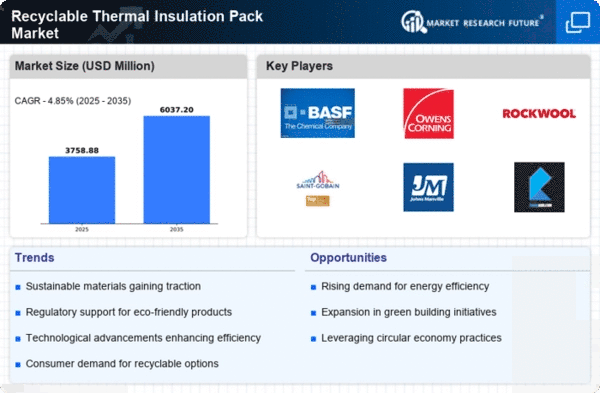
As per MRFR analysis, the Recyclable Thermal Insulation Pack Market Size was estimated at 3585.01 USD Million in 2024. The Recyclable Thermal Insulation Pack industry is projected to grow from 3758.96 USD Million in 2025 to 6037.2 USD Million by 2035, exhibiting a compound annual growth rate (CAGR) of 4.85 during the forecast period 2025 - 2035.

Key Market Trends & Highlights

The Recyclable Thermal Insulation Pack Market is poised for substantial growth driven by sustainability and energy efficiency demands.

  • The market is increasingly oriented towards sustainability, reflecting a broader global trend.
  • North America remains the largest market, while Asia-Pacific is recognized as the fastest-growing region.
  • In the building insulation segment, polyethylene dominates, whereas polyurethane is emerging rapidly in packaging insulation.
  • Key market drivers include rising energy costs and robust sustainability initiatives, which are shaping consumer preferences.

Market Size & Forecast

2024 Market Size 3585.01 (USD Million)
2035 Market Size 6037.2 (USD Million)
CAGR (2025 - 2035) 4.85%

Major Players

BASF SE (DE), Owens Corning (US), Rockwool International A/S (DK), Saint-Gobain (FR), Johns Manville (US), Knauf Insulation (DE), Armacell International S.A. (LU), Thermafiber, Inc. (US), Kingspan Group (IE)

Our Impact
Enabled $4.3B Revenue Impact for Fortune 500 and Leading Multinationals
Partnering with 2000+ Global Organizations Each Year
30K+ Citations by Top-Tier Firms in the Industry

Recyclable Thermal Insulation Pack Market Trends

The Recyclable Thermal Insulation Pack Market is currently experiencing a notable shift towards sustainability and eco-friendliness. As environmental concerns gain prominence, manufacturers are increasingly focusing on developing insulation materials that are not only effective but also recyclable. This trend aligns with global efforts to reduce waste and promote circular economy practices. The demand for such products is likely to rise as consumers and businesses alike seek solutions that minimize their ecological footprint. Furthermore, advancements in technology are facilitating the creation of innovative insulation solutions that meet stringent performance standards while being environmentally responsible. In addition to sustainability, the Recyclable Thermal Insulation Pack Market is witnessing a growing interest in energy efficiency. As energy costs continue to fluctuate, there is a heightened awareness of the importance of thermal insulation in reducing energy consumption. This awareness is driving both residential and commercial sectors to invest in high-performance insulation products. Moreover, regulatory frameworks are increasingly supporting the adoption of energy-efficient materials, further propelling market growth. Overall, the Recyclable Thermal Insulation Pack Market appears poised for expansion, driven by a combination of environmental consciousness and the pursuit of energy efficiency.

Sustainability Focus

The emphasis on sustainable practices is reshaping the Recyclable Thermal Insulation Pack Market. Manufacturers are prioritizing the development of materials that can be recycled, thus reducing waste and promoting environmental responsibility. This trend is likely to resonate with consumers who are increasingly aware of their ecological impact.

Energy Efficiency Demand

There is a rising demand for energy-efficient solutions within the Recyclable Thermal Insulation Pack Market. As energy prices fluctuate, both residential and commercial sectors are recognizing the value of effective thermal insulation in minimizing energy consumption. This trend is further supported by regulatory initiatives aimed at promoting energy efficiency.

Technological Advancements

Innovations in technology are playing a crucial role in the evolution of the Recyclable Thermal Insulation Pack Market. New manufacturing processes and materials are emerging, enabling the production of insulation products that meet high performance standards while remaining environmentally friendly. This advancement may enhance market competitiveness and appeal.

Recyclable Thermal Insulation Pack Market Drivers

Market Growth Projections

The Global Recyclable Thermal Insulation Pack Market Industry is projected to experience significant growth over the coming years. With a market value expected to reach 3.59 USD Billion in 2024 and further increase to 6.04 USD Billion by 2035, the industry is poised for a robust expansion. The anticipated CAGR of 4.85% from 2025 to 2035 indicates a strong upward trajectory, driven by various factors including sustainability trends, regulatory support, and technological advancements. This growth trajectory suggests a promising future for recyclable thermal insulation packs as they become integral components of sustainable building practices.

Growing Demand for Sustainable Solutions

The Global Recyclable Thermal Insulation Pack Market Industry is witnessing a notable increase in demand for sustainable insulation solutions. As environmental awareness rises, consumers and businesses alike are seeking eco-friendly alternatives to traditional insulation materials. This shift is driven by regulatory pressures and a growing preference for products that minimize environmental impact. The market is projected to reach 3.59 USD Billion in 2024, reflecting a significant trend towards sustainability. Companies that invest in recyclable thermal insulation packs are likely to gain competitive advantages, appealing to a broader customer base that prioritizes sustainability in their purchasing decisions.

Market Penetration in Emerging Economies

Emerging economies are increasingly recognizing the importance of sustainable construction practices, which is positively impacting the Global Recyclable Thermal Insulation Pack Market Industry. As urbanization accelerates in these regions, there is a rising demand for energy-efficient building materials. The adoption of recyclable thermal insulation packs is gaining traction as these countries strive to meet international sustainability standards. This trend is expected to drive market growth, as manufacturers look to penetrate these developing markets. The potential for expansion in emerging economies presents a lucrative opportunity for businesses focused on recyclable insulation solutions.

Rising Energy Costs and Efficiency Awareness

The increasing cost of energy is prompting consumers and businesses to seek more efficient insulation solutions, thereby driving the Global Recyclable Thermal Insulation Pack Market Industry. As energy prices continue to rise, the financial benefits of investing in high-quality insulation become more apparent. Recyclable thermal insulation packs not only provide effective thermal performance but also contribute to long-term energy savings. This growing awareness of energy efficiency is likely to propel market growth, as stakeholders recognize the value of sustainable insulation solutions in mitigating energy costs. Consequently, the market is poised for expansion as energy efficiency becomes a priority.

Regulatory Support for Green Building Initiatives

Government regulations promoting green building practices are significantly influencing the Global Recyclable Thermal Insulation Pack Market Industry. Various countries are implementing stringent building codes that encourage the use of recyclable materials in construction. This regulatory support not only fosters innovation but also creates a favorable environment for manufacturers of recyclable thermal insulation packs. As a result, the market is expected to grow at a CAGR of 4.85% from 2025 to 2035, reaching an estimated 6.04 USD Billion by 2035. This growth indicates a robust alignment between regulatory frameworks and market dynamics, driving the adoption of sustainable insulation solutions.

Technological Advancements in Insulation Materials

Technological innovations are playing a pivotal role in shaping the Global Recyclable Thermal Insulation Pack Market Industry. Advances in material science have led to the development of high-performance recyclable insulation products that offer superior thermal efficiency. These innovations not only enhance the effectiveness of insulation but also contribute to reduced energy consumption in buildings. As energy efficiency becomes a critical focus for both consumers and regulators, the demand for technologically advanced recyclable thermal insulation packs is likely to increase. This trend underscores the importance of continuous research and development in maintaining competitiveness within the market.


Market Segment Insights

By Application: Building Insulation (Largest) vs. Packaging Insulation (Fastest-Growing)

In the Recyclable Thermal Insulation Pack Market, the application segment is notably diverse, with Building Insulation holding the largest market share. This segment benefits significantly from the ongoing demand for sustainable construction practices and energy-efficient building solutions. In contrast, Packaging Insulation is emerging rapidly, driven by the increasing need for innovative packaging solutions in various industries such as food and electronics. As companies recognize the environmental impact of their packaging, the shift towards recyclable solutions accelerates this growth. Looking at growth trends, Building Insulation continues to thrive due to stringent regulatory requirements and growing consumer awareness around energy efficiency. Meanwhile, Industrial and HVAC Insulation also play crucial roles in maintaining energy standards in manufacturing and heating systems. Packaging Insulation is witnessing the swiftest growth, attributed to the rise in e-commerce and the critical need for protective and sustainable packaging solutions across sectors. This trend reflects a broader commitment to environmental responsibility and reduced carbon footprints in packaging practices.

Packaging Insulation (Dominant) vs. Industrial Insulation (Emerging)

In the Recyclable Thermal Insulation Pack Market, Packaging Insulation is positioned as a dominant force, primarily due to its alignment with eco-friendly packaging initiatives. This segment is characterized by a robust demand for insulation materials that not only protect products during transit but also adhere to sustainable practices. As e-commerce expands, the necessity for effective packaging solutions remains paramount. On the other hand, Industrial Insulation is emerging steadily, driven by industrial applications that seek to optimize energy consumption and reduce operational costs. This segment is experiencing growth with an increasing focus on energy management and sustainability initiatives in industrial processes. Together, these segments illustrate the evolving landscape of sustainable insulation applications.

By Material Type: Polyethylene (Largest) vs. Polyurethane (Fastest-Growing)

In the Recyclable Thermal Insulation Pack Market, material types play a crucial role in determining product performance and customer preference. Polyethylene emerges as the largest segment, noted for its widespread application and cost-effectiveness in thermal insulation solutions. Following closely, polyurethane exhibits significant potential, driven by attributes such as superior thermal efficiency and lightweight nature, catering to a diverse customer base. Fiberglass and cellulose also capture substantial market shares, appealing to eco-conscious consumers and specific industry requirements.

Polyethylene (Dominant) vs. Polyurethane (Emerging)

Polyethylene has established itself as the dominant material in the recyclable thermal insulation pack market, favored for its balance of affordability, durability, and ease of processing. Its flexibility in application ranges from residential to industrial insulation solutions, making it a preferred choice among manufacturers. Conversely, polyurethane is emerging quickly due to its exceptional thermal-insulating properties and lightweight characteristics. This material is increasingly sought after in applications requiring superior energy efficiency, thus appealing to environmentally conscious consumers. Both materials showcase the growing trend towards sustainability, with recycling capabilities enhancing their market stability.

By End Use Industry: Construction (Largest) vs. Automotive (Fastest-Growing)

In the recyclable thermal insulation pack market, the 'End Use Industry' segment is significantly influenced by various applications including construction, automotive, aerospace, and electronics. Among these, the construction industry holds the largest share, driven by increasing demands for energy-efficient building materials. Additionally, the growing emphasis on sustainable practices has underpinned a strong preference for recyclable thermal insulation solutions in construction projects, leading to notable market stability within this sector. On the other hand, the automotive industry is recognized as the fastest-growing segment within this market. This growth is propelled by advancements in vehicle sustainability and regulatory mandates pushing for energy-efficient components. As vehicles evolve to become more eco-friendly, the adoption of recyclable thermal insulation packs is expected to swell, reflecting a significant shift in automotive manufacturing trends as companies strive for environmental compliance and reduced carbon footprints.

Construction: Dominant vs. Automotive: Emerging

In the recyclable thermal insulation pack market, the construction sector stands as the dominant force, characterized by its overwhelming requirements for energy efficiency and sustainability in building materials. This segment benefits from robust construction activities, with recyclable insulation solutions being favored for their environmental benefits and compliance with green building standards. In contrast, the automotive sector is emerging but showcases rapid growth, driven by technological advances and stringent emissions regulations. Automakers are increasingly integrating recyclable thermal insulation into their designs not only to meet environmental policies but also to enhance energy efficiency and overall vehicle performance, making it a promising area for future market expansion.

By Form Factor: Rolls (Largest) vs. Sheets (Fastest-Growing)

The Recyclable Thermal Insulation Pack Market features a diverse distribution among its form factor segments, with Rolls holding the largest market share due to their extensive applications in packaging and transportation. Rolls are favored for their ease of use and versatility, making them a preferred choice across various industries. Sheets and Blocks follow closely, but Sheets are rapidly gaining traction thanks to their adaptability in insulation solutions, proving to be nearly as ubiquitous as Rolls in certain applications. The growth trends in this segment are driven by increasing demand for sustainable insulation materials. The rise in environmentally conscious consumers and regulatory push for recycling are acting as significant tailwinds for the market. Rolls are expected to continue dominating, yet Sheets are emerging as the fastest-growing segment as manufacturers innovate to meet diverse customer needs and enhance thermal performance with recyclable materials.

Rolls (Dominant) vs. Sheets (Emerging)

Rolls have established themselves as the dominant form factor in the Recyclable Thermal Insulation Pack Market due to their extensive applications and flexibility, catering to a wide range of insulation needs. They provide significant advantages in production efficiency and ease of installation, appealing to both manufacturers and end-users. On the other hand, Sheets have emerged as a significant competitor, marked by their rapid growth in usage. Manufacturers are focusing on developing Sheets that not only meet insulation requirements but also comply with sustainable practices. This shift is characterized by innovations that improve their thermal efficiency while being recyclable, making Sheets increasingly appealing in a market that prioritizes sustainability.

By Thermal Performance: Low Conductivity (Largest) vs. High Conductivity (Fastest-Growing)

In the Recyclable Thermal Insulation Pack Market, thermal performance is categorized primarily into three segments: low conductivity, medium conductivity, and high conductivity. The low conductivity segment dominates the market due to its extensive use in thermal insulation applications, providing reliable performance in various environments. Its stable demand is driven by sectors focusing on energy efficiency and sustainability, making it a preferred choice among manufacturers and consumers. On the other hand, the high conductivity segment is emerging as the fastest-growing segment in response to increasing demands for rapid heat transfer solutions. Factors driving this growth include advancements in insulation materials that utilize recyclable components, as well as the growing emphasis on operational efficiency across industries. The medium conductivity segment continues to play a supportive role, facilitating adequate thermal resistance for various applications and contributing to the overall market dynamics.

Low Conductivity (Dominant) vs. High Conductivity (Emerging)

The low conductivity segment is characterized by its broad applicability across diverse industries, such as construction and packaging, where energy efficiency is paramount. This segment offers superior performance in maintaining thermal equilibrium, resulting in reduced energy costs for users. Low conductivity materials are recognized for their eco-friendly nature, aligning with rising consumer preferences for sustainable products. In contrast, the high conductivity segment, while smaller in current market share, is rapidly gaining traction due to the rise in applications requiring efficient heat transfer, such as in temperature-sensitive shipping solutions. This growth is spurred by innovations that enhance the recyclable nature of these materials, appealing to environmentally conscious consumers and industries striving for sustainability.

Get more detailed insights about Recyclable Thermal Insulation Pack Market

Regional Insights

North America : Market Leader in Insulation

North America is poised to maintain its leadership in the Recyclable Thermal Insulation Pack Market, holding a significant market share of 1790.0 million. The growth is driven by increasing energy efficiency regulations and a rising demand for sustainable building materials. The region's focus on green construction practices and government incentives for eco-friendly products further catalyze market expansion. The United States stands out as the primary market, with key players like Owens Corning and Johns Manville leading the charge. The competitive landscape is characterized by innovation and strategic partnerships among major companies, ensuring a robust supply chain. The presence of established manufacturers and a growing awareness of environmental issues are expected to bolster market growth in the coming years.

Europe : Sustainable Innovation Hub

Europe is emerging as a significant player in the Recyclable Thermal Insulation Pack Market, with a market size of 1071.0 million. The region's commitment to sustainability and stringent environmental regulations are key drivers of growth. Initiatives aimed at reducing carbon footprints and enhancing energy efficiency in buildings are propelling demand for recyclable insulation solutions. Leading countries such as Germany, France, and the UK are at the forefront of this market, with companies like BASF SE and Knauf Insulation driving innovation. The competitive landscape is marked by a focus on research and development, ensuring that products meet evolving regulatory standards. The presence of numerous manufacturers and a strong emphasis on sustainability are expected to further enhance market dynamics.

Asia-Pacific : Emerging Market Potential

Asia-Pacific is witnessing rapid growth in the Recyclable Thermal Insulation Pack Market, with a market size of 600.0 million. The increasing urbanization and industrialization in countries like China and India are driving demand for energy-efficient building materials. Government initiatives promoting sustainable construction practices are also contributing to market expansion. China is the leading country in this region, with significant investments in green building technologies. The competitive landscape features both local and international players, including Rockwool International A/S. As awareness of environmental issues grows, the demand for recyclable insulation solutions is expected to rise, further enhancing market opportunities in the region.

Middle East and Africa : Resource-Rich Frontier

The Middle East and Africa region is gradually emerging in the Recyclable Thermal Insulation Pack Market, with a market size of 124.01 million. The growth is driven by increasing construction activities and a rising focus on energy efficiency in building designs. Government initiatives aimed at promoting sustainable practices are also contributing to market development. Countries like the UAE and South Africa are leading the way, with a growing number of projects emphasizing eco-friendly materials. The competitive landscape is evolving, with both local and international companies, including Armacell International S.A., entering the market. As the region continues to develop, the demand for recyclable insulation solutions is expected to grow significantly.

Key Players and Competitive Insights

The Recyclable Thermal Insulation Pack Market is currently characterized by a dynamic competitive landscape, driven by increasing demand for sustainable building materials and stringent environmental regulations. Key players such as BASF SE (DE), Owens Corning (US), and Rockwool International A/S (DK) are strategically positioning themselves through innovation and partnerships. For instance, BASF SE (DE) has focused on enhancing its product portfolio with advanced insulation solutions that emphasize recyclability, while Owens Corning (US) has been investing in digital transformation to optimize its supply chain and improve customer engagement. These strategies collectively shape a competitive environment that is increasingly focused on sustainability and technological advancement.In terms of business tactics, companies are localizing manufacturing to reduce carbon footprints and enhance supply chain efficiency. The market structure appears moderately fragmented, with several key players exerting influence over their respective regions. This fragmentation allows for niche players to emerge, yet the collective strength of major companies like Knauf Insulation (DE) and Saint-Gobain (FR) ensures that competition remains robust and innovation-driven.

In November Rockwool International A/S (DK) announced a partnership with a leading construction firm to develop a new line of recyclable insulation products tailored for the European market. This strategic move not only enhances Rockwool's product offerings but also aligns with the growing trend towards sustainable construction practices. The collaboration is expected to leverage both companies' strengths, potentially leading to increased market share and customer loyalty.

In October Owens Corning (US) launched a new initiative aimed at integrating AI into its manufacturing processes, which is anticipated to improve efficiency and reduce waste. This initiative reflects a broader trend within the industry towards digitalization, suggesting that companies are increasingly recognizing the importance of technology in maintaining competitive advantage. The integration of AI could lead to significant cost savings and enhanced product quality, positioning Owens Corning favorably in the market.

In December BASF SE (DE) unveiled a new recycling program aimed at reclaiming insulation materials from construction sites, thereby promoting a circular economy. This initiative not only underscores BASF's commitment to sustainability but also addresses the growing regulatory pressures regarding waste management in the construction sector. By taking proactive steps in recycling, BASF is likely to enhance its brand reputation and attract environmentally conscious customers.

As of December current competitive trends indicate a strong shift towards digitalization, sustainability, and AI integration within the Recyclable Thermal Insulation Pack Market. Strategic alliances are increasingly shaping the landscape, allowing companies to pool resources and expertise to innovate more effectively. Looking ahead, competitive differentiation is expected to evolve, with a notable shift from price-based competition to a focus on innovation, technology, and supply chain reliability. This evolution suggests that companies that prioritize sustainable practices and technological advancements will likely emerge as leaders in the market.

Key Companies in the Recyclable Thermal Insulation Pack Market include

Industry Developments

Recent news developments in the  Recyclable Thermal Insulation Pack Market highlight increasing investments and innovations aimed at sustainability. Companies like EcoInsulation and Owens Corning are focusing on eco-friendly materials and processes to enhance energy efficiency, reflecting growing demand among consumers for sustainable building solutions. Current affairs indicate that the market is experiencing growth due to rising energy costs and stricter environmental regulations, with major players like Rockwool International and BASF ramping up production to meet regulatory standards.

Notably, there have been recent merger and acquisition activities, particularly involving Johnson Controls and Danfoss, which aims at expanding their product portfolios in insulation technology. Similarly, Kingspan Group has shown growth due to its strategic partnerships to enhance its market presence. The valuation of companies within this sector is witnessing an uptrend, driven by the increasing focus on insulation solutions that contribute to reducing carbon footprints. This positive market trajectory is impacting the overall competitive landscape, urging companies like SaintGobain and Knauf Insulation to innovate continuously and capture larger market shares in response to consumer demands for recyclable solutions.

Future Outlook

Recyclable Thermal Insulation Pack Market Future Outlook

The Recyclable Thermal Insulation Pack Market is projected to grow at a 4.85% CAGR from 2025 to 2035, driven by sustainability trends, regulatory support, and technological advancements.

New opportunities lie in:

  • Development of biodegradable insulation materials for eco-conscious consumers.
  • Expansion into emerging markets with tailored insulation solutions.
  • Partnerships with construction firms for integrated insulation systems.

By 2035, the market is expected to solidify its position as a leader in sustainable insulation solutions.

Market Segmentation

Recyclable Thermal Insulation Pack Market Application Outlook

  • Building Insulation
  • Industrial Insulation
  • Packaging Insulation
  • HVAC Insulation

Recyclable Thermal Insulation Pack Market Form Factor Outlook

  • Rolls
  • Sheets
  • Blocks
  • Custom Shapes

Recyclable Thermal Insulation Pack Market Material Type Outlook

  • Polyethylene
  • Polyurethane
  • Fiberglass
  • Cellulose

Recyclable Thermal Insulation Pack Market End Use Industry Outlook

  • Construction
  • Automotive
  • Aerospace
  • Electronics

Recyclable Thermal Insulation Pack Market Thermal Performance Outlook

  • Low Conductivity
  • Medium Conductivity
  • High Conductivity

Report Scope

MARKET SIZE 20243585.01(USD Million)
MARKET SIZE 20253758.96(USD Million)
MARKET SIZE 20356037.2(USD Million)
COMPOUND ANNUAL GROWTH RATE (CAGR)4.85% (2025 - 2035)
REPORT COVERAGERevenue Forecast, Competitive Landscape, Growth Factors, and Trends
BASE YEAR2024
Market Forecast Period2025 - 2035
Historical Data2019 - 2024
Market Forecast UnitsUSD Million
Key Companies ProfiledBASF SE (DE), Owens Corning (US), Rockwool International A/S (DK), Saint-Gobain (FR), Johns Manville (US), Knauf Insulation (DE), Armacell International S.A. (LU), Thermafiber, Inc. (US), Kingspan Group (IE)
Segments CoveredApplication, Material Type, End Use Industry, Form Factor, Thermal Performance
Key Market OpportunitiesGrowing demand for sustainable packaging solutions drives innovation in the Recyclable Thermal Insulation Pack Market.
Key Market DynamicsRising consumer demand for sustainable packaging drives innovation in recyclable thermal insulation pack solutions.
Countries CoveredNorth America, Europe, APAC, South America, MEA
Leave a Comment

FAQs

What is the projected CAGR for the Recyclable Thermal Insulation Pack Market from 2025 to 2034?

Recyclable Thermal Insulation Pack Market is projected to grow at a CAGR of 4.85% during the forecast period, 2025-2035

Which application segment is estimated to hold the largest market value in 2035?

The Building Insulation segment is expected to be valued at 1.95 USD Billion in 2035.

How is the North American market expected to perform by 2035?

The North American market is projected to reach 1.7 USD Billion by 2035.

What will be the market value of the HVAC Systems application in 2035?

The HVAC Systems application is expected to be valued at 1.2 USD Billion in 2035.

Who are the key players in the Recyclable Thermal Insulation Pack Market?

Major players include EcoInsulation, Dow Chemical, SaintGobain, and Owens Corning among others.

What is the estimated value of the Industrial Insulation segment in 2035?

The Industrial Insulation segment is projected to be valued at 1.1 USD Billion in 2035.

How much is the Packaging Insulation segment expected to grow by 2035?

The Packaging Insulation segment is anticipated to reach 0.75 USD Billion by 2035.

What is the expected market size for Europe in 2035?

The European market is projected to be valued at 1.45 USD Billion in 2035.

What challenges does the Recyclable Thermal Insulation Pack Market face?

Challenges include fluctuating raw material prices and increasing competition among key players.

Download Free Sample

Kindly complete the form below to receive a free sample of this Report

Compare Licence

×
Features License Type
Single User Multiuser License Enterprise User
Price $4,950 $5,950 $7,250
Maximum User Access Limit 1 User Upto 10 Users Unrestricted Access Throughout the Organization
Free Customization
Direct Access to Analyst
Deliverable Format
Platform Access
Discount on Next Purchase 10% 15% 15%
Printable Versions