
×
Request Free Sample ×

Kindly complete the form below to receive a free sample of this Report

* Please use a valid business email

Leading companies partner with us for data-driven Insights

clients tt-cursor
Hero Background
English
Chinese
French
Japanese
Korean
German
Spanish

Propulsion System Market Trends

ID: MRFR/AD/10621-HCR
181 Pages
Sejal Akre
February 2026

Propulsion System Market Size, Share, Industry Trend & Analysis Research Report Information By Application (Missiles, Aircraft, Spacecraft, Unnamed Aerial Vehicles), By Type (Air-Breathing {Gas Turbines & Jet Engines, Ramjets & Scramjets, Internal Combustion}, Non-Air Breathing {Solid Propulsion, Liquid Propulsion, Hybrid Propulsion, Electric Propulsion}) By Region (North America, Europe, Asia-Pacific, Middle East and Africa and South America) - Forecast Till 2035

Share:
Download PDF ×

We do not share your information with anyone. However, we may send you emails based on your report interest from time to time. You may contact us at any time to opt-out.

Propulsion System Market Infographic
Purchase Options

Market Trends

Key Emerging Trends in the Propulsion System Market

The propulsion system market has been experiencing notable trends and developments driven by advancements in technology, environmental concerns, and the growing demand for more efficient and sustainable propulsion solutions across various industries. One prominent trend in this market is the increasing focus on electric and hybrid propulsion systems. With the push towards reducing carbon emissions and improving energy efficiency, electric and hybrid propulsion systems have gained significant traction in the automotive, aerospace, and marine sectors. Electric vehicles (EVs) and hybrid electric vehicles (HEVs) have seen rapid adoption, supported by government incentives, stricter emissions regulations, and advancements in battery technology. Similarly, in the aerospace industry, electric propulsion systems are being explored for use in aircraft, drones, and urban air mobility vehicles, promising quieter, cleaner, and more efficient flight operations.

Another key trend in the propulsion system market is the development of advanced propulsion technologies, including hydrogen fuel cells, alternative fuels, and more efficient combustion engines. Hydrogen fuel cells have emerged as a promising alternative to traditional internal combustion engines, offering zero-emission power generation for various applications, from automotive to maritime propulsion. Governments and industry players are investing in hydrogen infrastructure and research to overcome challenges related to storage, distribution, and cost, with the aim of establishing hydrogen as a viable and sustainable energy carrier.

Furthermore, there is a growing emphasis on autonomous and remotely operated propulsion systems, particularly in the marine and aerospace sectors. Autonomous vessels and aircraft equipped with advanced propulsion and navigation systems offer potential benefits such as improved safety, efficiency, and operational flexibility. These systems enable unmanned operations for tasks such as surveillance, cargo transport, and exploration, driving demand for autonomous propulsion solutions equipped with sensors, artificial intelligence, and connectivity capabilities.

Moreover, the propulsion system market is witnessing increased integration of digitalization, data analytics, and connectivity to optimize performance, enhance predictive maintenance, and enable remote monitoring and control. Smart propulsion systems equipped with sensors and IoT (Internet of Things) connectivity provide real-time insights into operational parameters such as fuel consumption, engine health, and performance metrics, allowing operators to optimize efficiency, reduce downtime, and lower operating costs. Additionally, digital twins and predictive analytics tools are being utilized to simulate and analyze propulsion system behavior, enabling proactive maintenance and troubleshooting to prevent costly failures and downtime.

Additionally, the propulsion system market is influenced by geopolitical factors, market consolidation, and shifting industry dynamics. Geopolitical tensions, trade disputes, and regulatory changes can impact the supply chain, trade routes, and market demand for propulsion systems. Furthermore, industry consolidation and strategic partnerships among manufacturers, suppliers, and technology providers are reshaping the competitive landscape and driving innovation and collaboration in the development of next-generation propulsion solutions.

However, despite the opportunities and advancements in the propulsion system market, several challenges remain, including regulatory uncertainty, infrastructure limitations, and technological barriers. Regulatory frameworks and emissions standards vary across regions, posing challenges for manufacturers and operators seeking to navigate compliance requirements and market access. Additionally, infrastructure for alternative fuels and charging stations for electric vehicles and aircraft is still underdeveloped in many regions, hindering widespread adoption. Moreover, technological hurdles such as energy density, cost, and safety concerns continue to present challenges for the commercialization of advanced propulsion systems.


Author
Sejal Akre
Senior Research Analyst

She has over 5 years of rich experience, in market research and consulting providing valuable market insights to client. Hands on expertise in management consulting, and extensive knowledge in domain including ICT, Automotive & Transportation and Aerospace & Defense. She is skilled in Go-to market strategy, industry analysis, market sizing, in depth company profiling, competitive intelligence & benchmarking and value chain amongst others.

Leave a Comment

FAQs

What is the projected market valuation of The Global Propulsion System by 2035?

<p>The projected market valuation for The Global Propulsion System by 2035 is 648.71 USD Billion.</p>

What was the overall market valuation of The Global Propulsion System in 2024?

<p>The overall market valuation of The Global Propulsion System in 2024 was 330.58 USD Billion.</p>

What is the expected CAGR for The Global Propulsion System during the forecast period 2025 - 2035?

<p>The expected CAGR for The Global Propulsion System during the forecast period 2025 - 2035 is 6.32%.</p>

Which companies are considered key players in The Global Propulsion System?

<p>Key players in The Global Propulsion System include General Electric, Rolls-Royce, Honeywell, Safran, Pratt & Whitney, MTU Aero Engines, Northrop Grumman, Boeing, and Airbus.</p>

What are the projected valuations for the Aircraft segment in The Global Propulsion System?

The projected valuations for the Aircraft segment in The Global Propulsion System range from 120.0 to 240.0 USD Billion.

How does the valuation of the Non-Air Breathing segment compare to the Air-Breathing segment?

The valuation of the Non-Air Breathing segment ranges from 198.35 to 384.36 USD Billion, which is higher than the Air-Breathing segment's range of 132.23 to 264.35 USD Billion.

What is the valuation range for the Missiles segment in The Global Propulsion System?

The valuation range for the Missiles segment in The Global Propulsion System is between 40.0 and 80.0 USD Billion.

What is the projected valuation for the Spacecraft segment by 2035?

The projected valuation for the Spacecraft segment in The Global Propulsion System is expected to range from 50.0 to 100.0 USD Billion.

What is the valuation range for Unmanned Aerial Vehicles in The Global Propulsion System?

The valuation range for Unmanned Aerial Vehicles in The Global Propulsion System is between 20.58 and 28.71 USD Billion.

How do the projected growth rates of different segments in The Global Propulsion System compare?

The projected growth rates of different segments indicate varying potential, with Non-Air Breathing systems likely experiencing higher growth compared to Air-Breathing systems.

Market Summary

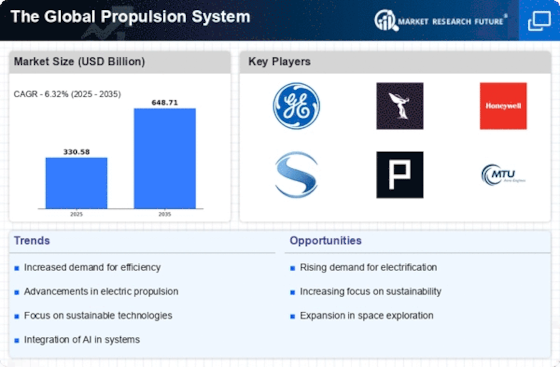
As per Market Research Future analysis, The Global Propulsion System Market Size was estimated at 330.58 USD Billion in 2024. The propulsion system industry is projected to grow from 351.48 USD Billion in 2025 to 648.71 USD Billion by 2035, exhibiting a compound annual growth rate (CAGR) of 6.32% during the forecast period 2025 - 2035

Key Market Trends & Highlights

The Global Propulsion System Market is experiencing a transformative shift towards sustainable technologies and increased investment in research and development.

  • North America remains the largest market for propulsion systems, driven by robust aerospace and defense sectors.
  • The Asia-Pacific region is emerging as the fastest-growing market, fueled by rapid industrialization and increasing aerospace activities.
  • The aircraft segment continues to dominate the market, while the spacecraft segment is witnessing the most rapid growth due to expanding space exploration initiatives.
  • Technological advancements in propulsion systems and government initiatives are key drivers propelling market growth.

Market Size & Forecast

2024 Market Size 330.58 (USD Billion)
2035 Market Size 648.71 (USD Billion)
CAGR (2025 - 2035) 6.32%
Largest Regional Market Share in 2024 Asia Pacific

Major Players

General Electric (US), Rolls-Royce (GB), Honeywell (US), Safran (FR), Pratt & Whitney (US), MTU Aero Engines (DE), Northrop Grumman (US), Boeing (US), Airbus (FR)

Market Trends

The Global Propulsion System Market is currently experiencing a transformative phase, driven by advancements in technology and increasing demand for efficient and sustainable solutions. The integration of innovative propulsion technologies, such as electric and hybrid systems, appears to be reshaping the landscape of this market. Stakeholders are increasingly focusing on reducing emissions and enhancing fuel efficiency, which suggests a shift towards greener alternatives. Furthermore, the growing emphasis on space exploration and satellite deployment is likely to propel the market forward, as new propulsion systems are developed to meet the unique challenges of these applications. In addition, The Global Propulsion System Market is witnessing a surge in investments aimed at research and development. This trend indicates a commitment to enhancing performance and reliability across various sectors, including aerospace, marine, and automotive. As industries strive to meet regulatory standards and consumer expectations, the demand for advanced propulsion solutions is expected to rise. Moreover, collaborations between private and public entities may foster innovation, leading to the emergence of novel propulsion technologies that could redefine operational capabilities in the near future.

Shift Towards Sustainable Technologies

The Global Propulsion System Market is increasingly leaning towards sustainable technologies. This trend is characterized by the adoption of electric and hybrid propulsion systems, which aim to minimize environmental impact. As regulatory pressures mount, industries are compelled to innovate and implement cleaner alternatives.

Investment in Research and Development

There is a notable increase in investments directed towards research and development within The Global Propulsion System Market. This focus on innovation is likely to enhance the performance and efficiency of propulsion systems, catering to the evolving needs of various sectors.

Expansion in Space Exploration

The ongoing expansion in space exploration initiatives is significantly influencing The Global Propulsion System Market. As nations and private companies pursue ambitious space missions, the demand for advanced propulsion technologies tailored for space applications is expected to grow.

Propulsion System Market Market Drivers

Growth in Defense Expenditure

The increase in defense expenditure across various nations is a notable driver for The Global Propulsion System Industry. Governments are investing heavily in modernizing their military capabilities, which includes upgrading propulsion systems for aircraft, naval vessels, and ground vehicles. This trend is particularly evident in regions experiencing geopolitical tensions, where defense budgets are being expanded to enhance national security. According to recent reports, global military spending is projected to reach unprecedented levels, with a significant portion allocated to advanced propulsion technologies. This surge in defense spending not only stimulates demand for innovative propulsion systems but also fosters collaboration between defense contractors and technology providers, thereby driving market growth.

Government Initiatives and Regulations

Government initiatives and regulations aimed at reducing carbon emissions are significantly impacting The Global Propulsion System Industry. Various countries are implementing stringent environmental regulations that require the aviation and maritime sectors to adopt cleaner propulsion technologies. For instance, initiatives promoting the use of sustainable aviation fuels and electric propulsion systems are gaining momentum. These regulatory frameworks not only encourage innovation but also provide financial incentives for companies investing in cleaner technologies. As a result, manufacturers are increasingly focusing on developing propulsion systems that comply with these regulations, thereby enhancing their market competitiveness and contributing to the overall growth of the industry.

Emergence of Space Exploration Initiatives

The emergence of space exploration initiatives is reshaping the landscape of The Global Propulsion System Industry. With both governmental and private entities investing in space missions, the demand for advanced propulsion systems is on the rise. Notable projects, such as Mars exploration missions and satellite deployment, require cutting-edge propulsion technologies to ensure mission success. The commercial space sector is also witnessing rapid growth, with companies aiming to provide launch services and space tourism. This burgeoning interest in space exploration is expected to drive innovation in propulsion systems, leading to the development of more efficient and powerful engines. As a result, the market is likely to experience substantial growth, fueled by the increasing number of space missions planned for the coming years.

Increasing Demand for Aerospace Applications

The rising demand for aerospace applications is a crucial factor influencing The Global Propulsion System Industry. As air travel continues to expand, the need for efficient and reliable propulsion systems becomes paramount. The commercial aviation sector is expected to witness a substantial increase in aircraft deliveries, with projections indicating a demand for over 40,000 new aircraft in the next two decades. This surge in demand necessitates advancements in propulsion technologies to enhance fuel efficiency and reduce operational costs. Furthermore, the growing interest in urban air mobility and unmanned aerial vehicles is likely to create new opportunities for propulsion system manufacturers, thereby driving market growth.

Technological Advancements in Propulsion Systems

The ongoing technological advancements in propulsion systems are a primary driver for The Global Propulsion System Industry. Innovations such as electric and hybrid propulsion technologies are gaining traction, offering enhanced efficiency and reduced emissions. The integration of advanced materials and manufacturing techniques is also contributing to the development of lighter and more efficient propulsion systems. According to recent data, the market for electric propulsion systems is projected to grow significantly, with estimates suggesting a compound annual growth rate of over 15% in the coming years. This shift towards more sophisticated technologies not only improves performance but also aligns with global sustainability goals, thereby attracting investments and fostering growth within the industry.

Market Segment Insights

By Application: Aircraft (Largest) vs. Spacecraft (Fastest-Growing)

<p>The Global Propulsion System exhibits a diverse application segment, including Missiles, Aircraft, Spacecraft, and Unmanned Aerial Vehicles. Among these, the Aircraft segment commands the largest share, driven by increasing air travel demand and advancements in automation technology. In contrast, while the Spacecraft segment holds a smaller share currently, it is recognized as the fastest-growing category due to innovations in space exploration and satellite launches.</p>

<p>Aircraft (Dominant) vs. Spacecraft (Emerging)</p>

<p>Aircraft propulsion systems are at the forefront of The Global Propulsion System, benefitting from substantial advancements in aerodynamics, engine efficiency, and environmental regulations. As airlines strive for sustainability, propulsion systems that reduce emissions are becoming increasingly essential. Meanwhile, the Spacecraft segment, though currently smaller, is emerging quickly, buoyed by increased governmental and private investments in space technologies. This segment focuses on developing efficient propulsion methods for satellite launches and interplanetary missions, positioning itself as a pivotal area within the market.</p>

By Type: Air-Breathing (Largest) vs. Non-Air Breathing (Fastest-Growing)

<p>In The Global Propulsion System, Air-Breathing propulsion systems hold a significant market share, leveraging existing technological advancements and established applications across various sectors. These systems effectively integrate with a wide range of vehicles and applications, which enhances their foothold in the market. Non-Air Breathing systems, meanwhile, are emerging rapidly as industries seek alternative propulsion methods to meet stringent environmental regulations and efficiency demands, capturing the attention of manufacturers and investors alike.</p>

<p>Air-Breathing (Dominant) vs. Non-Air Breathing (Emerging)</p>

<p>Air-Breathing propulsion systems are currently the dominant force in The Global Propulsion System, characterized by their ability to utilize atmospheric oxygen for combustion, making them efficient and widely applicable in aircraft and some marine vessels. Their proven performance in various environments plays a crucial role in their continued dominance. Conversely, Non-Air Breathing systems, which rely on onboard oxidizers, are an emerging segment due to their potential in specialized areas such as space exploration and military applications. This segment is gaining traction thanks to advancements in technology and materials, which are enabling higher efficiency and performance, thus attracting significant investment and interest.</p>

Get more detailed insights about Propulsion System Market Research Report—Global Forecast till 2035

Regional Insights

North America : Innovation and Leadership Hub

North America is the largest market for propulsion systems, holding approximately 40% of the global share. The region benefits from strong demand driven by advancements in aerospace technology, increased defense spending, and a robust commercial aviation sector. Regulatory support from agencies like the FAA fosters innovation and safety standards, further propelling market growth. The United States leads the market, with key players such as General Electric, Honeywell, and Pratt & Whitney dominating the landscape. Canada also contributes significantly, focusing on aerospace innovation. The competitive environment is characterized by continuous R&D investments and strategic partnerships among major firms, ensuring North America's position as a leader in propulsion technology.

Europe : Aerospace Innovation and Growth

Europe is the second-largest market for propulsion systems, accounting for around 30% of the global market share. The region's growth is fueled by increasing investments in sustainable aviation technologies and stringent environmental regulations. The European Union's Green Deal and initiatives from the European Aviation Safety Agency (EASA) are pivotal in driving innovation and compliance in the aerospace sector. Leading countries include Germany, France, and the UK, with major players like Rolls-Royce and Safran at the forefront. The competitive landscape is marked by collaborations between manufacturers and research institutions, focusing on developing next-generation propulsion systems. This synergy enhances Europe's capability to meet future aviation demands while adhering to environmental standards.

Asia-Pacific : Rapid Growth and Expansion

Asia-Pacific is witnessing rapid growth in the propulsion systems market, holding approximately 20% of the global share. The region's expansion is driven by increasing air travel demand, urbanization, and government initiatives to boost the aerospace industry. Countries like China and India are investing heavily in their aviation sectors, supported by favorable regulations and infrastructure development. China is the largest market in the region, with significant contributions from local manufacturers and partnerships with global players. The competitive landscape is evolving, with companies like MTU Aero Engines and Northrop Grumman expanding their presence. The focus on innovation and technology adaptation is crucial for meeting the rising demand for efficient propulsion systems in the region.

Middle East and Africa : Emerging Market Potential

The Middle East and Africa region is gradually emerging in the propulsion systems market, accounting for about 10% of the global share. The growth is primarily driven by increasing investments in aviation infrastructure and a rising number of air passengers. Countries like the UAE and South Africa are enhancing their aerospace capabilities, supported by government initiatives and partnerships with global firms. The competitive landscape is characterized by a mix of local and international players, with a focus on developing sustainable and efficient propulsion technologies. The presence of key players like Boeing and Airbus in the region is fostering innovation and collaboration, positioning the Middle East and Africa as a potential hub for future aerospace developments.

Key Players and Competitive Insights

The Propulsion System Market is a highly competitive industry, as numerous companies offer stamped metal parts and components to the automotive industry. The Propulsion System Market has experienced significant growth due to technological advancements and the increasing demand for efficient propulsion solutions in various industries. Propulsion systems are essential for the operation of vehicles, aircraft, and spacecraft as they provide the necessary power and thrust. The market is highly competitive, with several key players leading the way in innovation and investment in research and development.
The Propulsion System Market is characterized by intense competition among these key players, driving innovation and pushing the boundaries of propulsion technology. As the demand for efficient and sustainable propulsion systems continues to rise, these market players are poised to play a crucial role in shaping the future of propulsion across various industries.

Key Companies in the Propulsion System Market include

Industry Developments

  • Q3 2025: Moog Inc. introduced a compact electric propulsion thruster designed for small satellite constellations Moog Inc. launched a new compact electric propulsion thruster in July 2025, targeting small satellite constellations. The unit improves efficiency by 20% and offers modular integration for CubeSats and nanosats.
  • Q2 2025: Blue Origin successfully tested a next-generation BE-3U vacuum engine optimized for lunar landers In June 2025, Blue Origin completed a successful test of its BE-3U vacuum engine, which features a variable-thrust system designed to support lunar lander missions.

Future Outlook

Propulsion System Market Future Outlook

The Global Propulsion System Market is projected to grow at a 6.32% CAGR from 2025 to 2035, driven by advancements in technology, increasing demand for efficient propulsion, and environmental regulations.

New opportunities lie in:

  • Development of hybrid propulsion systems for commercial aviation
  • Expansion of electric propulsion technologies in urban air mobility
  • Investment in sustainable fuel alternatives for marine propulsion

By 2035, the market is expected to achieve substantial growth, driven by innovation and sustainability.

Market Segmentation

Propulsion System Market Type Outlook

  • Air-Breathing
  • Non-Air Breathing

Propulsion System Market Application Outlook

  • Missiles
  • Aircraft
  • Spacecraft
  • Unnamed Aerial Vehicles

Report Scope

MARKET SIZE 2024 330.58(USD Billion)
MARKET SIZE 2025 351.48(USD Billion)
MARKET SIZE 2035 648.71(USD Billion)
COMPOUND ANNUAL GROWTH RATE (CAGR) 6.32% (2025 - 2035)
REPORT COVERAGE Revenue Forecast, Competitive Landscape, Growth Factors, and Trends
BASE YEAR 2024
Market Forecast Period 2025 - 2035
Historical Data 2019 - 2024
Market Forecast Units USD Billion
Key Companies Profiled General Electric (US), Rolls-Royce (GB), Honeywell (US), Safran (FR), Pratt & Whitney (US), MTU Aero Engines (DE), Northrop Grumman (US), Boeing (US), Airbus (FR)
Segments Covered Application, Type, Region
Key Market Opportunities Advancements in electric propulsion technologies drive innovation in The Global Propulsion System.
Key Market Dynamics Technological advancements in propulsion systems drive competition and innovation across aerospace and automotive sectors.
Countries Covered North America, Europe, APAC, South America, MEA

FAQs

What is the projected market valuation of The Global Propulsion System by 2035?

<p>The projected market valuation for The Global Propulsion System by 2035 is 648.71 USD Billion.</p>

What was the overall market valuation of The Global Propulsion System in 2024?

<p>The overall market valuation of The Global Propulsion System in 2024 was 330.58 USD Billion.</p>

What is the expected CAGR for The Global Propulsion System during the forecast period 2025 - 2035?

<p>The expected CAGR for The Global Propulsion System during the forecast period 2025 - 2035 is 6.32%.</p>

Which companies are considered key players in The Global Propulsion System?

<p>Key players in The Global Propulsion System include General Electric, Rolls-Royce, Honeywell, Safran, Pratt & Whitney, MTU Aero Engines, Northrop Grumman, Boeing, and Airbus.</p>

What are the projected valuations for the Aircraft segment in The Global Propulsion System?

The projected valuations for the Aircraft segment in The Global Propulsion System range from 120.0 to 240.0 USD Billion.

How does the valuation of the Non-Air Breathing segment compare to the Air-Breathing segment?

The valuation of the Non-Air Breathing segment ranges from 198.35 to 384.36 USD Billion, which is higher than the Air-Breathing segment's range of 132.23 to 264.35 USD Billion.

What is the valuation range for the Missiles segment in The Global Propulsion System?

The valuation range for the Missiles segment in The Global Propulsion System is between 40.0 and 80.0 USD Billion.

What is the projected valuation for the Spacecraft segment by 2035?

The projected valuation for the Spacecraft segment in The Global Propulsion System is expected to range from 50.0 to 100.0 USD Billion.

What is the valuation range for Unmanned Aerial Vehicles in The Global Propulsion System?

The valuation range for Unmanned Aerial Vehicles in The Global Propulsion System is between 20.58 and 28.71 USD Billion.

How do the projected growth rates of different segments in The Global Propulsion System compare?

The projected growth rates of different segments indicate varying potential, with Non-Air Breathing systems likely experiencing higher growth compared to Air-Breathing systems.

  1. SECTION I: EXECUTIVE SUMMARY AND KEY HIGHLIGHTS
    1. | 1.1 EXECUTIVE SUMMARY
    2. | | 1.1.1 Market Overview
    3. | | 1.1.2 Key Findings
    4. | | 1.1.3 Market Segmentation
    5. | | 1.1.4 Competitive Landscape
    6. | | 1.1.5 Challenges and Opportunities
    7. | | 1.1.6 Future Outlook
  2. SECTION II: SCOPING, METHODOLOGY AND MARKET STRUCTURE
    1. | 2.1 MARKET INTRODUCTION
    2. | | 2.1.1 Definition
    3. | | 2.1.2 Scope of the study
    4. | | | 2.1.2.1 Research Objective
    5. | | | 2.1.2.2 Assumption
    6. | | | 2.1.2.3 Limitations
    7. | 2.2 RESEARCH METHODOLOGY
    8. | | 2.2.1 Overview
    9. | | 2.2.2 Data Mining
    10. | | 2.2.3 Secondary Research
    11. | | 2.2.4 Primary Research
    12. | | | 2.2.4.1 Primary Interviews and Information Gathering Process
    13. | | | 2.2.4.2 Breakdown of Primary Respondents
    14. | | 2.2.5 Forecasting Model
    15. | | 2.2.6 Market Size Estimation
    16. | | | 2.2.6.1 Bottom-Up Approach
    17. | | | 2.2.6.2 Top-Down Approach
    18. | | 2.2.7 Data Triangulation
    19. | | 2.2.8 Validation
  3. SECTION III: QUALITATIVE ANALYSIS
    1. | 3.1 MARKET DYNAMICS
    2. | | 3.1.1 Overview
    3. | | 3.1.2 Drivers
    4. | | 3.1.3 Restraints
    5. | | 3.1.4 Opportunities
    6. | 3.2 MARKET FACTOR ANALYSIS
    7. | | 3.2.1 Value chain Analysis
    8. | | 3.2.2 Porter's Five Forces Analysis
    9. | | | 3.2.2.1 Bargaining Power of Suppliers
    10. | | | 3.2.2.2 Bargaining Power of Buyers
    11. | | | 3.2.2.3 Threat of New Entrants
    12. | | | 3.2.2.4 Threat of Substitutes
    13. | | | 3.2.2.5 Intensity of Rivalry
    14. | | 3.2.3 COVID-19 Impact Analysis
    15. | | | 3.2.3.1 Market Impact Analysis
    16. | | | 3.2.3.2 Regional Impact
    17. | | | 3.2.3.3 Opportunity and Threat Analysis
  4. SECTION IV: QUANTITATIVE ANALYSIS
    1. | 4.1 Aerospace & Defense, BY Application (USD Billion)
    2. | | 4.1.1 Missiles
    3. | | 4.1.2 Aircraft
    4. | | 4.1.3 Spacecraft
    5. | | 4.1.4 Unnamed Aerial Vehicles
    6. | 4.2 Aerospace & Defense, BY Type (USD Billion)
    7. | | 4.2.1 Air-Breathing
    8. | | 4.2.2 Non-Air Breathing
    9. | 4.3 Aerospace & Defense, BY Region (USD Billion)
    10. | | 4.3.1 North America
    11. | | | 4.3.1.1 US
    12. | | | 4.3.1.2 Canada
    13. | | 4.3.2 Europe
    14. | | | 4.3.2.1 Germany
    15. | | | 4.3.2.2 UK
    16. | | | 4.3.2.3 France
    17. | | | 4.3.2.4 Russia
    18. | | | 4.3.2.5 Italy
    19. | | | 4.3.2.6 Spain
    20. | | | 4.3.2.7 Rest of Europe
    21. | | 4.3.3 APAC
    22. | | | 4.3.3.1 China
    23. | | | 4.3.3.2 India
    24. | | | 4.3.3.3 Japan
    25. | | | 4.3.3.4 South Korea
    26. | | | 4.3.3.5 Malaysia
    27. | | | 4.3.3.6 Thailand
    28. | | | 4.3.3.7 Indonesia
    29. | | | 4.3.3.8 Rest of APAC
    30. | | 4.3.4 South America
    31. | | | 4.3.4.1 Brazil
    32. | | | 4.3.4.2 Mexico
    33. | | | 4.3.4.3 Argentina
    34. | | | 4.3.4.4 Rest of South America
    35. | | 4.3.5 MEA
    36. | | | 4.3.5.1 GCC Countries
    37. | | | 4.3.5.2 South Africa
    38. | | | 4.3.5.3 Rest of MEA
  5. SECTION V: COMPETITIVE ANALYSIS
    1. | 5.1 Competitive Landscape
    2. | | 5.1.1 Overview
    3. | | 5.1.2 Competitive Analysis
    4. | | 5.1.3 Market share Analysis
    5. | | 5.1.4 Major Growth Strategy in the Aerospace & Defense
    6. | | 5.1.5 Competitive Benchmarking
    7. | | 5.1.6 Leading Players in Terms of Number of Developments in the Aerospace & Defense
    8. | | 5.1.7 Key developments and growth strategies
    9. | | | 5.1.7.1 New Product Launch/Service Deployment
    10. | | | 5.1.7.2 Merger & Acquisitions
    11. | | | 5.1.7.3 Joint Ventures
    12. | | 5.1.8 Major Players Financial Matrix
    13. | | | 5.1.8.1 Sales and Operating Income
    14. | | | 5.1.8.2 Major Players R&D Expenditure. 2023
    15. | 5.2 Company Profiles
    16. | | 5.2.1 General Electric (US)
    17. | | | 5.2.1.1 Financial Overview
    18. | | | 5.2.1.2 Products Offered
    19. | | | 5.2.1.3 Key Developments
    20. | | | 5.2.1.4 SWOT Analysis
    21. | | | 5.2.1.5 Key Strategies
    22. | | 5.2.2 Rolls-Royce (GB)
    23. | | | 5.2.2.1 Financial Overview
    24. | | | 5.2.2.2 Products Offered
    25. | | | 5.2.2.3 Key Developments
    26. | | | 5.2.2.4 SWOT Analysis
    27. | | | 5.2.2.5 Key Strategies
    28. | | 5.2.3 Honeywell (US)
    29. | | | 5.2.3.1 Financial Overview
    30. | | | 5.2.3.2 Products Offered
    31. | | | 5.2.3.3 Key Developments
    32. | | | 5.2.3.4 SWOT Analysis
    33. | | | 5.2.3.5 Key Strategies
    34. | | 5.2.4 Safran (FR)
    35. | | | 5.2.4.1 Financial Overview
    36. | | | 5.2.4.2 Products Offered
    37. | | | 5.2.4.3 Key Developments
    38. | | | 5.2.4.4 SWOT Analysis
    39. | | | 5.2.4.5 Key Strategies
    40. | | 5.2.5 Pratt & Whitney (US)
    41. | | | 5.2.5.1 Financial Overview
    42. | | | 5.2.5.2 Products Offered
    43. | | | 5.2.5.3 Key Developments
    44. | | | 5.2.5.4 SWOT Analysis
    45. | | | 5.2.5.5 Key Strategies
    46. | | 5.2.6 MTU Aero Engines (DE)
    47. | | | 5.2.6.1 Financial Overview
    48. | | | 5.2.6.2 Products Offered
    49. | | | 5.2.6.3 Key Developments
    50. | | | 5.2.6.4 SWOT Analysis
    51. | | | 5.2.6.5 Key Strategies
    52. | | 5.2.7 Northrop Grumman (US)
    53. | | | 5.2.7.1 Financial Overview
    54. | | | 5.2.7.2 Products Offered
    55. | | | 5.2.7.3 Key Developments
    56. | | | 5.2.7.4 SWOT Analysis
    57. | | | 5.2.7.5 Key Strategies
    58. | | 5.2.8 Boeing (US)
    59. | | | 5.2.8.1 Financial Overview
    60. | | | 5.2.8.2 Products Offered
    61. | | | 5.2.8.3 Key Developments
    62. | | | 5.2.8.4 SWOT Analysis
    63. | | | 5.2.8.5 Key Strategies
    64. | | 5.2.9 Airbus (FR)
    65. | | | 5.2.9.1 Financial Overview
    66. | | | 5.2.9.2 Products Offered
    67. | | | 5.2.9.3 Key Developments
    68. | | | 5.2.9.4 SWOT Analysis
    69. | | | 5.2.9.5 Key Strategies
    70. | 5.3 Appendix
    71. | | 5.3.1 References
    72. | | 5.3.2 Related Reports
  6. LIST OF FIGURES
    1. | 6.1 MARKET SYNOPSIS
    2. | 6.2 NORTH AMERICA MARKET ANALYSIS
    3. | 6.3 US MARKET ANALYSIS BY APPLICATION
    4. | 6.4 US MARKET ANALYSIS BY TYPE
    5. | 6.5 CANADA MARKET ANALYSIS BY APPLICATION
    6. | 6.6 CANADA MARKET ANALYSIS BY TYPE
    7. | 6.7 EUROPE MARKET ANALYSIS
    8. | 6.8 GERMANY MARKET ANALYSIS BY APPLICATION
    9. | 6.9 GERMANY MARKET ANALYSIS BY TYPE
    10. | 6.10 UK MARKET ANALYSIS BY APPLICATION
    11. | 6.11 UK MARKET ANALYSIS BY TYPE
    12. | 6.12 FRANCE MARKET ANALYSIS BY APPLICATION
    13. | 6.13 FRANCE MARKET ANALYSIS BY TYPE
    14. | 6.14 RUSSIA MARKET ANALYSIS BY APPLICATION
    15. | 6.15 RUSSIA MARKET ANALYSIS BY TYPE
    16. | 6.16 ITALY MARKET ANALYSIS BY APPLICATION
    17. | 6.17 ITALY MARKET ANALYSIS BY TYPE
    18. | 6.18 SPAIN MARKET ANALYSIS BY APPLICATION
    19. | 6.19 SPAIN MARKET ANALYSIS BY TYPE
    20. | 6.20 REST OF EUROPE MARKET ANALYSIS BY APPLICATION
    21. | 6.21 REST OF EUROPE MARKET ANALYSIS BY TYPE
    22. | 6.22 APAC MARKET ANALYSIS
    23. | 6.23 CHINA MARKET ANALYSIS BY APPLICATION
    24. | 6.24 CHINA MARKET ANALYSIS BY TYPE
    25. | 6.25 INDIA MARKET ANALYSIS BY APPLICATION
    26. | 6.26 INDIA MARKET ANALYSIS BY TYPE
    27. | 6.27 JAPAN MARKET ANALYSIS BY APPLICATION
    28. | 6.28 JAPAN MARKET ANALYSIS BY TYPE
    29. | 6.29 SOUTH KOREA MARKET ANALYSIS BY APPLICATION
    30. | 6.30 SOUTH KOREA MARKET ANALYSIS BY TYPE
    31. | 6.31 MALAYSIA MARKET ANALYSIS BY APPLICATION
    32. | 6.32 MALAYSIA MARKET ANALYSIS BY TYPE
    33. | 6.33 THAILAND MARKET ANALYSIS BY APPLICATION
    34. | 6.34 THAILAND MARKET ANALYSIS BY TYPE
    35. | 6.35 INDONESIA MARKET ANALYSIS BY APPLICATION
    36. | 6.36 INDONESIA MARKET ANALYSIS BY TYPE
    37. | 6.37 REST OF APAC MARKET ANALYSIS BY APPLICATION
    38. | 6.38 REST OF APAC MARKET ANALYSIS BY TYPE
    39. | 6.39 SOUTH AMERICA MARKET ANALYSIS
    40. | 6.40 BRAZIL MARKET ANALYSIS BY APPLICATION
    41. | 6.41 BRAZIL MARKET ANALYSIS BY TYPE
    42. | 6.42 MEXICO MARKET ANALYSIS BY APPLICATION
    43. | 6.43 MEXICO MARKET ANALYSIS BY TYPE
    44. | 6.44 ARGENTINA MARKET ANALYSIS BY APPLICATION
    45. | 6.45 ARGENTINA MARKET ANALYSIS BY TYPE
    46. | 6.46 REST OF SOUTH AMERICA MARKET ANALYSIS BY APPLICATION
    47. | 6.47 REST OF SOUTH AMERICA MARKET ANALYSIS BY TYPE
    48. | 6.48 MEA MARKET ANALYSIS
    49. | 6.49 GCC COUNTRIES MARKET ANALYSIS BY APPLICATION
    50. | 6.50 GCC COUNTRIES MARKET ANALYSIS BY TYPE
    51. | 6.51 SOUTH AFRICA MARKET ANALYSIS BY APPLICATION
    52. | 6.52 SOUTH AFRICA MARKET ANALYSIS BY TYPE
    53. | 6.53 REST OF MEA MARKET ANALYSIS BY APPLICATION
    54. | 6.54 REST OF MEA MARKET ANALYSIS BY TYPE
    55. | 6.55 KEY BUYING CRITERIA OF AEROSPACE & DEFENSE
    56. | 6.56 RESEARCH PROCESS OF MRFR
    57. | 6.57 DRO ANALYSIS OF AEROSPACE & DEFENSE
    58. | 6.58 DRIVERS IMPACT ANALYSIS: AEROSPACE & DEFENSE
    59. | 6.59 RESTRAINTS IMPACT ANALYSIS: AEROSPACE & DEFENSE
    60. | 6.60 SUPPLY / VALUE CHAIN: AEROSPACE & DEFENSE
    61. | 6.61 AEROSPACE & DEFENSE, BY APPLICATION, 2024 (% SHARE)
    62. | 6.62 AEROSPACE & DEFENSE, BY APPLICATION, 2024 TO 2035 (USD Billion)
    63. | 6.63 AEROSPACE & DEFENSE, BY TYPE, 2024 (% SHARE)
    64. | 6.64 AEROSPACE & DEFENSE, BY TYPE, 2024 TO 2035 (USD Billion)
    65. | 6.65 BENCHMARKING OF MAJOR COMPETITORS
  7. LIST OF TABLES
    1. | 7.1 LIST OF ASSUMPTIONS
    2. | | 7.1.1
    3. | 7.2 North America MARKET SIZE ESTIMATES; FORECAST
    4. | | 7.2.1 BY APPLICATION, 2025-2035 (USD Billion)
    5. | | 7.2.2 BY TYPE, 2025-2035 (USD Billion)
    6. | 7.3 US MARKET SIZE ESTIMATES; FORECAST
    7. | | 7.3.1 BY APPLICATION, 2025-2035 (USD Billion)
    8. | | 7.3.2 BY TYPE, 2025-2035 (USD Billion)
    9. | 7.4 Canada MARKET SIZE ESTIMATES; FORECAST
    10. | | 7.4.1 BY APPLICATION, 2025-2035 (USD Billion)
    11. | | 7.4.2 BY TYPE, 2025-2035 (USD Billion)
    12. | 7.5 Europe MARKET SIZE ESTIMATES; FORECAST
    13. | | 7.5.1 BY APPLICATION, 2025-2035 (USD Billion)
    14. | | 7.5.2 BY TYPE, 2025-2035 (USD Billion)
    15. | 7.6 Germany MARKET SIZE ESTIMATES; FORECAST
    16. | | 7.6.1 BY APPLICATION, 2025-2035 (USD Billion)
    17. | | 7.6.2 BY TYPE, 2025-2035 (USD Billion)
    18. | 7.7 UK MARKET SIZE ESTIMATES; FORECAST
    19. | | 7.7.1 BY APPLICATION, 2025-2035 (USD Billion)
    20. | | 7.7.2 BY TYPE, 2025-2035 (USD Billion)
    21. | 7.8 France MARKET SIZE ESTIMATES; FORECAST
    22. | | 7.8.1 BY APPLICATION, 2025-2035 (USD Billion)
    23. | | 7.8.2 BY TYPE, 2025-2035 (USD Billion)
    24. | 7.9 Russia MARKET SIZE ESTIMATES; FORECAST
    25. | | 7.9.1 BY APPLICATION, 2025-2035 (USD Billion)
    26. | | 7.9.2 BY TYPE, 2025-2035 (USD Billion)
    27. | 7.10 Italy MARKET SIZE ESTIMATES; FORECAST
    28. | | 7.10.1 BY APPLICATION, 2025-2035 (USD Billion)
    29. | | 7.10.2 BY TYPE, 2025-2035 (USD Billion)
    30. | 7.11 Spain MARKET SIZE ESTIMATES; FORECAST
    31. | | 7.11.1 BY APPLICATION, 2025-2035 (USD Billion)
    32. | | 7.11.2 BY TYPE, 2025-2035 (USD Billion)
    33. | 7.12 Rest of Europe MARKET SIZE ESTIMATES; FORECAST
    34. | | 7.12.1 BY APPLICATION, 2025-2035 (USD Billion)
    35. | | 7.12.2 BY TYPE, 2025-2035 (USD Billion)
    36. | 7.13 APAC MARKET SIZE ESTIMATES; FORECAST
    37. | | 7.13.1 BY APPLICATION, 2025-2035 (USD Billion)
    38. | | 7.13.2 BY TYPE, 2025-2035 (USD Billion)
    39. | 7.14 China MARKET SIZE ESTIMATES; FORECAST
    40. | | 7.14.1 BY APPLICATION, 2025-2035 (USD Billion)
    41. | | 7.14.2 BY TYPE, 2025-2035 (USD Billion)
    42. | 7.15 India MARKET SIZE ESTIMATES; FORECAST
    43. | | 7.15.1 BY APPLICATION, 2025-2035 (USD Billion)
    44. | | 7.15.2 BY TYPE, 2025-2035 (USD Billion)
    45. | 7.16 Japan MARKET SIZE ESTIMATES; FORECAST
    46. | | 7.16.1 BY APPLICATION, 2025-2035 (USD Billion)
    47. | | 7.16.2 BY TYPE, 2025-2035 (USD Billion)
    48. | 7.17 South Korea MARKET SIZE ESTIMATES; FORECAST
    49. | | 7.17.1 BY APPLICATION, 2025-2035 (USD Billion)
    50. | | 7.17.2 BY TYPE, 2025-2035 (USD Billion)
    51. | 7.18 Malaysia MARKET SIZE ESTIMATES; FORECAST
    52. | | 7.18.1 BY APPLICATION, 2025-2035 (USD Billion)
    53. | | 7.18.2 BY TYPE, 2025-2035 (USD Billion)
    54. | 7.19 Thailand MARKET SIZE ESTIMATES; FORECAST
    55. | | 7.19.1 BY APPLICATION, 2025-2035 (USD Billion)
    56. | | 7.19.2 BY TYPE, 2025-2035 (USD Billion)
    57. | 7.20 Indonesia MARKET SIZE ESTIMATES; FORECAST
    58. | | 7.20.1 BY APPLICATION, 2025-2035 (USD Billion)
    59. | | 7.20.2 BY TYPE, 2025-2035 (USD Billion)
    60. | 7.21 Rest of APAC MARKET SIZE ESTIMATES; FORECAST
    61. | | 7.21.1 BY APPLICATION, 2025-2035 (USD Billion)
    62. | | 7.21.2 BY TYPE, 2025-2035 (USD Billion)
    63. | 7.22 South America MARKET SIZE ESTIMATES; FORECAST
    64. | | 7.22.1 BY APPLICATION, 2025-2035 (USD Billion)
    65. | | 7.22.2 BY TYPE, 2025-2035 (USD Billion)
    66. | 7.23 Brazil MARKET SIZE ESTIMATES; FORECAST
    67. | | 7.23.1 BY APPLICATION, 2025-2035 (USD Billion)
    68. | | 7.23.2 BY TYPE, 2025-2035 (USD Billion)
    69. | 7.24 Mexico MARKET SIZE ESTIMATES; FORECAST
    70. | | 7.24.1 BY APPLICATION, 2025-2035 (USD Billion)
    71. | | 7.24.2 BY TYPE, 2025-2035 (USD Billion)
    72. | 7.25 Argentina MARKET SIZE ESTIMATES; FORECAST
    73. | | 7.25.1 BY APPLICATION, 2025-2035 (USD Billion)
    74. | | 7.25.2 BY TYPE, 2025-2035 (USD Billion)
    75. | 7.26 Rest of South America MARKET SIZE ESTIMATES; FORECAST
    76. | | 7.26.1 BY APPLICATION, 2025-2035 (USD Billion)
    77. | | 7.26.2 BY TYPE, 2025-2035 (USD Billion)
    78. | 7.27 MEA MARKET SIZE ESTIMATES; FORECAST
    79. | | 7.27.1 BY APPLICATION, 2025-2035 (USD Billion)
    80. | | 7.27.2 BY TYPE, 2025-2035 (USD Billion)
    81. | 7.28 GCC Countries MARKET SIZE ESTIMATES; FORECAST
    82. | | 7.28.1 BY APPLICATION, 2025-2035 (USD Billion)
    83. | | 7.28.2 BY TYPE, 2025-2035 (USD Billion)
    84. | 7.29 South Africa MARKET SIZE ESTIMATES; FORECAST
    85. | | 7.29.1 BY APPLICATION, 2025-2035 (USD Billion)
    86. | | 7.29.2 BY TYPE, 2025-2035 (USD Billion)
    87. | 7.30 Rest of MEA MARKET SIZE ESTIMATES; FORECAST
    88. | | 7.30.1 BY APPLICATION, 2025-2035 (USD Billion)
    89. | | 7.30.2 BY TYPE, 2025-2035 (USD Billion)
    90. | 7.31 PRODUCT LAUNCH/PRODUCT DEVELOPMENT/APPROVAL
    91. | | 7.31.1
    92. | 7.32 ACQUISITION/PARTNERSHIP
    93. | | 7.32.1

Aerospace & Defense Market Segmentation

Aerospace & Defense By Application (USD Billion, 2025-2035)

  • Missiles
  • Aircraft
  • Spacecraft
  • Unnamed Aerial Vehicles

Aerospace & Defense By Type (USD Billion, 2025-2035)

  • Air-Breathing
  • Non-Air Breathing
Infographic

Free Sample Request

Kindly complete the form below to receive a free sample of this Report

Get Free Sample

Customer Strories

Compare Licence

×
Features License Type
Single User Multiuser License Enterprise User
Price $4,950 $5,950 $7,250
Maximum User Access Limit 1 User Upto 10 Users Unrestricted Access Throughout the Organization
Free Customization
Direct Access to Analyst
Deliverable Format
Platform Access
Discount on Next Purchase 10% 15% 15%
Printable Versions