×
Request Free Sample ×

Kindly complete the form below to receive a free sample of this Report

* Please use a valid business email

Leading companies partner with us for data-driven Insights

clients tt-cursor
Hero Background

North America Enterprise Collaboration Market

ID: MRFR/ICT/58000-HCR
200 Pages
Aarti Dhapte
February 2026

North America Enterprise Collaboration Market Size, Share and Research Report: By Component (Solutions, Services), By Type (Asynchronous, Synchronous), By Organization Size (Large Enterprises, SMEs), By Deployment (Cloud, On-Premise), By Vertical (BFSI, IT & Telecommunications, Retail, Healthcare, Travel & Hospitality, Transportation & Logistics, Government, Energy & Utilities, Education, Others) and By Regional (US, Canada)- Industry Forecast to 2035

Share:
Download PDF ×

We do not share your information with anyone. However, we may send you emails based on your report interest from time to time. You may contact us at any time to opt-out.

North America Enterprise Collaboration Market Infographic
Purchase Options

North America Enterprise Collaboration Market Summary

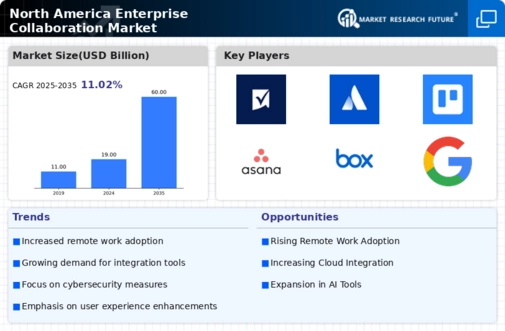
As per analysis, the North America Enterprise Collaboration Market is projected to grow from USD 19.31 Billion in 2025 to USD 53.71 Billion by 2035, exhibiting a compound annual growth rate (CAGR) of 10.75% during the forecast period (2025 - 2035).

Key Market Trends & Highlights

The North America Enterprise Collaboration Market is poised for robust growth driven by technological advancements and evolving work environments.

  • The integration of Artificial Intelligence is transforming communication tools, enhancing user experience and efficiency.
  • Security and compliance remain paramount as organizations prioritize data protection in their collaboration strategies.
  • Hybrid work models are increasingly adopted, particularly in the US, reshaping how teams interact and collaborate.
  • The market is driven by the integration of cloud technologies and a focus on employee engagement, particularly within collaboration software segments.

Market Size & Forecast

2024 Market Size 17.46 (USD Billion)
2035 Market Size 53.71 (USD Billion)
CAGR (2025 - 2035) 10.75%

Major Players

Microsoft (US), Slack Technologies (US), Cisco Systems (US), Zoom Video Communications (US), Atlassian (AU), Google (US), Salesforce (US), IBM (US), Workday (US)

Our Impact
Enabled $4.3B Revenue Impact for Fortune 500 and Leading Multinationals
Partnering with 2000+ Global Organizations Each Year
30K+ Citations by Top-Tier Firms in the Industry

North America Enterprise Collaboration Market Trends

The North America Enterprise Collaboration Market is currently experiencing a transformative phase, driven by the increasing need for organizations to enhance communication and streamline workflows. As businesses adapt to evolving technological landscapes, the demand for collaborative tools and platforms is on the rise. This market encompasses a variety of solutions, including messaging applications, video conferencing tools, and project management software, all designed to facilitate seamless interaction among teams. The emphasis on remote work and flexible arrangements has further accelerated the adoption of these technologies, as companies seek to maintain productivity and engagement across dispersed workforces. Moreover, the North America Enterprise Collaboration Market is characterized by a growing focus on integration capabilities. Organizations are increasingly looking for solutions that can connect various applications and systems, thereby creating a cohesive digital workspace. This trend suggests a shift towards more comprehensive platforms that not only support communication but also enhance overall operational efficiency. As businesses continue to prioritize collaboration, the market is likely to witness further innovations and developments, positioning it as a critical component of modern organizational strategies.

Integration of Artificial Intelligence

The North America Enterprise Collaboration Market is witnessing a notable trend towards the integration of artificial intelligence (AI) within collaboration tools. AI capabilities are being utilized to enhance user experiences, automate routine tasks, and provide intelligent insights. This integration appears to streamline workflows and improve decision-making processes, thereby fostering a more efficient collaborative environment.

Emphasis on Security and Compliance

In the North America Enterprise Collaboration Market, there is a growing emphasis on security and compliance measures. Organizations are increasingly aware of the risks associated with data breaches and are prioritizing solutions that offer robust security features. This trend indicates a shift towards platforms that not only facilitate collaboration but also ensure the protection of sensitive information.

Rise of Hybrid Work Models

The North America Enterprise Collaboration Market is adapting to the rise of hybrid work models, where employees split their time between remote and in-office settings. This trend necessitates the development of tools that support flexible collaboration, enabling teams to work effectively regardless of their physical location. As such, solutions that cater to this new work paradigm are becoming increasingly vital.

North America Enterprise Collaboration Market Drivers

Focus on Employee Engagement

In the North America Enterprise Collaboration Market, there is a growing emphasis on employee engagement as a critical driver of productivity and collaboration. Companies are increasingly recognizing that engaged employees are more likely to contribute positively to team dynamics and overall organizational success. Recent surveys indicate that organizations with high employee engagement levels experience up to 21% higher profitability. Consequently, businesses are investing in collaboration tools that promote interaction, feedback, and recognition among team members. These tools not only facilitate communication but also foster a sense of belonging and community within the workplace. As organizations strive to enhance employee satisfaction and retention, the focus on employee engagement is likely to continue shaping the North America Enterprise Collaboration Market.

Adoption of Advanced Analytics

The North America Enterprise Collaboration Market is witnessing a surge in the adoption of advanced analytics tools. Organizations are increasingly leveraging data analytics to gain insights into collaboration patterns, employee performance, and project outcomes. By utilizing these analytics, companies can identify bottlenecks in communication and collaboration processes, allowing them to make informed decisions to enhance efficiency. Recent studies suggest that organizations employing advanced analytics in their collaboration strategies can improve project success rates by up to 30%. This data-driven approach not only optimizes resource allocation but also fosters a culture of continuous improvement. As businesses in North America continue to prioritize data-driven decision-making, the adoption of advanced analytics is poised to be a significant driver in the Enterprise Collaboration Market.

Integration of Cloud Technologies

The North America Enterprise Collaboration Market is experiencing a notable shift towards cloud-based solutions. Organizations are increasingly adopting cloud technologies to enhance collaboration among teams, streamline workflows, and improve accessibility. According to recent data, approximately 70% of enterprises in North America have migrated at least some of their collaboration tools to the cloud. This transition not only reduces operational costs but also facilitates real-time communication and file sharing, which are essential in today's fast-paced business environment. Furthermore, the scalability offered by cloud solutions allows companies to adapt to changing demands, thereby fostering innovation and agility. As a result, the integration of cloud technologies is a driving force in the North America Enterprise Collaboration Market, enabling organizations to remain competitive and responsive to market dynamics.

Emergence of Collaborative Technologies

The North America Enterprise Collaboration Market is experiencing a notable emergence of collaborative technologies that enhance teamwork and communication. Tools such as video conferencing, instant messaging, and project management software are becoming integral to daily operations. Recent market analysis indicates that the video conferencing segment alone is expected to grow by 20% in the coming years, driven by the need for seamless communication among remote teams. These technologies not only facilitate real-time collaboration but also bridge geographical gaps, allowing organizations to tap into a global talent pool. As businesses continue to embrace these collaborative technologies, their impact on productivity and innovation is likely to drive further growth in the North America Enterprise Collaboration Market.

Regulatory Compliance and Data Security

The North America Enterprise Collaboration Market is increasingly influenced by regulatory compliance and data security concerns. With the rise of data breaches and stringent regulations such as the General Data Protection Regulation (GDPR) and the California Consumer Privacy Act (CCPA), organizations are compelled to prioritize secure collaboration solutions. Companies are investing in tools that not only facilitate collaboration but also ensure compliance with these regulations. This focus on security is reflected in the market, where the demand for secure collaboration platforms has surged, with a projected growth rate of 15% annually. As organizations navigate the complexities of compliance and security, the emphasis on regulatory adherence is likely to remain a key driver in the North America Enterprise Collaboration Market.


Market Segment Insights

By Application: Communication Tools (Largest) vs. Collaboration Software (Fastest-Growing)

In the North America Enterprise Collaboration Market, the application segment is crucial in shaping effective organizational communication. Among the various application values, Communication Tools hold the largest market share due to their essential role in facilitating real-time interaction and teamwork across distributed teams. Following closely are Document Management and Project Management solutions that complement these tools with robust functionalities, enhancing workflow efficiency. Growth trends in this segment are driven by the increasing need for remote work solutions and enhanced collaboration capabilities. The rapid adoption of cloud-based collaboration software reflects businesses' demand for flexibility and scalability. Additionally, organizations are prioritizing seamless integration of communication and collaboration tools, propelling further investments and innovations in this space.

Communication Tools: Dominant vs. Collaboration Software: Emerging

In the North America Enterprise Collaboration Market, Communication Tools are the dominant segment, providing businesses with essential platforms for messaging, video conferencing, and real-time collaboration. These tools, including applications like Zoom, Microsoft Teams, and Slack, are critical for maintaining productivity and morale in remote and hybrid work environments. Their popularity is bolstered by their ability to integrate with other enterprise software, fostering a more unified communication system. In contrast, Collaboration Software, while currently emerging, is rapidly gaining traction. It offers features such as project tracking, task assignments, and team collaboration spaces that allow teams to work cohesively. The growing trend towards agile project management methodologies and remote collaboration is creating new opportunities for these platforms, making them increasingly vital to enterprise operations.

By Deployment Type: Cloud-Based (Largest) vs. On-Premises (Fastest-Growing)

In the North America Enterprise Collaboration Market, the 'Deployment Type' segment is witnessing a dynamic distribution among cloud-based, on-premises, and hybrid solutions. Currently, cloud-based deployment leads the market with significant adoption due to its scalability, cost-effectiveness, and ease of implementation. On-premises solutions maintain a loyal customer base amidst growing concerns surrounding data security and compliance regulations, offering depth in customization that many enterprises still favor. Meanwhile, the hybrid model is gaining traction, signaling a shift towards flexibility and integrated infrastructures.

Deployment Models: Cloud-Based (Dominant) vs. Hybrid (Emerging)

Cloud-based deployment in the North America Enterprise Collaboration Market is characterized by its ever-increasing adoption, driven largely by businesses seeking agility and reduced overhead costs. This segment provides organizations with seamless access to collaboration tools from diverse locations, fostering remote work and enhancing productivity. In contrast, the hybrid model is emerging rapidly, as it allows businesses to innovate and customize solutions while leveraging both cloud and on-premises capabilities. This flexibility appeals particularly to enterprises that have critical legacy systems but are also looking to modernize their operations. As companies continue to adapt to evolving workplace dynamics, the hybrid model is likely to play a pivotal role in future deployments.

By End User: Small and Medium Enterprises (Largest) vs. Large Enterprises (Fastest-Growing)

The North America Enterprise Collaboration Market showcases a varied distribution of market share among its end user segments. Small and Medium Enterprises (SMEs) represent the largest share, driven by their increasing reliance on collaborative technologies to enhance productivity and streamline communication. In contrast, Large Enterprises, while smaller in share, are experiencing significant growth due to robust investments in enterprise solutions that foster teamwork across vast networks. Growth trends indicate a strong push towards cloud-based collaboration tools among SMEs, which seek to leverage cost-effective solutions that promote flexibility and accessibility. Meanwhile, Large Enterprises are adopting advanced technologies, such as artificial intelligence and machine learning, to optimize their collaboration frameworks. This blend of trends fuels a dynamic competitive landscape in the enterprise collaboration space, as organizations adapt to evolving work environments.

Small and Medium Enterprises (Dominant) vs. Government Organizations (Emerging)

In the North America Enterprise Collaboration Market, Small and Medium Enterprises (SMEs) dominate with a significant focus on collaborative tools that support agile business operations. With the increasing shift towards remote work, SMEs are rapidly adopting cloud-based solutions that enhance communication and operational efficiency. On the other hand, Government Organizations are emerging as a notable segment, embracing collaboration technologies to facilitate transparency and citizen engagement. The urgency to improve workflow and communication across agencies has led to investments in secure, scalable solutions. As both segments evolve, SMEs are leveraging user-friendly platforms, while Government Organizations prioritize compliance and security, leading to unique market positioning and strategies.

By Industry: Information Technology (Largest) vs. Healthcare (Fastest-Growing)

In the North America Enterprise Collaboration Market, the Information Technology sector leads significantly, commanding the largest market share. This dominance is driven by a high adoption rate of collaboration tools among IT companies, facilitating seamless communication and project management. Healthcare follows closely, experiencing rapid growth as organizations increasingly adopt collaboration solutions to enhance patient care coordination and operational efficiency. As the demand for remote healthcare services rises, the IT collaboration tools tailored for healthcare become pivotal in ensuring effective team communication and patient engagement.

Information Technology: Dominant vs. Healthcare: Emerging

The Information Technology segment is characterized by advanced solutions that leverage cloud computing, artificial intelligence, and integration capabilities for enhanced collaboration. IT companies prioritize tools that support virtual meetings, project management, and file sharing for improved workflow. In contrast, the Healthcare sector, while emerging, focuses on specific collaboration technologies that support telehealth, patient records management, and interdisciplinary communication. This sector is witnessing a transformational shift, driven by regulations, technological advancements, and the need for more efficient healthcare delivery systems. As such, the collaboration tools tailored for healthcare are becoming essential for meeting both operational demands and compliance requirements.

By Functionality: Real-Time Collaboration (Largest) vs. Video Conferencing (Fastest-Growing)

The North America Enterprise Collaboration Market under the functionality segment shows a significant distribution in favor of Real-Time Collaboration, which continues to maintain its largest share as enterprises seek efficient ways to enhance teamwork and communication among distributed teams. Task Management and Instant Messaging are also crucial but occupy smaller market portions, highlighting the emphasis on capabilities that promote immediacy and dynamic interactions.

Collaboration Methods: Real-Time Collaboration (Dominant) vs. Video Conferencing (Emerging)

Real-Time Collaboration remains the dominant force in the North American Enterprise Collaboration Market, characterized by tools that allow simultaneous interaction and sharing of ideas among team members, thus boosting productivity and engagement. This segment thrives on technological advancements that integrate AI and cloud solutions, facilitating seamless workflows and interoperability. Video Conferencing, while currently an emerging segment, is rapidly gaining traction as organizations adapt to hybrid work models, necessitating effective remote communication. This growth is driven by the increasing need for face-to-face interaction in virtual settings, leading to the adoption of advanced video solutions that support large-scale meetings and high-quality connections.

Get more detailed insights about North America Enterprise Collaboration Market

Regional Insights

US : Leading Innovation and Adoption Trends

The US holds a commanding market share of 15.12% in the Enterprise Collaboration Market, driven by rapid digital transformation and a strong emphasis on remote work solutions. Key growth drivers include the increasing demand for cloud-based collaboration tools, supported by government initiatives promoting digital infrastructure. Regulatory policies favoring technology adoption and investment in broadband connectivity further enhance market potential, while robust industrial development fosters a conducive environment for collaboration technologies.

Canada : Fostering Collaboration in Diverse Sectors

Canada's Enterprise Collaboration Market, with a share of 2.34%, is poised for growth as businesses increasingly adopt digital tools for enhanced productivity. Key growth drivers include government initiatives aimed at supporting small and medium enterprises (SMEs) and investments in technology infrastructure. Demand trends reflect a shift towards hybrid work models, with a focus on secure and efficient collaboration solutions tailored for various industries.

Key Players and Competitive Insights

The Enterprise Collaboration Market in North America is characterized by a dynamic competitive landscape, driven by the increasing demand for seamless communication and collaboration tools among businesses. Key players such as Microsoft (US), Slack Technologies (US), and Cisco Systems (US) are at the forefront, each adopting distinct strategies to enhance their market positioning. Microsoft (US) continues to innovate its Teams platform, integrating advanced AI capabilities to streamline workflows, while Slack Technologies (US) focuses on enhancing user experience through strategic partnerships and integrations with other software solutions. Cisco Systems (US) emphasizes security and reliability in its Webex platform, catering to enterprises that prioritize data protection in their collaboration tools. Collectively, these strategies contribute to a competitive environment that is increasingly focused on technological advancement and user-centric solutions.

In terms of business tactics, companies are localizing their offerings to better meet regional demands and optimizing their supply chains to enhance efficiency. The market structure appears moderately fragmented, with several key players exerting substantial influence. This fragmentation allows for a variety of solutions tailored to different business needs, fostering innovation and competition among providers.

In December 2025, Microsoft (US) announced the launch of a new AI-driven feature within Teams that automates meeting summaries and action items. This strategic move is likely to enhance productivity for users, positioning Microsoft as a leader in integrating AI into collaboration tools. The introduction of such features not only improves user engagement but also reinforces Microsoft’s commitment to innovation in the enterprise collaboration space.

In November 2025, Slack Technologies (US) expanded its partnership with Salesforce (US) to integrate customer relationship management (CRM) capabilities directly into its platform. This collaboration is significant as it allows users to access CRM data seamlessly within their communication tools, thereby streamlining workflows and enhancing productivity. Such strategic alliances indicate a trend towards creating more interconnected ecosystems that facilitate better collaboration across different business functions.

In October 2025, Cisco Systems (US) unveiled a new security framework for its Webex platform, aimed at addressing growing concerns over data privacy in remote collaboration. This initiative is crucial as it not only enhances the platform's appeal to security-conscious enterprises but also positions Cisco as a trusted provider in a market where data protection is paramount. The emphasis on security is likely to resonate well with organizations that prioritize compliance and risk management.

As of January 2026, the competitive trends in the Enterprise Collaboration Market are increasingly defined by digitalization, sustainability, and the integration of AI technologies. Strategic alliances among key players are shaping the landscape, fostering innovation and enhancing service offerings. Looking ahead, competitive differentiation is expected to evolve, with a shift from price-based competition to a focus on innovation, technology, and supply chain reliability. Companies that can effectively leverage these trends will likely gain a competitive edge in this rapidly evolving market.

Key Companies in the North America Enterprise Collaboration Market include

Industry Developments

The North America Enterprise Collaboration Market has seen dynamic developments recently, particularly with increased adoption of collaboration tools driven by remote and hybrid work models. Companies like Microsoft and Zoom Video Communications have expanded their capabilities to enhance user experience and meet growing demands for seamless team communication. In recent months, notable mergers and acquisitions have occurred, such as Microsoft's acquisition of Nuance Communications in April 2021, which enriches their AI-driven collaboration tools. Similarly, Salesforce announced a deal with Slack Technologies in December 2020 to better integrate team collaboration within itsCRM offerings. 

The market has experienced significant growth, with valuations for key players like Atlassian and Smartsheet positively influencing competition and innovation within the sector. Moreover, Box has launched new features focusing on secure file collaboration to cater to the rising demand for data protection within enterprises. Overall, the ongoing evolution of collaboration technologies and strategic acquisitions among leading firms underscores a vibrant and competitive North American market landscape, with organizations increasingly prioritizing adaptive solutions that facilitate efficiency and connectivity amidst changing work environments.

Future Outlook

North America Enterprise Collaboration Market Future Outlook

The North America Enterprise Collaboration Market is projected to grow at a 10.75% CAGR from 2025 to 2035, driven by technological advancements, remote work trends, and increasing demand for integrated solutions.

New opportunities lie in:

  • Development of AI-driven collaboration tools for enhanced productivity.
  • Expansion of cloud-based platforms to support hybrid work environments.
  • Integration of advanced analytics for real-time decision-making in teams.

By 2035, the market is expected to be robust, reflecting substantial growth and innovation.

Market Segmentation

North America Enterprise Collaboration Market End User Outlook

  • Small and Medium Enterprises
  • Large Enterprises
  • Government Organizations
  • Educational Institutions

North America Enterprise Collaboration Market Industry Outlook

  • Information Technology
  • Healthcare
  • Manufacturing
  • Finance

North America Enterprise Collaboration Market Application Outlook

  • Project Management
  • Document Management
  • Communication Tools
  • File Sharing
  • Collaboration Software

North America Enterprise Collaboration Market Functionality Outlook

  • Real-Time Collaboration
  • Task Management
  • Video Conferencing
  • Instant Messaging

North America Enterprise Collaboration Market Deployment Type Outlook

  • Cloud-Based
  • On-Premises
  • Hybrid

Report Scope

MARKET SIZE 202417.46(USD Billion)
MARKET SIZE 202519.31(USD Billion)
MARKET SIZE 203553.71(USD Billion)
COMPOUND ANNUAL GROWTH RATE (CAGR)10.75% (2024 - 2035)
REPORT COVERAGERevenue Forecast, Competitive Landscape, Growth Factors, and Trends
BASE YEAR2024
Market Forecast Period2025 - 2035
Historical Data2019 - 2024
Market Forecast UnitsUSD Billion
Key Companies ProfiledMicrosoft (US), Slack Technologies (US), Cisco Systems (US), Zoom Video Communications (US), Atlassian (AU), Google (US), Salesforce (US), IBM (US), Workday (US)
Segments CoveredApplication, Deployment Type, End User, Industry, Functionality
Key Market OpportunitiesIntegration of artificial intelligence in collaboration tools enhances productivity and user engagement in North America.
Key Market DynamicsRising demand for remote collaboration tools drives innovation and competition in the North America Enterprise Collaboration Market.
Countries CoveredUS, Canada
Leave a Comment

FAQs

What is the projected market valuation of the North America Enterprise Collaboration Market by 2035?

The projected market valuation is expected to reach 53.71 USD Billion by 2035.

What was the market valuation of the North America Enterprise Collaboration Market in 2024?

The overall market valuation was 17.46 USD Billion in 2024.

What is the expected CAGR for the North America Enterprise Collaboration Market during the forecast period 2025 - 2035?

The expected CAGR is 10.75% during the forecast period 2025 - 2035.

Which companies are considered key players in the North America Enterprise Collaboration Market?

Key players include Microsoft, Slack Technologies, Cisco Systems, Zoom Video Communications, and others.

What segment of the North America Enterprise Collaboration Market is projected to grow the most by 2035?

The Communication Tools segment is projected to grow from 4.0 USD Billion to 12.0 USD Billion by 2035.

How does the market size for Cloud-Based deployment compare to On-Premises deployment in 2035?

By 2035, Cloud-Based deployment is expected to reach 21.25 USD Billion, surpassing On-Premises at 15.75 USD Billion.

What is the projected market size for Large Enterprises in the North America Enterprise Collaboration Market by 2035?

The projected market size for Large Enterprises is anticipated to be 21.06 USD Billion by 2035.

Which industry is expected to contribute the most to the North America Enterprise Collaboration Market by 2035?

The Finance industry is projected to contribute significantly, growing from 5.46 USD Billion to 17.71 USD Billion by 2035.

What is the expected growth in the Real-Time Collaboration functionality segment by 2035?

The Real-Time Collaboration segment is expected to grow from 3.5 USD Billion to 10.5 USD Billion by 2035.

How do Small and Medium Enterprises compare to Government Organizations in terms of market size by 2035?

By 2035, Small and Medium Enterprises are projected to reach 10.56 USD Billion, slightly higher than Government Organizations at 10.47 USD Billion.

Download Free Sample

Kindly complete the form below to receive a free sample of this Report

Compare Licence

×
Features License Type
Single User Multiuser License Enterprise User
Price $4,950 $5,950 $7,250
Maximum User Access Limit 1 User Upto 10 Users Unrestricted Access Throughout the Organization
Free Customization
Direct Access to Analyst
Deliverable Format
Platform Access
Discount on Next Purchase 10% 15% 15%
Printable Versions







