×
Request Free Sample ×

Kindly complete the form below to receive a free sample of this Report

* Please use a valid business email

Leading companies partner with us for data-driven Insights

clients tt-cursor
Hero Background

India Enterprise Collaboration Market

ID: MRFR/ICT/58003-HCR
200 Pages
Aarti Dhapte
February 2026

India Enterprise Collaboration Market Size, Share and Research Report: By Component (Solutions, Services), By Type (Asynchronous, Synchronous), By Organization Size (Large Enterprises, SMEs), By Deployment (Cloud, On-Premise) and By Vertical (BFSI, IT & Telecommunications, Retail, Healthcare, Travel & Hospitality, Transportation & Logistics, Government, Energy & Utilities, Education, Others)- Industry Forecast to 2035

Share:
Download PDF ×

We do not share your information with anyone. However, we may send you emails based on your report interest from time to time. You may contact us at any time to opt-out.

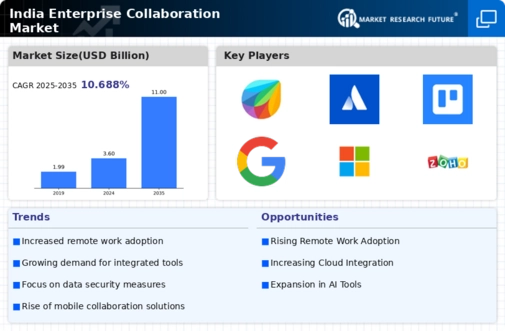
India Enterprise Collaboration Market Infographic
Purchase Options

India Enterprise Collaboration Market Summary

As per analysis, the India Enterprise Collaboration Market is projected to grow from USD 3.45 Billion in 2025 to USD 9.59 Billion by 2035, exhibiting a compound annual growth rate (CAGR) of 10.75% during the forecast period (2025 - 2035).

Key Market Trends & Highlights

The India enterprise collaboration market is experiencing robust growth driven by technological advancements and evolving workplace dynamics.

  • The document collaboration segment remains the largest, reflecting a strong demand for efficient file sharing and editing solutions.
  • Communication tools are the fastest-growing segment, indicating a shift towards real-time interaction and connectivity among teams.
  • Small enterprises dominate the market, yet large enterprises are emerging as the fastest-growing segment, highlighting diverse needs across business sizes.
  • Key market drivers include the growing demand for remote work solutions and government initiatives under the Digital India Program.

Market Size & Forecast

2024 Market Size 3.12 (USD Billion)
2035 Market Size 9.59 (USD Billion)
CAGR (2025 - 2035) 10.75%

Major Players

Microsoft (IN), Google (IN), Slack Technologies (US), Zoho Corporation (IN), Cisco Systems (US), Atlassian (AU), Trello (US), Salesforce (US), IBM (US)

Our Impact
Enabled $4.3B Revenue Impact for Fortune 500 and Leading Multinationals
Partnering with 2000+ Global Organizations Each Year
30K+ Citations by Top-Tier Firms in the Industry

India Enterprise Collaboration Market Trends

The India Enterprise Collaboration Market is currently experiencing a transformative phase, driven by the increasing need for organizations to enhance communication and streamline workflows. As businesses in India continue to embrace digital transformation, the demand for collaboration tools is on the rise. This shift is largely influenced by the growing emphasis on remote work and the necessity for teams to collaborate effectively, regardless of their physical locations. Furthermore, the integration of advanced technologies such as artificial intelligence and machine learning into collaboration platforms is reshaping how enterprises operate. These innovations not only improve efficiency but also foster a culture of collaboration among employees, which is essential for driving productivity and innovation. In addition, the government of India is actively promoting initiatives aimed at enhancing digital infrastructure, which further supports the growth of the india enterprise collaboration market. The push for smart cities and digital India initiatives is likely to create a conducive environment for the adoption of collaboration tools. As organizations increasingly recognize the value of seamless communication and teamwork, the market is poised for substantial growth. The focus on user-friendly interfaces and mobile accessibility is also expected to play a crucial role in attracting a wider user base, thereby expanding the market's reach and impact in the coming years.

Rise of Cloud-Based Solutions

The shift towards cloud-based collaboration tools is becoming increasingly prevalent in the india enterprise collaboration market. Organizations are recognizing the advantages of cloud technology, such as scalability, cost-effectiveness, and ease of access. This trend allows teams to collaborate in real-time, regardless of their geographical locations, thereby enhancing productivity and efficiency.

Integration of AI and Automation

The incorporation of artificial intelligence and automation into collaboration platforms is gaining traction within the india enterprise collaboration market. These technologies facilitate smarter workflows, enabling organizations to automate routine tasks and focus on strategic initiatives. This trend not only streamlines operations but also enhances decision-making processes.

Focus on Security and Compliance

As the india enterprise collaboration market expands, there is a growing emphasis on security and compliance measures. Organizations are increasingly prioritizing data protection and regulatory compliance to safeguard sensitive information. This trend reflects a broader awareness of the importance of maintaining trust and integrity in collaborative environments.

India Enterprise Collaboration Market Drivers

Integration of Advanced Technologies

The integration of advanced technologies such as artificial intelligence (AI) and machine learning (ML) is transforming the India enterprise collaboration market. These technologies enable organizations to automate routine tasks, analyze data, and enhance decision-making processes. For instance, AI-driven collaboration tools can provide insights into team performance and suggest improvements, thereby optimizing workflows. The market for AI in collaboration tools is projected to grow significantly, with estimates indicating a compound annual growth rate of over 30 percent in the coming years. As businesses increasingly adopt these technologies to improve collaboration and productivity, the enterprise collaboration market in India is likely to experience substantial growth. This trend reflects a broader shift towards leveraging technology to enhance business operations and drive innovation.

Growing Demand for Remote Work Solutions

The increasing demand for remote work solutions is a pivotal driver in the India enterprise collaboration market. As organizations adapt to flexible work arrangements, the need for robust collaboration tools has surged. According to recent data, approximately 70 percent of Indian companies have adopted remote work policies, necessitating platforms that facilitate seamless communication and project management. This trend is likely to continue, as businesses recognize the benefits of remote work in enhancing productivity and employee satisfaction. Consequently, the enterprise collaboration market in India is witnessing a significant uptick in the adoption of cloud-based collaboration tools, which enable teams to work together effectively, regardless of their physical location. This shift not only supports operational efficiency but also aligns with the broader digital transformation initiatives being pursued by many organizations across the country.

Emergence of Startups and Innovation Hubs

The emergence of startups and innovation hubs across India is a notable driver of the enterprise collaboration market. With a vibrant startup ecosystem, cities like Bengaluru, Hyderabad, and Pune are becoming hotspots for technological innovation. These startups often prioritize collaboration and communication, leading to the development of unique solutions tailored to specific industry needs. The rise of co-working spaces and incubators further fosters collaboration among startups, encouraging the sharing of ideas and resources. This dynamic environment is likely to stimulate demand for advanced collaboration tools, as startups seek to enhance their operational efficiency and scalability. Consequently, the enterprise collaboration market in India is expected to benefit from this influx of innovative solutions and the collaborative spirit inherent in the startup culture.

Government Initiatives and Digital India Program

Government initiatives, particularly the Digital India program, play a crucial role in propelling the India enterprise collaboration market. Launched to transform India into a digitally empowered society, this initiative emphasizes the importance of technology in enhancing governance and business operations. The government's focus on improving internet connectivity and digital infrastructure has created a conducive environment for the growth of collaboration tools. For instance, the National Broadband Mission aims to provide affordable internet access to all citizens, which is expected to boost the adoption of digital collaboration solutions. As more businesses leverage these tools to streamline operations and enhance communication, the enterprise collaboration market in India is poised for substantial growth. The alignment of government policies with industry needs suggests a promising future for collaboration technologies in the Indian business landscape.

Increased Focus on Employee Engagement and Collaboration

The heightened focus on employee engagement and collaboration is significantly influencing the India enterprise collaboration market. Organizations are increasingly recognizing that effective collaboration tools can enhance team dynamics and foster a culture of innovation. Research indicates that companies with high employee engagement levels experience 21 percent higher profitability. This realization is driving businesses to invest in collaboration platforms that facilitate real-time communication, knowledge sharing, and project management. As a result, the enterprise collaboration market in India is evolving to meet these demands, with a growing number of companies adopting tools that promote collaboration and engagement. This trend not only improves productivity but also contributes to employee retention, making it a critical driver for the market's growth.


Market Segment Insights

By Application: Document Collaboration (Largest) vs. Communication Tools (Fastest-Growing)

In the India enterprise collaboration market, the Application segment exhibits a dynamic distribution. Document Collaboration leads the way as the largest share, reflecting its essential role in business operations by enabling seamless team interactions and efficient workflow management. Following closely are Communication Tools, which have gained significant traction as organizations increasingly prioritize real-time collaboration to boost productivity and enhance team dynamics. As businesses adapt to new work environments, the growth trends in this segment are notable. Communication Tools have emerged as the fastest-growing segment, driven by the surge in remote work and the need for effective communication strategies. Meanwhile, Document Collaboration remains critical, yet it is being challenged by innovative solutions that integrate various application functionalities, paving the way for a more holistic approach to enterprise collaboration.

Document Collaboration (Dominant) vs. Communication Tools (Emerging)

Document Collaboration stands out as the dominant player in the India enterprise collaboration market, characterized by robust functionalities that facilitate group editing, version control, and secure sharing among teams. Its widespread adoption is reflective of the growing need for businesses to streamline document processes and improve collaborative efforts. On the other hand, Communication Tools represent an emerging segment, gaining momentum with features aimed at enhancing virtual interactions through instant messaging, video calls, and integration with other collaboration applications. The focus on user-friendly interfaces and mobile accessibility positions Communication Tools to become increasingly relevant. As organizations continue to refine their collaboration strategies, the convergence of these applications will be pivotal in shaping the future landscape of enterprise collaboration in India.

By End Use: Small Enterprises (Largest) vs. Large Enterprises (Fastest-Growing)

In the India enterprise collaboration market, small enterprises constitute the largest segment, benefiting from a growing focus on cost-effective collaboration tools tailored to their needs. This segment's strong adoption is fueled by the increasing digitization of operations and the necessity for effective team communication to drive productivity. Conversely, large enterprises are emerging as the fastest-growing segment within this market. As these companies expand and explore advanced collaboration solutions to enhance efficiency, their demand for integrated platforms is surging. This growth is also driven by the necessity to support remote working environments, necessitating seamless collaboration across diverse teams and locations.

Small Enterprises: Dominant vs. Large Enterprises: Emerging

The small enterprises segment is characterized by a high demand for affordable and user-friendly collaboration tools, allowing these businesses to improve their operational efficiency without significant investments. Various platforms are being customized to cater specifically to the limited resources available within these smaller establishments. In contrast, large enterprises, while currently emerging, are recognizing the need for sophisticated collaboration solutions that can handle complex workflows and support a larger workforce. These organizations are more inclined to invest in comprehensive tools that integrate communication, project management, and data sharing functionalities. As they scale, their collaboration needs become increasingly intricate, driving them to seek out solutions that offer customization, security, and scalability.

By Deployment Type: Cloud-Based (Largest) vs. On-Premises (Fastest-Growing)

In the India enterprise collaboration market, the deployment type segment is distinguished by a varied distribution of cloud-based, on-premises, and hybrid solutions. Cloud-based solutions lead the market due to their scalability, flexibility, and cost-effectiveness, attracting a significant number of organizations looking for efficient collaboration tools. On-premises solutions, although traditionally favored for their control and security, are steadily being overshadowed by cloud options, while hybrid models are increasingly gaining traction among enterprises seeking a balance between the two deployment types. The growth trends in this segment are largely driven by the increasing adoption of digital transformation strategies by organizations across India. Businesses are pivoting towards cloud-based deployments as they navigate the complexities of remote work and collaboration, while on-premises solutions are seeing a resurgence as companies focus on data security and compliance. Hybrid deployments are emerging as a preferred choice for enterprises seeking to leverage the benefits of both deployment types, fostering an environment of flexibility and innovation.

Cloud-Based (Dominant) vs. On-Premises (Emerging)

Cloud-based deployment solutions have established themselves as the dominant force in the India enterprise collaboration market due to their inherent advantages such as accessibility, cost-effectiveness, and the ability to support remote teams seamlessly. These solutions allow businesses to scale operations quickly and easily, promoting collaboration irrespective of geographical barriers. On the other hand, on-premises solutions are emerging as organizations prioritize data privacy, customization, and control over their collaboration tools. While these solutions cater more to organizations with stringent security requirements, they are increasingly integrating advanced functionalities to stay relevant. As firms weigh the pros and cons of each deployment, hybrid solutions are carving out a niche, providing a tailored approach that blends the strengths of both cloud-based and on-premises models.

By Industry: Information Technology (Largest) vs. Healthcare (Fastest-Growing)

In the India enterprise collaboration market, the Information Technology sector holds a significant share, positioning it as the largest segment. The proliferation of digital tools and platforms catering to IT companies underscores the demand for seamless collaboration solutions. With a focus on increasing productivity and efficiency, businesses in this sector have increasingly invested in advanced collaboration technologies, making it a prominent player in the market. Meanwhile, the Healthcare sector is emerging rapidly, recognized as the fastest-growing segment in enterprise collaboration. As healthcare providers adopt digital solutions for enhanced communication among staff, patients, and stakeholders, there is a notable rise in demand for collaboration tools that support telemedicine and patient management. This evolution within healthcare signifies not only growth but also a shift towards integrated and patient-centric collaboration environments.

IT (Dominant) vs. Healthcare (Emerging)

The Information Technology sector is a dominant player in the India enterprise collaboration market, characterized by its early adoption of advanced digital solutions. IT firms emphasize sophisticated tools that enable efficient project management, real-time communication, and cross-functional teamwork. The sector's long-term investments in collaboration technologies have established a strong foundation, allowing businesses to innovate continuously. On the other hand, the Healthcare sector, identified as an emerging market segment, exhibits unique characteristics driven by the need for efficient communication channels amid clinical environments. With significant investments in telehealth and digital patient care solutions, healthcare providers are evolving towards a collaborative approach that enhances care delivery. This segment is characterized by its focus on compliance with regulations, patient engagement, and the integration of technology to streamline workflows and improve health outcomes.

By User Type: Enterprise Users (Largest) vs. Team Users (Fastest-Growing)

In the Indian enterprise collaboration market, user types play a crucial role in shaping the ecosystem. Enterprise Users hold the largest market share, driven by large organizations seeking robust collaboration solutions to enhance productivity and communication. Their substantial adoption of collaborative tools has established them as the backbone of the market. Team Users, on the other hand, are witnessing rapid growth as organizations increasingly recognize the importance of teamwork and collaborative effort in achieving business goals. This segment is expanding rapidly, especially among small to medium enterprises that prioritize enhancing team efficiency and inter-departmental communication. The growth in the Team User segment can be attributed to the rising demand for flexible work environments and agile project management. Teams are now leveraging digital collaboration tools to streamline workflows, thus enabling faster decision-making and innovation. The increasing adoption of remote work and the gig economy in India has also contributed to the surge in Team Users, propelling the market towards more collaborative solutions that cater to diverse work styles and preferences.

Enterprise Users: Dominant vs. Team Users: Emerging

Enterprise Users in the Indian enterprise collaboration market represent large organizations that typically have extensive resources and complex communication needs. They rely on advanced collaboration tools that support high levels of security, scalability, and integration with other enterprise systems. This segment is characterized by a tendency to adopt platforms that can accommodate thousands of users and provide extensive features tailored for enterprise-level collaboration. Meanwhile, Team Users are emerging as a vibrant segment, particularly among startups and small businesses that prefer lightweight solutions. These users value ease of use and efficiency, often opting for tools that enhance real-time communication and project management. Overall, Team Users are adapting quickly to technology trends, focusing on tools that facilitate seamless collaboration in a more agile environment.

Get more detailed insights about India Enterprise Collaboration Market

Key Players and Competitive Insights

The enterprise collaboration market in India is characterized by a dynamic competitive landscape, driven by rapid technological advancements and an increasing demand for efficient communication tools. Major players such as Microsoft (IN), Google (IN), and Zoho Corporation (IN) are at the forefront, each adopting distinct strategies to enhance their market presence. Microsoft (IN) focuses on integrating AI capabilities into its collaboration tools, thereby enhancing user experience and productivity. Google (IN), on the other hand, emphasizes seamless integration across its suite of applications, fostering a collaborative ecosystem that appeals to businesses of all sizes. Zoho Corporation (IN) positions itself as a cost-effective alternative, targeting small and medium enterprises (SMEs) with a comprehensive suite of collaboration tools tailored to local needs. Collectively, these strategies contribute to a competitive environment that is increasingly centered around innovation and user-centric solutions.

In terms of business tactics, companies are increasingly localizing their offerings to better cater to the Indian market. This includes optimizing supply chains and enhancing customer support services. The market structure appears moderately fragmented, with a mix of established players and emerging startups vying for market share. The collective influence of these key players shapes the competitive dynamics, as they continuously innovate to meet the evolving demands of businesses.

In December 2025, Microsoft (IN) announced the launch of a new AI-driven feature within its Teams platform, aimed at enhancing real-time collaboration among remote teams. This strategic move underscores Microsoft's commitment to leveraging AI to improve user engagement and productivity, positioning it as a leader in the enterprise collaboration space. The introduction of such features is likely to attract more users, particularly in a market that increasingly values efficiency and innovation.

In November 2025, Google (IN) expanded its partnership with local telecom providers to enhance the connectivity of its collaboration tools. This initiative is significant as it aims to address connectivity issues faced by businesses in rural areas, thereby broadening its user base. By ensuring reliable access to its tools, Google (IN) strengthens its competitive position and demonstrates a commitment to inclusivity in the digital workspace.

In October 2025, Zoho Corporation (IN) launched a new suite of collaboration tools specifically designed for the Indian SME sector. This strategic initiative is crucial as it not only caters to a growing market segment but also reinforces Zoho's reputation as a local champion. By focusing on the unique needs of SMEs, Zoho (IN) is likely to enhance customer loyalty and drive market penetration.

As of January 2026, the enterprise collaboration market is witnessing trends such as increased digitalization, a focus on sustainability, and the integration of AI technologies. Strategic alliances among key players are shaping the competitive landscape, fostering innovation and enhancing service offerings. Looking ahead, it appears that competitive differentiation will increasingly hinge on technological innovation and supply chain reliability, rather than solely on price. This shift suggests a more nuanced approach to competition, where companies that prioritize innovation and customer-centric solutions are likely to thrive.

Key Companies in the India Enterprise Collaboration Market include

Industry Developments

The India Enterprise Collaboration Market has witnessed significant advancements in recent months. In October 2023, Microsoft announced enhancements to its Teams platform, integrating artificial intelligence features to improve the user experience. Similarly, in September 2023, Freshworks launched new collaboration tools aimed at boosting productivity in remote work settings. 

In terms of mergers and acquisitions, in August 2023, Cisco Systems acquired a leading audio and video conferencing technology company to enhance its collaboration offerings within the Indian market. Growth in this sector has been marked by increased demand for cloud-based collaboration tools; as businesses adapt to hybrid work models, companies like Slack Technologies and Zoho are seeing a surge in user adoption. 

Recent statistics indicate that the collaboration tools market in India was valued at USD 7 billion in 2023, marking a growth rate of 18% from the previous year. The Indian government has also emphasized the digital transformation agenda, further encouraging investment in collaboration technologies. Between 2021 and 2023, several companies, including Atlassian and Salesforce, expanded their operations in India, contributing to a vibrant ecosystem focused on enterprise collaboration and productivity solutions.

Future Outlook

India Enterprise Collaboration Market Future Outlook

The India enterprise collaboration market is poised for growth at 10.75% CAGR from 2025 to 2035, driven by digital transformation, remote work trends, and enhanced communication technologies.

New opportunities lie in:

  • Integration of AI-driven analytics for collaboration tools
  • Development of industry-specific collaboration platforms
  • Expansion of mobile collaboration solutions for remote teams

By 2035, the market is expected to be robust, reflecting substantial advancements in collaboration technologies.

Market Segmentation

India Enterprise Collaboration Market End Use Outlook

  • Small Enterprises
  • Medium Enterprises
  • Large Enterprises

India Enterprise Collaboration Market Industry Outlook

  • Information Technology
  • Healthcare
  • Education
  • Manufacturing

India Enterprise Collaboration Market User Type Outlook

  • Individual Users
  • Team Users
  • Enterprise Users

India Enterprise Collaboration Market Application Outlook

  • Project Management
  • Document Collaboration
  • Communication Tools
  • File Sharing
  • Task Management

India Enterprise Collaboration Market Deployment Type Outlook

  • Cloud-Based
  • On-Premises
  • Hybrid

Report Scope

MARKET SIZE 20243.12(USD Billion)
MARKET SIZE 20253.45(USD Billion)
MARKET SIZE 20359.59(USD Billion)
COMPOUND ANNUAL GROWTH RATE (CAGR)10.75% (2024 - 2035)
REPORT COVERAGERevenue Forecast, Competitive Landscape, Growth Factors, and Trends
BASE YEAR2024
Market Forecast Period2025 - 2035
Historical Data2019 - 2024
Market Forecast UnitsUSD Billion
Key Companies ProfiledMicrosoft (IN), Google (IN), Slack Technologies (US), Zoho Corporation (IN), Cisco Systems (US), Atlassian (AU), Trello (US), Salesforce (US), IBM (US)
Segments CoveredApplication, End Use, Deployment Type, Industry, User Type
Key Market OpportunitiesIntegration of artificial intelligence in the india enterprise collaboration market enhances productivity and streamlines communication.
Key Market DynamicsRising demand for integrated digital tools drives innovation in India's enterprise collaboration market.
Countries CoveredIndia
Leave a Comment

FAQs

What is the current valuation of the India enterprise collaboration market?

As of 2024, the market valuation was 3.12 USD Billion.

What is the projected market size for the India enterprise collaboration market by 2035?

The market is expected to reach a valuation of 9.59 USD Billion by 2035.

What is the expected CAGR for the India enterprise collaboration market during the forecast period 2025 - 2035?

The anticipated CAGR for the market during this period is 10.75%.

Which application segments are expected to show significant growth in the India enterprise collaboration market?

Project Management and Communication Tools are projected to grow from 0.78 to 2.34 USD Billion and 0.74 to 2.22 USD Billion, respectively.

How do small enterprises contribute to the India enterprise collaboration market?

Small enterprises had a market size of 0.93 USD Billion in 2024, which is expected to grow to 2.79 USD Billion.

What deployment types are gaining traction in the India enterprise collaboration market?

Cloud-Based deployment is projected to grow from 1.56 to 4.73 USD Billion, indicating a strong preference for this model.

Which industries are leading in the adoption of enterprise collaboration tools in India?

The Information Technology sector is expected to grow from 1.24 to 3.73 USD Billion, leading the market.

What user types are driving the growth of the India enterprise collaboration market?

Enterprise Users are projected to increase from 1.45 to 4.59 USD Billion, indicating a strong demand in larger organizations.

Who are the key players in the India enterprise collaboration market?

Key players include Microsoft, Google, Slack Technologies, Zoho Corporation, and Cisco Systems.

What is the expected growth trajectory for the document collaboration segment in the India enterprise collaboration market?

The document collaboration segment is projected to grow from 0.62 to 1.86 USD Billion, reflecting increasing demand.

Download Free Sample

Kindly complete the form below to receive a free sample of this Report

Compare Licence

×
Features License Type
Single User Multiuser License Enterprise User
Price $4,950 $5,950 $7,250
Maximum User Access Limit 1 User Upto 10 Users Unrestricted Access Throughout the Organization
Free Customization
Direct Access to Analyst
Deliverable Format
Platform Access
Discount on Next Purchase 10% 15% 15%
Printable Versions