×
Request Free Sample ×

Kindly complete the form below to receive a free sample of this Report

* Please use a valid business email

Leading companies partner with us for data-driven Insights

clients tt-cursor
Hero Background
English
Chinese
French
Japanese
Korean
German
Spanish

Multimedia Chipset Market Trends

ID: MRFR/SEM/3923-HCR
100 Pages
Ankit Gupta
February 2026

Multimedia Chipset Market Size, Share and Research Report By Type (Auto Chipsets and Graphic Chipsets), By Application (Digital Cable TV, Set-Top Box, IPTV, Home Media Player, Handheld Devices, and Others), By End-Users (Customers Electronics, IT & Telecommunications, Media & Entertainment, Government, and Others), And By Region (North America, Europe, Asia-Pacific, And Rest Of The World) –Industry Forecast Till 2035

Share:
Download PDF ×

We do not share your information with anyone. However, we may send you emails based on your report interest from time to time. You may contact us at any time to opt-out.

Multimedia Chipset Market Infographic
Purchase Options

Market Trends

Key Emerging Trends in the Multimedia Chipset Market

The Multimedia Chipset Market is experiencing dynamic shifts influenced by technological advancements and changing consumer behaviors. Over recent years, there has been a significant surge in demand for multimedia chipsets, driven by the proliferation of digital content consumption across various devices. One of the prevailing trends in the market is the increasing focus on high-performance graphics processing units (GPUs) to meet the demands of modern applications such as gaming, video editing, and virtual reality. As consumers seek more immersive and visually stunning experiences, manufacturers are investing in the development of powerful multimedia chipsets that can handle complex graphics rendering and deliver seamless performance.

The rise of 5G technology is playing a pivotal role in shaping the Multimedia Chipset Market. With the rollout of 5G networks, there is a growing need for chipsets that can support faster data speeds and low latency for multimedia streaming and real-time applications. This trend extends beyond smartphones to other connected devices, including smart TVs, IoT devices, and automotive entertainment systems, where high-speed connectivity is becoming a crucial requirement.

Another notable trend is the integration of artificial intelligence (AI) capabilities into multimedia chipsets. AI-enhanced chipsets are being increasingly adopted to enable features such as image and voice recognition, intelligent scene detection, and content optimization. This integration not only enhances the overall user experience but also contributes to the development of smarter and more responsive multimedia devices.

The Multimedia Chipset Market is also witnessing a shift towards energy-efficient designs. As environmental consciousness grows, manufacturers are developing chipsets that prioritize power efficiency without compromising on performance. This trend aligns with the broader industry push towards sustainability and green computing, where energy-efficient chipsets play a crucial role in reducing the carbon footprint of electronic devices.

Furthermore, the convergence of multimedia technologies with augmented reality (AR) and virtual reality (VR) is driving innovation in the market. Chipsets with enhanced graphics capabilities and specialized processing units for AR and VR applications are in high demand. This trend is evident in various sectors, including gaming, education, healthcare, and enterprise, where AR and VR technologies are increasingly being integrated for training, simulation, and immersive experiences.

The demand for multimedia chipsets is also being shaped by the evolving landscape of content creation and consumption. With the rise of user-generated content on platforms like social media and streaming services, there is a growing need for chipsets that can support high-quality video capture, encoding, and streaming. Manufacturers are responding to this trend by developing chipsets with advanced video processing capabilities and improved camera functionalities.

Moreover, the COVID-19 pandemic has accelerated the adoption of multimedia chipsets, particularly in the context of remote work and virtual collaboration. The increased reliance on video conferencing and online communication has led to a surge in demand for devices equipped with high-quality multimedia capabilities, driving innovation in webcam technology, audio processing, and overall multimedia performance.

The main reasons behind the growth of the global multimedia chipsets market include contributions from companies like NVIDIA Corporation, Intel Corporation, Qualcomm Inc., Cirrus Logic Inc., Advanced Micro Devices Inc., DSP Group, Inc., Apple Inc., and Broadcom Corporation. These companies play a significant role in offering multimedia chipset solutions. Another factor driving growth is the increasing demand for Internet Protocol Television (IPTV), which is experiencing a significant boost in the multimedia chipset sector. The rise in Internet connectivity and IPTV are gaining momentum and are major contributors to the growing multimedia chipset market.


Author
Ankit Gupta
Team Lead - Research

Ankit Gupta is a seasoned market intelligence and strategic research professional with over six plus years of experience in the ICT and Semiconductor industries. With academic roots in Telecom, Marketing, and Electronics, he blends technical insight with business strategy. Ankit has led 200+ projects, including work for Fortune 500 clients like Microsoft and Rio Tinto, covering market sizing, tech forecasting, and go-to-market strategies. Known for bridging engineering and enterprise decision-making, his insights support growth, innovation, and investment planning across diverse technology markets.

Leave a Comment

FAQs

What is the projected market valuation of the Multimedia Chipset Market by 2035?

<p>The Multimedia Chipset Market is projected to reach a valuation of 67.54 USD Billion by 2035.</p>

What was the market valuation of the Multimedia Chipset Market in 2024?

<p>In 2024, the Multimedia Chipset Market was valued at 37.51 USD Billion.</p>

What is the expected CAGR for the Multimedia Chipset Market during the forecast period 2025 - 2035?

<p>The expected CAGR for the Multimedia Chipset Market during the forecast period 2025 - 2035 is 5.49%.</p>

Which companies are considered key players in the Multimedia Chipset Market?

<p>Key players in the Multimedia Chipset Market include Qualcomm, NVIDIA, Intel, Broadcom, MediaTek, Samsung, Texas Instruments, Analog Devices, and STMicroelectronics.</p>

What are the projected valuations for auto chipsets and graphic chipsets by 2035?

<p>By 2035, auto chipsets are projected to reach 27.0 USD Billion, while graphic chipsets may reach 40.54 USD Billion.</p>

What applications are driving growth in the Multimedia Chipset Market?

<p>Applications such as digital cable TV, set-top boxes, IPTV, home media players, and handheld devices are driving growth, with handheld devices projected to reach 18.0 USD Billion by 2035.</p>

How do the end-user segments of the Multimedia Chipset Market compare in terms of projected growth?

End-user segments like consumer electronics and IT &amp; telecommunications are expected to grow, with consumer electronics projected to reach 18.0 USD Billion by 2035.

What is the expected growth trajectory for the Multimedia Chipset Market from 2024 to 2035?

The Multimedia Chipset Market is expected to grow from 37.51 USD Billion in 2024 to 67.54 USD Billion by 2035.

Which segment is anticipated to have the highest valuation by 2035 in the Multimedia Chipset Market?

The graphic chipsets segment is anticipated to have the highest valuation, potentially reaching 40.54 USD Billion by 2035.

What role do major companies play in shaping the Multimedia Chipset Market?

Major companies like Qualcomm and NVIDIA play a crucial role in shaping the Multimedia Chipset Market through innovation and competitive strategies.

Market Summary

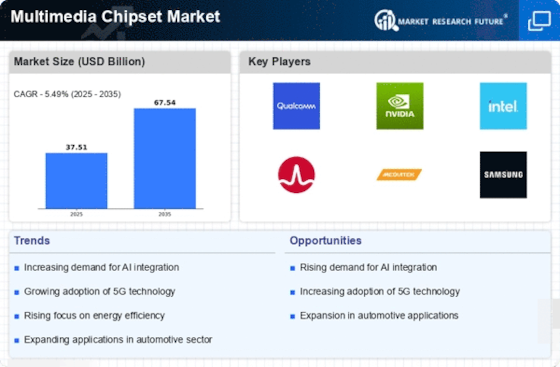
As per Market Research Future analysis, the Multimedia Chipset Market Size was estimated at 37.51 USD Billion in 2024. The Multimedia Chipset industry is projected to grow from 39.57 USD Billion in 2025 to 67.54 USD Billion by 2035, exhibiting a compound annual growth rate (CAGR) of 5.49% during the forecast period 2025 - 2035

Key Market Trends & Highlights

The Multimedia Chipset Market is poised for substantial growth driven by technological advancements and evolving consumer demands.

  • The integration of AI capabilities is transforming multimedia chipsets, enhancing performance and functionality. North America remains the largest market, while Asia-Pacific is emerging as the fastest-growing region in multimedia chipsets. Graphic chipsets dominate the market, whereas auto chipsets are experiencing rapid growth due to increasing automotive technology demands. The surge in demand for high-definition content and advancements in mobile technology are key drivers propelling market expansion.

Market Size & Forecast

2024 Market Size 37.51 (USD Billion)
2035 Market Size 67.54 (USD Billion)
CAGR (2025 - 2035) 5.49%
Largest Regional Market Share in 2024 North America

Major Players

Qualcomm (US), NVIDIA (US), Intel (US), Broadcom (US), MediaTek (TW), Samsung (KR), Texas Instruments (US), Analog Devices (US), STMicroelectronics (FR)

Market Trends

The Multimedia Chipset Market is currently experiencing a dynamic evolution, driven by the increasing demand for high-performance computing and advanced multimedia applications. As technology progresses, the integration of multimedia functionalities into various devices has become more prevalent. This trend is particularly evident in consumer electronics, where the need for enhanced audio and video processing capabilities is paramount. Furthermore, the rise of smart devices and the Internet of Things (IoT) has further propelled the necessity for sophisticated chipsets that can handle complex multimedia tasks efficiently. Manufacturers are focusing on innovation to meet these demands, leading to a competitive landscape characterized by rapid advancements in chipset design and functionality. In addition to consumer electronics, the Multimedia Chipset Market is also influenced by the growing adoption of artificial intelligence and machine learning technologies. These advancements necessitate chipsets that can support real-time data processing and analysis, thereby enhancing user experiences across various applications. The market appears poised for continued growth as companies invest in research and development to create next-generation multimedia solutions. As the industry evolves, collaboration between hardware and software developers is likely to play a crucial role in shaping the future of multimedia chipsets, ensuring they remain at the forefront of technological innovation.

Integration of AI Capabilities

The Multimedia Chipset Market is witnessing a notable trend towards the integration of artificial intelligence capabilities. This development allows chipsets to perform complex tasks such as image recognition and natural language processing, enhancing the overall functionality of devices. As AI becomes more prevalent, the demand for chipsets that can efficiently handle these processes is likely to increase.

Rise of Smart Devices

The proliferation of smart devices is significantly impacting the Multimedia Chipset Market. With more consumers adopting smart home technologies and wearable devices, there is a growing need for chipsets that can support seamless multimedia experiences. This trend suggests that manufacturers must prioritize the development of versatile and efficient chipsets to cater to this expanding market.

Focus on Energy Efficiency

Energy efficiency is emerging as a critical consideration within the Multimedia Chipset Market. As environmental concerns grow, there is a push for chipsets that consume less power while delivering high performance. This trend indicates a shift towards sustainable technology solutions, prompting manufacturers to innovate in ways that reduce energy consumption without compromising functionality.

Multimedia Chipset Market Market Drivers

Emergence of 5G Technology

The emergence of 5G technology is a pivotal driver for the Multimedia Chipset Market, as it facilitates faster data transmission and improved connectivity. This advancement enables the streaming of high-quality multimedia content without buffering, enhancing user experiences across various devices. Market forecasts indicate that the rollout of 5G networks will lead to a substantial increase in the demand for multimedia chipsets, particularly in sectors such as telecommunications and entertainment. As 5G technology becomes more widespread, the Multimedia Chipset Market is likely to see a significant uptick in sales, as manufacturers adapt their products to leverage the benefits of this next-generation connectivity.

Advancements in Mobile Technology

Advancements in mobile technology significantly influence the Multimedia Chipset Market, as smartphones and tablets increasingly become primary devices for media consumption. The integration of powerful multimedia chipsets in these devices enhances their capabilities, allowing for seamless playback of high-quality audio and video. Market data suggests that the smartphone segment alone accounts for over 50% of the total multimedia chipset sales, highlighting the critical role of mobile technology in driving market growth. As manufacturers continue to innovate and improve the performance of mobile devices, the demand for advanced multimedia chipsets is likely to rise, further propelling the Multimedia Chipset Market.

Increased Focus on Smart Home Devices

The increased focus on smart home devices is reshaping the Multimedia Chipset Market, as these devices require advanced chipsets to support various multimedia functionalities. With the rise of smart speakers, smart TVs, and home automation systems, the demand for multimedia chipsets that can handle voice recognition, video streaming, and other multimedia tasks is on the rise. Market data suggests that the smart home segment is projected to grow at a CAGR of approximately 15% over the next few years, indicating a robust opportunity for manufacturers in the Multimedia Chipset Market. This trend highlights the necessity for innovation in multimedia chipsets to meet the diverse needs of smart home applications.

Surge in Demand for High-Definition Content

The Multimedia Chipset Market experiences a notable surge in demand for high-definition content, driven by the proliferation of streaming services and the increasing consumption of 4K and 8K video formats. As consumers seek enhanced viewing experiences, manufacturers are compelled to innovate and produce chipsets that support higher resolutions and improved image quality. This trend is reflected in the market data, which indicates that the demand for multimedia chipsets capable of processing high-definition content is expected to grow at a compound annual growth rate (CAGR) of approximately 12% over the next five years. Consequently, companies within the Multimedia Chipset Market are investing heavily in research and development to meet these evolving consumer preferences.

Growth of Augmented and Virtual Reality Applications

The Multimedia Chipset Market is poised for growth due to the rising popularity of augmented reality (AR) and virtual reality (VR) applications. These technologies require sophisticated multimedia chipsets to deliver immersive experiences, which has led to increased investment in the development of specialized chipsets. Market analysis indicates that the AR and VR segment is expected to witness a CAGR of around 25% in the coming years, as more industries, including gaming, education, and healthcare, adopt these technologies. This trend underscores the importance of multimedia chipsets in enabling high-performance applications, thereby driving the Multimedia Chipset Market forward.

Market Segment Insights

By Type: Graphic Chipsets (Largest) vs. Auto Chipsets (Fastest-Growing)

<p>The Multimedia Chipset Market is evolving with two primary segments: graphic chipsets and auto chipsets. Graphic chipsets hold the largest market share, largely due to their extensive use in gaming and professional graphic applications. This part of the market has been driven by innovations in graphics technology, leading to enhanced performance and quality, which appeals to gamers and designers alike. Conversely, auto chipsets are gaining traction, reflecting a growing trend of advanced driver-assistance systems (ADAS) and in-vehicle infotainment systems. As vehicles become increasingly connected and automated, the demand for reliable auto chipsets continues to rise.</p>

<p>Chipsets: Graphic (Dominant) vs. Auto (Emerging)</p>

<p>Graphic chipsets, dominating the Multimedia Chipset Market, are designed to process and render graphics efficiently, catering to both consumer and enterprise sectors. They are integral in gaming consoles and high-end computers, where performance is paramount. Advanced features such as ray tracing and machine learning capabilities have solidified their lead. On the other hand, auto chipsets are emerging as essential components in modern vehicles, facilitating superior connectivity, entertainment options, and safety features. The rise of electric and autonomous vehicles has propelled the development and integration of these chipsets. Their adaptability and compatibility with various automotive systems highlight their crucial role in future mobility solutions.</p>

By Application: Digital Cable TV (Largest) vs. Set-Top Box (Fastest-Growing)

<p>The Multimedia Chipset Market exhibits a diverse application landscape, with 'Digital cable TV' commanding the largest market share. This segment thrives on the increasing demand for high-definition television and advanced viewing experiences. Following closely, the 'Set-top box' segment is also significant, bolstered by the growing trend of over-the-top content and streaming services, enhancing its competitive position. Other segments like 'IPTV' and 'Home media players' maintain noteworthy shares, catering to distinct consumer preferences for digital entertainment.</p>

<p>Digital Cable TV (Dominant) vs. Set-Top Box (Emerging)</p>

<p>In the Multimedia Chipset Market, 'Digital cable TV' stands out as a dominant application, leveraging its established infrastructure and subscriber base to maintain a competitive edge. This segment benefits from continuous enhancements in technology, enabling high-quality audio and video delivery. Conversely, 'Set-top boxes' represent an emerging force within the market, fueled by the proliferation of streaming services and consumer shifts towards on-demand content consumption. This trend drives innovation in set-top box functionalities, catering to diverse media formats, enhancing user experience, and expanding accessibility to a broader audience.</p>

By End-Users: Consumer Electronics (Largest) vs. Media & Entertainment (Fastest-Growing)

<p>The Multimedia Chipset Market showcases diverse end-user applications, with Consumer Electronics leading in market share. This segment includes devices such as smartphones, tablets, and televisions, which are continually integrated with advanced multimedia features. The IT & Telecommunications segment follows, driven by the need for enhanced connectivity and performance. Media & Entertainment has emerged as a vital segment, while Government and Others collectively make up a smaller share, indicating specific and niche applications within distinct markets.</p>

<p>Consumer Electronics (Dominant) vs. Media & Entertainment (Emerging)</p>

<p>The Consumer Electronics segment stands as the dominant force in the Multimedia Chipset Market. It encompasses a wide array of products that incorporate cutting-edge multimedia chipsets to offer superior audio and visual experiences. Innovations such as 4K and 8K resolutions, augmented reality, and interactive features have solidified its lead. Conversely, the Media & Entertainment sector is rapidly emerging, fueled by increasing demand for streaming services and high-quality content consumption. This sector is characterized by a swift adoption of multimedia technologies to support enhanced user experiences through gaming, virtual reality, and smart media devices.</p>

Get more detailed insights about Multimedia Chipset Market Research Report- Forecast to 2035

Regional Insights

North America : Innovation and Leadership Hub

North America is the largest market for multimedia chipsets, holding approximately 45% of the global share. The region's growth is driven by rapid technological advancements, increasing demand for high-performance devices, and supportive regulatory frameworks. The presence of major tech companies and a robust infrastructure further catalyze market expansion, with a focus on innovation and R&D investments. The United States leads the market, with key players like Qualcomm, NVIDIA, and Intel driving competition. The competitive landscape is characterized by continuous innovation and strategic partnerships. The region's emphasis on developing next-generation technologies, such as AI and IoT, positions it as a leader in the multimedia chipset sector, ensuring sustained growth and market relevance.

Europe : Emerging Market with Potential

Europe is witnessing significant growth in the multimedia chipset market, accounting for around 25% of the global share. The region's demand is fueled by increasing consumer electronics usage, advancements in automotive technology, and a strong push towards digital transformation. Regulatory support for innovation and sustainability initiatives also plays a crucial role in market dynamics, fostering a conducive environment for growth. Leading countries include Germany, France, and the UK, where companies like STMicroelectronics and MediaTek are prominent. The competitive landscape is evolving, with a focus on collaboration between tech firms and research institutions. This synergy is essential for developing cutting-edge solutions that meet the growing demands of consumers and industries alike.

Asia-Pacific : Rapid Growth and Adoption

Asia-Pacific is rapidly emerging as a powerhouse in the multimedia chipset market, holding approximately 20% of the global share. The region's growth is driven by increasing smartphone penetration, rising demand for smart home devices, and significant investments in 5G technology. Government initiatives aimed at boosting local manufacturing and innovation further support market expansion, making it a key player in the global landscape. Countries like China, South Korea, and Japan are at the forefront, with major companies such as Samsung and MediaTek leading the charge. The competitive environment is marked by aggressive pricing strategies and a focus on technological advancements. As the region continues to innovate, it is poised to capture a larger market share in the coming years, driven by consumer demand and technological evolution.

Middle East and Africa : Emerging Market with Challenges

The Middle East and Africa region is gradually emerging in the multimedia chipset market, currently holding about 10% of the global share. The growth is primarily driven by increasing smartphone adoption, expanding internet connectivity, and government initiatives aimed at enhancing digital infrastructure. However, challenges such as economic instability and limited local manufacturing capabilities hinder faster growth, necessitating strategic investments and partnerships. Countries like South Africa and the UAE are leading the market, with a growing presence of international players. The competitive landscape is characterized by a mix of local and global companies striving to meet the rising demand for multimedia solutions. As the region invests in technology and infrastructure, it is expected to see significant growth in the multimedia chipset sector in the coming years.

Key Players and Competitive Insights

Leading market players are investing heavily in research and development to expand their product lines, which will help the multimedia chipset market grow even more. There are some strategies for action that market participants are implementing to increase their presence around the world's global footprint, with important market developments including new product launches, contractual agreements and acquisitions, higher investments, and collaboration with other organizations. To expand and survive in a more competitive and rising market climate, the multimedia chipset industry must offer cost-effective items.Manufacturing locally to minimize operational costs is one of the key business tactics manufacturer use in the global multimedia chipset industry to benefit clients and increase the market sector. In recent years, the multimedia chipset industry has offered some of the most significant technological advancements.Major players in the multimedia chipset market, including NVIDIA Corporation (U.S.), Intel Corporation (U.S.), Realtek Semiconductor Corp (Taiwan), Qualcomm Inc. (U.S.), Cirrus Logic Inc. (U.S.), Advanced Micro Devices Inc. (U.S.), DSP Group, Inc. (U.S.), Apple Inc. (U.S.), Broadcom Corporation (U.S.), Marvell Technology Group, Limited (U.S.), Samsung Group (South Korea), Actions Semiconductor Co., Ltd. (China), MediaTek Inc. (Taiwan), NXP Semiconductors, N.V. (Netherlands), STMicroelectronics (Switzerland), and others are attempting to grow market demand by investing in research and development operations.NVIDIA created accelerated computing to solve issues that no one else can. Our work in AI and the metaverse, which has a tremendous impact on society, is transforming the biggest industries in the world. Since its founding in 1993, NVIDIA has dominated the field of accelerated computing. The company's 1999 release of the GPU ushered in the current era of artificial intelligence, revolutionized computer graphics, and is fueling the growth of the metaverse. It also fueled the growth of the PC gaming industry.NVIDIA is now a full-stack computing company that is revolutionizing the market with its products at the size of data centers.

In March Nvidia recently introduced a collection of cloud services to assist companies in creating and using generative AI models built for "domain-specific tasks," such as composing ad text and training on unique data.Intel is a market leader, developing technology that transforms the world and improves people's lives. Inspired by Moore's Law, we strive to improve semiconductor design and production to meet our client's most pressing needs. We unleash the power of data to improve business and society by integrating intelligence into every computing device, including the cloud, network, edge, and edge computing. The goal of Intel is to influence technology's development so that everyone on the planet can live in better times. Intel has advanced numerous industries, including artificial intelligence, analytics, and cloud-to-edge technology.

In February Intel announced the start of the Intel® Connectivity Analytics program to help wireless solution providers develop special networking and system insights – from network health and security to customer experience and service quality – to deliver better customer apps and services.

Key Companies in the Multimedia Chipset Market include

Industry Developments

February 2023: Microsoft and Intel are advancing the development of artificial intelligence (AI) on personal computers. The AI-enabled capabilities of Intel's forthcoming Meteor Lake client PC CPUs are also being previewed at Microsoft's Build 2023 conference.

May 2023: Qualcomm Technologies, Inc. showcased its latest developments in on-device AI, including generative AI operating on Snapdragon compute platforms and new development channels for programmers creating applications for Snapdragon-powered Windows 11 PCs.

Future Outlook

Multimedia Chipset Market Future Outlook

The Multimedia Chipset Market is projected to grow at a 5.49% CAGR from 2025 to 2035, driven by advancements in AI integration, increased demand for high-definition content, and the proliferation of smart devices.

New opportunities lie in:

  • Development of AI-optimized multimedia chipsets for enhanced processing capabilities.</p><p>Expansion into emerging markets with tailored multimedia solutions for local needs.</p><p>Partnerships with content providers to create integrated hardware-software ecosystems.

By 2035, the Multimedia Chipset Market is expected to achieve robust growth, solidifying its position as a key technology driver.

Market Segmentation

Multimedia Chipset Market Type Outlook

  • Auto chipsets
  • Graphic chipsets

Multimedia Chipset Market End-Users Outlook

  • Customer electronics
  • IT & Telecommunications
  • Media & Entertainment
  • Government
  • Others

Multimedia Chipset Market Application Outlook

  • Digital cable TV
  • Set-top box
  • IPTV
  • Home media player
  • Handheld devices
  • Others

Report Scope

MARKET SIZE 2024 37.51(USD Billion)
MARKET SIZE 2025 39.57(USD Billion)
MARKET SIZE 2035 67.54(USD Billion)
COMPOUND ANNUAL GROWTH RATE (CAGR) 5.49% (2025 - 2035)
REPORT COVERAGE Revenue Forecast, Competitive Landscape, Growth Factors, and Trends
BASE YEAR 2024
Market Forecast Period 2025 - 2035
Historical Data 2019 - 2024
Market Forecast Units USD Billion
Key Companies Profiled Qualcomm (US), NVIDIA (US), Intel (US), Broadcom (US), MediaTek (TW), Samsung (KR), Texas Instruments (US), Analog Devices (US), STMicroelectronics (FR)
Segments Covered Type, Application, End-Users, Region
Key Market Opportunities Integration of artificial intelligence in multimedia chipsets enhances performance and user experience.
Key Market Dynamics Technological advancements drive competition in the Multimedia Chipset Market, influencing consumer preferences and product innovation.
Countries Covered North America, Europe, APAC, South America, MEA

FAQs

What is the projected market valuation of the Multimedia Chipset Market by 2035?

<p>The Multimedia Chipset Market is projected to reach a valuation of 67.54 USD Billion by 2035.</p>

What was the market valuation of the Multimedia Chipset Market in 2024?

<p>In 2024, the Multimedia Chipset Market was valued at 37.51 USD Billion.</p>

What is the expected CAGR for the Multimedia Chipset Market during the forecast period 2025 - 2035?

<p>The expected CAGR for the Multimedia Chipset Market during the forecast period 2025 - 2035 is 5.49%.</p>

Which companies are considered key players in the Multimedia Chipset Market?

<p>Key players in the Multimedia Chipset Market include Qualcomm, NVIDIA, Intel, Broadcom, MediaTek, Samsung, Texas Instruments, Analog Devices, and STMicroelectronics.</p>

What are the projected valuations for auto chipsets and graphic chipsets by 2035?

<p>By 2035, auto chipsets are projected to reach 27.0 USD Billion, while graphic chipsets may reach 40.54 USD Billion.</p>

What applications are driving growth in the Multimedia Chipset Market?

<p>Applications such as digital cable TV, set-top boxes, IPTV, home media players, and handheld devices are driving growth, with handheld devices projected to reach 18.0 USD Billion by 2035.</p>

How do the end-user segments of the Multimedia Chipset Market compare in terms of projected growth?

End-user segments like consumer electronics and IT &amp; telecommunications are expected to grow, with consumer electronics projected to reach 18.0 USD Billion by 2035.

What is the expected growth trajectory for the Multimedia Chipset Market from 2024 to 2035?

The Multimedia Chipset Market is expected to grow from 37.51 USD Billion in 2024 to 67.54 USD Billion by 2035.

Which segment is anticipated to have the highest valuation by 2035 in the Multimedia Chipset Market?

The graphic chipsets segment is anticipated to have the highest valuation, potentially reaching 40.54 USD Billion by 2035.

What role do major companies play in shaping the Multimedia Chipset Market?

Major companies like Qualcomm and NVIDIA play a crucial role in shaping the Multimedia Chipset Market through innovation and competitive strategies.

  1. SECTION I: EXECUTIVE SUMMARY AND KEY HIGHLIGHTS
    1. | 1.1 EXECUTIVE SUMMARY
    2. | | 1.1.1 Market Overview
    3. | | 1.1.2 Key Findings
    4. | | 1.1.3 Market Segmentation
    5. | | 1.1.4 Competitive Landscape
    6. | | 1.1.5 Challenges and Opportunities
    7. | | 1.1.6 Future Outlook
  2. SECTION II: SCOPING, METHODOLOGY AND MARKET STRUCTURE
    1. | 2.1 MARKET INTRODUCTION
    2. | | 2.1.1 Definition
    3. | | 2.1.2 Scope of the study
    4. | | | 2.1.2.1 Research Objective
    5. | | | 2.1.2.2 Assumption
    6. | | | 2.1.2.3 Limitations
    7. | 2.2 RESEARCH METHODOLOGY
    8. | | 2.2.1 Overview
    9. | | 2.2.2 Data Mining
    10. | | 2.2.3 Secondary Research
    11. | | 2.2.4 Primary Research
    12. | | | 2.2.4.1 Primary Interviews and Information Gathering Process
    13. | | | 2.2.4.2 Breakdown of Primary Respondents
    14. | | 2.2.5 Forecasting Model
    15. | | 2.2.6 Market Size Estimation
    16. | | | 2.2.6.1 Bottom-Up Approach
    17. | | | 2.2.6.2 Top-Down Approach
    18. | | 2.2.7 Data Triangulation
    19. | | 2.2.8 Validation
  3. SECTION III: QUALITATIVE ANALYSIS
    1. | 3.1 MARKET DYNAMICS
    2. | | 3.1.1 Overview
    3. | | 3.1.2 Drivers
    4. | | 3.1.3 Restraints
    5. | | 3.1.4 Opportunities
    6. | 3.2 MARKET FACTOR ANALYSIS
    7. | | 3.2.1 Value chain Analysis
    8. | | 3.2.2 Porter's Five Forces Analysis
    9. | | | 3.2.2.1 Bargaining Power of Suppliers
    10. | | | 3.2.2.2 Bargaining Power of Buyers
    11. | | | 3.2.2.3 Threat of New Entrants
    12. | | | 3.2.2.4 Threat of Substitutes
    13. | | | 3.2.2.5 Intensity of Rivalry
    14. | | 3.2.3 COVID-19 Impact Analysis
    15. | | | 3.2.3.1 Market Impact Analysis
    16. | | | 3.2.3.2 Regional Impact
    17. | | | 3.2.3.3 Opportunity and Threat Analysis
  4. SECTION IV: QUANTITATIVE ANALYSIS
    1. | 4.1 Semiconductor & Electronics, BY Type (USD Billion)
    2. | | 4.1.1 Auto chipsets
    3. | | 4.1.2 Graphic chipsets
    4. | 4.2 Semiconductor & Electronics, BY Application (USD Billion)
    5. | | 4.2.1 Digital cable TV
    6. | | 4.2.2 Set-top box
    7. | | 4.2.3 IPTV
    8. | | 4.2.4 Home media player
    9. | | 4.2.5 Handheld devices
    10. | | 4.2.6 Others
    11. | 4.3 Semiconductor & Electronics, BY End-Users (USD Billion)
    12. | | 4.3.1 Customer electronics
    13. | | 4.3.2 IT & Telecommunications
    14. | | 4.3.3 Media & Entertainment
    15. | | 4.3.4 Government
    16. | | 4.3.5 Others
    17. | 4.4 Semiconductor & Electronics, BY Region (USD Billion)
    18. | | 4.4.1 North America
    19. | | | 4.4.1.1 US
    20. | | | 4.4.1.2 Canada
    21. | | 4.4.2 Europe
    22. | | | 4.4.2.1 Germany
    23. | | | 4.4.2.2 UK
    24. | | | 4.4.2.3 France
    25. | | | 4.4.2.4 Russia
    26. | | | 4.4.2.5 Italy
    27. | | | 4.4.2.6 Spain
    28. | | | 4.4.2.7 Rest of Europe
    29. | | 4.4.3 APAC
    30. | | | 4.4.3.1 China
    31. | | | 4.4.3.2 India
    32. | | | 4.4.3.3 Japan
    33. | | | 4.4.3.4 South Korea
    34. | | | 4.4.3.5 Malaysia
    35. | | | 4.4.3.6 Thailand
    36. | | | 4.4.3.7 Indonesia
    37. | | | 4.4.3.8 Rest of APAC
    38. | | 4.4.4 South America
    39. | | | 4.4.4.1 Brazil
    40. | | | 4.4.4.2 Mexico
    41. | | | 4.4.4.3 Argentina
    42. | | | 4.4.4.4 Rest of South America
    43. | | 4.4.5 MEA
    44. | | | 4.4.5.1 GCC Countries
    45. | | | 4.4.5.2 South Africa
    46. | | | 4.4.5.3 Rest of MEA
  5. SECTION V: COMPETITIVE ANALYSIS
    1. | 5.1 Competitive Landscape
    2. | | 5.1.1 Overview
    3. | | 5.1.2 Competitive Analysis
    4. | | 5.1.3 Market share Analysis
    5. | | 5.1.4 Major Growth Strategy in the Semiconductor & Electronics
    6. | | 5.1.5 Competitive Benchmarking
    7. | | 5.1.6 Leading Players in Terms of Number of Developments in the Semiconductor & Electronics
    8. | | 5.1.7 Key developments and growth strategies
    9. | | | 5.1.7.1 New Product Launch/Service Deployment
    10. | | | 5.1.7.2 Merger & Acquisitions
    11. | | | 5.1.7.3 Joint Ventures
    12. | | 5.1.8 Major Players Financial Matrix
    13. | | | 5.1.8.1 Sales and Operating Income
    14. | | | 5.1.8.2 Major Players R&D Expenditure. 2023
    15. | 5.2 Company Profiles
    16. | | 5.2.1 Qualcomm (US)
    17. | | | 5.2.1.1 Financial Overview
    18. | | | 5.2.1.2 Products Offered
    19. | | | 5.2.1.3 Key Developments
    20. | | | 5.2.1.4 SWOT Analysis
    21. | | | 5.2.1.5 Key Strategies
    22. | | 5.2.2 NVIDIA (US)
    23. | | | 5.2.2.1 Financial Overview
    24. | | | 5.2.2.2 Products Offered
    25. | | | 5.2.2.3 Key Developments
    26. | | | 5.2.2.4 SWOT Analysis
    27. | | | 5.2.2.5 Key Strategies
    28. | | 5.2.3 Intel (US)
    29. | | | 5.2.3.1 Financial Overview
    30. | | | 5.2.3.2 Products Offered
    31. | | | 5.2.3.3 Key Developments
    32. | | | 5.2.3.4 SWOT Analysis
    33. | | | 5.2.3.5 Key Strategies
    34. | | 5.2.4 Broadcom (US)
    35. | | | 5.2.4.1 Financial Overview
    36. | | | 5.2.4.2 Products Offered
    37. | | | 5.2.4.3 Key Developments
    38. | | | 5.2.4.4 SWOT Analysis
    39. | | | 5.2.4.5 Key Strategies
    40. | | 5.2.5 MediaTek (TW)
    41. | | | 5.2.5.1 Financial Overview
    42. | | | 5.2.5.2 Products Offered
    43. | | | 5.2.5.3 Key Developments
    44. | | | 5.2.5.4 SWOT Analysis
    45. | | | 5.2.5.5 Key Strategies
    46. | | 5.2.6 Samsung (KR)
    47. | | | 5.2.6.1 Financial Overview
    48. | | | 5.2.6.2 Products Offered
    49. | | | 5.2.6.3 Key Developments
    50. | | | 5.2.6.4 SWOT Analysis
    51. | | | 5.2.6.5 Key Strategies
    52. | | 5.2.7 Texas Instruments (US)
    53. | | | 5.2.7.1 Financial Overview
    54. | | | 5.2.7.2 Products Offered
    55. | | | 5.2.7.3 Key Developments
    56. | | | 5.2.7.4 SWOT Analysis
    57. | | | 5.2.7.5 Key Strategies
    58. | | 5.2.8 Analog Devices (US)
    59. | | | 5.2.8.1 Financial Overview
    60. | | | 5.2.8.2 Products Offered
    61. | | | 5.2.8.3 Key Developments
    62. | | | 5.2.8.4 SWOT Analysis
    63. | | | 5.2.8.5 Key Strategies
    64. | | 5.2.9 STMicroelectronics (FR)
    65. | | | 5.2.9.1 Financial Overview
    66. | | | 5.2.9.2 Products Offered
    67. | | | 5.2.9.3 Key Developments
    68. | | | 5.2.9.4 SWOT Analysis
    69. | | | 5.2.9.5 Key Strategies
    70. | 5.3 Appendix
    71. | | 5.3.1 References
    72. | | 5.3.2 Related Reports
  6. LIST OF FIGURES
    1. | 6.1 MARKET SYNOPSIS
    2. | 6.2 NORTH AMERICA MARKET ANALYSIS
    3. | 6.3 US MARKET ANALYSIS BY TYPE
    4. | 6.4 US MARKET ANALYSIS BY APPLICATION
    5. | 6.5 US MARKET ANALYSIS BY END-USERS
    6. | 6.6 CANADA MARKET ANALYSIS BY TYPE
    7. | 6.7 CANADA MARKET ANALYSIS BY APPLICATION
    8. | 6.8 CANADA MARKET ANALYSIS BY END-USERS
    9. | 6.9 EUROPE MARKET ANALYSIS
    10. | 6.10 GERMANY MARKET ANALYSIS BY TYPE
    11. | 6.11 GERMANY MARKET ANALYSIS BY APPLICATION
    12. | 6.12 GERMANY MARKET ANALYSIS BY END-USERS
    13. | 6.13 UK MARKET ANALYSIS BY TYPE
    14. | 6.14 UK MARKET ANALYSIS BY APPLICATION
    15. | 6.15 UK MARKET ANALYSIS BY END-USERS
    16. | 6.16 FRANCE MARKET ANALYSIS BY TYPE
    17. | 6.17 FRANCE MARKET ANALYSIS BY APPLICATION
    18. | 6.18 FRANCE MARKET ANALYSIS BY END-USERS
    19. | 6.19 RUSSIA MARKET ANALYSIS BY TYPE
    20. | 6.20 RUSSIA MARKET ANALYSIS BY APPLICATION
    21. | 6.21 RUSSIA MARKET ANALYSIS BY END-USERS
    22. | 6.22 ITALY MARKET ANALYSIS BY TYPE
    23. | 6.23 ITALY MARKET ANALYSIS BY APPLICATION
    24. | 6.24 ITALY MARKET ANALYSIS BY END-USERS
    25. | 6.25 SPAIN MARKET ANALYSIS BY TYPE
    26. | 6.26 SPAIN MARKET ANALYSIS BY APPLICATION
    27. | 6.27 SPAIN MARKET ANALYSIS BY END-USERS
    28. | 6.28 REST OF EUROPE MARKET ANALYSIS BY TYPE
    29. | 6.29 REST OF EUROPE MARKET ANALYSIS BY APPLICATION
    30. | 6.30 REST OF EUROPE MARKET ANALYSIS BY END-USERS
    31. | 6.31 APAC MARKET ANALYSIS
    32. | 6.32 CHINA MARKET ANALYSIS BY TYPE
    33. | 6.33 CHINA MARKET ANALYSIS BY APPLICATION
    34. | 6.34 CHINA MARKET ANALYSIS BY END-USERS
    35. | 6.35 INDIA MARKET ANALYSIS BY TYPE
    36. | 6.36 INDIA MARKET ANALYSIS BY APPLICATION
    37. | 6.37 INDIA MARKET ANALYSIS BY END-USERS
    38. | 6.38 JAPAN MARKET ANALYSIS BY TYPE
    39. | 6.39 JAPAN MARKET ANALYSIS BY APPLICATION
    40. | 6.40 JAPAN MARKET ANALYSIS BY END-USERS
    41. | 6.41 SOUTH KOREA MARKET ANALYSIS BY TYPE
    42. | 6.42 SOUTH KOREA MARKET ANALYSIS BY APPLICATION
    43. | 6.43 SOUTH KOREA MARKET ANALYSIS BY END-USERS
    44. | 6.44 MALAYSIA MARKET ANALYSIS BY TYPE
    45. | 6.45 MALAYSIA MARKET ANALYSIS BY APPLICATION
    46. | 6.46 MALAYSIA MARKET ANALYSIS BY END-USERS
    47. | 6.47 THAILAND MARKET ANALYSIS BY TYPE
    48. | 6.48 THAILAND MARKET ANALYSIS BY APPLICATION
    49. | 6.49 THAILAND MARKET ANALYSIS BY END-USERS
    50. | 6.50 INDONESIA MARKET ANALYSIS BY TYPE
    51. | 6.51 INDONESIA MARKET ANALYSIS BY APPLICATION
    52. | 6.52 INDONESIA MARKET ANALYSIS BY END-USERS
    53. | 6.53 REST OF APAC MARKET ANALYSIS BY TYPE
    54. | 6.54 REST OF APAC MARKET ANALYSIS BY APPLICATION
    55. | 6.55 REST OF APAC MARKET ANALYSIS BY END-USERS
    56. | 6.56 SOUTH AMERICA MARKET ANALYSIS
    57. | 6.57 BRAZIL MARKET ANALYSIS BY TYPE
    58. | 6.58 BRAZIL MARKET ANALYSIS BY APPLICATION
    59. | 6.59 BRAZIL MARKET ANALYSIS BY END-USERS
    60. | 6.60 MEXICO MARKET ANALYSIS BY TYPE
    61. | 6.61 MEXICO MARKET ANALYSIS BY APPLICATION
    62. | 6.62 MEXICO MARKET ANALYSIS BY END-USERS
    63. | 6.63 ARGENTINA MARKET ANALYSIS BY TYPE
    64. | 6.64 ARGENTINA MARKET ANALYSIS BY APPLICATION
    65. | 6.65 ARGENTINA MARKET ANALYSIS BY END-USERS
    66. | 6.66 REST OF SOUTH AMERICA MARKET ANALYSIS BY TYPE
    67. | 6.67 REST OF SOUTH AMERICA MARKET ANALYSIS BY APPLICATION
    68. | 6.68 REST OF SOUTH AMERICA MARKET ANALYSIS BY END-USERS
    69. | 6.69 MEA MARKET ANALYSIS
    70. | 6.70 GCC COUNTRIES MARKET ANALYSIS BY TYPE
    71. | 6.71 GCC COUNTRIES MARKET ANALYSIS BY APPLICATION
    72. | 6.72 GCC COUNTRIES MARKET ANALYSIS BY END-USERS
    73. | 6.73 SOUTH AFRICA MARKET ANALYSIS BY TYPE
    74. | 6.74 SOUTH AFRICA MARKET ANALYSIS BY APPLICATION
    75. | 6.75 SOUTH AFRICA MARKET ANALYSIS BY END-USERS
    76. | 6.76 REST OF MEA MARKET ANALYSIS BY TYPE
    77. | 6.77 REST OF MEA MARKET ANALYSIS BY APPLICATION
    78. | 6.78 REST OF MEA MARKET ANALYSIS BY END-USERS
    79. | 6.79 KEY BUYING CRITERIA OF SEMICONDUCTOR & ELECTRONICS
    80. | 6.80 RESEARCH PROCESS OF MRFR
    81. | 6.81 DRO ANALYSIS OF SEMICONDUCTOR & ELECTRONICS
    82. | 6.82 DRIVERS IMPACT ANALYSIS: SEMICONDUCTOR & ELECTRONICS
    83. | 6.83 RESTRAINTS IMPACT ANALYSIS: SEMICONDUCTOR & ELECTRONICS
    84. | 6.84 SUPPLY / VALUE CHAIN: SEMICONDUCTOR & ELECTRONICS
    85. | 6.85 SEMICONDUCTOR & ELECTRONICS, BY TYPE, 2024 (% SHARE)
    86. | 6.86 SEMICONDUCTOR & ELECTRONICS, BY TYPE, 2024 TO 2035 (USD Billion)
    87. | 6.87 SEMICONDUCTOR & ELECTRONICS, BY APPLICATION, 2024 (% SHARE)
    88. | 6.88 SEMICONDUCTOR & ELECTRONICS, BY APPLICATION, 2024 TO 2035 (USD Billion)
    89. | 6.89 SEMICONDUCTOR & ELECTRONICS, BY END-USERS, 2024 (% SHARE)
    90. | 6.90 SEMICONDUCTOR & ELECTRONICS, BY END-USERS, 2024 TO 2035 (USD Billion)
    91. | 6.91 BENCHMARKING OF MAJOR COMPETITORS
  7. LIST OF TABLES
    1. | 7.1 LIST OF ASSUMPTIONS
    2. | | 7.1.1
    3. | 7.2 North America MARKET SIZE ESTIMATES; FORECAST
    4. | | 7.2.1 BY TYPE, 2025-2035 (USD Billion)
    5. | | 7.2.2 BY APPLICATION, 2025-2035 (USD Billion)
    6. | | 7.2.3 BY END-USERS, 2025-2035 (USD Billion)
    7. | 7.3 US MARKET SIZE ESTIMATES; FORECAST
    8. | | 7.3.1 BY TYPE, 2025-2035 (USD Billion)
    9. | | 7.3.2 BY APPLICATION, 2025-2035 (USD Billion)
    10. | | 7.3.3 BY END-USERS, 2025-2035 (USD Billion)
    11. | 7.4 Canada MARKET SIZE ESTIMATES; FORECAST
    12. | | 7.4.1 BY TYPE, 2025-2035 (USD Billion)
    13. | | 7.4.2 BY APPLICATION, 2025-2035 (USD Billion)
    14. | | 7.4.3 BY END-USERS, 2025-2035 (USD Billion)
    15. | 7.5 Europe MARKET SIZE ESTIMATES; FORECAST
    16. | | 7.5.1 BY TYPE, 2025-2035 (USD Billion)
    17. | | 7.5.2 BY APPLICATION, 2025-2035 (USD Billion)
    18. | | 7.5.3 BY END-USERS, 2025-2035 (USD Billion)
    19. | 7.6 Germany MARKET SIZE ESTIMATES; FORECAST
    20. | | 7.6.1 BY TYPE, 2025-2035 (USD Billion)
    21. | | 7.6.2 BY APPLICATION, 2025-2035 (USD Billion)
    22. | | 7.6.3 BY END-USERS, 2025-2035 (USD Billion)
    23. | 7.7 UK MARKET SIZE ESTIMATES; FORECAST
    24. | | 7.7.1 BY TYPE, 2025-2035 (USD Billion)
    25. | | 7.7.2 BY APPLICATION, 2025-2035 (USD Billion)
    26. | | 7.7.3 BY END-USERS, 2025-2035 (USD Billion)
    27. | 7.8 France MARKET SIZE ESTIMATES; FORECAST
    28. | | 7.8.1 BY TYPE, 2025-2035 (USD Billion)
    29. | | 7.8.2 BY APPLICATION, 2025-2035 (USD Billion)
    30. | | 7.8.3 BY END-USERS, 2025-2035 (USD Billion)
    31. | 7.9 Russia MARKET SIZE ESTIMATES; FORECAST
    32. | | 7.9.1 BY TYPE, 2025-2035 (USD Billion)
    33. | | 7.9.2 BY APPLICATION, 2025-2035 (USD Billion)
    34. | | 7.9.3 BY END-USERS, 2025-2035 (USD Billion)
    35. | 7.10 Italy MARKET SIZE ESTIMATES; FORECAST
    36. | | 7.10.1 BY TYPE, 2025-2035 (USD Billion)
    37. | | 7.10.2 BY APPLICATION, 2025-2035 (USD Billion)
    38. | | 7.10.3 BY END-USERS, 2025-2035 (USD Billion)
    39. | 7.11 Spain MARKET SIZE ESTIMATES; FORECAST
    40. | | 7.11.1 BY TYPE, 2025-2035 (USD Billion)
    41. | | 7.11.2 BY APPLICATION, 2025-2035 (USD Billion)
    42. | | 7.11.3 BY END-USERS, 2025-2035 (USD Billion)
    43. | 7.12 Rest of Europe MARKET SIZE ESTIMATES; FORECAST
    44. | | 7.12.1 BY TYPE, 2025-2035 (USD Billion)
    45. | | 7.12.2 BY APPLICATION, 2025-2035 (USD Billion)
    46. | | 7.12.3 BY END-USERS, 2025-2035 (USD Billion)
    47. | 7.13 APAC MARKET SIZE ESTIMATES; FORECAST
    48. | | 7.13.1 BY TYPE, 2025-2035 (USD Billion)
    49. | | 7.13.2 BY APPLICATION, 2025-2035 (USD Billion)
    50. | | 7.13.3 BY END-USERS, 2025-2035 (USD Billion)
    51. | 7.14 China MARKET SIZE ESTIMATES; FORECAST
    52. | | 7.14.1 BY TYPE, 2025-2035 (USD Billion)
    53. | | 7.14.2 BY APPLICATION, 2025-2035 (USD Billion)
    54. | | 7.14.3 BY END-USERS, 2025-2035 (USD Billion)
    55. | 7.15 India MARKET SIZE ESTIMATES; FORECAST
    56. | | 7.15.1 BY TYPE, 2025-2035 (USD Billion)
    57. | | 7.15.2 BY APPLICATION, 2025-2035 (USD Billion)
    58. | | 7.15.3 BY END-USERS, 2025-2035 (USD Billion)
    59. | 7.16 Japan MARKET SIZE ESTIMATES; FORECAST
    60. | | 7.16.1 BY TYPE, 2025-2035 (USD Billion)
    61. | | 7.16.2 BY APPLICATION, 2025-2035 (USD Billion)
    62. | | 7.16.3 BY END-USERS, 2025-2035 (USD Billion)
    63. | 7.17 South Korea MARKET SIZE ESTIMATES; FORECAST
    64. | | 7.17.1 BY TYPE, 2025-2035 (USD Billion)
    65. | | 7.17.2 BY APPLICATION, 2025-2035 (USD Billion)
    66. | | 7.17.3 BY END-USERS, 2025-2035 (USD Billion)
    67. | 7.18 Malaysia MARKET SIZE ESTIMATES; FORECAST
    68. | | 7.18.1 BY TYPE, 2025-2035 (USD Billion)
    69. | | 7.18.2 BY APPLICATION, 2025-2035 (USD Billion)
    70. | | 7.18.3 BY END-USERS, 2025-2035 (USD Billion)
    71. | 7.19 Thailand MARKET SIZE ESTIMATES; FORECAST
    72. | | 7.19.1 BY TYPE, 2025-2035 (USD Billion)
    73. | | 7.19.2 BY APPLICATION, 2025-2035 (USD Billion)
    74. | | 7.19.3 BY END-USERS, 2025-2035 (USD Billion)
    75. | 7.20 Indonesia MARKET SIZE ESTIMATES; FORECAST
    76. | | 7.20.1 BY TYPE, 2025-2035 (USD Billion)
    77. | | 7.20.2 BY APPLICATION, 2025-2035 (USD Billion)
    78. | | 7.20.3 BY END-USERS, 2025-2035 (USD Billion)
    79. | 7.21 Rest of APAC MARKET SIZE ESTIMATES; FORECAST
    80. | | 7.21.1 BY TYPE, 2025-2035 (USD Billion)
    81. | | 7.21.2 BY APPLICATION, 2025-2035 (USD Billion)
    82. | | 7.21.3 BY END-USERS, 2025-2035 (USD Billion)
    83. | 7.22 South America MARKET SIZE ESTIMATES; FORECAST
    84. | | 7.22.1 BY TYPE, 2025-2035 (USD Billion)
    85. | | 7.22.2 BY APPLICATION, 2025-2035 (USD Billion)
    86. | | 7.22.3 BY END-USERS, 2025-2035 (USD Billion)
    87. | 7.23 Brazil MARKET SIZE ESTIMATES; FORECAST
    88. | | 7.23.1 BY TYPE, 2025-2035 (USD Billion)
    89. | | 7.23.2 BY APPLICATION, 2025-2035 (USD Billion)
    90. | | 7.23.3 BY END-USERS, 2025-2035 (USD Billion)
    91. | 7.24 Mexico MARKET SIZE ESTIMATES; FORECAST
    92. | | 7.24.1 BY TYPE, 2025-2035 (USD Billion)
    93. | | 7.24.2 BY APPLICATION, 2025-2035 (USD Billion)
    94. | | 7.24.3 BY END-USERS, 2025-2035 (USD Billion)
    95. | 7.25 Argentina MARKET SIZE ESTIMATES; FORECAST
    96. | | 7.25.1 BY TYPE, 2025-2035 (USD Billion)
    97. | | 7.25.2 BY APPLICATION, 2025-2035 (USD Billion)
    98. | | 7.25.3 BY END-USERS, 2025-2035 (USD Billion)
    99. | 7.26 Rest of South America MARKET SIZE ESTIMATES; FORECAST
    100. | | 7.26.1 BY TYPE, 2025-2035 (USD Billion)
    101. | | 7.26.2 BY APPLICATION, 2025-2035 (USD Billion)
    102. | | 7.26.3 BY END-USERS, 2025-2035 (USD Billion)
    103. | 7.27 MEA MARKET SIZE ESTIMATES; FORECAST
    104. | | 7.27.1 BY TYPE, 2025-2035 (USD Billion)
    105. | | 7.27.2 BY APPLICATION, 2025-2035 (USD Billion)
    106. | | 7.27.3 BY END-USERS, 2025-2035 (USD Billion)
    107. | 7.28 GCC Countries MARKET SIZE ESTIMATES; FORECAST
    108. | | 7.28.1 BY TYPE, 2025-2035 (USD Billion)
    109. | | 7.28.2 BY APPLICATION, 2025-2035 (USD Billion)
    110. | | 7.28.3 BY END-USERS, 2025-2035 (USD Billion)
    111. | 7.29 South Africa MARKET SIZE ESTIMATES; FORECAST
    112. | | 7.29.1 BY TYPE, 2025-2035 (USD Billion)
    113. | | 7.29.2 BY APPLICATION, 2025-2035 (USD Billion)
    114. | | 7.29.3 BY END-USERS, 2025-2035 (USD Billion)
    115. | 7.30 Rest of MEA MARKET SIZE ESTIMATES; FORECAST
    116. | | 7.30.1 BY TYPE, 2025-2035 (USD Billion)
    117. | | 7.30.2 BY APPLICATION, 2025-2035 (USD Billion)
    118. | | 7.30.3 BY END-USERS, 2025-2035 (USD Billion)
    119. | 7.31 PRODUCT LAUNCH/PRODUCT DEVELOPMENT/APPROVAL
    120. | | 7.31.1
    121. | 7.32 ACQUISITION/PARTNERSHIP
    122. | | 7.32.1

Semiconductor & Electronics Market Segmentation

Semiconductor & Electronics By Type (USD Billion, 2025-2035)

  • Auto chipsets
  • Graphic chipsets

Semiconductor & Electronics By Application (USD Billion, 2025-2035)

  • Digital cable TV
  • Set-top box
  • IPTV
  • Home media player
  • Handheld devices
  • Others

Semiconductor & Electronics By End-Users (USD Billion, 2025-2035)

  • Customer electronics
  • IT & Telecommunications
  • Media & Entertainment
  • Government
  • Others
Infographic

Free Sample Request

Kindly complete the form below to receive a free sample of this Report

Get Free Sample

Customer Strories

Compare Licence

×
Features License Type
Single User Multiuser License Enterprise User
Price $4,950 $5,950 $7,250
Maximum User Access Limit 1 User Upto 10 Users Unrestricted Access Throughout the Organization
Free Customization
Direct Access to Analyst
Deliverable Format
Platform Access
Discount on Next Purchase 10% 15% 15%
Printable Versions