×
Request Free Sample ×

Kindly complete the form below to receive a free sample of this Report

* Please use a valid business email

Leading companies partner with us for data-driven Insights

clients tt-cursor
Hero Background
English
Chinese
French
Japanese
Korean
German
Spanish

Monochrome Display Market Share

ID: MRFR/ICT/3755-CR
101 Pages
Aarti Dhapte
July 2019

Monochrome Display Market Research Report Information By Screen Type (Green Screen, White Screen and Amber Screen), By Display Type (CRT Display, LCD Display and LED Display), By End-User (Consumer Electronics, Automotive, Gaming, Medical and Manufacturing), And By Region (North America, Europe, Asia-Pacific, And Rest Of The World) –Market Forecast Till 2035.

Share:
Download PDF ×

We do not share your information with anyone. However, we may send you emails based on your report interest from time to time. You may contact us at any time to opt-out.

Monochrome Display Market Infographic
×
Monochrome Display Market Infographic Full View
Purchase Options

Market Share

Monochrome Display Market Share Analysis

In the unique scene of the Monochrome Display Market, organizations embrace different market share positioning procedures to lay out an upper hand and satisfy the developing needs of customers. One predominant methodology is separation, where organizations endeavor to recognize their items considering special elements or prevalent execution. For example, a few makers focus around creating monochrome displays with cutting edge innovations, like higher goal, better variance proportions, and further developed energy effectiveness. By offering unique benefits, these organizations plan to catch a specialty market fragment and construct a reliable client base.

Organizations examine the different requirements of their ideal interest group and make items to take care of explicit market sections. For instance, a few organizations might foster monochrome displays custom-made for clinical applications, streamlining highlights like grayscale precision for demonstrative purposes. This designated approach permits organizations to enter specialty markets and establish a good foundation for themselves as pioneers in specific portions. Development assumes a crucial part in market share situating in the Monochrome Display Market. Organizations that put resources into innovative work to present state of the art innovations or plan novel items can acquire an upper hand. Whether it is presenting adaptable displays, consolidating contact practicality, or improving solidness, development permits organizations to remain on top of things and draw in educated buyers. Physical development is one more procedure utilized to increment market share in the Monochrome Display Market. Organizations might investigate undiscovered locales or reinforce their presence in existing markets through essential speculations and distribution organizations. Understanding the one-of-a-kind inclinations and necessities of various districts empowers organizations to shape their items and marketing methodologies, guaranteeing a more powerful market entrance.

Author
Aarti Dhapte
Team Lead - Research

She holds an experience of about 6+ years in Market Research and Business Consulting, working under the spectrum of Information Communication Technology, Telecommunications and Semiconductor domains. Aarti conceptualizes and implements a scalable business strategy and provides strategic leadership to the clients. Her expertise lies in market estimation, competitive intelligence, pipeline analysis, customer assessment, etc.

Leave a Comment

FAQs

How much is the monochrome display market?

The global monochrome display market size was valued at USD 20.35 Billion in 2024.

What is the growth rate of the monochrome display market?

The global market is projected to grow at a CAGR of 10.86% during the forecast period, 2025-2034.

Which region held the largest market share in the monochrome display market?

North America had the largest share of the global market.

Who are the key players in the monochrome display market?

The key players in the market areEizo Corporation (Japan), Richardson Electronics Ltd. (US), Blaze display technology Co. Ltd. (China), Microtips Technology LLC (US), Tianma Microelectronics Co. Ltd. (China), Ampronix Inc. (US), JVC KenwoodCorporation (Japan), and Shelly Inc (US).

Which screen type led the monochrome display market?

The green screen category dominated the market in 2024.

Which display type had the largest market share in the monochrome display market?

The CRT display had the largest share of the global market.

Market Summary

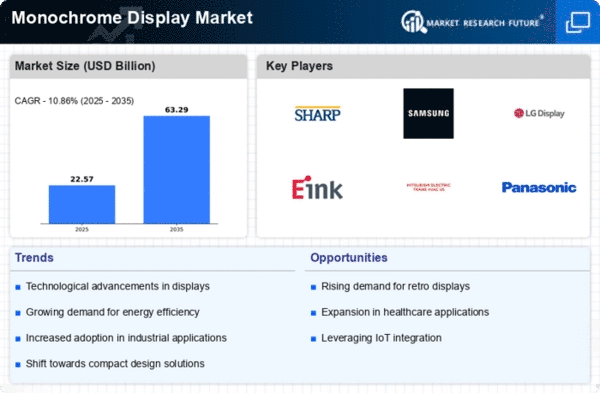
As per MRFR analysis, the Monochrome Display Market Size was estimated at 20.36 USD Billion in 2024. The Monochrome Display industry is projected to grow from 22.57 USD Billion in 2025 to 63.29 USD Billion by 2035, exhibiting a compound annual growth rate (CAGR) of 10.86 during the forecast period 2025 - 2035.

Key Market Trends & Highlights

The Monochrome Display Market is poised for growth driven by technological advancements and increasing integration with smart technologies.

  • North America remains the largest market for monochrome displays, driven by robust demand in consumer electronics.
  • Asia-Pacific is emerging as the fastest-growing region, fueled by rapid industrialization and technological adoption.
  • The consumer electronics segment dominates the market, while automotive displays are witnessing the fastest growth due to rising demand for advanced vehicle interfaces.
  • Key market drivers include the rising demand for cost-effective solutions and enhanced energy efficiency, particularly in industrial applications.

Market Size & Forecast

2024 Market Size 20.36 (USD Billion)
2035 Market Size 63.29 (USD Billion)
CAGR (2025 - 2035) 10.86%
Largest Regional Market Share in 2024 North America

Major Players

Sharp (JP), Samsung (KR), LG Display (KR), E Ink (TW), Mitsubishi Electric (JP), Panasonic (JP), Sony (JP), AU Optronics (TW)

Market Trends

The Monochrome Display Market is currently experiencing a notable evolution, driven by advancements in technology and shifting consumer preferences. As industries increasingly seek efficient and cost-effective display solutions, monochrome displays are gaining traction due to their simplicity and reliability. These displays, characterized by their ability to present information in a single color, are particularly favored in applications such as industrial equipment, medical devices, and automotive dashboards. The market appears to be expanding as manufacturers innovate to enhance the performance and durability of these displays, catering to a diverse range of sectors. Moreover, the Monochrome Display Market seems poised for further growth as environmental considerations become more prominent. The energy efficiency of monochrome displays, coupled with their lower production costs, positions them as an attractive option for businesses aiming to reduce their carbon footprint. Additionally, the integration of smart technologies into monochrome displays may enhance their functionality, potentially leading to increased adoption across various applications. Overall, the market is likely to witness a blend of traditional uses and modern innovations, reflecting the dynamic nature of consumer demands and technological advancements.

Technological Advancements

Recent innovations in display technology are enhancing the capabilities of monochrome displays. Manufacturers are focusing on improving resolution, contrast, and response times, which may lead to broader applications in sectors such as healthcare and automotive.

Sustainability Focus

With growing environmental awareness, the Monochrome Display Market is likely to benefit from the demand for energy-efficient solutions. These displays consume less power compared to their color counterparts, making them appealing for eco-conscious consumers and businesses.

Integration with Smart Technologies

The potential integration of smart technologies into monochrome displays could revolutionize their functionality. Features such as connectivity and interactivity may attract new users, expanding the market's reach into various industries.

Monochrome Display Market Market Drivers

Market Growth Projections

The Global Monochrome Display Market Industry is poised for substantial growth, with projections indicating a market size of 18.6 USD Billion in 2024 and an anticipated increase to 64.1 USD Billion by 2035. This growth trajectory suggests a robust compound annual growth rate (CAGR) of 11.89% from 2025 to 2035. The expansion is driven by various factors, including technological advancements, increased adoption in healthcare, and the rising demand for energy-efficient solutions. As industries continue to recognize the benefits of monochrome displays, the market is likely to experience sustained growth, reflecting the evolving needs of consumers and businesses alike.

Growing Demand in Industrial Automation

The Global Monochrome Display Market Industry benefits from the growing demand in industrial automation. Monochrome displays are widely used in control panels, machinery interfaces, and monitoring systems due to their clarity and ease of readability in various lighting conditions. As industries continue to adopt automation technologies to enhance efficiency and productivity, the need for reliable display solutions becomes more pronounced. This trend is reflected in the anticipated market growth, with projections indicating a substantial increase in demand for monochrome displays in industrial applications. The integration of these displays into automated systems is expected to drive significant advancements in the market.

Cost-Effectiveness of Monochrome Displays

Cost-effectiveness remains a pivotal driver in the Global Monochrome Display Market Industry. Monochrome displays typically require less complex manufacturing processes and materials, resulting in lower production costs compared to color displays. This affordability makes them an attractive option for various industries, including retail and transportation, where budget constraints are prevalent. Additionally, the longevity and durability of monochrome displays reduce replacement costs, further enhancing their appeal. As businesses seek to optimize their expenditures, the demand for cost-effective monochrome display solutions is likely to increase, supporting the market's growth trajectory in the coming years.

Rising Demand for Energy-Efficient Displays

The Global Monochrome Display Market Industry experiences a surge in demand for energy-efficient display technologies. As organizations increasingly prioritize sustainability, monochrome displays, known for their lower power consumption compared to color displays, become more appealing. This trend is particularly evident in sectors such as healthcare and industrial automation, where energy efficiency is paramount. The market is projected to reach 18.6 USD Billion in 2024, driven by the need for cost-effective solutions that reduce operational expenses. Furthermore, the anticipated growth in the market highlights the potential for monochrome displays to play a crucial role in achieving energy-saving goals.

Increased Adoption in Healthcare Applications

The Global Monochrome Display Market Industry sees increased adoption in healthcare applications, where reliability and clarity are critical. Monochrome displays are widely utilized in medical imaging devices, such as ultrasound machines and X-ray systems, due to their ability to provide clear and precise images. The growing emphasis on diagnostic accuracy and patient safety drives the demand for these displays in hospitals and clinics. As healthcare technology advances, the need for high-quality monochrome displays is expected to rise, contributing to the overall market growth. This trend aligns with the projected CAGR of 11.89% from 2025 to 2035, indicating a robust future for monochrome displays in healthcare.

Technological Advancements in Display Technology

Technological advancements significantly influence the Global Monochrome Display Market Industry. Innovations in display technology, such as improved resolution and enhanced contrast ratios, contribute to the growing adoption of monochrome displays across various applications. For instance, the integration of advanced LCD and OLED technologies allows for sharper images and better visibility in challenging environments. These advancements not only enhance user experience but also expand the potential applications of monochrome displays in sectors like automotive and aerospace. As the market evolves, these technological improvements are likely to drive growth, with projections indicating a market size of 64.1 USD Billion by 2035.


Market Segment Insights

By Application: Consumer Electronics (Largest) vs. Automotive Displays (Fastest-Growing)

The monochrome display market is significantly influenced by various applications, with consumer electronics holding the largest share due to high demand for devices like TVs, smartphones, and gaming consoles. Automotive displays have emerged as a crucial segment, driven by the integration of advanced technologies in vehicles such as infotainment systems and dashboard displays, thus contributing to a dynamic market landscape. As more industries adopt monochrome displays for their functionalities, the growth of automotive displays reflects a broader trend towards digitization in vehicles. The increasing need for streamlined interfaces in safety and navigation systems propels the advancement of technology, making this segment the fastest-growing within the monochrome display market.

Consumer Electronics (Dominant) vs. Automotive Displays (Emerging)

Consumer electronics represent the cornerstone of the monochrome display market, characterized by a robust presence in everyday electronic devices designed for consumers. This segment benefits from ever-evolving technology, ensuring high quality and aesthetic appeal. Meanwhile, automotive displays are emerging as a vital segment, driven by the automotive industry's shift towards smarter, interconnected technologies. These displays are crucial for driver interfaces and in-car entertainment, appealing to consumers who seek enhanced visibility and usability. The rising trend of electric and autonomous vehicles is further propelling the demand for reliable monochrome displays in this sector, indicating a shift in preferences away from traditional displays toward more modern solutions.

By Technology: Liquid Crystal Display (Largest) vs. Light Emitting Diode (Fastest-Growing)

In the Monochrome Display Market, Liquid Crystal Display (LCD) holds the largest market share, dominating the landscape due to its widespread adoption in various applications. With its efficiency and versatility, LCD technology remains the preferred choice for various monochrome display applications, captivating a significant portion of the market. Meanwhile, Light Emitting Diode (LED) technology has emerged as a leading contender, rapidly gaining ground with its energy-efficient properties and increasing preference in niche markets. The growth trajectory of the Monochrome Display Market is influenced by evolving consumer preferences and advancements in technology. LED displays are increasingly recognized for their superior performance, lower power consumption, and long lifespan, driving their expansion in the market. As technology advances, the adoption of these displays continues to surge, especially in innovative sectors such as automotive and consumer electronics, where quality and efficiency are paramount.

Technology: LCD (Dominant) vs. LED (Emerging)

Liquid Crystal Display (LCD) has been a stalwart in the Monochrome Display Market, characterized by its widespread utility and cost-effectiveness. Known for its clarity and color accuracy, LCD technology finds applications in various fields, from consumer electronics to industrial equipment. With a robust infrastructure built over decades, LCD continues to lead the market, supported by advancements in display technology, refining its performance further. On the other hand, Light Emitting Diode (LED) technology, while emerging, is gaining traction due to its advantages, such as energy efficiency, compact design, and longer lifespan compared to traditional technologies. As manufacturers increasingly focus on sustainability, LEDs are becoming more prevalent in monochrome applications, appealing to environmentally conscious consumers and driving innovative display solutions.

By End Use: Retail (Largest) vs. Healthcare (Fastest-Growing)

The Monochrome Display Market shows a diverse allocation of market share among various end-use segments, with the retail sector holding the largest share. Retail applications leverage monochrome displays for inventory management, price tags, and digital signage, showcasing their effectiveness in enhancing customer experiences. On the other hand, the healthcare sector is rapidly adopting monochrome displays for medical imaging and patient monitoring applications, reflecting a growing trend among healthcare providers to enhance clinical outcomes with reliable information systems.

Retail (Dominant) vs. Healthcare (Emerging)

In the Monochrome Display Market, the retail segment dominates due to its extensive use in point-of-sale systems and consumer interaction displays. Monochrome displays ensure clear visibility and lower power consumption, making them ideal for applications requiring constant data presentation. In contrast, the healthcare segment is emerging as a powerful player, driven by increasing demands for efficient patient monitoring and diagnostic imaging technologies. The adoption of monochrome displays in this sector is fueled by their ability to deliver critical information without the distractions of color, emphasizing clarity and reliability in patient care settings.

By Display Size: Large (Largest) vs. Small (Fastest-Growing)

The Monochrome Display Market showcases a diverse distribution among the display size segments, with the Large category dominating the scene. This segment accounts for a significant portion of the market, reflecting consumer preference for larger displays in various applications such as industrial and medical devices. Conversely, the Small display segment has gained traction recently, appealing to specific markets where compact design and energy efficiency are paramount. Growth trends indicate a robust uptick in demand for Small displays, attributed to the rising popularity of portable devices and IoT applications. As technology advances, Small monochrome displays are evolving with enhanced functionalities, attracting manufacturers to innovate within this segment. The Large displays, on the other hand, maintain a stronghold, driven by their adaptability and effectiveness in professional and commercial settings.

Large (Dominant) vs. Small (Emerging)

The Large display segment in the Monochrome Display Market stands as the dominant player, often utilized in applications where visibility and clarity are critical, such as medical imaging, industrial equipment, and public information displays. These displays are characterized by their impressive size and superior viewing angles, making them ideal for scenarios requiring high visibility. As companies continue to implement larger and more advanced monochrome displays, the demand is sustained. In contrast, the Small display segment is emerging rapidly, fueled by miniaturization trends in electronics and a growing preference for devices that prioritize portability. Known for their compact form factor, Small displays are commonly integrated into handheld devices and smart automation tools. Their energy efficiency and reduced footprint make them attractive to manufacturers focusing on innovative designs.

By Brightness Level: High (Largest) vs. Low (Fastest-Growing)

The Monochrome Display Market exhibits a diverse share distribution with various brightness levels shaping market trends. Currently, High brightness displays hold the largest market share, primarily due to their superior visibility and performance in diverse lighting conditions. Medium brightness displays follow closely, striking a balance between efficiency and visibility. In contrast, Low brightness displays are rapidly gaining traction, appealing to cost-sensitive applications where extreme brightness is unnecessary, making them a significant segment in the evolving market landscape.

Brightness Level: High (Dominant) vs. Low (Emerging)

High brightness monochrome displays are characterized by their exceptional clarity and visibility, making them ideal for outdoor applications and environments with high ambient light. They are widely adopted in industrial equipment, automotive displays, and outdoor signage due to their ability to outperform competing products in challenging lighting conditions. On the other hand, Low brightness displays are emerging as a cost-effective solution for applications like home appliances, entry-level devices, and environments with limited lighting needs. Their lower energy consumption and affordability make them highly attractive to budget-conscious consumers, positioning this segment as a rapidly growing sector in the monochrome display market.

Get more detailed insights about Monochrome Display Market Research Report - Global Forecast till 2035

Regional Insights

North America : Market Leader in Monochrome Displays

North America continues to lead the monochrome display market, holding a significant share of 10.5 in 2024. The growth is driven by increasing demand for high-quality displays in sectors like healthcare, automotive, and consumer electronics. Regulatory support for advanced display technologies further fuels this expansion, as companies innovate to meet stringent standards. The region's focus on R&D and technological advancements positions it as a hub for display innovation. The competitive landscape in North America is robust, featuring key players such as Sharp, Samsung, and LG Display. These companies are investing heavily in new technologies and product development to maintain their market positions. The presence of established firms, along with a growing number of startups, enhances competition and drives innovation. As the market evolves, partnerships and collaborations are expected to play a crucial role in shaping future trends.

Europe : Emerging Market with Growth Potential

Europe's monochrome display market is poised for growth, currently valued at 5.0. The region benefits from increasing adoption in industrial applications and smart devices, driven by a push for energy-efficient solutions. Regulatory frameworks promoting sustainability and innovation are key catalysts for market expansion. As companies adapt to these regulations, the demand for advanced monochrome displays is expected to rise, enhancing the market's overall growth trajectory. Leading countries in Europe include Germany, France, and the UK, where major players like E Ink and Panasonic are making significant strides. The competitive landscape is characterized by a mix of established firms and emerging startups, fostering innovation. As the market matures, collaborations between technology providers and manufacturers are likely to intensify, further driving advancements in display technology.

Asia-Pacific : Rapid Growth in Emerging Economies

The Asia-Pacific region, valued at 4.5, is experiencing rapid growth in the monochrome display market, driven by rising demand in consumer electronics and industrial applications. Countries like China, Japan, and South Korea are at the forefront, leveraging their technological advancements to enhance display quality. Regulatory support for innovation and sustainability is also a significant driver, encouraging companies to invest in R&D and new technologies to meet market needs. Key players in the region include LG Display, Sony, and AU Optronics, all of which are focusing on expanding their product offerings. The competitive landscape is dynamic, with both established companies and new entrants vying for market share. As the region continues to evolve, partnerships and collaborations are expected to play a crucial role in driving innovation and meeting the growing demand for monochrome displays.

Middle East and Africa : Niche Market with Growth Opportunities

The Middle East and Africa region, with a market size of 0.36, presents unique opportunities in the monochrome display sector. The growth is primarily driven by increasing investments in technology and infrastructure, particularly in sectors like retail and transportation. Regulatory initiatives aimed at enhancing digital transformation are also contributing to market growth, as businesses seek to adopt advanced display technologies to improve customer engagement and operational efficiency. Countries such as South Africa and the UAE are leading the way in adopting monochrome displays, with local players and international firms exploring market entry. The competitive landscape is gradually evolving, with a focus on innovation and quality. As the region continues to develop, the demand for monochrome displays is expected to rise, driven by both local and global players looking to capitalize on emerging opportunities.

Key Players and Competitive Insights

The Monochrome Display Market is currently characterized by a competitive landscape that is both dynamic and multifaceted. Key growth drivers include the increasing demand for energy-efficient displays and the rising adoption of monochrome technology in various applications, such as industrial automation and consumer electronics. Major players like Sharp (Japan), Samsung (South Korea), and E Ink (Taiwan) are strategically positioned to leverage these trends. Sharp (Japan) focuses on innovation in display technology, particularly in enhancing the resolution and energy efficiency of its monochrome displays. Meanwhile, Samsung (South Korea) emphasizes regional expansion and partnerships to strengthen its market presence, particularly in Asia-Pacific. E Ink (Taiwan) is dedicated to digital transformation, aiming to integrate its displays into smart devices, thereby shaping a competitive environment that is increasingly reliant on technological advancements.In terms of business tactics, companies are localizing manufacturing to reduce costs and optimize supply chains, which is particularly relevant in the context of global trade dynamics. The market structure appears moderately fragmented, with several key players exerting influence over their respective segments. This fragmentation allows for a variety of competitive strategies, as companies seek to differentiate themselves through innovation and operational efficiency.

In November Sharp (Japan) announced the launch of a new line of high-resolution monochrome displays aimed at the automotive sector. This strategic move is significant as it positions Sharp to capitalize on the growing demand for advanced display technologies in vehicles, potentially enhancing safety and user experience. The introduction of these displays could also lead to increased market share in a sector that is rapidly evolving towards digitalization.

In October Samsung (South Korea) entered into a partnership with a leading automotive manufacturer to develop integrated monochrome display solutions for electric vehicles. This collaboration is noteworthy as it not only expands Samsung's footprint in the automotive industry but also aligns with the broader trend of sustainability and innovation in transportation. By focusing on electric vehicles, Samsung is likely to enhance its competitive edge in a market that is increasingly prioritizing eco-friendly technologies.

In September E Ink (Taiwan) unveiled a new monochrome display technology that significantly reduces power consumption while maintaining high visibility in various lighting conditions. This development is crucial as it addresses the growing consumer demand for energy-efficient solutions, potentially setting a new standard in the industry. E Ink's commitment to sustainability through technological innovation may further solidify its position as a leader in the monochrome display market.

As of December current competitive trends indicate a strong emphasis on digitalization, sustainability, and the integration of AI technologies within the Monochrome Display Market. Strategic alliances are increasingly shaping the landscape, allowing companies to pool resources and expertise to drive innovation. Looking ahead, competitive differentiation is likely to evolve from traditional price-based competition to a focus on technological advancements, supply chain reliability, and sustainable practices. This shift underscores the importance of innovation as a key driver of market success.

Key Companies in the Monochrome Display Market include

Industry Developments

March 2022: Toshiba Electronic Devices & Storage Corporation has released two lens reduction type 1,500-pixel monochrome CCD linear image chips. These chips meet two important industry needs: they make equipment with sensors, like inspection equipment with monochrome sensors, work faster and use less power.

June 2023: The EIZO Corporation developed the 12.1-inch DuraVision FDX1204T monitor, which has a resolution of 1024 x 768 and is made to last in industrial settings.

Future Outlook

Monochrome Display Market Future Outlook

The Monochrome Display Market is projected to grow at a 10.86% CAGR from 2025 to 2035, driven by advancements in technology and increasing demand in various sectors.

New opportunities lie in:

  • Integration of monochrome displays in IoT devices for enhanced user interfaces.
  • Development of energy-efficient monochrome displays for portable electronics.
  • Expansion into automotive applications for dashboard displays and instrumentation.

By 2035, the Monochrome Display Market is expected to achieve substantial growth and diversification.

Market Segmentation

Monochrome Display Market End Use Outlook

  • Retail
  • Healthcare
  • Manufacturing
  • Transportation
  • Telecommunications

Monochrome Display Market Technology Outlook

  • Liquid Crystal Display
  • Light Emitting Diode
  • Electroluminescent Display
  • Thin Film Transistor
  • Organic Light Emitting Diode

Monochrome Display Market Application Outlook

  • Consumer Electronics
  • Automotive Displays
  • Industrial Equipment
  • Medical Devices
  • Aerospace

Monochrome Display Market Display Size Outlook

  • Small
  • Medium
  • Large
  • Extra Large

Monochrome Display Market Brightness Level Outlook

  • Low
  • Medium
  • High

Report Scope

MARKET SIZE 202420.36(USD Billion)
MARKET SIZE 202522.57(USD Billion)
MARKET SIZE 203563.29(USD Billion)
COMPOUND ANNUAL GROWTH RATE (CAGR)10.86% (2025 - 2035)
REPORT COVERAGERevenue Forecast, Competitive Landscape, Growth Factors, and Trends
BASE YEAR2024
Market Forecast Period2025 - 2035
Historical Data2019 - 2024
Market Forecast UnitsUSD Billion
Key Companies ProfiledSharp (JP), Samsung (KR), LG Display (KR), E Ink (TW), Mitsubishi Electric (JP), Panasonic (JP), Sony (JP), AU Optronics (TW)
Segments CoveredApplication, Technology, End Use, Display Size, Brightness Level
Key Market OpportunitiesIntegration of advanced technologies enhances functionality and efficiency in the Monochrome Display Market.
Key Market DynamicsTechnological advancements drive demand for monochrome displays in various applications, enhancing market competitiveness and innovation.
Countries CoveredNorth America, Europe, APAC, South America, MEA

FAQs

How much is the monochrome display market?

The global monochrome display market size was valued at USD 20.35 Billion in 2024.

What is the growth rate of the monochrome display market?

The global market is projected to grow at a CAGR of 10.86% during the forecast period, 2025-2034.

Which region held the largest market share in the monochrome display market?

North America had the largest share of the global market.

Who are the key players in the monochrome display market?

The key players in the market areEizo Corporation (Japan), Richardson Electronics Ltd. (US), Blaze display technology Co. Ltd. (China), Microtips Technology LLC (US), Tianma Microelectronics Co. Ltd. (China), Ampronix Inc. (US), JVC KenwoodCorporation (Japan), and Shelly Inc (US).

Which screen type led the monochrome display market?

The green screen category dominated the market in 2024.

Which display type had the largest market share in the monochrome display market?

The CRT display had the largest share of the global market.

  1. SECTION I: EXECUTIVE SUMMARY AND KEY HIGHLIGHTS
    1. | 1.1 EXECUTIVE SUMMARY
    2. | 1.1.1 Market Overview
    3. | 1.1.2 Key Findings
    4. | 1.1.3 Market Segmentation
    5. | 1.1.4 Competitive Landscape
    6. | 1.1.5 Challenges and Opportunities
    7. | 1.1.6 Future Outlook
  2. SECTION II: SCOPING, METHODOLOGY AND MARKET STRUCTURE
    1. | 2.1 MARKET INTRODUCTION
    2. | 2.1.1 Definition
    3. | 2.1.2 Scope of the study
    4. |-- 2.1.2.1 Research Objective
    5. |-- 2.1.2.2 Assumption
    6. |-- 2.1.2.3 Limitations
    7. | 2.2 RESEARCH METHODOLOGY
    8. | 2.2.1 Overview
    9. | 2.2.2 Data Mining
    10. | 2.2.3 Secondary Research
    11. | 2.2.4 Primary Research
    12. |-- 2.2.4.1 Primary Interviews and Information Gathering Process
    13. |-- 2.2.4.2 Breakdown of Primary Respondents
    14. | 2.2.5 Forecasting Model
    15. | 2.2.6 Market Size Estimation
    16. |-- 2.2.6.1 Bottom-Up Approach
    17. |-- 2.2.6.2 Top-Down Approach
    18. | 2.2.7 Data Triangulation
    19. | 2.2.8 Validation
  3. SECTION III: QUALITATIVE ANALYSIS
    1. | 3.1 MARKET DYNAMICS
    2. | 3.1.1 Overview
    3. | 3.1.2 Drivers
    4. | 3.1.3 Restraints
    5. | 3.1.4 Opportunities
    6. | 3.2 MARKET FACTOR ANALYSIS
    7. | 3.2.1 Value chain Analysis
    8. | 3.2.2 Porter's Five Forces Analysis
    9. |-- 3.2.2.1 Bargaining Power of Suppliers
    10. |-- 3.2.2.2 Bargaining Power of Buyers
    11. |-- 3.2.2.3 Threat of New Entrants
    12. |-- 3.2.2.4 Threat of Substitutes
    13. |-- 3.2.2.5 Intensity of Rivalry
    14. | 3.2.3 COVID-19 Impact Analysis
    15. |-- 3.2.3.1 Market Impact Analysis
    16. |-- 3.2.3.2 Regional Impact
    17. |-- 3.2.3.3 Opportunity and Threat Analysis
  4. SECTION IV: QUANTITATIVE ANALYSIS
    1. | 4.1 Information and Communications Technology, BY Application (USD Billion)
    2. | 4.1.1 Consumer Electronics
    3. | 4.1.2 Automotive Displays
    4. | 4.1.3 Industrial Equipment
    5. | 4.1.4 Medical Devices
    6. | 4.1.5 Aerospace
    7. | 4.2 Information and Communications Technology, BY Technology (USD Billion)
    8. | 4.2.1 Liquid Crystal Display
    9. | 4.2.2 Light Emitting Diode
    10. | 4.2.3 Electroluminescent Display
    11. | 4.2.4 Thin Film Transistor
    12. | 4.2.5 Organic Light Emitting Diode
    13. | 4.3 Information and Communications Technology, BY End Use (USD Billion)
    14. | 4.3.1 Retail
    15. | 4.3.2 Healthcare
    16. | 4.3.3 Manufacturing
    17. | 4.3.4 Transportation
    18. | 4.3.5 Telecommunications
    19. | 4.4 Information and Communications Technology, BY Display Size (USD Billion)
    20. | 4.4.1 Small
    21. | 4.4.2 Medium
    22. | 4.4.3 Large
    23. | 4.4.4 Extra Large
    24. | 4.5 Information and Communications Technology, BY Brightness Level (USD Billion)
    25. | 4.5.1 Low
    26. | 4.5.2 Medium
    27. | 4.5.3 High
    28. | 4.6 Information and Communications Technology, BY Region (USD Billion)
    29. | 4.6.1 North America
    30. |-- 4.6.1.1 US
    31. |-- 4.6.1.2 Canada
    32. | 4.6.2 Europe
    33. |-- 4.6.2.1 Germany
    34. |-- 4.6.2.2 UK
    35. |-- 4.6.2.3 France
    36. |-- 4.6.2.4 Russia
    37. |-- 4.6.2.5 Italy
    38. |-- 4.6.2.6 Spain
    39. |-- 4.6.2.7 Rest of Europe
    40. | 4.6.3 APAC
    41. |-- 4.6.3.1 China
    42. |-- 4.6.3.2 India
    43. |-- 4.6.3.3 Japan
    44. |-- 4.6.3.4 South Korea
    45. |-- 4.6.3.5 Malaysia
    46. |-- 4.6.3.6 Thailand
    47. |-- 4.6.3.7 Indonesia
    48. |-- 4.6.3.8 Rest of APAC
    49. | 4.6.4 South America
    50. |-- 4.6.4.1 Brazil
    51. |-- 4.6.4.2 Mexico
    52. |-- 4.6.4.3 Argentina
    53. |-- 4.6.4.4 Rest of South America
    54. | 4.6.5 MEA
    55. |-- 4.6.5.1 GCC Countries
    56. |-- 4.6.5.2 South Africa
    57. |-- 4.6.5.3 Rest of MEA
  5. SECTION V: COMPETITIVE ANALYSIS
    1. | 5.1 Competitive Landscape
    2. | 5.1.1 Overview
    3. | 5.1.2 Competitive Analysis
    4. | 5.1.3 Market share Analysis
    5. | 5.1.4 Major Growth Strategy in the Information and Communications Technology
    6. | 5.1.5 Competitive Benchmarking
    7. | 5.1.6 Leading Players in Terms of Number of Developments in the Information and Communications Technology
    8. | 5.1.7 Key developments and growth strategies
    9. |-- 5.1.7.1 New Product Launch/Service Deployment
    10. |-- 5.1.7.2 Merger & Acquisitions
    11. |-- 5.1.7.3 Joint Ventures
    12. | 5.1.8 Major Players Financial Matrix
    13. |-- 5.1.8.1 Sales and Operating Income
    14. |-- 5.1.8.2 Major Players R&D Expenditure. 2023
    15. | 5.2 Company Profiles
    16. | 5.2.1 Sharp (JP)
    17. |-- 5.2.1.1 Financial Overview
    18. |-- 5.2.1.2 Products Offered
    19. |-- 5.2.1.3 Key Developments
    20. |-- 5.2.1.4 SWOT Analysis
    21. |-- 5.2.1.5 Key Strategies
    22. | 5.2.2 Samsung (KR)
    23. |-- 5.2.2.1 Financial Overview
    24. |-- 5.2.2.2 Products Offered
    25. |-- 5.2.2.3 Key Developments
    26. |-- 5.2.2.4 SWOT Analysis
    27. |-- 5.2.2.5 Key Strategies
    28. | 5.2.3 LG Display (KR)
    29. |-- 5.2.3.1 Financial Overview
    30. |-- 5.2.3.2 Products Offered
    31. |-- 5.2.3.3 Key Developments
    32. |-- 5.2.3.4 SWOT Analysis
    33. |-- 5.2.3.5 Key Strategies
    34. | 5.2.4 E Ink (TW)
    35. |-- 5.2.4.1 Financial Overview
    36. |-- 5.2.4.2 Products Offered
    37. |-- 5.2.4.3 Key Developments
    38. |-- 5.2.4.4 SWOT Analysis
    39. |-- 5.2.4.5 Key Strategies
    40. | 5.2.5 Mitsubishi Electric (JP)
    41. |-- 5.2.5.1 Financial Overview
    42. |-- 5.2.5.2 Products Offered
    43. |-- 5.2.5.3 Key Developments
    44. |-- 5.2.5.4 SWOT Analysis
    45. |-- 5.2.5.5 Key Strategies
    46. | 5.2.6 Panasonic (JP)
    47. |-- 5.2.6.1 Financial Overview
    48. |-- 5.2.6.2 Products Offered
    49. |-- 5.2.6.3 Key Developments
    50. |-- 5.2.6.4 SWOT Analysis
    51. |-- 5.2.6.5 Key Strategies
    52. | 5.2.7 Sony (JP)
    53. |-- 5.2.7.1 Financial Overview
    54. |-- 5.2.7.2 Products Offered
    55. |-- 5.2.7.3 Key Developments
    56. |-- 5.2.7.4 SWOT Analysis
    57. |-- 5.2.7.5 Key Strategies
    58. | 5.2.8 AU Optronics (TW)
    59. |-- 5.2.8.1 Financial Overview
    60. |-- 5.2.8.2 Products Offered
    61. |-- 5.2.8.3 Key Developments
    62. |-- 5.2.8.4 SWOT Analysis
    63. |-- 5.2.8.5 Key Strategies
    64. | 5.3 Appendix
    65. | 5.3.1 References
    66. | 5.3.2 Related Reports

Information and Communications Technology Market Segmentation

Information and Communications Technology By Application (USD Billion, 2025-2035)

  • Consumer Electronics
  • Automotive Displays
  • Industrial Equipment
  • Medical Devices
  • Aerospace

Information and Communications Technology By Technology (USD Billion, 2025-2035)

  • Liquid Crystal Display
  • Light Emitting Diode
  • Electroluminescent Display
  • Thin Film Transistor
  • Organic Light Emitting Diode

Information and Communications Technology By End Use (USD Billion, 2025-2035)

  • Retail
  • Healthcare
  • Manufacturing
  • Transportation
  • Telecommunications

Information and Communications Technology By Display Size (USD Billion, 2025-2035)

  • Small
  • Medium
  • Large
  • Extra Large

Information and Communications Technology By Brightness Level (USD Billion, 2025-2035)

  • Low
  • Medium
  • High
Infographic

Free Sample Request

Kindly complete the form below to receive a free sample of this Report

Get Free Sample

Customer Strories

Compare Licence

×
Features License Type
Single User Multiuser License Enterprise User
Price $4,950 $5,950 $7,250
Maximum User Access Limit 1 User Upto 10 Users Unrestricted Access Throughout the Organization
Free Customization
Direct Access to Analyst
Deliverable Format
Platform Access
Discount on Next Purchase 10% 15% 15%
Printable Versions