×
Request Free Sample ×

Kindly complete the form below to receive a free sample of this Report

* Please use a valid business email

Leading companies partner with us for data-driven Insights

clients tt-cursor
Hero Background
English
Chinese
French
Japanese
Korean
German
Spanish

Monochrome Display Market Trends

ID: MRFR/ICT/3755-CR
101 Pages
Aarti Dhapte
July 2019

Monochrome Display Market Research Report Information By Screen Type (Green Screen, White Screen and Amber Screen), By Display Type (CRT Display, LCD Display and LED Display), By End-User (Consumer Electronics, Automotive, Gaming, Medical and Manufacturing), And By Region (North America, Europe, Asia-Pacific, And Rest Of The World) –Market Forecast Till 2035.

Share:
Download PDF ×

We do not share your information with anyone. However, we may send you emails based on your report interest from time to time. You may contact us at any time to opt-out.

Monochrome Display Market Infographic
Purchase Options

Market Trends

Key Emerging Trends in the Monochrome Display Market

The monochrome display market has seen exceptional patterns as of late, mirroring the developing inclinations and mechanical headways in the display business. One obvious pattern is the resurgence of monochrome displays in unambiguous applications where openness and unwavering quality are vital. Aside from the strength of variety displays in different buyer gadgets, monochrome displays have tracked down a specialty in basic regions like clinical equipment, modern hardware, and aviation instrumentation. In the medical services area, monochrome displays have become unique in symptomatic imaging, where grayscale precision is vital for distinguishing unpretentious intricacies in clinical pictures. Radiologists and medical services experts favor monochrome displays for their capacity to imitate exact shades of dark, assuring precise translation of X-beams, X-rays, and other clinical pictures. The market has answered this interest by presenting progressed monochrome display innovations that upgrade picture clearness and diminish eye strain during delayed review meetings. Modern applications have likewise powered the market patterns in monochrome displays. In conditions where unwavering quality and significance are first concerns, monochrome displays are liked because of their reliability and toughness. These displays are ordinarily utilized in charge boards, programmable logic controllers (PLCs), and human-machine interface (HMI) frameworks in modern computerization. The pattern is moving towards high-goal monochrome displays that give clear and sharp data, adding to worked on functional productivity in assembling and cycle control. Besides, the aviation area has seen a developing reception of monochrome displays in cockpit instrumentation. Pilots depend on these displays for basic data like route information, motor boundaries, and flight status. Monochrome displays offer better perceivability under shifting lighting conditions and consume less power contrasted with their variety partners, pursuing them a practical decision for flying applications. The market is answering with progresses in monochrome display innovation that consolidate highlights like daylight meaningfulness and night vision similarity to take care of the assorted necessities of the airplane business.

Author
Aarti Dhapte
AVP - Research

A consulting professional focused on helping businesses navigate complex markets through structured research and strategic insights. I partner with clients to solve high-impact business problems across market entry strategy, competitive intelligence, and opportunity assessment. Over the course of my experience, I have led and contributed to 100+ market research and consulting engagements, delivering insights across multiple industries and geographies, and supporting strategic decisions linked to $500M+ market opportunities. My core expertise lies in building robust market sizing, forecasting, and commercial models (top-down and bottom-up), alongside deep-dive competitive and industry analysis. I have played a key role in shaping go-to-market strategies, investment cases, and growth roadmaps, enabling clients to make confident, data-backed decisions in dynamic markets.

Leave a Comment

FAQs

What is the current valuation of the Monochrome Display Market as of 2024?

<p>The Monochrome Display Market was valued at 20.36 USD Billion in 2024.</p>

What is the projected market valuation for the Monochrome Display Market in 2035?

<p>The market is projected to reach a valuation of 63.29 USD Billion by 2035.</p>

What is the expected CAGR for the Monochrome Display Market during the forecast period 2025 - 2035?

<p>The expected CAGR for the Monochrome Display Market during the forecast period 2025 - 2035 is 10.86%.</p>

Which companies are considered key players in the Monochrome Display Market?

<p>Key players in the market include Sharp Corporation, Samsung Electronics, LG Display, Sony Corporation, E Ink Holdings, AU Optronics, Japan Display Inc., Microchip Technology Inc., and Nokia Corporation.</p>

What are the main application segments of the Monochrome Display Market?

<p>The main application segments include Consumer Electronics, Automotive Displays, Industrial Equipment, Medical Devices, and Aerospace Displays.</p>

How does the market size for Medical Devices compare to other application segments?

<p>The Medical Devices segment is projected to grow from 6.0 to 18.0 USD Billion, indicating substantial growth potential.</p>

What are the different technology segments within the Monochrome Display Market?

Technology segments include Liquid Crystal Display, Light Emitting Diode, Electroluminescent Display, Organic Light Emitting Diode, and Thin Film Transistor.

Which display size segment is expected to have the highest market valuation?

The Extra Large Displays segment is anticipated to grow from 6.63 to 20.29 USD Billion, suggesting a strong market presence.

What is the projected growth for the Telecommunications end-use segment?

The Telecommunications segment is expected to expand from 5.86 to 19.79 USD Billion, reflecting its increasing importance.

How does the brightness level affect the Monochrome Display Market?

The High Brightness segment is projected to grow from 10.36 to 33.29 USD Billion, indicating a rising demand for enhanced display quality.

Market Summary

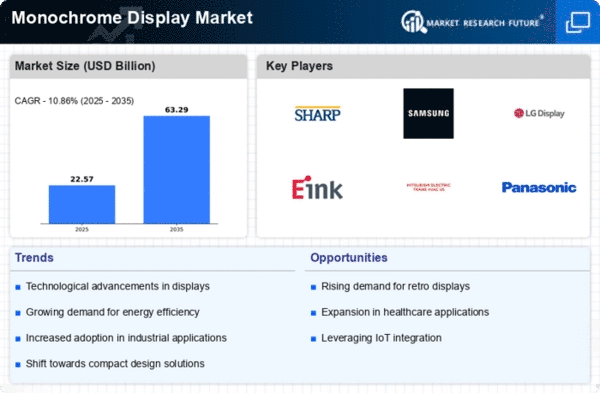
As per MRFR analysis, the Monochrome Display Market Size was estimated at 20.36 USD Billion in 2024. The Monochrome Display industry is projected to grow from 22.57 USD Billion in 2025 to 63.29 USD Billion by 2035, exhibiting a compound annual growth rate (CAGR) of 10.86% during the forecast period 2025 - 2035.

Key Market Trends & Highlights

The Monochrome Display Market is poised for growth driven by technological advancements and increasing integration with smart technologies.

  • North America remains the largest market for monochrome displays, driven by robust demand in consumer electronics. Asia-Pacific is emerging as the fastest-growing region, fueled by rapid industrialization and technological adoption. The consumer electronics segment dominates the market, while automotive displays are witnessing the fastest growth due to rising demand for advanced vehicle interfaces. Key market drivers include the rising demand for cost-effective solutions and enhanced energy efficiency, particularly in industrial applications.

Market Size & Forecast

2024 Market Size 20.36 (USD Billion)
2035 Market Size 63.29 (USD Billion)
CAGR (2025 - 2035) 10.86%
Largest Regional Market Share in 2024 North America

Major Players

Sharp (JP), Samsung (KR), LG Display (KR), E Ink (TW), Mitsubishi Electric (JP), Panasonic (JP), Sony (JP), AU Optronics (TW)

Market Trends

The Monochrome Display Market is currently experiencing a notable evolution, driven by advancements in technology and shifting consumer preferences. As industries increasingly seek efficient and cost-effective display solutions, monochrome displays are gaining traction due to their simplicity and reliability. These displays, characterized by their ability to present information in a single color, are particularly favored in applications such as industrial equipment, medical devices, and automotive dashboards. The market appears to be expanding as manufacturers innovate to enhance the performance and durability of these displays, catering to a diverse range of sectors. Moreover, the Monochrome Display Market seems poised for further growth as environmental considerations become more prominent. The energy efficiency of monochrome displays, coupled with their lower production costs, positions them as an attractive option for businesses aiming to reduce their carbon footprint. Additionally, the integration of smart technologies into monochrome displays may enhance their functionality, potentially leading to increased adoption across various applications. Overall, the market is likely to witness a blend of traditional uses and modern innovations, reflecting the dynamic nature of consumer demands and technological advancements.

Technological Advancements

Recent innovations in display technology are enhancing the capabilities of monochrome displays. Manufacturers are focusing on improving resolution, contrast, and response times, which may lead to broader applications in sectors such as healthcare and automotive.

Sustainability Focus

With growing environmental awareness, the Monochrome Display Market is likely to benefit from the demand for energy-efficient solutions. These displays consume less power compared to their color counterparts, making them appealing for eco-conscious consumers and businesses.

Integration with Smart Technologies

The potential integration of smart technologies into monochrome displays could revolutionize their functionality. Features such as connectivity and interactivity may attract new users, expanding the market's reach into various industries.

Monochrome Display Market Market Drivers

Market Growth Projections

The Global Monochrome Display Market Industry is poised for substantial growth, with projections indicating a market size of 18.6 USD Billion in 2024 and an anticipated increase to 64.1 USD Billion by 2035. This growth trajectory suggests a robust compound annual growth rate (CAGR) of 11.89% from 2025 to 2035. The expansion is driven by various factors, including technological advancements, increased adoption in healthcare, and the rising demand for energy-efficient solutions. As industries continue to recognize the benefits of monochrome displays, the market is likely to experience sustained growth, reflecting the evolving needs of consumers and businesses alike.

Growing Demand in Industrial Automation

The Global Monochrome Display Market Industry benefits from the growing demand in industrial automation. Monochrome displays are widely used in control panels, machinery interfaces, and monitoring systems due to their clarity and ease of readability in various lighting conditions. As industries continue to adopt automation technologies to enhance efficiency and productivity, the need for reliable display solutions becomes more pronounced. This trend is reflected in the anticipated market growth, with projections indicating a substantial increase in demand for monochrome displays in industrial applications. The integration of these displays into automated systems is expected to drive significant advancements in the market.

Cost-Effectiveness of Monochrome Displays

Cost-effectiveness remains a pivotal driver in the Global Monochrome Display Market Industry. Monochrome displays typically require less complex manufacturing processes and materials, resulting in lower production costs compared to color displays. This affordability makes them an attractive option for various industries, including retail and transportation, where budget constraints are prevalent. Additionally, the longevity and durability of monochrome displays reduce replacement costs, further enhancing their appeal. As businesses seek to optimize their expenditures, the demand for cost-effective monochrome display solutions is likely to increase, supporting the market's growth trajectory in the coming years.

Rising Demand for Energy-Efficient Displays

The Global Monochrome Display Market Industry experiences a surge in demand for energy-efficient display technologies. As organizations increasingly prioritize sustainability, monochrome displays, known for their lower power consumption compared to color displays, become more appealing. This trend is particularly evident in sectors such as healthcare and industrial automation, where energy efficiency is paramount. The market is projected to reach 18.6 USD Billion in 2024, driven by the need for cost-effective solutions that reduce operational expenses. Furthermore, the anticipated growth in the market highlights the potential for monochrome displays to play a crucial role in achieving energy-saving goals.

Increased Adoption in Healthcare Applications

The Global Monochrome Display Market Industry sees increased adoption in healthcare applications, where reliability and clarity are critical. Monochrome displays are widely utilized in medical imaging devices, such as ultrasound machines and X-ray systems, due to their ability to provide clear and precise images. The growing emphasis on diagnostic accuracy and patient safety drives the demand for these displays in hospitals and clinics. As healthcare technology advances, the need for high-quality monochrome displays is expected to rise, contributing to the overall market growth. This trend aligns with the projected CAGR of 11.89% from 2025 to 2035, indicating a robust future for monochrome displays in healthcare.

Technological Advancements in Display Technology

Technological advancements significantly influence the Global Monochrome Display Market Industry. Innovations in display technology, such as improved resolution and enhanced contrast ratios, contribute to the growing adoption of monochrome displays across various applications. For instance, the integration of advanced LCD and OLED technologies allows for sharper images and better visibility in challenging environments. These advancements not only enhance user experience but also expand the potential applications of monochrome displays in sectors like automotive and aerospace. As the market evolves, these technological improvements are likely to drive growth, with projections indicating a market size of 64.1 USD Billion by 2035.

Market Segment Insights

By Application: Consumer Electronics (Largest) vs. Automotive Displays (Fastest-Growing)

The monochrome display market is significantly influenced by various applications, with consumer electronics holding the largest share due to high demand for devices like TVs, smartphones, and gaming consoles. Automotive displays have emerged as a crucial segment, driven by the integration of advanced technologies in vehicles such as infotainment systems and dashboard displays, thus contributing to a dynamic market landscape. As more industries adopt monochrome displays for their functionalities, the growth of automotive displays reflects a broader trend towards digitization in vehicles. The increasing need for streamlined interfaces in safety and <a href="https://www.marketresearchfuture.com/reports/dental-surgical-navigation-system-market-39200">navigation systems</a> propels the advancement of technology, making this segment the fastest-growing within the monochrome display market.

Consumer Electronics (Dominant) vs. Automotive Displays (Emerging)

Consumer electronics represent the cornerstone of the monochrome display market, characterized by a robust presence in everyday electronic devices designed for consumers. This segment benefits from ever-evolving technology, ensuring high quality and aesthetic appeal. Meanwhile, automotive displays are emerging as a vital segment, driven by the automotive industry's shift towards smarter, interconnected technologies. These displays are crucial for driver interfaces and in-car entertainment, appealing to consumers who seek enhanced visibility and usability. The rising trend of electric and autonomous vehicles is further propelling the demand for reliable monochrome displays in this sector, indicating a shift in preferences away from traditional displays toward more modern solutions.

By Technology: Liquid Crystal Display (Largest) vs. Organic Light Emitting Diode (Fastest-Growing)

<p>In the Monochrome Display Market, Liquid Crystal Displays (LCDs) hold the most significant market share due to their established technology and widespread application across various devices, including calculators, watches, and medical instruments. Their longstanding presence in the market draws substantial demand. In contrast, Organic Light Emitting Diodes (OLEDs), while currently smaller in market share, are rapidly gaining traction owing to their superior image quality and increasing use in modern applications such as smartphones and wearables. This shift is indicative of changing consumer preferences toward higher-quality displays. Growth trends within the Monochrome Display Market point towards a pronounced increase in the adoption of OLED technology, driven by advancements in manufacturing techniques that reduce costs and enhance performance. Meanwhile, the durability and low power consumption of LCDs continue to support their dominance. Overall, the market is witnessing significant innovation, leading to rising investments in OLED technology, presenting opportunities for growth in the coming years.</p>

<p>Technology: LCD (Dominant) vs. OLED (Emerging)</p>

<p>Liquid Crystal Displays (LCDs) remain the dominant technology in the monochrome display market, characterized by their affordability, reliability, and low power consumption. This technology has established itself in a range of applications, including handheld devices and various industrial equipment. Their success can be attributed to their established manufacturing processes and compatibility with existing technologies. Conversely, Organic Light Emitting Diodes (OLEDs) are considered an emerging technology, known for their vibrant colors, higher contrast ratios, and flexibility in design. As consumer demand shifts towards products requiring better visual performance, OLEDs are positioned for rapid growth. Their innovative design allows for thinner displays, making them highly desirable for modern electronics, thus challenging the dominance of LCDs.</p>

By End Use: Retail (Largest) vs. Healthcare (Fastest-Growing)

The Monochrome Display Market shows a diverse allocation of market share among various end-use segments, with the retail sector holding the largest share. Retail applications leverage monochrome displays for inventory management, price tags, and digital signage, showcasing their effectiveness in enhancing customer experiences. On the other hand, the healthcare sector is rapidly adopting monochrome displays for medical imaging and patient monitoring applications, reflecting a growing trend among healthcare providers to enhance clinical outcomes with reliable information systems.

Retail (Dominant) vs. Healthcare (Emerging)

In the Monochrome Display Market, the retail segment dominates due to its extensive use in point-of-sale systems and consumer interaction displays. Monochrome displays ensure clear visibility and lower power consumption, making them ideal for applications requiring constant data presentation. In contrast, the healthcare segment is emerging as a powerful player, driven by increasing demands for efficient patient monitoring and diagnostic imaging technologies. The adoption of monochrome displays in this sector is fueled by their ability to deliver critical information without the distractions of color, emphasizing clarity and reliability in patient care settings.

By Display Size: Large Displays (Largest) vs. Medium Displays (Fastest-Growing)

<p>In the Monochrome Display Market, the distribution among different display sizes reveals interesting insights. Large Displays currently hold the largest share of the market, favored for their ability to offer enhanced visibility and readability in various applications. Medium Displays have also established a significant presence, catering to a diverse range of consumer electronics and industrial applications, thus contributing substantially to overall market dynamics. Growth trends in the Monochrome Display Market depict Medium Displays as the fastest-growing segment. This surge is driven by evolving consumer demands for compact yet effective display solutions in environments where space is a premium. The increasing adoption of medium-sized displays in portable devices and niche industrial applications is further propelling this growth, indicating a shift toward versatility and efficiency in monochrome display technology.</p>

<p>Large Displays (Dominant) vs. Medium Displays (Emerging)</p>

<p>Large Displays are currently the dominant force in the Monochrome Display Market due to their wide application range in settings like public transport systems, industrial machinery, and consumer electronics that require clear visibility from a distance. Their size allows for more detailed information presentation, making them an ideal choice for advertising and operational displays. Conversely, Medium Displays are emerging rapidly as a favored choice among tech developers and consumers alike, bridging the gap between small handheld devices and large public installations. Their compact nature suits environments like retail and equipment dashboards, where space is limited yet functionality is paramount. As industries continue to evolve, both segments are likely to witness significant growth, albeit driven by different market needs.</p>

By Brightness Level: High Brightness (Largest) vs. Low Brightness (Fastest-Growing)

<p>In the Monochrome Display Market, the distribution of market share among brightness levels reveals that High Brightness displays hold the largest segment share, appealing significantly to sectors demanding clarity and visibility under various lighting conditions. On the other hand, Low Brightness displays are capturing attention as they cater to cost-sensitive applications where energy efficiency is paramount. As such, the competition among these brightness levels is intensifying, with distinct target markets for each segment. Growth trends indicate that while High Brightness remains the dominant force, the increasing demand for Low Brightness solutions is notable, primarily driven by advancements in energy-saving technologies and a surging interest in eco-friendly displays. Additionally, the focus on integrating displays in diverse environments, including indoor and outdoor settings, continues to propel growth in both segments. Manufacturers are investing in innovations that enhance performance at different brightness levels to capture wider audiences across applications.</p>

<p>High Brightness (Dominant) vs. Low Brightness (Emerging)</p>

<p>High Brightness displays are characterized by their superior visibility in well-lit environments, making them essential for applications like outdoor advertising, industrial controls, and high-contrast graphical displays. This segment is often favored where clarity and brightness are critical for user engagement and operational efficiency. In contrast, Low Brightness displays are emerging as viable solutions for specific markets where low energy consumption and cost-effectiveness are prioritized, such as portable devices and power-sensitive applications. The shift towards energy-efficient technologies and the growing trend of sustainability have positioned Low Brightness displays favorably, enabling them to grow despite the stronghold of High Brightness options. This contrast illustrates a dynamic market where distinct demands shape product offerings.</p>

Get more detailed insights about Monochrome Display Market Research Report - Global Forecast till 2035

Regional Insights

North America : Market Leader in Monochrome Displays

North America continues to lead the monochrome display market, holding a significant share of 10.5 in 2024. The growth is driven by increasing demand for high-quality displays in sectors like healthcare, automotive, and consumer electronics. Regulatory support for advanced display technologies further fuels this expansion, as companies innovate to meet stringent standards. The region's focus on R&D and technological advancements positions it as a hub for display innovation. The competitive landscape in North America is robust, featuring key players such as Sharp, Samsung, and LG Display. These companies are investing heavily in new technologies and product development to maintain their market positions. The presence of established firms, along with a growing number of startups, enhances competition and drives innovation. As the market evolves, partnerships and collaborations are expected to play a crucial role in shaping future trends.

Europe : Emerging Market with Growth Potential

Europe's monochrome display market is poised for growth, currently valued at 5.0. The region benefits from increasing adoption in industrial applications and smart devices, driven by a push for energy-efficient solutions. Regulatory frameworks promoting sustainability and innovation are key catalysts for market expansion. As companies adapt to these regulations, the demand for advanced monochrome displays is expected to rise, enhancing the market's overall growth trajectory. Leading countries in Europe include Germany, France, and the UK, where major players like E Ink and Panasonic are making significant strides. The competitive landscape is characterized by a mix of established firms and emerging startups, fostering innovation. As the market matures, collaborations between technology providers and manufacturers are likely to intensify, further driving advancements in display technology.

Asia-Pacific : Rapid Growth in Emerging Economies

The Asia-Pacific region, valued at 4.5, is experiencing rapid growth in the monochrome display market, driven by rising demand in consumer electronics and industrial applications. Countries like China, Japan, and South Korea are at the forefront, leveraging their technological advancements to enhance display quality. Regulatory support for innovation and sustainability is also a significant driver, encouraging companies to invest in R&D and new technologies to meet market needs. Key players in the region include LG Display, Sony, and AU Optronics, all of which are focusing on expanding their product offerings. The competitive landscape is dynamic, with both established companies and new entrants vying for market share. As the region continues to evolve, partnerships and collaborations are expected to play a crucial role in driving innovation and meeting the growing demand for monochrome displays.

Middle East and Africa : Niche Market with Growth Opportunities

The Middle East and Africa region, with a market size of 0.36, presents unique opportunities in the monochrome display sector. The growth is primarily driven by increasing investments in technology and infrastructure, particularly in sectors like retail and transportation. Regulatory initiatives aimed at enhancing digital transformation are also contributing to market growth, as businesses seek to adopt advanced display technologies to improve customer engagement and operational efficiency. Countries such as South Africa and the UAE are leading the way in adopting monochrome displays, with local players and international firms exploring market entry. The competitive landscape is gradually evolving, with a focus on innovation and quality. As the region continues to develop, the demand for monochrome displays is expected to rise, driven by both local and global players looking to capitalize on emerging opportunities.

Key Players and Competitive Insights

The Monochrome Display Market is currently characterized by a competitive landscape that is both dynamic and multifaceted. Key growth drivers include the increasing demand for energy-efficient displays and the rising adoption of monochrome technology in various applications, such as industrial automation and consumer electronics. Major players like Sharp (Japan), Samsung (South Korea), and E Ink (Taiwan) are strategically positioned to leverage these trends. Sharp (Japan) focuses on innovation in display technology, particularly in enhancing the resolution and energy efficiency of its monochrome displays. Meanwhile, Samsung (South Korea) emphasizes regional expansion and partnerships to strengthen its market presence, particularly in Asia-Pacific. E Ink (Taiwan) is dedicated to digital transformation, aiming to integrate its displays into smart devices, thereby shaping a competitive environment that is increasingly reliant on technological advancements.In terms of business tactics, companies are localizing manufacturing to reduce costs and optimize supply chains, which is particularly relevant in the context of global trade dynamics. The market structure appears moderately fragmented, with several key players exerting influence over their respective segments. This fragmentation allows for a variety of competitive strategies, as companies seek to differentiate themselves through innovation and operational efficiency.
In November Sharp (Japan) announced the launch of a new line of high-resolution monochrome displays aimed at the automotive sector. This strategic move is significant as it positions Sharp to capitalize on the growing demand for advanced display technologies in vehicles, potentially enhancing safety and user experience. The introduction of these displays could also lead to increased market share in a sector that is rapidly evolving towards digitalization.
In October Samsung (South Korea) entered into a partnership with a leading automotive manufacturer to develop integrated monochrome display solutions for electric vehicles. This collaboration is noteworthy as it not only expands Samsung's footprint in the automotive industry but also aligns with the broader trend of sustainability and innovation in transportation. By focusing on electric vehicles, Samsung is likely to enhance its competitive edge in a market that is increasingly prioritizing eco-friendly technologies.
In September E Ink (Taiwan) unveiled a new monochrome display technology that significantly reduces power consumption while maintaining high visibility in various lighting conditions. This development is crucial as it addresses the growing consumer demand for energy-efficient solutions, potentially setting a new standard in the industry. E Ink's commitment to sustainability through technological innovation may further solidify its position as a leader in the monochrome display market.
As of December current competitive trends indicate a strong emphasis on digitalization, sustainability, and the integration of AI technologies within the Monochrome Display Market. Strategic alliances are increasingly shaping the landscape, allowing companies to pool resources and expertise to drive innovation. Looking ahead, competitive differentiation is likely to evolve from traditional price-based competition to a focus on technological advancements, supply chain reliability, and sustainable practices. This shift underscores the importance of innovation as a key driver of market success.

Key Companies in the Monochrome Display Market include

Industry Developments

March 2022: Toshiba Electronic Devices & Storage Corporation has released two lens reduction type 1,500-pixel monochrome CCD linear image chips. These chips meet two important industry needs: they make equipment with sensors, like inspection equipment with monochrome sensors, work faster and use less power.

June 2023: The EIZO Corporation developed the 12.1-inch DuraVision FDX1204T monitor, which has a resolution of 1024 x 768 and is made to last in industrial settings.

Future Outlook

Monochrome Display Market Future Outlook

The Monochrome Display Market is projected to grow at a 10.86% CAGR from 2025 to 2035, driven by advancements in technology and increasing demand in various sectors.

New opportunities lie in:

  • <p>Integration of monochrome displays in IoT devices for enhanced user interfaces. Development of energy-efficient monochrome displays for portable electronics. Expansion into automotive applications for dashboard displays and instrumentation.</p>

By 2035, the Monochrome Display Market is expected to achieve substantial growth and diversification.

Market Segmentation

Monochrome Display Market End Use Outlook

  • Retail
  • Healthcare
  • Manufacturing
  • Transportation
  • Telecommunications

Monochrome Display Market Technology Outlook

  • Liquid Crystal Display
  • Light Emitting Diode
  • Electroluminescent Display
  • Thin Film Transistor
  • Organic Light Emitting Diode

Monochrome Display Market Application Outlook

  • Consumer Electronics
  • Automotive Displays
  • Industrial Equipment
  • Medical Devices
  • Aerospace

Monochrome Display Market Display Size Outlook

  • Small
  • Medium
  • Large
  • Extra Large

Monochrome Display Market Brightness Level Outlook

  • Low
  • Medium
  • High

Report Scope

MARKET SIZE 2024 20.36(USD Billion)
MARKET SIZE 2025 22.57(USD Billion)
MARKET SIZE 2035 63.29(USD Billion)
COMPOUND ANNUAL GROWTH RATE (CAGR) 10.86% (2025 - 2035)
REPORT COVERAGE Revenue Forecast, Competitive Landscape, Growth Factors, and Trends
BASE YEAR 2024
Market Forecast Period 2025 - 2035
Historical Data 2019 - 2024
Market Forecast Units USD Billion
Key Companies Profiled Sharp (JP), Samsung (KR), LG Display (KR), E Ink (TW), Mitsubishi Electric (JP), Panasonic (JP), Sony (JP), AU Optronics (TW)
Segments Covered Application, Technology, End Use, Display Size, Brightness Level
Key Market Opportunities Integration of advanced technologies enhances functionality and efficiency in the Monochrome Display Market.
Key Market Dynamics Technological advancements drive demand for monochrome displays in various applications, enhancing market competitiveness and innovation.
Countries Covered North America, Europe, APAC, South America, MEA

FAQs

What is the current valuation of the Monochrome Display Market as of 2024?

<p>The Monochrome Display Market was valued at 20.36 USD Billion in 2024.</p>

What is the projected market valuation for the Monochrome Display Market in 2035?

<p>The market is projected to reach a valuation of 63.29 USD Billion by 2035.</p>

What is the expected CAGR for the Monochrome Display Market during the forecast period 2025 - 2035?

<p>The expected CAGR for the Monochrome Display Market during the forecast period 2025 - 2035 is 10.86%.</p>

Which companies are considered key players in the Monochrome Display Market?

<p>Key players in the market include Sharp Corporation, Samsung Electronics, LG Display, Sony Corporation, E Ink Holdings, AU Optronics, Japan Display Inc., Microchip Technology Inc., and Nokia Corporation.</p>

What are the main application segments of the Monochrome Display Market?

<p>The main application segments include Consumer Electronics, Automotive Displays, Industrial Equipment, Medical Devices, and Aerospace Displays.</p>

How does the market size for Medical Devices compare to other application segments?

<p>The Medical Devices segment is projected to grow from 6.0 to 18.0 USD Billion, indicating substantial growth potential.</p>

What are the different technology segments within the Monochrome Display Market?

Technology segments include Liquid Crystal Display, Light Emitting Diode, Electroluminescent Display, Organic Light Emitting Diode, and Thin Film Transistor.

Which display size segment is expected to have the highest market valuation?

The Extra Large Displays segment is anticipated to grow from 6.63 to 20.29 USD Billion, suggesting a strong market presence.

What is the projected growth for the Telecommunications end-use segment?

The Telecommunications segment is expected to expand from 5.86 to 19.79 USD Billion, reflecting its increasing importance.

How does the brightness level affect the Monochrome Display Market?

The High Brightness segment is projected to grow from 10.36 to 33.29 USD Billion, indicating a rising demand for enhanced display quality.

  1. SECTION I: EXECUTIVE SUMMARY AND KEY HIGHLIGHTS
    1. | 1.1 EXECUTIVE SUMMARY
    2. | | 1.1.1 Market Overview
    3. | | 1.1.2 Key Findings
    4. | | 1.1.3 Market Segmentation
    5. | | 1.1.4 Competitive Landscape
    6. | | 1.1.5 Challenges and Opportunities
    7. | | 1.1.6 Future Outlook
  2. SECTION II: SCOPING, METHODOLOGY AND MARKET STRUCTURE
    1. | 2.1 MARKET INTRODUCTION
    2. | | 2.1.1 Definition
    3. | | 2.1.2 Scope of the study
    4. | | | 2.1.2.1 Research Objective
    5. | | | 2.1.2.2 Assumption
    6. | | | 2.1.2.3 Limitations
    7. | 2.2 RESEARCH METHODOLOGY
    8. | | 2.2.1 Overview
    9. | | 2.2.2 Data Mining
    10. | | 2.2.3 Secondary Research
    11. | | 2.2.4 Primary Research
    12. | | | 2.2.4.1 Primary Interviews and Information Gathering Process
    13. | | | 2.2.4.2 Breakdown of Primary Respondents
    14. | | 2.2.5 Forecasting Model
    15. | | 2.2.6 Market Size Estimation
    16. | | | 2.2.6.1 Bottom-Up Approach
    17. | | | 2.2.6.2 Top-Down Approach
    18. | | 2.2.7 Data Triangulation
    19. | | 2.2.8 Validation
  3. SECTION III: QUALITATIVE ANALYSIS
    1. | 3.1 MARKET DYNAMICS
    2. | | 3.1.1 Overview
    3. | | 3.1.2 Drivers
    4. | | 3.1.3 Restraints
    5. | | 3.1.4 Opportunities
    6. | 3.2 MARKET FACTOR ANALYSIS
    7. | | 3.2.1 Value chain Analysis
    8. | | 3.2.2 Porter's Five Forces Analysis
    9. | | | 3.2.2.1 Bargaining Power of Suppliers
    10. | | | 3.2.2.2 Bargaining Power of Buyers
    11. | | | 3.2.2.3 Threat of New Entrants
    12. | | | 3.2.2.4 Threat of Substitutes
    13. | | | 3.2.2.5 Intensity of Rivalry
    14. | | 3.2.3 COVID-19 Impact Analysis
    15. | | | 3.2.3.1 Market Impact Analysis
    16. | | | 3.2.3.2 Regional Impact
    17. | | | 3.2.3.3 Opportunity and Threat Analysis
  4. SECTION IV: QUANTITATIVE ANALYSIS
    1. | 4.1 Information and Communications Technology, BY Application (USD Billion)
    2. | | 4.1.1 Consumer Electronics
    3. | | 4.1.2 Automotive Displays
    4. | | 4.1.3 Industrial Equipment
    5. | | 4.1.4 Medical Devices
    6. | | 4.1.5 Aerospace Displays
    7. | 4.2 Information and Communications Technology, BY Technology (USD Billion)
    8. | | 4.2.1 Liquid Crystal Display
    9. | | 4.2.2 Light Emitting Diode
    10. | | 4.2.3 Electroluminescent Display
    11. | | 4.2.4 Organic Light Emitting Diode
    12. | | 4.2.5 Thin Film Transistor
    13. | 4.3 Information and Communications Technology, BY End Use (USD Billion)
    14. | | 4.3.1 Retail
    15. | | 4.3.2 Healthcare
    16. | | 4.3.3 Transportation
    17. | | 4.3.4 Manufacturing
    18. | | 4.3.5 Telecommunications
    19. | 4.4 Information and Communications Technology, BY Display Size (USD Billion)
    20. | | 4.4.1 Small Displays
    21. | | 4.4.2 Medium Displays
    22. | | 4.4.3 Large Displays
    23. | | 4.4.4 Extra Large Displays
    24. | 4.5 Information and Communications Technology, BY Brightness Level (USD Billion)
    25. | | 4.5.1 Low Brightness
    26. | | 4.5.2 Medium Brightness
    27. | | 4.5.3 High Brightness
    28. | 4.6 Information and Communications Technology, BY Region (USD Billion)
    29. | | 4.6.1 North America
    30. | | | 4.6.1.1 US
    31. | | | 4.6.1.2 Canada
    32. | | 4.6.2 Europe
    33. | | | 4.6.2.1 Germany
    34. | | | 4.6.2.2 UK
    35. | | | 4.6.2.3 France
    36. | | | 4.6.2.4 Russia
    37. | | | 4.6.2.5 Italy
    38. | | | 4.6.2.6 Spain
    39. | | | 4.6.2.7 Rest of Europe
    40. | | 4.6.3 APAC
    41. | | | 4.6.3.1 China
    42. | | | 4.6.3.2 India
    43. | | | 4.6.3.3 Japan
    44. | | | 4.6.3.4 South Korea
    45. | | | 4.6.3.5 Malaysia
    46. | | | 4.6.3.6 Thailand
    47. | | | 4.6.3.7 Indonesia
    48. | | | 4.6.3.8 Rest of APAC
    49. | | 4.6.4 South America
    50. | | | 4.6.4.1 Brazil
    51. | | | 4.6.4.2 Mexico
    52. | | | 4.6.4.3 Argentina
    53. | | | 4.6.4.4 Rest of South America
    54. | | 4.6.5 MEA
    55. | | | 4.6.5.1 GCC Countries
    56. | | | 4.6.5.2 South Africa
    57. | | | 4.6.5.3 Rest of MEA
  5. SECTION V: COMPETITIVE ANALYSIS
    1. | 5.1 Competitive Landscape
    2. | | 5.1.1 Overview
    3. | | 5.1.2 Competitive Analysis
    4. | | 5.1.3 Market share Analysis
    5. | | 5.1.4 Major Growth Strategy in the Information and Communications Technology
    6. | | 5.1.5 Competitive Benchmarking
    7. | | 5.1.6 Leading Players in Terms of Number of Developments in the Information and Communications Technology
    8. | | 5.1.7 Key developments and growth strategies
    9. | | | 5.1.7.1 New Product Launch/Service Deployment
    10. | | | 5.1.7.2 Merger & Acquisitions
    11. | | | 5.1.7.3 Joint Ventures
    12. | | 5.1.8 Major Players Financial Matrix
    13. | | | 5.1.8.1 Sales and Operating Income
    14. | | | 5.1.8.2 Major Players R&D Expenditure. 2023
    15. | 5.2 Company Profiles
    16. | | 5.2.1 Sharp Corporation (JP)
    17. | | | 5.2.1.1 Financial Overview
    18. | | | 5.2.1.2 Products Offered
    19. | | | 5.2.1.3 Key Developments
    20. | | | 5.2.1.4 SWOT Analysis
    21. | | | 5.2.1.5 Key Strategies
    22. | | 5.2.2 Samsung Electronics (KR)
    23. | | | 5.2.2.1 Financial Overview
    24. | | | 5.2.2.2 Products Offered
    25. | | | 5.2.2.3 Key Developments
    26. | | | 5.2.2.4 SWOT Analysis
    27. | | | 5.2.2.5 Key Strategies
    28. | | 5.2.3 LG Display (KR)
    29. | | | 5.2.3.1 Financial Overview
    30. | | | 5.2.3.2 Products Offered
    31. | | | 5.2.3.3 Key Developments
    32. | | | 5.2.3.4 SWOT Analysis
    33. | | | 5.2.3.5 Key Strategies
    34. | | 5.2.4 Sony Corporation (JP)
    35. | | | 5.2.4.1 Financial Overview
    36. | | | 5.2.4.2 Products Offered
    37. | | | 5.2.4.3 Key Developments
    38. | | | 5.2.4.4 SWOT Analysis
    39. | | | 5.2.4.5 Key Strategies
    40. | | 5.2.5 E Ink Holdings (TW)
    41. | | | 5.2.5.1 Financial Overview
    42. | | | 5.2.5.2 Products Offered
    43. | | | 5.2.5.3 Key Developments
    44. | | | 5.2.5.4 SWOT Analysis
    45. | | | 5.2.5.5 Key Strategies
    46. | | 5.2.6 AU Optronics (TW)
    47. | | | 5.2.6.1 Financial Overview
    48. | | | 5.2.6.2 Products Offered
    49. | | | 5.2.6.3 Key Developments
    50. | | | 5.2.6.4 SWOT Analysis
    51. | | | 5.2.6.5 Key Strategies
    52. | | 5.2.7 Japan Display Inc. (JP)
    53. | | | 5.2.7.1 Financial Overview
    54. | | | 5.2.7.2 Products Offered
    55. | | | 5.2.7.3 Key Developments
    56. | | | 5.2.7.4 SWOT Analysis
    57. | | | 5.2.7.5 Key Strategies
    58. | | 5.2.8 Microchip Technology Inc. (US)
    59. | | | 5.2.8.1 Financial Overview
    60. | | | 5.2.8.2 Products Offered
    61. | | | 5.2.8.3 Key Developments
    62. | | | 5.2.8.4 SWOT Analysis
    63. | | | 5.2.8.5 Key Strategies
    64. | | 5.2.9 Nokia Corporation (FI)
    65. | | | 5.2.9.1 Financial Overview
    66. | | | 5.2.9.2 Products Offered
    67. | | | 5.2.9.3 Key Developments
    68. | | | 5.2.9.4 SWOT Analysis
    69. | | | 5.2.9.5 Key Strategies
    70. | 5.3 Appendix
    71. | | 5.3.1 References
    72. | | 5.3.2 Related Reports
  6. LIST OF FIGURES
    1. | 6.1 MARKET SYNOPSIS
    2. | 6.2 NORTH AMERICA MARKET ANALYSIS
    3. | 6.3 US MARKET ANALYSIS BY APPLICATION
    4. | 6.4 US MARKET ANALYSIS BY TECHNOLOGY
    5. | 6.5 US MARKET ANALYSIS BY END USE
    6. | 6.6 US MARKET ANALYSIS BY DISPLAY SIZE
    7. | 6.7 US MARKET ANALYSIS BY BRIGHTNESS LEVEL
    8. | 6.8 CANADA MARKET ANALYSIS BY APPLICATION
    9. | 6.9 CANADA MARKET ANALYSIS BY TECHNOLOGY
    10. | 6.10 CANADA MARKET ANALYSIS BY END USE
    11. | 6.11 CANADA MARKET ANALYSIS BY DISPLAY SIZE
    12. | 6.12 CANADA MARKET ANALYSIS BY BRIGHTNESS LEVEL
    13. | 6.13 EUROPE MARKET ANALYSIS
    14. | 6.14 GERMANY MARKET ANALYSIS BY APPLICATION
    15. | 6.15 GERMANY MARKET ANALYSIS BY TECHNOLOGY
    16. | 6.16 GERMANY MARKET ANALYSIS BY END USE
    17. | 6.17 GERMANY MARKET ANALYSIS BY DISPLAY SIZE
    18. | 6.18 GERMANY MARKET ANALYSIS BY BRIGHTNESS LEVEL
    19. | 6.19 UK MARKET ANALYSIS BY APPLICATION
    20. | 6.20 UK MARKET ANALYSIS BY TECHNOLOGY
    21. | 6.21 UK MARKET ANALYSIS BY END USE
    22. | 6.22 UK MARKET ANALYSIS BY DISPLAY SIZE
    23. | 6.23 UK MARKET ANALYSIS BY BRIGHTNESS LEVEL
    24. | 6.24 FRANCE MARKET ANALYSIS BY APPLICATION
    25. | 6.25 FRANCE MARKET ANALYSIS BY TECHNOLOGY
    26. | 6.26 FRANCE MARKET ANALYSIS BY END USE
    27. | 6.27 FRANCE MARKET ANALYSIS BY DISPLAY SIZE
    28. | 6.28 FRANCE MARKET ANALYSIS BY BRIGHTNESS LEVEL
    29. | 6.29 RUSSIA MARKET ANALYSIS BY APPLICATION
    30. | 6.30 RUSSIA MARKET ANALYSIS BY TECHNOLOGY
    31. | 6.31 RUSSIA MARKET ANALYSIS BY END USE
    32. | 6.32 RUSSIA MARKET ANALYSIS BY DISPLAY SIZE
    33. | 6.33 RUSSIA MARKET ANALYSIS BY BRIGHTNESS LEVEL
    34. | 6.34 ITALY MARKET ANALYSIS BY APPLICATION
    35. | 6.35 ITALY MARKET ANALYSIS BY TECHNOLOGY
    36. | 6.36 ITALY MARKET ANALYSIS BY END USE
    37. | 6.37 ITALY MARKET ANALYSIS BY DISPLAY SIZE
    38. | 6.38 ITALY MARKET ANALYSIS BY BRIGHTNESS LEVEL
    39. | 6.39 SPAIN MARKET ANALYSIS BY APPLICATION
    40. | 6.40 SPAIN MARKET ANALYSIS BY TECHNOLOGY
    41. | 6.41 SPAIN MARKET ANALYSIS BY END USE
    42. | 6.42 SPAIN MARKET ANALYSIS BY DISPLAY SIZE
    43. | 6.43 SPAIN MARKET ANALYSIS BY BRIGHTNESS LEVEL
    44. | 6.44 REST OF EUROPE MARKET ANALYSIS BY APPLICATION
    45. | 6.45 REST OF EUROPE MARKET ANALYSIS BY TECHNOLOGY
    46. | 6.46 REST OF EUROPE MARKET ANALYSIS BY END USE
    47. | 6.47 REST OF EUROPE MARKET ANALYSIS BY DISPLAY SIZE
    48. | 6.48 REST OF EUROPE MARKET ANALYSIS BY BRIGHTNESS LEVEL
    49. | 6.49 APAC MARKET ANALYSIS
    50. | 6.50 CHINA MARKET ANALYSIS BY APPLICATION
    51. | 6.51 CHINA MARKET ANALYSIS BY TECHNOLOGY
    52. | 6.52 CHINA MARKET ANALYSIS BY END USE
    53. | 6.53 CHINA MARKET ANALYSIS BY DISPLAY SIZE
    54. | 6.54 CHINA MARKET ANALYSIS BY BRIGHTNESS LEVEL
    55. | 6.55 INDIA MARKET ANALYSIS BY APPLICATION
    56. | 6.56 INDIA MARKET ANALYSIS BY TECHNOLOGY
    57. | 6.57 INDIA MARKET ANALYSIS BY END USE
    58. | 6.58 INDIA MARKET ANALYSIS BY DISPLAY SIZE
    59. | 6.59 INDIA MARKET ANALYSIS BY BRIGHTNESS LEVEL
    60. | 6.60 JAPAN MARKET ANALYSIS BY APPLICATION
    61. | 6.61 JAPAN MARKET ANALYSIS BY TECHNOLOGY
    62. | 6.62 JAPAN MARKET ANALYSIS BY END USE
    63. | 6.63 JAPAN MARKET ANALYSIS BY DISPLAY SIZE
    64. | 6.64 JAPAN MARKET ANALYSIS BY BRIGHTNESS LEVEL
    65. | 6.65 SOUTH KOREA MARKET ANALYSIS BY APPLICATION
    66. | 6.66 SOUTH KOREA MARKET ANALYSIS BY TECHNOLOGY
    67. | 6.67 SOUTH KOREA MARKET ANALYSIS BY END USE
    68. | 6.68 SOUTH KOREA MARKET ANALYSIS BY DISPLAY SIZE
    69. | 6.69 SOUTH KOREA MARKET ANALYSIS BY BRIGHTNESS LEVEL
    70. | 6.70 MALAYSIA MARKET ANALYSIS BY APPLICATION
    71. | 6.71 MALAYSIA MARKET ANALYSIS BY TECHNOLOGY
    72. | 6.72 MALAYSIA MARKET ANALYSIS BY END USE
    73. | 6.73 MALAYSIA MARKET ANALYSIS BY DISPLAY SIZE
    74. | 6.74 MALAYSIA MARKET ANALYSIS BY BRIGHTNESS LEVEL
    75. | 6.75 THAILAND MARKET ANALYSIS BY APPLICATION
    76. | 6.76 THAILAND MARKET ANALYSIS BY TECHNOLOGY
    77. | 6.77 THAILAND MARKET ANALYSIS BY END USE
    78. | 6.78 THAILAND MARKET ANALYSIS BY DISPLAY SIZE
    79. | 6.79 THAILAND MARKET ANALYSIS BY BRIGHTNESS LEVEL
    80. | 6.80 INDONESIA MARKET ANALYSIS BY APPLICATION
    81. | 6.81 INDONESIA MARKET ANALYSIS BY TECHNOLOGY
    82. | 6.82 INDONESIA MARKET ANALYSIS BY END USE
    83. | 6.83 INDONESIA MARKET ANALYSIS BY DISPLAY SIZE
    84. | 6.84 INDONESIA MARKET ANALYSIS BY BRIGHTNESS LEVEL
    85. | 6.85 REST OF APAC MARKET ANALYSIS BY APPLICATION
    86. | 6.86 REST OF APAC MARKET ANALYSIS BY TECHNOLOGY
    87. | 6.87 REST OF APAC MARKET ANALYSIS BY END USE
    88. | 6.88 REST OF APAC MARKET ANALYSIS BY DISPLAY SIZE
    89. | 6.89 REST OF APAC MARKET ANALYSIS BY BRIGHTNESS LEVEL
    90. | 6.90 SOUTH AMERICA MARKET ANALYSIS
    91. | 6.91 BRAZIL MARKET ANALYSIS BY APPLICATION
    92. | 6.92 BRAZIL MARKET ANALYSIS BY TECHNOLOGY
    93. | 6.93 BRAZIL MARKET ANALYSIS BY END USE
    94. | 6.94 BRAZIL MARKET ANALYSIS BY DISPLAY SIZE
    95. | 6.95 BRAZIL MARKET ANALYSIS BY BRIGHTNESS LEVEL
    96. | 6.96 MEXICO MARKET ANALYSIS BY APPLICATION
    97. | 6.97 MEXICO MARKET ANALYSIS BY TECHNOLOGY
    98. | 6.98 MEXICO MARKET ANALYSIS BY END USE
    99. | 6.99 MEXICO MARKET ANALYSIS BY DISPLAY SIZE
    100. | 6.100 MEXICO MARKET ANALYSIS BY BRIGHTNESS LEVEL
    101. | 6.101 ARGENTINA MARKET ANALYSIS BY APPLICATION
    102. | 6.102 ARGENTINA MARKET ANALYSIS BY TECHNOLOGY
    103. | 6.103 ARGENTINA MARKET ANALYSIS BY END USE
    104. | 6.104 ARGENTINA MARKET ANALYSIS BY DISPLAY SIZE
    105. | 6.105 ARGENTINA MARKET ANALYSIS BY BRIGHTNESS LEVEL
    106. | 6.106 REST OF SOUTH AMERICA MARKET ANALYSIS BY APPLICATION
    107. | 6.107 REST OF SOUTH AMERICA MARKET ANALYSIS BY TECHNOLOGY
    108. | 6.108 REST OF SOUTH AMERICA MARKET ANALYSIS BY END USE
    109. | 6.109 REST OF SOUTH AMERICA MARKET ANALYSIS BY DISPLAY SIZE
    110. | 6.110 REST OF SOUTH AMERICA MARKET ANALYSIS BY BRIGHTNESS LEVEL
    111. | 6.111 MEA MARKET ANALYSIS
    112. | 6.112 GCC COUNTRIES MARKET ANALYSIS BY APPLICATION
    113. | 6.113 GCC COUNTRIES MARKET ANALYSIS BY TECHNOLOGY
    114. | 6.114 GCC COUNTRIES MARKET ANALYSIS BY END USE
    115. | 6.115 GCC COUNTRIES MARKET ANALYSIS BY DISPLAY SIZE
    116. | 6.116 GCC COUNTRIES MARKET ANALYSIS BY BRIGHTNESS LEVEL
    117. | 6.117 SOUTH AFRICA MARKET ANALYSIS BY APPLICATION
    118. | 6.118 SOUTH AFRICA MARKET ANALYSIS BY TECHNOLOGY
    119. | 6.119 SOUTH AFRICA MARKET ANALYSIS BY END USE
    120. | 6.120 SOUTH AFRICA MARKET ANALYSIS BY DISPLAY SIZE
    121. | 6.121 SOUTH AFRICA MARKET ANALYSIS BY BRIGHTNESS LEVEL
    122. | 6.122 REST OF MEA MARKET ANALYSIS BY APPLICATION
    123. | 6.123 REST OF MEA MARKET ANALYSIS BY TECHNOLOGY
    124. | 6.124 REST OF MEA MARKET ANALYSIS BY END USE
    125. | 6.125 REST OF MEA MARKET ANALYSIS BY DISPLAY SIZE
    126. | 6.126 REST OF MEA MARKET ANALYSIS BY BRIGHTNESS LEVEL
    127. | 6.127 KEY BUYING CRITERIA OF INFORMATION AND COMMUNICATIONS TECHNOLOGY
    128. | 6.128 RESEARCH PROCESS OF MRFR
    129. | 6.129 DRO ANALYSIS OF INFORMATION AND COMMUNICATIONS TECHNOLOGY
    130. | 6.130 DRIVERS IMPACT ANALYSIS: INFORMATION AND COMMUNICATIONS TECHNOLOGY
    131. | 6.131 RESTRAINTS IMPACT ANALYSIS: INFORMATION AND COMMUNICATIONS TECHNOLOGY
    132. | 6.132 SUPPLY / VALUE CHAIN: INFORMATION AND COMMUNICATIONS TECHNOLOGY
    133. | 6.133 INFORMATION AND COMMUNICATIONS TECHNOLOGY, BY APPLICATION, 2024 (% SHARE)
    134. | 6.134 INFORMATION AND COMMUNICATIONS TECHNOLOGY, BY APPLICATION, 2024 TO 2035 (USD Billion)
    135. | 6.135 INFORMATION AND COMMUNICATIONS TECHNOLOGY, BY TECHNOLOGY, 2024 (% SHARE)
    136. | 6.136 INFORMATION AND COMMUNICATIONS TECHNOLOGY, BY TECHNOLOGY, 2024 TO 2035 (USD Billion)
    137. | 6.137 INFORMATION AND COMMUNICATIONS TECHNOLOGY, BY END USE, 2024 (% SHARE)
    138. | 6.138 INFORMATION AND COMMUNICATIONS TECHNOLOGY, BY END USE, 2024 TO 2035 (USD Billion)
    139. | 6.139 INFORMATION AND COMMUNICATIONS TECHNOLOGY, BY DISPLAY SIZE, 2024 (% SHARE)
    140. | 6.140 INFORMATION AND COMMUNICATIONS TECHNOLOGY, BY DISPLAY SIZE, 2024 TO 2035 (USD Billion)
    141. | 6.141 INFORMATION AND COMMUNICATIONS TECHNOLOGY, BY BRIGHTNESS LEVEL, 2024 (% SHARE)
    142. | 6.142 INFORMATION AND COMMUNICATIONS TECHNOLOGY, BY BRIGHTNESS LEVEL, 2024 TO 2035 (USD Billion)
    143. | 6.143 BENCHMARKING OF MAJOR COMPETITORS
  7. LIST OF TABLES
    1. | 7.1 LIST OF ASSUMPTIONS
    2. | | 7.1.1
    3. | 7.2 North America MARKET SIZE ESTIMATES; FORECAST
    4. | | 7.2.1 BY APPLICATION, 2025-2035 (USD Billion)
    5. | | 7.2.2 BY TECHNOLOGY, 2025-2035 (USD Billion)
    6. | | 7.2.3 BY END USE, 2025-2035 (USD Billion)
    7. | | 7.2.4 BY DISPLAY SIZE, 2025-2035 (USD Billion)
    8. | | 7.2.5 BY BRIGHTNESS LEVEL, 2025-2035 (USD Billion)
    9. | 7.3 US MARKET SIZE ESTIMATES; FORECAST
    10. | | 7.3.1 BY APPLICATION, 2025-2035 (USD Billion)
    11. | | 7.3.2 BY TECHNOLOGY, 2025-2035 (USD Billion)
    12. | | 7.3.3 BY END USE, 2025-2035 (USD Billion)
    13. | | 7.3.4 BY DISPLAY SIZE, 2025-2035 (USD Billion)
    14. | | 7.3.5 BY BRIGHTNESS LEVEL, 2025-2035 (USD Billion)
    15. | 7.4 Canada MARKET SIZE ESTIMATES; FORECAST
    16. | | 7.4.1 BY APPLICATION, 2025-2035 (USD Billion)
    17. | | 7.4.2 BY TECHNOLOGY, 2025-2035 (USD Billion)
    18. | | 7.4.3 BY END USE, 2025-2035 (USD Billion)
    19. | | 7.4.4 BY DISPLAY SIZE, 2025-2035 (USD Billion)
    20. | | 7.4.5 BY BRIGHTNESS LEVEL, 2025-2035 (USD Billion)
    21. | 7.5 Europe MARKET SIZE ESTIMATES; FORECAST
    22. | | 7.5.1 BY APPLICATION, 2025-2035 (USD Billion)
    23. | | 7.5.2 BY TECHNOLOGY, 2025-2035 (USD Billion)
    24. | | 7.5.3 BY END USE, 2025-2035 (USD Billion)
    25. | | 7.5.4 BY DISPLAY SIZE, 2025-2035 (USD Billion)
    26. | | 7.5.5 BY BRIGHTNESS LEVEL, 2025-2035 (USD Billion)
    27. | 7.6 Germany MARKET SIZE ESTIMATES; FORECAST
    28. | | 7.6.1 BY APPLICATION, 2025-2035 (USD Billion)
    29. | | 7.6.2 BY TECHNOLOGY, 2025-2035 (USD Billion)
    30. | | 7.6.3 BY END USE, 2025-2035 (USD Billion)
    31. | | 7.6.4 BY DISPLAY SIZE, 2025-2035 (USD Billion)
    32. | | 7.6.5 BY BRIGHTNESS LEVEL, 2025-2035 (USD Billion)
    33. | 7.7 UK MARKET SIZE ESTIMATES; FORECAST
    34. | | 7.7.1 BY APPLICATION, 2025-2035 (USD Billion)
    35. | | 7.7.2 BY TECHNOLOGY, 2025-2035 (USD Billion)
    36. | | 7.7.3 BY END USE, 2025-2035 (USD Billion)
    37. | | 7.7.4 BY DISPLAY SIZE, 2025-2035 (USD Billion)
    38. | | 7.7.5 BY BRIGHTNESS LEVEL, 2025-2035 (USD Billion)
    39. | 7.8 France MARKET SIZE ESTIMATES; FORECAST
    40. | | 7.8.1 BY APPLICATION, 2025-2035 (USD Billion)
    41. | | 7.8.2 BY TECHNOLOGY, 2025-2035 (USD Billion)
    42. | | 7.8.3 BY END USE, 2025-2035 (USD Billion)
    43. | | 7.8.4 BY DISPLAY SIZE, 2025-2035 (USD Billion)
    44. | | 7.8.5 BY BRIGHTNESS LEVEL, 2025-2035 (USD Billion)
    45. | 7.9 Russia MARKET SIZE ESTIMATES; FORECAST
    46. | | 7.9.1 BY APPLICATION, 2025-2035 (USD Billion)
    47. | | 7.9.2 BY TECHNOLOGY, 2025-2035 (USD Billion)
    48. | | 7.9.3 BY END USE, 2025-2035 (USD Billion)
    49. | | 7.9.4 BY DISPLAY SIZE, 2025-2035 (USD Billion)
    50. | | 7.9.5 BY BRIGHTNESS LEVEL, 2025-2035 (USD Billion)
    51. | 7.10 Italy MARKET SIZE ESTIMATES; FORECAST
    52. | | 7.10.1 BY APPLICATION, 2025-2035 (USD Billion)
    53. | | 7.10.2 BY TECHNOLOGY, 2025-2035 (USD Billion)
    54. | | 7.10.3 BY END USE, 2025-2035 (USD Billion)
    55. | | 7.10.4 BY DISPLAY SIZE, 2025-2035 (USD Billion)
    56. | | 7.10.5 BY BRIGHTNESS LEVEL, 2025-2035 (USD Billion)
    57. | 7.11 Spain MARKET SIZE ESTIMATES; FORECAST
    58. | | 7.11.1 BY APPLICATION, 2025-2035 (USD Billion)
    59. | | 7.11.2 BY TECHNOLOGY, 2025-2035 (USD Billion)
    60. | | 7.11.3 BY END USE, 2025-2035 (USD Billion)
    61. | | 7.11.4 BY DISPLAY SIZE, 2025-2035 (USD Billion)
    62. | | 7.11.5 BY BRIGHTNESS LEVEL, 2025-2035 (USD Billion)
    63. | 7.12 Rest of Europe MARKET SIZE ESTIMATES; FORECAST
    64. | | 7.12.1 BY APPLICATION, 2025-2035 (USD Billion)
    65. | | 7.12.2 BY TECHNOLOGY, 2025-2035 (USD Billion)
    66. | | 7.12.3 BY END USE, 2025-2035 (USD Billion)
    67. | | 7.12.4 BY DISPLAY SIZE, 2025-2035 (USD Billion)
    68. | | 7.12.5 BY BRIGHTNESS LEVEL, 2025-2035 (USD Billion)
    69. | 7.13 APAC MARKET SIZE ESTIMATES; FORECAST
    70. | | 7.13.1 BY APPLICATION, 2025-2035 (USD Billion)
    71. | | 7.13.2 BY TECHNOLOGY, 2025-2035 (USD Billion)
    72. | | 7.13.3 BY END USE, 2025-2035 (USD Billion)
    73. | | 7.13.4 BY DISPLAY SIZE, 2025-2035 (USD Billion)
    74. | | 7.13.5 BY BRIGHTNESS LEVEL, 2025-2035 (USD Billion)
    75. | 7.14 China MARKET SIZE ESTIMATES; FORECAST
    76. | | 7.14.1 BY APPLICATION, 2025-2035 (USD Billion)
    77. | | 7.14.2 BY TECHNOLOGY, 2025-2035 (USD Billion)
    78. | | 7.14.3 BY END USE, 2025-2035 (USD Billion)
    79. | | 7.14.4 BY DISPLAY SIZE, 2025-2035 (USD Billion)
    80. | | 7.14.5 BY BRIGHTNESS LEVEL, 2025-2035 (USD Billion)
    81. | 7.15 India MARKET SIZE ESTIMATES; FORECAST
    82. | | 7.15.1 BY APPLICATION, 2025-2035 (USD Billion)
    83. | | 7.15.2 BY TECHNOLOGY, 2025-2035 (USD Billion)
    84. | | 7.15.3 BY END USE, 2025-2035 (USD Billion)
    85. | | 7.15.4 BY DISPLAY SIZE, 2025-2035 (USD Billion)
    86. | | 7.15.5 BY BRIGHTNESS LEVEL, 2025-2035 (USD Billion)
    87. | 7.16 Japan MARKET SIZE ESTIMATES; FORECAST
    88. | | 7.16.1 BY APPLICATION, 2025-2035 (USD Billion)
    89. | | 7.16.2 BY TECHNOLOGY, 2025-2035 (USD Billion)
    90. | | 7.16.3 BY END USE, 2025-2035 (USD Billion)
    91. | | 7.16.4 BY DISPLAY SIZE, 2025-2035 (USD Billion)
    92. | | 7.16.5 BY BRIGHTNESS LEVEL, 2025-2035 (USD Billion)
    93. | 7.17 South Korea MARKET SIZE ESTIMATES; FORECAST
    94. | | 7.17.1 BY APPLICATION, 2025-2035 (USD Billion)
    95. | | 7.17.2 BY TECHNOLOGY, 2025-2035 (USD Billion)
    96. | | 7.17.3 BY END USE, 2025-2035 (USD Billion)
    97. | | 7.17.4 BY DISPLAY SIZE, 2025-2035 (USD Billion)
    98. | | 7.17.5 BY BRIGHTNESS LEVEL, 2025-2035 (USD Billion)
    99. | 7.18 Malaysia MARKET SIZE ESTIMATES; FORECAST
    100. | | 7.18.1 BY APPLICATION, 2025-2035 (USD Billion)
    101. | | 7.18.2 BY TECHNOLOGY, 2025-2035 (USD Billion)
    102. | | 7.18.3 BY END USE, 2025-2035 (USD Billion)
    103. | | 7.18.4 BY DISPLAY SIZE, 2025-2035 (USD Billion)
    104. | | 7.18.5 BY BRIGHTNESS LEVEL, 2025-2035 (USD Billion)
    105. | 7.19 Thailand MARKET SIZE ESTIMATES; FORECAST
    106. | | 7.19.1 BY APPLICATION, 2025-2035 (USD Billion)
    107. | | 7.19.2 BY TECHNOLOGY, 2025-2035 (USD Billion)
    108. | | 7.19.3 BY END USE, 2025-2035 (USD Billion)
    109. | | 7.19.4 BY DISPLAY SIZE, 2025-2035 (USD Billion)
    110. | | 7.19.5 BY BRIGHTNESS LEVEL, 2025-2035 (USD Billion)
    111. | 7.20 Indonesia MARKET SIZE ESTIMATES; FORECAST
    112. | | 7.20.1 BY APPLICATION, 2025-2035 (USD Billion)
    113. | | 7.20.2 BY TECHNOLOGY, 2025-2035 (USD Billion)
    114. | | 7.20.3 BY END USE, 2025-2035 (USD Billion)
    115. | | 7.20.4 BY DISPLAY SIZE, 2025-2035 (USD Billion)
    116. | | 7.20.5 BY BRIGHTNESS LEVEL, 2025-2035 (USD Billion)
    117. | 7.21 Rest of APAC MARKET SIZE ESTIMATES; FORECAST
    118. | | 7.21.1 BY APPLICATION, 2025-2035 (USD Billion)
    119. | | 7.21.2 BY TECHNOLOGY, 2025-2035 (USD Billion)
    120. | | 7.21.3 BY END USE, 2025-2035 (USD Billion)
    121. | | 7.21.4 BY DISPLAY SIZE, 2025-2035 (USD Billion)
    122. | | 7.21.5 BY BRIGHTNESS LEVEL, 2025-2035 (USD Billion)
    123. | 7.22 South America MARKET SIZE ESTIMATES; FORECAST
    124. | | 7.22.1 BY APPLICATION, 2025-2035 (USD Billion)
    125. | | 7.22.2 BY TECHNOLOGY, 2025-2035 (USD Billion)
    126. | | 7.22.3 BY END USE, 2025-2035 (USD Billion)
    127. | | 7.22.4 BY DISPLAY SIZE, 2025-2035 (USD Billion)
    128. | | 7.22.5 BY BRIGHTNESS LEVEL, 2025-2035 (USD Billion)
    129. | 7.23 Brazil MARKET SIZE ESTIMATES; FORECAST
    130. | | 7.23.1 BY APPLICATION, 2025-2035 (USD Billion)
    131. | | 7.23.2 BY TECHNOLOGY, 2025-2035 (USD Billion)
    132. | | 7.23.3 BY END USE, 2025-2035 (USD Billion)
    133. | | 7.23.4 BY DISPLAY SIZE, 2025-2035 (USD Billion)
    134. | | 7.23.5 BY BRIGHTNESS LEVEL, 2025-2035 (USD Billion)
    135. | 7.24 Mexico MARKET SIZE ESTIMATES; FORECAST
    136. | | 7.24.1 BY APPLICATION, 2025-2035 (USD Billion)
    137. | | 7.24.2 BY TECHNOLOGY, 2025-2035 (USD Billion)
    138. | | 7.24.3 BY END USE, 2025-2035 (USD Billion)
    139. | | 7.24.4 BY DISPLAY SIZE, 2025-2035 (USD Billion)
    140. | | 7.24.5 BY BRIGHTNESS LEVEL, 2025-2035 (USD Billion)
    141. | 7.25 Argentina MARKET SIZE ESTIMATES; FORECAST
    142. | | 7.25.1 BY APPLICATION, 2025-2035 (USD Billion)
    143. | | 7.25.2 BY TECHNOLOGY, 2025-2035 (USD Billion)
    144. | | 7.25.3 BY END USE, 2025-2035 (USD Billion)
    145. | | 7.25.4 BY DISPLAY SIZE, 2025-2035 (USD Billion)
    146. | | 7.25.5 BY BRIGHTNESS LEVEL, 2025-2035 (USD Billion)
    147. | 7.26 Rest of South America MARKET SIZE ESTIMATES; FORECAST
    148. | | 7.26.1 BY APPLICATION, 2025-2035 (USD Billion)
    149. | | 7.26.2 BY TECHNOLOGY, 2025-2035 (USD Billion)
    150. | | 7.26.3 BY END USE, 2025-2035 (USD Billion)
    151. | | 7.26.4 BY DISPLAY SIZE, 2025-2035 (USD Billion)
    152. | | 7.26.5 BY BRIGHTNESS LEVEL, 2025-2035 (USD Billion)
    153. | 7.27 MEA MARKET SIZE ESTIMATES; FORECAST
    154. | | 7.27.1 BY APPLICATION, 2025-2035 (USD Billion)
    155. | | 7.27.2 BY TECHNOLOGY, 2025-2035 (USD Billion)
    156. | | 7.27.3 BY END USE, 2025-2035 (USD Billion)
    157. | | 7.27.4 BY DISPLAY SIZE, 2025-2035 (USD Billion)
    158. | | 7.27.5 BY BRIGHTNESS LEVEL, 2025-2035 (USD Billion)
    159. | 7.28 GCC Countries MARKET SIZE ESTIMATES; FORECAST
    160. | | 7.28.1 BY APPLICATION, 2025-2035 (USD Billion)
    161. | | 7.28.2 BY TECHNOLOGY, 2025-2035 (USD Billion)
    162. | | 7.28.3 BY END USE, 2025-2035 (USD Billion)
    163. | | 7.28.4 BY DISPLAY SIZE, 2025-2035 (USD Billion)
    164. | | 7.28.5 BY BRIGHTNESS LEVEL, 2025-2035 (USD Billion)
    165. | 7.29 South Africa MARKET SIZE ESTIMATES; FORECAST
    166. | | 7.29.1 BY APPLICATION, 2025-2035 (USD Billion)
    167. | | 7.29.2 BY TECHNOLOGY, 2025-2035 (USD Billion)
    168. | | 7.29.3 BY END USE, 2025-2035 (USD Billion)
    169. | | 7.29.4 BY DISPLAY SIZE, 2025-2035 (USD Billion)
    170. | | 7.29.5 BY BRIGHTNESS LEVEL, 2025-2035 (USD Billion)
    171. | 7.30 Rest of MEA MARKET SIZE ESTIMATES; FORECAST
    172. | | 7.30.1 BY APPLICATION, 2025-2035 (USD Billion)
    173. | | 7.30.2 BY TECHNOLOGY, 2025-2035 (USD Billion)
    174. | | 7.30.3 BY END USE, 2025-2035 (USD Billion)
    175. | | 7.30.4 BY DISPLAY SIZE, 2025-2035 (USD Billion)
    176. | | 7.30.5 BY BRIGHTNESS LEVEL, 2025-2035 (USD Billion)
    177. | 7.31 PRODUCT LAUNCH/PRODUCT DEVELOPMENT/APPROVAL
    178. | | 7.31.1
    179. | 7.32 ACQUISITION/PARTNERSHIP
    180. | | 7.32.1

Information and Communications Technology Market Segmentation

Information and Communications Technology By Application (USD Billion, 2025-2035)

  • Consumer Electronics
  • Automotive Displays
  • Industrial Equipment
  • Medical Devices
  • Aerospace Displays

Information and Communications Technology By Technology (USD Billion, 2025-2035)

  • Liquid Crystal Display
  • Light Emitting Diode
  • Electroluminescent Display
  • Organic Light Emitting Diode
  • Thin Film Transistor

Information and Communications Technology By End Use (USD Billion, 2025-2035)

  • Retail
  • Healthcare
  • Transportation
  • Manufacturing
  • Telecommunications

Information and Communications Technology By Display Size (USD Billion, 2025-2035)

  • Small Displays
  • Medium Displays
  • Large Displays
  • Extra Large Displays

Information and Communications Technology By Brightness Level (USD Billion, 2025-2035)

  • Low Brightness
  • Medium Brightness
  • High Brightness
Infographic

Free Sample Request

Kindly complete the form below to receive a free sample of this Report

Get Free Sample

Customer Strories

Compare Licence

×
Features License Type
Single User Multiuser License Enterprise User
Price $4,950 $5,950 $7,250
Maximum User Access Limit 1 User Upto 10 Users Unrestricted Access Throughout the Organization
Free Customization
Direct Access to Analyst
Deliverable Format
Platform Access
Discount on Next Purchase 10% 15% 15%
Printable Versions