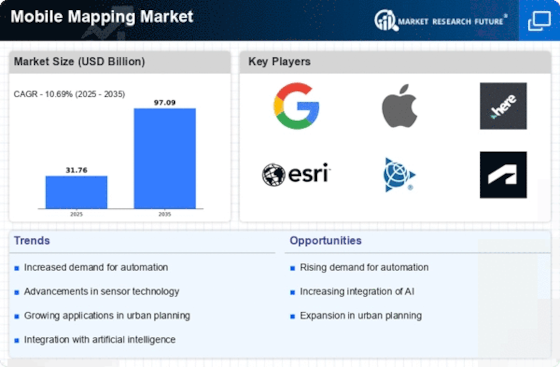
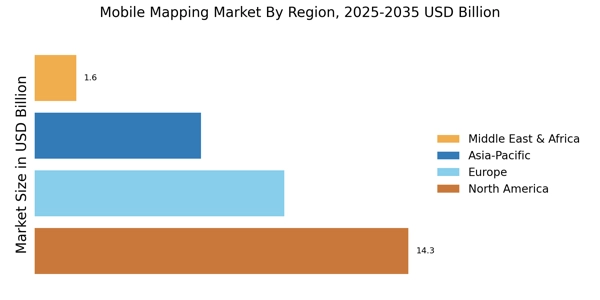
The Mobile Mapping Market is currently experiencing a transformative phase, driven by advancements in technology and increasing demand for accurate geospatial data. The integration of high-resolution imaging, LiDAR, and GPS technologies has enhanced the capabilities of mobile mapping systems, allowing for more precise data collection and analysis. This evolution is not merely a trend but appears to be a fundamental shift in how geographic information is gathered and utilized across various sectors, including urban planning, transportation, and environmental monitoring. As organizations recognize the value of real-time data, the Mobile Mapping Market is likely to expand, fostering innovation and competition among key players.
Mobile mapping enables the rapid collection of geospatial data using vehicle-mounted sensors, transforming how location intelligence is generated across industries. The concept of mapping mobile platforms has gained attention as organizations seek flexible, real-time geospatial data collection methods. Mobile mapping applications are widely used in land surveying, infrastructure planning, urban development, and environmental monitoring. A mobile mapping system integrates GPS, LiDAR, cameras, and inertial sensors to capture accurate geospatial data in real time.
Moreover, the growing emphasis on smart city initiatives and infrastructure development is propelling the adoption of mobile mapping solutions. Stakeholders are increasingly leveraging these technologies to improve decision-making processes and optimize resource allocation. The potential for mobile mapping to facilitate enhanced situational awareness and operational efficiency suggests that its relevance will continue to rise. As the market evolves, it may also witness the emergence of new applications and use cases, further solidifying its position as a critical component in the geospatial landscape. A mobile mapping survey allows rapid and cost-effective data collection for road networks, utilities, and urban infrastructure projects.
Growth in the automotive digital mapping market, particularly for autonomous and connected vehicles, is supporting demand for advanced mobile mapping solutions. Emerging mapping trends, including AI-driven data processing and real-time geospatial analytics, are reshaping the Mobile Mapping Market. Mobile mapping services are increasingly adopted by governments and enterprises to outsource large-scale geospatial data collection and analysis. Continuous innovation in mobile mapping technology, including LiDAR, AI, and cloud-based analytics, is improving data accuracy and operational efficiency.
Technological Advancements
The Mobile Mapping Market is witnessing rapid technological advancements that enhance data collection and processing capabilities. Innovations in sensor technology, such as LiDAR and high-resolution cameras, are enabling more accurate and detailed mapping solutions. These advancements are likely to improve the efficiency of various applications, from urban planning to disaster management.
Increased Demand for Real-Time Data
There is a growing demand for real-time data across multiple industries, which is influencing the Mobile Mapping Market. Organizations are increasingly seeking immediate access to geospatial information to support decision-making processes. This trend suggests that mobile mapping solutions will play a crucial role in providing timely insights for various applications.
Expansion of Smart City Initiatives
The rise of smart city initiatives is significantly impacting the Mobile Mapping Market. As cities strive to enhance infrastructure and improve quality of life, mobile mapping technologies are being integrated into urban planning and management. This trend indicates a shift towards more data-driven approaches in city development, potentially increasing the adoption of mobile mapping solutions.