×
Request Free Sample ×

Kindly complete the form below to receive a free sample of this Report

* Please use a valid business email

Leading companies partner with us for data-driven Insights

clients tt-cursor
Hero Background

Microcontroller Market

ID: MRFR/SEM/9425-CR
128 Pages
Ankit Gupta
July 2024

Microcontroller Market Size, Share & Industry Analysis: By Class (4 to 8-Bit, 16-Bit, 32-Bit, 64-Bit, and Others), By Application (Consumer Electronics, Automotive, Industrial Manufacturing, Communication and IT, and Others), and By Region (North America, Europe, Asia-Pacific, Middle East & Africa, and South America) –Industry Forecast Till 2035

Share:
Download PDF ×

We do not share your information with anyone. However, we may send you emails based on your report interest from time to time. You may contact us at any time to opt-out.

Microcontroller Market Infographic
Purchase Options

Microcontroller Market Summary

As per MRFR analysis, the Microcontroller Market Size was estimated at 29628.7 USD Million in 2024. The Microcontroller industry is projected to grow from 33397.54 USD Million in 2025 to 110594.53 USD Million by 2035, exhibiting a compound annual growth rate (CAGR) of 12.72 during the forecast period 2025 - 2035.

Key Market Trends & Highlights

The microcontroller market is experiencing robust growth driven by technological advancements and increasing demand across various sectors.

  • The rise of IoT applications is significantly shaping the microcontroller market landscape, particularly in North America.
  • Energy efficiency remains a focal point, as manufacturers strive to create more sustainable and cost-effective solutions.
  • Integration and miniaturization trends are evident, especially in the consumer electronics segment, which is currently the largest market.
  • The expansion of automotive electronics and the increasing demand for smart devices are key drivers propelling market growth.

Market Size & Forecast

2024 Market Size 29628.7 (USD Million)
2035 Market Size 110594.53 (USD Million)
CAGR (2025 - 2035) 12.72%

Major Players

Microchip Technology (US), Texas Instruments (US), NXP Semiconductors (NL), STMicroelectronics (CH), Infineon Technologies (DE), Renesas Electronics (JP), Analog Devices (US), Cypress Semiconductor (US), Silicon Labs (US)

Our Impact
Enabled $4.3B Revenue Impact for Fortune 500 and Leading Multinationals
Partnering with 2000+ Global Organizations Each Year
30K+ Citations by Top-Tier Firms in the Industry

Microcontroller Market Trends

The Microcontroller Market is experiencing dynamic evolution, driven by technological advancements and rising demand across sectors. The proliferation of smart devices and IoT has led to greater adoption of microcontroller industrial applications and compact 32 bit MCU solutions.. Integration and miniaturization trends are reshaping the microcontroller market, as devices require multifunctionality in smaller chips. These innovations enhance device performance, reliability, and sustainability. This trend is further fueled by the growing emphasis on energy efficiency and sustainability, prompting manufacturers to innovate and develop products that meet these criteria.

Moreover, the Microcontroller Market is witnessing a shift towards integration and miniaturization. As devices become smaller and more complex, the demand for microcontrollers that can perform multiple functions within a single chip is likely to rise. This integration not only reduces the physical footprint of devices but also enhances performance and reliability. The competitive landscape is characterized by rapid technological advancements, with companies investing heavily in research and development to stay ahead. Overall, the Microcontroller Market appears poised for continued growth, driven by technological innovation and evolving consumer needs.

Rise of IoT Applications

The adoption of IoT technologies is increasing the need for microcontroller industrial and embedded solutions capable of managing connectivity efficiently. As more devices become interconnected, the demand for microcontrollers that can efficiently manage data and connectivity is on the rise. This trend is likely to continue as industries seek to leverage IoT for improved operational efficiency.

Focus on Energy Efficiency

Energy-efficient designs are being prioritized, making microcontroller latest innovations crucial for portable and battery-operated devices. Manufacturers are responding to environmental concerns and regulatory pressures by developing microcontrollers that consume less power while maintaining performance. This focus on sustainability is expected to shape product development strategies moving forward.

Integration and Miniaturization

Integration trends highlight the use of mikrocontrol and microcontrolleur in devices to perform multiple tasks in a single chip, improving efficiency and reducing physical footprint. As devices require more functionality in smaller packages, microcontrollers that combine multiple features into a single chip are becoming increasingly desirable. This shift not only enhances device performance but also supports the development of compact and efficient electronic systems.

Microcontroller Market Drivers

Market Growth Projections

The Global Microcontroller Market Industry is poised for substantial growth, with projections indicating a market value of 29.6 USD Billion in 2024, expected to reach 110.4 USD Billion by 2035. This growth trajectory suggests a robust CAGR of 12.7% from 2025 to 2035, driven by various factors including the rise of IoT devices, advancements in automotive technology, and increasing demand for consumer electronics. The market dynamics indicate a favorable environment for innovation and investment in microcontroller technology, positioning it as a critical component in the evolution of modern electronics.

Rising Demand for IoT Devices

The increasing proliferation of Internet of Things devices is a primary driver of the Global Microcontroller Market Industry. As more devices become interconnected, the need for efficient microcontrollers that can handle complex tasks while consuming minimal power becomes paramount. For instance, smart home devices, wearables, and industrial IoT applications are all reliant on microcontrollers for functionality. This trend is expected to contribute significantly to the market's growth, with projections indicating a market value of 29.6 USD Billion in 2024, escalating to 110.4 USD Billion by 2035, reflecting a robust CAGR of 12.7% from 2025 to 2035.

Growth in Consumer Electronics

Consumer electronics continue to be a significant driver for the Global Microcontroller Market Industry. The demand for smart appliances, smartphones, and other electronic devices necessitates the integration of microcontrollers for enhanced functionality and user experience. As consumers increasingly seek innovative features and connectivity in their devices, manufacturers are compelled to invest in advanced microcontroller technology. This trend is expected to sustain the market's growth trajectory, with the industry projected to reach 29.6 USD Billion in 2024 and potentially expanding to 110.4 USD Billion by 2035, driven by a CAGR of 12.7% from 2025 to 2035.

Emergence of Artificial Intelligence

The integration of artificial intelligence into various applications is reshaping the landscape of the Global Microcontroller Market Industry. Microcontrollers are increasingly being designed to support AI functionalities, enabling devices to perform complex tasks and make intelligent decisions. This trend is particularly evident in sectors such as robotics, healthcare, and automation, where AI-driven solutions are gaining traction. As the demand for smart, autonomous systems grows, the role of microcontrollers in facilitating these advancements is expected to expand, potentially leading to increased market value and innovation.

Advancements in Automotive Technology

The automotive sector is undergoing a transformation, with microcontrollers playing a crucial role in the development of advanced driver-assistance systems and electric vehicles. The Global Microcontroller Market Industry is witnessing increased adoption of microcontrollers in vehicles for functions such as engine control, safety systems, and infotainment. As automotive manufacturers strive to enhance vehicle performance and safety, the demand for sophisticated microcontrollers is likely to surge. This shift not only supports the growth of the microcontroller market but also aligns with the broader trend of electrification and automation in the automotive industry.

Increasing Focus on Energy Efficiency

Energy efficiency is becoming a critical consideration across various sectors, driving the demand for microcontrollers that optimize power consumption. The Global Microcontroller Market Industry is responding to this trend by developing microcontrollers that not only enhance performance but also reduce energy usage. This is particularly relevant in applications such as smart grids and renewable energy systems, where efficient energy management is essential. As industries strive to meet regulatory standards and consumer expectations for sustainability, the adoption of energy-efficient microcontrollers is likely to accelerate, further propelling market growth.


Market Segment Insights

By Application: Consumer Electronics (Largest) vs. Automotive (Fastest-Growing)

The consumer electronics segment dominates the microcontroller market, while the automotive segment is emerging, fueled by microcontroller for automotive applications such as electric vehicles and advanced driver-assistance systems. This segment incorporates a variety of applications, including smartphones, laptops, and home appliances, underlining its vast reach and importance. The automotive segment, while smaller, is rapidly gaining traction, primarily due to the increasing adoption of advanced driver-assistance systems and electric vehicles, positioning it as a crucial contributor to future growth.

Application: Consumer Electronics (Dominant) vs. Automotive (Emerging)

Consumer electronics is a dominant segment within the Microcontroller Market, characterized by high demand for compact, energy-efficient solutions to power a wide range of devices from smart appliances to entertainment systems. On the other hand, the automotive sector is emerging at a fast pace, with microcontrollers playing a crucial role in enhancing automotive safety features, infotainment, and connectivity. This segment is anticipated to leverage the shift towards electric and autonomous vehicles, driving innovation and necessitating the integration of advanced microcontroller solutions to meet stringent performance and reliability standards.

By End Use: Embedded Systems (Largest) vs. Robotics (Fastest-Growing)

The Microcontroller Market is predominantly driven by the Embedded systems remain dominant, while IoT growth drives demand for microcontroller industrial applications and 32 bit MCU adoption. Following closely is the Internet of Things (IoT) which, while currently smaller in market share compared to embedded systems, is rapidly expanding owing to the increase in connected devices and smart home applications.

Looking ahead, the growth of the Microcontroller Market is predominantly fueled by technological advancements and the adoption of IoT solutions. The rising demand for automation in processes and the proliferation of smart home devices are significant contributors to this growth. As businesses and consumers increasingly seek smarter, more efficient technologies, the Microcontroller Market is poised to experience substantial evolution and expansion in these segments.

Embedded Systems (Dominant) vs. Robotics (Emerging)

Embedded systems are foundational to the microcontroller market, designed for specific tasks within larger devices. Their integration in consumer electronics and automation solutions makes them indispensable, driving steady demand. In contrast, robotics is rapidly emerging as a key focus area, propelled by advancements in artificial intelligence and machine learning. This segment is witnessing significant investments, fostering innovation in design and functionality. As industries shift towards automation, robotics microcontrollers are essential for developing autonomous systems and smart machinery, indicating a dynamic shift in market priorities.

By Architecture: Harvard Architecture (Largest) vs. Von Neumann Architecture (Fastest-Growing)

In the Microcontroller Market, Harvard Architecture holds the largest share due to its efficient data processing capabilities, allowing simultaneous access to instructions and data. This architecture is particularly favored in applications requiring high-speed data processing and memory operations, establishing a strong foothold in sectors like automotive and industrial automation. Conversely, Von Neumann Architecture, while initially sharing a smaller portion of the market, is rapidly gaining traction and adapting to modern computing needs, particularly in low-cost consumer electronics.

Architecture: Harvard (Dominant) vs. Von Neumann (Emerging)

Harvard Architecture is recognized as a dominant force in the Microcontroller Market, characterized by its ability to separate memory stores for instructions and data, thereby enhancing the speed of computations. This architecture is ideal for systems where performance is critical, such as in real-time processing scenarios. Meanwhile, Von Neumann Architecture is emerging as a viable alternative, especially in low-performance applications due to its simplicity and cost-effectiveness. It operates on a single memory space for both instructions and data, making it attractive for entry-level microcontrollers in IoT devices. The high versatility of both architectures contributes to their sustained relevance in various technological applications.

By Technology: Analog Microcontrollers (Largest) vs. Low Power Microcontrollers (Fastest-Growing)

The Microcontroller Market is witnessing a diverse distribution among its technology segments. Digital Microcontrollers are widely used; Low Power Microcontrollers are gaining traction for portable IoT devices. 64 bit microcontroller is relevant for high-performance applications. Analog Microcontrollers also contribute notably to the market, particularly in applications requiring signal processing and interfacing with the real world. Meanwhile, Hybrid Microcontrollers are emerging as a balanced solution combining features from both analog and digital realms, catering to specialized needs.

Technology: Analog Microcontrollers (Dominant) vs. Low Power Microcontrollers (Emerging)

Analog Microcontrollers are distinguished by their ability to handle real-world signals, making them a dominant force in applications requiring precise control, such as motor control and power management. These microcontrollers excel in low-speed, high-accuracy tasks and are often preferred in legacy systems. In contrast, Low Power Microcontrollers are emerging as a crucial component in the rapidly expanding field of wearable technology and smart home devices. They are designed to operate on minimal energy, thereby extending battery life and fostering innovation in the Internet of Things (IoT) sector, where efficiency is paramount.

By Size: 32-bit Microcontrollers (Largest) vs. 8-bit Microcontrollers (Fastest-Growing)

In the microcontroller market, 32-bit microcontrollers hold the largest market share due to their versatility and compatibility with complex applications, which makes them a preferred choice across diverse industries including automotive, industrial automation, and healthcare. The growing demand for more processing power and features, coupled with the increasing adoption of IoT devices, has significantly contributed to the prevalence of 32-bit microcontrollers in the market. Conversely, 8-bit microcontrollers are experiencing rapid growth as they cater to cost-sensitive applications in consumer electronics and simple automation. Their low power consumption and ease of integration continue to attract a broad user base, resulting in the fastest growth rate among the various segment values.

Microcontroller Size: 32-bit (Dominant) vs. 8-bit (Emerging)

32-bit microcontrollers are at the forefront of the microcontroller market due to their high processing capabilities, enabling them to handle complex tasks and multi-tasking requirements in advanced applications. They offer a significant advantage in terms of processing power, memory capacity, and peripherals integration, making them a favored choice for smart devices and industrial applications. On the other hand, 8-bit microcontrollers, while limited in processing capabilities, remain crucial for basic control tasks in simpler devices. Their low cost, ease of use, and widespread availability make them particularly appealing in markets where budget constraints are paramount. The versatility of both segment values illustrates the breadth of applications and customer requirements in the microcontroller landscape.

Get more detailed insights about Microcontroller Market

Regional Insights

North America : Innovation and Growth Hub

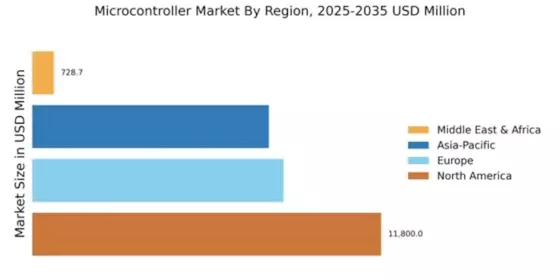
North America is poised to maintain its leadership in the microcontroller market, with a projected market size of $11,800M by December 2025. Innovation hub with key microcontroller manufacturers like Microchip Technology and Texas Instruments. The region benefits from robust demand driven by advancements in IoT, automotive electronics, and smart devices. Regulatory support for technology innovation further fuels growth, ensuring a favorable environment for microcontroller applications across various sectors.

The United States stands as the dominant player, hosting key manufacturers like Microchip Technology and Texas Instruments. The competitive landscape is characterized by continuous innovation and strategic partnerships among leading firms. With a strong focus on R&D, North American companies are well-positioned to capitalize on emerging trends, solidifying their market presence and driving future growth.

Europe : Diverse Market with Strong Demand

Europe's microcontroller market is projected to reach $8,500M by December 2025, driven by increasing demand in automotive, industrial automation, and consumer electronics. The region's focus on sustainability and energy efficiency is catalyzing the adoption of advanced microcontroller technologies. Regulatory frameworks promoting digital transformation are also key growth drivers, enhancing market dynamics. Leading countries such as Germany, France, and the Netherlands are at the forefront of this growth, with a competitive landscape featuring major players like NXP Semiconductors and STMicroelectronics. The European market is characterized by a strong emphasis on innovation and collaboration among industry stakeholders, ensuring a vibrant ecosystem for microcontroller development.

Asia-Pacific : Emerging Powerhouse in Technology

Asia-Pacific is emerging as a powerhouse in the microcontroller market, with a market size of $8,000M projected by December 2025. The region's growth is fueled by rapid industrialization, increasing consumer electronics demand, and advancements in smart technologies. Countries are investing heavily in R&D and infrastructure, supported by favorable government policies that encourage innovation and technology adoption. China, Japan, and South Korea are leading the charge, with significant contributions from companies like Renesas Electronics and Infineon Technologies. The competitive landscape is vibrant, with numerous local and international players vying for market share. This dynamic environment fosters innovation and ensures a steady supply of advanced microcontroller solutions to meet diverse industry needs.

Middle East and Africa : Emerging Market with Potential

The Middle East and Africa (MEA) region is witnessing gradual growth in the microcontroller market, projected to reach $728.7M by December 2025. The demand is driven by increasing investments in smart infrastructure and the adoption of automation technologies across various sectors. Government initiatives aimed at enhancing digital capabilities are also contributing to market expansion, creating a conducive environment for microcontroller applications. Countries like South Africa and the UAE are leading the way, with a growing presence of key players and local manufacturers. The competitive landscape is evolving, with both The Microcontroller share. This region presents unique opportunities for growth, particularly in sectors like automotive and consumer electronics, as technology adoption accelerates.

Microcontroller Market Regional Image

Key Players and Competitive Insights

The Microcontroller Market is currently characterized by intense competition and rapid technological advancements, driven by the increasing demand for automation, IoT applications, and smart devices. Key players focus on low-power 32 bit MCU, digital microcontrollers, and industrial solutions, fostering innovation in the microcontroller market. Strategic partnerships and local manufacturing are helping to mitigate supply chain risks. Major players such as Microchip Technology (US), Texas Instruments (US), and NXP Semiconductors (NL) are strategically positioned to leverage their extensive product portfolios and R&D capabilities. Microchip Technology (US) focuses on innovation in low-power microcontrollers, while Texas Instruments (US) emphasizes its analog and embedded processing solutions. NXP Semiconductors (NL) is actively pursuing partnerships to enhance its automotive and industrial applications, thereby shaping a competitive environment that prioritizes technological differentiation and market responsiveness. Key business tactics within the Microcontroller Market include localizing manufacturing and optimizing supply chains to enhance efficiency and reduce costs. The market structure appears moderately fragmented, with a mix of established players and emerging companies. The collective influence of key players is significant, as they engage in strategic collaborations and acquisitions to bolster their market positions and expand their global reach. 
In November 2025, Microchip Technology (US) announced the launch of its latest low-power microcontroller series, which is designed to cater to the growing demand for energy-efficient solutions in IoT devices. This strategic move not only reinforces Microchip's commitment to innovation but also positions the company to capture a larger share of the burgeoning IoT market, where energy efficiency is paramount.
In October 2025, Texas Instruments (US) unveiled a new family of microcontrollers aimed at automotive applications, focusing on enhanced safety features and connectivity. This initiative underscores Texas Instruments' strategy to penetrate the automotive sector, which is increasingly reliant on advanced microcontroller technology for safety and performance enhancements, thereby solidifying its competitive edge in this lucrative market. 
In September 2025, NXP Semiconductors (NL) entered a strategic partnership with a leading automotive manufacturer to develop next-generation microcontrollers for electric vehicles. This collaboration is indicative of NXP's focus on the automotive sector and its commitment to driving innovation in electric mobility, which is expected to be a key growth area in the coming years.
As of December 2025, the Microcontroller Market is witnessing trends such as digitalization, sustainability, and AI integration, which are reshaping competitive dynamics. Strategic alliances are becoming increasingly important, as companies seek to combine their strengths to address complex market demands. The competitive landscape is likely to evolve from a focus on price-based competition to one centered on innovation, technology, and supply chain reliability, suggesting that companies that prioritize these aspects will be better positioned for future success.

Key Companies in the Microcontroller Market include

Industry Developments

  • Q1 2025: Infineon is the new market leader in the global microcontroller market Infineon Technologies AG became the number one supplier in the global microcontroller market, increasing its market share to 21.3% in 2024 and achieving the largest year-over-year gain among competitors for the first time in its history.[2]
  • Q1 2025: Infineon leads the global microcontroller market Infineon Technologies reached the top position in the global microcontroller market, surpassing competitors with a 21.3% market share in 2024, marking a significant milestone for the company.[3]

Future Outlook

Microcontroller Market Future Outlook

The Microcontroller Market is projected to grow at a 12.72% CAGR from 2025 to 2035, driven by advancements in IoT, automotive applications, and consumer electronics.

New opportunities lie in:

  • Development of smart home automation systems Integration of microcontrollers in electric vehicle technologies Expansion into wearable health monitoring devices

By 2035, the Microcontroller Market is expected to be robust, driven by diverse applications and technological innovations.

Market Segmentation

Microcontroller Market Size Outlook

  • 8-bit Microcontrollers
  • 16-bit Microcontrollers
  • 32-bit Microcontrollers
  • 64-bit Microcontrollers
  • High Density Microcontrollers

Microcontroller Market End Use Outlook

  • Embedded Systems
  • Robotics
  • Smart Home Devices
  • Wearable Technology
  • Internet of Things

Microcontroller Market Technology Outlook

  • Analog Microcontrollers
  • Digital Microcontrollers
  • Hybrid Microcontrollers
  • Low Power Microcontrollers
  • High Performance Microcontrollers

Microcontroller Market Application Outlook

  • Consumer Electronics
  • Automotive
  • Industrial Automation
  • Healthcare
  • Telecommunications

Microcontroller Market Architecture Outlook

  • Harvard Architecture
  • Von Neumann Architecture
  • Modified Harvard Architecture
  • System on Chip
  • Microcontroller Unit

Report Scope

MARKET SIZE 2024 29628.7(USD Million)
MARKET SIZE 2025 33397.54(USD Million)
MARKET SIZE 2035 110594.53(USD Million)
COMPOUND ANNUAL GROWTH RATE (CAGR) 12.72% (2025 - 2035)
REPORT COVERAGE Revenue Forecast, Competitive Landscape, Growth Factors, and Trends
BASE YEAR 2024
Market Forecast Period 2025 - 2035
Historical Data 2019 - 2024
Market Forecast Units USD Million
Key Companies Profiled Microchip Technology (US), Texas Instruments (US), NXP Semiconductors (NL), STMicroelectronics (CH), Infineon Technologies (DE), Renesas Electronics (JP), Analog Devices (US), Cypress Semiconductor (US), Silicon Labs (US)
Segments Covered Application, End Use, Architecture, Technology, Size
Key Market Opportunities Integration of artificial intelligence in embedded systems drives growth in the Microcontroller Market.
Key Market Dynamics Rising demand for energy-efficient microcontrollers drives innovation and competition among leading semiconductor manufacturers.
Countries Covered North America, Europe, APAC, South America, MEA
Leave a Comment

FAQs

How much is the Microcontroller market?

The Microcontroller Market size is expected to be valued at USD 29628.70 billion in 2024.

What is the growth rate of the Microcontroller market?

The global market is projected to grow at a CAGR of 12.72% during the forecast period, 2025 to 2035.

Which region held the largest market share in the Microcontroller market?

The Asia pacific had the largest share of the global market.

Who are the key players in the Microcontroller market?

The key players in the market Texas Instruments Incorporated, Microchip Technology, Broadcom Inc., ROHM Co., Ltd, Renesas Electronics Corp, Infineon Technologies AG, STMicroelectronics N.V, NXP Semiconductors NV, and Toshiba Electronic Devices & Storage Corporation.

Which Class led the Microcontroller market?

64-Bit dominated the market in 2023.

Download Free Sample

Kindly complete the form below to receive a free sample of this Report

Compare Licence

×
Features License Type
Single User Multiuser License Enterprise User
Price $4,950 $5,950 $7,250
Maximum User Access Limit 1 User Upto 10 Users Unrestricted Access Throughout the Organization
Free Customization
Direct Access to Analyst
Deliverable Format
Platform Access
Discount on Next Purchase 10% 15% 15%
Printable Versions