×
Request Free Sample ×

Kindly complete the form below to receive a free sample of this Report

* Please use a valid business email

Leading companies partner with us for data-driven Insights

clients tt-cursor
Hero Background
English
Chinese
French
Japanese
Korean
German
Spanish

Microbiome Sequencing Services Market Share

ID: MRFR/HC/6063-HCR
160 Pages
Rahul Gotadki
February 2026

Microbiome Sequencing Services Market Research Report Information By Technology (Sequencing by Litigation (SBL), Sequencing by Synthesis (SBS), Short Gun Sequencing, Targeted Gene Sequencing, RNA Sequencing, and Others), By Application (Gastrointestinal Diseases, Infectious Diseases, CNS Diseases, Oncology, and Others), and By Region (North America, Europe, Asia-Pacific, And Rest Of The World) –Market Forecast Till 2035

Share:
Download PDF ×

We do not share your information with anyone. However, we may send you emails based on your report interest from time to time. You may contact us at any time to opt-out.

Microbiome Sequencing Services Market Infographic
Purchase Options

Market Share

Microbiome Sequencing Services Market Share Analysis

The Microbiome Sequencing Services are growing very quickly. Market studies the different bacteria communities in the human body. To become the leaders in high-quality, complete microbiome sequencing, these businesses use a variety of strategies to gain market share. To stay competitive in microbiome sequencing services, methods for sequencing must always be improved. Companies use NGS and metagenomics to learn more about microbe communities and attract customers who want the latest sequencing services. It makes sense to form good relationships. Universities, science companies, and pharmaceutical companies can use microbiome sequencing services to do study and come up with new medicines. Because they work together, their services get more respect and market share. There are a lot of different microbial study fields, so companies tailor their services to those areas. Firms can meet the needs of healthcare and university experts for gut health, skin bacteria, and outdoor microbiomes through customization. Businesses want to grow their global markets while also looking into microbiome studies in their own countries. By tailoring their services to the microbiomes and study goals of different regions, companies may be able to break into foreign markets and take over the global microbiome sequencing scene. It's not okay to mess up sequence data. Companies use strict quality control methods that follow the rules set by the government and the industry. These high standards help customers trust the company, which makes it a good choice for microbiome sequencing. A strategic edge can be gained from better genetic research. Bioinformatics systems are used by businesses to look at big amounts of microbiome data and give customers useful information. Researchers who study data are drawn to services that offer advanced analytics. It's important to have great customer service. Collaboration and advising services from companies help researchers plan studies, collect samples, and figure out what the results mean. This focus on the customer approach builds long-lasting relationships and improves the names of microbial sequencing service companies. Microbiome sequencing is taught to the public by businesses. Online tools, workshops, and seminars help spread information, which makes the company look like a guide and brings in clients who are looking for help. To reach the market, you need to do good marketing. Companies post study papers, white papers, and go to workshops to show that they are experts in microbiome sequencing. People looking for stars in their field want brands that they can trust and that lead the way in thinking. Companies keep up with studies on microbiomes. In microbiome science, companies change their services to fit new study questions and methods. This makes them look flexible and quick to act.
Author
Rahul Gotadki
Research Manager

He holds an experience of about 9+ years in Market Research and Business Consulting, working under the spectrum of Life Sciences and Healthcare domains. Rahul conceptualizes and implements a scalable business strategy and provides strategic leadership to the clients. His expertise lies in market estimation, competitive intelligence, pipeline analysis, customer assessment, etc.

Leave a Comment

FAQs

What is the projected market valuation of the Microbiome Sequencing Services Market by 2035?

<p>The projected market valuation for the Microbiome Sequencing Services Market is 12510.97 USD Million by 2035.</p>

Which companies are considered key players in the Microbiome Sequencing Services Market?

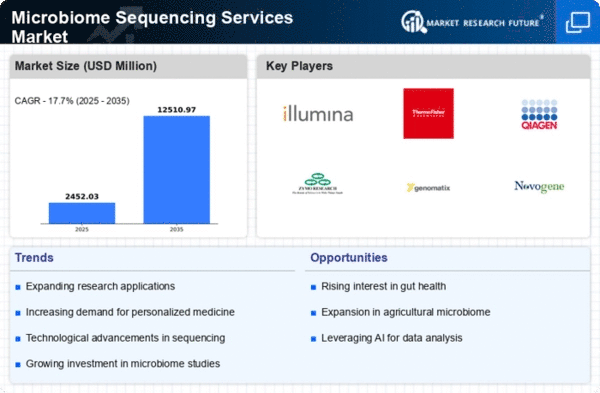
<p>Key players in the market include Illumina, Thermo Fisher Scientific, Qiagen, Zymo Research, Genomatix, BGI Genomics, Novogene, Macrogen, and Oxford Nanopore Technologies.</p>

What was the market valuation of the Microbiome Sequencing Services Market in 2024?

<p>The overall market valuation of the Microbiome Sequencing Services Market was 2083.29 USD Million in 2024.</p>

What is the expected CAGR for the Microbiome Sequencing Services Market during the forecast period 2025 - 2035?

<p>The expected CAGR for the Microbiome Sequencing Services Market during the forecast period 2025 - 2035 is 17.7%.</p>

How does the Clinical Diagnostics segment perform in terms of market valuation?

<p>The Clinical Diagnostics segment had a valuation of 500.0 USD Million in 2024 and is projected to reach 3000.0 USD Million by 2035.</p>

What are the key applications of microbiome sequencing services?

<p>Key applications of microbiome sequencing services include Clinical Diagnostics, Research and Development, Personalized Medicine, Agricultural Microbiome, and Environmental Monitoring.</p>

Which technology segment is expected to show the highest growth in the Microbiome Sequencing Services Market?

The Shotgun Sequencing technology segment is expected to show the highest growth, with a valuation of 683.29 USD Million in 2024 and a projected 4110.97 USD Million by 2035.

What is the market valuation for the Environmental Monitoring segment in 2024?

The Environmental Monitoring segment had a valuation of 283.29 USD Million in 2024.

How does the Pharmaceuticals end-use segment compare to others in market valuation?

The Pharmaceuticals end-use segment had a valuation of 500.0 USD Million in 2024, indicating a strong position within the market.

What is the projected valuation for the Agricultural Microbiome segment by 2035?

The Agricultural Microbiome segment is projected to reach a valuation of 1800.0 USD Million by 2035.

Market Summary

As per MRFR analysis, the Microbiome Sequencing Services Market was estimated at 2083.29 USD Million in 2024. The microbiome sequencing industry is projected to grow from 2452.03 in 2025 to 12510.97 by 2035, exhibiting a compound annual growth rate (CAGR) of 17.7% during the forecast period 2025 - 2035.

Key Market Trends & Highlights

The Microbiome Sequencing Services Market is poised for substantial growth driven by technological advancements and increasing consumer awareness.

  • North America remains the largest market for microbiome sequencing services, driven by robust healthcare infrastructure and research funding. Asia-Pacific is emerging as the fastest-growing region, fueled by rising investments in biotechnology and healthcare innovation. The Clinical Diagnostics segment holds the largest share, while the Research and Development segment is experiencing rapid growth due to increased research activities. Technological advancements in sequencing and rising consumer awareness are key drivers propelling market expansion.

Market Size & Forecast

2024 Market Size 2083.29 (USD Million)
2035 Market Size 12510.97 (USD Million)
CAGR (2025 - 2035) 17.7%
Largest Regional Market Share in 2024 North America

Major Players

<p><a href="https://sapac.illumina.com/areas-of-interest/microbiology/microbial-sequencing-methods.html">Illumina </a>(US), Thermo Fisher Scientific (US), Qiagen (DE), Zymo Research (US), Genomatix (DE), Novogene (CN), Macrogen (KR), BaseClear (NL), Molecular Research LP (US)</p>

Market Trends

The Microbiome Sequencing Services Market is currently experiencing a notable evolution, driven by advancements in genomic technologies and an increasing understanding of the human microbiome's role in health and disease. This market encompasses a range of services that facilitate the analysis of microbial communities, providing insights that are crucial for personalized medicine, drug development, and nutritional science. As research continues to unveil the complexities of microbial interactions, the demand for sequencing services is likely to expand, attracting a diverse clientele from academic institutions to pharmaceutical companies. Furthermore, the integration of artificial intelligence and machine learning into data analysis processes appears to enhance the accuracy and efficiency of microbiome studies, potentially leading to groundbreaking discoveries in various fields. In addition to technological advancements, the Microbiome Sequencing Services Market is influenced by a growing consumer interest in health and wellness. Individuals are increasingly seeking personalized health solutions, which may drive demand for microbiome analysis as a tool for optimizing diet and lifestyle choices. This trend suggests a shift towards a more proactive approach to health management, where understanding one's microbiome could play a pivotal role. As the market continues to mature, collaborations between research institutions and commercial entities may foster innovation, ultimately leading to the development of new applications and services that cater to the evolving needs of consumers and healthcare providers.

Technological Advancements in Sequencing

Recent innovations in sequencing technologies are transforming the Microbiome Sequencing Services Market. Enhanced methods, such as next-generation sequencing, are enabling more comprehensive and faster analysis of microbial communities. This evolution not only improves the accuracy of results but also reduces the time required for processing samples, making it more accessible for various stakeholders.

Rising Consumer Awareness

There is a noticeable increase in consumer awareness regarding the importance of gut health and its connection to overall well-being. This heightened interest is likely to drive demand for microbiome sequencing services, as individuals seek personalized insights into their health. Consequently, companies may focus on developing user-friendly testing kits and services that cater to this growing market.

Collaborative Research Initiatives

Collaborations between academic institutions and private enterprises are becoming more prevalent within the Microbiome Sequencing Services Market. These partnerships aim to leverage shared expertise and resources, fostering innovation in microbiome research. Such initiatives may lead to the development of novel applications and services, ultimately enhancing the market's growth potential.

Microbiome Sequencing Services Market Market Drivers

Market Growth Projections

The Global Microbiome Sequencing Services Market Industry is projected to witness substantial growth over the coming years. The market is expected to reach 2.08 USD Billion in 2024 and is forecasted to expand to 11.7 USD Billion by 2035. This growth trajectory suggests a compound annual growth rate of 16.99% from 2025 to 2035. Such projections indicate a robust demand for microbiome sequencing services, driven by advancements in technology, increased research funding, and a growing consumer focus on health and wellness.

Increased Research Funding

The Global Microbiome Sequencing Services Market Industry benefits from increased funding for microbiome research from both public and private sectors. Governments and research institutions are recognizing the potential of microbiome studies in various fields, including medicine, agriculture, and environmental science. This influx of funding is facilitating large-scale studies and collaborations, thereby expanding the scope of microbiome research. As a result, the demand for sequencing services is expected to rise, contributing to a compound annual growth rate of 16.99% from 2025 to 2035.

Growing Awareness of Gut Health

There is a growing awareness of the importance of gut health among consumers, which is significantly influencing the Global Microbiome Sequencing Services Market Industry. As individuals become more informed about the link between gut microbiota and overall health, they are increasingly seeking microbiome testing services. This trend is reflected in the rising number of companies offering consumer-oriented microbiome sequencing services. The increasing consumer demand for gut health insights is likely to drive market expansion, as more individuals seek personalized recommendations based on their microbiome profiles.

Advancements in Sequencing Technologies

Technological advancements in sequencing methodologies are propelling the Global Microbiome Sequencing Services Market Industry forward. Innovations such as next-generation sequencing (NGS) and single-cell sequencing are enhancing the accuracy and efficiency of microbiome analysis. These technologies enable researchers and clinicians to obtain comprehensive microbial profiles, which are essential for understanding complex interactions within the microbiome. As these technologies continue to evolve, they are likely to attract more investments and drive market growth, potentially leading to a market size of 11.7 USD Billion by 2035.

Rising Demand for Personalized Medicine

The Global Microbiome Sequencing Services Market Industry is experiencing a notable increase in demand for personalized medicine. This trend is largely driven by the growing recognition of the microbiome's role in health and disease. As healthcare providers seek to tailor treatments based on individual microbiome profiles, the market is projected to reach 2.08 USD Billion in 2024. This shift towards personalized healthcare solutions indicates a significant opportunity for microbiome sequencing services, as they provide critical insights that can enhance therapeutic efficacy and patient outcomes.

Regulatory Support for Microbiome Research

Regulatory bodies are increasingly supporting microbiome research, which is positively impacting the Global Microbiome Sequencing Services Market Industry. Initiatives aimed at promoting microbiome studies and establishing guidelines for microbiome-based products are fostering a conducive environment for innovation. This regulatory support not only encourages research but also enhances public trust in microbiome-related products and services. As regulations evolve, they may facilitate market entry for new players and technologies, further stimulating growth in the microbiome sequencing services sector.

Market Segment Insights

By Application: Clinical Diagnostics (Largest) vs. Research and Development (Fastest-Growing)

<p>In the Microbiome Sequencing Services Market, the application segments are diverse, with Clinical Diagnostics leading in market share. This segment has gained significance due to the increasing recognition of microbiomes in disease detection and treatment. Following closely is Research and Development, which has gained traction as more organizations invest in innovative microbiome research to enhance healthcare outcomes. Personalized Medicine also plays a notable role, bridging the gap between genetic testing and tailored health strategies. As the Microbiome Sequencing Services Market evolves, growth trends indicate that Research and Development is experiencing the fastest expansion. This surge can be attributed to advancements in technology, coupled with growing research initiatives focused on understanding the microbiome's role in health and disease. Similarly, Personalized Medicine is poised for growth, given its potential to revolutionize treatment strategies based on individual microbiome profiles, while the Agricultural Microbiome and Environmental Monitoring segments are steadily gaining attention for their essential roles in sustainable practices and biodiversity assessment.</p>

<p>Clinical Diagnostics (Dominant) vs. Research and Development (Emerging)</p>

<p>Clinical Diagnostics remains a dominant force in the Microbiome Sequencing Services Market, largely due to its critical role in detecting diseases through microbiome analysis. This segment leverages advanced sequencing technologies to offer insights into patient health, leading to improved diagnostic capabilities and treatment plans. In contrast, Research and Development is emerging as a pivotal segment, driven by the need for groundbreaking studies that explore the complex interactions between microbiomes and health outcomes. Institutions and organizations are increasingly investing in microbiome research, aiming to uncover new therapeutic avenues. Together, these segments highlight the diversity and potential of microbiome sequencing, catering to critical needs in health diagnostics while fostering innovation in research.</p>

By Technology: 16S rRNA Sequencing (Largest) vs. Shotgun Sequencing (Fastest-Growing)

<p>In the Microbiome Sequencing Services Market, 16S rRNA sequencing currently dominates the landscape due to its established protocols and accuracy in determining microbial diversity. This method enjoys the largest market share, appealing to researchers and healthcare providers focused on microbiome studies. On the other hand, shotgun sequencing, while smaller in share, is rapidly gaining traction. Its ability to sequence entire communities of microorganisms provides deeper insights, making it increasingly preferable among researchers pursuing comprehensive analyses of microbiomes.</p>

<p>Technology: 16S rRNA Sequencing (Dominant) vs. Shotgun Sequencing (Emerging)</p>

<p>16S rRNA sequencing is characterized by its specificity towards bacterial identification and is favored for its cost-effectiveness and reliability. It serves as a crucial method for examining microbial compositions in various environments, from ecological studies to clinical diagnostics. In contrast, shotgun sequencing emerges as a comprehensive approach allowing deeper sequencing of all genetic material from the sample. This technology is gaining momentum due to its versatility in analyzing complex microbiomes, making it particularly appealing for advanced research applications and providing richer genomic insights.</p>

By End Use: Healthcare (Largest) vs. Pharmaceuticals (Fastest-Growing)

<p>In the Microbiome Sequencing Services Market, the healthcare sector holds the largest market share, driven by its extensive applications in disease diagnosis and treatment personalization. Following closely is the pharmaceuticals segment, which is experiencing rapid growth as companies increasingly focus on microbiome-based therapies and drug development tailored to individual microbiome profiles. Agriculture and environmental services are also significant, but their share is comparatively smaller due to emerging developments in microbiome research.</p>

<p>Healthcare: Diagnostics (Dominant) vs. Pharmaceuticals: Drug Development (Emerging)</p>

<p>The healthcare segment is robust, characterized by a substantial focus on diagnostics and patient treatment methodologies driven by microbiome insights. Dominating this market, diagnostics leverage microbiome analysis to enhance accuracy in disease detection. In contrast, the pharmaceuticals segment, recognized as emerging, is swiftly adapting to new biological insights, focusing on drug development. This sector is pivotal for developing innovative therapies that consider individual microbiomes, marking a transformative approach in treatment personalization. Both segments are instrumental in advancing the microbiome's understanding and application, though the healthcare sector currently leads in adoption.</p>

Get more detailed insights about Microbiome Sequencing Services Market Research Report – Forecast till 2035

Regional Insights

North America : Market Leader in Innovation

North America is poised to maintain its leadership in the microbiome sequencing services market, holding a significant share of approximately 1041.65 million in 2024. The region's growth is driven by increasing investments in biotechnology, rising demand for personalized medicine, and supportive regulatory frameworks. The presence of advanced research institutions and a robust healthcare infrastructure further catalyze market expansion. The United States stands out as the primary contributor, with key players like Illumina, Thermo Fisher Scientific, and Zymo Research leading the charge. The competitive landscape is characterized by continuous innovation and strategic partnerships aimed at enhancing service offerings. As the market evolves, the focus on integrating microbiome data into clinical applications is expected to drive further growth.

Europe : Emerging Market with Potential

Europe is witnessing a burgeoning microbiome sequencing services market, valued at approximately 675.0 million in 2024. The region's growth is fueled by increasing awareness of microbiome research, supportive government initiatives, and a rising number of clinical trials. Regulatory bodies are actively promoting research in microbiome applications, which is expected to enhance market dynamics significantly. Leading countries such as Germany, the UK, and France are at the forefront, with companies like Qiagen and Genomatix making substantial contributions. The competitive landscape is marked by collaborations between academic institutions and industry players, fostering innovation. As the market matures, the integration of microbiome data into healthcare practices is anticipated to gain momentum.

Asia-Pacific : Rapidly Growing Market

Asia-Pacific is emerging as a significant player in the microbiome sequencing services market, with a valuation of around 300.0 million in 2024. The region's growth is driven by increasing investments in healthcare infrastructure, rising awareness of microbiome research, and a growing number of research initiatives. Governments are also implementing policies to support biotechnology advancements, which are expected to further stimulate market growth. Countries like China, Japan, and South Korea are leading the charge, with companies such as Novogene and Macrogen playing pivotal roles. The competitive landscape is characterized by a mix of local and international players, fostering innovation and collaboration. As the market evolves, the focus on personalized medicine and health management is likely to drive further expansion.

Middle East and Africa : Niche Market with Opportunities

The Middle East and Africa region is gradually developing its microbiome sequencing services market, valued at approximately 66.64 million in 2024. The growth is primarily driven by increasing healthcare investments, rising awareness of microbiome research, and the establishment of research institutions. Regulatory support is also beginning to emerge, which is expected to enhance the market landscape in the coming years. Countries like South Africa and the UAE are leading the way, with a growing number of local and international players entering the market. The competitive landscape is still in its infancy, but there is significant potential for growth as awareness of microbiome applications in health and disease management increases. As the market matures, collaborations between research institutions and industry players are expected to flourish.

Key Players and Competitive Insights

The Microbiome Sequencing Services Market is currently characterized by a dynamic competitive landscape, driven by advancements in genomic technologies and an increasing focus on personalized medicine. Key players such as Illumina (US), Thermo Fisher Scientific (US), and Novogene (CN) are at the forefront, leveraging their technological prowess and extensive product portfolios to capture market share. Illumina (US) has positioned itself as a leader through continuous innovation in sequencing technologies, while Thermo Fisher Scientific (US) emphasizes its comprehensive suite of solutions for microbiome analysis, enhancing its operational focus on customer-centric services. Novogene (CN), on the other hand, is expanding its global footprint, particularly in Asia, to tap into emerging markets, thereby shaping the competitive environment through strategic regional expansion.
In terms of business tactics, companies are increasingly localizing manufacturing and optimizing supply chains to enhance efficiency and reduce costs. The market appears moderately fragmented, with a mix of established players and emerging companies vying for dominance. The collective influence of these key players is significant, as they drive technological advancements and set industry standards, thereby shaping the overall market structure.
In November 2025, Illumina (US) announced a partnership with a leading healthcare provider to integrate its microbiome sequencing services into routine clinical practice. This strategic move is likely to enhance patient outcomes by enabling more precise diagnostics and personalized treatment plans, thereby reinforcing Illumina's position as a pioneer in the field. The collaboration underscores the growing recognition of microbiome analysis in clinical settings, potentially setting a precedent for future partnerships.
In October 2025, Thermo Fisher Scientific (US) launched a new line of microbiome sequencing kits designed for high-throughput applications. This introduction is significant as it caters to the increasing demand for scalable solutions in microbiome research, allowing researchers to conduct large-scale studies with greater efficiency. The move not only strengthens Thermo Fisher's product offerings but also positions the company to capitalize on the growing trend of large-scale microbiome studies.
In September 2025, Novogene (CN) expanded its laboratory facilities in Europe, aiming to enhance its service capabilities and meet the rising demand for microbiome sequencing in the region. This expansion is indicative of Novogene's commitment to increasing its operational capacity and improving service delivery, which may provide a competitive edge in the European market. The strategic investment reflects a broader trend of companies seeking to establish a stronger presence in key geographical areas.
As of December 2025, the competitive trends in the Microbiome Sequencing Services Market are increasingly defined by digitalization, sustainability, and the integration of artificial intelligence (AI) in data analysis. Strategic alliances among key players are shaping the landscape, fostering innovation and collaboration. The shift from price-based competition to a focus on technological advancement and supply chain reliability is evident, suggesting that future competitive differentiation will hinge on the ability to innovate and deliver high-quality, reliable services.

Key Companies in the Microbiome Sequencing Services Market include

Industry Developments

January 2022:Eagle Genomics and Quadram Institute have formed a new strategic alliance to speed up microbiome analysis using an AI-augmented knowledge discovery platform and genetic sequencing technology. The collaboration with the Quadram Institute will involve the sharing of datasets, tools, and innovation pipelines to aid in the understanding of complex microbiome data through Eagle Genomics' e[datascientist] platform, building on the agreement with the Earlham Institute, a Norwich-based leader in data-intensive bioscience research.

June 2021:Illumina and Microba Life Sciences have formed a collaboration to better study the role of the human gut microbiome in human health and illness. The collaboration will combine Illumina's ground-breaking NGS techniques with Microba's high-quality proprietary gut microbiome analysis platform to generate the precise metagenomic data researchers need to fuel new discoveries.

Future Outlook

Microbiome Sequencing Services Market Future Outlook

The Microbiome Sequencing Services Market is projected to grow at a 17.7% CAGR from 2025 to 2035, driven by advancements in <a href="https://www.marketresearchfuture.com/reports/personalized-medicine-market-2937">personalized medicine</a>, increasing research funding, and rising consumer awareness.

New opportunities lie in:

  • Development of integrated microbiome analysis platforms for clinical applications.
  • Expansion of subscription-based microbiome testing services for consumers.
  • Partnerships with pharmaceutical companies for microbiome-related drug development.

By 2035, the market is expected to be robust, driven by innovation and strategic partnerships.

Market Segmentation

Microbiome Sequencing Services Market End Use Outlook

  • Healthcare
  • Pharmaceuticals
  • Agriculture
  • Food and Beverage
  • Environmental Services

Microbiome Sequencing Services Market Technology Outlook

  • 16S rRNA Sequencing
  • Whole Genome Sequencing
  • Metagenomic Sequencing
  • Shotgun Sequencing

Microbiome Sequencing Services Market Application Outlook

  • Clinical Diagnostics
  • Research and Development
  • Personalized Medicine
  • Agricultural Microbiome
  • Environmental Monitoring

Report Scope

MARKET SIZE 2024 2083.29(USD Million)
MARKET SIZE 2025 2452.03(USD Million)
MARKET SIZE 2035 12510.97(USD Million)
COMPOUND ANNUAL GROWTH RATE (CAGR) 17.7% (2025 - 2035)
REPORT COVERAGE Revenue Forecast, Competitive Landscape, Growth Factors, and Trends
BASE YEAR 2024
Market Forecast Period 2025 - 2035
Historical Data 2019 - 2024
Market Forecast Units USD Million
Key Companies Profiled Illumina (US), Thermo Fisher Scientific (US), Qiagen (DE), Zymo Research (US), Genomatix (DE), Novogene (CN), Macrogen (KR), BaseClear (NL), Molecular Research LP (US)
Segments Covered Application, Technology, End Use
Key Market Opportunities Advancements in personalized medicine drive demand for Microbiome Sequencing Services Market innovations and applications.
Key Market Dynamics Rising demand for personalized medicine drives innovation and competition in microbiome sequencing services.
Countries Covered North America, Europe, APAC, South America, MEA

FAQs

What is the projected market valuation of the Microbiome Sequencing Services Market by 2035?

<p>The projected market valuation for the Microbiome Sequencing Services Market is 12510.97 USD Million by 2035.</p>

Which companies are considered key players in the Microbiome Sequencing Services Market?

<p>Key players in the market include Illumina, Thermo Fisher Scientific, Qiagen, Zymo Research, Genomatix, BGI Genomics, Novogene, Macrogen, and Oxford Nanopore Technologies.</p>

What was the market valuation of the Microbiome Sequencing Services Market in 2024?

<p>The overall market valuation of the Microbiome Sequencing Services Market was 2083.29 USD Million in 2024.</p>

What is the expected CAGR for the Microbiome Sequencing Services Market during the forecast period 2025 - 2035?

<p>The expected CAGR for the Microbiome Sequencing Services Market during the forecast period 2025 - 2035 is 17.7%.</p>

How does the Clinical Diagnostics segment perform in terms of market valuation?

<p>The Clinical Diagnostics segment had a valuation of 500.0 USD Million in 2024 and is projected to reach 3000.0 USD Million by 2035.</p>

What are the key applications of microbiome sequencing services?

<p>Key applications of microbiome sequencing services include Clinical Diagnostics, Research and Development, Personalized Medicine, Agricultural Microbiome, and Environmental Monitoring.</p>

Which technology segment is expected to show the highest growth in the Microbiome Sequencing Services Market?

The Shotgun Sequencing technology segment is expected to show the highest growth, with a valuation of 683.29 USD Million in 2024 and a projected 4110.97 USD Million by 2035.

What is the market valuation for the Environmental Monitoring segment in 2024?

The Environmental Monitoring segment had a valuation of 283.29 USD Million in 2024.

How does the Pharmaceuticals end-use segment compare to others in market valuation?

The Pharmaceuticals end-use segment had a valuation of 500.0 USD Million in 2024, indicating a strong position within the market.

What is the projected valuation for the Agricultural Microbiome segment by 2035?

The Agricultural Microbiome segment is projected to reach a valuation of 1800.0 USD Million by 2035.

  1. SECTION I: EXECUTIVE SUMMARY AND KEY HIGHLIGHTS
    1. | 1.1 EXECUTIVE SUMMARY
    2. | | 1.1.1 Market Overview
    3. | | 1.1.2 Key Findings
    4. | | 1.1.3 Market Segmentation
    5. | | 1.1.4 Competitive Landscape
    6. | | 1.1.5 Challenges and Opportunities
    7. | | 1.1.6 Future Outlook
  2. SECTION II: SCOPING, METHODOLOGY AND MARKET STRUCTURE
    1. | 2.1 MARKET INTRODUCTION
    2. | | 2.1.1 Definition
    3. | | 2.1.2 Scope of the study
    4. | | | 2.1.2.1 Research Objective
    5. | | | 2.1.2.2 Assumption
    6. | | | 2.1.2.3 Limitations
    7. | 2.2 RESEARCH METHODOLOGY
    8. | | 2.2.1 Overview
    9. | | 2.2.2 Data Mining
    10. | | 2.2.3 Secondary Research
    11. | | 2.2.4 Primary Research
    12. | | | 2.2.4.1 Primary Interviews and Information Gathering Process
    13. | | | 2.2.4.2 Breakdown of Primary Respondents
    14. | | 2.2.5 Forecasting Model
    15. | | 2.2.6 Market Size Estimation
    16. | | | 2.2.6.1 Bottom-Up Approach
    17. | | | 2.2.6.2 Top-Down Approach
    18. | | 2.2.7 Data Triangulation
    19. | | 2.2.8 Validation
  3. SECTION III: QUALITATIVE ANALYSIS
    1. | 3.1 MARKET DYNAMICS
    2. | | 3.1.1 Overview
    3. | | 3.1.2 Drivers
    4. | | 3.1.3 Restraints
    5. | | 3.1.4 Opportunities
    6. | 3.2 MARKET FACTOR ANALYSIS
    7. | | 3.2.1 Value chain Analysis
    8. | | 3.2.2 Porter's Five Forces Analysis
    9. | | | 3.2.2.1 Bargaining Power of Suppliers
    10. | | | 3.2.2.2 Bargaining Power of Buyers
    11. | | | 3.2.2.3 Threat of New Entrants
    12. | | | 3.2.2.4 Threat of Substitutes
    13. | | | 3.2.2.5 Intensity of Rivalry
    14. | | 3.2.3 COVID-19 Impact Analysis
    15. | | | 3.2.3.1 Market Impact Analysis
    16. | | | 3.2.3.2 Regional Impact
    17. | | | 3.2.3.3 Opportunity and Threat Analysis
  4. SECTION IV: QUANTITATIVE ANALYSIS
    1. | 4.1 Healthcare, BY Application (USD Million)
    2. | | 4.1.1 Clinical Diagnostics
    3. | | 4.1.2 Research and Development
    4. | | 4.1.3 Personalized Medicine
    5. | | 4.1.4 Agricultural Microbiome
    6. | | 4.1.5 Environmental Monitoring
    7. | 4.2 Healthcare, BY Technology (USD Million)
    8. | | 4.2.1 16S rRNA Sequencing
    9. | | 4.2.2 Whole Genome Sequencing
    10. | | 4.2.3 Metagenomic Sequencing
    11. | | 4.2.4 Shotgun Sequencing
    12. | 4.3 Healthcare, BY End Use (USD Million)
    13. | | 4.3.1 Healthcare
    14. | | 4.3.2 Pharmaceuticals
    15. | | 4.3.3 Agriculture
    16. | | 4.3.4 Food and Beverage
    17. | | 4.3.5 Environmental Services
    18. | 4.4 Healthcare, BY Region (USD Million)
    19. | | 4.4.1 North America
    20. | | | 4.4.1.1 US
    21. | | | 4.4.1.2 Canada
    22. | | 4.4.2 Europe
    23. | | | 4.4.2.1 Germany
    24. | | | 4.4.2.2 UK
    25. | | | 4.4.2.3 France
    26. | | | 4.4.2.4 Russia
    27. | | | 4.4.2.5 Italy
    28. | | | 4.4.2.6 Spain
    29. | | | 4.4.2.7 Rest of Europe
    30. | | 4.4.3 APAC
    31. | | | 4.4.3.1 China
    32. | | | 4.4.3.2 India
    33. | | | 4.4.3.3 Japan
    34. | | | 4.4.3.4 South Korea
    35. | | | 4.4.3.5 Malaysia
    36. | | | 4.4.3.6 Thailand
    37. | | | 4.4.3.7 Indonesia
    38. | | | 4.4.3.8 Rest of APAC
    39. | | 4.4.4 South America
    40. | | | 4.4.4.1 Brazil
    41. | | | 4.4.4.2 Mexico
    42. | | | 4.4.4.3 Argentina
    43. | | | 4.4.4.4 Rest of South America
    44. | | 4.4.5 MEA
    45. | | | 4.4.5.1 GCC Countries
    46. | | | 4.4.5.2 South Africa
    47. | | | 4.4.5.3 Rest of MEA
  5. SECTION V: COMPETITIVE ANALYSIS
    1. | 5.1 Competitive Landscape
    2. | | 5.1.1 Overview
    3. | | 5.1.2 Competitive Analysis
    4. | | 5.1.3 Market share Analysis
    5. | | 5.1.4 Major Growth Strategy in the Healthcare
    6. | | 5.1.5 Competitive Benchmarking
    7. | | 5.1.6 Leading Players in Terms of Number of Developments in the Healthcare
    8. | | 5.1.7 Key developments and growth strategies
    9. | | | 5.1.7.1 New Product Launch/Service Deployment
    10. | | | 5.1.7.2 Merger & Acquisitions
    11. | | | 5.1.7.3 Joint Ventures
    12. | | 5.1.8 Major Players Financial Matrix
    13. | | | 5.1.8.1 Sales and Operating Income
    14. | | | 5.1.8.2 Major Players R&D Expenditure. 2023
    15. | 5.2 Company Profiles
    16. | | 5.2.1 Illumina (US)
    17. | | | 5.2.1.1 Financial Overview
    18. | | | 5.2.1.2 Products Offered
    19. | | | 5.2.1.3 Key Developments
    20. | | | 5.2.1.4 SWOT Analysis
    21. | | | 5.2.1.5 Key Strategies
    22. | | 5.2.2 Thermo Fisher Scientific (US)
    23. | | | 5.2.2.1 Financial Overview
    24. | | | 5.2.2.2 Products Offered
    25. | | | 5.2.2.3 Key Developments
    26. | | | 5.2.2.4 SWOT Analysis
    27. | | | 5.2.2.5 Key Strategies
    28. | | 5.2.3 Qiagen (DE)
    29. | | | 5.2.3.1 Financial Overview
    30. | | | 5.2.3.2 Products Offered
    31. | | | 5.2.3.3 Key Developments
    32. | | | 5.2.3.4 SWOT Analysis
    33. | | | 5.2.3.5 Key Strategies
    34. | | 5.2.4 Zymo Research (US)
    35. | | | 5.2.4.1 Financial Overview
    36. | | | 5.2.4.2 Products Offered
    37. | | | 5.2.4.3 Key Developments
    38. | | | 5.2.4.4 SWOT Analysis
    39. | | | 5.2.4.5 Key Strategies
    40. | | 5.2.5 Genomatix (DE)
    41. | | | 5.2.5.1 Financial Overview
    42. | | | 5.2.5.2 Products Offered
    43. | | | 5.2.5.3 Key Developments
    44. | | | 5.2.5.4 SWOT Analysis
    45. | | | 5.2.5.5 Key Strategies
    46. | | 5.2.6 BGI Genomics (CN)
    47. | | | 5.2.6.1 Financial Overview
    48. | | | 5.2.6.2 Products Offered
    49. | | | 5.2.6.3 Key Developments
    50. | | | 5.2.6.4 SWOT Analysis
    51. | | | 5.2.6.5 Key Strategies
    52. | | 5.2.7 Novogene (CN)
    53. | | | 5.2.7.1 Financial Overview
    54. | | | 5.2.7.2 Products Offered
    55. | | | 5.2.7.3 Key Developments
    56. | | | 5.2.7.4 SWOT Analysis
    57. | | | 5.2.7.5 Key Strategies
    58. | | 5.2.8 Macrogen (KR)
    59. | | | 5.2.8.1 Financial Overview
    60. | | | 5.2.8.2 Products Offered
    61. | | | 5.2.8.3 Key Developments
    62. | | | 5.2.8.4 SWOT Analysis
    63. | | | 5.2.8.5 Key Strategies
    64. | | 5.2.9 Oxford Nanopore Technologies (GB)
    65. | | | 5.2.9.1 Financial Overview
    66. | | | 5.2.9.2 Products Offered
    67. | | | 5.2.9.3 Key Developments
    68. | | | 5.2.9.4 SWOT Analysis
    69. | | | 5.2.9.5 Key Strategies
    70. | 5.3 Appendix
    71. | | 5.3.1 References
    72. | | 5.3.2 Related Reports
  6. LIST OF FIGURES
    1. | 6.1 MARKET SYNOPSIS
    2. | 6.2 NORTH AMERICA MARKET ANALYSIS
    3. | 6.3 US MARKET ANALYSIS BY APPLICATION
    4. | 6.4 US MARKET ANALYSIS BY TECHNOLOGY
    5. | 6.5 US MARKET ANALYSIS BY END USE
    6. | 6.6 CANADA MARKET ANALYSIS BY APPLICATION
    7. | 6.7 CANADA MARKET ANALYSIS BY TECHNOLOGY
    8. | 6.8 CANADA MARKET ANALYSIS BY END USE
    9. | 6.9 EUROPE MARKET ANALYSIS
    10. | 6.10 GERMANY MARKET ANALYSIS BY APPLICATION
    11. | 6.11 GERMANY MARKET ANALYSIS BY TECHNOLOGY
    12. | 6.12 GERMANY MARKET ANALYSIS BY END USE
    13. | 6.13 UK MARKET ANALYSIS BY APPLICATION
    14. | 6.14 UK MARKET ANALYSIS BY TECHNOLOGY
    15. | 6.15 UK MARKET ANALYSIS BY END USE
    16. | 6.16 FRANCE MARKET ANALYSIS BY APPLICATION
    17. | 6.17 FRANCE MARKET ANALYSIS BY TECHNOLOGY
    18. | 6.18 FRANCE MARKET ANALYSIS BY END USE
    19. | 6.19 RUSSIA MARKET ANALYSIS BY APPLICATION
    20. | 6.20 RUSSIA MARKET ANALYSIS BY TECHNOLOGY
    21. | 6.21 RUSSIA MARKET ANALYSIS BY END USE
    22. | 6.22 ITALY MARKET ANALYSIS BY APPLICATION
    23. | 6.23 ITALY MARKET ANALYSIS BY TECHNOLOGY
    24. | 6.24 ITALY MARKET ANALYSIS BY END USE
    25. | 6.25 SPAIN MARKET ANALYSIS BY APPLICATION
    26. | 6.26 SPAIN MARKET ANALYSIS BY TECHNOLOGY
    27. | 6.27 SPAIN MARKET ANALYSIS BY END USE
    28. | 6.28 REST OF EUROPE MARKET ANALYSIS BY APPLICATION
    29. | 6.29 REST OF EUROPE MARKET ANALYSIS BY TECHNOLOGY
    30. | 6.30 REST OF EUROPE MARKET ANALYSIS BY END USE
    31. | 6.31 APAC MARKET ANALYSIS
    32. | 6.32 CHINA MARKET ANALYSIS BY APPLICATION
    33. | 6.33 CHINA MARKET ANALYSIS BY TECHNOLOGY
    34. | 6.34 CHINA MARKET ANALYSIS BY END USE
    35. | 6.35 INDIA MARKET ANALYSIS BY APPLICATION
    36. | 6.36 INDIA MARKET ANALYSIS BY TECHNOLOGY
    37. | 6.37 INDIA MARKET ANALYSIS BY END USE
    38. | 6.38 JAPAN MARKET ANALYSIS BY APPLICATION
    39. | 6.39 JAPAN MARKET ANALYSIS BY TECHNOLOGY
    40. | 6.40 JAPAN MARKET ANALYSIS BY END USE
    41. | 6.41 SOUTH KOREA MARKET ANALYSIS BY APPLICATION
    42. | 6.42 SOUTH KOREA MARKET ANALYSIS BY TECHNOLOGY
    43. | 6.43 SOUTH KOREA MARKET ANALYSIS BY END USE
    44. | 6.44 MALAYSIA MARKET ANALYSIS BY APPLICATION
    45. | 6.45 MALAYSIA MARKET ANALYSIS BY TECHNOLOGY
    46. | 6.46 MALAYSIA MARKET ANALYSIS BY END USE
    47. | 6.47 THAILAND MARKET ANALYSIS BY APPLICATION
    48. | 6.48 THAILAND MARKET ANALYSIS BY TECHNOLOGY
    49. | 6.49 THAILAND MARKET ANALYSIS BY END USE
    50. | 6.50 INDONESIA MARKET ANALYSIS BY APPLICATION
    51. | 6.51 INDONESIA MARKET ANALYSIS BY TECHNOLOGY
    52. | 6.52 INDONESIA MARKET ANALYSIS BY END USE
    53. | 6.53 REST OF APAC MARKET ANALYSIS BY APPLICATION
    54. | 6.54 REST OF APAC MARKET ANALYSIS BY TECHNOLOGY
    55. | 6.55 REST OF APAC MARKET ANALYSIS BY END USE
    56. | 6.56 SOUTH AMERICA MARKET ANALYSIS
    57. | 6.57 BRAZIL MARKET ANALYSIS BY APPLICATION
    58. | 6.58 BRAZIL MARKET ANALYSIS BY TECHNOLOGY
    59. | 6.59 BRAZIL MARKET ANALYSIS BY END USE
    60. | 6.60 MEXICO MARKET ANALYSIS BY APPLICATION
    61. | 6.61 MEXICO MARKET ANALYSIS BY TECHNOLOGY
    62. | 6.62 MEXICO MARKET ANALYSIS BY END USE
    63. | 6.63 ARGENTINA MARKET ANALYSIS BY APPLICATION
    64. | 6.64 ARGENTINA MARKET ANALYSIS BY TECHNOLOGY
    65. | 6.65 ARGENTINA MARKET ANALYSIS BY END USE
    66. | 6.66 REST OF SOUTH AMERICA MARKET ANALYSIS BY APPLICATION
    67. | 6.67 REST OF SOUTH AMERICA MARKET ANALYSIS BY TECHNOLOGY
    68. | 6.68 REST OF SOUTH AMERICA MARKET ANALYSIS BY END USE
    69. | 6.69 MEA MARKET ANALYSIS
    70. | 6.70 GCC COUNTRIES MARKET ANALYSIS BY APPLICATION
    71. | 6.71 GCC COUNTRIES MARKET ANALYSIS BY TECHNOLOGY
    72. | 6.72 GCC COUNTRIES MARKET ANALYSIS BY END USE
    73. | 6.73 SOUTH AFRICA MARKET ANALYSIS BY APPLICATION
    74. | 6.74 SOUTH AFRICA MARKET ANALYSIS BY TECHNOLOGY
    75. | 6.75 SOUTH AFRICA MARKET ANALYSIS BY END USE
    76. | 6.76 REST OF MEA MARKET ANALYSIS BY APPLICATION
    77. | 6.77 REST OF MEA MARKET ANALYSIS BY TECHNOLOGY
    78. | 6.78 REST OF MEA MARKET ANALYSIS BY END USE
    79. | 6.79 KEY BUYING CRITERIA OF HEALTHCARE
    80. | 6.80 RESEARCH PROCESS OF MRFR
    81. | 6.81 DRO ANALYSIS OF HEALTHCARE
    82. | 6.82 DRIVERS IMPACT ANALYSIS: HEALTHCARE
    83. | 6.83 RESTRAINTS IMPACT ANALYSIS: HEALTHCARE
    84. | 6.84 SUPPLY / VALUE CHAIN: HEALTHCARE
    85. | 6.85 HEALTHCARE, BY APPLICATION, 2024 (% SHARE)
    86. | 6.86 HEALTHCARE, BY APPLICATION, 2024 TO 2035 (USD Million)
    87. | 6.87 HEALTHCARE, BY TECHNOLOGY, 2024 (% SHARE)
    88. | 6.88 HEALTHCARE, BY TECHNOLOGY, 2024 TO 2035 (USD Million)
    89. | 6.89 HEALTHCARE, BY END USE, 2024 (% SHARE)
    90. | 6.90 HEALTHCARE, BY END USE, 2024 TO 2035 (USD Million)
    91. | 6.91 BENCHMARKING OF MAJOR COMPETITORS
  7. LIST OF TABLES
    1. | 7.1 LIST OF ASSUMPTIONS
    2. | | 7.1.1
    3. | 7.2 North America MARKET SIZE ESTIMATES; FORECAST
    4. | | 7.2.1 BY APPLICATION, 2025-2035 (USD Million)
    5. | | 7.2.2 BY TECHNOLOGY, 2025-2035 (USD Million)
    6. | | 7.2.3 BY END USE, 2025-2035 (USD Million)
    7. | 7.3 US MARKET SIZE ESTIMATES; FORECAST
    8. | | 7.3.1 BY APPLICATION, 2025-2035 (USD Million)
    9. | | 7.3.2 BY TECHNOLOGY, 2025-2035 (USD Million)
    10. | | 7.3.3 BY END USE, 2025-2035 (USD Million)
    11. | 7.4 Canada MARKET SIZE ESTIMATES; FORECAST
    12. | | 7.4.1 BY APPLICATION, 2025-2035 (USD Million)
    13. | | 7.4.2 BY TECHNOLOGY, 2025-2035 (USD Million)
    14. | | 7.4.3 BY END USE, 2025-2035 (USD Million)
    15. | 7.5 Europe MARKET SIZE ESTIMATES; FORECAST
    16. | | 7.5.1 BY APPLICATION, 2025-2035 (USD Million)
    17. | | 7.5.2 BY TECHNOLOGY, 2025-2035 (USD Million)
    18. | | 7.5.3 BY END USE, 2025-2035 (USD Million)
    19. | 7.6 Germany MARKET SIZE ESTIMATES; FORECAST
    20. | | 7.6.1 BY APPLICATION, 2025-2035 (USD Million)
    21. | | 7.6.2 BY TECHNOLOGY, 2025-2035 (USD Million)
    22. | | 7.6.3 BY END USE, 2025-2035 (USD Million)
    23. | 7.7 UK MARKET SIZE ESTIMATES; FORECAST
    24. | | 7.7.1 BY APPLICATION, 2025-2035 (USD Million)
    25. | | 7.7.2 BY TECHNOLOGY, 2025-2035 (USD Million)
    26. | | 7.7.3 BY END USE, 2025-2035 (USD Million)
    27. | 7.8 France MARKET SIZE ESTIMATES; FORECAST
    28. | | 7.8.1 BY APPLICATION, 2025-2035 (USD Million)
    29. | | 7.8.2 BY TECHNOLOGY, 2025-2035 (USD Million)
    30. | | 7.8.3 BY END USE, 2025-2035 (USD Million)
    31. | 7.9 Russia MARKET SIZE ESTIMATES; FORECAST
    32. | | 7.9.1 BY APPLICATION, 2025-2035 (USD Million)
    33. | | 7.9.2 BY TECHNOLOGY, 2025-2035 (USD Million)
    34. | | 7.9.3 BY END USE, 2025-2035 (USD Million)
    35. | 7.10 Italy MARKET SIZE ESTIMATES; FORECAST
    36. | | 7.10.1 BY APPLICATION, 2025-2035 (USD Million)
    37. | | 7.10.2 BY TECHNOLOGY, 2025-2035 (USD Million)
    38. | | 7.10.3 BY END USE, 2025-2035 (USD Million)
    39. | 7.11 Spain MARKET SIZE ESTIMATES; FORECAST
    40. | | 7.11.1 BY APPLICATION, 2025-2035 (USD Million)
    41. | | 7.11.2 BY TECHNOLOGY, 2025-2035 (USD Million)
    42. | | 7.11.3 BY END USE, 2025-2035 (USD Million)
    43. | 7.12 Rest of Europe MARKET SIZE ESTIMATES; FORECAST
    44. | | 7.12.1 BY APPLICATION, 2025-2035 (USD Million)
    45. | | 7.12.2 BY TECHNOLOGY, 2025-2035 (USD Million)
    46. | | 7.12.3 BY END USE, 2025-2035 (USD Million)
    47. | 7.13 APAC MARKET SIZE ESTIMATES; FORECAST
    48. | | 7.13.1 BY APPLICATION, 2025-2035 (USD Million)
    49. | | 7.13.2 BY TECHNOLOGY, 2025-2035 (USD Million)
    50. | | 7.13.3 BY END USE, 2025-2035 (USD Million)
    51. | 7.14 China MARKET SIZE ESTIMATES; FORECAST
    52. | | 7.14.1 BY APPLICATION, 2025-2035 (USD Million)
    53. | | 7.14.2 BY TECHNOLOGY, 2025-2035 (USD Million)
    54. | | 7.14.3 BY END USE, 2025-2035 (USD Million)
    55. | 7.15 India MARKET SIZE ESTIMATES; FORECAST
    56. | | 7.15.1 BY APPLICATION, 2025-2035 (USD Million)
    57. | | 7.15.2 BY TECHNOLOGY, 2025-2035 (USD Million)
    58. | | 7.15.3 BY END USE, 2025-2035 (USD Million)
    59. | 7.16 Japan MARKET SIZE ESTIMATES; FORECAST
    60. | | 7.16.1 BY APPLICATION, 2025-2035 (USD Million)
    61. | | 7.16.2 BY TECHNOLOGY, 2025-2035 (USD Million)
    62. | | 7.16.3 BY END USE, 2025-2035 (USD Million)
    63. | 7.17 South Korea MARKET SIZE ESTIMATES; FORECAST
    64. | | 7.17.1 BY APPLICATION, 2025-2035 (USD Million)
    65. | | 7.17.2 BY TECHNOLOGY, 2025-2035 (USD Million)
    66. | | 7.17.3 BY END USE, 2025-2035 (USD Million)
    67. | 7.18 Malaysia MARKET SIZE ESTIMATES; FORECAST
    68. | | 7.18.1 BY APPLICATION, 2025-2035 (USD Million)
    69. | | 7.18.2 BY TECHNOLOGY, 2025-2035 (USD Million)
    70. | | 7.18.3 BY END USE, 2025-2035 (USD Million)
    71. | 7.19 Thailand MARKET SIZE ESTIMATES; FORECAST
    72. | | 7.19.1 BY APPLICATION, 2025-2035 (USD Million)
    73. | | 7.19.2 BY TECHNOLOGY, 2025-2035 (USD Million)
    74. | | 7.19.3 BY END USE, 2025-2035 (USD Million)
    75. | 7.20 Indonesia MARKET SIZE ESTIMATES; FORECAST
    76. | | 7.20.1 BY APPLICATION, 2025-2035 (USD Million)
    77. | | 7.20.2 BY TECHNOLOGY, 2025-2035 (USD Million)
    78. | | 7.20.3 BY END USE, 2025-2035 (USD Million)
    79. | 7.21 Rest of APAC MARKET SIZE ESTIMATES; FORECAST
    80. | | 7.21.1 BY APPLICATION, 2025-2035 (USD Million)
    81. | | 7.21.2 BY TECHNOLOGY, 2025-2035 (USD Million)
    82. | | 7.21.3 BY END USE, 2025-2035 (USD Million)
    83. | 7.22 South America MARKET SIZE ESTIMATES; FORECAST
    84. | | 7.22.1 BY APPLICATION, 2025-2035 (USD Million)
    85. | | 7.22.2 BY TECHNOLOGY, 2025-2035 (USD Million)
    86. | | 7.22.3 BY END USE, 2025-2035 (USD Million)
    87. | 7.23 Brazil MARKET SIZE ESTIMATES; FORECAST
    88. | | 7.23.1 BY APPLICATION, 2025-2035 (USD Million)
    89. | | 7.23.2 BY TECHNOLOGY, 2025-2035 (USD Million)
    90. | | 7.23.3 BY END USE, 2025-2035 (USD Million)
    91. | 7.24 Mexico MARKET SIZE ESTIMATES; FORECAST
    92. | | 7.24.1 BY APPLICATION, 2025-2035 (USD Million)
    93. | | 7.24.2 BY TECHNOLOGY, 2025-2035 (USD Million)
    94. | | 7.24.3 BY END USE, 2025-2035 (USD Million)
    95. | 7.25 Argentina MARKET SIZE ESTIMATES; FORECAST
    96. | | 7.25.1 BY APPLICATION, 2025-2035 (USD Million)
    97. | | 7.25.2 BY TECHNOLOGY, 2025-2035 (USD Million)
    98. | | 7.25.3 BY END USE, 2025-2035 (USD Million)
    99. | 7.26 Rest of South America MARKET SIZE ESTIMATES; FORECAST
    100. | | 7.26.1 BY APPLICATION, 2025-2035 (USD Million)
    101. | | 7.26.2 BY TECHNOLOGY, 2025-2035 (USD Million)
    102. | | 7.26.3 BY END USE, 2025-2035 (USD Million)
    103. | 7.27 MEA MARKET SIZE ESTIMATES; FORECAST
    104. | | 7.27.1 BY APPLICATION, 2025-2035 (USD Million)
    105. | | 7.27.2 BY TECHNOLOGY, 2025-2035 (USD Million)
    106. | | 7.27.3 BY END USE, 2025-2035 (USD Million)
    107. | 7.28 GCC Countries MARKET SIZE ESTIMATES; FORECAST
    108. | | 7.28.1 BY APPLICATION, 2025-2035 (USD Million)
    109. | | 7.28.2 BY TECHNOLOGY, 2025-2035 (USD Million)
    110. | | 7.28.3 BY END USE, 2025-2035 (USD Million)
    111. | 7.29 South Africa MARKET SIZE ESTIMATES; FORECAST
    112. | | 7.29.1 BY APPLICATION, 2025-2035 (USD Million)
    113. | | 7.29.2 BY TECHNOLOGY, 2025-2035 (USD Million)
    114. | | 7.29.3 BY END USE, 2025-2035 (USD Million)
    115. | 7.30 Rest of MEA MARKET SIZE ESTIMATES; FORECAST
    116. | | 7.30.1 BY APPLICATION, 2025-2035 (USD Million)
    117. | | 7.30.2 BY TECHNOLOGY, 2025-2035 (USD Million)
    118. | | 7.30.3 BY END USE, 2025-2035 (USD Million)
    119. | 7.31 PRODUCT LAUNCH/PRODUCT DEVELOPMENT/APPROVAL
    120. | | 7.31.1
    121. | 7.32 ACQUISITION/PARTNERSHIP
    122. | | 7.32.1

Healthcare Market Segmentation

Healthcare By Application (USD Million, 2025-2035)

  • Clinical Diagnostics
  • Research and Development
  • Personalized Medicine
  • Agricultural Microbiome
  • Environmental Monitoring

Healthcare By Technology (USD Million, 2025-2035)

  • 16S rRNA Sequencing
  • Whole Genome Sequencing
  • Metagenomic Sequencing
  • Shotgun Sequencing

Healthcare By End Use (USD Million, 2025-2035)

  • Healthcare
  • Pharmaceuticals
  • Agriculture
  • Food and Beverage
  • Environmental Services
Infographic

Free Sample Request

Kindly complete the form below to receive a free sample of this Report

Get Free Sample

Customer Strories

Compare Licence

×
Features License Type
Single User Multiuser License Enterprise User
Price $4,950 $5,950 $7,250
Maximum User Access Limit 1 User Upto 10 Users Unrestricted Access Throughout the Organization
Free Customization
Direct Access to Analyst
Deliverable Format
Platform Access
Discount on Next Purchase 10% 15% 15%
Printable Versions