Request Free Sample ×

Kindly complete the form below to receive a free sample of this Report

* Please use a valid business email

Leading companies partner with us for data-driven Insights

clients tt-cursor
Hero Background

Micro Server Market

ID: MRFR/ICT/4186-HCR
100 Pages
Ankit Gupta
April 2026

Micro Server Market Research Report Information By Component (Solution, Service), Application (Media Storage, Data Center, Data Analytics, Cloud Computing), Organization Size (Small & Medium Enterprises, Large Enterprises) – Global Forecast Till 2035.

Share:
Download PDF ×

We do not share your information with anyone. However, we may send you emails based on your report interest from time to time. You may contact us at any time to opt-out.

Micro Server Market Infographic
Purchase Options

Micro Server Market Summary

As per MRFR analysis, the Micro Server Market Size was estimated at 44.5 USD Billion in 2024. The Micro Server industry is projected to grow from 49.2 USD Billion in 2025 to 154.46 USD Billion by 2035, exhibiting a compound annual growth rate (CAGR) of 12.11% during the forecast period 2025 - 2035.

Key Market Trends & Highlights

The Micro Server Market is experiencing robust growth driven by technological advancements and increasing demand for efficient computing solutions.

  • North America remains the largest market for micro servers, driven by a strong demand for data center optimization.
  • The Asia-Pacific region is the fastest-growing market, reflecting a surge in cloud computing and IoT device adoption.
  • Cloud computing continues to dominate the micro server segment, while high-performance computing is emerging as the fastest-growing area.
  • Rising demand for edge computing and the cost-effectiveness of micro servers are key drivers propelling market expansion.

Market Size & Forecast

2024 Market Size 44.5 (USD Billion)
2035 Market Size 154.46 (USD Billion)
CAGR (2025 - 2035) 12.11%

Major Players

Hewlett Packard Enterprise (US), Dell Technologies (US), Lenovo (CN), Cisco Systems (US), Supermicro (US), IBM (US), Fujitsu (JP), Oracle (US), Inspur (CN)

Our Impact
Enabled $4.3B Revenue Impact for Fortune 500 and Leading Multinationals
Partnering with 2000+ Global Organizations Each Year
30K+ Citations by Top-Tier Firms in the Industry

Micro Server Market Trends

The Micro Server Market is currently experiencing a transformative phase, driven by the increasing demand for energy-efficient computing solutions. Organizations are progressively shifting towards micro servers due to their compact size, lower power consumption, and cost-effectiveness. This trend is particularly evident in data centers, where the need for scalable and flexible infrastructure is paramount. As businesses seek to optimize their operations, micro servers are emerging as a viable alternative to traditional server architectures, offering enhanced performance without the associated overhead costs. Furthermore, the rise of cloud computing and virtualization technologies is propelling the adoption of micro servers, as they facilitate efficient resource allocation and management. In addition to energy efficiency, the Micro Server Market is witnessing a surge in interest from small and medium-sized enterprises (SMEs). These organizations are increasingly recognizing the advantages of micro servers in terms of affordability and ease of deployment. The ability to quickly scale resources according to demand is particularly appealing in today's fast-paced business environment. Moreover, advancements in technology are enabling micro servers to support a wider range of applications, further broadening their appeal. As the market continues to evolve, it appears poised for sustained growth, driven by innovation and changing consumer preferences.

Energy Efficiency and Sustainability

The Micro Server Market is increasingly focused on energy efficiency, as organizations prioritize sustainable computing solutions. Micro servers consume less power compared to traditional servers, making them an attractive option for businesses aiming to reduce their carbon footprint. This trend aligns with global efforts to promote environmentally friendly technologies.

Adoption by Small and Medium-Sized Enterprises

Small and medium-sized enterprises are increasingly adopting micro servers due to their cost-effectiveness and ease of deployment. These businesses benefit from the scalability offered by micro servers, allowing them to adjust resources based on their specific needs without incurring significant expenses.

Integration with Cloud Computing

The integration of micro servers with cloud computing platforms is becoming more prevalent. This synergy allows organizations to leverage the flexibility and scalability of cloud services while utilizing the compact and efficient nature of micro servers, enhancing overall operational efficiency.

Micro Server Market Drivers

Advancements in Technology

Technological advancements play a crucial role in shaping the Global Micro Server Market Industry. Innovations in processor design, virtualization, and energy management are enhancing the performance and capabilities of micro servers. These advancements enable organizations to deploy micro servers in various applications, from edge computing to big data analytics. As technology continues to evolve, the market is likely to witness a compound annual growth rate of 12.12% from 2025 to 2035. This growth is indicative of the increasing adoption of micro servers across diverse sectors, driven by the need for efficient and powerful computing solutions.

Emerging Markets and Startups

Emerging markets and startups are becoming increasingly relevant in the Global Micro Server Market Industry. As new businesses enter the technology landscape, they often seek cost-effective and scalable solutions to meet their computing needs. Micro servers provide an attractive option for startups due to their lower initial investment and operational costs. This trend is particularly evident in regions with growing technology sectors, where the demand for micro servers is expected to rise. The influx of startups is likely to stimulate innovation and competition within the market, further driving its growth and diversification.

Increased Adoption of IoT Devices

The proliferation of Internet of Things (IoT) devices is significantly impacting the Global Micro Server Market Industry. As more devices become interconnected, the demand for micro servers that can efficiently process and manage the data generated by these devices is rising. Micro servers are well-suited for IoT applications due to their compact size and energy efficiency. This trend is expected to contribute to the overall growth of the market, as organizations seek to leverage micro servers for data processing at the edge. The integration of micro servers in IoT ecosystems is likely to enhance operational efficiency and drive further market expansion.

Growth of Cloud Computing Services

The Global Micro Server Market Industry is significantly influenced by the rapid expansion of cloud computing services. As businesses increasingly migrate to cloud-based solutions, the demand for micro servers, which provide the necessary infrastructure for cloud services, is on the rise. Micro servers offer scalability and flexibility, making them ideal for cloud environments. This growth is reflected in the market's trajectory, with projections indicating a rise to 156.7 USD Billion by 2035. The increasing reliance on cloud services is expected to drive further innovation and investment in micro server technology, solidifying its role in the global computing ecosystem.

Rising Demand for Energy Efficiency

The Global Micro Server Market Industry is experiencing a notable surge in demand for energy-efficient computing solutions. Organizations are increasingly seeking to reduce their energy consumption and operational costs, leading to a shift towards micro servers that consume less power compared to traditional servers. This trend is particularly pronounced in data centers, where energy efficiency is paramount. As a result, the Global Micro Server Market is projected to reach 44.5 USD Billion in 2024, driven by the need for sustainable technology solutions. The emphasis on energy efficiency is likely to continue influencing purchasing decisions, thereby shaping the market landscape.

Market Segment Insights

By Application: Cloud Computing (Largest) vs. Edge Computing (Fastest-Growing)

The Micro Server Market is witnessing a diverse distribution of market share among its application segments. Cloud Computing leads as the largest segment, driven by the increasing demand for scalable and flexible services from organizations adopting cloud technologies. Following closely are Data Centers and Web Hosting services, which cater to the rising need for efficient data storage solutions. High-Performance Computing also plays a significant role, particularly in sectors requiring intensive computation. Meanwhile, Edge Computing is rapidly gaining traction with its capability to process data closer to the source, minimizing latency and maximizing speed. Growth trends in the Micro Server Market's application segment are largely influenced by changing technology needs. Organizations are increasingly adopting cloud services due to their flexibility and cost-effectiveness, fueling Cloud Computing's dominance. Additionally, the rise of IoT and the need for real-time data processing are propelling Edge Computing as the fastest-growing segment. The demand for efficient data processing in various sectors, including healthcare and automotive, highlights the evolving landscape of the Micro Server Market.

Cloud Computing: Dominant vs. Edge Computing: Emerging

Cloud Computing remains the dominant application in the Micro Server Market, characterized by its significant share in providing scalable resources necessary for businesses. Its ability to offer elastic computing power aligns with the growing need for services such as Software as a Service (SaaS) and Infrastructure as a Service (IaaS). On the other hand, Edge Computing is emerging rapidly, driven by the increase in IoT devices and the need for low-latency processing. It allows organizations to perform data processing closer to where data is generated, enhancing response times and reducing bandwidth requirements. This growth is attracting significant investments and innovation, positioning Edge Computing as a crucial player in the Micro Server ecosystem.

By End Use: Small and Medium Enterprises (Largest) vs. Telecommunications (Fastest-Growing)

In the Micro Server Market, the end use analysis reveals a diverse distribution of share among Small and Medium Enterprises (SMEs), Large Enterprises, Telecommunications, Government, and Education. SMEs dominate the market due to their increasing reliance on micro servers for cost-effective processing solutions. Telecommunication companies are also significant players, leveraging micro servers to improve network performance and reduce costs, establishing a competitive landscape where both segments strive for technological advancement. As businesses undergo digital transformation, SMEs are adopting micro servers to enhance IT efficiency and scalability. Telecommunications represent the fastest-growing segment as they accelerate their shift towards cloud and edge computing. With a growing demand for high-performance computing in mobile networks, factors such as 5G deployment and IoT innovations drive investment in micro server infrastructure, signaling an essential evolution in market dynamics.

Small and Medium Enterprises: Dominant vs. Telecommunications: Emerging

Small and Medium Enterprises stand as the dominant force in the Micro Server Market, leveraging the flexibility and scalability of micro server technology to meet their growing computing needs. This segment benefits from a strong focus on optimizing costs while improving operational efficiency, which plays a crucial role in their adoption of micro servers. On the other hand, Telecommunications is an emerging segment that is rapidly gaining traction. Driven by trends such as the shift to cloud services and an increased focus on edge computing, telecommunications companies are investing heavily in micro servers to enhance processing capabilities and service delivery. The demand for advanced processing in mobile networks and the growth of 5G technology make this sector a vital area of innovation within the market.

By Form Factor: Rack-Mount (Largest) vs. Blade (Fastest-Growing)

In the Micro Server Market, the 'By Form Factor' segment reveals a distinct market share distribution, with Rack-Mount configurations leading the way. Traditionally favored for their scalability and ease of integration, Rack-Mount micro servers dominate due to their widespread adoption in data centers and enterprise environments. In contrast, Blade micro servers are emerging rapidly as the fastest-growing segment, driven by their efficient use of space and energy, appealing particularly to businesses seeking to optimize their IT infrastructure.

Rack-Mount (Dominant) vs. Blade (Emerging)

Rack-Mount micro servers are characterized by their standardization, allowing them to fit seamlessly into existing data center racks. They offer high-density solutions that can accommodate a large number of servers in a limited footprint, making them popular among enterprises with substantial computational needs. On the other hand, Blade micro servers, while still a smaller share of the market, provide an attractive alternative with their modular architecture that reduces cabling clutter and power consumption. As organizations increasingly prioritize energy efficiency and space-saving technologies, the demand for Blade micro servers is projected to escalate.

By Processor Type: ARM (Largest) vs. x86 (Fastest-Growing)

In the Micro Server Market, the processor type segment is primarily characterized by the dominance of ARM, which has established a significant market presence. The percentage of installations and usage investments heavily lean towards ARM due to its efficiency and performance benefits in data centers. Meanwhile, the x86 architecture continues to gain traction, particularly among enterprises transitioning from legacy systems, contributing to its position as the fastest-growing segment even though it holds a smaller market share compared to ARM.

Processor Types: ARM (Dominant) vs. x86 (Emerging)

ARM processors have become the dominant force in the Micro Server Market due to their energy-efficient designs and high-performance capabilities, allowing businesses to maximize performance while minimizing power consumption. They are particularly advantageous for tasks requiring scalability and flexibility, appealing to cloud service providers. On the other hand, x86 processors are emerging vigorously, characterized by their compatibility with a broad range of software applications and operating systems. This compatibility, together with advancements in performance, has made x86 a compelling choice for organizations looking to modernize their infrastructures without sacrificing accessibility to existing resources.

By Deployment Type: On-Premises (Largest) vs. Cloud (Fastest-Growing)

The Micro Server Market exhibits a varied distribution across deployment types. On-Premises solutions hold the largest market share, primarily favored by enterprises requiring total control over their data and infrastructure. This segment is characterized by traditional IT environments where businesses invest in their hardware and manage it internally. In contrast, the Cloud deployment, while currently smaller, is gaining traction rapidly as more organizations transition to digital solutions and seek scalability, flexibility, and cost-efficiency in operations.

Deployment Type: On-Premises (Dominant) vs. Cloud (Emerging)

On-Premises micro servers remain the dominant player in the market, appealing to businesses that prioritize security, compliance, and customization. These systems provide organizations with the ability to manage their hardware and data infrastructure directly, leading to enhanced privacy and control. In contrast, the Cloud segment is emerging quickly, driven by the rise of remote work and the increasing demand for scalable solutions. Cloud micro servers enable businesses to access resources over the internet, offering elasticity and a pay-as-you-go model, appealing to startups and smaller enterprises who seek to minimize upfront costs and maximize operational agility.

Get more detailed insights about Micro Server Market

Regional Insights

North America : Market Leader in Micro Servers

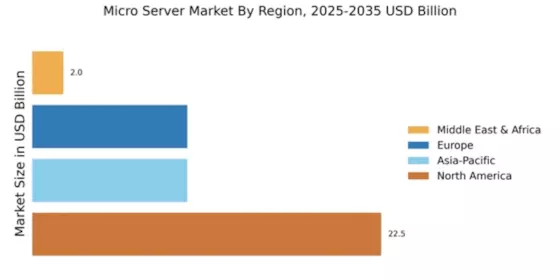
North America continues to lead the micro server market, holding a significant share of 22.5% as of 2024. The region's growth is driven by increasing demand for cloud computing, data centers, and IoT applications. Regulatory support for technology innovation and investment in infrastructure further catalyze market expansion. The rise of edge computing and the need for energy-efficient solutions are also pivotal in shaping demand trends. The competitive landscape in North America is robust, featuring key players such as Hewlett Packard Enterprise, Dell Technologies, and Cisco Systems. These companies are at the forefront of technological advancements, offering innovative micro server solutions tailored to diverse business needs. The presence of established tech giants and a strong startup ecosystem fosters a dynamic environment for growth and competition.

Europe : Emerging Market with Growth Potential

Europe's micro server market is poised for growth, currently valued at €10.0 million. The region is witnessing a surge in demand for energy-efficient computing solutions, driven by sustainability initiatives and regulatory frameworks promoting green technology. The European Union's commitment to digital transformation and data sovereignty is also a significant catalyst for market growth, encouraging investments in local data centers and micro server technologies. Leading countries in this region include Germany, the UK, and France, where major players like Fujitsu and IBM are actively expanding their market presence. The competitive landscape is characterized by a mix of established firms and innovative startups, all vying to capture market share. The focus on hybrid cloud solutions and edge computing is shaping the future of micro servers in Europe, making it a vibrant market for investment.

Asia-Pacific : Rapid Growth in Technology Adoption

The Asia-Pacific region, with a market size of $10.0 million, is experiencing rapid growth in the micro server sector. This surge is fueled by increasing internet penetration, the rise of e-commerce, and a growing demand for cloud services. Governments in countries like China and India are implementing favorable policies to boost technology adoption, which is further driving market expansion. The focus on smart cities and digital infrastructure is also a key growth driver in this region. China, Japan, and India are leading the charge in the Asia-Pacific micro server market, with companies like Lenovo and Inspur making significant strides. The competitive landscape is marked by a blend of local and international players, all striving to innovate and meet the diverse needs of businesses. The emphasis on cost-effective and scalable solutions is shaping the market dynamics, making it a hotspot for technological advancements.

Middle East and Africa : Emerging Market with Untapped Potential

The Middle East and Africa (MEA) region, with a market size of $2.0 million, is an emerging market for micro servers, characterized by untapped potential. The growth is driven by increasing digital transformation initiatives and investments in IT infrastructure across various sectors. Governments are recognizing the importance of technology in economic diversification, leading to favorable regulations that support the adoption of micro servers and cloud solutions. Countries like the UAE and South Africa are at the forefront of this growth, with a rising number of data centers and tech startups. The competitive landscape is evolving, with both local and international players entering the market. The focus on enhancing connectivity and digital services is expected to drive further growth in the micro server sector, making MEA a region to watch in the coming years.

Micro Server Market Regional Image

Key Players and Competitive Insights

The Micro Server Market is currently characterized by a dynamic competitive landscape, driven by the increasing demand for energy-efficient computing solutions and the proliferation of cloud-based services. Key players such as Hewlett Packard Enterprise (US), Dell Technologies (US), and Lenovo (CN) are strategically positioning themselves through innovation and partnerships. For instance, these companies are focusing on enhancing their product offerings with advanced features that cater to the growing needs of data centers and edge computing. Their collective strategies not only foster competition but also stimulate market growth by pushing technological boundaries and improving operational efficiencies.In terms of business tactics, companies are increasingly localizing manufacturing and optimizing supply chains to enhance responsiveness to market demands. The competitive structure of the Micro Server Market appears moderately fragmented, with several players vying for market share. This fragmentation is indicative of a landscape where innovation and customer-centric approaches are paramount, allowing key players to exert considerable influence over market dynamics.

In November Dell Technologies (US) announced a strategic partnership with a leading cloud service provider to enhance its micro server offerings. This collaboration aims to integrate advanced AI capabilities into their micro servers, thereby improving performance and energy efficiency. The significance of this move lies in Dell's commitment to staying at the forefront of technological advancements, which could potentially reshape customer expectations and drive further adoption of their solutions.Similarly, in October 2025, Lenovo (CN) unveiled a new line of micro servers designed specifically for small to medium-sized enterprises (SMEs). This launch is particularly noteworthy as it reflects Lenovo's strategy to penetrate underserved market segments, thereby expanding its customer base. By tailoring solutions to meet the unique needs of SMEs, Lenovo is likely to enhance its competitive positioning and drive revenue growth in a rapidly evolving market.Moreover, in September 2025, Hewlett Packard Enterprise (US) made headlines by acquiring a software startup specializing in cloud management solutions. This acquisition is expected to bolster HPE's micro server capabilities by integrating sophisticated software tools that enhance operational efficiency and scalability. The strategic importance of this acquisition lies in HPE's ability to offer comprehensive solutions that address the complexities of modern IT environments, thereby solidifying its market presence.

As of December the Micro Server Market is witnessing trends that emphasize digitalization, sustainability, and AI integration. Strategic alliances among key players are increasingly shaping the competitive landscape, fostering innovation and collaboration. Looking ahead, it is anticipated that competitive differentiation will evolve, with a pronounced shift from price-based competition to a focus on innovation, technology, and supply chain reliability. This evolution underscores the necessity for companies to adapt and innovate continuously to maintain a competitive edge in a rapidly changing market.

Key Companies in the Micro Server Market include

Industry Developments

The launch of its new IBM z16 mainframe happened in July 2022. Based on the IBM Telum Processor, it was built based on more than 1,100 hours of co-creation with over 70 of its mainframe's customers and partners. This new server extends IBM’s technical leadership already existing in ‘systems of record’ for the largest enterprise organizations worldwide.

In May 2022, HPE and NVIDIA, for example, worked together to allow businesses to tap into AI’s potential via an end-to-end enterprise platform that runs on a consumption-based model backed by HPE GreenLake for NVIDIA AI Enterprise. This is facilitated by pioneer superlative industry HPE servers, which are NVIDIA Certified, to accelerate how fast developers can construct AI and high-performance data analytics.

On the other hand, in April 2022, FS.COM, a high-speed network solution provider for data centers, enterprises and telecom networks, partnered with Super Micro Computer, Inc., a leading global enterprise computing, storage, networking solutions and green-computing technology firm. Some rack servers with powerful performance and high reliability are delivered to help customers deploy applications for virtualization, big data, and cloud computing in the digital economy.

However, Hewlett Packard Enterprise (HPE) announced partnership with VMware Inc.by November 2022 to deliver fully integrated solutions endowed with simple pay-as-you-go hybrid cloud consumption model.

Similarly,in September 2021,I recognize that IBM has launched IBM Power servers supporting smooth scaling up towards a hybrid cloud.The New IBM Power E1080 server offers per core performance which is 2.5x greater than x86-based servers or sets a new world record SAP benchmark per core versus eight-socket systems First ever metering of Red Hat OpenShift & Red Hat Enterprise Linux on-premises server scheduled to improve software licensing costs.

In October 2020, Intel Corporation is introducing the Software Guard Extension confidential computing technology to its Xeon Scalable lineup for the first time with the upcoming Ice Lake server processors, which will have expanded capabilities and added security features.

Future Outlook

Micro Server Market Future Outlook

The Micro Server Market is projected to grow at a 12.11% CAGR from 2025 to 2035, driven by increasing demand for energy-efficient computing and cloud services.

New opportunities lie in:

  • Development of energy-efficient micro server solutions for data centers.
  • Expansion into edge computing applications for IoT devices.
  • Partnerships with cloud service providers to enhance service offerings.

By 2035, the Micro Server Market is expected to be robust, driven by innovation and strategic partnerships.

Market Segmentation

Micro Server Market End Use Outlook

  • Small and Medium Enterprises
  • Large Enterprises
  • Telecommunications
  • Government
  • Education

Micro Server Market Application Outlook

  • Cloud Computing
  • Data Center
  • Web Hosting
  • High-Performance Computing
  • Edge Computing

Micro Server Market Form Factor Outlook

  • Rack-Mount
  • Blade
  • Micro Tower
  • Compact

Micro Server Market Processor Type Outlook

  • ARM Architecture
  • x86 Architecture
  • Power Architecture
  • RISC Architecture

Micro Server Market Deployment Model Outlook

  • On-Premises
  • Hybrid Cloud
  • Public Cloud

Report Scope

MARKET SIZE 2024 44.5(USD Billion)
MARKET SIZE 2025 49.2(USD Billion)
MARKET SIZE 2035 154.46(USD Billion)
COMPOUND ANNUAL GROWTH RATE (CAGR) 12.11% (2025 - 2035)
REPORT COVERAGE Revenue Forecast, Competitive Landscape, Growth Factors, and Trends
BASE YEAR 2024
Market Forecast Period 2025 - 2035
Historical Data 2019 - 2024
Market Forecast Units USD Billion
Key Companies Profiled Hewlett Packard Enterprise (US), Dell Technologies (US), Lenovo (CN), Cisco Systems (US), Supermicro (US), IBM (US), Fujitsu (JP), Oracle (US), Inspur (CN)

Segments Covered Application, End Use, Processor Type, Form Factor, Deployment Model
Key Market Opportunities Growing demand for energy-efficient computing solutions drives innovation in the Micro Server Market.
Key Market Dynamics Rising demand for energy-efficient computing drives innovation and competition in the Micro Server Market.
Countries Covered North America, Europe, APAC, South America, MEA

Market Highlights

Author
Author
Author Profile
Ankit Gupta LinkedIn
Team Lead - Research
Ankit Gupta is a seasoned market intelligence and strategic research professional with over six plus years of experience in the ICT and Semiconductor industries. With academic roots in Telecom, Marketing, and Electronics, he blends technical insight with business strategy. Ankit has led 200+ projects, including work for Fortune 500 clients like Microsoft and Rio Tinto, covering market sizing, tech forecasting, and go-to-market strategies. Known for bridging engineering and enterprise decision-making, his insights support growth, innovation, and investment planning across diverse technology markets.
Co-Author
Co-Author Profile
Aarti Dhapte LinkedIn
AVP - Research
A consulting professional focused on helping businesses navigate complex markets through structured research and strategic insights. I partner with clients to solve high-impact business problems across market entry strategy, competitive intelligence, and opportunity assessment. Over the course of my experience, I have led and contributed to 100+ market research and consulting engagements, delivering insights across multiple industries and geographies, and supporting strategic decisions linked to $500M+ market opportunities. My core expertise lies in building robust market sizing, forecasting, and commercial models (top-down and bottom-up), alongside deep-dive competitive and industry analysis. I have played a key role in shaping go-to-market strategies, investment cases, and growth roadmaps, enabling clients to make confident, data-backed decisions in dynamic markets.
Leave a Comment

FAQs

What is the current valuation of the Micro Server Market as of 2025?

The Micro Server Market is valued at approximately 44.5 USD Billion in 2024.

What is the projected market size for the Micro Server Market by 2035?

The market is expected to reach a valuation of 154.46 USD Billion by 2035.

What is the expected CAGR for the Micro Server Market during the forecast period 2025 - 2035?

The expected CAGR for the Micro Server Market during the forecast period 2025 - 2035 is 12.11%.

Which application segments are driving growth in the Micro Server Market?

Key application segments include Cloud Computing, Data Center, and Web Hosting, with valuations ranging from 8.0 to 40.0 USD Billion.

How do small and medium enterprises contribute to the Micro Server Market?

Small and Medium Enterprises are projected to grow from 8.9 USD Billion to 31.2 USD Billion by 2035.

What are the leading companies in the Micro Server Market?

Prominent players include Hewlett Packard Enterprise, Dell Technologies, and Lenovo, among others.

What is the significance of the x86 processor type in the Micro Server Market?

The x86 processor type is expected to grow from 25.0 USD Billion to 90.0 USD Billion by 2035.

What form factors are prevalent in the Micro Server Market?

Rack-Mount and Blade form factors are leading, with projected valuations of 52.0 USD Billion and 35.0 USD Billion, respectively, by 2035.

How does the deployment type affect the Micro Server Market?

On-Premises deployment is anticipated to grow from 17.78 USD Billion to 62.0 USD Billion by 2035.

What role does the telecommunications sector play in the Micro Server Market?

The telecommunications sector is expected to expand from 10.0 USD Billion to 35.0 USD Billion by 2035.

Research Approach

Research Methodology on Micro Services Market

Introduction

Market Research Future’s (MRFR) report on the global microservices architecture market for the period of 2023-2030 provides a brief segmental analysis of the market and the various factors that are likely to influence its growth during the review period. The report is compiled using both primary and secondary data sources, which gives a detailed overview of the market, its size and top regions.

Research Methodology

To conduct the market research and generate the report, it is necessary to employ a comprehensive methodology which includes the following activities and components.

Data Collection

The research process began with the collection of primary and secondary market data, which is sourced from reputable sources including market publications, research studies, surveys, websites, and reports. The data was organized and analyzed according to the framework set by the report’s requirements.

Market Segmental Analysis

The report is divided into five parts relating to market segmentation. These include product types, applications, regions, users, and competitive landscape. This segmental analysis allowed for a detailed description of the market landscape and the various technologies that are available for the various segments.

Industry Insights

Market insights are gathered from different industry experts and stakeholders from the industry. This allows for the development of comprehensive insights into the global microservices architecture market.

Expert Interviews

Finally, expert interviews are conducted to gain further insights into the market. These are conducted with industry experts including designers, developers, and providers.

Conclusion

The report on the microservices architecture market contains a comprehensive methodology employed throughout the research and compilation process. Primary market data, secondary sources, and expert interviews are used to provide a thorough overview of the microservices architecture market and its various growth opportunities. Segmental analysis is provided to provide more in-depth insights into the possible trends and developments in the market.

Download Free Sample

Kindly complete the form below to receive a free sample of this Report

Compare Licence

×
Features License Type
Single User Multiuser License Enterprise User
Price $4,950 $5,950 $7,250
Maximum User Access Limit 1 User Upto 10 Users Unrestricted Access Throughout the Organization
Free Customization
Direct Access to Analyst
Deliverable Format
Platform Access
Discount on Next Purchase 10% 15% 15%
Printable Versions
%>