×
Request Free Sample ×

Kindly complete the form below to receive a free sample of this Report

* Please use a valid business email

Leading companies partner with us for data-driven Insights

clients tt-cursor
Hero Background
English
Chinese
French
Japanese
Korean
German
Spanish

Medical Carts Market Share

ID: MRFR/MED/5967-HCR
200 Pages
Rahul Gotadki
October 2025

Medical Carts Market Research Report By Type (Medication Carts, Emergency Carts, Anesthesia Carts, Procedure Carts), By Material (Metal, Plastic, Wood), By Configuration (Mobile Carts, Wall-Mounted Carts, Stationary Carts), By End Use (Hospitals, Nursing Homes, Ambulatory Surgical Centers, Home Healthcare) and By Regional (North America, Europe, South America, Asia Pacific, Middle East and Africa) - Growth & Industry Forecast 2025 To 2035

Share:
Download PDF ×

We do not share your information with anyone. However, we may send you emails based on your report interest from time to time. You may contact us at any time to opt-out.

Medical Carts Market Infographic
×
Medical Carts Market Infographic Full View
Purchase Options

Market Share

Medical Carts Market Share Analysis

A lot of work goes into making sure that medical carts are customized to meet the needs of healthcare situations. A business might be able to get a bigger share of the healthcare market if they make designs and sets that are flexible and can be used in patient rooms, surgery areas, and emergency rooms. Companies spend money on medical carts with the newest tools to stay ahead of the competition. Data networking, tracking with radio frequency identification, and smart locks are some of the things that make things better and safer. Healthcare groups that want to improve their technology to provide better care to patients and make processes more efficient are drawn to companies that sell themselves as experts in their areas and offer new ideas. Medical cart makers know how important it is to keep places where people get care free of germs, so they focus on making designs that are easier to clean. Cart makers make their goods look clean by using antibacterial materials and adding features like smooth surfaces and sealed edges. This helps them get their goods into hospitals that have the tightest rules for patient safety. One of the most important things you can do to move up the market is to making things better for your customers. The companies that make medical carts pay attention to useful design principles to make sure the carts are simple to use and materials are easy to get to. Healthcare workers use products with simple displays and work desks that can be adjusted in height more often, so those products get a bigger share of the market. A good partnership with healthcare groups could be all it takes to get a bigger piece of the market. Sometimes, businesses can make solutions that are just right for healthcare centers if they listen to what they need and want. By keeping these ties, the company also builds its image as a service that doctors can trust. This makes people more likely to choose and trust that brand.


Author
Rahul Gotadki
Assistant Manager

He holds an experience of about 7+ years in Market Research and Business Consulting, working under the spectrum of Life Sciences and Healthcare domains. Rahul conceptualizes and implements a scalable business strategy and provides strategic leadership to the clients. His expertise lies in market estimation, competitive intelligence, pipeline analysis, customer assessment, etc. In addition to the above, his other responsibility includes strategic tracking of high growth markets & advising clients on the potential areas of focus they could direct their business initiatives

Leave a Comment

FAQs

What is the projected growth of the Medical Carts market?

The Medical Carts market is the expected increase in total market value of 5.91 USD billion over a defined forecast period 2025–2035. It is driven by factors such as demand trends, technological advances, regulatory changes, and geographic expansion.

What is the size of the Medical Carts market?

Medical Carts market size was valued at approximately 1.57 billion USD in 2024. This figure will reach 5.91 billion USD covering all regions (America, Europe, Asia, MEA and ROW), focusing its segments / services / distribution channels till 2035.

What is the CAGR of the Medical Carts market?

Medical Carts market is expected to grow at a CAGR of 12.82% between 2025 and 2035.

How much will the Medical Carts market be worth by 2035?

Medical Carts market is expected to be worth of 5.91 billion USD, reflecting growth driven by usage, technology and global demands by the end of 2035.

How will the Medical Carts market perform over the next 10 years?

Over the next 10 years the Medical Carts market is expected to shift from usd billion 1.57 to 5.91 billion USD, led by adoption of advanced tech, demographic trends, regulatory approvals, with potential headwinds from 2025 to 2035.

Which region is expected to have the largest market share in the Global Medical Carts Market by 2035?

North America is expected to dominate the market with a value of 1.913 USD Billion by 2035.

What is the market value of Medication Carts in 2024?

The market value of Medication Carts is estimated to be 1.05 USD Billion in 2024.

How much is the Emergency Carts segment projected to be valued in 2035?

The Emergency Carts segment is projected to be valued at 1.85 USD Billion by 2035.

What are some major players in the Global Medical Carts Market?

Key players include Ergotron, Advantech, and Omnicell among others.

What is the expected market value for Procedure Carts in 2035?

The Procedure Carts segment is expected to reach a market value of 0.8 USD Billion by 2035.

Market Summary

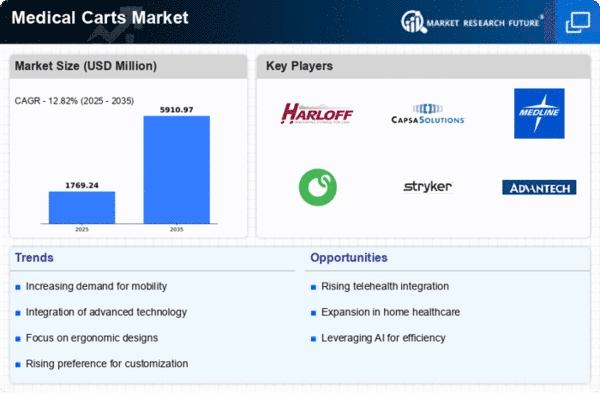
As per MRFR analysis, the Medical Carts Market Size was estimated at 1568.2 USD Million in 2024. The Medical Carts industry is projected to grow from 1769.25 USD Million in 2025 to 5910.97 USD Million by 2035, exhibiting a compound annual growth rate (CAGR) of 12.82 during the forecast period 2025 - 2035.

Key Market Trends & Highlights

The Medical Carts Market is experiencing robust growth driven by technological advancements and evolving healthcare needs.

  • The integration of smart technologies is transforming medical carts, enhancing their functionality and efficiency.
  • Infection control remains a critical focus, prompting the development of specialized carts designed to minimize contamination risks.
  • Customization and versatility are increasingly demanded, particularly in the hospital segment, to meet diverse operational needs.
  • Rising demand for efficient healthcare delivery and increased focus on patient safety are key drivers propelling market expansion, especially in North America and the Asia-Pacific region.

Market Size & Forecast

2024 Market Size 1568.2 (USD Million)
2035 Market Size 5910.97 (USD Million)
CAGR (2025 - 2035) 12.82%
Largest Regional Market Share in 2024 North America

Major Players

<p>Harloff (US), Capsa Solutions (US), Medline Industries (US), Omnicell (US), Stryker Corporation (US), Advantech (TW), InterMetro Industries (US), TBS Healthcare (GB), AFC Industries (US)</p>

Market Trends

The Medical Carts Market is currently experiencing a transformative phase, driven by advancements in healthcare technology and the increasing demand for efficient medical solutions. As healthcare facilities strive to enhance patient care and streamline operations, the adoption of medical carts has become more prevalent. These carts are designed to facilitate the storage and transportation of medical supplies, equipment, and medications, thereby improving workflow and accessibility within clinical environments. Furthermore, the integration of smart technologies into medical carts is reshaping their functionality, allowing for better inventory management and real-time data tracking. In addition to technological advancements, the Medical Carts Market is influenced by the growing emphasis on infection control and safety protocols in healthcare settings. The need for mobile solutions that can be easily sanitized and maintained is becoming increasingly critical. As hospitals and clinics prioritize patient safety, the demand for specialized medical carts that meet stringent hygiene standards is likely to rise. Overall, the Medical Carts Market appears poised for growth, with innovations and evolving healthcare needs driving its expansion.

Integration of Smart Technologies

The Medical Carts Market is witnessing a notable trend towards the incorporation of smart technologies. These innovations enhance the functionality of medical carts, enabling features such as real-time tracking of inventory and automated alerts for restocking supplies. This integration not only improves operational efficiency but also supports better patient care by ensuring that healthcare professionals have immediate access to necessary resources.

Focus on Infection Control

A growing emphasis on infection control within healthcare facilities is shaping the Medical Carts Market. As hospitals implement stricter hygiene protocols, there is an increasing demand for medical carts that are designed for easy cleaning and disinfection. This trend reflects a broader commitment to patient safety and the need for equipment that can withstand rigorous sanitation processes.

Customization and Versatility

Customization is becoming a key factor in the Medical Carts Market, as healthcare providers seek solutions tailored to their specific needs. Versatile designs that accommodate various medical equipment and supplies are gaining traction. This trend allows for greater adaptability in different clinical settings, ensuring that medical carts can effectively support diverse healthcare functions.

Medical Carts Market Market Drivers

Growing Aging Population

The aging population worldwide is a significant driver of the Global Medical Carts Market Industry. As the demographic shift continues, there is an increasing prevalence of chronic diseases that require ongoing medical attention. This trend necessitates the use of medical carts that can efficiently store and transport medical supplies and equipment needed for elderly care. The market's projected growth to 5.5 USD Billion by 2035 reflects the increasing demand for healthcare services tailored to the elderly. Consequently, healthcare providers are likely to invest in medical carts that enhance their ability to deliver care to this growing segment of the population.

Market Growth Projections

The Global Medical Carts Market Industry is projected to experience substantial growth over the next decade. With a market value of 3.46 USD Billion in 2024, it is expected to reach 5.5 USD Billion by 2035. This growth trajectory suggests a compound annual growth rate of 4.3% from 2025 to 2035. The increasing demand for mobile healthcare solutions, coupled with advancements in technology and a focus on patient safety, is likely to drive this expansion. As healthcare providers seek to enhance their operational efficiency and patient care capabilities, the market for medical carts is poised for significant development.

Increased Focus on Infection Control

Infection control remains a critical concern in healthcare settings, driving the Global Medical Carts Market Industry. The ongoing emphasis on maintaining sterile environments has led to a demand for medical carts designed with infection prevention features. These carts often include materials that are easy to clean and disinfect, thereby reducing the risk of cross-contamination. As healthcare facilities prioritize patient safety, the adoption of specialized medical carts is likely to rise. This trend is indicative of a broader movement towards enhancing hygiene standards in healthcare, which is expected to contribute to the market's growth trajectory over the coming years.

Regulatory Compliance and Standardization

Regulatory compliance and standardization are crucial factors influencing the Global Medical Carts Market Industry. Healthcare facilities are required to adhere to strict regulations regarding the storage and transportation of medical supplies. This has led to an increased demand for medical carts that meet these regulatory standards. Manufacturers are responding by designing carts that comply with safety and quality regulations, ensuring that healthcare providers can maintain compliance while optimizing their operations. The anticipated compound annual growth rate of 4.3% from 2025 to 2035 indicates a sustained interest in compliant medical carts, as healthcare facilities prioritize adherence to regulations.

Rising Demand for Efficient Healthcare Delivery

The Global Medical Carts Market Industry is experiencing a surge in demand for efficient healthcare delivery systems. As healthcare facilities strive to improve patient outcomes, the need for mobile medical carts that facilitate quick access to medical supplies and equipment becomes paramount. In 2024, the market is projected to reach 3.46 USD Billion, reflecting the increasing emphasis on streamlined workflows in hospitals and clinics. This trend is likely to continue as healthcare providers recognize the importance of mobility and organization in enhancing patient care. The integration of technology into these carts further supports this demand, enabling better inventory management and reducing response times.

Technological Advancements in Medical Equipment

Technological advancements play a pivotal role in shaping the Global Medical Carts Market Industry. Innovations such as integrated electronic health record systems and telemedicine capabilities are increasingly being incorporated into medical carts. These advancements not only enhance the functionality of the carts but also improve the overall efficiency of healthcare delivery. As a result, healthcare providers are more inclined to invest in modern medical carts that can support these technologies. The anticipated growth of the market to 5.5 USD Billion by 2035 underscores the potential of these advancements to transform healthcare environments, making them more responsive to patient needs.

Market Segment Insights

By Application: Emergency Medical Services (Largest) vs. Pharmacy (Fastest-Growing)

<p>The Medical Carts Market is characterized by diverse applications, with Emergency Medical Services leading in market share. This segment plays a critical role in acute patient care, ensuring timely access to medical supplies and equipment during emergencies. Following closely are segments like Pharmacy and Surgical carts, which also contribute significantly to the overall market dynamics. Laboratory and Patient Care carts, while crucial, hold smaller shares in comparison, indicating the specialized nature of their applications in healthcare settings. As the industry evolves, the growth trends point toward increasing demand for Pharmacy carts, driven by the rising need for efficient drug management systems. Emergency Medical Services will continue to dominate due to the ongoing focus on improving emergency response capabilities and healthcare outcomes. Surgical carts are also expected to witness steady growth, fueled by advancements in surgical technologies and practices.</p>

<p>Emergency Medical Services (Dominant) vs. Pharmacy (Emerging)</p>

<p>Emergency Medical Services (EMS) carts are a dominant force in the Medical Carts Market, characterized by their specialized design for rapid deployment in critical situations. They enhance operational efficiency within emergency departments and field operations, ensuring the swift availability of essential medical equipment. Their rugged construction and mobility features are tailored for dynamic environments, making them indispensable in urgent care settings. On the other hand, Pharmacy carts represent an emerging segment, increasingly sought after for their role in streamlining medication administration and inventory management. As healthcare providers prioritize patient safety and efficiency, Pharmacy carts are adopting innovative technologies, such as electronic prescriptions and automated dispensing systems, making them vital in modern healthcare practices.</p>

By End Use: Hospitals (Largest) vs. Clinics (Fastest-Growing)

<p>The medical carts market is segmented into various end-use applications, with hospitals holding the largest share due to the high demand for efficient patient care and medication management. Hospitals utilize medical carts extensively for transporting medications, charts, and medical equipment, which significantly contributes to their dominant market position. Following hospitals, clinics are also noteworthy consumers, leveraging medical carts to streamline operations and enhance patient care. However, their market share is comparatively smaller as they cater to fewer patients than larger hospital facilities.</p>

<p>Hospitals (Dominant) vs. Clinics (Emerging)</p>

<p>Hospitals represent the dominant force in the medical carts market, primarily due to their extensive operational requirements and the need for streamlined processes. The use of mobile carts in these settings facilitates quick access to medications and healthcare supplies, thereby enhancing workflow efficiency. In contrast, clinics have emerged as essential players, albeit at a smaller scale. Their growing adoption of medical carts is driven by the need for better patient handling and efficiency in outpatient settings. While hospitals leverage more sophisticated carts for broad applications, clinics focus on versatility and compactness, making them a rapidly evolving segment within this market.</p>

By Product Type: Medication Carts (Largest) vs. Procedure Carts (Fastest-Growing)

<p>In the Medical Carts Market, Medication Carts hold the largest share, primarily due to their essential role in the efficient dispensing of medications in hospitals and clinics. Following closely are Procedure Carts, which are also gaining traction as healthcare facilities strive to enhance procedural efficiency and patient care. Other categories, such as Storage Carts and Transport Carts, are significant but trail behind in market share and demand, given their more specialized applications in healthcare settings.</p>

<p>Medication Carts (Dominant) vs. Procedure Carts (Emerging)</p>

<p>Medication Carts are designed for storing and dispensing medications, and their dominance in the market can be attributed to their integral role in enhancing medication safety and accessibility in healthcare settings. On the other hand, Procedure Carts, while currently emerging, are quickly becoming essential due to increasing procedural complexity in hospitals. Their versatile design enables quick access to necessary tools and supplies during medical procedures, making them vital for improving operational efficiency. Together, these cart types highlight the evolving landscape of healthcare logistics where both reliability and adaptability are paramount.</p>

By Material: Metal (Largest) vs. Plastic (Fastest-Growing)

<p>The Medical Carts Market shows a well-defined distribution of market share across various materials used in cart manufacturing. Metal leads the segment with a substantial share due to its durability and reliability in high-demand medical environments. Plastic, while smaller in market share, is gaining traction owing to its lightweight nature and lower costs, appealing to budget-conscious healthcare facilities. Meanwhile, other materials like wood, composite, and aluminum are present but lag behind in comparison to metal and plastic. As healthcare facilities increasingly prioritize flexibility and cost-effectiveness, the growth of plastic medical carts is notable. Trends show a shift towards materials that can accommodate rapid changes in healthcare needs and standards. Innovations in composite materials, which offer a balance of sturdiness and lightweight properties, are also projected to fuel growth. Moreover, the aging population and the rise of outpatient care are driving demand for versatile medical carts, enhancing opportunities for all material segments, especially emerging options like plastic and composite.</p>

<p>Metal (Dominant) vs. Composite (Emerging)</p>

<p>In the Medical Carts Market, metal remains the dominant material due to its robustness, ensuring long-term performance in demanding environments. Metal carts are preferred for their stability and can support heavier loads, making them suitable for a variety of medical settings. On the other hand, composite materials represent the emerging segment. These carts are crafted from a blend of materials, offering both strength and lightweight convenience. Their ability to withstand disinfectants and harsh cleaning protocols makes them increasingly favored in healthcare environments. While metal caters to established demands, composites are appealing to modern medical facilities seeking innovative solutions that combine functionality and cost-effectiveness. As both segments evolve, the competition will likely intensify, leading to advancements in design and utility.</p>

By Design Type: Mobile Carts (Largest) vs. Multi-functional Carts (Fastest-Growing)

<p>In the Medical Carts Market, Mobile Carts hold the largest share, primarily due to their versatility and accessibility in various healthcare settings, including hospitals and clinics. Wall-mounted Carts and Stationary Carts also feature significantly; however, they cater to specific applications, limiting their overall market presence. The Customizable Carts segment is growing, appealing to institutions with unique needs, though Mobile Carts remain the preferred choice for many medical professionals due to their mobility and ease of use.</p>

<p>Mobile Carts (Dominant) vs. Multi-functional Carts (Emerging)</p>

<p>Mobile Carts represent the dominant force in the Medical Carts Market, known for their ease of transport and practical design that serves the dynamic needs of healthcare providers. They are essential in emergency situations, enabling quick access to medical supplies. On the other hand, Multi-functional Carts are emerging rapidly due to their versatility and ability to serve multiple functions within healthcare settings. They combine features of traditional carts while offering adaptability for various equipment and supplies. This adaptability is driving their popularity, particularly in settings where space and efficiency are critical.</p>

Get more detailed insights about Medical Carts Market Research Report – Global Forecast till 2035

Regional Insights

North America : Market Leader in Medical Carts

North America is poised to maintain its leadership in the medical carts market, holding a significant share of $780.0 million in 2024. The region's growth is driven by increasing healthcare expenditures, technological advancements, and a rising demand for efficient patient care solutions. Regulatory support for healthcare infrastructure improvements further catalyzes market expansion, ensuring compliance with safety and quality standards. The competitive landscape is robust, featuring key players such as Harloff, Capsa Solutions, and Stryker Corporation. The U.S. remains the dominant country, leveraging its advanced healthcare system and innovation capabilities. Companies are focusing on product differentiation and strategic partnerships to enhance their market presence, ensuring a steady supply of innovative medical carts to meet evolving healthcare needs.

Europe : Emerging Market with Growth Potential

Europe's medical carts market is valued at $450.0 million, reflecting a growing demand driven by an aging population and increasing hospital admissions. Regulatory frameworks, such as the Medical Device Regulation (MDR), are enhancing product safety and efficacy, thereby boosting consumer confidence. The region is witnessing a shift towards smart medical carts, integrating technology for better patient management and workflow efficiency. Leading countries include Germany, France, and the UK, where healthcare investments are on the rise. The competitive landscape features companies like TBS Healthcare and Medline Industries, which are innovating to meet market demands. The presence of established players and a focus on R&D are key factors propelling market growth, positioning Europe as a significant player in The Medical Carts.

Asia-Pacific : Rapid Growth in Healthcare Sector

The Asia-Pacific medical carts market, valued at $280.0 million, is experiencing rapid growth due to increasing healthcare investments and a rising population. Countries like China and India are expanding their healthcare infrastructure, leading to a higher demand for medical carts. Regulatory initiatives aimed at improving healthcare quality are also driving market growth, as hospitals seek to comply with international standards. China and Japan are the leading markets in this region, with significant contributions from local manufacturers like Advantech. The competitive landscape is evolving, with both The Medical Carts share. Innovations in design and functionality are crucial as healthcare facilities aim to enhance operational efficiency and patient care, making the Asia-Pacific region a focal point for medical cart advancements.

Middle East and Africa : Emerging Market with Unique Challenges

The Middle East and Africa medical carts market, valued at $58.2 million, is gradually expanding, driven by increasing healthcare investments and a growing focus on improving healthcare delivery. The region faces unique challenges, including regulatory hurdles and varying healthcare standards, but initiatives to enhance healthcare infrastructure are paving the way for market growth. Countries like the UAE and South Africa are leading the charge, investing in modern healthcare facilities. The competitive landscape is characterized by a mix of local and international players, with companies like AFC Industries making strides in the market. The demand for innovative medical carts is rising as healthcare providers seek to improve patient care and operational efficiency. As the region continues to develop, the medical carts market is expected to grow, albeit at a slower pace compared to other regions.

Key Players and Competitive Insights

The Medical Carts Market is currently characterized by a dynamic competitive landscape, driven by technological advancements, increasing demand for efficient healthcare delivery, and a growing emphasis on patient safety. Key players such as Harloff (US), Capsa Solutions (US), and Stryker Corporation (US) are strategically positioning themselves through innovation and partnerships. Harloff (US) focuses on enhancing product functionality and customization, while Capsa Solutions (US) emphasizes digital transformation and integration of smart technologies into their offerings. Stryker Corporation (US) is leveraging its extensive portfolio to expand its market reach, indicating a trend towards comprehensive solutions that cater to diverse healthcare needs.

The competitive structure of the Medical Carts Market appears moderately fragmented, with several players vying for market share. Key business tactics include localizing manufacturing to reduce costs and optimize supply chains, which is becoming increasingly vital in a globalized economy. The collective influence of these major companies shapes the market dynamics, as they continuously adapt to evolving customer demands and regulatory requirements.

In November 2025, Stryker Corporation (US) announced a strategic partnership with a leading software firm to develop AI-driven solutions for their medical carts. This collaboration aims to enhance operational efficiency and improve patient outcomes by integrating advanced analytics into their product line. The strategic importance of this move lies in Stryker's commitment to innovation, positioning itself as a leader in the integration of technology within healthcare environments.

In October 2025, Capsa Solutions (US) launched a new line of mobile medication carts equipped with IoT capabilities. This initiative reflects the company's focus on digital transformation, allowing healthcare providers to track medication usage in real-time. The introduction of these smart carts is likely to enhance medication management and reduce errors, thereby improving patient safety and operational efficiency.

In September 2025, Harloff (US) expanded its manufacturing capabilities by investing in a new facility in the Midwest. This strategic move is expected to streamline production processes and reduce lead times, enabling the company to respond more effectively to market demands. The expansion signifies Harloff's commitment to maintaining a competitive edge through operational excellence and responsiveness to customer needs.

As of December 2025, current trends in the Medical Carts Market indicate a strong shift towards digitalization, sustainability, and AI integration. Strategic alliances among key players are shaping the competitive landscape, fostering innovation and enhancing product offerings. The evolution of competitive differentiation appears to be moving away from price-based competition towards a focus on technological advancements, reliability in supply chains, and the ability to deliver comprehensive solutions that meet the complex needs of healthcare providers.

Key Companies in the Medical Carts Market include

Industry Developments

Recent developments in the Global Medical Carts Market have indicated significant growth and innovation among key players such as Ergotron, Advantech, and Capsa Healthcare. Advances in technological features and design have resulted in enhanced functionality and usability in healthcare settings. Notably, in September 2023, INTERMETRO Industries launched a new range of medical carts designed to improve portability and storage efficiency, catering to the evolving needs of healthcare providers. Furthermore, in July 2023, Hamilton Medical announced an expansion of their product line, focusing on smart medical cart solutions that integrate seamlessly with existing hospital technologies.

The market has also witnessed impactful mergers and acquisitions, with DRE Medical being acquired by Omnicell in August 2023, which will enable better product integration and distribution strategies in the market. The valuation of companies within the Global Medical Carts Market continues to rise due to increasing demand for efficient healthcare delivery, driven partly by the ongoing global health challenges. Moreover, recent years have seen heightened investments in Research and Development from firms like Alimed, indicating a trend towards next-generation medical carts that enhance patient care and streamline workflow in healthcare facilities.

Future Outlook

Medical Carts Market Future Outlook

<p>The Medical Carts Market is projected to grow at a 12.82% CAGR from 2024 to 2035, driven by technological advancements, increasing healthcare demands, and enhanced patient care solutions.</p>

New opportunities lie in:

  • <p>Integration of telehealth capabilities in medical carts</p>
  • <p>Development of customizable modular cart systems</p>
  • <p>Expansion into emerging markets with tailored solutions</p>

<p>By 2035, the Medical Carts Market is expected to achieve substantial growth and innovation.</p>

Market Segmentation

Medical Carts Market End Use Outlook

  • Hospitals
  • Clinics
  • Long-term Care Facilities
  • Home Healthcare
  • Ambulatory Surgical Centers

Medical Carts Market Material Outlook

  • Metal
  • Plastic
  • Wood
  • Composite
  • Aluminum

Medical Carts Market Application Outlook

  • Emergency Medical Services
  • Pharmacy
  • Surgical
  • Patient Care
  • Laboratory

Medical Carts Market Design Type Outlook

  • Mobile Carts
  • Wall-mounted Carts
  • Stationary Carts
  • Multi-functional Carts
  • Customizable Carts

Medical Carts Market Product Type Outlook

  • Medication Carts
  • Procedure Carts
  • Storage Carts
  • Transport Carts
  • Utility Carts

Report Scope

MARKET SIZE 20241568.2(USD Million)
MARKET SIZE 20251769.25(USD Million)
MARKET SIZE 20355910.97(USD Million)
COMPOUND ANNUAL GROWTH RATE (CAGR)12.82% (2024 - 2035)
REPORT COVERAGERevenue Forecast, Competitive Landscape, Growth Factors, and Trends
BASE YEAR2024
Market Forecast Period2025 - 2035
Historical Data2019 - 2024
Market Forecast UnitsUSD Million
Key Companies ProfiledHarloff (US), Capsa Solutions (US), Medline Industries (US), Omnicell (US), Stryker Corporation (US), Advantech (TW), InterMetro Industries (US), TBS Healthcare (GB), AFC Industries (US)
Segments CoveredApplication, End Use, Product Type, Material, Design Type
Key Market OpportunitiesIntegration of advanced telehealth solutions in Medical Carts Market enhances patient care and operational efficiency.
Key Market DynamicsRising demand for advanced medical carts driven by technological innovations and evolving healthcare delivery models.
Countries CoveredNorth America, Europe, APAC, South America, MEA

FAQs

What is the projected growth of the Medical Carts market?

The Medical Carts market is the expected increase in total market value of 5.91 USD billion over a defined forecast period 2025–2035. It is driven by factors such as demand trends, technological advances, regulatory changes, and geographic expansion.

What is the size of the Medical Carts market?

Medical Carts market size was valued at approximately 1.57 billion USD in 2024. This figure will reach 5.91 billion USD covering all regions (America, Europe, Asia, MEA and ROW), focusing its segments / services / distribution channels till 2035.

What is the CAGR of the Medical Carts market?

Medical Carts market is expected to grow at a CAGR of 12.82% between 2025 and 2035.

How much will the Medical Carts market be worth by 2035?

Medical Carts market is expected to be worth of 5.91 billion USD, reflecting growth driven by usage, technology and global demands by the end of 2035.

How will the Medical Carts market perform over the next 10 years?

Over the next 10 years the Medical Carts market is expected to shift from usd billion 1.57 to 5.91 billion USD, led by adoption of advanced tech, demographic trends, regulatory approvals, with potential headwinds from 2025 to 2035.

Which region is expected to have the largest market share in the Global Medical Carts Market by 2035?

North America is expected to dominate the market with a value of 1.913 USD Billion by 2035.

What is the market value of Medication Carts in 2024?

The market value of Medication Carts is estimated to be 1.05 USD Billion in 2024.

How much is the Emergency Carts segment projected to be valued in 2035?

The Emergency Carts segment is projected to be valued at 1.85 USD Billion by 2035.

What are some major players in the Global Medical Carts Market?

Key players include Ergotron, Advantech, and Omnicell among others.

What is the expected market value for Procedure Carts in 2035?

The Procedure Carts segment is expected to reach a market value of 0.8 USD Billion by 2035.

  1. SECTION I: EXECUTIVE SUMMARY AND KEY HIGHLIGHTS
    1. | 1.1 EXECUTIVE SUMMARY
  2. SECTION II: SCOPING, METHODOLOGY AND MARKET STRUCTURE
    1. | 2.1 MARKET INTRODUCTION
    2. | 2.2 RESEARCH METHODOLOGY
  3. SECTION III: QUALITATIVE ANALYSIS
    1. | 3.1 MARKET DYNAMICS
    2. | 3.2 MARKET FACTOR ANALYSIS
  4. SECTION IV: QUANTITATIVE ANALYSIS
    1. | 4.1 Healthcare, BY Application (USD Million)
    2. | 4.2 Healthcare, BY End Use (USD Million)
    3. | 4.3 Healthcare, BY Product Type (USD Million)
    4. | 4.4 Healthcare, BY Material (USD Million)
    5. | 4.5 Healthcare, BY Design Type (USD Million)
    6. | 4.6 Healthcare, BY Region (USD Million)
  5. SECTION V: COMPETITIVE ANALYSIS
    1. | 5.1 Competitive Landscape
    2. | 5.2 Company Profiles
    3. | 5.3 Appendix

Medical Carts Market Segmentation

Market Segmentation Overview

  • Detailed segmentation data will be available in the full report
  • Comprehensive analysis by multiple parameters
  • Regional and country-level breakdowns
  • Market size forecasts by segment
Infographic

Free Sample Request

Kindly complete the form below to receive a free sample of this Report

Get Free Sample

Customer Strories

Compare Licence

×
Features License Type
Single User Multiuser License Enterprise User
Price $4,950 $5,950 $7,250
Maximum User Access Limit 1 User Upto 10 Users Unrestricted Access Throughout the Organization
Free Customization
Direct Access to Analyst
Deliverable Format
Platform Access
Discount on Next Purchase 10% 15% 15%
Printable Versions