Request Free Sample ×

Kindly complete the form below to receive a free sample of this Report

* Please use a valid business email

Leading companies partner with us for data-driven Insights

clients tt-cursor
Hero Background

Magnetic Optical Current Transformer Market

ID: MRFR/EnP/10516-HCR
128 Pages
Priya Nagrale
April 2026

Magnetic Optical Current Transformer Market Research Report Information By Type (Spreader Bar, Conventional), By Material Type (Cotton Type, Fiber Type, Non-fiber Type), By Application (Transformer , Electronic Measurement Devices, Networking Devices, Power Systems & Instrumentations, Transmission Line-bus, Electrical High Voltage (EHV) Substations, Polypropylene, Others), By Sales Channel (Offline Channels, Online Channels) And By Region (North America, Europe, Asia-Pacific, And Rest Of The World) - Growth & Industry Forecast to 2035

Share:
Download PDF ×

We do not share your information with anyone. However, we may send you emails based on your report interest from time to time. You may contact us at any time to opt-out.

Magnetic Optical Current Transformer Market Infographic
Purchase Options
⚠ STRAIT OF HORMUZ CRISIS ALERT
13 Million Barrels/Day at Risk | 31% of Global Seaborne Oil Flow | Qatar LNG Halted — Oil, Natural Gas, Power Generation & Energy Security Markets Disrupted, Insurance Withdrawn, $80–100+ Price Scenarios Active | Get Crisis-Adjusted Production, Pricing & Security Analysis

Magnetic Optical Current Transformer Market Summary

As per MRFR analysis, the Magnetic Optical Current Transformer Market Size was estimated at 228.96 USD Billion in 2024. The Magnetic Optical Current Transformer industry is projected to grow from 247.73 USD Billion in 2025 to 544.93 USD Billion by 2035, exhibiting a compound annual growth rate (CAGR) of 8.2% during the forecast period 2025 - 2035.

Key Market Trends & Highlights

The Magnetic Optical Current Transformer Market is poised for substantial growth driven by technological advancements and regulatory support.

  • North America remains the largest market for Magnetic Optical Current Transformers, driven by robust power infrastructure investments.
  • Asia-Pacific is identified as the fastest-growing region, reflecting a surge in demand for renewable energy sources.
  • The Power Generation segment continues to dominate the market, while the Smart Grids segment exhibits the highest growth potential.
  • Technological advancements and regulatory support for sustainability are key drivers propelling the market forward.

Market Size & Forecast

2024 Market Size 228.96 (USD Billion)
2035 Market Size 544.93 (USD Billion)
CAGR (2025 - 2035) 8.2%

Major Players

Siemens (DE), General Electric (US), Schneider Electric (FR), ABB (CH), Honeywell (US), Mitsubishi Electric (JP), Emerson Electric (US), Rohde & Schwarz (DE), Toshiba (JP)

Our Impact
Enabled $4.3B Revenue Impact for Fortune 500 and Leading Multinationals
Partnering with 2000+ Global Organizations Each Year
30K+ Citations by Top-Tier Firms in the Industry

Magnetic Optical Current Transformer Market Trends

The Magnetic Optical Current Transformer Market is currently experiencing a notable evolution, driven by advancements in technology and increasing demand for efficient energy management solutions. This market appears to be influenced by the growing emphasis on renewable energy sources, which necessitates precise monitoring and control of electrical systems. As industries seek to enhance their operational efficiency, the integration of magnetic optical current transformers into power systems is becoming more prevalent. These devices offer enhanced accuracy and reliability, which are essential for modern electrical grids. Furthermore, the trend towards smart grid technology is likely to propel the adoption of these transformers, as they facilitate real-time data acquisition and analysis, thereby improving overall system performance. In addition to technological advancements, regulatory frameworks aimed at reducing carbon emissions and promoting sustainable practices are shaping the Magnetic Optical Current Transformer Market. Governments worldwide are implementing policies that encourage the use of advanced metering infrastructure, which includes magnetic optical current transformers. This regulatory support may lead to increased investments in infrastructure upgrades, further driving market growth. As the focus on energy efficiency intensifies, the demand for innovative solutions that can provide accurate measurements and enhance grid stability is expected to rise. Overall, the Magnetic Optical Current Transformer Market is poised for substantial growth, reflecting the broader trends in energy management and sustainability.

Technological Advancements

The Magnetic Optical Current Transformer Market is witnessing rapid technological innovations that enhance measurement accuracy and reliability. These advancements are crucial for modern electrical systems, where precision is paramount. As new technologies emerge, they are likely to improve the performance and functionality of current transformers, making them more appealing to various industries.

Regulatory Support for Sustainability

Government policies aimed at promoting sustainability are significantly influencing the Magnetic Optical Current Transformer Market. Regulatory frameworks that encourage the adoption of energy-efficient technologies are likely to drive demand for these transformers. This support may lead to increased investments in infrastructure, further bolstering market growth.

Integration with Smart Grids

The integration of magnetic optical current transformers with smart grid technologies is a prominent trend in the market. This integration facilitates real-time monitoring and data analysis, which enhances the efficiency and reliability of electrical systems. As smart grid initiatives expand, the demand for these transformers is expected to grow, reflecting the need for advanced energy management solutions.

Magnetic Optical Current Transformer Market Drivers

Market Growth Projections

The Global Magnetic Optical Current Transformer Market Industry is poised for substantial growth, with projections indicating a market size of 221 USD Billion in 2024 and an anticipated increase to 503.5 USD Billion by 2035. This growth trajectory suggests a compound annual growth rate (CAGR) of 7.77% from 2025 to 2035. Such figures underscore the increasing adoption of magnetic optical current transformers across various sectors, driven by technological advancements and the growing demand for efficient energy management solutions.

Increasing Focus on Smart Grids

The transition towards smart grid technologies is a crucial factor driving the Global Magnetic Optical Current Transformer Market Industry. Smart grids require sophisticated monitoring and control systems to optimize energy distribution and consumption. Magnetic optical current transformers play a vital role in these systems by providing real-time data on electrical currents, enabling utilities to enhance operational efficiency and reliability. As governments and energy providers invest in smart grid infrastructure, the demand for advanced current transformers is expected to surge, further propelling market growth in the coming years.

Growing Demand for Renewable Energy

The increasing global emphasis on renewable energy sources is a pivotal driver for the Global Magnetic Optical Current Transformer Market Industry. As nations strive to meet sustainability goals, the integration of renewable energy systems, such as solar and wind, necessitates advanced monitoring and measurement technologies. Magnetic optical current transformers offer enhanced accuracy and reliability in measuring electrical currents in these systems. This trend is reflected in the projected market growth, with the industry expected to reach 221 USD Billion in 2024 and potentially 503.5 USD Billion by 2035, indicating a robust CAGR of 7.77% from 2025 to 2035.

Regulatory Support for Energy Efficiency

Regulatory frameworks promoting energy efficiency and sustainability are significantly impacting the Global Magnetic Optical Current Transformer Market Industry. Governments worldwide are implementing policies that encourage the adoption of energy-efficient technologies in various sectors, including power generation and distribution. Magnetic optical current transformers align with these initiatives by offering precise measurements that facilitate better energy management. As regulatory bodies continue to enforce stricter energy efficiency standards, the market for these transformers is likely to expand, driven by the need for compliance and improved operational performance.

Rising Investment in Infrastructure Development

The surge in infrastructure development, particularly in emerging economies, is a notable driver of the Global Magnetic Optical Current Transformer Market Industry. As countries invest in modernizing their electrical grids and expanding power generation capacities, the demand for reliable measurement solutions becomes paramount. Magnetic optical current transformers are essential for ensuring the stability and efficiency of these systems. With the anticipated growth in infrastructure projects, the market for these transformers is expected to experience substantial growth, reflecting the broader trends in global energy infrastructure investments.

Technological Advancements in Measurement Techniques

Technological innovations in measurement techniques are significantly influencing the Global Magnetic Optical Current Transformer Market Industry. The development of advanced materials and manufacturing processes has led to the creation of more efficient and precise current transformers. These advancements enhance the performance of electrical systems, particularly in high-voltage applications. For instance, the integration of fiber optics in current transformers allows for improved signal integrity and reduced electromagnetic interference. As industries increasingly adopt these technologies, the demand for magnetic optical current transformers is likely to rise, contributing to the overall market expansion.


Market Segment Insights

By Application: Power Generation (Largest) vs. Renewable Energy (Fastest-Growing)

The Magnetic Optical Current Transformer Market is experiencing a diverse distribution across its application segments. Power Generation holds the largest share as it extensively integrates Magnetic Optical Current Transformers to enhance efficiency and reliability in energy generation processes. This segment alone dominates the market, driven by the increasing need for advanced monitoring and control solutions in traditional and renewable energy plants. Conversely, Renewable Energy, while currently smaller in share, represents the fastest-growing application, propelled by the global shift towards greener energy solutions and the necessity for precise current measurement technologies to optimize energy production from renewable sources.

Power Generation (Dominant) vs. Renewable Energy (Emerging)

In the Magnetic Optical Current Transformer Market, Power Generation stands as the dominant application, utilizing advanced current sensing technology to improve operational efficiency and safety in energy facilities. It focuses primarily on large-scale energy production, which requires robust and accurate monitoring solutions. On the other hand, Renewable Energy is considered an emerging application that is rapidly gaining traction, driven by regulatory support and a commitment to sustainable practices. This segment is characterized by the integration of smart technologies to facilitate better energy management and integration of solar, wind, and other renewable sources, marking a significant evolution in the energy landscape.

By End Use: Utilities (Largest) vs. Telecommunications (Fastest-Growing)

In the Magnetic Optical Current Transformer Market, the utilities segment is the largest contributor, reflecting its essential role in power distribution and management. This segment encompasses a wide range of applications, including transmission and distribution networks, which require reliable and accurate current measurements for operational efficiency. Conversely, the telecommunications sector has emerged as the fastest-growing segment, driven by the increasing demand for high-speed communication networks that necessitate innovative technology solutions. The growth trends in these segments indicate a strong trajectory for utilities due to the ongoing investments in infrastructure and modernization. Meanwhile, the telecommunications sector is expanding rapidly due to the surge in data traffic and the need for enhanced network reliability. Both segments are witnessing technological advancements that improve performance and efficiency, positioning them favorably in the market for the foreseeable future.

Utilities (Dominant) vs. Telecommunications (Emerging)

The utilities segment represents the dominant force within the Magnetic Optical Current Transformer Market, owing to its critical function in electricity generation, transmission, and distribution. It emphasizes the essential requirements for precision and reliability in current measurement, supporting the integration of renewable energy sources into the grid. The segment's robust adoption can be attributed to ongoing infrastructure upgrades and the necessity for enhanced monitoring systems. On the other hand, the telecommunications segment is emerging as a key player, fueled by rapid advancements in communication technologies and the rise of smart grid applications. This segment seeks to leverage innovative magnetic optical current transformers to ensure optimal performance in networking environments, addressing the needs of both current measurement and protection in increasingly complex telecommunication networks.

By Technology: Fiber Optic Technology (Largest) vs. Magnetic Field Sensing (Fastest-Growing)

In the Technology segment of the Magnetic Optical Current Transformer market, Fiber Optic Technology leads significantly, accounting for the largest share due to its unparalleled accuracy and reliability in current sensing. Magnetic Field Sensing is gaining traction and shows a promising growth trajectory, attracting investments for new applications in various industrial sectors. Digital Signal Processing and Data Acquisition also contribute to the segment but are trailing behind in market share and growth rates.

Technology: Fiber Optic Technology (Dominant) vs. Magnetic Field Sensing (Emerging)

Fiber Optic Technology is recognized as the dominant force in the Magnetic Optical Current Transformer market, celebrated for its high accuracy and flexibility, enabling precise monitoring of electrical currents. It offers superior performance in harsh environments, making it essential for various industrial applications. Magnetic Field Sensing, conversely, is emerging as a competitive player, leveraging advancements in sensor technology to become an attractive option for smart grid initiatives. This technology is particularly appealing due to its compact design and capability to function effectively in diverse conditions.

By Installation Type: Indoor Installation (Largest) vs. Outdoor Installation (Fastest-Growing)

In the Magnetic Optical Current Transformer Market, the indoor installation segment holds the largest share compared to outdoor and portable installations. The majority of installations are conducted indoors, especially in controlled environments where safety and reliability are paramount. This segment benefits from stable demand in various industries including manufacturing, utilities, and telecommunications. Meanwhile, the outdoor installation segment, while smaller, is rapidly evolving with technological advancements and increasing demand for grid modernization. Outdoor installations are increasingly popular for their ability to withstand harsh environmental conditions and facilitate more flexible energy distribution solutions. Growth trends for the installation type segment are shaped by escalating energy needs and advancements in technology. The indoor segment continues to dominate partially due to the ongoing investments in urban infrastructure, where reliable monitoring is crucial. On the other hand, outdoor installation types are witnessing the fastest growth, driven by the push for renewable energy sources and smart grid technologies, which necessitate more robust outdoor solutions. Both segments cater to different market needs, emphasizing the importance of versatility in installation type for future developments in this sector.

Indoor Installation: Dominant vs. Outdoor Installation: Emerging

Indoor installation of magnetic optical current transformers is characterized by its prevalence in industrial and commercial facilities, where operational stability and protection from external elements are essential. This segment has established itself as the dominant force, equipped with advanced features that enhance safety and efficiency in power monitoring and management. Conversely, outdoor installation is emerging as a significant segment, driven by the need to adapt to the evolving energy landscape. It includes transformers designed to endure harsh environmental conditions, making them suitable for substations and renewable energy applications. The growing focus on sustainable energy solutions and smart grid initiatives positions outdoor installations favorably in future market expansion.

Get more detailed insights about Magnetic Optical Current Transformer Market

Regional Insights

North America : Market Leader in Innovation

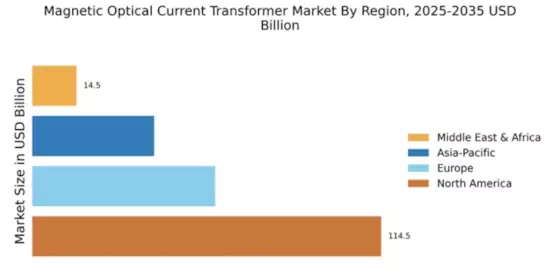
North America is poised to maintain its leadership in the Magnetic Optical Current Transformer market, holding a significant market share of 114.48 million. The region's growth is driven by increasing investments in smart grid technologies and renewable energy initiatives. Regulatory support for energy efficiency and modernization of electrical infrastructure further catalyzes demand, making it a hub for innovation in this sector. The competitive landscape is characterized by the presence of major players such as General Electric and Siemens, which are at the forefront of technological advancements. The U.S. and Canada are leading countries, with a strong focus on R&D and deployment of advanced current transformer solutions. This competitive edge is bolstered by strategic partnerships and collaborations among key industry stakeholders, ensuring sustained growth in the region.

Europe : Emerging Market with Growth Potential

Europe, with a market size of €60.0 million, is witnessing a surge in demand for Magnetic Optical Current Transformers, driven by stringent regulations aimed at enhancing energy efficiency and reducing carbon emissions. The European Union's commitment to sustainable energy solutions and smart grid technologies is a significant catalyst for market growth. Countries like Germany and France are leading the charge, supported by favorable government policies and funding initiatives. The competitive landscape in Europe features key players such as Schneider Electric and ABB, who are investing heavily in innovation and technology. The presence of established manufacturers, coupled with a growing number of startups, is fostering a dynamic market environment. As the region transitions towards greener energy solutions, the demand for advanced current transformers is expected to rise, positioning Europe as a critical player in the global market.

Asia-Pacific : Rapid Growth in Emerging Economies

Asia-Pacific, with a market size of $40.0 million, is emerging as a significant player in the Magnetic Optical Current Transformer market. The region's growth is fueled by rapid industrialization, urbanization, and increasing investments in infrastructure development. Countries like China and India are leading the way, with government initiatives aimed at modernizing electrical grids and enhancing energy efficiency, creating a robust demand for advanced current transformer technologies. The competitive landscape is evolving, with both established companies and new entrants vying for market share. Key players such as Mitsubishi Electric and Toshiba are focusing on innovation and localization strategies to cater to the diverse needs of the region. As the demand for reliable and efficient energy solutions continues to rise, Asia-Pacific is set to become a crucial market for Magnetic Optical Current Transformers, attracting significant investments and technological advancements.

Middle East and Africa : Emerging Market with Unique Challenges

The Middle East and Africa region, with a market size of $14.48 million, is gradually emerging in the Magnetic Optical Current Transformer market. The growth is primarily driven by the need for improved electrical infrastructure and the adoption of smart grid technologies. Countries like South Africa and the UAE are investing in modernization efforts, supported by government initiatives aimed at enhancing energy efficiency and reliability in power distribution. The competitive landscape is characterized by a mix of local and international players, with companies like Emerson Electric making significant inroads. However, challenges such as regulatory hurdles and varying levels of technological adoption across countries may impact growth. Despite these challenges, the region presents opportunities for investment and development, particularly in renewable energy projects and infrastructure upgrades.

Magnetic Optical Current Transformer Market Regional Image

Key Players and Competitive Insights

The Magnetic Optical Current Transformer Market is currently characterized by a dynamic competitive landscape, driven by technological advancements and increasing demand for efficient energy management solutions. Key players such as Siemens (DE), General Electric (US), and Schneider Electric (FR) are strategically positioned to leverage innovation and digital transformation to enhance their market presence. Siemens (DE) focuses on integrating smart grid technologies, while General Electric (US) emphasizes sustainability through its eco-friendly product lines. Schneider Electric (FR) is actively pursuing partnerships to expand its digital offerings, collectively shaping a competitive environment that prioritizes technological prowess and sustainability.In terms of business tactics, companies are increasingly localizing manufacturing to reduce costs and optimize supply chains. The market appears moderately fragmented, with several key players exerting considerable influence. This structure allows for a diverse range of products and services, catering to various customer needs while fostering healthy competition among established and emerging players.
In November ABB (CH) announced a strategic partnership with a leading renewable energy firm to develop advanced magnetic optical current transformers tailored for solar applications. This collaboration is significant as it aligns with ABB's commitment to sustainability and positions the company to capitalize on the growing renewable energy sector. By integrating innovative technologies, ABB aims to enhance the efficiency and reliability of its products, thereby strengthening its competitive edge.
In October Honeywell (US) unveiled a new line of magnetic optical current transformers designed for smart grid applications. This launch is pivotal as it reflects Honeywell's focus on digitalization and the integration of AI technologies into its product offerings. The introduction of these advanced transformers is expected to improve grid reliability and operational efficiency, further solidifying Honeywell's position in the market.
In September Mitsubishi Electric (JP) expanded its manufacturing capabilities in Southeast Asia, aiming to meet the rising demand for magnetic optical current transformers in the region. This strategic move is crucial as it not only enhances Mitsubishi's production capacity but also allows for quicker response times to local market needs. By optimizing its supply chain, Mitsubishi Electric is likely to improve its competitive stance in a rapidly evolving market.
As of December current competitive trends indicate a strong emphasis on digitalization, sustainability, and AI integration within the Magnetic Optical Current Transformer Market. Strategic alliances are increasingly shaping the landscape, enabling companies to pool resources and expertise to drive innovation. The shift from price-based competition to a focus on technological advancement and supply chain reliability is evident, suggesting that future competitive differentiation will hinge on the ability to innovate and adapt to changing market demands.

Key Companies in the Magnetic Optical Current Transformer Market include

Industry Developments

May 2022:The first 500 kV substation in Hunan with remote one key sequence control has been operationally deployed. The entire system, which was put into operation by NR Electric Co., received good marks from its users.

ARTECHE participated in a hackathon called ‘2022-Weetbe’ in 2022, thereby innovating the asset management of the High Voltage Power Grid.

Hunan’s first 500 kV substation was put into operation successfully with remote one key sequence control. The users appreciated NR Electric Co., which undertakes the entire system.

Profotech and Elektrozavod have entered into scientific and technological cooperation, which is based on the execution of complex projects on buildings, reconstruction of power facilities, and development and testing of new products based on joint R&D.

In 2018, Profotech became a resident of the special economic zone ‘Technopolis Moscow’ and set up serial production.

ARTECHE participated in a hackathon called ‘2022-Weetbe’ in 2022, thereby innovating the asset management of the High Voltage Power Grid.

The Hunan Shuicheng substation (500kV) that started operations last May enabled remote one-key sequential control function execution to take place.

NR Electric Co. designed its own complete set of voltage sag control equipment from the high-speed switch in December 2020 and passed the type test from Xi’an High Voltage Apparatus Research Institute; that is, the full set test; it has been completely certified by competent authority for its performance evaluation.

ABB released OPTICALCAL – an optical calibration system for optical current transformers–that allows accurate OCT calibration, ensuring reliable and precise current measurement. ABB partnered with Rievtech Electronic Co. during the development of a new range of high-voltage optical current transformers specifically for the Chinese market. The partnership seeks to take advantage of ABB’s OCT expertise.

Future Outlook

Magnetic Optical Current Transformer Market Future Outlook

The Magnetic Optical Current Transformer Market is projected to grow at an 8.2% CAGR from 2025 to 2035, driven by technological advancements and increasing demand for energy efficiency.

New opportunities lie in:

  • Development of smart grid integration solutions Expansion into renewable energy sectors Implementation of predictive maintenance services for transformers

By 2035, the market is expected to achieve substantial growth, driven by innovation and strategic investments.

Market Segmentation

Magnetic Optical Current Transformer Market End Use Outlook

  • Utilities
  • Manufacturing
  • Transportation
  • Telecommunications

Magnetic Optical Current Transformer Market Technology Outlook

  • Fiber Optic Technology
  • Magnetic Field Sensing
  • Digital Signal Processing
  • Data Acquisition

Magnetic Optical Current Transformer Market Application Outlook

  • Power Generation
  • Renewable Energy
  • Industrial Automation
  • Smart Grids

Magnetic Optical Current Transformer Market Installation Type Outlook

  • Indoor
  • Outdoor
  • Portable

Report Scope

MARKET SIZE 2024 228.96(USD Billion)
MARKET SIZE 2025 247.73(USD Billion)
MARKET SIZE 2035 544.93(USD Billion)
COMPOUND ANNUAL GROWTH RATE (CAGR) 8.2% (2025 - 2035)
REPORT COVERAGE Revenue Forecast, Competitive Landscape, Growth Factors, and Trends
BASE YEAR 2024
Market Forecast Period 2025 - 2035
Historical Data 2019 - 2024
Market Forecast Units USD Billion
Key Companies Profiled Siemens (DE), General Electric (US), Schneider Electric (FR), ABB (CH), Honeywell (US), Mitsubishi Electric (JP), Emerson Electric (US), Rohde & Schwarz (DE), Toshiba (JP)
Segments Covered Application, End Use, Technology, Installation Type
Key Market Opportunities Integration of advanced sensing technologies enhances efficiency in the Magnetic Optical Current Transformer Market.
Key Market Dynamics Technological advancements and regulatory changes drive the adoption of Magnetic Optical Current Transformers in energy sectors.
Countries Covered North America, Europe, APAC, South America, MEA

Market Highlights

Author
Author
Author Profile
Priya Nagrale LinkedIn
Senior Research Analyst
With an experience of over five years in market research industry (Chemicals & Materials domain), I gather and analyze market data from diverse sources to produce results, which are then presented back to a client. Also, provide recommendations based on the findings. As a Senior Research Analyst, I perform quality checks (QC) for market estimations, QC for reports, and handle queries and work extensively on client customizations. Also, handle the responsibilities of client proposals, report planning, report finalization, and execution
Leave a Comment

FAQs

What is the projected market valuation of the Magnetic Optical Current Transformer Market by 2035?

The market is projected to reach a valuation of 544.93 USD Billion by 2035.

What was the overall market valuation of the Magnetic Optical Current Transformer Market in 2024?

The overall market valuation was 228.96 USD Billion in 2024.

What is the expected CAGR for the Magnetic Optical Current Transformer Market during the forecast period 2025 - 2035?

The expected CAGR for the market during this period is 8.2%.

Which application segment is anticipated to have the highest valuation by 2035?

The Smart Grids application segment is expected to reach 204.93 USD Billion by 2035.

What are the key players in the Magnetic Optical Current Transformer Market?

Key players include Siemens, General Electric, Schneider Electric, ABB, Honeywell, Mitsubishi Electric, Emerson Electric, Rohde & Schwarz, and Toshiba.

How does the Renewable Energy segment perform in terms of valuation by 2035?

The Renewable Energy segment is projected to achieve a valuation of 130.0 USD Billion by 2035.

What is the anticipated valuation for the Telecommunications end-use segment by 2035?

The Telecommunications end-use segment is likely to reach 224.93 USD Billion by 2035.

Which technology segment is expected to show significant growth by 2035?

The Data Acquisition technology segment is projected to attain a valuation of 224.93 USD Billion by 2035.

What is the expected valuation for Outdoor Installation by 2035?

The Outdoor Installation segment is anticipated to reach 220.0 USD Billion by 2035.

How does the Manufacturing end-use segment compare in valuation to the Utilities segment by 2035?

By 2035, the Manufacturing segment is expected to reach 120.0 USD Billion, while the Utilities segment is projected at 110.0 USD Billion.
Download Free Sample

Kindly complete the form below to receive a free sample of this Report

Compare Licence

×
Features License Type
Single User Multiuser License Enterprise User
Price $4,950 $5,950 $7,250
Maximum User Access Limit 1 User Upto 10 Users Unrestricted Access Throughout the Organization
Free Customization
Direct Access to Analyst
Deliverable Format
Platform Access
Discount on Next Purchase 10% 15% 15%
Printable Versions