Increased Focus on Miniaturization
The Liquid Lens Module Market is also influenced by the trend towards miniaturization in electronic devices. As consumer electronics become smaller and more compact, the demand for lightweight and space-efficient optical solutions is rising. Liquid lenses, with their ability to provide high performance in a reduced form factor, are well-positioned to meet this demand. This trend is particularly evident in the smartphone and wearable technology markets, where manufacturers are seeking innovative ways to integrate advanced optics without compromising on size or weight. The miniaturization trend is expected to contribute to a steady growth trajectory for the liquid lens market.
Rising Adoption in Medical Devices
The Liquid Lens Module Market is witnessing increased adoption in the medical sector, particularly in diagnostic and imaging devices. Liquid lenses offer significant advantages in terms of compactness and the ability to adjust focus without mechanical parts, which is crucial for portable medical equipment. The demand for high-resolution imaging in endoscopic procedures and other diagnostic tools is propelling the growth of liquid lens technology. According to recent estimates, the medical segment is expected to account for nearly 30% of the overall market share by 2026, highlighting the potential of liquid lenses in enhancing medical imaging capabilities.
Growing Interest in Autonomous Vehicles
The Liquid Lens Module Market is poised to benefit from the growing interest in autonomous vehicles. As the automotive industry shifts towards automation, the need for advanced sensing and imaging technologies becomes critical. Liquid lenses can enhance the performance of cameras and sensors used in autonomous driving systems by providing rapid focus adjustments and improved image quality. This is particularly important for applications such as obstacle detection and navigation. Analysts predict that the automotive segment could represent a substantial share of the liquid lens market, with growth driven by the increasing investment in autonomous vehicle technologies.
Surge in Demand for Augmented Reality Applications
The Liquid Lens Module Market is benefiting from the burgeoning demand for augmented reality (AR) applications. As AR technology becomes more prevalent in various sectors, including gaming, education, and training, the need for high-quality optics is paramount. Liquid lenses provide the necessary flexibility and precision to create immersive experiences, making them ideal for AR headsets and smart glasses. Market analysts suggest that the AR segment could drive a significant portion of the liquid lens market, with projections indicating a potential increase in revenue by over 20% in the next few years as more companies invest in AR technologies.
Technological Innovations in Liquid Lens Module Market
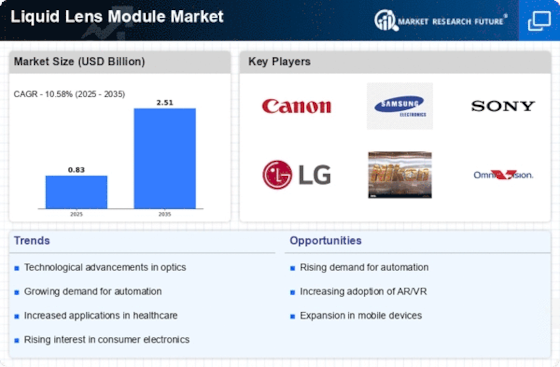
The Liquid Lens Module Market is experiencing a surge in technological innovations that enhance optical performance and versatility. Recent advancements in materials and design have led to the development of lenses that can change shape and focus dynamically. This adaptability is particularly beneficial in applications such as smartphones and cameras, where rapid focus adjustments are essential. The integration of artificial intelligence and machine learning algorithms into lens systems is also gaining traction, allowing for smarter autofocus capabilities. As a result, the market is projected to grow at a compound annual growth rate of approximately 15% over the next five years, driven by these technological enhancements.