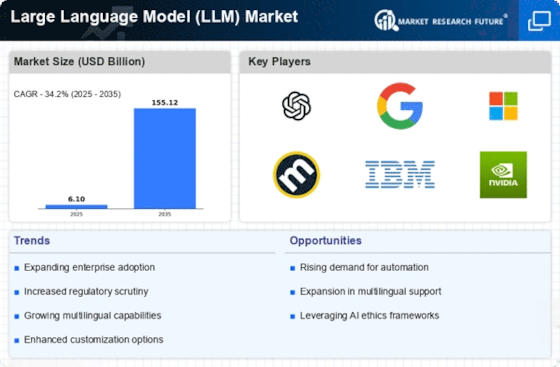
The Large Language Model Market (LLM) Market is currently experiencing a transformative phase, characterized by rapid advancements in artificial intelligence and natural language processing technologies. Organizations across various sectors are increasingly adopting LLMs to enhance their operational efficiency, improve customer interactions, and drive innovation. This growing interest is fueled by the models' ability to generate human-like text, automate tasks, and provide insights from vast datasets. As businesses recognize the potential of LLMs, investment in research and development is likely to escalate, leading to more sophisticated applications and solutions.
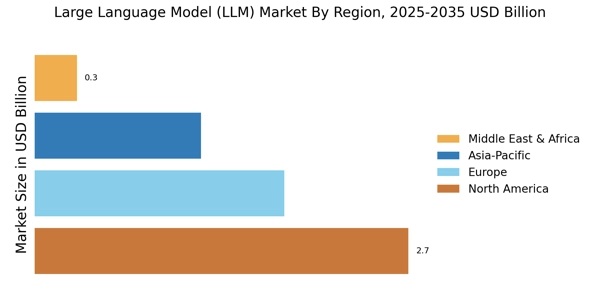
The large language models market is expanding rapidly as organizations increasingly adopt AI-driven solutions to automate content generation, enhance customer engagement, and improve data-driven decision-making. This large language model market analysis highlights strong growth momentum driven by advancements in natural language processing, cloud deployment, and enterprise AI adoption. The large language model market size reflects accelerating enterprise investments in scalable AI infrastructure and language-based automation tools. The large language models market size is expected to witness exponential expansion as adoption increases across BFSI, healthcare, retail, and education sectors.
Moreover, the competitive landscape of the Large Language Model Market (LLM) Market is evolving, with numerous players striving to differentiate their offerings. Collaboration between technology firms and academic institutions appears to be a key strategy for fostering innovation. Additionally, ethical considerations surrounding the deployment of LLMs are gaining prominence, prompting stakeholders to address issues related to bias, transparency, and accountability. As the market matures, it seems that a balanced approach, integrating technological advancement with ethical responsibility, will be crucial for sustainable growth in the future.
Key large language model market trends include rapid adoption of generative AI, increasing focus on ethical AI practices, and growing integration of LLMs into enterprise workflows. The adoption of large language models for digital marketing is increasing as organizations leverage AI for personalized content creation, campaign optimization, and customer engagement analytics. OpenAI and the large language model market play a pivotal role in shaping innovation, with advancements in foundation models accelerating enterprise adoption and ecosystem development. In terms of innovation, scale, and commercial adoption, OpenAI, Google, and Microsoft are often cited when assessing who leads in the large language model market. The large language model LLM market is becoming increasingly competitive as vendors differentiate through model performance, deployment flexibility, and responsible AI frameworks.
Increased Adoption Across Industries
Various sectors are increasingly integrating Large Language Models (LLMs) into their operations. This trend indicates a shift towards automation and enhanced efficiency, as organizations leverage LLMs for tasks such as customer service, content generation, and data analysis.
Focus on Ethical AI Practices
As the Large Language Model Market (LLM) Market expands, there is a growing emphasis on ethical considerations. Stakeholders are prioritizing transparency, accountability, and bias mitigation, which suggests a collective effort to ensure responsible AI deployment.
Collaboration for Innovation
Partnerships between technology companies and academic institutions are becoming more prevalent. This trend highlights the importance of collaborative research and development in driving advancements in LLM capabilities and applications.