×
Request Free Sample ×

Kindly complete the form below to receive a free sample of this Report

* Please use a valid business email

Leading companies partner with us for data-driven Insights

clients tt-cursor
Hero Background

Germany Large Language Model Market

ID: MRFR/ICT/58867-HCR
200 Pages
Aarti Dhapte
February 2026

Germany Large Language Model Market Size, Share and Trends Analysis Report By Application (Text Generation, Conversational Agents, Sentiment Analysis, Text Summarization), By Deployment Model (Cloud-Based, On-Premises), By End User (BFSI, Healthcare, Retail, Education) and By Technology (Transformers, RNN, CNN) - Forecast to 2035

Share:
Download PDF ×

We do not share your information with anyone. However, we may send you emails based on your report interest from time to time. You may contact us at any time to opt-out.

Germany Large Language Model Market Infographic
Purchase Options

Germany Large Language Model Market Summary

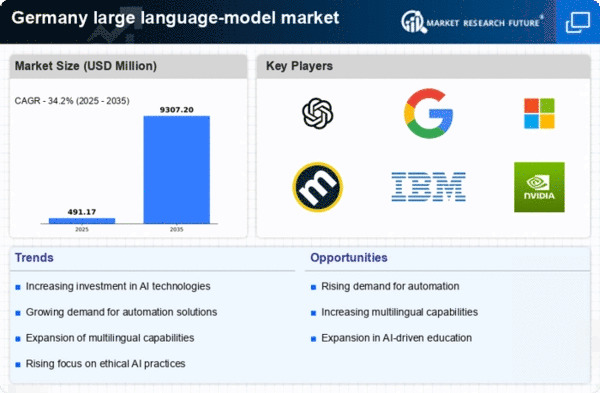
As per Market Research Future analysis, the Germany Large Language Model Market size was estimated at 366.0 USD Million in 2024. The Large Language-model market is projected to grow from 491.17 USD Million in 2025 to 9307.2 USD Million by 2035, exhibiting a compound annual growth rate (CAGR) of 34% during the forecast period 2025 - 2035

Key Market Trends & Highlights

The Germany large language-model market is experiencing robust growth driven by enterprise adoption and technological advancements.

  • The largest segment in the Germany large language-model market is enterprise solutions, reflecting a strong demand for automation.
  • The fastest-growing segment is customer service applications, highlighting the increasing reliance on AI-driven interactions.
  • Germany is witnessing a notable focus on ethical AI practices, ensuring responsible deployment of language models.
  • Key market drivers include rising demand for automation and government initiatives supporting AI research and development.

Market Size & Forecast

2024 Market Size 366.0 (USD Million)
2035 Market Size 9307.2 (USD Million)
CAGR (2025 - 2035) 34.2%

Major Players

OpenAI (US), Google (US), Microsoft (US), Meta (US), IBM (US), NVIDIA (US), Cohere (CA), Anthropic (US), Hugging Face (FR)

Our Impact
Enabled $4.3B Revenue Impact for Fortune 500 and Leading Multinationals
Partnering with 2000+ Global Organizations Each Year
30K+ Citations by Top-Tier Firms in the Industry

Germany Large Language Model Market Trends

the Germany Large Language Model Market is experiencing notable growth, driven by advancements in artificial intelligence and natural language processing technologies.. In Germany, the demand for these models is increasing across various sectors, including finance, healthcare, and education. Organizations are recognizing the potential of large language models to enhance customer interactions, automate processes, and improve decision-making. This trend is further supported by government initiatives aimed at fostering innovation in AI, which may lead to increased investment and collaboration between public and private sectors. Moreover, the integration of large language models into existing systems appears to be a priority for many companies. As businesses seek to leverage data for competitive advantage, the ability to analyze and generate human-like text is becoming essential. The focus on ethical AI and responsible usage is also gaining traction, as stakeholders emphasize the importance of transparency and accountability in AI applications. This evolving landscape suggests that the large language-model market in Germany is poised for continued expansion, with a strong emphasis on innovation and ethical considerations in its development and deployment.

Increased Adoption in Enterprises

Organizations in Germany are increasingly adopting large language models to streamline operations and enhance customer engagement. This trend indicates a shift towards automation and efficiency, as businesses recognize the value of these models in processing vast amounts of data and generating insights.

Focus on Ethical AI

There is a growing emphasis on ethical considerations within the large language-model market. Stakeholders are advocating for responsible AI practices, ensuring that models are developed and deployed with transparency and accountability, which may influence regulatory frameworks.

Investment in Research and Development

Investment in research and development related to large language models is on the rise. This trend suggests that both public and private sectors in Germany are committed to advancing AI technologies, potentially leading to innovative applications and improved model performance.

Germany Large Language Model Market Drivers

Rising Demand for Automation

The large language-model market in Germany is experiencing a notable surge in demand for automation across various sectors. Businesses are increasingly recognizing the potential of language models to streamline operations, enhance productivity, and reduce costs. In 2025, it is estimated that the automation market in Germany could reach €10 billion, with a significant portion attributed to the integration of large language models. This trend is driven by the need for efficient customer service solutions, automated content generation, and data analysis. As organizations seek to optimize their workflows, the large language-model market is likely to play a pivotal role in facilitating these advancements. This will reshape the operational landscape..

Focus on Data Privacy and Security

In the context of the large language-model market, data privacy and security have emerged as paramount concerns for businesses in Germany. With stringent regulations such as the General Data Protection Regulation (GDPR) in place, companies are compelled to ensure that their AI solutions comply with these standards. This focus on data protection is likely to influence the development of language models, as organizations seek to implement robust security measures. In 2025, it is estimated that investments in data security solutions will increase by 20%, reflecting the growing emphasis on safeguarding sensitive information. As a result, the large language-model market may evolve to prioritize privacy-centric features, thereby enhancing trust and adoption.

Government Initiatives and Funding

The German government is actively promoting the development and adoption of artificial intelligence technologies, including large language models. Initiatives aimed at fostering innovation and research in AI are gaining momentum, with funding allocations reaching approximately €1 billion in 2025. These efforts are designed to position Germany as a leader in AI technology, encouraging collaboration between academia and industry. The large language-model market stands to benefit significantly from these government initiatives, as they provide the necessary resources and support for research and development. This environment is conducive to the growth of the market, potentially leading to breakthroughs in language processing capabilities.

Integration with Emerging Technologies

The convergence of large language models with emerging technologies such as machine learning, natural language processing, and cloud computing is reshaping the technological landscape in Germany. This integration is expected to enhance the capabilities of language models, making them more efficient and versatile. In 2025, the market for cloud-based AI solutions is anticipated to grow by 25%, with a substantial portion driven by advancements in large language models. As organizations increasingly adopt these integrated solutions, the large language-model market is poised for significant growth, potentially leading to innovative applications across various industries.

Growing Interest in Multilingual Capabilities

Germany's diverse linguistic landscape is driving a growing interest in multilingual capabilities within the large language-model market. As businesses expand their operations internationally, the need for language models that can understand and generate content in multiple languages becomes increasingly critical. In 2025, it is projected that the demand for multilingual language models will account for over 30% of the total market share in Germany. This trend reflects the necessity for companies to engage effectively with diverse customer bases, thereby enhancing their competitive edge. Consequently, the large language-model market is likely to evolve to meet these multilingual demands, fostering inclusivity and accessibility.


Market Segment Insights

By Application: Text Generation (Largest) vs. Conversational Agents (Fastest-Growing)

In the Germany large language-model market, Text Generation remains the dominant application with the largest market share. This segment is widely utilized across various industries, enabling companies to automate content creation and enhance user engagement through tailored communications. Following closely, Conversational Agents are rapidly gaining traction, reflecting an increased demand for real-time interactions between businesses and customers, leading to significant share gains in recent years. The growth in these segments is driven by advancements in artificial intelligence and machine learning, coupled with the rising need for efficient communication solutions. Furthermore, organizations are recognizing the value of sentiment analysis and text summarization as vital tools for deciphering customer feedback and streamlining information processing. The growing inclination towards digital transformation in enterprises propels these applications forward, fostering innovation and enhancing user experiences.

Text Generation: Dominant vs. Sentiment Analysis: Emerging

Text Generation stands as the dominant force in the Germany large language-model market, known for its robust capabilities in generating coherent and contextually relevant text across various domains. It finds applications in marketing, content writing, and customer service automation, establishing itself as an essential tool for brands looking to optimize their communication strategies. On the other hand, Sentiment Analysis is an emerging segment, gaining popularity for its ability to gauge customer opinions and emotions through data interpretation. This application aids businesses in tailoring their marketing approaches and improving customer satisfaction. Both segments play pivotal roles in transforming data into actionable insights, with Text Generation leading in market presence while Sentiment Analysis shows promising growth potential.

By Deployment Model: Cloud-Based (Largest) vs. On-Premises (Fastest-Growing)

In the Germany large language-model market, the deployment model landscape is dominated by cloud-based solutions, which capture a substantial market share owing to their flexibility, scalability, and ease of integration. On-premises solutions, while traditionally preferred by industries with stringent data privacy requirements, are gradually gaining traction among businesses looking for tailored solutions and enhanced control over their data environments. Growth trends indicate a strong upward trajectory for both segments; however, on-premises deployment is emerging as the fastest-growing segment. The increasing need for companies to own their infrastructure and mitigate potential security risks is driving this trend. Meanwhile, cloud-based models continue to thrive as organizations prioritize agility and cost-effectiveness in their operations, leading to a competitive yet complementary market environment.

Cloud-Based (Dominant) vs. On-Premises (Emerging)

Cloud-based deployment in the Germany large language-model market is characterized by its significant dominance as businesses lean towards solutions that offer flexible access and rapid deployment capabilities. This model simplifies integration with existing applications, thus attracting diverse industry players. On-premises deployment, while currently an emerging choice, is seeing increased interest among enterprises that prioritize security, compliance, and customization of their language models. As businesses navigate data sovereignty laws, this segment is expected to expand, catering to specific use cases where control over data and infrastructure is paramount. Both models play crucial roles, with cloud-based solutions leading the charge while on-premises options present a viable alternative as they evolve.

By End User: BFSI (Largest) vs. Healthcare (Fastest-Growing)

In the Germany large language-model market, the distribution of market share reveals that the BFSI sector takes the lead, representing a significant portion of the overall market due to its high reliance on data-driven insights and real-time customer interactions. Following closely, the healthcare industry is witnessing a robust increase in adoption, driven by the need for enhanced patient care and operational efficiencies, thereby rapidly gaining a share in this competitive landscape. Growth trends in the Germany large language-model market are being shaped by technological advancements and increasing investments in AI across sectors. The BFSI sector's growth is propelled by demands for better risk management and customer service automation, while the healthcare segment is experiencing a boom due to rising healthcare costs and the ongoing digital transformation, which accelerates the integration of language models for improved diagnostics and patient engagement.

BFSI (Dominant) vs. Healthcare (Emerging)

The BFSI sector stands as the dominant force in the Germany large language-model market, characterized by its extensive use of advanced analytics, fraud detection, and customer service automation. Financial institutions leverage language models to enhance client interactions and streamline operations, making them more efficient and responsive to market changes. On the other hand, the healthcare sector is emerging rapidly, focusing on personalized medicine and telehealth solutions. It is increasingly adopting language models to facilitate communication and improve patient outcomes, driven by a necessity for efficient data handling and the shift towards automated healthcare services. This growing trend indicates a clear demand for innovative solutions that both sectors are eager to implement.

By Technology: Transformers (Largest) vs. RNN (Fastest-Growing)

The Germany large language-model market is currently dominated by the Transformer architecture, which is recognized for its exceptional performance in natural language processing tasks. With its ability to manage vast datasets, it holds the largest market share among the various technologies, signaling a strong preference from consumers and businesses alike. In contrast, Recurrent Neural Networks (RNN) while smaller in market presence, are gaining traction as their unique sequential processing capabilities align well with specific applications, making them an appealing solution for certain use cases. Growth trends in the Germany large language-model market show a significant shift towards Transformers due to their scalability and effectiveness in handling complex language tasks. Meanwhile, RNNs are seeing a resurgence fueled by innovations that enhance their efficiency and applicability. As organizations increasingly adopt AI-driven solutions, the demand for both technologies is anticipated to rise, driven by the need for more sophisticated language understanding and generation capabilities.

Technology: Transformers (Dominant) vs. RNN (Emerging)

Transformers are the dominant technology in the Germany large language-model market, known for their high efficiency and accuracy in performing tasks such as translation and content generation through attention mechanisms. Their robust architecture allows for pre-training on large datasets, which in turn leads to improved performance across various language processing applications. In contrast, RNNs represent an emerging segment that is carving out its niche, particularly in applications that require sequence prediction and temporal data analysis. Although they face challenges such as vanishing gradients, recent advancements have improved their stability and capability, allowing them to remain relevant and competitive alongside Transformers.

Get more detailed insights about Germany Large Language Model Market

Key Players and Competitive Insights

The large language-model market is currently characterized by intense competition and rapid innovation, driven by advancements in artificial intelligence (AI) and increasing demand for natural language processing (NLP) applications. Key players such as OpenAI (US), Google (US), and Microsoft (US) are at the forefront, each adopting distinct strategies to enhance their market positioning. OpenAI (US) focuses on continuous innovation, particularly in developing more sophisticated models that can understand and generate human-like text. Google (US) emphasizes integration with its existing services, leveraging its vast data resources to improve model performance. Meanwhile, Microsoft (US) is pursuing strategic partnerships, notably with OpenAI (US), to enhance its cloud offerings and AI capabilities, thereby shaping a competitive environment that is both collaborative and competitive.The market structure appears moderately fragmented, with a mix of established players and emerging startups. Key tactics employed by these companies include localizing their operations to better serve regional markets and optimizing supply chains to enhance efficiency. This collective influence of major players fosters a dynamic landscape where innovation and responsiveness to market needs are paramount.

In October OpenAI (US) announced the launch of its latest language model, which reportedly offers improved contextual understanding and user interaction capabilities. This strategic move is significant as it not only reinforces OpenAI's leadership in the market but also sets a new benchmark for competitors, compelling them to accelerate their own development efforts. The introduction of this model is likely to attract a broader user base, enhancing OpenAI's market share.

In September Google (US) unveiled a new suite of tools designed to integrate its language models with enterprise applications, aiming to streamline workflows for businesses. This initiative underscores Google's commitment to enhancing productivity through AI, positioning the company as a vital partner for organizations seeking to leverage language models for operational efficiency. The strategic importance of this move lies in its potential to deepen customer engagement and expand Google's footprint in the enterprise sector.

In August Microsoft (US) expanded its partnership with OpenAI (US) to include joint research initiatives focused on ethical AI development. This collaboration is particularly noteworthy as it highlights a growing trend among tech giants to prioritize responsible AI practices. By aligning with OpenAI, Microsoft not only enhances its credibility in the AI space but also addresses increasing regulatory scrutiny regarding AI ethics, which could be a decisive factor in future market dynamics.

As of November the competitive landscape is increasingly defined by trends such as digitalization, sustainability, and the integration of AI across various sectors. Strategic alliances are becoming more prevalent, as companies recognize the value of collaboration in driving innovation. Looking ahead, competitive differentiation is likely to evolve, shifting from traditional price-based competition to a focus on technological innovation, reliability in supply chains, and the ability to deliver tailored solutions. This transition may redefine success in the market, emphasizing the importance of agility and forward-thinking strategies.

Key Companies in the Germany Large Language Model Market include

Industry Developments

In recent months, the Germany Large Language Model Market has seen significant developments, particularly with major players like OpenAI, SAP, and NVIDIA making strides in the field. SAP has been focusing on integrating its enterprise software solutions with advanced language models to enhance business processes. June 13, 2025 — Deutsche Telekom and NVIDIA collaborated to establish Germany's first industrial AI cloud. 

The cloud will support local industrial LLM duties among manufacturers by deploying 10,000 GPUs in a specialized facility. On June 16, 2025, NVIDIA underscored the concept of "sovereign AI" at VivaTech. The company announced AI infrastructure partnerships throughout Europe, including a French-German Mistral initiative that utilized 18,000 Blackwell GPUs, to facilitate the deployment of LLM with local compute sovereignty.

Over the last couple of years, Germany has also seen investments in AI technology increase, driven by governmental initiatives aimed at fostering innovation in AI research. This aligns with Germany’s goal of becoming a leader in AI, supported by substantial funding and research projects. The market evolution is shaping how businesses leverage language models to optimize operations and improve user experiences across industries.

Future Outlook

Germany Large Language Model Market Future Outlook

The Large Language Model Market in Germany is projected to grow at a 34.2% CAGR from 2025 to 2035, driven by advancements in AI technology and increasing demand for automation.

New opportunities lie in:

  • Development of industry-specific language models for healthcare applications.
  • Integration of language models in customer service automation tools.
  • Creation of multilingual support systems for global enterprises.

By 2035, the market is expected to achieve substantial growth, positioning itself as a leader in AI-driven solutions.

Market Segmentation

Germany Large Language Model Market End User Outlook

  • BFSI
  • Healthcare
  • Retail
  • Education

Germany Large Language Model Market Technology Outlook

  • Transformers
  • RNN
  • CNN

Germany Large Language Model Market Application Outlook

  • Text Generation
  • Conversational Agents
  • Sentiment Analysis
  • Text Summarization

Germany Large Language Model Market Deployment Model Outlook

  • Cloud-Based
  • On-Premises

Report Scope

MARKET SIZE 2024 366.0(USD Million)
MARKET SIZE 2025 491.17(USD Million)
MARKET SIZE 2035 9307.2(USD Million)
COMPOUND ANNUAL GROWTH RATE (CAGR) 34.2% (2025 - 2035)
REPORT COVERAGE Revenue Forecast, Competitive Landscape, Growth Factors, and Trends
BASE YEAR 2024
Market Forecast Period 2025 - 2035
Historical Data 2019 - 2024
Market Forecast Units USD Million
Key Companies Profiled OpenAI (US), Google (US), Microsoft (US), Meta (US), IBM (US), NVIDIA (US), Cohere (CA), Anthropic (US), Hugging Face (FR)
Segments Covered Application, Deployment Model, End User, Technology
Key Market Opportunities Integration of advanced AI capabilities in diverse industries enhances growth potential in the large language-model market.
Key Market Dynamics Growing demand for advanced natural language processing solutions drives innovation in the large language-model market.
Countries Covered Germany
Leave a Comment

FAQs

What is the expected market size of the Germany Large Language Model Market in 2024?

The market is expected to be valued at 161.92 million USD in 2024.

What is the projected market size of the Germany Large Language Model Market in 2035?

By 2035, the market is expected to reach a value of 788.0 million USD.

What is the expected CAGR for the Germany Large Language Model Market from 2025 to 2035?

The expected CAGR for the market during this period is 15.472%.

Which application is projected to dominate the Germany Large Language Model Market by 2035?

Text Generation is projected to be the dominant application, valued at 325.0 million USD by 2035.

What are the key players in the Germany Large Language Model Market?

Major players include OpenAI, SAP, NVIDIA, Hugging Face, and Google among others.

What is the market value for Conversational Agents in 2024?

The market value for Conversational Agents is expected to be 45.0 million USD in 2024.

How much is the Sentiment Analysis segment expected to be valued by 2035?

The Sentiment Analysis segment is projected to reach 150.0 million USD by 2035.

What is the estimated market value for Text Summarization in 2024?

Text Summarization is estimated to be valued at 21.92 million USD in 2024.

What growth trends are anticipated in the Germany Large Language Model Market from 2025 to 2035?

The market is expected to experience robust growth driven by increasing demand for AI applications.

What is the market value for the Conversational Agents application by 2035?

The market value for Conversational Agents is projected to be 220.0 million USD by 2035.

Download Free Sample

Kindly complete the form below to receive a free sample of this Report

Compare Licence

×
Features License Type
Single User Multiuser License Enterprise User
Price $4,950 $5,950 $7,250
Maximum User Access Limit 1 User Upto 10 Users Unrestricted Access Throughout the Organization
Free Customization
Direct Access to Analyst
Deliverable Format
Platform Access
Discount on Next Purchase 10% 15% 15%
Printable Versions