×
Request Free Sample ×

Kindly complete the form below to receive a free sample of this Report

* Please use a valid business email

Leading companies partner with us for data-driven Insights

clients tt-cursor
Hero Background

Japan Visual Positioning System Market

ID: MRFR/ICT/60818-HCR
200 Pages
Aarti Dhapte
February 2026

Japan Visual Positioning System Market Size, Share and Trends Analysis Report By Component (Sensors, Camera, Systems, Markers, Others), By Location (Indoor Positioning System, Outdoor Positioning System), By Type (1D, 2D, 3D), By Solution (Navigation, Analytics, Tracking, Industrial Solutions, Others), By Platform (UAVs/Drones, AGV, Robotics, AUV, Others) and By Application (Commercial Application, Defense Application)- Forecast to 2035

Share:
Download PDF ×

We do not share your information with anyone. However, we may send you emails based on your report interest from time to time. You may contact us at any time to opt-out.

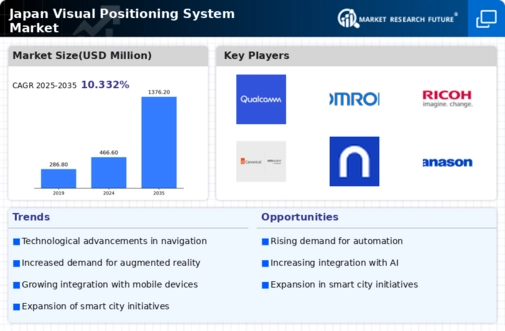
Japan Visual Positioning System Market Infographic
Purchase Options

Japan Visual Positioning System Market Summary

As per analysis, the Japan visual positioning system market is projected to grow from USD 588.02 Million in 2024 to USD 1,770.03 Million by 2035, exhibiting a compound annual growth rate (CAGR) of 10.54% during the forecast period (2025 - 2035).

Key Market Trends & Highlights

The Japan visual positioning system market is poised for substantial growth driven by technological advancements and urban development initiatives.

  • The retail segment remains the largest contributor to the visual positioning system market, reflecting a strong demand for enhanced consumer experiences.
  • Augmented reality is the largest segment, indicating a significant integration of visual positioning systems in immersive applications.
  • The transportation segment is currently the fastest-growing, driven by the increasing adoption of autonomous vehicle technologies.
  • Key market drivers include the integration with IoT technologies and government support for smart city projects.

Market Size & Forecast

2024 Market Size 588.02 (USD Million)
2035 Market Size 1770.03 (USD Million)
CAGR (2025 - 2035) 10.54%

Major Players

Sony (JP), Panasonic (JP), Fujitsu (JP), NEC (JP), Hitachi (JP), Sharp (JP), Omron (JP), Mitsubishi Electric (JP), Yamaha (JP)

Our Impact
Enabled $4.3B Revenue Impact for Fortune 500 and Leading Multinationals
Partnering with 2000+ Global Organizations Each Year
30K+ Citations by Top-Tier Firms in the Industry

Japan Visual Positioning System Market Trends

The Japan visual positioning system market is currently experiencing a notable evolution, driven by advancements in technology and increasing demand for precise location-based services. This market encompasses a range of applications, including navigation, augmented reality, and robotics, which are becoming increasingly integrated into daily life. The proliferation of smart devices and the growing emphasis on automation in various sectors appear to be propelling the adoption of visual positioning systems. Furthermore, the Japanese government's initiatives to enhance infrastructure and promote smart city developments may further stimulate market growth. In addition, the competitive landscape of the Japan visual positioning system market is characterized by a diverse array of players, from established technology firms to innovative startups. This dynamic environment fosters collaboration and the exchange of ideas, which could lead to the development of novel solutions tailored to local needs. As the market continues to mature, it seems likely that consumer preferences will shift towards more sophisticated and user-friendly systems, thereby influencing product offerings and service delivery in the coming years.

Integration with Augmented Reality

The integration of visual positioning systems with augmented reality applications is becoming increasingly prevalent in Japan. This trend suggests that businesses are recognizing the potential of combining real-world environments with digital information, enhancing user experiences in sectors such as retail, tourism, and education. As technology advances, the synergy between these two fields may lead to innovative solutions that cater to the unique demands of Japanese consumers.

Focus on Smart City Initiatives

Japan's commitment to developing smart cities appears to be a driving force behind the visual positioning system market. Government initiatives aimed at improving urban infrastructure and connectivity may create opportunities for the deployment of advanced positioning technologies. This focus on smart city projects indicates a potential for increased investment and collaboration among stakeholders, ultimately benefiting the market.

Emphasis on Precision and Accuracy

There is a growing emphasis on precision and accuracy within the Japan visual positioning system market. As industries such as logistics, healthcare, and manufacturing seek to optimize operations, the demand for highly accurate positioning solutions is likely to rise. This trend may lead to advancements in technology and methodologies, ensuring that systems meet the rigorous standards expected by Japanese businesses.

Japan Visual Positioning System Market Drivers

Expansion of Smart City Projects

The expansion of smart city projects across Japan is poised to drive the visual positioning system market significantly. Urban areas are increasingly adopting smart technologies to enhance infrastructure, improve public services, and promote sustainability. The Japanese government has earmarked substantial investments for smart city initiatives, with a focus on integrating visual positioning systems to facilitate efficient urban planning and management. For example, cities like Tokyo and Osaka are implementing smart traffic management systems that rely on accurate positioning data. This trend may lead to a projected market growth of approximately 10% annually, as municipalities seek to leverage visual positioning systems to create more livable and efficient urban environments.

Integration with IoT Technologies

The integration of Internet of Things (IoT) technologies within the Japan visual positioning system market appears to be a pivotal driver. As smart devices proliferate, the demand for seamless connectivity and real-time data exchange intensifies. This integration facilitates enhanced location-based services, enabling businesses to optimize operations and improve customer experiences. For instance, the Japanese government has been actively promoting IoT initiatives, which could potentially lead to a market growth rate of approximately 15% annually. The synergy between IoT and visual positioning systems may result in innovative applications across various sectors, including retail, logistics, and urban planning, thereby reinforcing the industry's relevance in a rapidly evolving technological landscape.

Rising Demand for Autonomous Vehicles

The rising demand for autonomous vehicles is likely to serve as a significant driver for the Japan visual positioning system market. As Japan continues to advance its automotive technologies, the need for precise navigation and positioning systems becomes increasingly critical. The government has set ambitious targets for the deployment of autonomous vehicles, with projections indicating that the market for such vehicles could reach 1.5 million units by 2030. This surge in demand necessitates the integration of advanced visual positioning systems to ensure safety and efficiency. Consequently, the industry may experience substantial growth, as automotive manufacturers seek to incorporate cutting-edge positioning technologies into their vehicles.

Government Support and Policy Frameworks

Government support and robust policy frameworks significantly influence the Japan visual positioning system market. The Japanese government has been investing in advanced technologies, including visual positioning systems, to enhance urban infrastructure and public safety. Initiatives such as the 'Society 5.0' vision aim to integrate digital technologies into everyday life, which may bolster the adoption of visual positioning systems. Furthermore, funding programs and incentives for research and development in this sector could potentially accelerate innovation and market penetration. As a result, the industry may witness a compound annual growth rate (CAGR) of around 12% over the next five years, driven by favorable governmental policies and strategic investments.

Increased Focus on Retail and Consumer Experience

An increased focus on enhancing retail and consumer experiences is emerging as a key driver in the Japan visual positioning system market. Retailers are increasingly utilizing visual positioning systems to provide personalized shopping experiences, optimize store layouts, and improve inventory management. The rise of e-commerce and changing consumer behaviors necessitate innovative solutions that can bridge the gap between online and offline shopping. According to recent market analyses, the retail sector in Japan is expected to grow by 8% annually, with visual positioning systems playing a crucial role in this transformation. As businesses strive to create engaging and efficient shopping environments, the demand for advanced positioning technologies is likely to surge.


Market Segment Insights

By Application: Retail (Largest) vs. Transportation (Fastest-Growing)

In the Japan visual positioning system market, the application segment is led by retail, which holds the largest market share. Retail utilizes visual positioning systems for enhancing customer engagement and streamlining inventory management. Following closely, transportation is rapidly gaining traction, reflecting broader advancements in logistics and navigation technologies. Overall, healthcare, manufacturing, and entertainment also contribute to the segment but at comparatively lower shares, signifying emerging opportunities in these fields. The growth trends in this segment are driven by technological advancements in artificial intelligence and machine learning, enhancing the precision and utility of visual positioning systems. Retail's dominance is bolstered by the need for personalized customer experiences. Meanwhile, transportation is the fastest-growing application due to increased demands for seamless navigation solutions in smart cities and the logistics sector. This growth is further supported by government initiatives aimed at integrating advanced technologies into various sectors.

Retail (Dominant) vs. Transportation (Emerging)

The retail application of visual positioning systems has become dominant in the Japan market due to its ability to enhance in-store experiences and optimize supply chain management. Retailers leverage these systems for customer analytics and personalized marketing efforts, which have proven effective in improving sales. Conversely, transportation is emerging rapidly as a significant application, driven by the need for efficient logistics and intelligent navigation systems. As urban infrastructure evolves and smart city initiatives gain momentum, transportation applications are being adopted more widely, portraying its potential for growth. The demand for visual positioning in transportation is rising, influenced by aspirations for autonomous vehicles and improved traffic management, positioning it as a critical area for future development.

By Technology: Augmented Reality (Largest) vs. Computer Vision (Fastest-Growing)

In the Japan visual positioning system market, the distribution of market share among the technology segments reveals a clear dominance of Augmented Reality, which holds the largest share due to its extensive applications in industries such as retail, gaming, and education. This technology enhances user experience by overlaying digital information in real-time, making it a favored choice among businesses looking to innovate. Following closely is Computer Vision, which, while not the largest, is recognized as the fastest-growing segment, driven by the increasing demand for automation and data analysis solutions. The growth trends in the technology segment are significantly influenced by advancements in machine learning and artificial intelligence, which are fundamentally enhancing the capabilities of visual positioning systems. The push for more efficient, accurate, and user-friendly solutions in various sectors—including manufacturing and logistics—encourages the adoption of these technologies. Factors such as the integration of sensor fusion techniques and improvements in hardware are also contributing to the robust growth anticipated in the Computer Vision segment, as companies seek to leverage detailed analytics for informed decision-making.

Technology: Augmented Reality (Dominant) vs. Computer Vision (Emerging)

In the Japan visual positioning system market, Augmented Reality (AR) stands out as the dominant technology due to its ability to provide immersive experiences and real-time interaction, making it highly attractive for various applications. Its prevalence in industries such as retail for virtual fitting rooms and in education for interactive learning environments showcases its market strength. Conversely, Computer Vision is emerging as a critical technology driven by advancements in automation and the need for data analytics. It enables machines to interpret and respond to visual data, making it invaluable in sectors like manufacturing for quality control and robotics. As businesses increasingly seek to optimize operations, computer vision's capabilities position it for significant growth in the coming years.

By End Use: Smartphones (Largest) vs. Wearable Devices (Fastest-Growing)

In the Japan visual positioning system market, the distribution of end use segments reveals that smartphones hold the largest market share, driven by their widespread adoption and integration of advanced positioning technologies. Tablets also contribute significantly, but they lag behind smartphones, focusing on specific applications within sectors like education and logistics. Meanwhile, wearable devices are gaining traction, offering innovative solutions for health monitoring and augmented reality, indicating a shifting consumer preference toward multifunctional devices. The growth trends in this segment are largely influenced by technological advancements, particularly the integration of AI and machine learning in visual positioning systems. Drones are emerging as a valuable player, with applications in aerial surveying and infrastructure inspections, while automotive applications are steadily increasing, driven by the demand for enhanced navigation systems in connected vehicles. As users gravitate toward smart, interconnected devices, the demand for visual positioning systems is expected to rise across all end-use categories, with wearable devices seeing the most rapid growth due to increased health awareness.

Smartphones (Dominant) vs. Drones (Emerging)

Smartphones represent the dominant force in the Japan visual positioning system market, benefiting from extensive infrastructure support and consumer familiarity with mobile technology. Their integration with GPS and advanced imaging systems makes them indispensable for daily navigation and various applications, from retail to real estate. On the other hand, drones are emerging as a significant player, increasingly utilized for tasks such as emergency response, agricultural monitoring, and geographic mapping. Although they currently hold a smaller market share compared to smartphones, their adoption is accelerating due to innovations in drone technology, regulatory support, and new applications that leverage visual positioning systems for improved data collection and analysis. This contrast underscores the dynamic nature of the market, with smartphones maintaining dominance while drones rapidly evolve as a competitive force.

Get more detailed insights about Japan Visual Positioning System Market

Key Players and Competitive Insights

The visual positioning system market in Japan is characterized by a dynamic competitive landscape, driven by rapid technological advancements and increasing demand for precision in navigation and location-based services. Key players such as Sony (Japan), Panasonic (Japan), and Fujitsu (Japan) are at the forefront, each adopting distinct strategies to enhance their market presence. Sony (Japan) focuses on innovation, particularly in integrating AI and machine learning into its visual positioning solutions, which enhances accuracy and user experience. Meanwhile, Panasonic (Japan) emphasizes partnerships with local governments to implement smart city initiatives, thereby expanding its operational footprint. Fujitsu (Japan) is leveraging its expertise in cloud computing to offer integrated solutions that combine visual positioning with data analytics, thus appealing to a broader range of industries.

The business tactics employed by these companies reflect a concerted effort to localize manufacturing and optimize supply chains, which is crucial in a moderately fragmented market. This competitive structure allows for a diverse range of offerings, yet the influence of major players remains significant. The collective strategies of these companies not only enhance their individual market positions but also contribute to a more robust ecosystem that fosters innovation and collaboration.

In December 2025, Sony (Japan) announced a strategic partnership with a leading automotive manufacturer to develop advanced visual positioning systems for autonomous vehicles. This collaboration is pivotal as it positions Sony at the intersection of automotive technology and visual positioning, potentially revolutionizing navigation systems in the automotive sector. The integration of Sony's cutting-edge technology with the automotive partner's expertise could lead to enhanced safety and efficiency in self-driving cars.

In November 2025, Panasonic (Japan) launched a new visual positioning platform aimed at smart city applications, which includes real-time data analytics and user-friendly interfaces. This initiative is strategically important as it aligns with global trends towards urbanization and the need for efficient city management. By focusing on smart city solutions, Panasonic not only diversifies its product offerings but also strengthens its role as a key player in the burgeoning smart infrastructure market.

In October 2025, Fujitsu (Japan) unveiled a cloud-based visual positioning service that integrates with IoT devices, enhancing operational efficiency for businesses in logistics and supply chain management. This move is significant as it reflects the growing trend of digital transformation across industries. By providing a comprehensive solution that combines visual positioning with IoT capabilities, Fujitsu positions itself as a leader in the convergence of these technologies, catering to the increasing demand for smart logistics solutions.

As of January 2026, the competitive trends in the visual positioning system market are increasingly defined by digitalization, sustainability, and the integration of AI technologies. Strategic alliances are becoming more prevalent, as companies recognize the value of collaboration in driving innovation. The competitive landscape is shifting from traditional price-based competition to a focus on technological advancement and supply chain reliability. This evolution suggests that future differentiation will hinge on the ability to innovate and adapt to changing market demands, ultimately shaping a more resilient and forward-thinking industry.

Key Companies in the Japan Visual Positioning System Market include

Industry Developments

Recent developments in the Japan Visual Positioning System Market showcase a dynamic landscape with several companies actively innovating and expanding their capabilities. In October 2023, Qualcomm advanced its offerings by integrating advanced visual positioning technology into mobile devices, enhancing user navigation. Ricoh also made strides in this space with the launch of new visual recognition software aimed at industrial applications. 

Additionally, Omron announced expansions in its visual recognition technology for automated inspection processes in manufacturing earlier this year. The market has seen a notable growth trajectory, driven by increased demand for sophisticated navigation solutions across various sectors, including automotive and manufacturing. 

Significant activities over the past few years include NEC's development of visual positioning algorithms in 2021, and Hitachi's exploration of smart city applications in 2022. The collaborative effort among these prominent firms reflects a committed movement toward innovation and efficiency in visual positioning technologies within Japan.

Future Outlook

Japan Visual Positioning System Market Future Outlook

The Japan visual positioning system market is projected to grow at a 10.54% CAGR from 2025 to 2035, driven by advancements in AI, increased demand for automation, and enhanced data analytics capabilities.

New opportunities lie in:

  • Integration of visual positioning systems in autonomous vehicles
  • Development of augmented reality applications for retail environments
  • Expansion of smart city initiatives utilizing visual positioning technology

By 2035, the market is expected to be robust, driven by innovation and strategic partnerships.

Market Segmentation

Japan Visual Positioning System Market End Use Outlook

  • Smartphones
  • Tablets
  • Wearable Devices
  • Automotive
  • Drones

Japan Visual Positioning System Market Technology Outlook

  • Augmented Reality
  • Computer Vision
  • Artificial Intelligence
  • Machine Learning
  • Sensor Fusion

Japan Visual Positioning System Market Application Outlook

  • Retail
  • Transportation
  • Healthcare
  • Manufacturing
  • Entertainment

Report Scope

MARKET SIZE 2024588.02(USD Million)
MARKET SIZE 2025648.95(USD Million)
MARKET SIZE 20351770.03(USD Million)
COMPOUND ANNUAL GROWTH RATE (CAGR)10.54% (2024 - 2035)
REPORT COVERAGERevenue Forecast, Competitive Landscape, Growth Factors, and Trends
BASE YEAR2024
Market Forecast Period2025 - 2035
Historical Data2019 - 2024
Market Forecast UnitsUSD Million
Key Companies ProfiledSony (JP), Panasonic (JP), Fujitsu (JP), NEC (JP), Hitachi (JP), Sharp (JP), Omron (JP), Mitsubishi Electric (JP), Yamaha (JP)
Segments CoveredApplication, Technology, End Use
Key Market OpportunitiesIntegration of artificial intelligence in the japan visual positioning system market enhances accuracy and user experience.
Key Market DynamicsRising demand for precision navigation solutions drives innovation in Japan's visual positioning system market.
Countries CoveredJapan
Leave a Comment

FAQs

What is the current valuation of the Japan visual positioning system market?

As of 2024, the market valuation was 588.02 USD Million.

What is the projected market valuation for the Japan visual positioning system market in 2035?

The market is projected to reach a valuation of 1770.03 USD Million by 2035.

What is the expected CAGR for the Japan visual positioning system market during the forecast period 2025 - 2035?

The expected CAGR for the market during the forecast period 2025 - 2035 is 10.54%.

Which application segments are driving the Japan visual positioning system market?

Key application segments include Entertainment, Retail, Transportation, Healthcare, and Manufacturing, with Entertainment valued at 252.2 USD Million in 2024.

What technologies are contributing to the growth of the Japan visual positioning system market?

Technologies such as Artificial Intelligence, Computer Vision, Augmented Reality, Machine Learning, and Sensor Fusion are pivotal, with Artificial Intelligence valued at 150.0 USD Million in 2024.

Which end-use segments are prominent in the Japan visual positioning system market?

Prominent end-use segments include Smartphones, Automotive, Tablets, Wearable Devices, and Drones, with Smartphones valued at 176.0 USD Million in 2024.

Who are the key players in the Japan visual positioning system market?

Key players include Sony, Panasonic, Fujitsu, NEC, Hitachi, Sharp, Omron, Mitsubishi Electric, and Yamaha.

How did the market perform in the Entertainment segment in 2024?

In 2024, the Entertainment segment was valued at 252.2 USD Million, indicating strong market interest.

What was the valuation of the Healthcare segment in the Japan visual positioning system market in 2024?

The Healthcare segment was valued at 70.4 USD Million in 2024.

What is the potential for growth in the Japan visual positioning system market?

The market appears poised for substantial growth, with projections indicating a significant increase in valuation by 2035.

Download Free Sample

Kindly complete the form below to receive a free sample of this Report

Compare Licence

×
Features License Type
Single User Multiuser License Enterprise User
Price $4,950 $5,950 $7,250
Maximum User Access Limit 1 User Upto 10 Users Unrestricted Access Throughout the Organization
Free Customization
Direct Access to Analyst
Deliverable Format
Platform Access
Discount on Next Purchase 10% 15% 15%
Printable Versions