×
Request Free Sample ×

Kindly complete the form below to receive a free sample of this Report

* Please use a valid business email

Leading companies partner with us for data-driven Insights

clients tt-cursor
Hero Background

Germany Visual Positioning System Market

ID: MRFR/ICT/60817-HCR
200 Pages
Aarti Dhapte
February 2026

Germany Visual Positioning System Market Size, Share and Trends Analysis Report By Component (Sensors, Camera, Systems, Markers, Others), By Location (Indoor Positioning System, Outdoor Positioning System), By Type (1D, 2D, 3D), By Solution (Navigation, Analytics, Tracking, Industrial Solutions, Others), By Platform (UAVs/Drones, AGV, Robotics, AUV, Others) and By Application (Commercial Application, Defense Application)- Forecast to 2035

Share:
Download PDF ×

We do not share your information with anyone. However, we may send you emails based on your report interest from time to time. You may contact us at any time to opt-out.

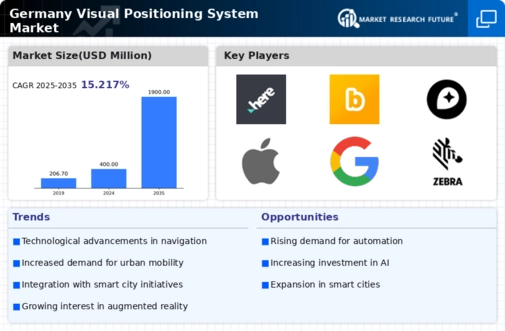
Germany Visual Positioning System Market Infographic
Purchase Options

Germany Visual Positioning System Market Summary

As per analysis, the Germany visual positioning system market is projected to grow from USD 448.02 Million in 2024 to USD 494.43 Million in 2025, exhibiting a compound annual growth rate (CAGR) of 10.54% during the forecast period (2025 - 2035).

Key Market Trends & Highlights

The Germany visual positioning system market is experiencing robust growth driven by technological advancements and increasing applications across various sectors.

  • The navigation segment remains the largest contributor to the market, reflecting a strong demand for precision navigation solutions.
  • Augmented reality is emerging as the fastest-growing segment, indicating a shift towards innovative applications in visual positioning systems.
  • The automotive sector continues to dominate, while the aerospace segment is rapidly gaining traction due to advancements in technology.
  • Key market drivers include the growing demand for precision navigation and supportive government policies fostering smart city developments.

Market Size & Forecast

2024 Market Size 448.02 (USD Million)
2035 Market Size 1348.59 (USD Million)
CAGR (2025 - 2035) 10.54%

Major Players

HERE Technologies (DE), Siemens (DE), Bosch (DE), TomTom (NL), NavVis (DE), LeddarTech (CA), SICK AG (DE), Mapbox (US), Google (US)

Our Impact
Enabled $4.3B Revenue Impact for Fortune 500 and Leading Multinationals
Partnering with 2000+ Global Organizations Each Year
30K+ Citations by Top-Tier Firms in the Industry

Germany Visual Positioning System Market Trends

The germany visual positioning system market is currently experiencing a notable evolution, driven by advancements in technology and increasing demand for precise navigation solutions. The integration of visual positioning systems into various sectors, including logistics, transportation, and smart cities, appears to be reshaping operational efficiencies. As urban environments become more complex, the necessity for accurate positioning systems that can function in real-time is becoming increasingly apparent. This trend is further supported by the growing emphasis on automation and digitalization across industries, which suggests a robust future for visual positioning technologies in Germany. Moreover, the regulatory landscape in Germany is evolving to accommodate these technological advancements. Government initiatives aimed at promoting innovation in navigation and positioning technologies indicate a supportive environment for market growth. The collaboration between public and private sectors is likely to enhance research and development efforts, fostering a climate conducive to breakthroughs in visual positioning systems. As the market matures, it may witness the emergence of new players and innovative solutions that cater specifically to the unique challenges faced by various industries in Germany.

Increased Adoption in Logistics

The logistics sector in Germany is increasingly adopting visual positioning systems to enhance supply chain efficiency. These systems facilitate real-time tracking and management of goods, which is crucial for meeting consumer demands and optimizing operations.

Integration with Smart City Initiatives

Visual positioning systems are becoming integral to smart city projects in Germany. By providing accurate location data, these systems support urban planning, traffic management, and public safety, contributing to the overall functionality of modern cities.

Focus on Automation and Robotics

There is a growing trend towards the integration of visual positioning systems with automation and robotics in various industries. This synergy enhances operational capabilities, allowing for more precise navigation and task execution in complex environments.

Germany Visual Positioning System Market Drivers

Supportive Government Policies

The Germany visual positioning system market benefits from a range of supportive government policies aimed at fostering innovation and technological advancement. The German government has implemented various initiatives to promote the development of smart technologies, including visual positioning systems. For instance, funding programs and grants are available for research and development projects that focus on enhancing navigation technologies. Additionally, the government's commitment to improving infrastructure, particularly in urban areas, is likely to create a conducive environment for the adoption of visual positioning systems. This supportive regulatory framework may encourage investments in the industry, leading to further advancements and market growth.

Advancements in Sensor Technology

Advancements in sensor technology are significantly influencing the Germany visual positioning system market. The development of high-resolution cameras, LiDAR, and other sensor technologies has enhanced the accuracy and reliability of visual positioning systems. These advancements enable more precise mapping and navigation capabilities, which are essential for applications in autonomous vehicles, robotics, and industrial automation. The German automotive industry, a key player in the global market, is increasingly investing in sensor technologies to improve vehicle navigation systems. With the automotive sector projected to grow at a rate of 3% annually, the demand for advanced visual positioning systems is likely to rise, further propelling market growth.

Growing Demand for Precision Navigation

The Germany visual positioning system market is experiencing a notable surge in demand for precision navigation solutions. This growth is largely driven by the increasing need for accurate location data across various sectors, including logistics, transportation, and autonomous vehicles. As businesses seek to enhance operational efficiency, the integration of visual positioning systems has become essential. According to recent data, the logistics sector in Germany is projected to grow at a compound annual growth rate of 4.5% through 2026, further fueling the demand for advanced navigation technologies. The ability to provide real-time, precise positioning information is likely to be a key differentiator for companies operating in this competitive landscape.

Rising Interest in Smart City Developments

The Germany visual positioning system market is poised to benefit from the rising interest in smart city developments. As urban areas in Germany continue to grow, there is an increasing emphasis on creating efficient, sustainable, and technologically advanced cities. Visual positioning systems play a crucial role in smart city initiatives by enabling precise location tracking for various applications, including traffic management, public safety, and urban planning. The German government has allocated substantial funding for smart city projects, with an estimated investment of EUR 1 billion over the next five years. This investment is likely to drive the adoption of visual positioning systems, as cities seek to leverage technology for improved urban living.

Integration with Augmented Reality Applications

The integration of visual positioning systems with augmented reality (AR) applications is emerging as a significant driver in the Germany visual positioning system market. As AR technology continues to evolve, its applications in sectors such as retail, tourism, and education are becoming increasingly prevalent. Visual positioning systems enhance AR experiences by providing accurate spatial data, enabling users to interact with their environment in real-time. The German AR market is expected to reach a valuation of approximately EUR 1.5 billion by 2026, indicating a strong potential for collaboration between AR and visual positioning technologies. This synergy could lead to innovative solutions that cater to diverse consumer needs.


Market Segment Insights

By Application: Navigation (Largest) vs. Augmented Reality (Fastest-Growing)

In the Germany visual positioning system market, the application segment is diverse, with navigation leading in market share. It has established itself as the dominant application, proliferating in automotive, personal devices, and logistics. Following navigation are applications like mapping and augmented reality, which are rapidly gaining traction due to technological advancements and increasing consumer demand. Surveying and robotics also contribute to the segmentation, highlighting the versatility of visual positioning systems across multiple sectors. The growth trends are largely driven by advancements in technology and rising need for precise location data in various domains. The mapping application has shown steady growth due to its essential role in urban planning and infrastructure development. Conversely, the augmented reality application is emerging as the fastest-growing segment, fueled by the integration of visual positioning with mobile devices and its application in gaming and training environments.

Navigation (Dominant) vs. Augmented Reality (Emerging)

The navigation application remains the dominant force in the Germany visual positioning system market, driven by its extensive use in smartphones, vehicles, and various navigation devices. This application focuses on providing precise location tracking and route guidance, leading to increased user dependency on visual positioning technologies. On the other hand, augmented reality represents an emerging segment characterized by innovative uses in education, retail, and gaming. This segment harnesses visual positioning to overlay digital information onto the real world, capturing consumer interest and expanding functionalities across various applications. The synergy between augmented reality and visual positioning offers opportunities for growth as consumer technology evolves, promising an exciting future for this segment.

By End Use: Automotive (Largest) vs. Aerospace (Fastest-Growing)

In the Germany visual positioning system market, the automotive sector commands a significant share, driven by the increasing adoption of advanced driver-assistance systems (ADAS) that leverage visual positioning technologies. This sector's dominance is attributed to the strong presence of automotive manufacturers focusing on integrating these systems to enhance vehicle safety and navigation accuracy. In contrast, the aerospace sector is rapidly gaining traction, highlighting its potential through innovative applications in air traffic management and automated landing systems.

Automotive: Dominant vs. Aerospace: Emerging

The automotive segment within the Germany visual positioning system market is characterized by its robust integration in both consumer and commercial vehicles, where precision in positioning is critical for safety and efficiency. This dominance is supported by established partnerships between technology providers and automakers, fostering innovation and product development. The aerospace segment, although emergent, showcases exponential growth potential as new applications in flight navigation and airport management begin to take shape. While the automotive segment is focused on immediate benefits and safety, the aerospace sector is harnessing cutting-edge technologies to redefine air travel efficiency and safety.

By Technology: Camera-based Systems (Largest) vs. Lidar Systems (Fastest-Growing)

In the Germany visual positioning system market, the distribution of market share among different technology segments shows a clear leader in camera-based systems. These systems dominate the landscape due to their versatility and widespread application in various industries including automotive and robotics. Other technologies like lidar and infrared systems follow but occupy smaller portions of the market, reflecting their niche applications. Lidar systems, however, are gaining traction as more industries seek precise measurements and 3D mapping capabilities, indicating a shift in market preferences towards advanced technologies. The growth trends within the visual positioning segment highlight significant drivers for both camera-based and lidar systems. Camera-based systems benefit from continuous innovations in imaging technology and sensor capabilities, which enhance their performance. Conversely, lidar systems are experiencing rapid growth due to increasing demand for autonomous vehicles and advanced robotics that require precise environmental mapping. As industries evolve, technology integration and advancements will likely further shape these segments in the coming years.

Technology: Camera-based Systems (Dominant) vs. Lidar Systems (Emerging)

Camera-based systems are recognized as the dominant technology within the Germany visual positioning system market, primarily due to their affordability, ease of integration, and extensive application in fields such as surveillance, autonomous vehicles, and augmented reality. These systems leverage high-resolution imaging to achieve accurate positioning, making them suitable for both industrial and consumer applications. In contrast, lidar systems, though categorized as emerging technologies, are increasingly being favored for their unique capabilities in 3D mapping and precise distance measurements. Their adoption is on the rise across various sectors, particularly in autonomous driving, due to advancements in laser technology that enhance data accuracy and reliability. As these technologies develop, the distinction between camera-based and lidar systems will play a crucial role in the technological landscape.

By Component Type: Sensors (Largest) vs. Software (Fastest-Growing)

In the Germany visual positioning system market, the component type segment exhibits a diverse distribution of market share, with sensors occupying the largest segment. These devices play a crucial role in determining accurate positioning and have become essential across various applications. Software is emerging as the fastest-growing segment, reflecting the increasing need for advanced analytics and real-time data processing in visual systems. As more industries utilize visual positioning for automation and operational efficiency, the demand for these components is expected to rise significantly. The growth trends in this segment are driven by advancements in technology, including the integration of artificial intelligence and machine learning in software development for visual systems. Furthermore, the necessity for enhanced connectivity and the Internet of Things (IoT) is leading to increased adoption of sophisticated sensors and data processing units. The shift towards smart manufacturing and automated workflows is also contributing to the upward trajectory of these components, particularly software, as organizations seek innovative solutions that leverage data-driven insights.

Sensors: Dominant vs. Software: Emerging

In the current landscape of the Germany visual positioning system market, sensors are regarded as the dominant component, offering high precision and reliability which are essential for effective positioning. These devices, ranging from LIDAR and cameras to ultrasonic sensors, are integral to a variety of applications including navigation and robotics. On the other hand, software is an emerging player, characterized by its capability to enhance the utility of hardware through data management, processing, and analytics. As industries increasingly adopt visual positioning technology, software solutions are rapidly evolving, becoming more sophisticated to handle complex data. The synergy between sensors and software is vital as it propels the overall innovation within the market, making systems more intuitive and efficient.

By Deployment Type: Cloud-based (Largest) vs. On-premise (Fastest-Growing)

The Germany visual positioning system market is characterized by a significant shift towards Cloud-based deployments, which currently dominate the landscape. Businesses are increasingly adopting Cloud-based solutions due to their scalability, ease of use, and reduced IT overhead costs. In contrast, On-premise deployments, while currently a smaller segment, are quickly gaining traction among enterprises seeking control, security, and customization options that these systems provide. As technology evolves, firms are navigating these deployment types based on their operational needs and regulatory requirements.

Deployment Type: Cloud-based (Dominant) vs. On-premise (Emerging)

Cloud-based visual positioning systems have risen to prominence in the German market, offering flexible, scalable, and cost-effective solutions that appeal to various sectors, such as retail and logistics. These systems are particularly favored for their real-time data analytics capabilities and reduced infrastructure burdens. In contrast, On-premise solutions are experiencing an emerging trend driven by organizations prioritizing data sovereignty and advanced security measures. Companies are increasingly attracted to On-premise systems that allow for tailored integrations and dedicated support, addressing specific industry needs while still ensuring robust performance. Together, these deployment types illustrate a dynamic landscape where cloud flexibility and on-premise control coalesce.

Get more detailed insights about Germany Visual Positioning System Market

Key Players and Competitive Insights

The competitive dynamics within the visual positioning system market in Germany are characterized by a blend of innovation, strategic partnerships, and a focus on digital transformation. Key players such as HERE Technologies (DE), Siemens (DE), and Bosch (DE) are at the forefront, each adopting distinct strategies that collectively shape the market landscape. HERE Technologies (DE) emphasizes its commitment to enhancing location-based services through continuous innovation in mapping and positioning technologies. Siemens (DE), on the other hand, leverages its extensive industrial expertise to integrate visual positioning systems into smart infrastructure solutions, thereby enhancing operational efficiency. Bosch (DE) focuses on developing advanced sensor technologies that facilitate precise positioning, which is crucial for applications in autonomous vehicles and smart cities.

The market structure appears moderately fragmented, with a mix of established players and emerging startups. Key business tactics such as localizing manufacturing and optimizing supply chains are prevalent among these companies, allowing them to respond swiftly to market demands. The collective influence of these players fosters a competitive environment where innovation and technological advancements are paramount, driving the market forward.

In December 2025, HERE Technologies (DE) announced a strategic partnership with a leading automotive manufacturer to integrate its visual positioning technology into next-generation vehicles. This collaboration is expected to enhance navigation accuracy and support autonomous driving features, indicating a significant step towards the future of mobility. The strategic importance of this partnership lies in its potential to position HERE as a leader in the automotive sector, capitalizing on the growing demand for advanced positioning solutions.

In November 2025, Siemens (DE) unveiled a new visual positioning system designed for smart factories, aimed at optimizing production processes through real-time data analytics. This innovation not only underscores Siemens' commitment to digital transformation but also highlights the increasing convergence of manufacturing and positioning technologies. The strategic relevance of this development is profound, as it aligns with the broader trend of Industry 4.0, where data-driven decision-making is essential for operational excellence.

In October 2025, Bosch (DE) launched a new suite of sensor technologies that enhance the accuracy of visual positioning systems in urban environments. This initiative reflects Bosch's focus on smart city applications and its dedication to sustainability. The strategic importance of this launch is evident, as it positions Bosch to capitalize on the growing demand for environmentally friendly urban solutions, thereby reinforcing its competitive edge in the market.

As of January 2026, current trends in the visual positioning system market are heavily influenced by digitalization, sustainability, and the integration of AI technologies. Strategic alliances among key players are shaping the competitive landscape, fostering innovation and enhancing product offerings. Looking ahead, it is likely that competitive differentiation will increasingly pivot from price-based strategies to a focus on technological innovation, reliability in supply chains, and the ability to deliver sustainable solutions. This shift suggests a transformative phase in the market, where companies that prioritize innovation and adaptability will likely emerge as leaders.

Key Companies in the Germany Visual Positioning System Market include

Industry Developments

Recent developments in the Germany Visual Positioning System Market indicate a robust growth trajectory, largely influenced by technological advancements and increased demand across various sectors such as transportation, logistics, and augmented reality applications. HERE Technologies has expanded its offerings with enhanced mapping solutions that leverage visual positioning capabilities. In terms of mergers and acquisitions, there have not been notable activities reported involving the specified companies within the last few months. 

However, growth figures indicate a market valuation increase, driven by players like Apple, which have been investing in Research and Development to enhance user experiences and functionalities. In the last couple of years, companies have focused on integrating AI and machine learning to refine visual positioning accuracy, with significant investments noted as early as April 2022. 

The German government is actively promoting digital transformation initiatives which positively influence the push for innovative positioning systems. Companies like Blippar and Mapbox are also witnessing increased collaborations aimed at developing smart city solutions, further strengthening their presence in the region. The overall ecosystem is evolving, exhibiting a trend towards more integrated and efficient visual positioning systems.

Future Outlook

Germany Visual Positioning System Market Future Outlook

The Germany visual positioning system market is projected to grow at a 10.54% CAGR from 2025 to 2035, driven by technological advancements, increased automation, and demand for precision in various sectors.

New opportunities lie in:

  • Integration of AI-driven analytics for enhanced positioning accuracy.
  • Development of mobile applications for real-time positioning services.
  • Expansion into logistics and supply chain management solutions.

By 2035, the market is expected to be robust, driven by innovation and diverse applications.

Market Segmentation

Germany Visual Positioning System Market End Use Outlook

  • Automotive
  • Aerospace
  • Construction
  • Consumer Electronics
  • Healthcare

Germany Visual Positioning System Market Technology Outlook

  • Camera-based Systems
  • Lidar Systems
  • Infrared Systems
  • Ultrasonic Systems
  • Hybrid Systems

Germany Visual Positioning System Market Application Outlook

  • Navigation
  • Mapping
  • Augmented Reality
  • Robotics
  • Surveying

Germany Visual Positioning System Market Component Type Outlook

  • Sensors
  • Software
  • Hardware
  • Data Processing Units
  • Connectivity Modules

Germany Visual Positioning System Market Deployment Type Outlook

  • On-premise
  • Cloud-based
  • Hybrid

Report Scope

MARKET SIZE 2024448.02(USD Million)
MARKET SIZE 2025494.43(USD Million)
MARKET SIZE 20351348.59(USD Million)
COMPOUND ANNUAL GROWTH RATE (CAGR)10.54% (2024 - 2035)
REPORT COVERAGERevenue Forecast, Competitive Landscape, Growth Factors, and Trends
BASE YEAR2024
Market Forecast Period2025 - 2035
Historical Data2019 - 2024
Market Forecast UnitsUSD Million
Key Companies ProfiledHERE Technologies (DE), Siemens (DE), Bosch (DE), TomTom (NL), NavVis (DE), LeddarTech (CA), SICK AG (DE), Mapbox (US), Google (US)
Segments CoveredApplication, End Use, Technology, Component Type, Deployment Type
Key Market OpportunitiesIntegration of artificial intelligence in the germany visual positioning system market enhances accuracy and efficiency.
Key Market DynamicsGrowing demand for precision navigation solutions drives innovation in Germany's visual positioning system market.
Countries CoveredGermany
Leave a Comment

FAQs

What is the current valuation of the Germany visual positioning system market?

As of 2024, the market valuation was 448.02 USD Million.

What is the projected market size for the Germany visual positioning system market by 2035?

The market is projected to reach a valuation of 1348.59 USD Million by 2035.

What is the expected CAGR for the Germany visual positioning system market during the forecast period?

The expected CAGR for the market from 2025 to 2035 is 10.54%.

Which companies are considered key players in the Germany visual positioning system market?

Key players include HERE Technologies, Siemens, Bosch, TomTom, NavVis, LeddarTech, SICK AG, Mapbox, and Google.

What are the main application segments of the Germany visual positioning system market?

The main application segments include Navigation, Mapping, Augmented Reality, Robotics, and Surveying.

How does the automotive sector contribute to the Germany visual positioning system market?

In 2024, the automotive sector contributed 112.0 USD Million, with projections indicating growth to 340.0 USD Million.

What technology segments are present in the Germany visual positioning system market?

Technology segments include Camera-based Systems, Lidar Systems, Infrared Systems, Ultrasonic Systems, and Hybrid Systems.

What is the significance of cloud-based deployment in the Germany visual positioning system market?

Cloud-based deployment was valued at 179.2 USD Million in 2024, with expectations to grow to 537.74 USD Million by 2035.

What components are essential in the Germany visual positioning system market?

Essential components include Sensors, Software, Hardware, Data Processing Units, and Connectivity Modules.

How does the healthcare sector impact the Germany visual positioning system market?

The healthcare sector had a valuation of 80.02 USD Million in 2024, with projections suggesting growth to 238.59 USD Million.

Download Free Sample

Kindly complete the form below to receive a free sample of this Report

Compare Licence

×
Features License Type
Single User Multiuser License Enterprise User
Price $4,950 $5,950 $7,250
Maximum User Access Limit 1 User Upto 10 Users Unrestricted Access Throughout the Organization
Free Customization
Direct Access to Analyst
Deliverable Format
Platform Access
Discount on Next Purchase 10% 15% 15%
Printable Versions