×
Request Free Sample ×

Kindly complete the form below to receive a free sample of this Report

* Please use a valid business email

Leading companies partner with us for data-driven Insights

clients tt-cursor
Hero Background

Japan Telecom API Market

ID: MRFR/ICT/56642-HCR
200 Pages
Garvit Vyas
February 2026

Japan Telecom API Market Size, Share and Trends Analysis Report By Type (Presence Detection, Location Determination Data, Others), By Service (SMS, Payment API, Location API, Others) andBy End User (Enterprise, Internal Telecom Developer, Others)- Forecast to 2035

Share:
Download PDF ×

We do not share your information with anyone. However, we may send you emails based on your report interest from time to time. You may contact us at any time to opt-out.

Japan Telecom API Market Infographic
Purchase Options

Japan Telecom API Market Summary

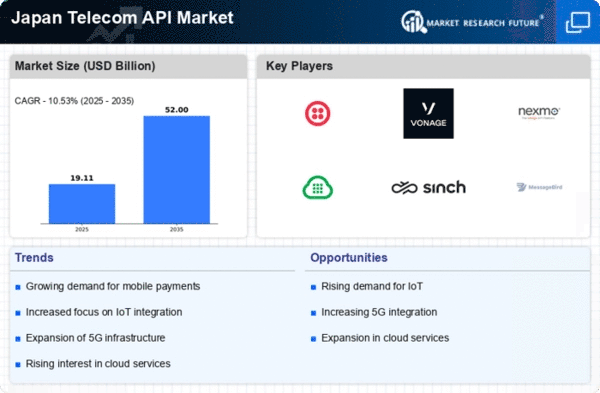
As per Market Research Future analysis, the Japan Telecom API Market Size was estimated at 17.29 USD Billion in 2024. The Japan telecom api market is projected to grow from 19.11 USD Billion in 2025 to 52.0 USD Billion by 2035, exhibiting a compound annual growth rate (CAGR) of 10.5% during the forecast period 2025 - 2035

Key Market Trends & Highlights

The Japan Telecom API Market is experiencing robust growth driven by technological advancements and evolving consumer demands.

  • The largest segment in the Japan telecom API market is mobile payment solutions, reflecting a growing trend towards digital transactions.
  • The fastest-growing segment is IoT integration, which is increasingly vital for smart city initiatives and connected devices.
  • There is a notable emphasis on open APIs, facilitating seamless integration and collaboration among various telecom services.
  • Key market drivers include the expansion of 5G infrastructure and the rising adoption of artificial intelligence, which are shaping the future of telecom APIs.

Market Size & Forecast

2024 Market Size 17.29 (USD Billion)
2035 Market Size 52.0 (USD Billion)
CAGR (2025 - 2035) 10.53%

Major Players

Twilio (US), Vonage (US), Nexmo (US), Plivo (US), Sinch (SE), MessageBird (NL), Telnyx (US), Telesign (US)

Our Impact
Enabled $4.3B Revenue Impact for Fortune 500 and Leading Multinationals
Partnering with 2000+ Global Organizations Each Year
30K+ Citations by Top-Tier Firms in the Industry

Japan Telecom API Market Trends

The Telecom API Market in Japan is currently experiencing a notable transformation, driven by advancements in technology and increasing demand for seamless connectivity. The proliferation of mobile devices and the rise of IoT applications are compelling telecom operators to enhance their service offerings through innovative APIs. This shift not only facilitates better integration of services but also enables businesses to create customized solutions that cater to specific consumer needs. As a result, the telecom api market is becoming a critical component in the digital ecosystem, fostering collaboration between telecom providers and various industries. Moreover, regulatory frameworks in Japan are evolving to support the growth of the telecom api market. The government is actively promoting initiatives that encourage the development of open APIs, which are essential for fostering competition and innovation. This regulatory support, combined with the increasing adoption of cloud-based solutions, is likely to propel the market forward. Companies are now focusing on enhancing their API capabilities to provide more value-added services, thereby improving customer experiences and driving revenue growth. The future of the telecom api market appears promising, with numerous opportunities for stakeholders to capitalize on emerging trends and technologies.

Rise of IoT Integration

The integration of IoT technologies is significantly influencing the telecom api market. As more devices become interconnected, telecom operators are leveraging APIs to facilitate communication between these devices and their networks. This trend is likely to enhance operational efficiency and enable new service offerings.

Emphasis on Open APIs

There is a growing emphasis on the development of open APIs within the telecom api market. This approach encourages collaboration among various stakeholders, allowing for the creation of innovative solutions that can address diverse consumer needs and enhance service delivery.

Cloud-Based Solutions Adoption

The adoption of cloud-based solutions is reshaping the telecom api market. By utilizing cloud infrastructure, telecom providers can offer scalable and flexible API services, which are essential for meeting the dynamic demands of businesses and consumers alike.

Japan Telecom API Market Drivers

Expansion of 5G Infrastructure

The rollout of 5G infrastructure in Japan is a pivotal driver for the Telecom API Market. As telecom operators invest heavily in 5G networks, the demand for APIs that can leverage the enhanced capabilities of this technology is on the rise. 5G promises significantly faster data speeds and lower latency, which opens new avenues for innovative applications across various sectors, including healthcare, automotive, and entertainment. The telecom api market is likely to benefit from this expansion, with projections indicating a potential market growth of 25% by 2027. This growth is attributed to the increasing number of connected devices and the need for APIs that can facilitate real-time data exchange and communication. Consequently, telecom companies are focusing on developing APIs that can harness the full potential of 5G, thereby driving the overall market forward.

Emergence of Smart City Initiatives

The development of smart city initiatives in Japan is significantly impacting the Telecom API Market. As urban areas seek to enhance infrastructure and improve quality of life through technology, telecom APIs are essential for integrating various smart services, such as traffic management, energy efficiency, and public safety. The Japanese government has allocated substantial funding for smart city projects, with investments expected to reach ¥1 trillion by 2025. This influx of capital is likely to drive demand for telecom APIs that facilitate the interconnectivity of smart devices and systems. Consequently, the telecom api market is projected to grow by 22% as municipalities and private enterprises collaborate to implement innovative solutions. This trend underscores the critical role of telecom APIs in shaping the future of urban living and infrastructure development.

Rising Adoption of Artificial Intelligence

The integration of artificial intelligence (AI) into telecom services is emerging as a significant driver for the Telecom API Market in Japan. AI technologies are being utilized to enhance customer service, optimize network management, and improve operational efficiency. Telecom APIs play a crucial role in enabling AI applications by providing the necessary data and functionalities for machine learning algorithms. As businesses increasingly adopt AI-driven solutions, the demand for telecom APIs that support these technologies is expected to rise. Market analysts suggest that the telecom api market could see a growth rate of approximately 18% over the next few years, driven by the need for intelligent automation and data analytics. This trend reflects a broader shift towards digital transformation within the telecom sector, positioning APIs as vital components in the deployment of AI solutions.

Growing Demand for Mobile Payment Solutions

The Telecom API Market in Japan experiences a notable surge in demand for mobile payment solutions. With the increasing adoption of smartphones and digital wallets, consumers are seeking seamless payment experiences. This trend is further supported by the Japanese government's push towards a cashless society, aiming for 40% of transactions to be digital by 2025. Telecom APIs facilitate secure and efficient payment processing, enabling businesses to integrate payment functionalities into their applications. As a result, the telecom api market is projected to grow significantly, with estimates suggesting a compound annual growth rate (CAGR) of 15% over the next five years. This growth is indicative of the broader shift towards digital financial services, positioning telecom APIs as essential enablers in the evolving landscape of mobile commerce.

Increased Focus on Data Privacy Regulations

In Japan, the Telecom API Market is increasingly influenced by stringent data privacy regulations. The enactment of the Act on the Protection of Personal Information (APPI) has heightened the need for telecom companies to ensure compliance with data handling practices. As businesses leverage telecom APIs to access and process user data, the emphasis on privacy and security becomes paramount. Companies are investing in robust API management solutions to safeguard sensitive information, which is likely to drive growth in the telecom api market. The market is expected to witness a rise in demand for APIs that incorporate advanced security features, potentially leading to a 20% increase in API-related investments by 2026. This regulatory landscape not only shapes the operational strategies of telecom providers but also enhances consumer trust in digital services.


Market Segment Insights

By Type: Presence Detection (Largest) vs. Location Determination Data (Fastest-Growing)

In the Japan Telecom API Market, the market share is predominantly driven by Presence Detection, which leads as the largest segment. It holds a significant share in the overall distribution, being widely adopted by telecom operators for enhancing user experience and optimizing resource allocation. Conversely, Location Determination Data captures an increasing share, reflecting the growing demand for real-time data services and location-based applications, which are gaining traction among businesses and consumers alike. Growth trends in this segment are largely fueled by technological advancements and an increasing reliance on digital communications. The demand for accurate and timely data for both personal and business applications is escalating. Presence Detection remains a staple for service delivery, while Location Determination Data is emerging swiftly, supported by innovations in mobile technology and the expansion of IoT applications that require precise location tracking.

Presence Detection (Dominant) vs. Location Determination Data (Emerging)

Presence Detection is characterized by its ability to track user engagement and network presence, making it an indispensable tool for telecom service providers aiming to enhance connectivity services. Its dominance in the market is attributed to the widespread integration within telecom infrastructures, allowing for better analytics and resource management. On the other hand, Location Determination Data is an emerging player, driven by advancements in GPS and mobile technologies. This segment is gaining momentum as businesses increasingly seek location-based solutions for marketing and operational efficiency. The rising penetration of smartphones and smart devices is propelling its adoption, positioning it as a critical component in the future of telecommunications.

By Service: SMS (Largest) vs. Payment API (Fastest-Growing)

In the Japan Telecom API Market, the allocation of market share among service segments reveals SMS as the largest player, dominating due to its extensive use across various sectors for communication purposes. Following behind, the Payment API is emerging quickly, gaining traction with businesses looking to streamline transactions and enhance customer experiences. Other services, including Location API and others, hold smaller portions of the market, indicating niche applications that are growing but at a slower pace. Growth trends in this sector are largely driven by increasing mobile connectivity and the need for seamless communication services. The adoption of Payment APIs is particularly fueled by the rise in e-commerce and mobile payment solutions, as businesses innovate to keep up with consumer demands. Meanwhile, SMS remains a staple due to its reliability and high engagement rates, although alternative messaging solutions are beginning to carve out their space in the market.

SMS (Dominant) vs. Payment API (Emerging)

SMS has established itself as a dominant force in the Japan telecom api market, leveraged by its simplicity and effectiveness in reaching a broad audience instantly. It caters to diverse industries, enhancing customer engagement and operational efficiency by serving as a reliable communication channel. In contrast, the Payment API is an emerging segment, marked by its innovative approach to facilitating transactions. It appeals to businesses eager to adopt mobile payment technologies, thus making purchasing more seamless for consumers. As firms increasingly incorporate sophisticated payment solutions into their operations, the Payment API's strategic importance will only continue to grow, positioning it as a critical driver of digital commerce.

By End User: Enterprise (Largest) vs. Internal Telecom Developer (Fastest-Growing)

In the Japan Telecom API Market, Enterprise users hold a significant market share due to their larger budgets and necessity for integrated solutions. This segment, comprising large corporations, is increasingly adopting telecom APIs to enhance communication and streamline operations across various sectors. Meanwhile, Internal Telecom Developers, while a smaller segment, are rapidly gaining traction as they innovate and build tailored solutions that specifically meet the unique needs of their organizations. This shift indicates a diversification in the user base and the extent of telecom API applications. The growth trends in the Japan telecom api market reveal that the Internal Telecom Developer segment is becoming a key driver of growth, emphasizing customization and flexibility over traditional solutions. As more organizations seek to develop bespoke applications utilizing telecom API capabilities, the speed at which these developers can deliver innovative solutions positions them as one of the fastest-growing segments. This trend is fueled by the increasing demand for agile and responsive telecom solutions that can adapt to the changing needs of businesses.

Enterprise (Dominant) vs. Internal Telecom Developer (Emerging)

The Enterprise segment is characterized by established companies leveraging telecom APIs for operational efficiency and enhanced customer engagement. These enterprises typically have the resources and infrastructure to implement advanced solutions, resulting in a dominant presence within the market. In contrast, Internal Telecom Developers represent an emerging segment focused on creating customized applications that address specific business challenges. Their agile approach allows for rapid deployment and adaptation, making them increasingly relevant in a landscape where unique and flexible solutions are in high demand. While Enterprises capitalize on existing frameworks, Internal Developers challenge the status quo by innovating and driving transformation within their companies.

Get more detailed insights about Japan Telecom API Market

Key Players and Competitive Insights

The Telecom API Market in Japan is characterized by a dynamic competitive landscape, driven by rapid technological advancements and increasing demand for integrated communication solutions. Key players such as Twilio (US), Vonage (US), and Sinch (SE) are strategically positioning themselves through innovation and partnerships. Twilio (US) focuses on enhancing its platform capabilities, while Vonage (US) emphasizes its cloud communication services to cater to diverse business needs. Sinch (SE) is actively pursuing regional expansion, particularly in Asia, to capitalize on the growing demand for telecom APIs. Collectively, these strategies contribute to a competitive environment that is increasingly centered around customer-centric solutions and technological integration.
In terms of business tactics, companies are localizing their offerings to better meet the specific needs of the Japanese market. This localization includes adapting APIs to comply with local regulations and cultural preferences. The market structure appears moderately fragmented, with several players vying for market share. However, the influence of major companies is significant, as they set industry standards and drive innovation through their extensive resources and technological expertise.
In October 2025, Twilio (US) announced a strategic partnership with a leading Japanese e-commerce platform to enhance its messaging services. This collaboration aims to streamline customer interactions and improve user engagement through personalized communication. The strategic importance of this partnership lies in Twilio's ability to leverage the e-commerce platform's extensive user base, thereby expanding its reach in the Japanese market and reinforcing its position as a leader in the telecom API space.
In September 2025, Vonage (US) launched a new suite of APIs tailored for the Japanese market, focusing on voice and video communication solutions. This launch is significant as it addresses the increasing demand for remote communication tools among businesses in Japan. By offering localized solutions, Vonage enhances its competitive edge and aligns its services with the evolving needs of Japanese enterprises, potentially increasing its market share.
In August 2025, Sinch (SE) acquired a local telecom API provider to strengthen its presence in Japan. This acquisition is strategically important as it allows Sinch to integrate local expertise and resources, facilitating a more robust service offering. The move not only enhances Sinch's operational capabilities but also positions the company to better compete against established players in the region.
As of November 2025, current trends in the telecom api market include a strong emphasis on digitalization, sustainability, and the integration of AI technologies. Strategic alliances are increasingly shaping the competitive landscape, enabling companies to pool resources and expertise to deliver innovative solutions. Looking ahead, competitive differentiation is likely to evolve from traditional price-based competition to a focus on innovation, technological advancements, and supply chain reliability. This shift underscores the importance of agility and responsiveness in meeting the diverse needs of customers in a rapidly changing market.

Key Companies in the Japan Telecom API Market include

Industry Developments

Recent developments in the Japan Telecom API Market highlight significant growth and technological advancements. In September 2023, SoftBank announced a partnership with Amazon Web Services to enhance its cloud-based telecom services, focusing on the development of scalable API solutions for enterprises. Concurrently, NTT Communications launched new API offerings aimed at improving connectivity for IoT devices, reinforcing its position in the competitive landscape. In terms of mergers and acquisitions, KDDI acquired a stake in a local startup in July 2023 to strengthen its API service portfolio, which aligns with its ongoing digital transformation strategy.

Over the last two years, major events include Rakuten Mobile's deployment of its cloud-native mobile network, which leverages APIs for enhanced functionality, and NEC's commitment to investing in 5G technologies, further boosting the telecom API sector's capabilities. The market valuation has shown robust growth, spurred by increasing demand for integrated communication solutions amid Japan's digital transformation. Companies like Ericsson and Fujitsu are also making significant strides in API development, contributing to the overall dynamism of the Japan Telecom API Market.


Future Outlook

Japan Telecom API Market Future Outlook

The telecom API market in Japan is poised for growth at a 10.53% CAGR from 2025 to 2035, driven by increased digital transformation and demand for seamless connectivity.

New opportunities lie in:

  • Development of AI-driven customer engagement APIs
  • Expansion of IoT integration services for smart cities
  • Creation of secure payment processing APIs for e-commerce platforms

By 2035, the telecom API market is expected to achieve substantial growth and innovation.

Market Segmentation

Japan Telecom API Market Type Outlook

  • Presence Detection
  • Location Determination Data
  • Others

Japan Telecom API Market Service Outlook

  • SMS
  • Payment API
  • Location API
  • Others

Japan Telecom API Market End User Outlook

  • Enterprise
  • Internal Telecom Developer
  • Others

Report Scope

MARKET SIZE 2024 17.29(USD Billion)
MARKET SIZE 2025 19.11(USD Billion)
MARKET SIZE 2035 52.0(USD Billion)
COMPOUND ANNUAL GROWTH RATE (CAGR) 10.53% (2025 - 2035)
REPORT COVERAGE Revenue Forecast, Competitive Landscape, Growth Factors, and Trends
BASE YEAR 2024
Market Forecast Period 2025 - 2035
Historical Data 2019 - 2024
Market Forecast Units USD Billion
Key Companies Profiled Twilio (US), Vonage (US), Nexmo (US), Plivo (US), Sinch (SE), MessageBird (NL), Telnyx (US), Telesign (US)
Segments Covered Type, Service, End User
Key Market Opportunities Integration of advanced analytics and AI in telecom API services enhances operational efficiency and customer experience.
Key Market Dynamics Rising demand for telecom APIs driven by digital transformation and regulatory shifts in Japan's telecommunications sector.
Countries Covered Japan
Leave a Comment

FAQs

What is the projected market size of the Japan Telecom API Market in 2024?

In 2024, the Japan Telecom API Market is expected to be valued at 17.5 billion USD.

What is the expected market size of the Japan Telecom API Market by 2035?

By 2035, the Japan Telecom API Market is anticipated to reach a value of 59.8 billion USD.

What is the expected CAGR for the Japan Telecom API Market from 2025 to 2035?

The expected CAGR for the Japan Telecom API Market from 2025 to 2035 is 11.819%.

What are the market values for Presence Detection by 2035?

The market value for Presence Detection is expected to reach 17.3 billion USD by 2035.

What will be the market size for Location Determination Data in 2024?

In 2024, the market size for Location Determination Data is projected to be 6.5 billion USD.

Who are the major players in the Japan Telecom API Market?

Key players in the Japan Telecom API Market include SoftBank, NEC, Cisco Systems, and Huawei.

How much is the Others segment of the Japan Telecom API Market valued at in 2024?

The Others segment in the Japan Telecom API Market is valued at 6.0 billion USD in 2024.

What is the anticipated market value for the Others segment by 2035?

By 2035, the Others segment is expected to grow to a market value of 20.0 billion USD.

What are the growth opportunities in the Japan Telecom API Market?

The Japan Telecom API Market presents growth opportunities in areas such as location-based services and enhanced communication applications.

What is the market value for Location Determination Data by 2035?

The market value for Location Determination Data is projected to be 22.5 billion USD by 2035.

Download Free Sample

Kindly complete the form below to receive a free sample of this Report

Compare Licence

×
Features License Type
Single User Multiuser License Enterprise User
Price $4,950 $5,950 $7,250
Maximum User Access Limit 1 User Upto 10 Users Unrestricted Access Throughout the Organization
Free Customization
Direct Access to Analyst
Deliverable Format
Platform Access
Discount on Next Purchase 10% 15% 15%
Printable Versions