×
Request Free Sample ×

Kindly complete the form below to receive a free sample of this Report

* Please use a valid business email

Leading companies partner with us for data-driven Insights

clients tt-cursor
Hero Background

Japan Stem Cell Therapy Market

ID: MRFR/Pharma/51404-HCR
200 Pages
Rahul Gotadki
February 2026

Japan Stem Cell Therapy Market Research Report By Application (Orthopedic, Cardiovascular, Neurological, Dermatological, Dental), By Type of Stem Cells (Embryonic Stem Cells, Adult Stem Cells, Induced Pluripotent Stem Cells, Mesenchymal Stem Cells), By Therapeutic Area (Regenerative Medicine, Cancer Treatment, Autoimmune Diseases, Genetic Disorders), and By Procedure Type (Surgical Procedures, Non-surgical Procedures) -Forecast to 2035

Share:
Download PDF ×

We do not share your information with anyone. However, we may send you emails based on your report interest from time to time. You may contact us at any time to opt-out.

Japan Stem Cell Therapy Market Infographic
Purchase Options

Japan Stem Cell Therapy Market Summary

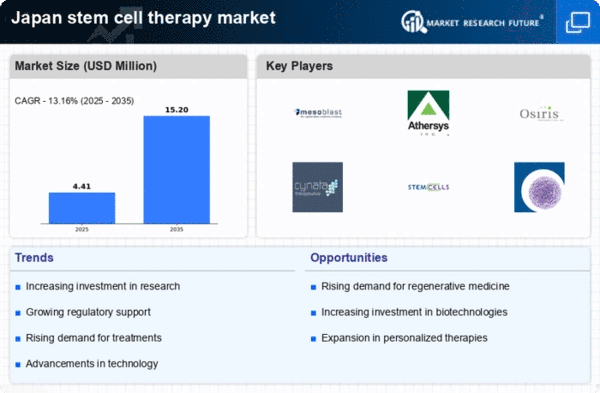
As per Market Research Future analysis, the Japan stem cell-therapy Size was estimated at 3.9 USD Million in 2024. The Japan stem cell-therapy market is projected to grow from 4.41 USD Million in 2025 to 15.2 USD Million by 2035, exhibiting a compound annual growth rate (CAGR) of 13.1% during the forecast period 2025 - 2035

Key Market Trends & Highlights

The Japan The Japan stem cell-therapy market is poised for substantial growth, driven by innovation and regulatory support.

  • Regulatory support and innovation are shaping the future of the Japan stem cell-therapy market.
  • The largest segment is regenerative medicine, while the fastest-growing segment is oncology-related therapies.
  • Increased investment in research is fostering collaboration between sectors, enhancing the development of stem cell therapies.
  • Rising prevalence of chronic diseases and government initiatives are key drivers propelling market expansion.

Market Size & Forecast

2024 Market Size 3.9 (USD Million)
2035 Market Size 15.2 (USD Million)
CAGR (2025 - 2035) 13.16%

Major Players

Mesoblast (AU), Athersys (US), Osiris Therapeutics (US), Cynata Therapeutics (AU), StemCells Inc. (US), Regen BioPharma (US), Tigenix (BE), Kite Pharma (US), Vericel Corporation (US)

Our Impact
Enabled $4.3B Revenue Impact for Fortune 500 and Leading Multinationals
Partnering with 2000+ Global Organizations Each Year
30K+ Citations by Top-Tier Firms in the Industry

Japan Stem Cell Therapy Market Trends

The stem cell-therapy market is experiencing notable advancements, driven by increasing research initiatives and a growing understanding of regenerative medicine. Japan, with its robust healthcare infrastructure and commitment to innovation, plays a pivotal role in this evolution. The government has been actively supporting research and development in this field, which has led to the establishment of numerous clinical trials and collaborations between academic institutions and private enterprises. This collaborative environment fosters the exploration of novel therapies, potentially enhancing treatment options for various diseases and conditions. Moreover, the regulatory landscape in Japan is evolving to accommodate the unique challenges posed by stem cell therapies. The Pharmaceuticals and Medical Devices Agency (PMDA) has been working to streamline approval processes, thereby encouraging the introduction of new therapies into the market. This proactive approach not only enhances patient access to cutting-edge treatments but also positions Japan as a leader in the stem cell-therapy market. As the landscape continues to develop, it appears that the integration of advanced technologies, such as artificial intelligence and gene editing, may further propel the market forward, offering promising avenues for future research and application.

Regulatory Support and Innovation

The regulatory framework in Japan is adapting to facilitate the growth of the stem cell-therapy market. The PMDA is implementing measures to expedite the approval of innovative therapies, which encourages research and development. This supportive environment is likely to attract investments and foster collaborations among stakeholders.

Increased Investment in Research

There is a noticeable rise in funding directed towards stem cell research in Japan. Both public and private sectors are investing in innovative projects, which may lead to breakthroughs in treatment options. This trend suggests a commitment to advancing regenerative medicine and improving patient outcomes.

Collaboration Between Sectors

The stem cell-therapy market is witnessing enhanced collaboration between academic institutions, healthcare providers, and industry players. These partnerships are crucial for sharing knowledge and resources, potentially accelerating the development of new therapies and improving clinical practices.

Japan Stem Cell Therapy Market Drivers

Collaborative Research Efforts

Collaborative research efforts between academic institutions, healthcare providers, and private companies are emerging as a key driver for the stem cell-therapy market. In Japan, partnerships are being formed to leverage expertise and resources in the development of innovative therapies. These collaborations facilitate knowledge sharing and accelerate the translation of research findings into clinical applications. For instance, joint ventures between universities and biotech firms are enabling the rapid advancement of stem cell technologies. Such partnerships not only enhance the quality of research but also increase the likelihood of successful product development. As these collaborative initiatives continue to grow, they are expected to significantly impact the stem cell-therapy market by fostering innovation and expediting the availability of new treatment options for patients.

Government Initiatives and Funding

Government initiatives aimed at promoting regenerative medicine are significantly influencing the stem cell-therapy market. In Japan, the government has established various funding programs and regulatory frameworks to support research and development in this field. The Ministry of Health, Labour and Welfare has allocated substantial resources to encourage innovation in stem cell therapies, which is expected to enhance the overall market landscape. For instance, the government has introduced fast-track approval processes for promising therapies, thereby reducing the time to market. This proactive approach not only fosters a conducive environment for research but also attracts private investments, further stimulating market growth. As a result, the stem cell-therapy market is likely to benefit from increased funding and support, facilitating the development of novel therapies and expanding treatment options for patients.

Rising Prevalence of Chronic Diseases

The increasing incidence of chronic diseases in Japan is a pivotal driver for the stem cell-therapy market. Conditions such as diabetes, cardiovascular diseases, and neurodegenerative disorders are becoming more prevalent, necessitating innovative treatment options. According to recent health statistics, chronic diseases account for approximately 60% of all deaths in Japan, highlighting the urgent need for effective therapies. Stem cell therapies offer potential solutions for regenerating damaged tissues and organs, thus addressing the underlying causes of these diseases. The growing patient population seeking advanced treatment options is likely to propel the demand for stem cell therapies, thereby fostering market growth. As healthcare providers and researchers focus on developing targeted therapies, the stem cell-therapy market is expected to expand significantly in response to this rising health challenge.

Technological Advancements in Cell Therapy

Technological innovations in cell therapy are transforming the landscape of the stem cell-therapy market. Advances in gene editing, such as CRISPR technology, and improvements in cell culture techniques are enhancing the efficacy and safety of stem cell treatments. In Japan, research institutions and biotech companies are increasingly investing in these technologies, which could lead to breakthroughs in personalized medicine. The integration of artificial intelligence in research and development processes is also streamlining the identification of suitable stem cell candidates for various therapies. As these technologies mature, they are likely to improve treatment outcomes and reduce costs, making stem cell therapies more accessible to patients. Consequently, the stem cell-therapy market is poised for growth as these advancements continue to emerge and gain traction within the healthcare system.

Growing Awareness and Acceptance of Stem Cell Therapies

The rising awareness and acceptance of stem cell therapies among healthcare professionals and patients are driving the growth of the stem cell-therapy market. Educational campaigns and outreach programs have been instrumental in informing the public about the potential benefits of these therapies. As more patients seek alternative treatment options for chronic and degenerative diseases, the demand for stem cell therapies is expected to rise. Additionally, endorsements from medical professionals and successful case studies are contributing to a more favorable perception of these treatments. In Japan, the increasing number of clinical trials and positive outcomes reported in the media are likely to enhance public confidence in stem cell therapies. This growing acceptance may lead to a surge in patient inquiries and treatment requests, thereby propelling the market forward.

Market Segment Insights

By Application: Cell Therapy (Largest) vs. Gene Therapy (Fastest-Growing)

In the Japan stem cell-therapy market, the application segment reveals a diverse distribution of market share among its different categories. Cell Therapy holds the largest share, driven by its established benefits and widespread clinical applications. Meanwhile, Tissue Engineering and Regenerative Medicine also contribute significantly to market dynamics, albeit with varying degrees of adoption and market presence. Gene Therapy, while smaller, is gaining traction due to recent advancements and novel treatment options. Growth trends in this segment are characterized by rapid technological innovations and increasing investment in research and development. The demand for personalized medicine and targeted therapies is propelling Gene Therapy into a favorable position. Additionally, regulatory support and successful clinical trials are enhancing market confidence, further driving interest and adoption across the application spectrum in the Japan stem cell-therapy market.

Cell Therapy (Dominant) vs. Gene Therapy (Emerging)

Cell Therapy is characterized by its established methodologies, focusing on the use of living cells to treat various diseases, thus positioning it as the dominant force within the application segment. Its therapeutic range encompasses cancer treatment, genetic disorders, and autoimmune diseases, making it a versatile choice for healthcare providers. On the other hand, Gene Therapy is emerging as an exciting alternative, with innovative techniques aimed at correcting genetic defects. This segment shows immense promise due to ongoing research, which is unlocking new avenues for treatment, particularly for previously untreatable genetic conditions. As both segments evolve, their interplay could redefine treatment paradigms within the market.

By Type of Stem Cells: Induced Pluripotent Stem Cells (Largest) vs. Mesenchymal Stem Cells (Fastest-Growing)

The market share distribution among the various types of stem cells reveals that induced pluripotent stem cells hold the largest share, primarily due to their versatility and potential in regenerative medicine. Adult stem cells and embryonic stem cells also contribute significantly but lag behind in terms of widespread application and acceptance in clinical practices. Meanwhile, mesenchymal stem cells are gradually gaining traction, reflecting an increasing interest in their therapeutic benefits and applicability across various conditions. Growth trends within this segment are driven by advancements in research and technology that enhance the efficacy and safety of stem cell therapies. The rising demand for customized medicine and the growing global focus on innovative treatments are propelling the expansion of the stem cell-therapy landscape. Additionally, supportive government initiatives for stem cell research are creating a favorable environment for further market development, particularly for mesenchymal stem cells, which are emerging as a preferred choice for many clinical applications.

Induced Pluripotent Stem Cells (Dominant) vs. Mesenchymal Stem Cells (Emerging)

Induced pluripotent stem cells (iPSCs) are a dominant force in the Japan stem cell-therapy market due to their ability to differentiate into any cell type, making them invaluable for research and therapeutic applications. Their potential to overcome the ethical concerns associated with embryonic stem cells adds to their appeal. In contrast, mesenchymal stem cells (MSCs) are emerging as a promising option, particularly due to their ease of extraction and ability to modulate immune responses. While iPSCs are at the forefront of research, MSCs are gaining momentum for their applications in tissue regeneration and repair. Both segment values showcase distinct competencies that cater to the evolving healthcare landscape.

By Source of Stem Cells: Bone Marrow (Largest) vs. Cord Blood (Fastest-Growing)

In the Japan stem cell-therapy market, Bone Marrow represents the largest source of stem cells, capturing a significant share due to its extensive clinical usage and historical precedence. Cord Blood is gaining attention as an emerging source, demonstrating a notable increase in interest, particularly among parents opting for cord blood banking for potential therapeutic applications. On the other hand, Adipose Tissue and Peripheral Blood are also contributing to the segment's diversity, with unique characteristics that cater to specific therapeutic needs. Growth trends indicate a robust evolution within the source of stem cells segment, driven by advancements in medical technology and a rising demand for personalized therapies. Increasing awareness regarding the benefits of cryopreservation for Cord Blood and innovative processing techniques for Adipose Tissue are significant factors. Regulatory backing and ongoing clinical trials are expected to further propel the market, enhancing treatment options and accessibility for patients.

Bone Marrow (Dominant) vs. Cord Blood (Emerging)

Bone Marrow serves as the dominant source of stem cells, widely recognized for its effective applications in hematopoietic therapies. This source is characterized by its comprehensive research backing and established protocols, which ensure its reliability in various treatments. In contrast, Cord Blood is emerging as a notable alternative, celebrated for its high cell viability and lower risk of graft-versus-host disease compared to bone marrow transplants. The unique properties of Cord Blood, combined with a growing trend in parents banking for future use, signify its potential to redefine the landscape of stem cell therapies, offering new avenues for treatment in conditions that were previously difficult to manage.

By End User: Hospitals (Largest) vs. Research Institutions (Fastest-Growing)

The Japan stem cell-therapy market showcases a diverse landscape among its end users, with hospitals leading the segment in terms of market share. The significant investment in healthcare infrastructure and increased demand for advanced therapeutic procedures in hospitals drive their dominant position. On the other hand, research institutions, while not holding the majority share, are rapidly gaining traction due to heightened interest in stem cell research and the development of innovative therapies. Growth trends within the end user segment are notable, particularly for research institutions, which are recognized as the fastest-growing segment. Factors contributing to this growth include government funding, collaborative efforts between academic and private sectors, and increasing clinical trial activities. As the need for regenerative medicine continues to evolve, both hospitals and research institutions are adapting to capitalize on emerging technologies that advance stem cell therapies.

Hospitals (Dominant) vs. Research Institutions (Emerging)

Hospitals serve as the dominant end user in the Japan stem cell-therapy market, benefiting from comprehensive healthcare networks and their ability to provide a wide range of stem cell treatments. Their established infrastructure, coupled with a steady influx of patients seeking advanced therapies, solidifies their market position. In contrast, research institutions are now emerging as vital contributors within this ecosystem. They focus on groundbreaking research and clinical applications of stem cells, fostering partnerships with biotech firms and pharmaceutical companies to facilitate innovation. This collaboration not only enhances their research capabilities but also accelerates the translation of scientific breakthroughs into clinical applications, making them increasingly influential in shaping the future landscape of stem cell therapies.

Get more detailed insights about Japan Stem Cell Therapy Market

Key Players and Competitive Insights

The stem cell-therapy market in Japan is characterized by a dynamic competitive landscape, driven by advancements in regenerative medicine and increasing investments in research and development. Key players such as Mesoblast (AU), Athersys (US), and Cynata Therapeutics (AU) are strategically positioned to leverage their innovative therapies and clinical trial successes. Mesoblast (AU) focuses on developing allogeneic cell therapies, which may provide a competitive edge in treating chronic diseases. Athersys (US) emphasizes partnerships with healthcare providers to enhance its market reach, while Cynata Therapeutics (AU) is advancing its proprietary Cymerus™ technology, which could potentially streamline the production of stem cells. Collectively, these strategies contribute to a competitive environment that is increasingly focused on innovation and collaboration.
In terms of business tactics, companies are localizing manufacturing and optimizing supply chains to enhance efficiency and reduce costs. The market appears moderately fragmented, with several players vying for market share. However, the influence of key players is substantial, as they drive technological advancements and set industry standards. This competitive structure suggests that while there is room for new entrants, established companies are likely to maintain a significant foothold through their strategic initiatives.
In October 2025, Mesoblast (AU) announced a collaboration with a leading Japanese hospital to conduct a pivotal clinical trial for its allogeneic cell therapy targeting heart failure. This partnership is strategically important as it not only enhances Mesoblast's credibility in the Japanese market but also aligns with the country's growing focus on innovative healthcare solutions. The trial's success could potentially pave the way for regulatory approvals and market entry, thereby strengthening Mesoblast's position in the region.
In September 2025, Athersys (US) secured a partnership with a prominent Japanese biopharmaceutical firm to co-develop its MultiStem® cell therapy for neurological conditions. This collaboration is indicative of Athersys's strategy to leverage local expertise and resources, which may facilitate faster market penetration and regulatory navigation. The partnership underscores the importance of strategic alliances in enhancing product development and distribution capabilities in Japan's competitive landscape.
In August 2025, Cynata Therapeutics (AU) reported positive results from a Phase 2 clinical trial of its Cymerus™ stem cell therapy for osteoarthritis. This development is crucial as it not only validates Cynata's technology but also positions the company favorably against competitors. The successful trial results may attract further investment and partnerships, reinforcing Cynata's market presence and potential for future growth.
As of November 2025, current trends in the stem cell-therapy market include a heightened focus on digitalization, sustainability, and the integration of artificial intelligence in research and development processes. Strategic alliances are increasingly shaping the competitive landscape, enabling companies to pool resources and expertise. Looking ahead, competitive differentiation is likely to evolve from traditional price-based competition to a focus on innovation, technological advancements, and supply chain reliability. This shift may redefine market dynamics, emphasizing the importance of developing unique therapeutic solutions that address unmet medical needs.

Key Companies in the Japan Stem Cell Therapy Market include

Industry Developments

Recent developments in the Japan Stem Cell Therapy Market have shown significant growth and innovation. Companies such as Astellas Pharma and Takeda Pharmaceutical have been pivotal in advancing Research and Development initiatives in regenerative medicine, focusing on new therapies for conditions like spinal cord injuries and macular degeneration.

JCR Pharmaceuticals recently submitted a New Drug Application for its stem cell-derived therapy, highlighting increasing momentum in this sector. In August 2023, Sumitomo Dainippon Pharma announced a collaborative research agreement with a leading academic institution to enhance cell therapy applications.

Merger and acquisition activities have also gained traction, with Astellas Pharma acquiring certain assets from a biotech firm in July 2023 to bolster its regenerative medicine portfolio, thus impacting the market landscape.

The market valuation of stem cell therapy companies in Japan has seen robust growth over the past couple of years, with a notable increase in investments that are driving technological advancements and expanding treatment options. Regulatory support from the Japanese government continues to encourage innovation in this domain, aiming to position Japan as a leader in stem cell and regenerative therapies on the global stage.

Future Outlook

Japan Stem Cell Therapy Market Future Outlook

The Stem Cell Therapy Market in Japan is projected to grow at a 13.16% CAGR from 2025 to 2035, driven by technological advancements, increasing investments, and rising demand for regenerative medicine.

New opportunities lie in:

  • Development of personalized stem cell therapies for chronic diseases
  • Expansion of telehealth platforms for remote patient monitoring
  • Partnerships with biotech firms for innovative product pipelines

By 2035, the market is expected to achieve substantial growth, positioning itself as a leader in regenerative medicine.

Market Segmentation

Japan Stem Cell Therapy Market End User Outlook

  • Hospitals
  • Research Institutions
  • Pharmaceutical Companies
  • Biotechnology Companies

Japan Stem Cell Therapy Market Application Outlook

  • Cell Therapy
  • Tissue Engineering
  • Regenerative Medicine
  • Gene Therapy

Japan Stem Cell Therapy Market Type of Stem Cells Outlook

  • Embryonic Stem Cells
  • Adult Stem Cells
  • Induced Pluripotent Stem Cells
  • Mesenchymal Stem Cells

Japan Stem Cell Therapy Market Source of Stem Cells Outlook

  • Bone Marrow
  • Cord Blood
  • Adipose Tissue
  • Peripheral Blood

Report Scope

MARKET SIZE 2024 3.9(USD Million)
MARKET SIZE 2025 4.41(USD Million)
MARKET SIZE 2035 15.2(USD Million)
COMPOUND ANNUAL GROWTH RATE (CAGR) 13.16% (2025 - 2035)
REPORT COVERAGE Revenue Forecast, Competitive Landscape, Growth Factors, and Trends
BASE YEAR 2024
Market Forecast Period 2025 - 2035
Historical Data 2019 - 2024
Market Forecast Units USD Million
Key Companies Profiled Mesoblast (AU), Athersys (US), Osiris Therapeutics (US), Cynata Therapeutics (AU), StemCells Inc. (US), Regen BioPharma (US), Tigenix (BE), Kite Pharma (US), Vericel Corporation (US)
Segments Covered Application, Type of Stem Cells, Source of Stem Cells, End User
Key Market Opportunities Advancements in regenerative medicine technologies enhance growth potential in the stem cell-therapy market.
Key Market Dynamics Regulatory advancements and technological innovations drive growth in Japan's stem cell-therapy market.
Countries Covered Japan
Leave a Comment

FAQs

What is the projected market size of the Japan Stem Cell Therapy Market in 2024?

The Japan Stem Cell Therapy Market is expected to be valued at 612.0 million USD in 2024.

What will be the expected market growth by 2035?

By 2035, the Japan Stem Cell Therapy Market is projected to reach a value of 2,299.0 million USD.

What is the expected CAGR for the Japan Stem Cell Therapy Market from 2025 to 2035?

The expected CAGR for the Japan Stem Cell Therapy Market during the period from 2025 to 2035 is 12.786%.

Which application segment is expected to dominate the market by 2035?

By 2035, the Orthopedic application segment is expected to dominate the market, valued at 445.0 million USD.

What will be the market value of the Neurological application segment in 2035?

The Neurological application segment is projected to be valued at 550.0 million USD by 2035.

Who are the major players in the Japan Stem Cell Therapy Market?

Key players in the market include Gree Inc., Japan Regenerative Medicine, and Astellas Pharma among others.

What is the expected market value for the Dental application in 2024?

The Dental application segment is expected to be valued at 162.0 million USD in 2024.

What is the projected market size for the Cardiovascular application segment in 2035?

The Cardiovascular application segment is projected to reach a market size of 330.0 million USD by 2035.

How does the Dermatological application segment's value compare from 2024 to 2035?

The Dermatological application segment is expected to grow from 90.0 million USD in 2024 to 330.0 million USD in 2035.

What are the growth opportunities in the Japan Stem Cell Therapy Market?

Growth opportunities in the market include advancements in regenerative medicine and increasing investment in research and development.

Download Free Sample

Kindly complete the form below to receive a free sample of this Report

Compare Licence

×
Features License Type
Single User Multiuser License Enterprise User
Price $4,950 $5,950 $7,250
Maximum User Access Limit 1 User Upto 10 Users Unrestricted Access Throughout the Organization
Free Customization
Direct Access to Analyst
Deliverable Format
Platform Access
Discount on Next Purchase 10% 15% 15%
Printable Versions