×
Request Free Sample ×

Kindly complete the form below to receive a free sample of this Report

* Please use a valid business email

Leading companies partner with us for data-driven Insights

clients tt-cursor
Hero Background

Japan Recreation Management Software Market

ID: MRFR/ICT/59996-HCR
200 Pages
Aarti Dhapte
February 2026

Japan Recreation Management Software Market Size, Share and Trends Analysis Report By Deployment Type (On-Premise, Cloud-Based, Hybrid), By Application (Facility Management, Event Management, Membership Management, Program Management), By End User (Public Sector, Private Sector, Non-Profit Organizations) and By Functionality (Booking Management, Payment Processing, Reporting and Analytics, Customer Relationship Management)-Forecast to 2035

Share:
Download PDF ×

We do not share your information with anyone. However, we may send you emails based on your report interest from time to time. You may contact us at any time to opt-out.

Japan Recreation Management Software Market Infographic
Purchase Options

Japan Recreation Management Software Market Summary

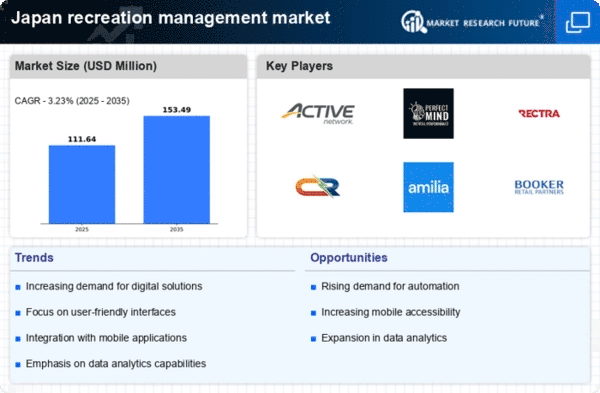
As per Market Research Future analysis, the Japan recreation management market size was estimated at 108.15 USD Million in 2024. The Japan recreation management-software market is projected to grow from 111.64 USD Million in 2025 to 153.49 USD Million by 2035, exhibiting a compound annual growth rate (CAGR) of 3.2% during the forecast period 2025 - 2035

Key Market Trends & Highlights

The Japan recreation management-software market is experiencing a transformative shift towards advanced technological integration and user-centric solutions.

  • The market is witnessing increased adoption of cloud-based solutions, enhancing accessibility and scalability.
  • Integration of mobile applications is becoming prevalent, allowing users to manage recreation activities on-the-go.
  • There is a growing focus on data analytics and reporting, enabling organizations to make informed decisions based on user engagement.
  • Key market drivers include the rising interest in health and wellness programs and the emphasis on sustainability and eco-friendly practices.

Market Size & Forecast

2024 Market Size 108.15 (USD Million)
2035 Market Size 153.49 (USD Million)
CAGR (2025 - 2035) 3.23%

Major Players

Active Network (US), PerfectMind (CA), RecTrac (US), CivicRec (US), Amilia (CA), Booker (US), EZFacility (US), MyRec (US)

Our Impact
Enabled $4.3B Revenue Impact for Fortune 500 and Leading Multinationals
Partnering with 2000+ Global Organizations Each Year
30K+ Citations by Top-Tier Firms in the Industry

Japan Recreation Management Software Market Trends

the market is currently experiencing a notable evolution, driven by the increasing demand for efficient management solutions across various recreational facilities. In Japan, the integration of technology into recreational services has become more pronounced, as organizations seek to enhance user experiences and streamline operations. This shift is largely influenced by the growing emphasis on digital transformation, which encourages facilities to adopt software that can manage bookings, memberships, and customer interactions more effectively. As a result, the market is witnessing a surge in innovative solutions tailored to meet the specific needs of recreational operators. Moreover, the focus on sustainability and community engagement is shaping the landscape of the recreation management-software market. Facilities are increasingly looking for software that not only optimizes their operations but also promotes eco-friendly practices and fosters community involvement. This trend suggests a potential for software solutions that incorporate features aimed at tracking environmental impact and facilitating community events. As the market continues to evolve, it appears that the intersection of technology, sustainability, and community engagement will play a crucial role in determining the future direction of recreation management software in Japan.

Increased Adoption of Cloud-Based Solutions

The recreation management-software market is witnessing a shift towards cloud-based solutions, which offer flexibility and scalability. This trend allows facilities to access their management systems from anywhere, enhancing operational efficiency and user accessibility.

Integration of Mobile Applications

Mobile applications are becoming increasingly important in the recreation management-software market. These applications enable users to make reservations, access information, and engage with services directly from their smartphones, thereby improving user experience.

Focus on Data Analytics and Reporting

There is a growing emphasis on data analytics within the recreation management-software market. Facilities are leveraging data to gain insights into user behavior, optimize resource allocation, and enhance decision-making processes.

Japan Recreation Management Software Market Drivers

Increased Investment in Smart Technologies

The recreation management-software market in Japan is witnessing a surge in investment towards smart technologies. Facilities are increasingly adopting Internet of Things (IoT) devices and smart sensors to enhance operational efficiency and improve user experiences. For instance, smart access control systems and automated scheduling tools are becoming commonplace, allowing for seamless management of resources. This technological advancement is projected to grow the market by approximately 25% over the next five years. As organizations recognize the benefits of integrating smart technologies, software solutions that can interface with these devices are becoming essential. This trend not only streamlines operations but also provides valuable data insights, enabling facilities to make informed decisions and optimize their offerings in the recreation management-software market.

Growing Demand for User-Friendly Interfaces

The recreation management-software market in Japan experiences a notable shift towards user-friendly interfaces. As organizations seek to enhance user engagement, software providers are increasingly focusing on intuitive designs that cater to diverse user demographics. This trend is particularly relevant in recreational facilities, where staff and patrons alike benefit from simplified navigation and accessibility. A report indicates that approximately 70% of users prefer software that is easy to use, which drives demand for solutions that prioritize user experience. Consequently, companies that invest in developing user-centric platforms are likely to gain a competitive edge in the recreation management-software market. This focus on usability not only improves operational efficiency but also fosters higher customer satisfaction, ultimately contributing to increased adoption rates across various recreational sectors.

Expansion of Online Booking and Payment Systems

The recreation management-software market in Japan is experiencing a significant expansion in online booking and payment systems. As consumer preferences shift towards convenience, facilities are increasingly adopting software that enables seamless online transactions and reservations. This trend is particularly relevant in the context of recreational activities, where timely access to services is paramount. Data suggests that facilities offering online booking options can see a 40% increase in customer engagement. As a result, software solutions that integrate secure payment gateways and user-friendly booking interfaces are becoming essential. This evolution not only enhances operational efficiency but also improves customer satisfaction, thereby driving growth in the recreation management-software market. The ability to facilitate easy transactions is likely to become a key differentiator for facilities aiming to thrive in a competitive landscape.

Rising Interest in Health and Wellness Programs

The recreation management-software market in Japan is significantly influenced by the increasing interest in health and wellness programs. As the population becomes more health-conscious, recreational facilities are expanding their offerings to include fitness classes, wellness workshops, and community health initiatives. This shift necessitates robust software solutions that can manage diverse program schedules, track participant engagement, and analyze health outcomes. Market data suggests that facilities integrating wellness programs see a 30% increase in membership retention. Consequently, software providers are adapting their solutions to support these evolving needs, thereby enhancing their relevance in the recreation management-software market. This trend not only promotes healthier lifestyles but also drives revenue growth for facilities that effectively leverage technology to manage their wellness offerings.

Emphasis on Sustainability and Eco-Friendly Practices

the market in Japan is increasingly shaped by a growing emphasis on sustainability and eco-friendly practices. As environmental awareness rises, recreational facilities are seeking software solutions that support green initiatives, such as energy management and resource optimization. This shift is reflected in the adoption of software that tracks energy consumption and promotes sustainable practices among users. Market analysis indicates that facilities implementing eco-friendly measures can enhance their appeal, potentially increasing patronage by 20%. Consequently, software providers are responding by developing features that facilitate sustainability reporting and compliance with environmental regulations. This trend not only aligns with societal values but also positions facilities favorably within the recreation management-software market, as they strive to attract environmentally conscious consumers.


Market Segment Insights

By Deployment Type: Cloud-Based (Largest) vs. Hybrid (Fastest-Growing)

In the Japan recreation management-software market, the distribution of deployment types shows a clear preference for Cloud-Based solutions, which dominate the segment. These solutions are favored for their scalability, easier accessibility, and lower upfront costs. On-Premise solutions, while still relevant, hold a smaller share due to factors such as maintenance requirements and limited accessibility compared to the increasing adoption of Cloud-Based technologies. Hybrid solutions are emerging as a versatile option, blending the benefits of both deployment types. As organizations in Japan increasingly embrace digital transformation, the growth of Cloud-Based deployment is driven by the need for real-time data access, improved collaboration, and enhanced user experiences. The Hybrid model, with its flexible integration capabilities, is witnessing rapid growth as it allows users to tailor their deployment according to specific needs. Factors such as mobile integration and remote management capabilities further propel the demand for Hybrid solutions, making it the fastest-growing segment in this market.

Cloud-Based (Dominant) vs. Hybrid (Emerging)

Cloud-Based solutions dominate the Japan recreation management-software market due to their cost-effectiveness and versatility. These solutions enable organizations to access software applications from anywhere, enhancing operational efficiency and user experience. They offer features such as automatic updates, high scalability, and superior data security, making them appealing to a wide range of organizations. Conversely, Hybrid solutions are emerging as a favorable alternative for businesses seeking flexibility. They allow a combination of on-premises and cloud functionalities, catering to specific regulatory requirements and providing data control while still leveraging cloud advantages. This adaptability is particularly attractive to organizations dealing with sensitive data or those in industries with stringent compliance standards.

By Application: Membership Management (Largest) vs. Program Management (Fastest-Growing)

In the Japan recreation management-software market, the application segment is primarily dominated by Membership Management, capturing a significant market share due to its essential role in managing client memberships and data. Event Management and Facility Management follow closely, reflecting the importance of organized events and resource allocation in recreational facilities, although they hold comparatively smaller portions of the market. Program Management is emerging rapidly, recognized as the fastest-growing segment, driven by the increasing demand for comprehensive programs that enhance user engagement and participation in recreational activities. As technology advances, managing and analyzing programs effectively is becoming pivotal, leading to significant investments in software solutions that cater to this need, thereby ensuring sustained growth for this segment.

Membership Management (Dominant) vs. Program Management (Emerging)

Membership Management plays a dominant role in the Japan recreation management-software market, providing software solutions that streamline member registration, retention, and communication. This segment is characterized by its ability to facilitate personalized experiences and ensure effective tracking of member data. On the other hand, Program Management represents a rapidly emerging segment focused on creating and managing recreational programs. This segment caters to the evolving needs of organizations looking to enhance user experience through innovative program offerings, integrating digital tools that enable better engagement and flexible scheduling. As a result, Program Management is poised for significant growth, driven by changing consumer interests and technological advancements.

By End User: Public Sector (Largest) vs. Private Sector (Fastest-Growing)

In the Japan recreation management-software market, the end-user distribution shows that the Public Sector holds a substantial share, reflecting a strong reliance on robust software solutions for managing recreational activities and resources. This sector encompasses government entities and public facilities, which are increasingly adopting technology to enhance service delivery and efficiency. Conversely, the Private Sector is emerging as the fastest-growing segment, driven by a surge in recreational businesses seeking innovative software to streamline operations and improve customer engagement. The growth in this sector is primarily fueled by trends such as digital transformation and the increasing need for personalized services, indicating a vibrant competitive landscape ahead.

Public Sector (Dominant) vs. Private Sector (Emerging)

The Public Sector is characterized by its comprehensive approach to recreation management, focusing on accessibility and community engagement. This segment typically includes municipal parks, community centers, and educational institutions, where recreation software is utilized to optimize scheduling, facility management, and resource allocation. On the other hand, the Private Sector, including gyms, fitness clubs, and entertainment venues, is rapidly evolving. This segment highlights adaptability and innovation, with businesses embracing management solutions that offer enhanced customer experiences, integrate with social media, and provide data analytics for informed decision-making. The contrast between these segments illustrates a robust market dynamic, with the Public Sector remaining dominant and the Private Sector positioning itself as an emerging contender.

By Functionality: Booking Management (Largest) vs. Reporting and Analytics (Fastest-Growing)

In the Japan recreation management-software market, the 'Booking Management' segment holds the largest market share, as organizations increasingly prioritize streamlined reservation processes. This segment is crucial for maximizing facility utilization and enhancing customer satisfaction. On the other hand, 'Reporting and Analytics' is emerging rapidly, attracting significant attention from businesses seeking to leverage data for decision-making and operational efficiency. This segment's growth indicates a shift toward data-driven strategies in the recreation sector. The growth trends in these functionalities are driven by technological advancements and changing consumer expectations. Automation of booking processes is making 'Booking Management' indispensable for recreational facilities, while the 'Reporting and Analytics' sector is thriving due to the rising demand for actionable insights. Key drivers include increased competition and the necessity for data insights to optimize services, ensuring that organizations remain agile and responsive to market changes.

Booking Management (Dominant) vs. Reporting and Analytics (Emerging)

'Booking Management' remains the dominant functionality, providing essential tools for managing reservations and schedules. This segment is characterized by user-friendly interfaces and integration capabilities, enabling seamless operations and enhancing customer experiences. Meanwhile, 'Reporting and Analytics' stands out as an emerging segment, harnessing powerful data analysis tools to uncover trends and improve service efficiency. Companies are increasingly adopting this functionality to collect and analyze performance data, leading to informed strategic decisions. The ability to transform raw data into actionable insights is critical for organizations aiming to stay competitive in the evolving landscape of recreational management.

Get more detailed insights about Japan Recreation Management Software Market

Key Players and Competitive Insights

The recreation management-software market in Japan is currently characterized by a dynamic competitive landscape, driven by technological advancements and an increasing demand for efficient management solutions. Key players such as Active Network (US), PerfectMind (CA), and RecTrac (US) are strategically positioned to leverage innovation and digital transformation. Active Network (US) focuses on enhancing user experience through continuous software updates and customer feedback integration, while PerfectMind (CA) emphasizes its cloud-based solutions to facilitate remote access and operational efficiency. RecTrac (US) has adopted a strategy of regional expansion, targeting local municipalities and community centers to broaden its market reach. Collectively, these strategies contribute to a moderately fragmented market structure, where competition is intensified by the presence of both established firms and emerging startups.In terms of business tactics, companies are increasingly localizing their offerings to better meet the specific needs of Japanese clients. This localization often involves adapting software features to align with local regulations and cultural preferences. The market structure appears to be moderately fragmented, with several key players exerting influence over their respective niches. The collective impact of these companies fosters a competitive environment that encourages innovation and responsiveness to market demands.

In October Active Network (US) announced a partnership with a leading Japanese sports organization to develop tailored solutions for youth sports management. This collaboration is expected to enhance Active Network's visibility in the Japanese market and provide localized features that cater to the unique requirements of youth sports programs. Such strategic partnerships are likely to bolster Active Network's competitive edge by integrating local insights into their software offerings.

In September PerfectMind (CA) launched a new feature aimed at enhancing customer engagement through personalized communication tools. This initiative reflects a growing trend towards customer-centric software solutions, allowing organizations to foster stronger relationships with their users. The introduction of these tools may position PerfectMind as a leader in user engagement, potentially attracting new clients seeking innovative ways to connect with their communities.

In August RecTrac (US) expanded its service offerings by integrating advanced analytics capabilities into its platform. This move is indicative of a broader trend towards data-driven decision-making in the recreation management sector. By providing clients with actionable insights, RecTrac aims to enhance operational efficiency and improve service delivery, thereby solidifying its market position.

As of November the competitive trends in the recreation management-software market are increasingly defined by digitalization, sustainability, and the integration of artificial intelligence (AI). Strategic alliances are becoming more prevalent, as companies recognize the value of collaboration in driving innovation. The competitive landscape is likely to evolve, with a shift from price-based competition towards differentiation through technology and supply chain reliability. This transition suggests that companies will need to invest in innovative solutions and sustainable practices to maintain their competitive advantage.

Key Companies in the Japan Recreation Management Software Market include

Industry Developments

The Japan Recreation Management Software Market has seen notable developments recently, particularly as businesses adapt to new operational demands post-pandemic. Companies such as Clubessential and Mindbody have been enhancing their service offerings to meet the shift towards digital engagement, emphasizing user-friendly platforms and integrated solutions for managing facilities and memberships. In terms of mergers and acquisitions, there have been no publicly reported activities related to companies like Recreation Management or Active Network in recent months.

However, the general market valuation continues to grow; investments in advanced technologies are propelling an increase in the adoption of leisure and recreation management tools. This growth is further supported by government initiatives aimed at promoting digital transformation across various sectors.

Major happenings in the last two years include a pivot to cloud-based solutions and an increased focus on customer experience, highlighted by the rise of platforms like PerfectMind and Wild Apricot, which are transitioning to robust online solutions for their users. This shift reflects Japan's ongoing commitment to enhancing its recreational landscapes through effective management software amidst changing societal expectations.

Future Outlook

Japan Recreation Management Software Market Future Outlook

The Recreation Management Software Market in Japan is projected to grow at a 3.23% CAGR from 2025 to 2035, driven by technological advancements and increasing demand for efficient management solutions.

New opportunities lie in:

  • Integration of AI-driven analytics for personalized user experiences.
  • Development of mobile applications for real-time facility management.
  • Partnerships with local governments for community engagement initiatives.

By 2035, the market is expected to achieve robust growth, reflecting evolving consumer needs and technological integration.

Market Segmentation

Japan Recreation Management Software Market End User Outlook

  • Public Sector
  • Private Sector
  • Non-Profit Organizations

Japan Recreation Management Software Market Application Outlook

  • Facility Management
  • Event Management
  • Membership Management
  • Program Management

Japan Recreation Management Software Market Functionality Outlook

  • Booking Management
  • Payment Processing
  • Reporting and Analytics
  • Customer Relationship Management

Japan Recreation Management Software Market Deployment Type Outlook

  • On-Premise
  • Cloud-Based
  • Hybrid

Report Scope

MARKET SIZE 2024 108.15(USD Million)
MARKET SIZE 2025 111.64(USD Million)
MARKET SIZE 2035 153.49(USD Million)
COMPOUND ANNUAL GROWTH RATE (CAGR) 3.23% (2025 - 2035)
REPORT COVERAGE Revenue Forecast, Competitive Landscape, Growth Factors, and Trends
BASE YEAR 2024
Market Forecast Period 2025 - 2035
Historical Data 2019 - 2024
Market Forecast Units USD Million
Key Companies Profiled Active Network (US), PerfectMind (CA), RecTrac (US), CivicRec (US), Amilia (CA), Booker (US), EZFacility (US), MyRec (US)
Segments Covered Deployment Type, Application, End User, Functionality
Key Market Opportunities Integration of advanced analytics and mobile solutions enhances user engagement in the recreation management-software market.
Key Market Dynamics Rising demand for integrated solutions drives innovation in Japan's recreation management-software market.
Countries Covered Japan
Leave a Comment

FAQs

What is the expected market size of the Japan Recreation Management Software Market in 2024?

The expected market size of the Japan Recreation Management Software Market in 2024 is valued at 108.16 million USD.

What will the market be valued at by 2035?

By 2035, the Japan Recreation Management Software Market is projected to be valued at 446.34 million USD.

What is the expected CAGR for the Japan Recreation Management Software Market from 2025 to 2035?

The expected CAGR for the Japan Recreation Management Software Market from 2025 to 2035 is 13.753%.

Which segment is expected to dominate the market by 2035?

By 2035, the Cloud-Based segment is expected to dominate the market with an estimated value of 226.39 million USD.

What are the expected values for On-Premise deployment type in 2024 and 2035?

The On-Premise deployment type is expected to be valued at 32.46 million USD in 2024 and 126.78 million USD in 2035.

Which key players are significant in the Japan Recreation Management Software Market?

Significant players in the market include Recreation Management, Clubessential, Mindbody, and CivicPlus among others.

What is the anticipated value of the Hybrid deployment type by 2035?

By 2035, the Hybrid deployment type is anticipated to reach a value of 93.17 million USD.

What is the market size for Cloud-Based deployment segment in 2024?

The market size for the Cloud-Based deployment segment in 2024 is valued at 54.89 million USD.

Which segment is forecasted to experience significant growth from 2025 to 2035?

The Cloud-Based segment is forecasted to experience significant growth during the period from 2025 to 2035.

What are some growth drivers for the Japan Recreation Management Software Market?

Growth drivers for the market include the increasing demand for digital solutions in recreation management and enhanced user experience.

Download Free Sample

Kindly complete the form below to receive a free sample of this Report

Compare Licence

×
Features License Type
Single User Multiuser License Enterprise User
Price $4,950 $5,950 $7,250
Maximum User Access Limit 1 User Upto 10 Users Unrestricted Access Throughout the Organization
Free Customization
Direct Access to Analyst
Deliverable Format
Platform Access
Discount on Next Purchase 10% 15% 15%
Printable Versions