×
Request Free Sample ×

Kindly complete the form below to receive a free sample of this Report

* Please use a valid business email

Leading companies partner with us for data-driven Insights

clients tt-cursor
Hero Background

Japan Embedded Graphical User Interface Development Software Market

ID: MRFR/ICT/58022-HCR
200 Pages
Aarti Dhapte
February 2026

Japan Embedded Graphical User Interface (GUI) Development Software Market Research Report By Component (Software, Services), By Organization Size (SMEs, Large Enterprises), and By Industry Vertical (Healthcare & Medical, Industrial, Automotive, Consumer electronics, BFSI, Others)-Forecast to 2035

Share:
Download PDF ×

We do not share your information with anyone. However, we may send you emails based on your report interest from time to time. You may contact us at any time to opt-out.

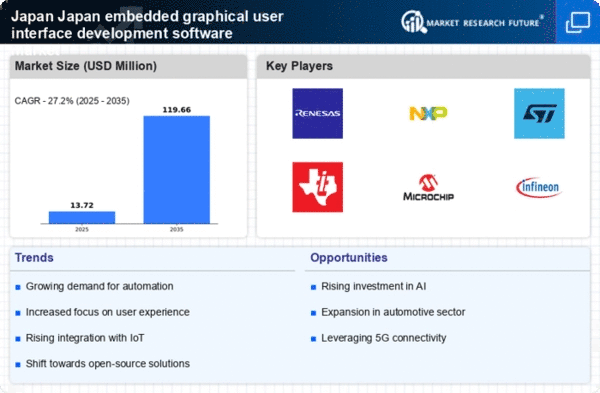
Japan Embedded Graphical User Interface Development Software Market Infographic
Purchase Options

Japan Embedded Graphical User Interface Development Software Market Summary

As per analysis, the Japan Embedded Graphical User Interface As per analysis, the Japan Embedded Graphical User Interface GUI Development Software Market is projected to grow from USD 10.79 Million in 2024 to USD 13.73 Million in 2025, exhibiting a compound annual growth rate (CAGR) of 24.45% during the forecast period (2025 - 2035). Development Software Market is projected to grow from USD 10.79 Million in 2024 to USD 13.73 Million in 2025, exhibiting a compound annual growth rate (CAGR) of 24.45% during the forecast period (2025 - 2035).

Key Market Trends & Highlights

The Japan Embedded Graphical User Interface Development Software Market is poised for substantial growth driven by technological advancements and evolving consumer preferences.

  • The Consumer Electronics segment remains the largest contributor to the market, reflecting a robust demand for innovative user interfaces.
  • Automotive applications are emerging as the fastest-growing segment, propelled by advancements in automotive technology and increasing integration of smart features.
  • There is a notable trend towards the incorporation of AI in GUI development, enhancing user experience and functionality across various applications.
  • Key market drivers include the growing demand for consumer electronics and government support for technology innovation, which are likely to fuel further market expansion.

Market Size & Forecast

2024 Market Size 10.79 (USD Million)
2035 Market Size 119.66 (USD Million)
CAGR (2025 - 2035) 24.45%

Major Players

Qt Company (JP), Renesas Electronics Corporation (JP), Mitsubishi Electric Corporation (JP), Hitachi, Ltd. (JP), Fujitsu Limited (JP), NEC Corporation (JP), Toshiba Corporation (JP), Sony Corporation (JP), NVIDIA Corporation (US)

Our Impact
Enabled $4.3B Revenue Impact for Fortune 500 and Leading Multinationals
Partnering with 2000+ Global Organizations Each Year
30K+ Citations by Top-Tier Firms in the Industry

Japan Embedded Graphical User Interface Development Software Market Trends

The Japan Embedded Graphical User Interface The Japan Embedded Graphical User Interface GUI Development Software Market is poised for substantial growth driven by technological advancements and evolving consumer preferences. Development Software Market is currently experiencing a notable evolution, driven by the increasing demand for sophisticated user interfaces in various embedded systems. This market appears to be influenced by advancements in technology, particularly in sectors such as automotive, consumer electronics, and industrial automation. As companies strive to enhance user experience, the integration of intuitive graphical interfaces into embedded systems has become a focal point. Furthermore, the growing trend towards automation and smart devices in Japan suggests a potential increase in the adoption of these software solutions. In addition, the emphasis on energy efficiency and compact design in embedded systems is likely to shape the development of GUI software. Japanese manufacturers are focusing on creating solutions that not only meet functional requirements but also align with environmental standards. This dual focus on performance and sustainability may drive innovation within the Japan Embedded Graphical User Interface The Japan Embedded Graphical User Interface GUI Development Software Market is currently experiencing a notable evolution, driven by the increasing demand for sophisticated user interfaces in various embedded systems. Development Software Market, leading to the emergence of new tools and frameworks tailored to specific industry needs. As the market continues to evolve, collaboration between software developers and hardware manufacturers could further enhance the capabilities of embedded GUI solutions, fostering a more integrated approach to product development.

Rise of Automotive Applications

The automotive sector in Japan is increasingly adopting embedded GUI development software to enhance user interaction within vehicles. This trend indicates a shift towards more sophisticated infotainment systems and driver assistance technologies, which require intuitive interfaces for optimal user experience.

Focus on Smart Home Devices

There is a growing interest in smart home technologies within the Japan Embedded Graphical User Interface Gui Development Software Market. As consumers seek more control over their home environments, developers are creating user-friendly interfaces that facilitate seamless interaction with various smart devices.

Integration of AI in GUI Development

The incorporation of artificial intelligence into GUI development is becoming more prevalent in Japan. This trend suggests that software solutions are evolving to include features such as predictive analytics and personalized user experiences, enhancing the overall functionality of embedded systems.

Japan Embedded Graphical User Interface Development Software Market Drivers

Rise of IoT Applications

The Japan Embedded Graphical User Interface The Japan Embedded Graphical User Interface GUI Development Software Market Industry is poised for growth due to the rise of Internet of Things (IoT) applications. Development Software Market is poised for growth due to the rise of Internet of Things (IoT) applications. As Japan continues to embrace smart technologies across various sectors, including healthcare, agriculture, and manufacturing, the demand for embedded GUIs that facilitate seamless interaction with IoT devices is increasing. In 2025, the IoT market in Japan was estimated to reach 20 billion USD, highlighting the potential for GUI development software tailored to these applications. This trend indicates a shift towards more interconnected systems, where user interfaces play a crucial role in enhancing user experience and operational efficiency. Consequently, the embedded GUI software market is likely to expand, driven by the need for innovative solutions that cater to the growing IoT ecosystem.

Focus on User-Centric Design

The Japan Embedded Graphical User Interface The Japan Embedded Graphical User Interface GUI Development Software Market Industry is increasingly focusing on user-centric design principles. Development Software Market is increasingly focusing on user-centric design principles. As consumer expectations evolve, there is a growing emphasis on creating intuitive and aesthetically pleasing interfaces that enhance user satisfaction. In 2025, Market Research Future indicated that 70 percent of consumers in Japan prioritize user experience when selecting electronic devices. This trend compels developers to invest in advanced GUI development software that allows for customization and personalization. Companies that prioritize user-centric design are likely to gain a competitive edge in the market, as they can better meet the needs of their target audience. This focus on design not only drives innovation within the embedded GUI software market but also contributes to the overall growth of the technology sector in Japan.

Advancements in Automotive Technology

The Japan Embedded Graphical User Interface The Japan Embedded Graphical User Interface GUI Development Software Market Industry is significantly influenced by advancements in automotive technology. Development Software Market is significantly influenced by advancements in automotive technology. The automotive sector in Japan is increasingly integrating sophisticated infotainment systems and driver assistance technologies, which require advanced graphical user interfaces. In 2025, the automotive GUI market was projected to grow by 15 percent, reflecting the industry's shift towards more interactive and user-friendly interfaces. This trend is further supported by government initiatives promoting smart mobility and electric vehicles, which necessitate the development of intuitive embedded GUIs. As automotive manufacturers seek to differentiate their products, the demand for specialized GUI development software is expected to rise, fostering innovation and enhancing user engagement.

Growing Demand for Consumer Electronics

The Japan Embedded Graphical User Interface The Japan Embedded Graphical User Interface GUI Development Software Market Industry is experiencing a surge in demand driven by the proliferation of consumer electronics. Development Software Market is experiencing a surge in demand driven by the proliferation of consumer electronics. With Japan being a global leader in technology, the need for sophisticated user interfaces in devices such as smartphones, tablets, and wearables is paramount. In 2025, the consumer electronics market in Japan was valued at approximately 30 billion USD, indicating a robust growth trajectory. This demand necessitates advanced GUI development software that can cater to the unique requirements of Japanese consumers, who often prioritize aesthetics and functionality. As manufacturers strive to enhance user experience, the embedded GUI software market is likely to expand, providing opportunities for innovation and competition among developers.

Government Support for Technology Innovation

The Japan Embedded Graphical User Interface The Japan Embedded Graphical User Interface GUI Development Software Market Industry benefits from substantial government support aimed at fostering technology innovation. Development Software Market benefits from substantial government support aimed at fostering technology innovation. The Japanese government has implemented various policies to promote research and development in the tech sector, including funding initiatives and tax incentives for companies investing in software development. In 2025, government funding for technology innovation reached approximately 5 billion USD, underscoring the commitment to enhancing Japan's technological landscape. This supportive environment encourages companies to invest in advanced GUI development software, which is essential for creating competitive products in a rapidly evolving market. As a result, the embedded GUI software market is likely to see increased activity and growth, driven by both public and private sector collaboration.


Market Segment Insights

By Application: Consumer Electronics (Largest) vs. Automotive (Fastest-Growing)

In the Japan Embedded Graphical User Interface In the Japan Embedded Graphical User Interface GUI Development Software Market, the application segment is diversified, with significant contributions from Consumer Electronics, Automotive, Industrial Automation, Healthcare, and Telecommunications. Development Software Market, the application segment is diversified, with significant contributions from Consumer Electronics, Automotive, Industrial Automation, Healthcare, and Telecommunications. Among these, Consumer Electronics holds the largest market share due to the high demand for user-friendly interfaces in smartphones, televisions, and home appliances. Automotive is witnessing remarkable growth driven by the increasing integration of advanced graphical interfaces in vehicles, catering to enhanced user experiences and safety features. The growth trends indicate a rising focus on digitization across various sectors. The Automotive segment stands out as the fastest-growing application, propelled by innovations such as electric vehicles and smart technology integration. Meanwhile, Healthcare remains vital as remote patient monitoring and health management applications thrive, leading to evolving user needs for intuitive interfaces. Telecommunications also plays a crucial role as the demand for smart devices and connected solutions persists, fostering overall market expansion.

Consumer Electronics: Dominant vs. Automotive: Emerging

The Consumer Electronics segment is characterized by its robust presence in the Japan Embedded Graphical User Interface GUI Development Software Market. This segment includes devices like smartphones, tablets, and smart appliances, all of which necessitate sophisticated GUI solutions for improved user engagement. The strong consumer demand for innovative and aesthetically pleasing interfaces ensures that this sector remains dominant. On the other hand, the Automotive sector, while currently emerging, is rapidly evolving. The integration of advanced display technologies and a shift towards electric vehicles are fuelling its growth. As cars become more connected and reliant on software-driven interfaces for both operation and entertainment, the significance of GUI development in this segment is expected to soar, creating new opportunities and challenges.

By End Use: Large Enterprises (Largest) vs. Startups (Fastest-Growing)

In the Japan Embedded Graphical User Interface (In the Japan Embedded Graphical User Interface (GUI) Development Software Market, Large Enterprises hold a significant share, leveraging their established infrastructures and resources to dominate the landscape.) Development Software Market, Large Enterprises hold a significant share, leveraging their established infrastructures and resources to dominate the landscape. Their advanced requirements for tailored solutions and integrations push their sustained market presence, appealing to software providers looking for larger contracts. In contrast, Startups represent a burgeoning segment, gaining traction as the market evolves and technology becomes more accessible. These agile companies are increasingly adopting innovative GUI development tools to carve out niche markets and bring unique user experiences to their products. Growth trends in this segment indicate a robust expansion, especially for Startups that are rapidly adapting to the increasing demand for user-friendly interfaces. Factors such as technological advancements, the rise of IoT devices, and the growing emphasis on user experience are propelling Startups into visibility, transforming them into key players. Large Enterprises will likely continue their lead, but the agility and innovative spirit of Startups signify an exciting evolution in the GUI development landscape, where flexibility and creativity will drive success as user needs change.

Enterprises: Large (Dominant) vs. Startups (Emerging)

Large Enterprises in the GUI development sector tend to have well-established processes and are able to leverage substantial resources for their projects. They typically focus on complex, high-reliability applications where extensive testing and customization are critical. Conversely, Startups thrive on innovation and disruption, often providing niche solutions that prioritize speed and user-centric design. This agility allows them to respond swiftly to market demands and adopt new technologies faster than their larger counterparts. As a result, the dynamic between these two segments shapes the market narrative, with Large Enterprises representing stability and Startups providing fresh perspectives and solutions. Their competition fosters a rich environment for advancements in GUI development, propelling both segments forward.

By Deployment Model: Cloud-Based (Largest) vs. On-Premises (Fastest-Growing)

In the Japan Embedded Graphical User Interface (In the Japan Embedded Graphical User Interface (GUI) Development Software Market, the deployment model segments have shown a diverse distribution in market share.) Development Software Market, the deployment model segments have shown a diverse distribution in market share. Currently, the Cloud-Based deployment model holds a significant share, driven by the increasing adoption of cloud technologies and the convenience they offer to developers. On the other hand, the On-Premises model, while traditionally popular, is witnessing a rapid growth trajectory as organizations prioritize data security and control over their applications, making it an essential part of the market landscape. As businesses in Japan continue to evolve, the demand for flexible and scalable solutions fuels the growth of the Cloud-Based model. Simultaneously, the Fastest-Growing On-Premises deployment signifies a shift towards hybrid infrastructures, where businesses seek tailored solutions that combine the benefits of both models. This trend highlights the need for development software that can operate seamlessly across different environments, catering to the diverse needs of organizations in Japan.

Cloud-Based (Dominant) vs. On-Premises (Emerging)

The Cloud-Based deployment model stands as the dominant force in the Japan Embedded GUI Development Software market, offering organizations unmatched flexibility, scalability, and collaborative features. Developers are increasingly drawn to cloud solutions for their ability to facilitate remote work and streamline the development process with integrated tools and services. Conversely, the On-Premises segment is emerging as organizations recognize the value of having complete control over their data and development environments. This model appeals to sectors prioritizing compliance and data privacy, where businesses prefer to keep sensitive information within their infrastructures. As competition intensifies, vendors must adapt to cater to both segments, ensuring robust, secure, and accessible solutions that meet varying business requirements.

By User Type: Professional Developers (Largest) vs. Non-Technical Users (Fastest-Growing)

In the Japan Embedded Graphical User Interface (In the Japan Embedded Graphical User Interface (GUI) Development Software Market, market share distribution reveals a clear dominance of Professional Developers.) Development Software Market, market share distribution reveals a clear dominance of Professional Developers. This group holds the largest share, reflecting their essential role in the creation and implementation of embedded GUI systems. In contrast, Non-Technical Users, who represent a growing segment, are increasingly leveraging user-friendly GUI tools that simplify development processes, thus enhancing their market presence.

Professional Developers (Dominant) vs. Freelancers (Emerging)

Professional Developers dominate the Japan Embedded GUI Development Software Market due to their in-depth technical expertise and capability to navigate complex software environments. They drive innovation and ensure the integration of sophisticated functionalities within user interfaces. In contrast, Freelancers represent an emerging segment that leverages flexible, on-demand development tools to cater to diverse client needs. While they may have less market share, the rise of remote working and project-based contracts positions freelancers to capture opportunities, especially as businesses seek agile solutions that professional developers traditionally offer. As the market evolves, both segments will play crucial roles in shaping the future of GUI development.

By Programming Language: C++ (Largest) vs. Java (Fastest-Growing)

In the Japan Embedded Graphical User Interface In the Japan Embedded Graphical User Interface GUI Development Software Market, C++ holds the largest market share, being favored for its performance efficiency and direct hardware access. Development Software Market, C++ holds the largest market share, being favored for its performance efficiency and direct hardware access, making it ideal for embedded systems. Java, while trailing in overall market share, is the fastest-growing segment due to its portability and robustness, making it increasingly popular among developers looking for flexible cross-platform solutions. The growth trends for both C++ and Java reveal distinct patterns. C++ continues to benefit from industries that require high-performance applications, reinforcing its stronghold in the embedded systems sector. Conversely, Java's rapid growth can be attributed to an expanding developer community and its increasing adoption in enterprise solutions, which boost demand for GUI development software capable of running on various platforms.

C++ (Dominant) vs. Java (Emerging)

C++ is the cornerstone of GUI development in the embedded systems market in Japan, characterized by its object-oriented features and fine-grained control over system resources. This makes it the go-to language for applications requiring speed and efficiency. It is widely adopted in automotive and telecommunications sectors where performance is critical. On the other hand, Java is emerging as a significant player, particularly in environments requiring cross-platform compatibility. Its write-once-run-anywhere capability allows developers to create user-friendly interfaces that can be deployed across various devices, enhancing its attractiveness in the evolving market landscape.

Get more detailed insights about Japan Embedded Graphical User Interface Development Software Market

Key Players and Competitive Insights

The Embedded Graphical User Interface Gui Development Software Market in Japan is characterized by a dynamic competitive landscape, driven by rapid technological advancements and increasing demand for sophisticated user interfaces across various sectors. Key players such as Qt Company (Japan), Renesas Electronics Corporation (Japan), and Mitsubishi Electric Corporation (Japan) are strategically positioned to leverage innovation and regional expertise. Qt Company (Japan) focuses on enhancing its software capabilities through continuous updates and community engagement, while Renesas Electronics Corporation (Japan) emphasizes integration with its semiconductor solutions to provide comprehensive development environments. Mitsubishi Electric Corporation (Japan) is also investing in partnerships to expand its reach in the automotive and industrial sectors, collectively shaping a competitive environment that prioritizes technological advancement and customer-centric solutions.

The market structure appears moderately fragmented, with several players vying for market share through localized manufacturing and supply chain optimization. Companies are increasingly localizing their operations to better serve the Japanese market, which may enhance responsiveness to customer needs and reduce lead times. This localized approach, combined with strategic partnerships, allows these companies to optimize their supply chains and improve overall efficiency, thereby influencing the competitive dynamics of the market.

In December 2025, Qt Company (Japan) announced the launch of its latest version of the Qt framework, which includes enhanced support for AI-driven applications. This strategic move is significant as it positions the company to capitalize on the growing trend of AI integration in user interface development, potentially attracting a broader customer base seeking advanced functionalities. The emphasis on AI capabilities may also enhance the user experience, setting Qt Company apart from its competitors.

In November 2025, Renesas Electronics Corporation (Japan) unveiled a new suite of development tools aimed at streamlining the design process for embedded systems. This initiative is crucial as it reflects the company's commitment to innovation and efficiency, enabling developers to create more sophisticated applications with reduced time-to-market. By enhancing its tool offerings, Renesas is likely to strengthen its competitive position and appeal to a wider range of developers in the embedded software space.

In October 2025, Mitsubishi Electric Corporation (Japan) entered into a strategic partnership with a leading automotive manufacturer to develop next-generation user interfaces for electric vehicles. This collaboration is indicative of the growing importance of user experience in the automotive sector, particularly as electric vehicles become more prevalent. By aligning with a major player in the automotive industry, Mitsubishi Electric is poised to leverage its expertise in embedded systems to create innovative solutions that meet the evolving demands of consumers.

As of January 2026, the competitive trends in the Embedded Graphical User Interface Gui Development Software Market are increasingly defined by digitalization, sustainability, and AI integration. Strategic alliances are becoming more prevalent, as companies recognize the need to collaborate to enhance their technological capabilities and market reach. The shift from price-based competition to a focus on innovation, technology, and supply chain reliability is evident, suggesting that future competitive differentiation will hinge on the ability to deliver cutting-edge solutions that meet the complex needs of customers.

Key Companies in the Japan Embedded Graphical User Interface Development Software Market include

Industry Developments

The Qt Company Japan announced the release of Qt Creator 16.0 in March 2025. This version brought significant improvements, such as asynchronous ABI detection, better Windows startup performance, improved handling of QML imports, and the addition of a Figma-to-Qt plugin and Qt AI Assistant, which simplified embedded GUI workflows for infotainment and mobile systems.

Qt Creator 16's beta version, released in February 2025, optimized cross-platform development environments with improved SDK management on platforms such as Android, QNX, and MCU.

The Khronos Group previously revealed support for Vulkan 1.4, a crucial upgrade standardizing necessary graphics extensions across platforms, including integrated GPU-accelerated displays for automotive and industrial applications, during SIGGRAPH Asia in Tokyo in December 2024.

The Vulkan Safety Critical Working Group was then formed by Khronos in early December 2024 with the goal of creating safety-certified Vulkan API specifications for mission-critical systems like car cockpits and medical equipment. This development is specifically pertinent to embedded GUI systems that need secure, real-time rendering.

Furthermore, Birds-of-a-Feather seminars for integrated graphics frameworks like Vulkan and WebGL were held during the SIGGRAPH Asia 2024 event in Tokyo, demonstrating Japan's increasing interest in GPU-accelerated GUI standards.

These industry actions show that Japan's automotive, industrial, and consumer tech industries are moving quickly toward the creation of high-performance, safe, and AI-enabled integrated graphical user interfaces.

Japan Embedded Graphical User Interface (GUI)

Future Outlook

Japan Embedded Graphical User Interface Development Software Market Future Outlook

The Japan Embedded Graphical User Interface GUI Development Software Market is poised for growth at 24.45% CAGR from 2025 to 2035, driven by technological advancements and increasing demand for automation.

New opportunities lie in:

  • Integration of AI-driven analytics for user behavior insights.
  • Development of cross-platform GUI tools for IoT applications.
  • Expansion into automotive embedded systems for enhanced user interfaces.

By 2035, the market is expected to achieve substantial growth, reflecting robust demand and innovation.

Market Segmentation

Japan Embedded Graphical User Interface Development Software Market End Use Outlook

  • Small and Medium Enterprises
  • Large Enterprises
  • Startups

Japan Embedded Graphical User Interface Development Software Market User Type Outlook

  • Professional Developers
  • Non-Technical Users
  • Freelancers

Japan Embedded Graphical User Interface Development Software Market Application Outlook

  • Consumer Electronics
  • Automotive
  • Industrial Automation
  • Healthcare
  • Telecommunications

Japan Embedded Graphical User Interface Development Software Market Deployment Model Outlook

  • On-Premises
  • Cloud-Based
  • Hybrid

Japan Embedded Graphical User Interface Development Software Market Programming Language Outlook

  • C++
  • Java
  • Python
  • JavaScript

Report Scope

MARKET SIZE 202410.79(USD Million)
MARKET SIZE 202513.73(USD Million)
MARKET SIZE 2035119.66(USD Million)
COMPOUND ANNUAL GROWTH RATE (CAGR)24.45% (2024 - 2035)
REPORT COVERAGERevenue Forecast, Competitive Landscape, Growth Factors, and Trends
BASE YEAR2024
Market Forecast Period2025 - 2035
Historical Data2019 - 2024
Market Forecast UnitsUSD Million
Key Companies ProfiledQt Company (JP), Renesas Electronics Corporation (JP), Mitsubishi Electric Corporation (JP), Hitachi, Ltd. (JP), Fujitsu Limited (JP), NEC Corporation (JP), Toshiba Corporation (JP), Sony Corporation (JP), NVIDIA Corporation (US)
Segments CoveredApplication, End Use, Deployment Model, User Type, Programming Language
Key Market OpportunitiesRising demand for advanced user interfaces in automotive and consumer electronics sectors drives Japan Embedded Graphical User Interface Gui Development Software Market.
Key Market DynamicsRising demand for advanced user interfaces drives innovation in Japan's Embedded Graphical User Interface Development Software market.
Countries CoveredJapan
Leave a Comment

FAQs

What is the projected market valuation for the Japan Embedded GUI Development Software Market in 2035?

The projected market valuation for the Japan Embedded GUI Development Software Market in 2035 is 119.66 USD Million.

What was the overall market valuation in 2024?

The overall market valuation for the Japan Embedded GUI Development Software Market was 10.79 USD Million in 2024.

What is the expected CAGR for the market during the forecast period 2025 - 2035?

The expected CAGR for the Japan Embedded GUI Development Software Market during the forecast period 2025 - 2035 is 24.45%.

Which companies are considered key players in the Japan Embedded GUI Development Software Market?

Key players in the market include Qt Company, Renesas Electronics Corporation, Mitsubishi Electric Corporation, and others.

How does the market perform in the Consumer Electronics segment?

The Consumer Electronics segment had a valuation range from 2.5 to 27.5 USD Million.

What is the valuation range for the Automotive segment in the market?

The Automotive segment's valuation range is from 2.0 to 22.0 USD Million.

What are the projected valuations for Small and Medium Enterprises in the market?

The projected valuations for Small and Medium Enterprises range from 3.23 to 35.99 USD Million.

What is the expected performance of the Cloud-Based deployment model?

The Cloud-Based deployment model is expected to have a valuation range from 4.31 to 48.83 USD Million.

Which programming languages are most utilized in the market?

The most utilized programming languages include C++, Java, Python, and JavaScript, with valuations ranging from 2.15 to 35.0 USD Million.

What is the valuation range for professional developers in the market?

The valuation range for professional developers is from 4.31 to 48.0 USD Million.

Download Free Sample

Kindly complete the form below to receive a free sample of this Report

Compare Licence

×
Features License Type
Single User Multiuser License Enterprise User
Price $4,950 $5,950 $7,250
Maximum User Access Limit 1 User Upto 10 Users Unrestricted Access Throughout the Organization
Free Customization
Direct Access to Analyst
Deliverable Format
Platform Access
Discount on Next Purchase 10% 15% 15%
Printable Versions