×
Request Free Sample ×

Kindly complete the form below to receive a free sample of this Report

* Please use a valid business email

Leading companies partner with us for data-driven Insights

clients tt-cursor
Hero Background

Japan Palliative Care Market

ID: MRFR/HC/47691-HCR
200 Pages
Rahul Gotadki
February 2026

Japan Palliative Care Market Research Report By Type (Hospital Inpatient Care, Hospice Inpatient Care, Nursing Homes, Residential Facility Care, Homecare, Private Residence Care), By End-User (Long Term Care Centers & Rehabilitation Centers, Hospitals & Clinics, Palliative Care Centers, Home Care Settings) and By Application (Cardiac Disease, Congestive Heart Failure, Cancer, Chronic Obstructive Pulmonary Disease (COPD), Kidney Failure, Alzheimer’s Disease, Parkinson’s Disease, Amyotrophic Lateral Sclerosis (ALS)) -Forecast to 2035

Share:
Download PDF ×

We do not share your information with anyone. However, we may send you emails based on your report interest from time to time. You may contact us at any time to opt-out.

Japan Palliative Care Market Infographic
Purchase Options

Japan Palliative Care Market Summary

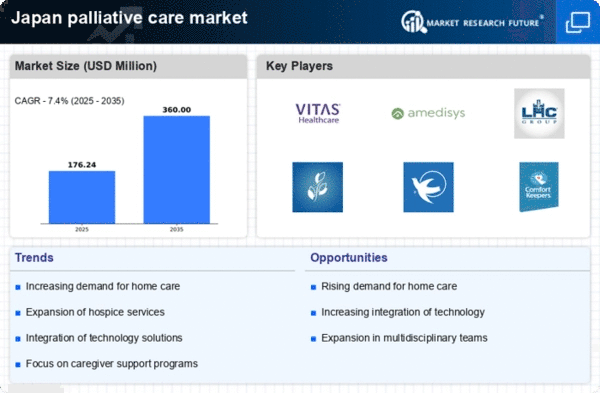
As per Market Research Future analysis, the Japan palliative care market size was estimated at 164.1 USD Million in 2024. The Japan palliative care market is projected to grow from 176.24 USD Million in 2025 to 360.0 USD Million by 2035, exhibiting a compound annual growth rate (CAGR) of 7% during the forecast period 2025 - 2035

Key Market Trends & Highlights

The Japan palliative care market is experiencing a transformative shift towards integration and public acceptance.

  • The integration of palliative care into healthcare systems is becoming increasingly prevalent across Japan.
  • Education and training initiatives for healthcare professionals are gaining momentum to enhance palliative care delivery.
  • Public awareness and acceptance of palliative care are rising, reflecting a cultural shift towards compassionate end-of-life care.
  • The aging population and chronic illnesses are major drivers propelling the demand for palliative care services in Japan.

Market Size & Forecast

2024 Market Size 164.1 (USD Million)
2035 Market Size 360.0 (USD Million)
CAGR (2025 - 2035) 7.4%

Major Players

VITAS Healthcare (US), Amedisys Inc (US), LHC Group (US), Brookdale Senior Living (US), Visiting Angels (US), Comfort Keepers (US), Gentiva Health Services (US), Curo Health Services (US)

Our Impact
Enabled $4.3B Revenue Impact for Fortune 500 and Leading Multinationals
Partnering with 2000+ Global Organizations Each Year
30K+ Citations by Top-Tier Firms in the Industry

Japan Palliative Care Market Trends

The palliative care market in Japan is experiencing notable evolution, driven by an increasing recognition of the importance of quality of life for patients with serious illnesses. This shift is largely influenced by demographic changes, particularly the aging population, which necessitates enhanced healthcare services tailored to the needs of individuals facing life-limiting conditions. As healthcare providers adapt to these changes, there is a growing emphasis on integrating palliative care into standard medical practice, ensuring that patients receive comprehensive support that addresses both physical and emotional needs. Furthermore, the Japanese government has been proactive in promoting policies that encourage the development of palliative care services, reflecting a commitment to improving patient outcomes and overall healthcare quality. In addition to policy support, there is a rising awareness among the public regarding the benefits of palliative care. Educational initiatives aimed at healthcare professionals and the general population are fostering a better understanding of palliative approaches, which may lead to increased demand for these services. This trend suggests a potential shift in societal attitudes towards end-of-life care, emphasizing dignity and comfort. As the palliative care market continues to evolve, it appears poised for growth, driven by both policy advancements and changing perceptions surrounding serious illness management.

Integration of Palliative Care in Healthcare Systems

There is a growing trend towards the integration of palliative care within existing healthcare frameworks. This approach aims to ensure that patients receive holistic care throughout their treatment journey, rather than only at the end of life. By embedding palliative care principles into standard medical practices, healthcare providers can enhance patient experiences and outcomes.

Increased Focus on Education and Training

Educational initiatives targeting healthcare professionals are becoming more prevalent. These programs aim to equip practitioners with the necessary skills and knowledge to deliver effective palliative care. As a result, there is a potential for improved service delivery and patient satisfaction, as well as a more informed workforce.

Rising Public Awareness and Acceptance

Public awareness regarding the benefits of palliative care is on the rise. Campaigns and community outreach efforts are helping to shift perceptions about end-of-life care, promoting a greater understanding of the importance of comfort and quality of life. This increased acceptance may lead to higher demand for palliative services.

Japan Palliative Care Market Drivers

Aging Population and Chronic Illnesses

The aging population in Japan is a critical driver for the palliative care market. As of 2025, approximately 28% of the population is aged 65 and older, leading to an increased prevalence of chronic illnesses such as cancer, heart disease, and dementia. This demographic shift necessitates a robust palliative care framework to address the complex needs of elderly patients. The palliative care market is likely to expand as healthcare providers adapt to these demographic changes, ensuring that patients receive comprehensive care that focuses on quality of life. Furthermore, the government has recognized the importance of integrating palliative care into standard healthcare practices, which may further stimulate market growth. The combination of an aging population and the rising incidence of chronic conditions suggests a sustained demand for palliative care services in Japan.

Cultural Shifts Towards End-of-Life Care

Cultural attitudes towards end-of-life care are gradually shifting in Japan, which may positively impact the palliative care market. Traditionally, discussions surrounding death and dying have been considered taboo; however, there is a growing recognition of the importance of quality of life in the final stages of life. This cultural shift is encouraging more families to seek palliative care services, as they become more aware of the benefits of such care. The palliative care market is likely to see increased demand as societal norms evolve, leading to greater acceptance of palliative care as a viable option for managing serious illnesses. Additionally, educational initiatives aimed at demystifying palliative care are expected to further enhance public understanding and acceptance, thereby driving market growth.

Technological Advancements in Healthcare

Technological advancements are significantly influencing the palliative care market in Japan. Innovations such as telemedicine, electronic health records, and mobile health applications are enhancing the delivery of palliative care services. These technologies facilitate better communication between patients, families, and healthcare providers, ensuring that care is tailored to individual needs. The palliative care market is likely to benefit from these advancements, as they improve access to care, particularly in rural areas where healthcare resources may be limited. Furthermore, the integration of artificial intelligence in symptom management and pain relief strategies could lead to more effective treatment plans, thereby enhancing patient outcomes. As technology continues to evolve, its impact on the palliative care market is expected to grow, potentially transforming how care is delivered.

Government Initiatives and Policy Support

Government initiatives play a pivotal role in shaping the palliative care market in Japan. Recent policies have emphasized the need for improved end-of-life care, with the Ministry of Health, Labour and Welfare advocating for the integration of palliative care into the healthcare system. Funding allocations for palliative care services have increased, with the government investing approximately ¥30 billion annually to enhance service delivery. This financial support is expected to bolster the palliative care market by facilitating the development of specialized training programs for healthcare professionals and expanding access to palliative care services. Additionally, public health campaigns aimed at raising awareness about the benefits of palliative care are likely to contribute to a more informed patient population, further driving demand for these essential services.

Rising Demand for Home-Based Care Services

The demand for home-based palliative care services is on the rise in Japan, driven by a preference for receiving care in familiar surroundings. Many patients and families express a desire to avoid hospital settings, opting instead for home care that allows for greater comfort and autonomy. This trend is reshaping the palliative care market, as healthcare providers are increasingly focusing on developing home-based care models. The government has recognized this shift, implementing policies that support home care services and provide funding for necessary resources. As a result, the market for home-based palliative care is expected to expand, with an emphasis on training caregivers and ensuring that families have access to the support they need. This growing preference for home care may lead to a more personalized approach to palliative care, ultimately enhancing patient satisfaction.


Market Segment Insights

By Type: Homecare (Largest) vs. Hospice Inpatient Care (Fastest-Growing)

In the Japan palliative care market, the segment distribution reveals that Homecare is the largest segment, accounting for a significant share of the overall market. Following closely are Hospice Inpatient Care and Nursing Homes, which also hold substantial portions. The demand for these services is largely driven by the increasing aging population and the growing need for specialized end-of-life care, which is reshaping how these care types are received throughout the country. Growth trends within this segment indicate a notable shift toward Homecare services, which offer patients comfort and familiarity in their own environments. Additionally, Hospice Inpatient Care is identified as the fastest-growing segment, propelled by the increasing recognition of its importance in providing compassionate and specialized support. Factors such as government incentives, advancements in care practices, and rising public awareness are further driving this growth and reshaping the palliative care landscape.

Homecare (Dominant) vs. Hospice Inpatient Care (Emerging)

Homecare stands out as the dominant service within the Japan palliative care market, offering personalized support and medical care in a familiar environment. This segment caters to patients seeking comfort and familiarity, which significantly enhances their quality of life. In contrast, Hospice Inpatient Care, although emerging, is gaining traction as an essential service designed to provide comprehensive end-of-life care in a dedicated setting. This segment focuses on pain management and emotional support for patients and their families, making it a vital component of the overall palliative care services. Both segments are crucial in addressing the unique needs of patients, but they serve different preferences and logistical considerations in the market.

By End-User: Hospitals & Clinics (Largest) vs. Home Care Settings (Fastest-Growing)

In the Japan palliative care market, the distribution of market share among end-user segments reveals that Hospitals & Clinics hold the largest portion, reflective of their critical role in providing specialized care. Following closely, Long Term Care Centers & Rehabilitation Centers contribute significantly, however, they do not overshadow the dominance of hospital services. Palliative Care Centers have a considerable presence, while Home Care Settings are emerging rapidly as a vital alternative for patient care, especially with the aging population influencing care preferences. Growth trends within these segments are driven by an increasing patient population requiring specialized palliative care services, leading to a stronger focus on comfort and quality of life. The rising preference for Home Care Settings has been fueled by technological advancements enabling remote monitoring and telehealth services. Furthermore, the cultural shift towards family-based care is enhancing the appeal of Home Care, making it the fastest-growing segment in the market as families seek accessible and personalized support for their loved ones.

Hospitals & Clinics (Dominant) vs. Home Care Settings (Emerging)

Hospitals & Clinics represent the dominant force in the palliative care landscape, providing comprehensive medical services and advanced patient management. Their extensive resources and multidisciplinary teams ensure a high standard of care, catering to complex medical needs. In contrast, Home Care Settings are emerging as a popular choice, driven by increasing patient preferences for care in familiar surroundings. This segment emphasizes personalized service, allowing caregivers to operate flexibly and responsively to individual patient requirements. The growth of digital health solutions enhances the effectiveness of Home Care, supporting patients' needs while alleviating the burden on formal care facilities.

By Application: Cancer (Largest) vs. Chronic Obstructive Pulmonary Disease (COPD) (Fastest-Growing)

In the Japan palliative care market, Cancer holds the largest market share among the various application segments, driven by the increasing incidence of cancer cases and the aging population. Other significant segments include Chronic Obstructive Pulmonary Disease (COPD), which is gaining traction as awareness and diagnosis improve, while diseases like Alzheimer’s and ALS also contribute to the overall demand for palliative care services. The growth trends in the Japan palliative care market are significantly influenced by advancements in medical technologies and the expansion of palliative care programs. The rise in chronic illnesses coupled with a need for quality end-of-life care has propelled Cancer and COPD segments into the spotlight. Moreover, the cultural shift towards valuing quality of life for patients with terminal conditions is fostering rapid growth in these applications, making them critical in the evolving healthcare landscape.

Cancer (Dominant) vs. Chronic Obstructive Pulmonary Disease (COPD) (Emerging)

Cancer remains the dominant application in the Japan palliative care market, characterized by comprehensive treatment protocols focusing on symptom management and patient comfort. With advancements in oncology, there is an increased emphasis on personalized care, which has raised expectations among patients and families alike. On the other hand, Chronic Obstructive Pulmonary Disease (COPD) is emerging as a vital segment, reflecting rising health awareness and the need for specialized palliative solutions. COPD management involves a multi-faceted approach that integrates pulmonary rehabilitation and medications to enhance patient well-being. Both segments exhibit distinct characteristics, yet their overlapping goals encompass improving the quality of life for patients experiencing chronic and terminal conditions.

Get more detailed insights about Japan Palliative Care Market

Key Players and Competitive Insights

The palliative care market in Japan is characterized by a competitive landscape that is increasingly shaped by innovation, strategic partnerships, and a focus on patient-centered care. Key players such as VITAS Healthcare (US), Amedisys Inc (US), and LHC Group (US) are actively redefining their operational strategies to enhance service delivery and expand their market presence. VITAS Healthcare (US) has positioned itself as a leader in providing comprehensive palliative care solutions, emphasizing the integration of advanced technologies to improve patient outcomes. Meanwhile, Amedisys Inc (US) focuses on expanding its home health services, which aligns with the growing demand for in-home palliative care, thereby enhancing its competitive edge. LHC Group (US) is also making strides in this area, leveraging partnerships with healthcare systems to broaden its service offerings and reach a wider patient base.The business tactics employed by these companies reflect a moderately fragmented market structure, where local players coexist with larger entities. Companies are increasingly localizing their services to cater to regional needs, optimizing supply chains to ensure timely delivery of care, and enhancing operational efficiencies. This collective approach not only strengthens their market positions but also fosters a competitive environment that encourages innovation and responsiveness to patient needs.

In October VITAS Healthcare (US) announced a strategic partnership with a leading telehealth provider to enhance its remote care capabilities. This move is significant as it allows VITAS to offer more flexible and accessible palliative care options, particularly for patients in rural areas. The integration of telehealth services is likely to improve patient engagement and satisfaction, positioning VITAS favorably in a market that increasingly values convenience and accessibility.

In September Amedisys Inc (US) launched a new initiative aimed at training healthcare professionals in palliative care best practices. This initiative is crucial as it not only elevates the standard of care provided but also addresses the growing need for skilled professionals in this specialized field. By investing in workforce development, Amedisys is likely to enhance its reputation and attract more patients seeking high-quality palliative care services.

In August LHC Group (US) expanded its service offerings by acquiring a regional home health agency specializing in palliative care. This acquisition is indicative of LHC's strategy to consolidate its market presence and diversify its service portfolio. By integrating specialized palliative care services, LHC Group can better meet the needs of patients and families, thereby strengthening its competitive position in the market.

As of November the palliative care market is witnessing trends such as digitalization, sustainability, and the integration of artificial intelligence (AI) into care delivery. These trends are reshaping the competitive landscape, with companies increasingly forming strategic alliances to leverage technological advancements. The shift from price-based competition to a focus on innovation and technology is evident, as organizations seek to differentiate themselves through enhanced service offerings and reliable supply chains. Looking ahead, the competitive differentiation in the palliative care market is likely to evolve, with an emphasis on delivering high-quality, patient-centered care that meets the diverse needs of the population.

Key Companies in the Japan Palliative Care Market include

Industry Developments

The Japan Palliative Care Market has seen significant developments recently, particularly in response to the country’s growing aging population and chronic illness rates. Notable companies such as Ono Pharmaceutical, Takeda Pharmaceutical, and Astellas Pharma have been increasing their efforts in Research and Development for palliative care therapies. In June 2023, Takeda announced a partnership with global organizations to enhance its pain management capabilities, reflecting a broader industry trend towards collaborative solutions in palliative care.

Additionally, Kyowa Hakko Kirin expanded its product line in palliative care to address symptoms related to oncology patients. There have also been discussions surrounding mergers and acquisitions within the sector; for example, in August 2023, Bristol-Myers Squibb acquired a valuable palliative care treatment developer, marking a notable operation aimed at advancing their therapeutic offerings. In the past two years, notable market growth has been reported, with Japan's palliative care drug market valued at approximately 390 billion JPY as of 2022, driven by an increase in patients requiring specialized care.

This demand has stimulated investments and innovations across various companies, positioning Japan as a critical market for palliative care solutions.

Future Outlook

Japan Palliative Care Market Future Outlook

The Palliative Care Market is projected to grow at a 7.4% CAGR from 2025 to 2035, driven by an aging population, increased chronic diseases, and enhanced healthcare policies.

New opportunities lie in:

  • Development of telehealth platforms for remote palliative consultations.
  • Integration of AI-driven patient management systems for personalized care.
  • Expansion of home-based palliative care services to meet rising demand.

By 2035, the palliative care market is expected to be robust, reflecting significant growth and innovation.

Market Segmentation

Japan Palliative Care Market Type Outlook

  • Hospital Inpatient Care
  • Hospice Inpatient Care
  • Nursing Homes
  • Residential Facility Care
  • Homecare
  • Private Residence Care

Japan Palliative Care Market End-User Outlook

  • Long Term Care Centers & Rehabilitation Centers
  • Hospitals & Clinics
  • Palliative Care Centers
  • Home Care Settings

Japan Palliative Care Market Application Outlook

  • Cardiac Disease
  • Congestive Heart Failure
  • Cancer
  • Chronic Obstructive Pulmonary Disease (COPD)
  • Kidney Failure
  • Alzheimer’s Disease
  • Parkinson’s Disease
  • Amyotrophic Lateral Sclerosis (ALS)

Report Scope

MARKET SIZE 2024 164.1(USD Million)
MARKET SIZE 2025 176.24(USD Million)
MARKET SIZE 2035 360.0(USD Million)
COMPOUND ANNUAL GROWTH RATE (CAGR) 7.4% (2025 - 2035)
REPORT COVERAGE Revenue Forecast, Competitive Landscape, Growth Factors, and Trends
BASE YEAR 2024
Market Forecast Period 2025 - 2035
Historical Data 2019 - 2024
Market Forecast Units USD Million
Key Companies Profiled VITAS Healthcare (US), Amedisys Inc (US), LHC Group (US), Brookdale Senior Living (US), Visiting Angels (US), Comfort Keepers (US), Gentiva Health Services (US), Curo Health Services (US)
Segments Covered Type, End-User, Application
Key Market Opportunities Integration of telehealth solutions enhances access to palliative care services in Japan.
Key Market Dynamics Growing demand for personalized palliative care solutions driven by aging population and evolving healthcare policies in Japan.
Countries Covered Japan
Leave a Comment

FAQs

What is the expected market size of the Japan Palliative Care Market in 2024?

The Japan Palliative Care Market is expected to be valued at approximately 341.88 million USD in 2024.

What will be the market size of the Japan Palliative Care Market by 2035?

By 2035, the Japan Palliative Care Market is projected to reach a valuation of around 549.02 million USD.

What is the expected CAGR for the Japan Palliative Care Market from 2025 to 2035?

The market is anticipated to grow at a compound annual growth rate (CAGR) of 4.4% from 2025 to 2035.

Which segment of the Japan Palliative Care Market is expected to have the largest value in 2024?

In 2024, the Homecare segment is anticipated to account for the largest market value at approximately 96.88 million USD.

What is the projected market value for Hospital Inpatient Care in 2035?

The Hospital Inpatient Care segment is expected to be valued at about 120.0 million USD by 2035.

Who are the key players in the Japan Palliative Care Market?

Major players in the market include companies such as Ono Pharmaceutical, Novartis, and Takeda Pharmaceutical among others.

What is the expected market value for Hospice Inpatient Care in 2024?

The Hospice Inpatient Care segment is expected to be valued at approximately 75.0 million USD in 2024.

What is the market value for Nursing Homes in 2035?

The Nursing Homes segment is projected to reach a market value of about 100.0 million USD in 2035.

What are the growth drivers for the Japan Palliative Care Market?

Increasing demand for specialized care and an aging population are key growth drivers for the market.

How is the Residential Facility Care segment expected to perform by 2035?

The Residential Facility Care segment is anticipated to grow to a value of around 55.0 million USD by 2035.

Download Free Sample

Kindly complete the form below to receive a free sample of this Report

Compare Licence

×
Features License Type
Single User Multiuser License Enterprise User
Price $4,950 $5,950 $7,250
Maximum User Access Limit 1 User Upto 10 Users Unrestricted Access Throughout the Organization
Free Customization
Direct Access to Analyst
Deliverable Format
Platform Access
Discount on Next Purchase 10% 15% 15%
Printable Versions