×
Request Free Sample ×

Kindly complete the form below to receive a free sample of this Report

* Please use a valid business email

Leading companies partner with us for data-driven Insights

clients tt-cursor
Hero Background

Japan Multilayer Ceramic Capacitor Market

ID: MRFR/CnM/55899-HCR
200 Pages
Aarti Dhapte
February 2026

Japan Multilayer Ceramic Capacitor Market Research Report By Type (Class I-NP0/C0G, U2J, Others, Class II- X7R, X5R, Y5V, Z5U) and By Application (Consumer Electronics, Automotive, Manufacturing, Telecommunication, Transportation, Healthcare) - Forecast to 2035

Share:
Download PDF ×

We do not share your information with anyone. However, we may send you emails based on your report interest from time to time. You may contact us at any time to opt-out.

Japan Multilayer Ceramic Capacitor Market Infographic
Purchase Options

Japan Multilayer Ceramic Capacitor Market Summary

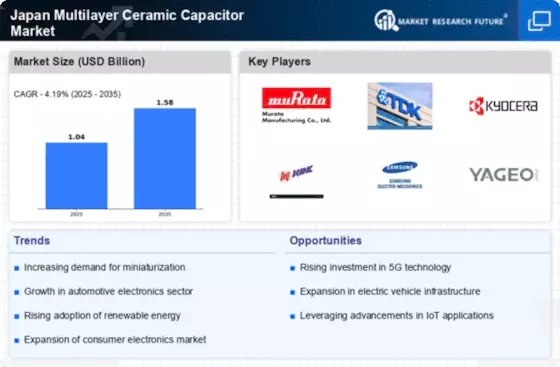
As per analysis, the Japan Multilayer Ceramic Capacitor Market is projected to grow from USD 1.05 Billion in 2025 to USD 1.58 Billion by 2035, exhibiting a compound annual growth rate (CAGR) of 4.19% during the forecast period (2025 - 2035).

Key Market Trends & Highlights

The Japan Multilayer Ceramic Capacitor Market is poised for growth driven by technological advancements and increasing demand across key segments.

  • The consumer electronics segment remains the largest contributor to the market, particularly in smartphones.
  • Automotive electronics is the fastest-growing segment, reflecting a shift towards electric vehicles.
  • Technological advancements and sustainability initiatives are shaping the future of multilayer ceramic capacitors.
  • Rising demand for consumer electronics and government support for electronics manufacturing are key drivers of market growth.

Market Size & Forecast

2024 Market Size 1.0 (USD Billion)
2035 Market Size 1.58 (USD Billion)
CAGR (2025 - 2035) 4.19%

Major Players

Murata Manufacturing Co (JP), TDK Corporation (JP), Kyocera Corporation (JP), Nihon Dempa Kogyo Co (JP), Samsung Electro-Mechanics (KR), Yageo Corporation (TW), Vishay Intertechnology Inc (US), Kemet Corporation (US)

Our Impact
Enabled $4.3B Revenue Impact for Fortune 500 and Leading Multinationals
Partnering with 2000+ Global Organizations Each Year
30K+ Citations by Top-Tier Firms in the Industry

Japan Multilayer Ceramic Capacitor Market Trends

The Japan Multilayer Ceramic Capacitor Market is currently experiencing a notable evolution, driven by advancements in technology and increasing demand across various sectors. The market appears to be influenced by the growing adoption of electric vehicles, consumer electronics, and renewable energy systems. As industries in Japan continue to innovate, the need for high-performance capacitors that offer reliability and efficiency becomes paramount. This trend suggests a shift towards more compact and efficient designs, which may enhance the overall performance of electronic devices. Furthermore, the emphasis on miniaturization in electronics is likely to propel the demand for multilayer ceramic capacitors, as they are essential components in modern circuitry. In addition to technological advancements, the regulatory environment in Japan seems to play a crucial role in shaping the market landscape. Government initiatives aimed at promoting sustainable practices and energy efficiency could potentially drive the adoption of multilayer ceramic capacitors in various applications. As manufacturers align their production processes with these regulations, there may be an increase in the availability of eco-friendly capacitor options. Overall, the Japan Multilayer Ceramic Capacitor Market appears poised for growth, with a focus on innovation, sustainability, and meeting the evolving needs of consumers and industries alike.

Technological Advancements

The Japan Multilayer Ceramic Capacitor Market is witnessing a surge in technological innovations, particularly in the fields of telecommunications and automotive applications. Enhanced manufacturing techniques are enabling the production of capacitors with improved performance characteristics, such as higher capacitance and lower equivalent series resistance. This trend indicates a growing emphasis on developing capacitors that can withstand the demands of high-frequency applications, which are increasingly prevalent in modern electronic devices.

Sustainability Initiatives

There is a noticeable shift towards sustainability within the Japan Multilayer Ceramic Capacitor Market, driven by government policies and consumer preferences. Manufacturers are increasingly focusing on producing environmentally friendly capacitors that comply with stringent regulations. This trend suggests that companies are not only prioritizing performance but also considering the ecological impact of their products, which may lead to the development of new materials and processes that reduce environmental footprints.

Miniaturization of Electronics

The trend of miniaturization in electronics is significantly influencing the Japan Multilayer Ceramic Capacitor Market. As devices become smaller and more compact, the demand for multilayer ceramic capacitors that can fit into limited spaces while maintaining high performance is rising. This trend indicates a potential for innovation in capacitor design, as manufacturers strive to create smaller, more efficient components that meet the needs of modern electronic applications.

Japan Multilayer Ceramic Capacitor Market Drivers

Growth in Automotive Electronics

The Japan Multilayer Ceramic Capacitor Market is poised for growth due to the increasing integration of electronics in the automotive sector. As the automotive industry shifts towards electric vehicles (EVs) and advanced driver-assistance systems (ADAS), the demand for reliable and compact capacitors is on the rise. In 2025, the automotive electronics market in Japan was estimated to be worth around 30 billion USD, with multilayer ceramic capacitors playing a crucial role in enhancing the performance of various electronic systems. The trend towards electrification and automation in vehicles necessitates the use of high-quality capacitors, which are essential for power management and signal processing. This shift is likely to drive further investments in multilayer ceramic capacitor technology, thereby expanding the market.

Focus on Renewable Energy Solutions

The Japan Multilayer Ceramic Capacitor Market is also driven by the growing emphasis on renewable energy solutions. As Japan continues to invest in sustainable energy sources, the demand for efficient energy storage systems is rising. Multilayer ceramic capacitors are increasingly utilized in renewable energy applications, such as solar inverters and wind turbine systems, due to their reliability and performance. In 2025, the renewable energy sector in Japan was projected to reach a market size of approximately 20 billion USD, with multilayer ceramic capacitors playing a vital role in enhancing the efficiency of energy conversion and storage systems. This trend indicates a promising future for the Japan Multilayer Ceramic Capacitor Market, as the shift towards sustainable energy solutions continues to gain momentum.

Rising Demand for Consumer Electronics

The Japan Multilayer Ceramic Capacitor Market is experiencing a notable surge in demand driven by the increasing consumption of consumer electronics. With Japan being home to several leading electronics manufacturers, the need for high-performance capacitors is paramount. In 2025, the consumer electronics sector in Japan was valued at approximately 50 billion USD, and this figure is projected to grow as innovations in smartphones, tablets, and wearable devices continue to evolve. The integration of multilayer ceramic capacitors in these devices enhances performance and reliability, thereby propelling market growth. Furthermore, the trend towards smart home technologies and IoT devices is likely to further amplify the demand for multilayer ceramic capacitors, as these applications require compact and efficient components.

Advancements in Manufacturing Technologies

The Japan Multilayer Ceramic Capacitor Market is significantly influenced by advancements in manufacturing technologies. Innovations such as automated production lines and advanced material processing techniques have improved the efficiency and quality of multilayer ceramic capacitors. In 2025, the introduction of new manufacturing processes is expected to reduce production costs while enhancing product performance. These advancements allow manufacturers to produce capacitors with higher capacitance values and smaller form factors, catering to the evolving needs of the electronics industry. As manufacturers adopt these technologies, the Japan Multilayer Ceramic Capacitor Market is likely to witness increased competition and innovation, ultimately benefiting end-users with superior products.

Government Support for Electronics Manufacturing

The Japan Multilayer Ceramic Capacitor Market benefits significantly from government initiatives aimed at bolstering the electronics manufacturing sector. The Japanese government has implemented various policies to promote research and development in advanced materials and components, including multilayer ceramic capacitors. For instance, the 'New Economic Policy' introduced in 2025 emphasizes innovation in technology and manufacturing, providing financial incentives for companies investing in high-tech components. This support not only enhances the competitiveness of Japanese manufacturers but also encourages the adoption of multilayer ceramic capacitors in various applications, thereby stimulating market growth. The collaboration between government and industry stakeholders is expected to yield advancements that could further solidify Japan's position as a leader in The Multilayer Ceramic Capacitor.


Market Segment Insights

By Application: Consumer Electronics (Largest) vs. Automotive (Fastest-Growing)

In the Japan Multilayer Ceramic Capacitor Market, the 'Application' segment demonstrates a varied distribution with 'Consumer Electronics' commanding the largest share. This category encompasses devices such as smartphones, tablets, and laptops, significantly contributing to the market's size and stability. Following closely are sectors like 'Automotive', which while not the largest, is quickly gaining traction due to the increasing incorporation of advanced electronic systems in vehicles.

Consumer Electronics: Dominant vs. Automotive: Emerging

The 'Consumer Electronics' segment is characterized by its high demand for compact and efficient capacitors, which are integral to modern electronic devices. As end-user preferences shift towards lighter and more portable gadgets, multilayer ceramic capacitors are preferred due to their superior performance and reliability. Conversely, the 'Automotive' sector represents an emerging market, driven by trends such as electric vehicles and autonomous technology. As automotive manufacturers increase the adoption of sophisticated electronic components to enhance functionality and compliance with regulatory standards, the demand for multilayer ceramic capacitors in this sector is expected to escalate rapidly.

By End Use: Smartphones (Largest) vs. Electric Vehicles (Fastest-Growing)

In the Japan Multilayer Ceramic Capacitor Market, the end-use segment exhibits a diverse distribution of applications across various categories, including smartphones, laptops, electric vehicles, home appliances, and wearable devices. Among these, smartphones hold the largest share, significantly influencing the overall market dynamics. This dominance can be attributed to the high demand for advanced electronic features and compact designs that necessitate the use of multilayer ceramic capacitors. As consumers continue to favor high-performance devices, smartphones remain a critical driver for the market.

Smartphones (Dominant) vs. Electric Vehicles (Emerging)

Smartphones demonstrate a dominant position in the Japan Multilayer Ceramic Capacitor Market, primarily due to their extensive adoption in daily life and the constant innovation in mobile technologies. The demand for smaller, more efficient, and powerful smartphones compels manufacturers to incorporate multilayer ceramic capacitors to optimize performance and functionality. On the other hand, electric vehicles represent an emerging segment that is rapidly gaining traction. The surge in environmental awareness and government incentives for sustainable transport solutions significantly boost electric vehicle production, leading to a rising need for advanced capacitors. Both segments are vital in shaping the future landscape of the market, though they cater to distinct consumer needs.

By Type: Class 2 Capacitors (Largest) vs. Class 1 Capacitors (Fastest-Growing)

In the Japan Multilayer Ceramic Capacitor Market, the share of Class 2 Capacitors stands out as the largest segment due to their robust application in consumer electronics and telecommunications. These capacitors are widely favored for their higher capacitance values and voltage ratings, serving a diverse range of devices. Class 1 Capacitors, while holding a smaller market share, are rapidly gaining traction, particularly in precision applications where stability and quality are paramount. This growth reflects shifting technological trends towards more reliable capacitor solutions. The growth trends within these segment values indicate a dynamic market landscape. Class 2 Capacitors continue to dominate, driven by increasing demand in industries such as automotive and communication. In contrast, Class 1 Capacitors are emerging as a preferred choice in high-frequency and precision-driven applications, leading them to be noted as the fastest-growing segment. Factors contributing to this growth include the rising integration of electronics in everyday consumer products and advancements in capacitor technology that enhance performance and reliability.

Class 2 Capacitors (Dominant) vs. Class 1 Capacitors (Emerging)

Class 2 Capacitors play a dominant role in the Japan Multilayer Ceramic Capacitor Market, as they are extensively utilized in applications that require higher capacitance and non-polarized characteristics—ideal for a variety of electronic devices. Their popularity stems from the ability to provide stable performance under different temperature and voltage conditions, making them a reliable choice for manufacturers. While Class 1 Capacitors serve smaller niches aimed at high-frequency applications, they are emerging quickly due to their essential role in precision applications such as RF circuits and medical devices. The trend towards miniaturization and increased efficiency in electronics is bolstering the demand for Class 1 Capacitors, positioning them as a vital segment for future growth.

By Material: Barium Titanate (Largest) vs. Titanium Dioxide (Fastest-Growing)

In the Japan Multilayer Ceramic Capacitor Market, the material segment is critical, with Barium Titanate taking the lead due to its superior dielectric properties, which enhance capacitance performance. Following closely are Titanium Dioxide and Zirconium Oxide, which also hold significant market shares. The distribution showcases Barium Titanate's dominance, while materials like Alumina and Silicon Dioxide contribute to a diverse material portfolio that supports various applications from consumer electronics to automotive sectors. The growth in the material segment is fuelled by increasing demand for compact electronic components and advancements in manufacturing technologies. Barium Titanate continues to be favored for its high permittivity, whereas Titanium Dioxide is emerging rapidly as manufacturers seek materials optimized for advanced electronics. The trend toward miniaturization and high-performance devices drives innovation and competition in this segment, leading to enhanced market dynamics and material usage optimization.

Barium Titanate (Dominant) vs. Titanium Dioxide (Emerging)

Barium Titanate is established as the dominant material in the Japan Multilayer Ceramic Capacitor Market thanks to its exceptional dielectric properties and regulatory compliance for high-performance applications. This material is vital for producing capacitors with high capacitance, enabling smaller and more efficient electronic devices. In contrast, Titanium Dioxide is recognized as an emerging material with unique benefits, including better temperature stability and lower losses. Its rapid adoption highlights a shift towards materials that offer both performance and sustainability in electronics, which reflects growing consumer preferences for energy-efficient solutions. This evolving landscape poses exciting opportunities for manufacturers looking to innovate and meet future electronic component demands.

By Voltage Rating: Low Voltage (Largest) vs. Medium Voltage (Fastest-Growing)

In the Japan Multilayer Ceramic Capacitor Market, the voltage rating segment shows a notable distribution across different categories. Low Voltage capacitors hold the largest market share, favored for their extensive applications in consumer electronics and automotive sectors. Conversely, Medium Voltage capacitors are emerging rapidly, attributed to their growing use in industrial applications and renewable energy systems. These segments are crucial as they cater to distinct but vital customer needs, further shaping the market dynamics.

Low Voltage (Dominant) vs. Medium Voltage (Emerging)

Low Voltage capacitors are characterized by their ability to operate effectively in sensitive electronic applications, making them indispensable in devices such as smartphones and power supplies. Their reliability and cost-effectiveness render them dominant in the market. On the other hand, Medium Voltage capacitors are gaining traction as they support higher operational voltages, which is increasingly important in power distribution and energy systems. Their growing applications in renewable energy configurations and industrial machinery highlight their emergence and significance, positioning them as a pivotal segment in the evolving market landscape.

Get more detailed insights about Japan Multilayer Ceramic Capacitor Market

Key Players and Competitive Insights

The Multilayer Ceramic Capacitor Market in Japan is characterized by a competitive landscape that is both dynamic and multifaceted. Key growth drivers include the increasing demand for compact electronic devices, advancements in automotive electronics, and the rising trend of electric vehicles (EVs). Major players such as Murata Manufacturing Co (Japan), TDK Corporation (Japan), and Kyocera Corporation (Japan) are at the forefront, each adopting distinct strategies to enhance their market positioning. Murata Manufacturing Co (Japan) focuses on innovation and R&D, particularly in high-capacitance products, while TDK Corporation (Japan) emphasizes strategic partnerships to bolster its supply chain capabilities. Kyocera Corporation (Japan) is actively pursuing regional expansion, particularly in Asia, to tap into emerging markets, thereby shaping a competitive environment that is increasingly collaborative yet fiercely competitive.

In terms of business tactics, localizing manufacturing and optimizing supply chains are pivotal strategies employed by these companies. The market structure appears moderately fragmented, with a blend of established players and emerging competitors. This fragmentation allows for a diverse range of products and innovations, although the collective influence of key players like Murata and TDK tends to dominate market trends and pricing strategies.

In December 2025, Murata Manufacturing Co (Japan) announced a significant investment in a new manufacturing facility in Osaka, aimed at increasing production capacity for high-performance capacitors. This strategic move is likely to enhance their ability to meet the growing demand from the automotive sector, particularly for electric vehicles, where high reliability and performance are critical. The investment underscores Murata's commitment to maintaining its leadership position through capacity expansion and technological advancement.

In November 2025, TDK Corporation (Japan) entered into a strategic partnership with a leading automotive manufacturer to develop next-generation capacitors tailored for electric vehicles. This collaboration is expected to leverage TDK's expertise in materials science and the automotive partner's market reach, potentially leading to innovative solutions that could redefine performance standards in the EV market. Such partnerships are indicative of a broader trend towards collaboration in the industry, aimed at accelerating product development cycles.

In October 2025, Kyocera Corporation (Japan) launched a new line of multilayer ceramic capacitors designed specifically for high-frequency applications in telecommunications. This product launch not only reflects Kyocera's focus on innovation but also highlights the increasing demand for advanced components in the rapidly evolving telecommunications sector. By addressing specific market needs, Kyocera positions itself as a key player in a niche segment, potentially enhancing its competitive edge.

As of January 2026, current trends in the Multilayer Ceramic Capacitor Market are increasingly defined by digitalization, sustainability, and the integration of AI technologies. Strategic alliances are becoming more prevalent, as companies recognize the need to pool resources and expertise to navigate the complexities of modern supply chains. Looking ahead, competitive differentiation is likely to evolve from traditional price-based competition towards a focus on innovation, technological advancements, and supply chain reliability. This shift suggests that companies that prioritize R&D and strategic partnerships will be better positioned to thrive in an increasingly competitive landscape.

Key Companies in the Japan Multilayer Ceramic Capacitor Market include

Industry Developments

In recent developments within the Japan Multilayer Ceramic Capacitor Market, companies such as Murata Manufacturing, TDK Corporation, and Kyocera Corporation have continued to innovate and expand their product offerings. As of October 2023, Murata announced advancements in high-capacitance multilayer ceramic capacitors aimed at automotive applications, reflecting the ongoing push for electric vehicle technology. 

Meanwhile, TDK Corporation has reinforced its market presence through enhanced manufacturing capabilities in response to rising demand for consumer electronics. On the acquisition front, in March 2022, AVX Corporation was involved in a strategic merger that bolstered its portfolio in the high-capacitance segment, strengthening its competitiveness in the region. 

The overall market has experienced a notable growth trajectory, influenced by the increasing adoption of various electronic devices, with projections indicating a continued upward trend in valuation. This has been further propelled by governmental initiatives aimed at promoting domestic technology advancements and reducing reliance on foreign imports, ensuring a robust position for local manufacturers like Holy Stone Enterprise and Yageo Corporation in the evolving global marketplace.

Future Outlook

Japan Multilayer Ceramic Capacitor Market Future Outlook

The Japan Multilayer Ceramic Capacitor Market is projected to grow at a 4.19% CAGR from 2025 to 2035, driven by advancements in electronics and increasing demand for compact components.

New opportunities lie in:

  • Expansion into automotive electronics for enhanced performance
  • Development of high-capacitance multilayer ceramic capacitors for renewable energy applications
  • Strategic partnerships with tech firms for innovative product solutions

By 2035, the market is expected to solidify its position as a leader in advanced electronic components.

Market Segmentation

Japan Multilayer Ceramic Capacitor Market Type Outlook

  • Class 1 Capacitors
  • Class 2 Capacitors
  • High Voltage Capacitors
  • Low Voltage Capacitors
  • Multilayer Capacitors

Japan Multilayer Ceramic Capacitor Market End Use Outlook

  • Smartphones
  • Laptops
  • Electric Vehicles
  • Home Appliances
  • Wearable Devices

Japan Multilayer Ceramic Capacitor Market Material Outlook

  • Titanium Dioxide
  • Barium Titanate
  • Zirconium Oxide
  • Alumina
  • Silicon Dioxide

Japan Multilayer Ceramic Capacitor Market Application Outlook

  • Consumer Electronics
  • Automotive
  • Telecommunications
  • Industrial Equipment
  • Medical Devices

Japan Multilayer Ceramic Capacitor Market Voltage Rating Outlook

  • Low Voltage
  • Medium Voltage
  • High Voltage
  • Ultra High Voltage
  • Standard Voltage

Report Scope

MARKET SIZE 20241.0(USD Billion)
MARKET SIZE 20251.05(USD Billion)
MARKET SIZE 20351.58(USD Billion)
COMPOUND ANNUAL GROWTH RATE (CAGR)4.19% (2024 - 2035)
REPORT COVERAGERevenue Forecast, Competitive Landscape, Growth Factors, and Trends
BASE YEAR2024
Market Forecast Period2025 - 2035
Historical Data2019 - 2024
Market Forecast UnitsUSD Billion
Key Companies ProfiledMurata Manufacturing Co (JP), TDK Corporation (JP), Kyocera Corporation (JP), Nihon Dempa Kogyo Co (JP), Samsung Electro-Mechanics (KR), Yageo Corporation (TW), Vishay Intertechnology Inc (US), Kemet Corporation (US)
Segments CoveredApplication, End Use, Type, Material, Voltage Rating
Key Market OpportunitiesGrowing demand for high-frequency applications drives innovation in the Japan Multilayer Ceramic Capacitor Market.
Key Market DynamicsRising demand for compact electronic devices drives innovation in Japan's Multilayer Ceramic Capacitor Market.
Countries CoveredJapan
Leave a Comment

FAQs

What is the projected market valuation of the Japan Multilayer Ceramic Capacitor Market by 2035?

The market is expected to reach a valuation of 1.58 USD Billion by 2035.

What was the market valuation of the Japan Multilayer Ceramic Capacitor Market in 2024?

The overall market valuation was 1.0 USD Billion in 2024.

What is the expected CAGR for the Japan Multilayer Ceramic Capacitor Market during the forecast period 2025 - 2035?

The expected CAGR for the market during this period is 4.19%.

Which companies are considered key players in the Japan Multilayer Ceramic Capacitor Market?

Key players include Murata Manufacturing Co, TDK Corporation, Kyocera Corporation, and others.

How did the Consumer Electronics segment perform in 2024 compared to 2026?

The Consumer Electronics segment increased from 0.4 USD Billion in 2024 to 0.63 USD Billion in 2026.

What is the projected growth of the Automotive segment from 2024 to 2026?

The Automotive segment is projected to grow from 0.2 USD Billion in 2024 to 0.32 USD Billion in 2026.

What are the expected values for the Class 2 Capacitors segment by 2026?

The Class 2 Capacitors segment is expected to reach 0.63 USD Billion by 2026.

How does the market for High Voltage Capacitors compare between 2024 and 2026?

The market for High Voltage Capacitors is projected to grow from 0.15 USD Billion in 2024 to 0.24 USD Billion in 2026.

What is the anticipated performance of the Barium Titanate material segment by 2026?

The Barium Titanate material segment is anticipated to reach 0.47 USD Billion by 2026.

What end-use applications are expected to drive growth in the Japan Multilayer Ceramic Capacitor Market?

End-use applications such as Smartphones and Electric Vehicles are expected to drive growth significantly.

Download Free Sample

Kindly complete the form below to receive a free sample of this Report

Compare Licence

×
Features License Type
Single User Multiuser License Enterprise User
Price $4,950 $5,950 $7,250
Maximum User Access Limit 1 User Upto 10 Users Unrestricted Access Throughout the Organization
Free Customization
Direct Access to Analyst
Deliverable Format
Platform Access
Discount on Next Purchase 10% 15% 15%
Printable Versions