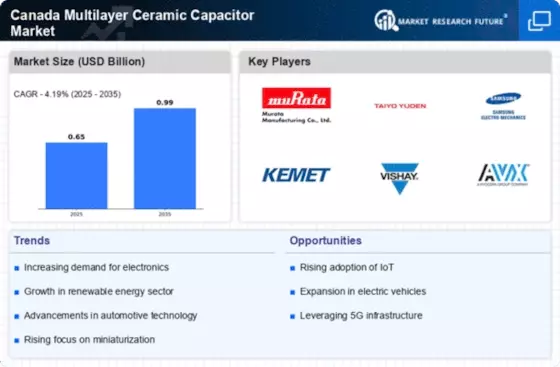
The Multilayer Ceramic Capacitor Market in Canada is characterized by a competitive landscape that is increasingly shaped by innovation, strategic partnerships, and regional expansion. Key players such as Murata Manufacturing Co., Ltd. (Japan), Samsung Electro-Mechanics (South Korea), and KEMET Corporation (US) are at the forefront, each employing distinct strategies to enhance their market positioning. Murata, for instance, focuses on advanced materials and miniaturization technologies, which are critical in meeting the demands of high-performance applications. Meanwhile, Samsung Electro-Mechanics emphasizes its robust supply chain and manufacturing capabilities, allowing it to respond swiftly to market fluctuations. KEMET Corporation, on the other hand, is actively pursuing mergers and acquisitions to bolster its product portfolio and expand its market reach, thereby intensifying the competitive dynamics within the sector.
The business tactics employed by these companies reflect a concerted effort to optimize operations and enhance customer satisfaction. Localizing manufacturing has emerged as a prevalent strategy, enabling firms to reduce lead times and mitigate supply chain disruptions. The market structure appears moderately fragmented, with several players vying for market share, yet the influence of major companies remains substantial. This competitive environment fosters innovation and drives advancements in product offerings, as companies strive to differentiate themselves in a crowded marketplace.
In December 2025, Murata Manufacturing Co., Ltd. (Japan) announced the launch of a new series of multilayer ceramic capacitors designed for automotive applications, which are expected to meet the stringent requirements of electric vehicles. This strategic move underscores Murata's commitment to innovation and positions the company favorably within the rapidly evolving automotive sector, where demand for high-performance components is surging. The introduction of these capacitors is likely to enhance Murata's competitive edge and solidify its reputation as a leader in advanced electronic components.
In November 2025, KEMET Corporation (US) revealed its plans to expand its manufacturing facility in Canada, aiming to increase production capacity for multilayer ceramic capacitors. This expansion is indicative of KEMET's strategy to localize production and cater to the growing demand in North America. By enhancing its manufacturing capabilities, KEMET is poised to improve its supply chain efficiency and responsiveness, which could significantly impact its market share in the region.
In October 2025, Samsung Electro-Mechanics (South Korea) entered into a strategic partnership with a leading automotive manufacturer to supply multilayer ceramic capacitors for next-generation electric vehicles. This collaboration not only highlights Samsung's focus on the automotive sector but also reflects a broader trend of strategic alliances aimed at leveraging technological advancements. Such partnerships are likely to enhance product development and accelerate time-to-market for innovative solutions, thereby reinforcing Samsung's competitive position.
As of January 2026, the Multilayer Ceramic Capacitor Market is witnessing trends that emphasize digitalization, sustainability, and the integration of artificial intelligence in manufacturing processes. Companies are increasingly recognizing the importance of strategic alliances, which are shaping the competitive landscape by fostering innovation and enhancing operational efficiencies. The shift from price-based competition to a focus on technology, reliability, and sustainable practices is becoming evident. As the market evolves, differentiation through innovation and supply chain resilience will likely be paramount for companies seeking to maintain a competitive advantage.