×
Request Free Sample ×

Kindly complete the form below to receive a free sample of this Report

* Please use a valid business email

Leading companies partner with us for data-driven Insights

clients tt-cursor
Hero Background

Japan Mobile Biometric Security Service Market

ID: MRFR/ICT/62829-HCR
200 Pages
Aarti Dhapte
February 2026

Japan Mobile Biometric Security Service Market Size, Share and Trends Analysis Report By Technology (Fingerprint Recognition, Facial Recognition, Iris Recognition, Voice Recognition, Behavioral Biometrics), By Application (Identity Verification, Access Control, Payment Authentication, Time and Attendance Tracking), By End Use (BFSI, Government, Healthcare, Retail, Transportation) and By Deployment Type (Cloud-Based, On-Premises)- Forecast to 2035

Share:
Download PDF ×

We do not share your information with anyone. However, we may send you emails based on your report interest from time to time. You may contact us at any time to opt-out.

Japan Mobile Biometric Security Service Market Infographic
Purchase Options

Japan Mobile Biometric Security Service Market Summary

As per Market Research Future analysis, the Japan Mobile Biometric Security Service Market size was estimated at 588.0 USD Million in 2024. The Mobile Biometric-security-service market is projected to grow from 648.15 USD Million in 2025 to 1716.0 USD Million by 2035, exhibiting a compound annual growth rate (CAGR) of 10.2% during the forecast period 2025 - 2035

Key Market Trends & Highlights

The Japan mobile biometric-security-service market is experiencing robust growth driven by technological advancements and increasing consumer demand for security solutions.

  • The market is witnessing a rising demand for contactless solutions, particularly in the financial services and healthcare segments.
  • Integration with IoT devices is becoming a prominent trend, enhancing the functionality of biometric systems across various applications.
  • Regulatory compliance is increasingly influencing market dynamics, especially in sectors like banking and government.
  • Key market drivers include increasing cybersecurity threats and consumer preference for enhanced security, propelling the adoption of mobile biometric solutions.

Market Size & Forecast

2024 Market Size 588.0 (USD Million)
2035 Market Size 1716.0 (USD Million)
CAGR (2025 - 2035) 10.23%

Major Players

Gemalto (FR), NEC Corporation (JP), Safran (FR), Fujitsu (JP), HID Global (US), MorphoTrust (US), IDEMIA (FR), Crossmatch (US)

Our Impact
Enabled $4.3B Revenue Impact for Fortune 500 and Leading Multinationals
Partnering with 2000+ Global Organizations Each Year
30K+ Citations by Top-Tier Firms in the Industry

Japan Mobile Biometric Security Service Market Trends

The Japan Mobile Biometric Security Service Market is experiencing notable growth., driven by increasing concerns over security and the need for efficient identification methods. In Japan, the adoption of biometric technologies is becoming more prevalent across various sectors, including finance, healthcare, and public safety. This trend is largely influenced by advancements in technology, which enhance the accuracy and speed of biometric systems. Furthermore, the integration of mobile devices with biometric capabilities is reshaping how organizations approach security, allowing for more convenient and secure access to sensitive information. As a result, businesses are increasingly investing in mobile biometric solutions to protect their assets and ensure compliance with regulatory requirements. In addition, This market is likely to benefit from the growing emphasis on digital transformation within Japanese enterprises.. Organizations are recognizing the importance of safeguarding their digital infrastructure, leading to a surge in demand for biometric authentication methods. The convenience of mobile biometric solutions, such as fingerprint and facial recognition, is appealing to both consumers and businesses alike. This shift towards mobile solutions indicates a broader trend towards enhancing security measures while maintaining user experience. Overall, the mobile biometric-security-service market appears poised for continued expansion as technology evolves and security needs become more complex.

Rising Demand for Contactless Solutions

The mobile biometric-security-service market is witnessing a shift towards contactless authentication methods. This trend is driven by the need for hygienic and efficient solutions, particularly in public spaces. Technologies such as facial recognition and iris scanning are gaining traction, as they offer seamless user experiences without physical contact.

Integration with IoT Devices

There is a growing trend of integrating mobile biometric-security services with Internet of Things (IoT) devices. This integration enhances security protocols by allowing biometric authentication to be embedded in various smart devices. As IoT adoption increases, the demand for secure biometric solutions is likely to rise.

Focus on Regulatory Compliance

Organizations are increasingly prioritizing compliance with data protection regulations. The mobile biometric-security-service market is adapting to these requirements by offering solutions that ensure secure data handling and user privacy. This focus on compliance is shaping the development of new biometric technologies.

Japan Mobile Biometric Security Service Market Drivers

Increasing Cybersecurity Threats

The mobile biometric-security-service market in Japan is experiencing growth due to the rising incidence of cybersecurity threats. As organizations face sophisticated cyber-attacks, the need for robust security measures becomes paramount. Biometric solutions, which offer unique identification methods such as fingerprint and facial recognition, are increasingly adopted to mitigate these risks. According to recent data, the market for biometric security solutions is projected to grow at a CAGR of 15% through 2027. This trend indicates a strong demand for mobile biometric services, as businesses seek to protect sensitive data and maintain customer trust. This market is thus positioned to benefit from this heightened focus on cybersecurity., as companies prioritize investments in advanced security technologies.

Rising Adoption of Mobile Devices

The proliferation of mobile devices in Japan is a key driver for the mobile biometric-security-service market. With an increasing number of consumers relying on smartphones and tablets for daily transactions, the demand for secure mobile applications is surging. Biometric authentication provides a convenient and secure method for users to access their devices and applications. Recent statistics show that mobile device penetration in Japan has reached approximately 90%, creating a substantial market for mobile biometric solutions. As businesses strive to enhance user experience while ensuring security, the mobile biometric-security-service market is likely to see continued growth, driven by the widespread adoption of mobile technology.

Government Initiatives and Support

The Japanese government is actively promoting the adoption of advanced security technologies, including mobile biometric solutions. Initiatives aimed at enhancing national security and public safety are driving investments in biometric systems. For instance, the government has allocated substantial funding to support research and development in biometric technologies. This support is likely to stimulate growth in the mobile biometric-security-service market, as public and private sectors collaborate to implement these solutions. Furthermore, the government's emphasis on digital transformation in various sectors, including finance and healthcare, is expected to increase the demand for mobile biometric services. As a result, the mobile biometric-security-service market is poised to expand significantly in response to these governmental efforts.

Consumer Preference for Enhanced Security

In Japan, there is a noticeable shift in consumer preferences towards enhanced security measures, particularly in mobile applications. As individuals become more aware of privacy concerns and data breaches, they are increasingly seeking services that offer biometric authentication. This trend is reflected in the growing adoption of mobile banking and e-commerce platforms that utilize biometric security features. Recent surveys indicate that over 60% of consumers prefer biometric authentication over traditional passwords, highlighting a clear demand for mobile biometric-security services. Consequently, businesses are compelled to integrate these solutions to meet consumer expectations, thereby driving growth in the mobile biometric-security-service market.

Technological Advancements in Biometric Systems

The mobile biometric-security-service market is significantly influenced by rapid technological advancements in biometric systems. Innovations such as artificial intelligence and machine learning are enhancing the accuracy and efficiency of biometric authentication methods. These advancements are making biometric solutions more accessible and user-friendly, which is likely to attract a broader customer base. For instance, the introduction of advanced facial recognition technology has improved the speed and reliability of mobile biometric services. As these technologies continue to evolve, they are expected to drive further adoption of mobile biometric solutions across various sectors, including finance, healthcare, and retail, thereby propelling the growth of the mobile biometric-security-service market.


Market Segment Insights

By Technology: Fingerprint Recognition (Largest) vs. Facial Recognition (Fastest-Growing)

In the Japan mobile biometric-security-service market, Fingerprint Recognition holds the largest market share, driven by its widespread adoption in smartphones and security applications. This segment is known for its reliability and user acceptance, making it the preferred choice among consumers and businesses alike. Meanwhile, Facial Recognition is rapidly gaining traction due to advancements in AI and machine learning technology, leading to a significant increase in its market presence. The growth trends in this segment are fueled by increasing security concerns and the need for seamless authentication processes. Fingerprint Recognition continues to benefit from integration in various devices, while Facial Recognition is expected to see exponential growth, especially in areas such as access control and surveillance. This indicates a shift in consumer preferences towards more advanced biometric solutions, contributing to the overall market expansion.

Technology: Fingerprint Recognition (Dominant) vs. Facial Recognition (Emerging)

Fingerprint Recognition has established itself as a dominant force in the Japan mobile biometric-security-service market, characterized by its quick authentication processes and robust security measures. Its implementation across various sectors, including finance and telecommunications, underscores its reliability and consumer trust. In contrast, Facial Recognition, while still emerging, is rapidly gaining acceptance due to its convenience and efficiency, primarily in mobile devices and security systems. This technology is becoming increasingly sophisticated with the integration of AI, allowing for improved accuracy and speed. As consumers demand more user-friendly security solutions, both technologies are poised for significant growth, catering to a diverse range of applications within the market.

By Application: Identity Verification (Largest) vs. Access Control (Fastest-Growing)

In the Japan mobile biometric-security-service market, the Identity Verification segment holds the largest share, driven by widespread adoption across various sectors such as finance and healthcare. Meanwhile, Access Control, while smaller, is rapidly gaining traction due to increasing demands for security in workplaces and public facilities, highlighting a notable shift in consumer priorities towards safety and authentication. Growth trends show that advancements in technology and the increasing necessity for secure transactions are pushing both segments forward. The rise of remote working and digital platforms has fueled the demand for biometric solutions in Identity Verification, while the emergence of smart technologies is contributing to the rapid growth in Access Control. These trends signify a transformative phase within the market, valuing security and efficiency higher than ever.

Identity Verification (Dominant) vs. Payment Authentication (Emerging)

Identity Verification remains the dominant segment within the Japan mobile biometric-security-service market, characterized by its essential role in ensuring user authenticity and trust across multiple applications. It is widely utilized in sectors including banking, healthcare, and government services, emphasizing a strong need for robust security solutions. On the other hand, Payment Authentication is emerging as a vital segment, gaining momentum with the rapid digitalization of payment processes and the increasing prevalence of e-commerce. This segment focuses on streamlining secure payment methods, leveraging biometric technology to enhance user experience while preventing fraud. Both segments exhibit unique characteristics that cater to the evolving security landscape, reinforcing consumer confidence and adoption rates in biometric solutions.

By End Use: BFSI (Largest) vs. Healthcare (Fastest-Growing)

In the Japan mobile biometric-security-service market, the market share is predominantly held by the BFSI sector, which utilizes biometric security for secure transactions and identity verification. This segment benefits from increasing demands for secure digital banking solutions. Following closely is the Healthcare sector, leveraging biometric services for patient identification and access control, reflecting a rising interest in integrating advanced security solutions into healthcare facilities. The growth trends within these segments indicate a robust movement towards adopting biometric technologies driven by the need for enhanced security and operational efficiency. BFSI remains the dominant force, primarily because of strong regulatory requirements and the necessity for secure ID authentication. Meanwhile, the Healthcare sector is rapidly emerging due to advancements in patient data protection and the adoption of telehealth, making it one of the fastest-growing segments in the market.

BFSI (Dominant) vs. Healthcare (Emerging)

The BFSI segment is characterized by its substantial investment in biometric technologies, significantly driven by regulations necessitating stringent security measures. This segment comprises banks, insurance companies, and financial institutions focused on minimizing fraud and enhancing customer experience through secure biometric solutions. Conversely, the Healthcare segment is experiencing rapid growth, primarily due to the increasing importance of patient data confidentiality and the rise of telemedicine. Healthcare providers are integrating biometric solutions to streamline patient identification processes and ensure authorized access to sensitive information. The distinct needs of each segment drive their contrasting growth trajectories, with BFSI being more established and Healthcare rapidly evolving to meet new challenges.

By Deployment Type: Cloud-Based (Largest) vs. On-Premises (Fastest-Growing)

In the Japan mobile biometric-security-service market, the distribution of market share between the two key deployment types reveals distinct preferences. Cloud-Based solutions hold the largest share, favored for their scalability and ease of access. On-Premises solutions, while smaller in market share, are rapidly gaining traction due to their enhanced security features and control in sensitive environments. Both segments reflect an evolving landscape where users are increasingly discerning about their deployment choices. The growth trends for these deployment types indicate a strong shift towards Cloud-Based services, driven by the demand for agility and remote accessibility. However, the On-Premises segment is emerging as a robust alternative, experiencing significant growth as organizations prioritize data security and privacy. Factors such as regulatory compliance and the rise in cyber threats are propelling both segments, highlighting the dynamic nature of service delivery in this market.

Cloud-Based: Dominant vs. On-Premises: Emerging

Cloud-Based solutions dominate the Japan mobile biometric-security-service market, offering unmatched flexibility, deployment speed, and user accessibility, making them ideal for businesses aiming for rapid digital transformation. These solutions benefit from continuous updates and maintenance managed by service providers, ensuring that users always have the latest features. Conversely, On-Premises solutions are emerging as a vital choice for sectors demanding stringent data governance and security controls. They provide organizations with direct control over their data, which is crucial for compliance with local laws. Companies in sensitive industries, such as finance and healthcare, are increasingly investing in On-Premises solutions as they seek to mitigate risks associated with data breaches and enhance overall security posture.

Get more detailed insights about Japan Mobile Biometric Security Service Market

Key Players and Competitive Insights

The mobile biometric-security-service market in Japan is characterized by a dynamic competitive landscape, driven by technological advancements and increasing demand for secure authentication solutions. Key players such as NEC Corporation (Japan), IDEMIA (France), and Fujitsu (Japan) are at the forefront, each adopting distinct strategies to enhance their market positioning. NEC Corporation (Japan) focuses on innovation through the development of advanced biometric technologies, while IDEMIA (France) emphasizes strategic partnerships to expand its service offerings. Fujitsu (Japan) is leveraging its expertise in digital transformation to integrate biometric solutions into broader security frameworks, collectively shaping a competitive environment that prioritizes technological sophistication and customer-centric solutions.The market structure appears moderately fragmented, with several players vying for market share. Key business tactics include localizing manufacturing to reduce costs and optimize supply chains, which is particularly relevant in the context of Japan's robust manufacturing sector. The collective influence of these major players fosters a competitive atmosphere where innovation and operational efficiency are paramount, allowing them to respond swiftly to evolving market demands.

In October NEC Corporation (Japan) announced a collaboration with a leading telecommunications provider to enhance mobile biometric authentication services. This strategic move is likely to bolster NEC's market presence by integrating biometric solutions into mobile platforms, thereby addressing the growing consumer demand for secure mobile transactions. Such partnerships may enhance user experience and trust, positioning NEC as a leader in mobile security solutions.

In September IDEMIA (France) launched a new biometric identification system tailored for public safety applications. This initiative underscores IDEMIA's commitment to innovation and its strategic focus on expanding its footprint in the public sector. By addressing the specific needs of law enforcement and emergency services, IDEMIA is likely to strengthen its competitive edge and capture a larger share of the market.

In August Fujitsu (Japan) unveiled a cutting-edge biometric solution that integrates AI capabilities for real-time identity verification. This development not only enhances the accuracy and speed of biometric authentication but also aligns with the growing trend of AI integration in security services. Fujitsu's focus on advanced technology positions it favorably in a market increasingly driven by the need for efficient and reliable security solutions.

As of November current competitive trends indicate a strong emphasis on digitalization, sustainability, and the integration of AI technologies within the mobile biometric-security-service market. Strategic alliances are becoming increasingly vital, as companies seek to leverage complementary strengths to enhance their offerings. Looking ahead, competitive differentiation is expected to evolve, shifting from traditional price-based competition to a focus on innovation, technological advancement, and supply chain reliability. This transition suggests that companies that prioritize these aspects will likely emerge as leaders in the market.
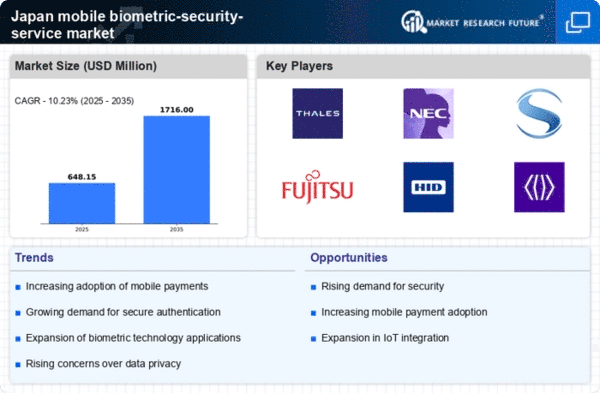
Key Companies in the Japan Mobile Biometric Security Service Market include

Industry Developments

Recent developments in the Japan Mobile Biometric Security Service Market have seen significant activity, particularly from major players such as NEC, Mitsubishi Electric, and Fujitsu, indicating a heightened focus on advanced security solutions. As of August 2023, NEC announced enhancements to its biometric identification systems to improve efficiency and security in mobile applications. Furthermore, the market has experienced an uptick in mergers and acquisitions, with Ayonix acquiring a strategic partnership with Crossmatch in June 2023 aimed at expanding their biometric capabilities.

In another notable event, in September 2023, IDEMIA launched a new mobile biometric solution designed specifically for law enforcement agencies, emphasizing the growing demand for mobile security. The market is projected to grow steadily due to increased demand for smartphone security solutions and governmental initiatives encouraging the adoption of biometric technologies. Last year, in November 2022, Hitachi also announced a collaboration with OECD to enhance equipment in biometric data usage and establish stronger security measures, showcasing the active participation of Japanese companies in bolstering mobile biometric security. As technology advances, companies like Sony and Innovatrics are also investing heavily in Research and Development to maintain a competitive edge in this evolving field.

Future Outlook

Japan Mobile Biometric Security Service Market Future Outlook

The Mobile Biometric Security Service Market is projected to grow at a 10.23% CAGR from 2025 to 2035, driven by technological advancements and increasing security concerns.

New opportunities lie in:

  • Integration of biometric authentication in mobile payment systems
  • Development of AI-driven biometric analytics for enhanced security
  • Expansion of biometric solutions in IoT devices for smart homes

By 2035, the market is expected to achieve substantial growth and innovation.

Market Segmentation

Japan Mobile Biometric Security Service Market End Use Outlook

  • BFSI
  • Government
  • Healthcare
  • Retail
  • Transportation

Japan Mobile Biometric Security Service Market Technology Outlook

  • Fingerprint Recognition
  • Facial Recognition
  • Iris Recognition
  • Voice Recognition
  • Behavioral Biometrics

Japan Mobile Biometric Security Service Market Application Outlook

  • Identity Verification
  • Access Control
  • Payment Authentication
  • Time and Attendance Tracking

Japan Mobile Biometric Security Service Market Deployment Type Outlook

  • Cloud-Based
  • On-Premises

Report Scope

MARKET SIZE 2024 588.0(USD Million)
MARKET SIZE 2025 648.15(USD Million)
MARKET SIZE 2035 1716.0(USD Million)
COMPOUND ANNUAL GROWTH RATE (CAGR) 10.23% (2025 - 2035)
REPORT COVERAGE Revenue Forecast, Competitive Landscape, Growth Factors, and Trends
BASE YEAR 2024
Market Forecast Period 2025 - 2035
Historical Data 2019 - 2024
Market Forecast Units USD Million
Key Companies Profiled Gemalto (FR), NEC Corporation (JP), Safran (FR), Fujitsu (JP), HID Global (US), MorphoTrust (US), IDEMIA (FR), Crossmatch (US)
Segments Covered Technology, Application, End Use, Deployment Type
Key Market Opportunities Integration of advanced artificial intelligence in mobile biometric-security-service market enhances user authentication and security.
Key Market Dynamics Rising demand for mobile biometric-security-services driven by regulatory compliance and technological advancements in Japan.
Countries Covered Japan
Leave a Comment

FAQs

What is the expected market size of the Japan Mobile Biometric Security Service Market in 2024?

The Japan Mobile Biometric Security Service Market is expected to be valued at 583.5 USD Million in 2024.

What is the projected market size for the Japan Mobile Biometric Security Service Market by 2035?

By 2035, the Japan Mobile Biometric Security Service Market is anticipated to reach a value of 2185.0 USD Million.

What is the expected CAGR for the Japan Mobile Biometric Security Service Market from 2025 to 2035?

The market is projected to grow at a CAGR of 12.753% from 2025 to 2035.

Which biometric technology segment is expected to dominate the market in 2024?

Fingerprint Recognition is expected to dominate the market, valued at 130.0 USD Million in 2024.

What will be the market value of Facial Recognition technology in 2035?

Facial Recognition technology is projected to be valued at 685.0 USD Million in 2035.

Which major players are leading the Japan Mobile Biometric Security Service Market?

Key players in the market include NEC, Mitsubishi Electric, Oki Electric Industry, and IDEMIA.

How much is the Iris Recognition segment expected to grow by 2035?

The Iris Recognition segment is expected to grow to 250.0 USD Million by 2035.

What is the projected market value of Voice Recognition technology by 2035?

Voice Recognition technology is anticipated to reach a market value of 300.0 USD Million by 2035.

What is the expected market value for Behavioral Biometrics in 2024?

Behavioral Biometrics is expected to be valued at 103.5 USD Million in 2024.

What are the key challenges facing the Japan Mobile Biometric Security Service Market?

Key challenges include ensuring data privacy and combating biometric spoofing in the market.

Download Free Sample

Kindly complete the form below to receive a free sample of this Report

Compare Licence

×
Features License Type
Single User Multiuser License Enterprise User
Price $4,950 $5,950 $7,250
Maximum User Access Limit 1 User Upto 10 Users Unrestricted Access Throughout the Organization
Free Customization
Direct Access to Analyst
Deliverable Format
Platform Access
Discount on Next Purchase 10% 15% 15%
Printable Versions