×
Request Free Sample ×

Kindly complete the form below to receive a free sample of this Report

* Please use a valid business email

Leading companies partner with us for data-driven Insights

clients tt-cursor
Hero Background

Japan Metaverse Market

ID: MRFR/ICT/58847-HCR
200 Pages
Aarti Dhapte
February 2026

Japan Metaverse Market Size, Share and Research Report: By Component (Software, Hardware), By Platform (Desktop/Laptops, Mobile, Wearables), By Technology (Blockchain, VR & AR, Mixed Reality, Others), By Application (Online Shopping, Content Creation, Gaming, Social Media, Others) and By End User (Consumer, Enterprises)- Industry Forecast to 2035

Share:
Download PDF ×

We do not share your information with anyone. However, we may send you emails based on your report interest from time to time. You may contact us at any time to opt-out.

Japan Metaverse Market Infographic
Purchase Options

Japan Metaverse Market Summary

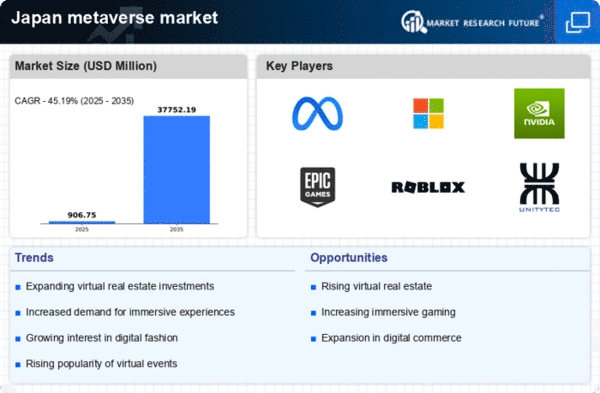
As per Market Research Future analysis, the Japan Metaverse Market size was estimated at 624.52 USD Million in 2024. The Metaverse market is projected to grow from 906.75 USD Million in 2025 to 37752.19 USD Million by 2035, exhibiting a compound annual growth rate (CAGR) of 45.1% during the forecast period 2025 - 2035

Key Market Trends & Highlights

The Japan metaverse market is poised for substantial growth driven by technological advancements and cultural integration.

  • Investment in technology is surging, indicating a robust commitment to metaverse development.
  • Cultural integration is becoming increasingly prominent, enhancing user engagement and experience.
  • Government support for digital initiatives is fostering a conducive environment for metaverse expansion.
  • Rising consumer demand for virtual experiences and advancements in AR and VR technologies are key drivers of market growth.

Market Size & Forecast

2024 Market Size 624.52 (USD Million)
2035 Market Size 37752.19 (USD Million)
CAGR (2025 - 2035) 45.19%

Major Players

Meta Platforms (US), Microsoft (US), NVIDIA (US), Epic Games (US), Roblox Corporation (US), Unity Technologies (US), Tencent (CN), Sony (JP), Decentraland (NZ)

Our Impact
Enabled $4.3B Revenue Impact for Fortune 500 and Leading Multinationals
Partnering with 2000+ Global Organizations Each Year
30K+ Citations by Top-Tier Firms in the Industry

Japan Metaverse Market Trends

The Japan Metaverse Market in Japan is currently experiencing a dynamic evolution, driven by advancements in technology and increasing consumer interest. As digital interactions become more prevalent, various sectors are exploring the potential of immersive environments. This market is characterized by a blend of virtual reality (VR), augmented reality (AR), and blockchain technologies, which together create unique experiences for users. Companies are investing in innovative solutions to enhance user engagement, suggesting a promising trajectory for growth. Furthermore, the Japanese government is actively supporting initiatives that promote digital transformation, which may further stimulate the metaverse market. In addition, the cultural landscape of Japan plays a crucial role in shaping the metaverse market. The integration of traditional elements with modern technology appears to resonate well with consumers. This fusion not only attracts local users but also has the potential to appeal to international audiences. As the market continues to mature, collaboration between tech firms and content creators is likely to foster a rich ecosystem that enhances the overall user experience. The future of the metaverse market in Japan seems bright, with ongoing developments indicating a robust and innovative environment.

Increased Investment in Technology

There is a noticeable trend of heightened investment in technology related to the metaverse market. Companies are allocating resources towards developing advanced VR and AR solutions, which are essential for creating immersive experiences. This influx of capital is likely to accelerate innovation and enhance the overall quality of offerings in the market.

Cultural Integration

The metaverse market is witnessing a trend of cultural integration, where traditional Japanese elements are being incorporated into digital experiences. This approach not only enriches the content but also fosters a deeper connection with users, making the virtual environments more relatable and engaging.

Government Support for Digital Initiatives

The Japanese government is actively promoting digital initiatives that support the growth of the metaverse market. By providing funding and resources for technology development, the government aims to create a favorable environment for innovation, which could lead to significant advancements in the sector.

Japan Metaverse Market Drivers

Expansion of E-commerce into Virtual Spaces

The metaverse market in Japan is experiencing a significant expansion of e-commerce into virtual spaces, as businesses recognize the potential for enhanced customer engagement. Retailers are increasingly establishing virtual storefronts within the metaverse, allowing consumers to browse and purchase products in immersive environments. As of November 2025, the virtual retail market in Japan is projected to grow by 40% annually, driven by the desire for unique shopping experiences. This shift is likely to transform the metaverse market, as companies adapt their strategies to leverage the benefits of virtual commerce and meet the evolving expectations of consumers.

Increased Collaboration Among Tech Companies

The metaverse market in Japan is witnessing a rise in collaboration among technology companies, which is fostering innovation and development. Partnerships between gaming firms, software developers, and hardware manufacturers are becoming more common, as these entities seek to create integrated solutions for the metaverse. This collaborative approach is likely to enhance the overall quality of virtual experiences and expand the reach of the metaverse market. As of November 2025, over 40% of companies in the tech sector are engaged in partnerships aimed at developing metaverse-related products and services, indicating a strong trend towards collective advancement in this space.

Growing Interest from Educational Institutions

Educational institutions in Japan are increasingly exploring the potential of the metaverse market as a platform for innovative learning experiences. The integration of virtual classrooms and interactive learning environments is gaining traction, with many universities and schools adopting metaverse technologies to enhance educational outcomes. As of November 2025, approximately 30% of educational institutions in Japan have implemented or are planning to implement metaverse solutions in their curricula. This trend not only enriches the learning experience but also positions the metaverse market as a vital component of the future educational landscape.

Rising Consumer Demand for Virtual Experiences

The metaverse market in Japan is experiencing a notable surge in consumer demand for immersive virtual experiences. This trend is driven by the increasing popularity of online gaming, social interactions, and virtual events. As of November 2025, approximately 60% of Japanese consumers express interest in engaging with virtual environments for entertainment and socialization. This growing appetite for virtual experiences is prompting companies to invest in innovative technologies that enhance user engagement. The metaverse market is likely to benefit from this consumer shift, as businesses strive to create more interactive and personalized experiences that cater to the evolving preferences of users.

Advancements in Augmented Reality (AR) and Virtual Reality (VR) Technologies

Technological advancements in AR and VR are significantly influencing the metaverse market in Japan. The continuous development of hardware and software solutions is enabling more sophisticated and realistic virtual environments. As of November 2025, the market for AR and VR technologies in Japan is projected to reach $10 billion, reflecting a compound annual growth rate (CAGR) of 25% over the next five years. These innovations are essential for enhancing user experiences within the metaverse, allowing for seamless interactions and greater immersion. Consequently, the metaverse market is poised for growth as companies leverage these technologies to create compelling virtual experiences.


Market Segment Insights

By Component Type: Hardware (Largest) vs. Software (Fastest-Growing)

As of recent evaluations, the Japan metaverse market exhibits a significant distribution of market share across component types. Hardware remains the largest segment, driven by the increasing consumer demand for immersive experiences facilitated by advanced gaming technologies. Meanwhile, the software segment is swiftly gaining traction, benefiting from the rise in virtual environments and interactive applications, which continue to engage a broader audience. Growth trends in this segment are fueled by technological advancements and the burgeoning interest in virtual reality (VR) and augmented reality (AR) applications. As entertainment, education, and business sectors increasingly adopt metaverse solutions, the software components are expected to witness substantial growth. Furthermore, partnerships between technology firms and entertainment providers are enhancing software capabilities, making it a pivotal area of focus for future market strategies.

Hardware: Dominant vs. Software: Emerging

Hardware serves as the dominant force in the Japan metaverse market, offering essential devices like VR headsets and motion sensors that enhance user interaction and experience. This segment benefits from established brands and robust consumer loyalty. Conversely, the software segment is emerging as a critical player, characterized by innovative applications that cater to diverse user needs such as gaming, virtual meetings, and educational tools. The adaptability of software solutions to various industries positions it as a catalyst for market expansion. As consumers seek richer, more interactive experiences, both segments will play crucial roles, yet hardware will lead in terms of market presence, while software will drive future engagement and growth.

By Platform Type: Mobile (Largest) vs. Wearables (Fastest-Growing)

In the Japan metaverse market, the market share distribution reveals that Mobile platforms dominate with the largest user base, capitalizing on the high penetration of smartphones in the region. Desktop/Laptops follow as a significant segment but face challenges in attracting new users who prefer the convenience and accessibility of mobile devices. Wearables, while currently a smaller share in the market, are rapidly gaining traction due to their innovative features tailored for immersive experiences. The growth trends within this segment indicate that Mobile will continue to lead, driven by advancements in mobile technology and increasing content availability. Wearables are poised for rapid growth as more consumers adopt these devices for enhanced interactivity within the metaverse. Factors such as technological innovation and consumer preference for immersive experiences will further accelerate this segment's expansion.

Mobile (Dominant) vs. Wearables (Emerging)

Mobile platforms are the dominant force in the Japan metaverse market, providing users with an easily accessible gateway to immersive experiences. Their success stems from widespread smartphone adoption and app availability, allowing users to engage with the metaverse on-the-go. In contrast, Wearables represent an emerging sector set to reshape user interaction within the metaverse. Wearables, including smart glasses and VR headsets, promise a more immersive experience, yet they still need to build a substantial user base. Their growth is fueled by advancements in technology and increased consumer interest in high-definition, immersive environments. As developers create more user-friendly applications, the appeal of wearables is expected to surge.

By Technology Type: VR & AR (Largest) vs. Blockchain (Fastest-Growing)

In the Japan metaverse market, the technology type segment is primarily dominated by VR & AR, which captures a significant share of the market. Following closely behind, Blockchain technology is gaining traction as an essential component, especially for secure transactions and asset ownership. Other technologies like Mixed Reality and Others represent smaller portions but are crucial for specific applications and innovations, contributing to diversification in the market. Growth trends in this segment indicate a robust increase in adoption, particularly for VR & AR technology, as it enhances user experiences and engagement in virtual environments. Meanwhile, Blockchain's appeal is rapidly growing due to its ability to provide transparency and security, making it attractive for developers and users alike. The interest in Mixed Reality continues to expand, driven by advancements in hardware and software that blur the lines between real and virtual worlds, pushing the boundaries of interactive experiences.

VR & AR (Dominant) vs. Blockchain (Emerging)

VR & AR technology stands out as the dominant force in the Japan metaverse market, enabling immersive experiences across gaming, entertainment, and education. This technology facilitates rich, interactive environments that attract users and foster engagement. Its versatility has allowed it to become a staple in various applications, effectively establishing a strong foothold in the market landscape. On the other hand, Blockchain technology, while still emerging, is rapidly evolving and gaining significant attention. It brings unique advantages such as secure digital ownership and decentralized finance, appealing particularly to developers looking to innovate within the metaverse. As both technologies continue to evolve, their interplay will likely shape the future landscape of the market.

By Application Type: Gaming (Largest) vs. Online Shopping (Fastest-Growing)

In the Japan metaverse market, the application type segment showcases a distinct distribution of market share among its categories. Gaming continues to hold the largest share, driven by a robust player base and immersive experiences that attract users of all ages. Online Shopping, while currently holding a smaller share, is rapidly gaining traction as e-commerce evolves within virtual environments, allowing consumers to engage in new shopping experiences that blend interaction and convenience. Growth trends within these segments indicate a strong push towards integrating advanced technologies. The gaming sector is likely to benefit from developments in virtual reality (VR) and augmented reality (AR), enhancing user experiences and leading to increased engagement. Conversely, Online Shopping is emerging as a significant growth area, as brands explore novel ways to reach tech-savvy consumers through innovative advertising and interactive shopping experiences that the metaverse facilitates.

Gaming: Dominant vs. Online Shopping: Emerging

Gaming has established itself as the dominant application within the Japan metaverse market, characterized by its ability to deliver immersive experiences that transcend traditional gaming formats. Players are drawn to the interactivity and social aspects that virtual environments offer. Meanwhile, Online Shopping is marked as an emerging segment, harnessing the capabilities of the metaverse to transform retail experiences. Retailers are adopting virtual storefronts, creating unique shopping experiences that engage consumers more profoundly than conventional online shopping. The synergy between gaming and shopping in the metaverse suggests potential cross-pollination, with brands keen on capitalizing on gaming platforms to reach wider audiences while enhancing consumer loyalty and experience.

By End User: Consumers (Largest) vs. Enterprises (Fastest-Growing)

In the Japan metaverse market, the distribution of the end user segment showcases that consumers hold the largest share, significantly impacting market dynamics. Enterprises, while smaller in share, represent a rapidly expanding facet of the market. This divergence illustrates differing needs and engagement levels across user types, with consumers driving a substantial portion of interactive experiences. Examining growth trends, enterprises are emerging as the fastest-growing end user segment due to increased investments in digital solutions and innovative applications of metaverse technologies. This surge is driven by the need for improved customer engagement and operational efficiency, leading to a robust interest in virtual collaboration and immersive experiences that enhance business functions.

Consumers: Dominant vs. Enterprises: Emerging

In the Japan metaverse market, consumers are characterized by their vast engagement in virtual environments, utilizing metaverse platforms for entertainment, social interactions, and recreational activities. This segment thrives on immersive experiences that cater to personal interests and lifestyle preferences, dominating the market landscape. In contrast, enterprises, while currently a smaller segment, are rapidly evolving as they recognize the potential of metaverse technologies for business applications. This includes virtual events, training modules, and marketing campaigns, positioning them as an emerging force with an agile approach to integrating metaverse solutions into traditional business models.

Get more detailed insights about Japan Metaverse Market

Key Players and Competitive Insights

The metaverse market exhibits a dynamic competitive landscape, characterized by rapid technological advancements and a growing emphasis on immersive experiences. Key players such as Meta Platforms (US), Microsoft (US), and Sony (Japan) are at the forefront, each adopting distinct strategies to enhance their market positioning. Meta Platforms (US) continues to focus on innovation through its extensive investments in virtual reality (VR) and augmented reality (AR) technologies, aiming to create a more interconnected digital ecosystem. Meanwhile, Microsoft (US) leverages its cloud computing capabilities to integrate metaverse solutions into its existing software offerings, thereby enhancing user engagement and operational efficiency. Sony (Japan), with its strong foothold in gaming, is strategically expanding its metaverse initiatives by developing exclusive content that attracts a dedicated user base, thus shaping a competitive environment that prioritizes user experience and technological integration.The business tactics employed by these companies reflect a concerted effort to optimize their operations within a moderately fragmented market structure. Localizing manufacturing and enhancing supply chain efficiencies are pivotal strategies that these firms are adopting to respond to regional demands and mitigate operational risks. The collective influence of these key players fosters a competitive atmosphere where innovation and strategic partnerships are paramount, allowing them to navigate the complexities of the metaverse landscape effectively.

In September Meta Platforms (US) announced a partnership with a leading Japanese gaming studio to co-develop immersive VR experiences tailored for the Asian market. This collaboration is significant as it not only enhances Meta's content offerings but also positions the company to tap into the lucrative gaming sector in Japan, which is known for its high consumer engagement with digital entertainment. Such strategic alliances are likely to bolster Meta's competitive edge in the region.

In October Microsoft (US) unveiled its latest metaverse platform, which integrates AI-driven analytics to enhance user interactions within virtual environments. This move is crucial as it underscores Microsoft's commitment to leveraging artificial intelligence to create more personalized and engaging user experiences. By incorporating advanced analytics, Microsoft aims to differentiate its offerings in a crowded marketplace, potentially attracting a broader audience.

In August Sony (Japan) launched a new initiative aimed at integrating its gaming ecosystem with metaverse functionalities, allowing users to seamlessly transition between gaming and virtual social experiences. This strategic action is indicative of Sony's intent to capitalize on its existing user base while expanding its reach into the metaverse. By creating a cohesive experience, Sony is likely to strengthen its market position and foster greater user loyalty.

As of November the competitive trends within the metaverse market are increasingly defined by digitalization, sustainability, and the integration of AI technologies. Strategic alliances are becoming a cornerstone of competitive differentiation, enabling companies to pool resources and expertise to innovate more effectively. The shift from price-based competition to a focus on technological advancement and supply chain reliability is evident, suggesting that future competitive dynamics will hinge on the ability to deliver unique, high-quality experiences that resonate with users.

Key Companies in the Japan Metaverse Market include

Industry Developments

The Japan Metaverse Market has been experiencing significant developments recently. In September 2023, Nintendo announced its partnership with local startups to enhance its engagement within the Metaverse, leveraging its gaming IPs to create interactive virtual environments. 

Meanwhile, DeNA has been actively exploring collaborations with various sectors to integrate blockchain technology into its gaming offerings, aiming to enhance user experience and data security. Taito launched a new virtual arcade experience that utilizes augmented reality, aiming to revive classic gaming in digital arenas. In the realm of mergers and acquisitions, CyberAgent acquired a controlling stake in a leading virtual reality content company in August 2023, indicating a strategic move to bolster their presence in the Metaverse. 

The overall valuation of companies within this sector is on the rise, with estimates suggesting growth driven by increased user engagement and investment in Research and Development. Furthermore, industry players like SEGA continue to expand their digital footprints, enhancing their Metaverse offerings through innovative experiences, demonstrating the dynamically evolving landscape of the Japan Metaverse Market.

Future Outlook

Japan Metaverse Market Future Outlook

The metaverse market in Japan is projected to grow at a 45.19% CAGR from 2025 to 2035, driven by technological advancements, increased consumer engagement, and enterprise adoption.

New opportunities lie in:

  • Development of immersive training platforms for corporate clients.
  • Creation of virtual real estate marketplaces for digital assets.
  • Integration of AI-driven analytics for personalized user experiences.

By 2035, the metaverse market in Japan is expected to be a dynamic and integral part of the digital economy.

Market Segmentation

Japan Metaverse Market End User Outlook

  • Consumers
  • Enterprises

Japan Metaverse Market Platform Type Outlook

  • Desktop/Laptops
  • Mobile
  • Wearables

Japan Metaverse Market Component Type Outlook

  • Hardware
  • Software

Japan Metaverse Market Technology Type Outlook

  • Blockchain
  • VR & AR
  • Mixed Reality
  • Others

Japan Metaverse Market Application Type Outlook

  • Gaming
  • Online Shopping
  • Content Creation
  • Social Media
  • Others

Report Scope

MARKET SIZE 2024 624.52(USD Million)
MARKET SIZE 2025 906.75(USD Million)
MARKET SIZE 2035 37752.19(USD Million)
COMPOUND ANNUAL GROWTH RATE (CAGR) 45.19% (2025 - 2035)
REPORT COVERAGE Revenue Forecast, Competitive Landscape, Growth Factors, and Trends
BASE YEAR 2024
Market Forecast Period 2025 - 2035
Historical Data 2019 - 2024
Market Forecast Units USD Million
Key Companies Profiled Meta Platforms (US), Microsoft (US), NVIDIA (US), Epic Games (US), Roblox Corporation (US), Unity Technologies (US), Tencent (CN), Sony (JP), Decentraland (NZ)
Segments Covered Component Type, Platform Type, Technology Type, Application Type, End User
Key Market Opportunities Integration of immersive technologies enhances user engagement in the metaverse market.
Key Market Dynamics Rising consumer interest in immersive experiences drives innovation and competition in the metaverse market.
Countries Covered Japan
Leave a Comment

FAQs

What is the expected market size of the Japan Metaverse Market in 2024?

The Japan Metaverse Market is expected to be valued at approximately 619.12 million USD in 2024.

What will be the market's projected value by 2035?

By 2035, the Japan Metaverse Market is projected to reach a value of around 2,324.0 million USD.

What is the compound annual growth rate (CAGR) for the Japan Metaverse Market between 2025 and 2035?

The expected CAGR for the Japan Metaverse Market from 2025 to 2035 is approximately 12.778%.

Which segments contribute to the Japan Metaverse Market in terms of components?

The Japan Metaverse Market is segmented into software and hardware components.

What is the market value for software in the Japan Metaverse Market by 2035?

The value of the software component in the Japan Metaverse Market is expected to reach 900.0 million USD by 2035.

What is the expected market value for hardware in 2024?

The hardware segment of the Japan Metaverse Market is anticipated to be valued at 369.12 million USD in 2024.

Who are some of the key players in the Japan Metaverse Market?

Major players in the Japan Metaverse Market include companies such as DeNA, Square Enix, SEGA, and Sony.

What opportunities are driving the growth of the Japan Metaverse Market?

Innovations in gaming, virtual reality, and social interaction are key opportunities driving the market's growth.

How does the Japan Metaverse Market differ from global counterparts?

The Japan Metaverse Market showcases unique cultural elements and top-tier gaming innovations distinct from global markets.

What challenges might affect the Japan Metaverse Market in the coming years?

Potential challenges include regulatory issues and the need for advanced technology infrastructure.

Download Free Sample

Kindly complete the form below to receive a free sample of this Report

Compare Licence

×
Features License Type
Single User Multiuser License Enterprise User
Price $4,950 $5,950 $7,250
Maximum User Access Limit 1 User Upto 10 Users Unrestricted Access Throughout the Organization
Free Customization
Direct Access to Analyst
Deliverable Format
Platform Access
Discount on Next Purchase 10% 15% 15%
Printable Versions