×
Request Free Sample ×

Kindly complete the form below to receive a free sample of this Report

* Please use a valid business email

Leading companies partner with us for data-driven Insights

clients tt-cursor
Hero Background

Japan Hospital Services Market

ID: MRFR/HS/50723-HCR
200 Pages
Rahul Gotadki
February 2026

Japan Hospital Services Market Research Report: Size, Share, Trend Analysis By Hospital Type (State-owned Hospital, Private Hospital, Public/ Community Hospital), By Service Type (Outpatient Services, Inpatient Service) and By Service Areas (Cardiovascular, Acute Care, Cancer Care, Diagnostics, Imaging, Neurorehabilitation and amp Psychiatry Services, Gynecology, Others) - Growth Outlook & Industry Forecast 2025 To 2035

Share:
Download PDF ×

We do not share your information with anyone. However, we may send you emails based on your report interest from time to time. You may contact us at any time to opt-out.

Japan Hospital Services Market Infographic
Purchase Options

Japan Hospital Services Market Summary

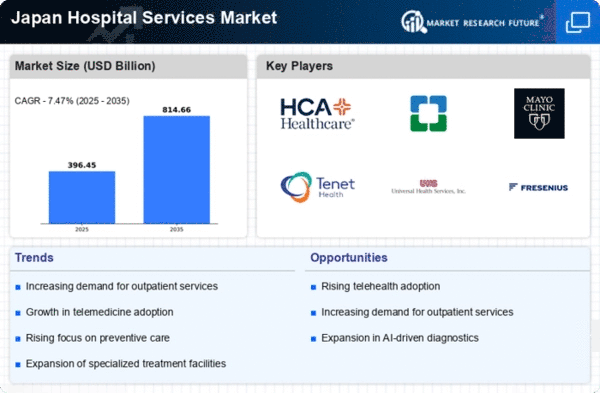
As per Market Research Future analysis, the Japan Hospital Services Market Size was estimated at 368.89 USD Billion in 2024. The Japan hospital services market is projected to grow from 396.45 USD Billion in 2025 to 814.66 USD Billion by 2035, exhibiting a compound annual growth rate (CAGR) of 7.4% during the forecast period 2025 - 2035

Key Market Trends & Highlights

The Japan The hospital services market. is experiencing a transformative shift driven by technological advancements and demographic changes.

  • Technological integration is reshaping hospital services, enhancing operational efficiency and patient care.
  • The aging population in Japan is leading to increased demand for healthcare services, particularly in geriatrics and chronic disease management.
  • Value-based care models are gaining traction, focusing on patient outcomes rather than service volume, which is influencing hospital strategies.
  • Rising healthcare expenditure and government initiatives are major drivers propelling the growth of specialized services in the market.

Market Size & Forecast

2024 Market Size 368.89 (USD Billion)
2035 Market Size 814.66 (USD Billion)
CAGR (2025 - 2035) 7.47%

Major Players

HCA Healthcare (US), Cleveland Clinic (US), Mayo Clinic (US), Tenet Healthcare (US), Universal Health Services (US), Fresenius SE & Co. KGaA (DE), Ramsay Santé (FR), NMC Health (AE), IHH Healthcare Berhad (MY)

Our Impact
Enabled $4.3B Revenue Impact for Fortune 500 and Leading Multinationals
Partnering with 2000+ Global Organizations Each Year
30K+ Citations by Top-Tier Firms in the Industry

Japan Hospital Services Market Trends

The The hospital services market in Japan. is currently experiencing a transformative phase, driven by various factors including technological advancements, demographic shifts, and evolving patient expectations. The aging population is a significant driver, as older individuals typically require more medical attention and specialized services. This demographic trend necessitates an expansion of healthcare facilities and services tailored to meet the needs of elderly patients. Furthermore, the integration of digital health technologies is reshaping how services are delivered, enhancing efficiency and patient engagement. Telemedicine, electronic health records, and mobile health applications are becoming increasingly prevalent, allowing for more accessible and streamlined care. In addition to demographic changes, the hospital services market is influenced by government policies aimed at improving healthcare access and quality. Initiatives to promote preventive care and chronic disease management are gaining traction, reflecting a shift towards value-based care. This approach emphasizes outcomes rather than volume, encouraging hospitals to focus on patient satisfaction and long-term health results. As these trends continue to evolve, the hospital services market is likely to adapt, fostering innovation and improving overall healthcare delivery in Japan.

Technological Integration

The incorporation of advanced technologies is reshaping the hospital services market. Innovations such as telemedicine and electronic health records are enhancing patient care and operational efficiency. These technologies facilitate remote consultations and streamline information sharing, ultimately improving patient outcomes.

Aging Population

Japan's demographic landscape is characterized by a rapidly aging population, which significantly impacts the demand for hospital services. As the elderly population grows, there is an increasing need for specialized care and facilities that cater to their unique health requirements.

Value-Based Care

The shift towards value-based care is becoming more pronounced within the hospital services market. This model prioritizes patient outcomes and satisfaction over the volume of services provided, encouraging hospitals to enhance the quality of care and focus on long-term health results.

Japan Hospital Services Market Drivers

Focus on Patient-Centric Care

The hospital services market in Japan is increasingly prioritizing patient-centric care, reflecting a broader shift towards personalized healthcare solutions. Hospitals are adopting strategies that emphasize patient engagement, satisfaction, and tailored treatment plans. This approach is supported by data indicating that patient satisfaction scores are directly linked to improved health outcomes. As hospitals invest in training staff and enhancing communication with patients, the overall quality of care is expected to improve. This focus on patient-centricity not only fosters loyalty but also positions hospitals to better meet the diverse needs of their communities, thereby driving growth in the hospital services market.

Rising Healthcare Expenditure

The hospital services market in Japan is experiencing a notable increase in healthcare expenditure, which is projected to reach approximately $500 billion by 2025. This rise is driven by various factors, including advancements in medical technology and an increasing demand for high-quality healthcare services. As the government allocates more funds to healthcare, hospitals are likely to expand their services and improve infrastructure. This trend indicates a growing commitment to enhancing patient care and outcomes, thereby positively impacting the hospital services market. Furthermore, the emphasis on preventive care and early diagnosis is expected to contribute to this upward trajectory, as hospitals adapt to meet the evolving needs of the population.

Government Initiatives and Policies

The hospital services market in Japan is significantly influenced by government initiatives aimed at improving healthcare access and quality. Recent policies have focused on enhancing the efficiency of hospital operations and promoting integrated care models. For example, the government has introduced funding programs to support hospitals in adopting innovative technologies and practices. These initiatives are expected to streamline processes and reduce costs, potentially leading to a more sustainable hospital services market. Additionally, the government's commitment to universal healthcare coverage ensures that a larger segment of the population can access hospital services, thereby driving demand and fostering growth in the sector.

Technological Advancements in Healthcare

The hospital services market in Japan is increasingly shaped by rapid technological advancements, which are transforming the way healthcare is delivered. Innovations such as telemedicine, electronic health records, and robotic surgery are becoming more prevalent, enhancing operational efficiency and patient care. For instance, the adoption of telemedicine has surged, with a reported increase of 30% in usage among hospitals in urban areas. These technologies not only improve patient outcomes but also reduce the burden on hospital staff, allowing for more efficient service delivery. As hospitals continue to integrate these advancements, the market is likely to experience significant growth and evolution.

Increased Demand for Specialized Services

The hospital services market in Japan is witnessing a surge in demand for specialized medical services, particularly in fields such as oncology, cardiology, and orthopedics. This trend is largely attributed to the rising prevalence of chronic diseases and lifestyle-related health issues among the population. As a result, hospitals are increasingly investing in specialized departments and advanced medical equipment to cater to these needs. For instance, the market for oncology services alone is expected to grow by 8% annually, reflecting the urgent need for targeted treatments. This shift towards specialization not only enhances patient outcomes but also positions hospitals to compete effectively in a rapidly evolving healthcare landscape.


Market Segment Insights

By Hospital Type: Private Hospital (Largest) vs. Public/ Community Hospital (Fastest-Growing)

In the Japan hospital services market, the distribution of market share among hospital types reveals significant preferences among patients and payers. Private hospitals hold the largest share, attracting patients with their advanced facilities and personalized services. They are often perceived as more reliable, leading to a strong preference among the affluent segment of the population. In contrast, public and community hospitals cater to a broader demographic, providing essential services at lower costs, yet they are increasingly becoming the choice for those seeking accessible healthcare. The growth trends in this segment indicate a dynamic shift towards public and community hospitals, which are recognized as the fastest-growing segment. Factors contributing to this growth include government initiatives promoting universal health coverage and rising demand for affordable healthcare solutions. Additionally, the increasing aging population in Japan is driving the establishment and expansion of these facilities, making them integral to addressing the country's healthcare needs.

Private Hospital (Dominant) vs. Public/ Community Hospital (Emerging)

Private hospitals in the Japan hospital services market are characterized by their advanced medical technology and patient-centered care, often providing a higher quality of service compared to their public counterparts. These hospitals attract a well-to-do demographic and enjoy a dominant market position due to their ability to invest in state-of-the-art facilities and specialized medical practitioners. Conversely, public and community hospitals are emerging as vital healthcare providers, focusing on affordability and accessibility. They play an essential role in the healthcare ecosystem, particularly for underserved populations. Their ability to adapt to governmental healthcare policies and the growing demand for comprehensive community health services positions them strategically for future growth, filling critical gaps in Japan's healthcare landscape.

By Service Type: Outpatient Services (Largest) vs. Inpatient Services (Fastest-Growing)

In the Japan hospital services market, the distribution of market share between outpatient and inpatient services highlights the dominance of outpatient services. Representing a substantial portion of overall service delivery, outpatient services are favored for their convenience and accessibility to patients. On the other hand, inpatient services, while smaller in market share, are crucial for handling complex medical cases that require extended care and support. Growth trends in the Japan hospital services market indicate a steady rise in demand for both service types. Outpatient services are experiencing consistent growth due to the increasing preference for less invasive treatments and shorter hospital stays, while inpatient services are projected to grow at a faster rate due to advancements in medical technology and an aging population that necessitates more complex healthcare solutions.

Outpatient Services (Dominant) vs. Inpatient Services (Emerging)

Outpatient services in the Japan hospital services market are characterized by their efficiency and increasing patient throughput, serving as the backbone of healthcare delivery. These services cater to a variety of medical needs, from routine check-ups to minor procedures, thus allowing patients to receive care without the need for overnight stays. Conversely, inpatient services, although traditionally seen as necessary for serious medical interventions, are emerging rapidly as hospitals innovate with advanced treatment methodologies and improved patient care protocols. This growth reflects a changing landscape where hospitals are not only addressing acute medical needs but also focusing on comprehensive care solutions, ultimately enhancing patient satisfaction and healthcare outcomes.

By Service Areas: Cardiovascular (Largest) vs. Acute Care (Fastest-Growing)

In the Japan hospital services market, market share is distributed among several key areas, with Cardiovascular services holding a significant portion. Other segments, such as Acute Care, also represent considerable shares, but they are rapidly expanding, particularly in response to increasing demand for urgent medical treatments. The other segments like Cancer Care and Diagnostics and Imaging follow, each contributing valuable shares to the overall market landscape. Growth trends in the segment indicate a robust upward trajectory for many areas, especially Acute Care, which is driven by rising health awareness and an aging population requiring more immediate medical attention. Concurrently, Cardiovascular services benefit from advancements in technology and increased public focus on heart health, solidifying their position as dominant players in the market. Additionally, other segments like Cancer Care and Neurorehabilitation are gaining traction as healthcare evolves to meet patient needs.

Cardiovascular (Dominant) vs. Acute Care (Emerging)

Cardiovascular services are currently the dominant segment in the market, characterized by advanced treatment options and robust infrastructure. This segment benefits from a skilled workforce and state-of-the-art technology, making it a leading choice for patients requiring specialized care. Conversely, Acute Care is emerging rapidly, fueled by the need for urgent medical responses and an increase in lifestyle-related health issues. As healthcare facilities adapt to provide comprehensive emergency services, the Acute Care segment is seeing innovations and expansions that cater to immediate patient needs. Both segments play crucial roles in enhancing healthcare delivery, with Cardiovascular services providing stability and Acute Care reshaping patient expectations.

Get more detailed insights about Japan Hospital Services Market

Key Players and Competitive Insights

The The hospital services market. in Japan is characterized by a competitive landscape that is increasingly shaped by innovation, strategic partnerships, and digital transformation. Key players such as HCA Healthcare (US), Fresenius SE & Co. KGaA (DE), and Ramsay Santé (FR) are actively pursuing strategies that enhance their operational capabilities and market presence. HCA Healthcare (US) has focused on expanding its telehealth services, which appears to be a response to the growing demand for remote healthcare solutions. Meanwhile, Fresenius SE & Co. KGaA (DE) is investing in advanced medical technologies, indicating a commitment to improving patient outcomes through innovation. Ramsay Santé (FR) has been enhancing its service offerings through strategic acquisitions, which suggests a focus on consolidating its market position and expanding its geographical reach.
The business tactics employed by these companies reflect a market structure that is moderately fragmented, with a mix of large multinational corporations and regional players. Localizing manufacturing and optimizing supply chains are common strategies that help these companies reduce costs and improve service delivery. The collective influence of these key players is significant, as they not only drive competition but also set benchmarks for quality and service standards within the market.
In October 2025, HCA Healthcare (US) announced a partnership with a leading Japanese technology firm to develop AI-driven diagnostic tools. This strategic move is likely to enhance HCA's service offerings in Japan, positioning the company at the forefront of technological innovation in healthcare. The integration of AI into diagnostic processes could potentially streamline operations and improve patient care, reflecting a broader trend towards digitalization in the industry.
In September 2025, Fresenius SE & Co. KGaA (DE) launched a new line of dialysis products tailored for the Japanese market. This initiative not only demonstrates the company's commitment to addressing local healthcare needs but also highlights its strategy of product localization. By aligning its offerings with the specific requirements of Japanese patients, Fresenius is likely to strengthen its competitive edge and foster customer loyalty.
In August 2025, Ramsay Santé (FR) completed the acquisition of a regional hospital network in Japan, which is expected to enhance its operational footprint in the country. This acquisition appears to be a strategic effort to increase market share and diversify service offerings. By integrating these facilities, Ramsay Santé may improve its service delivery and operational efficiency, thereby positioning itself as a more formidable competitor in the Japanese hospital services market.
As of November 2025, the competitive trends in the hospital services market are increasingly defined by digitalization, sustainability, and the integration of AI technologies. Strategic alliances are becoming more prevalent, as companies recognize the value of collaboration in enhancing service delivery and operational efficiency. Looking ahead, competitive differentiation is likely to evolve from traditional price-based competition to a focus on innovation, technology integration, and supply chain reliability. This shift underscores the importance of adaptability and forward-thinking strategies in navigating the complexities of the hospital services market.

Key Companies in the Japan Hospital Services Market include

Industry Developments

Recent developments in the Japan Hospital Services Market have been pivotal, with a notable increase in the adoption of advanced medical technologies. Companies like Hitachi and Philips are pushing innovations in telemedicine and diagnostic imaging, responding to the demands of an aging population. As of September 2023, Fujifilm Holdings has expanded its imaging solutions line-up to enhance patient care. Meanwhile, Mitsubishi Electric is focusing on smart hospital solutions that integrate artificial intelligence to streamline operations. 

Notable market growth is being driven by companies such as GE Healthcare and Siemens Healthineers, which are advancing their diagnostic capabilities.In terms of mergers and acquisitions, in October 2022, Terumo Corporation announced its acquisition of a leading cardiac device manufacturer, augmenting its portfolio significantly. 

Olympus has also been actively investing in start-ups that specialize in robotic surgery technology in March 2023. This strategic move aims to expand their market share in surgical services. The Japan Hospital Services Market has shown resilience with growing valuations, evidencing the sector's potential in improving healthcare delivery systems. Asahi Kasei and Ricoh are also revising strategies to enhance operational efficacy in hospitals across Japan.

Future Outlook

Japan Hospital Services Market Future Outlook

The Hospital Services Market in Japan is projected to grow at a 7.47% CAGR from 2025 to 2035, driven by technological advancements, an aging population, and increased healthcare spending.

New opportunities lie in:

  • Telehealth integration for remote patient monitoring solutions.
  • Development of specialized outpatient surgical centers.
  • Investment in AI-driven diagnostic tools for enhanced patient care.

By 2035, the market is expected to achieve substantial growth, reflecting evolving healthcare demands.

Market Segmentation

Japan Hospital Services Market Service Type Outlook

  • Outpatient Services
  • Inpatient Services

Japan Hospital Services Market Hospital Type Outlook

  • State-owned Hospital
  • Private Hospital
  • Public/ Community Hospital

Japan Hospital Services Market Service Areas Outlook

  • Cardiovascular
  • Acute Care
  • Cancer Care
  • Diagnostics and Imaging
  • Neurorehabilitation & Psychiatry Services
  • Gynecology
  • Others

Report Scope

MARKET SIZE 2024 368.89(USD Billion)
MARKET SIZE 2025 396.45(USD Billion)
MARKET SIZE 2035 814.66(USD Billion)
COMPOUND ANNUAL GROWTH RATE (CAGR) 7.47% (2025 - 2035)
REPORT COVERAGE Revenue Forecast, Competitive Landscape, Growth Factors, and Trends
BASE YEAR 2024
Market Forecast Period 2025 - 2035
Historical Data 2019 - 2024
Market Forecast Units USD Billion
Key Companies Profiled HCA Healthcare (US), Cleveland Clinic (US), Mayo Clinic (US), Tenet Healthcare (US), Universal Health Services (US), Fresenius SE & Co. KGaA (DE), Ramsay Santé (FR), NMC Health (AE), IHH Healthcare Berhad (MY)
Segments Covered Hospital Type, Service Type, Service Areas
Key Market Opportunities Integration of telehealth services enhances patient access and optimizes operational efficiency in the hospital services market.
Key Market Dynamics Technological advancements and regulatory changes are reshaping the competitive landscape of hospital services in Japan.
Countries Covered Japan
Leave a Comment

FAQs

What is the expected market size of the Japan Hospital Services Market in 2024?

The Japan Hospital Services Market is expected to be valued at 461.12 billion USD in 2024.

What will the market value of the Japan Hospital Services Market be in 2035?

The market is projected to reach 1200.0 billion USD by the year 2035.

What is the expected compound annual growth rate (CAGR) for the Japan Hospital Services Market from 2025 to 2035?

The market is expected to grow at a CAGR of 9.084 percent from 2025 to 2035.

Which hospital type is projected to have the largest market value in 2035?

The Public/Community Hospital segment is projected to be valued at 600.0 billion USD in 2035.

How much is the Private Hospital market valued at in 2024?

In 2024, the Private Hospital segment is valued at 180.0 billion USD.

Who are the key players in the Japan Hospital Services Market?

Major players include Hitachi, Philips, Mitsubishi Electric, and GE Healthcare among others.

What is the projected market size for State-owned Hospitals by 2035?

The State-owned Hospital segment is expected to reach a value of 200.0 billion USD in 2035.

What is the market value of Public/Community Hospitals in 2024?

The Public/Community Hospital segment is valued at 201.12 billion USD in 2024.

What growth opportunities exist within the Japan Hospital Services Market?

There are significant growth opportunities driven by technological advancements and rising healthcare demands.

What challenges might the Japan Hospital Services Market face?

Challenges include regulatory hurdles and the high costs associated with advanced medical technologies.

Download Free Sample

Kindly complete the form below to receive a free sample of this Report

Compare Licence

×
Features License Type
Single User Multiuser License Enterprise User
Price $4,950 $5,950 $7,250
Maximum User Access Limit 1 User Upto 10 Users Unrestricted Access Throughout the Organization
Free Customization
Direct Access to Analyst
Deliverable Format
Platform Access
Discount on Next Purchase 10% 15% 15%
Printable Versions