×
Request Free Sample ×

Kindly complete the form below to receive a free sample of this Report

* Please use a valid business email

Leading companies partner with us for data-driven Insights

clients tt-cursor
Hero Background

Japan Hip Implants Market

ID: MRFR/MED/49361-HCR
200 Pages
Garvit Vyas
February 2026

Japan Hip Implants Market Research Report By Product Type (Total Hip Replacement Implants, Fixed-Bearing Hip Implants, Mobile-Bearing Total Hip Implants, Partial Hip Replacement Implants, Hip Resurfacing Implants, Revision Hip Replacement Implants), By End User (Hospitals, Orthopedic Clinics, Ambulatory Surgical Centers) andBy Material (Metal-on-Polyethylene, Ceramic-on-Metal, Metal-on-Metal, Ceramic-on-Polyethylene, Ceramic-on-Ceramic) - Growth & Industry Forecast 2025 To 2035

Share:
Download PDF ×

We do not share your information with anyone. However, we may send you emails based on your report interest from time to time. You may contact us at any time to opt-out.

Japan Hip Implants Market Infographic
Purchase Options

Japan Hip Implants Market Summary

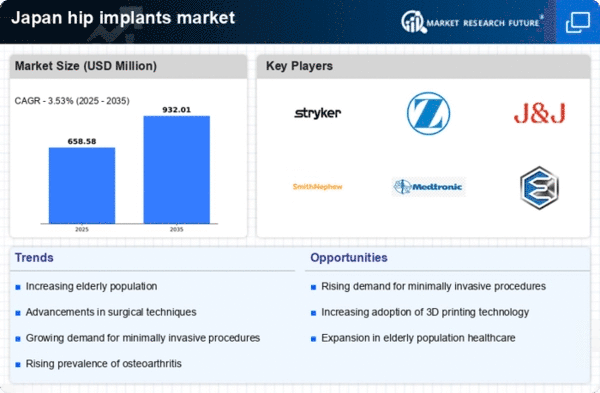
As per Market Research Future analysis, the Japan hip implants market size was estimated at 636.12 $ Million in 2024. The Japan hip implants market is projected to grow from 658.58 $ Million in 2025 to 932.01 $ Million by 2035, exhibiting a compound annual growth rate (CAGR) of 3.5% during the forecast period 2025 - 2035

Key Market Trends & Highlights

The Japan hip implants market is poised for growth driven by technological advancements and demographic shifts.

  • Technological advancements in hip implants are enhancing patient outcomes and surgical efficiency.
  • The aging population in Japan is contributing to an increased demand for hip replacement surgeries.
  • Regulatory support is facilitating the introduction of innovative products in the market.
  • Rising incidence of hip disorders and increased healthcare expenditure are key drivers of market growth.

Market Size & Forecast

2024 Market Size 636.12 (USD Million)
2035 Market Size 932.01 (USD Million)
CAGR (2025 - 2035) 3.53%

Major Players

Stryker (US), Zimmer Biomet (US), DePuy Synthes (US), Smith & Nephew (GB), Medtronic (US), Exactech (US), Aesculap (DE), B. Braun (DE), Ottobock (DE), Wright Medical (US)

Our Impact
Enabled $4.3B Revenue Impact for Fortune 500 and Leading Multinationals
Partnering with 2000+ Global Organizations Each Year
30K+ Citations by Top-Tier Firms in the Industry

Japan Hip Implants Market Trends

The hip implants market in Japan is currently experiencing notable growth, driven by an aging population and increasing prevalence of hip-related disorders. As the demographic landscape shifts, the demand for effective orthopedic solutions rises, prompting advancements in implant technology. Innovations in materials and design are enhancing the longevity and performance of hip implants, which appears to be a key factor influencing patient outcomes. Furthermore, the healthcare system in Japan is adapting to these changes, with hospitals and clinics increasingly adopting state-of-the-art surgical techniques and implant options. In addition, the regulatory environment is evolving to support the introduction of new products, which may further stimulate market expansion. The emphasis on patient safety and efficacy is paramount, leading to rigorous testing and approval processes for new devices. This focus on quality assurance is likely to foster consumer confidence in hip implants, thereby encouraging more individuals to seek surgical interventions. Overall, the hip implants market is poised for continued growth, reflecting broader trends in healthcare and technology within Japan.

Technological Advancements

Recent innovations in materials and design are enhancing the performance and durability of hip implants. These advancements may lead to improved patient outcomes and satisfaction, as well as a reduction in revision surgeries.

Aging Population

The increasing number of elderly individuals in Japan is contributing to a higher incidence of hip-related disorders. This demographic shift is likely to drive demand for hip implants, as older adults seek effective solutions for mobility and pain management.

Regulatory Support

The evolving regulatory framework in Japan is facilitating the introduction of new hip implant technologies. Stricter safety and efficacy standards may enhance consumer trust and encourage healthcare providers to adopt innovative solutions.

Japan Hip Implants Market Drivers

Rising Healthcare Expenditure

Japan's healthcare expenditure has been on the rise, which is a significant driver for the hip implants market. With an aging population and increasing healthcare needs, the government and private sectors are investing more in medical technologies and surgical procedures. Recent data indicates that healthcare spending in Japan has increased by approximately 10% annually, reflecting a commitment to improving patient care. This financial support enables hospitals to acquire advanced hip implant technologies and expand their surgical capabilities. Consequently, the hip implants market is likely to experience robust growth as healthcare facilities enhance their offerings to meet the rising demand.

Innovations in Implant Materials

Advancements in materials science are significantly influencing the hip implants market. The introduction of innovative materials, such as highly cross-linked polyethylene and ceramic coatings, enhances the durability and biocompatibility of implants. These innovations are crucial in reducing wear rates and improving patient outcomes. In Japan, the market has seen a shift towards these advanced materials, with a reported increase in their adoption by approximately 25% over the past few years. This trend not only improves the longevity of implants but also aligns with the growing patient preference for minimally invasive procedures. Consequently, the hip implants market is likely to benefit from these technological advancements.

Rising Incidence of Hip Disorders

The increasing prevalence of hip disorders in Japan is a primary driver for the hip implants market. Conditions such as osteoarthritis and rheumatoid arthritis are becoming more common, particularly among the aging population. According to recent health statistics, approximately 30% of individuals over 65 years old in Japan experience some form of hip-related issues. This trend necessitates surgical interventions, leading to a higher demand for hip implants. Furthermore, the Japanese healthcare system is adapting to these needs by enhancing access to orthopedic surgeries, which is likely to further stimulate market growth. The hip implants market is thus positioned to expand as more patients seek effective solutions for their hip disorders.

Increased Awareness of Joint Health

There is a growing awareness among the Japanese population regarding joint health and the importance of early intervention for hip-related issues. Educational campaigns and health programs are encouraging individuals to seek medical advice sooner, which is likely to lead to an increase in elective surgeries. This heightened awareness is reflected in a reported 20% rise in consultations for hip disorders in recent years. As more patients become informed about treatment options, the demand for hip implants is expected to rise correspondingly. Thus, the hip implants market stands to gain from this cultural shift towards proactive health management.

Government Initiatives for Healthcare Improvement

The Japanese government is actively promoting initiatives aimed at improving healthcare services, which directly impacts the hip implants market. Policies that support advanced surgical techniques and the integration of new technologies into healthcare facilities are being implemented. For instance, the government has allocated substantial funding to enhance orthopedic care, which is expected to increase the number of hip surgeries performed annually. This proactive approach may lead to a projected growth rate of 15% in the hip implants market over the next five years. As a result, the hip implants market is poised to thrive under these supportive governmental measures.


Market Segment Insights

By Product: Total Hip Implants (Largest) vs. Fixed-Bearing Hip Implants (Fastest-Growing)

In the Japan hip implants market, Total Hip Implants represent the largest segment, comprising a significant portion of the overall market share, driven by increasing prevalence of hip disorders and advancements in implant technology. Following this, Fixed-Bearing Hip Implants are also substantial, maintaining a considerable market presence due to their popularity among orthopedic surgeons and favorable patient outcomes. Emerging trends indicate a robust growth trajectory for Mobile-Bearing Total Hip Implants, which are gaining traction thanks to their low wear rates and enhanced range of motion. Additionally, the rise in minimally invasive procedures and an aging population are key drivers fueling the expansion of Partial Hip Implants and Revision Hip Implants, highlighting a broadening scope for various product offerings within the market.

Total Hip Implants (Dominant) vs. Partial Hip Implants (Emerging)

Total Hip Implants serve as the cornerstone of the Japan hip implants market, delivering comprehensive solutions for patients requiring full joint replacement. Their dominance is attributed to proven effectiveness and high success rates, making them the go-to choice for surgeons. Conversely, Partial Hip Implants are increasingly being recognized as an emerging option, offering surgeons a versatile approach for patients with specific conditions affecting only part of the hip joint. These implants facilitate quicker recovery and may result in a lower complication rate, further enhancing their appeal. As technology progresses, both segments are expected to evolve, catering to diverse patient needs and surgical preferences.

By End-User: Hospitals (Largest) vs. Orthopedic Clinics (Fastest-Growing)

In the Japan hip implants market, hospitals account for the largest share of the end-user segment, representing a significant portion of overall demand. This dominance is attributed to the comprehensive services offered and the advanced surgical capabilities found in these institutions, making them the preferred choice for hip implant procedures. On the other hand, orthopedic clinics are recognized as the fastest-growing segment within the Japan hip implants market. The rise of these clinics can be linked to the increasing focus on outpatient procedures and the high level of specialization they provide. This trend is further accelerated by the aging population and a greater emphasis on personalized care solutions.

Hospitals (Dominant) vs. Orthopedic Clinics (Emerging)

Hospitals stand as the dominant end-user in the Japan hip implants market due to their extensive infrastructure, access to advanced technology, and experienced surgical teams. They provide comprehensive surgical services, post-operative care, and have the capacity to handle complex cases. Conversely, orthopedic clinics are emerging rapidly as a viable option for hip implant surgeries. These specialized facilities prioritize outpatient care and offer convenience and personalized services. Their growth reflects changing patient preferences for quick treatment options and a focus on rehabilitation, aligning with modern healthcare trends.

By Material: Metal-on-Polyethylene (Largest) vs. Ceramic-on-Metal (Fastest-Growing)

In the Japan hip implants market, the distribution among the various material types indicates a strong preference for Metal-on-Polyethylene, which captures the largest market share due to its established reliability and cost-effectiveness. Following closely are Ceramic-on-Metal formulations, known for their wear resistance, which have gained traction among patients and healthcare providers alike. This distribution reflects ongoing trends towards longevity and performance in surgical materials, with Metal-on-Polyethylene holding a venerable position. The growth trends for this segment are largely driven by advancements in material science, leading to improved implant performance and patient outcomes. The increasing preference for lower wear rates associated with Ceramic-on-Metal types has positioned this segment as the fastest-growing in the market. Factors such as an aging population and a rise in hip-related health issues are also accelerating the demand for these innovative materials in surgical procedures.

Metal-on-Polyethylene (Dominant) vs. Ceramic-on-Metal (Emerging)

Metal-on-Polyethylene is regarded as the dominant material in the Japan hip implants market due to its favorable cost-to-performance ratio and widespread clinical acceptance. This combination has made it a preferred choice among surgeons, contributing to its sustained demand. In contrast, Ceramic-on-Metal is emerging as a significant contender, offering superior wear resistance and lower friction, which can lead to better outcomes for patients. As patient awareness increases and they seek longer-lasting solutions, Ceramic-on-Metal is likely to see enhanced adoption rates. Both materials reflect pivotal innovations in implant technology, catering to diverse patient needs and improving quality of life.

Get more detailed insights about Japan Hip Implants Market

Key Players and Competitive Insights

The hip implants market in Japan is characterized by a competitive landscape that is both dynamic and multifaceted. Key growth drivers include an aging population, increasing prevalence of orthopedic conditions, and advancements in implant technology. Major players such as Stryker (US), Zimmer Biomet (US), and DePuy Synthes (US) are strategically positioned to leverage these trends. Stryker (US) focuses on innovation and product development, particularly in minimally invasive surgical techniques, while Zimmer Biomet (US) emphasizes partnerships with healthcare providers to enhance patient outcomes. DePuy Synthes (US) is actively pursuing digital transformation initiatives to streamline operations and improve surgical precision, collectively shaping a competitive environment that prioritizes technological advancement and patient-centric solutions.In terms of business tactics, companies are increasingly localizing manufacturing to reduce lead times and enhance supply chain efficiency. The market structure appears moderately fragmented, with several key players holding substantial market shares. This fragmentation allows for a diverse range of products and innovations, yet the collective influence of these major companies drives a competitive atmosphere where differentiation is crucial.

In October Stryker (US) announced the launch of a new line of hip implants designed with advanced biomaterials aimed at improving integration with bone tissue. This strategic move is significant as it not only enhances Stryker's product portfolio but also positions the company to meet the growing demand for more biocompatible solutions in orthopedic surgery. The introduction of these implants could potentially lead to improved patient outcomes and reduced recovery times, thereby reinforcing Stryker's competitive edge.

In September Zimmer Biomet (US) entered into a strategic partnership with a leading Japanese healthcare provider to co-develop innovative hip implant solutions tailored to the local market. This collaboration is indicative of Zimmer Biomet's commitment to understanding regional needs and adapting its offerings accordingly. By aligning with local expertise, the company may enhance its market penetration and foster trust among healthcare professionals and patients alike.

In August DePuy Synthes (US) unveiled a new digital platform that integrates AI-driven analytics to assist surgeons in preoperative planning and intraoperative decision-making. This initiative underscores the growing trend of digitalization within the industry, as it aims to improve surgical outcomes and operational efficiency. By leveraging technology, DePuy Synthes is likely to set a new standard for surgical precision in hip implant procedures, further solidifying its market position.

As of November current competitive trends are increasingly defined by digitalization, sustainability, and the integration of AI technologies. Strategic alliances are becoming more prevalent, as companies recognize the value of collaboration in driving innovation and enhancing product offerings. The competitive landscape is shifting from a focus on price-based competition to one that emphasizes technological advancement, supply chain reliability, and the ability to deliver superior patient outcomes. This evolution suggests that companies that prioritize innovation and strategic partnerships will likely emerge as leaders in the hip implants market.

Key Companies in the Japan Hip Implants Market include

Industry Developments

Recent developments in the Japan Hip Implants Market show a rising demand for advanced orthopedic solutions, driven by an aging population and increasing awareness of joint health. Notably, in July 2023, Stryker announced the launch of an innovative hip implant designed to enhance patient outcomes, signaling an investment in Research and Development to cater to market needs.

Furthermore, Smith and Nephew have reported an increase in market share due to its comprehensive approach to personalized orthopedic solutions.Current affairs reveal that key players such as Medtronic and Zimmer Biomet are focused on expanding their footprint through strategic collaborations and technological advancements, integrating digital health solutions into their offerings.

The market has experienced a steady growth in valuation, attributed to rising surgical procedures and a shift toward minimally invasive techniques. In terms of mergers and acquisitions, there have been no publicly disclosed recent transactions. However, the competitive landscape remains dynamic, with companies like DePuy Synthes intensifying their market strategies to capture the needs of the Japanese healthcare system, which prioritizes quality care and patient satisfaction.

Future Outlook

Japan Hip Implants Market Future Outlook

The Hip Implants Market in Japan is projected to grow at a 3.53% CAGR from 2025 to 2035, driven by an aging population, technological advancements, and increasing healthcare expenditure.

New opportunities lie in:

  • Development of personalized implant solutions using 3D printing technology.
  • Expansion of telehealth services for post-operative care management.
  • Strategic partnerships with rehabilitation centers for integrated patient care.

By 2035, the hip implants market is expected to achieve substantial growth and innovation.

Market Segmentation

Japan Hip Implants Market Product Outlook

  • Total Hip implants
  • Fixed-Bearing Hip Implants
  • Mobile-Bearing Total Hip Implants
  • Partial Hip implants
  • Hip Resurfacing Implants
  • Revision Hip implants

Japan Hip Implants Market End-User Outlook

  • Hospitals
  • Orthopedic Clinics
  • Ambulatory Surgical Centers

Japan Hip Implants Market Material Outlook

  • Metal-on-Polyethylene
  • Ceramic-on-Metal
  • Metal-on-Metal
  • Ceramic-on-Polyethylene
  • Ceramic-on-Ceramic

Report Scope

MARKET SIZE 2024 636.12(USD Million)
MARKET SIZE 2025 658.58(USD Million)
MARKET SIZE 2035 932.01(USD Million)
COMPOUND ANNUAL GROWTH RATE (CAGR) 3.53% (2025 - 2035)
REPORT COVERAGE Revenue Forecast, Competitive Landscape, Growth Factors, and Trends
BASE YEAR 2024
Market Forecast Period 2025 - 2035
Historical Data 2019 - 2024
Market Forecast Units USD Million
Key Companies Profiled Stryker (US), Zimmer Biomet (US), DePuy Synthes (US), Smith & Nephew (GB), Medtronic (US), Exactech (US), Aesculap (DE), B. Braun (DE), Ottobock (DE), Wright Medical (US)
Segments Covered Product, End-User, Material
Key Market Opportunities Adoption of advanced materials and minimally invasive techniques enhances growth potential in the hip implants market.
Key Market Dynamics Rising demand for innovative hip implants driven by aging population and advancements in surgical techniques.
Countries Covered Japan
Leave a Comment

FAQs

What is the expected market value of the Japan Hip Implants Market in 2024?

The Japan Hip Implants Market is expected to be valued at 381.75 million USD in 2024.

What will be the market value of the Japan Hip Implants Market by 2035?

By 2035, the Japan Hip Implants Market is projected to reach a value of 532.25 million USD.

What is the estimated CAGR for the Japan Hip Implants Market from 2025 to 2035?

The estimated CAGR for the Japan Hip Implants Market from 2025 to 2035 is 3.067%.

Which product type dominates the Japan Hip Implants Market in 2024?

In 2024, Total Hip Replacement Implants are projected to dominate the Japan Hip Implants Market with a value of 150.0 million USD.

What is the market value of Fixed-Bearing Hip Implants in 2024?

Fixed-Bearing Hip Implants are expected to have a market value of 90.0 million USD in 2024.

Who are the key players in the Japan Hip Implants Market?

Major players in the Japan Hip Implants Market include Stryker, DePuy Synthes, and Zimmer Biomet.

What is the projected growth rate for Mobile-Bearing Total Hip Implants from 2025 to 2035?

Mobile-Bearing Total Hip Implants are expected to experience growth reaching 103.77 million USD by 2035.

What are the expected trends driving growth in the Japan Hip Implants Market?

Key trends driving growth include advancements in implant technology and an increasing aging population.

What is the market value for Partial Hip Replacement Implants in 2035?

The market value for Partial Hip Replacement Implants is projected to reach 62.34 million USD by 2035.

How do current global scenarios impact the Japan Hip Implants Market?

Current global scenarios may influence supply chain dynamics and regulatory changes affecting the Japan Hip Implants Market.

Download Free Sample

Kindly complete the form below to receive a free sample of this Report

Compare Licence

×
Features License Type
Single User Multiuser License Enterprise User
Price $4,950 $5,950 $7,250
Maximum User Access Limit 1 User Upto 10 Users Unrestricted Access Throughout the Organization
Free Customization
Direct Access to Analyst
Deliverable Format
Platform Access
Discount on Next Purchase 10% 15% 15%
Printable Versions