×
Request Free Sample ×

Kindly complete the form below to receive a free sample of this Report

* Please use a valid business email

Leading companies partner with us for data-driven Insights

clients tt-cursor
Hero Background

Japan Gpon Technology Market

ID: MRFR/ICT/58891-HCR
200 Pages
Aarti Dhapte
February 2026

Japan GPON Technology Market Size, Share and Trends Analysis Report By Technology (2.5G PON, XG-PON, XGS-PON, NG-PON2), By Component (Optical Network Terminal, Optical Line Terminal), and By Application (FTTH, Other FTTx, Mobile Backhaul) - Forecast to 2035

Share:
Download PDF ×

We do not share your information with anyone. However, we may send you emails based on your report interest from time to time. You may contact us at any time to opt-out.

Japan Gpon Technology Market Infographic
Purchase Options

Japan Gpon Technology Market Summary

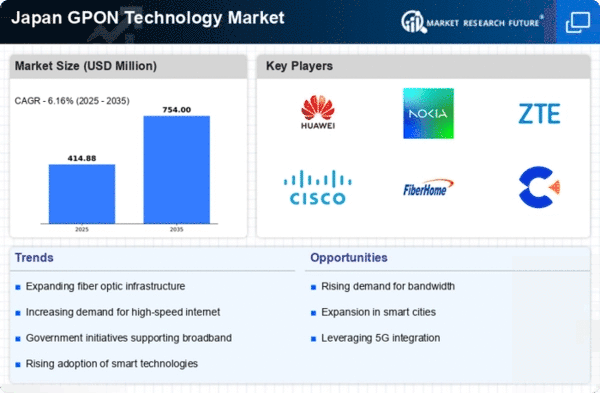
As per Market Research Future analysis, the Japan GPON Technology Market Size was estimated at 390.81 USD Million in 2024. The Japan gpon technology market is projected to grow from 414.88 USD Million in 2025 to 754.0 USD Million by 2035, exhibiting a compound annual growth rate (CAGR) of 6.1% during the forecast period 2025 - 2035

Key Market Trends & Highlights

The Japan GPON technology market is poised for substantial growth driven by increasing demand for high-speed internet and supportive government initiatives.

  • The largest segment in the Japan GPON technology market is residential broadband, while the fastest-growing segment is enterprise solutions.
  • Rising demand for high-speed internet continues to drive investments in GPON infrastructure across urban areas.
  • Government initiatives and policies are fostering a favorable environment for digital infrastructure development in Japan.
  • Key market drivers include increasing urbanization and consumer demand for enhanced digital experiences.

Market Size & Forecast

2024 Market Size 390.81 (USD Million)
2035 Market Size 754.0 (USD Million)
CAGR (2025 - 2035) 6.16%

Major Players

Huawei (CN), Nokia (FI), ZTE (CN), Cisco (US), FiberHome (CN), Calix (US), ADTRAN (US), Mitsubishi Electric (JP), NEC (JP)

Our Impact
Enabled $4.3B Revenue Impact for Fortune 500 and Leading Multinationals
Partnering with 2000+ Global Organizations Each Year
30K+ Citations by Top-Tier Firms in the Industry

Japan Gpon Technology Market Trends

The gpon technology market is currently experiencing a notable transformation, driven by the increasing demand for high-speed internet connectivity across various sectors. In Japan, the proliferation of smart devices and the rise of digital services have intensified the need for robust broadband solutions. This trend is further supported by government initiatives aimed at enhancing digital infrastructure, which appear to be fostering a conducive environment for the expansion of gpon technology. As a result, service providers are likely to invest significantly in upgrading their networks to meet consumer expectations for faster and more reliable internet access. Moreover, the competitive landscape within the gpon technology market is evolving, with numerous players striving to differentiate their offerings. This competition may lead to innovations in technology and service delivery, potentially enhancing user experiences. The focus on sustainability and energy efficiency is also becoming increasingly relevant, as stakeholders seek to minimize environmental impacts while maximizing performance. Overall, the gpon technology market in Japan seems poised for growth, driven by technological advancements and a commitment to improving connectivity for all citizens.

Rising Demand for High-Speed Internet

The gpon technology market is witnessing a surge in demand for high-speed internet services. This trend is largely attributed to the increasing reliance on digital platforms for work, education, and entertainment. As consumers seek faster and more reliable connections, service providers are compelled to enhance their infrastructure, thereby driving growth in the market.

Government Initiatives and Support

Government policies in Japan are playing a crucial role in the advancement of the gpon technology market. Initiatives aimed at improving digital infrastructure and promoting broadband access are likely to encourage investments from both public and private sectors. This support may facilitate the deployment of gpon technology, ensuring wider accessibility.

Focus on Sustainability and Efficiency

There is a growing emphasis on sustainability within the gpon technology market. Stakeholders are increasingly prioritizing energy-efficient solutions that reduce environmental impact. This focus on sustainability may lead to the development of innovative technologies that not only enhance performance but also align with global environmental goals.

Japan Gpon Technology Market Drivers

Rising Competition Among Service Providers

The competitive landscape among internet service providers in Japan is intensifying, which is driving innovation and investment in the gpon technology market. As companies strive to differentiate themselves, many are expanding their fiber-optic networks to offer superior services. This competition has led to a decrease in prices, making high-speed internet more accessible to a broader audience. Recent statistics indicate that the number of households subscribing to fiber-optic services has increased by 20% over the past year, reflecting the growing consumer preference for faster internet. The gpon technology market is thus benefiting from this competitive environment, as providers invest in infrastructure upgrades to attract and retain customers. This trend is likely to continue, further stimulating growth in the market.

Technological Advancements in Fiber Optics

Technological innovations in fiber optics are significantly influencing the gpon technology market in Japan. The development of new materials and techniques has led to improved performance and reduced costs in fiber-optic installations. For instance, advancements in passive optical networks (PON) technology have enabled higher data transmission rates and increased network efficiency. This is particularly relevant in Japan, where the demand for high-speed internet continues to rise. The gpon technology market is likely to see a boost as service providers adopt these new technologies to enhance their offerings. Furthermore, the integration of artificial intelligence and machine learning in network management is expected to optimize performance and reduce operational costs, making gpon solutions more attractive to both providers and consumers alike.

Increasing Urbanization and Connectivity Needs

The rapid urbanization in Japan is driving the demand for enhanced connectivity solutions, particularly in metropolitan areas. As cities expand, the need for high-speed internet access becomes paramount. The gpon technology market is poised to benefit from this trend, as urban residents increasingly seek reliable and fast internet services. According to recent data, urban areas in Japan have seen a surge in internet subscriptions, with a notable increase of approximately 15% in the last year alone. This urban growth necessitates the deployment of advanced fiber-optic networks, which gpon technology provides, ensuring that urban populations remain connected and can access digital services seamlessly. The gpon technology market is thus positioned to capitalize on this urbanization trend, as service providers look to upgrade their infrastructure to meet the growing demands of city dwellers.

Consumer Demand for Enhanced Digital Experiences

As digital consumption patterns evolve, there is a growing consumer demand for enhanced digital experiences in Japan. The proliferation of streaming services, online gaming, and smart home technologies is driving the need for faster and more reliable internet connections. The gpon technology market is well-positioned to meet these demands, as it offers the necessary bandwidth and low latency required for high-quality digital experiences. Recent surveys indicate that over 70% of consumers prioritize internet speed and reliability when choosing a service provider. This trend is prompting service providers to invest in gpon technology to ensure they can deliver the performance that consumers expect. The gpon technology market is thus likely to see sustained growth as providers adapt to the changing preferences of their customer base.

Government Policies Promoting Digital Infrastructure

The Japanese government is actively promoting the development of digital infrastructure, which is positively impacting the gpon technology market. Initiatives aimed at enhancing broadband access in rural and underserved areas are encouraging investments in fiber-optic networks. The government has set ambitious targets to ensure that 100% of households have access to high-speed internet by 2025, which is likely to drive demand for gpon technology solutions. Additionally, funding programs and incentives for service providers to expand their networks are becoming more prevalent. This supportive regulatory environment is fostering growth in the gpon technology market, as companies are more willing to invest in infrastructure projects that align with government objectives. The collaboration between public and private sectors is expected to yield significant advancements in connectivity across Japan.


Market Segment Insights

By Technology: XGS-PON (Largest) vs. NG-PON2 (Fastest-Growing)

The Japan gpon technology market is witnessing a dynamic distribution of market share among its segment values. XGS-PON has established itself as the largest player, owing to its robust performance and high capacity to meet growing data demands. In comparison, 2.5G PON and XG-PON are also significant players but are gradually losing ground to the advancements represented by XGS-PON and NG-PON2. Growth trends indicate a strong inclination towards higher capacity and faster technologies. NG-PON2 is emerging as the fastest-growing segment, driven by demand for ultra-fast internet and symmetrical speeds. This trend is propelled by increasing consumer requirements for bandwidth-intensive applications, positioning NG-PON2 as a crucial player in the near future.

Technology: XGS-PON (Dominant) vs. NG-PON2 (Emerging)

XGS-PON holds a dominant position in the Japan gpon technology market, characterized by its ability to deliver higher bandwidths and more efficient data transmission. This technology supports a wide range of applications, including 4K video streaming and cloud services, making it highly relevant in today's digital landscape. Conversely, NG-PON2 is rapidly emerging as an essential technology, with features that allow for flexible deployment and scalability. Its architecture accommodates future advancements, ensuring operators can meet evolving user demands. While XGS-PON caters to existing high-bandwidth needs, NG-PON2 offers a glimpse into the future, fostering innovation and expanding available services.

By Component: Optical Network Terminal (Largest) vs. Optical Line Terminal (Fastest-Growing)

The segment values in the Japan gpon technology market reveal a significant distribution, with Optical Network Terminals capturing the largest share among components. This dominance is attributed to their essential role in connecting end-user devices to fiber optic networks, offering high speeds and reliability. Meanwhile, Optical Line Terminals are emerging as vital components as the demand for high-speed internet continues to grow, showcasing a rapid increase in market presence. Growth trends in the Japan gpon technology market are favorable for both segments. The demand for high-speed internet fueled by remote work and digital services is driving expansion, with Optical Network Terminals remaining essential for existing infrastructure. At the same time, Optical Line Terminals are experiencing growth due to their critical function in supporting increased data traffic and service quality in next-generation networks, making them a key area of focus for future investments.

Optical Network Terminal (Dominant) vs. Optical Line Terminal (Emerging)

The Optical Network Terminal is currently the dominant component in the Japan gpon technology market, recognized for its ability to facilitate seamless multimedia support and efficient data flow to consumers. Its established infrastructure supports a wide range of residential and business applications, thereby reinforcing its market stature. In contrast, the Optical Line Terminal is identifying itself as an emerging player, strategically evolving to enhance the service capabilities and integrate more closely with advanced fiber optic networks. Its role in boosting connectivity and performance makes it a focal point for new developments and technological advancements in the sector.

By Application: FTTH (Largest) vs. Mobile Backhaul (Fastest-Growing)

In the Japan gpon technology market, the distribution of market share among the application segments reveals that FTTH occupies the largest portion, significantly dominating the landscape. Other FTTx applications follow, while Mobile Backhaul is carving out a niche with increasing relevance amidst growing data demands. The competitive environment shifts continuously as service providers enhance infrastructure capabilities to meet consumer expectations, thereby impacting market dynamics. The growth trends within these segments highlight FTTH as a stronghold due to its comprehensive reach and established technology, while Mobile Backhaul showcases rapid expansion fueled by the rise of mobile data traffic. The demand for faster internet and seamless connectivity services is a primary driver, propelling Mobile Backhaul into a key player position, necessitating investments in upgraded fiber optics and advanced technologies to keep pace with user requirements.

FTTH (Dominant) vs. Mobile Backhaul (Emerging)

FTTH stands out as the dominant segment, well-established and widely adopted across urban and rural areas, providing high-speed internet access to households and businesses alike. Its robust infrastructure is complemented by consistent upgrades that align with evolving requirements. In contrast, Mobile Backhaul is an emerging segment, gaining traction due to the significant increase in mobile data consumption, spurred by advancements in technology and user demand. This segment represents a critical link for mobile operators, needing significant enhancements in fiber connectivity as 5G rollout increases. Both segments have distinct characteristics, with FTTH focusing on direct access for end-users and Mobile Backhaul facilitating mobile network connectivity, influencing overall market growth in the competitive landscape.

Get more detailed insights about Japan Gpon Technology Market

Key Players and Competitive Insights

The gpon technology market in Japan is characterized by a dynamic competitive landscape, driven by rapid advancements in telecommunications infrastructure and increasing demand for high-speed internet services. Key players such as Huawei (CN), Nokia (FI), and NEC Corporation (Japan) are strategically positioned to leverage their technological expertise and extensive portfolios. Huawei (CN) focuses on innovation and R&D, aiming to enhance its product offerings, while Nokia (FI) emphasizes partnerships and collaborations to expand its market reach. NEC Corporation (Japan) is actively pursuing digital transformation initiatives, which are crucial for maintaining competitiveness in this evolving market. Collectively, these strategies contribute to a competitive environment that is increasingly focused on technological advancement and customer-centric solutions.In terms of business tactics, companies are localizing manufacturing and optimizing supply chains to enhance operational efficiency. The market structure appears moderately fragmented, with several key players exerting influence over various segments. This fragmentation allows for a diverse range of offerings, yet the collective strength of major companies like ZTE (CN) and Cisco (US) ensures that competition remains robust. The interplay between localized strategies and The gpon technology market dynamics in the coming years.

In October ZTE Corporation (CN) announced a strategic partnership with a leading Japanese telecommunications provider to enhance fiber-optic network capabilities. This collaboration is expected to bolster ZTE's presence in the Japanese market, allowing for the deployment of advanced gpon solutions tailored to local needs. The strategic importance of this partnership lies in its potential to accelerate network upgrades and improve service delivery, thereby positioning ZTE as a key player in the region.

In September Nokia (FI) unveiled its latest gpon technology solutions at a major industry conference in Tokyo, showcasing innovations aimed at increasing network efficiency and reducing operational costs. This event underscores Nokia's commitment to staying at the forefront of technological advancements. By introducing cutting-edge solutions, Nokia aims to attract new customers and strengthen its existing relationships, thereby enhancing its competitive position in the market.

In November NEC Corporation (Japan) launched a new initiative focused on integrating AI into its gpon technology offerings. This move is indicative of NEC's strategy to leverage artificial intelligence for optimizing network performance and enhancing customer experience. The integration of AI is likely to provide NEC with a competitive edge, as it aligns with the growing trend of digitalization in the telecommunications sector.

As of November the competitive trends in the gpon technology market are increasingly defined by digitalization, sustainability, and AI integration. Strategic alliances are playing a pivotal role in shaping the landscape, enabling companies to pool resources and expertise. Looking ahead, competitive differentiation is expected to evolve, with a shift from price-based competition to a focus on innovation, technology, and supply chain reliability. This transition may redefine how companies position themselves in the market, emphasizing the importance of technological advancements and sustainable practices.

Key Companies in the Japan Gpon Technology Market include

Industry Developments

Legacy GPON is still used and still depends on international manufacturers, even though Japan's GPON footprint tends to favor the Ethernet-PON (EPON/GE-PON) standard post-mandate. Citing cost-effectiveness and bandwidth requirements, the Japanese government ordered future FTTH construction to switch from BPON to Gigabit Ethernet PON (GE-PON/EPON) in late 2023.

For GPON and GE-PON access layer deployments, vendors such as Huawei, ZTE, Nokia, NEC, and Fujitsu, as well as integration by NTT, Fujitsu, and NTT DOCOMO, continue to be essential. Through NEC and NTT hardware, Nokia's Quillion chipset—which supports the progression from GPON to 25G PON—will be integrated into upcoming testbeds and trials in Japan.

Japanese integrators are assessing the ADTRAN and Calix platforms for controlled settings, and these systems are still advised for business and telecom pilots. Japan's fiber infrastructure is supported by routing, optical transport, chipset, and cabling components from Cisco, Arris/CommScope, Marvell, Broadcom, Hitachi, and Mitsubishi Electric.Overall, the ecosystem is still maintained by both local and international GPON providers through ISP networks, trials, and compatibility testing, even as Japan moves toward GE-PON architecture.

Future Outlook

Japan Gpon Technology Market Future Outlook

The GPON Technology Market in Japan is projected to grow at a 6.16% CAGR from 2025 to 2035, driven by increasing demand for high-speed internet and smart city initiatives.

New opportunities lie in:

  • Expansion of fiber optic infrastructure in rural areas
  • Development of integrated smart home solutions
  • Partnerships with local governments for urban connectivity projects

By 2035, the gpon technology market is expected to achieve substantial growth and innovation.

Market Segmentation

Japan Gpon Technology Market Component Outlook

  • Optical Network Terminal
  • Optical Line Terminal

Japan Gpon Technology Market Technology Outlook

  • 2.5G PON
  • XG-PON
  • XGS-PON
  • NG-PON2

Japan Gpon Technology Market Application Outlook

  • FTTH
  • Other FTTx
  • Mobile Backhaul

Report Scope

MARKET SIZE 2024 390.81(USD Million)
MARKET SIZE 2025 414.88(USD Million)
MARKET SIZE 2035 754.0(USD Million)
COMPOUND ANNUAL GROWTH RATE (CAGR) 6.16% (2025 - 2035)
REPORT COVERAGE Revenue Forecast, Competitive Landscape, Growth Factors, and Trends
BASE YEAR 2024
Market Forecast Period 2025 - 2035
Historical Data 2019 - 2024
Market Forecast Units USD Million
Key Companies Profiled Huawei (CN), Nokia (FI), ZTE (CN), Cisco (US), FiberHome (CN), Calix (US), ADTRAN (US), Mitsubishi Electric (JP), NEC (JP)
Segments Covered Technology, Component, Application
Key Market Opportunities Expansion of fiber optic infrastructure driven by increasing demand for high-speed internet access.
Key Market Dynamics Rising demand for high-speed internet drives competitive innovation in the gpon technology market.
Countries Covered Japan
Leave a Comment

FAQs

What is the expected market size of the Japan GPON Technology Market in 2024?

The Japan GPON Technology Market is expected to be valued at 386.93 million USD in 2024.

What will be the market size of the Japan GPON Technology Market by 2035?

By 2035, the Japan GPON Technology Market is projected to reach a valuation of 759.85 million USD.

What is the expected CAGR for the Japan GPON Technology Market from 2025 to 2035?

The expected CAGR for the Japan GPON Technology Market from 2025 to 2035 is 6.328%.

Which technology segment has the highest projected value in 2035 within the Japan GPON Technology Market?

The XGS-PON technology segment is projected to have the highest value at 240.0 million USD in 2035.

What was the market value of the NG-PON2 technology in 2024?

The NG-PON2 technology segment is valued at 101.93 million USD in 2024.

Who are the major players in the Japan GPON Technology Market?

Key players in the market include ZTE, Huawei, Nokia, and Cisco Systems among others.

What is the growth rate for the 2.5G PON technology segment from 2024 to 2035?

The 2.5G PON technology segment is expected to grow from 70.0 million USD in 2024 to 140.0 million USD in 2035.

How is the Japan GPON Technology Market expected to evolve in terms of challenges?

The market may face challenges such as the need for continuous innovation and addressing competition.

What applications are driving growth in the Japan GPON Technology Market?

Applications in broadband access and telecommunications are significantly driving the growth in this market.

How is the market influenced by current technological trends?

Emerging trends such as the shift towards higher bandwidth requirements are positively impacting market growth.

Download Free Sample

Kindly complete the form below to receive a free sample of this Report

Compare Licence

×
Features License Type
Single User Multiuser License Enterprise User
Price $4,950 $5,950 $7,250
Maximum User Access Limit 1 User Upto 10 Users Unrestricted Access Throughout the Organization
Free Customization
Direct Access to Analyst
Deliverable Format
Platform Access
Discount on Next Purchase 10% 15% 15%
Printable Versions