×
Request Free Sample ×

Kindly complete the form below to receive a free sample of this Report

* Please use a valid business email

Leading companies partner with us for data-driven Insights

clients tt-cursor
Hero Background

India Gpon Technology Market

ID: MRFR/ICT/58893-HCR
200 Pages
Aarti Dhapte
February 2026

India GPON Technology Market Research Report By Technology (2.5G PON, XG-PON, XGS-PON, NG-PON2), By Component (Optical Network Terminal, Optical Line Terminal), and By Application (FTTH, Other FTTx, Mobile Backhaul) - Forecast to 2035

Share:
Download PDF ×

We do not share your information with anyone. However, we may send you emails based on your report interest from time to time. You may contact us at any time to opt-out.

India Gpon Technology Market Infographic
Purchase Options

India Gpon Technology Market Summary

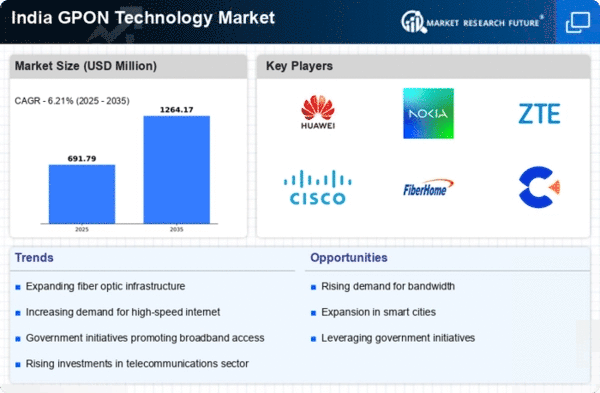
As per Market Research Future analysis, the India Gpon Technology Market size was estimated at 651.34 USD Million in 2024. The Gpon Technology market is projected to grow from 691.79 USD Million in 2025 to 1264.17 USD Million by 2035, exhibiting a compound annual growth rate (CAGR) of 6.2% during the forecast period 2025 - 2035

Key Market Trends & Highlights

The India GPON technology market is poised for substantial growth driven by increasing demand for high-speed internet and supportive government initiatives.

  • The demand for high-speed internet continues to rise, indicating a robust market trajectory.
  • Government initiatives and investments are playing a crucial role in the expansion of GPON technology across the country.
  • The residential segment emerges as the largest, while the enterprise segment is recognized as the fastest-growing in the market.
  • Key drivers include increasing internet penetration and government policy support, which are likely to propel market growth.

Market Size & Forecast

2024 Market Size 651.34 (USD Million)
2035 Market Size 1264.17 (USD Million)
CAGR (2025 - 2035) 6.21%

Major Players

Huawei (CN), Nokia (FI), ZTE (CN), Cisco (US), FiberHome (CN), Calix (US), ADTRAN (US), Mitsubishi Electric (JP)

Our Impact
Enabled $4.3B Revenue Impact for Fortune 500 and Leading Multinationals
Partnering with 2000+ Global Organizations Each Year
30K+ Citations by Top-Tier Firms in the Industry

India Gpon Technology Market Trends

The India Gpon Technology Market is currently experiencing a transformative phase, driven by the increasing demand for high-speed internet connectivity across various sectors. This surge is largely attributed to the rapid digitalization of services, which necessitates robust and efficient broadband solutions. As urbanization continues to rise, the need for reliable internet access becomes paramount, prompting both private and public sectors to invest in advanced fiber-optic technologies. The government has also initiated several programs aimed at enhancing digital infrastructure, which further supports the expansion of this market. Moreover, the competitive landscape is evolving, with numerous players entering the gpon technology market, offering innovative solutions tailored to meet diverse consumer needs. This influx of competition is likely to foster technological advancements and drive down costs, making high-speed internet more accessible to a broader audience. As the market matures, it appears poised for sustained growth, with potential opportunities in rural areas where connectivity remains limited. The ongoing developments suggest a promising future for the gpon technology market, as it aligns with the broader goals of digital inclusion and economic growth.

Rising Demand for High-Speed Internet

The gpon technology market is witnessing an upsurge in demand for high-speed internet services. This trend is primarily driven by the increasing reliance on digital platforms for education, business, and entertainment. As more users seek faster and more reliable internet connections, service providers are compelled to enhance their offerings, leading to a greater adoption of gpon technology.

Government Initiatives and Investments

Government initiatives aimed at improving digital infrastructure are significantly impacting the gpon technology market. Various programs and policies are being implemented to promote broadband connectivity, particularly in underserved regions. These efforts are likely to stimulate investment in gpon technology, facilitating wider access to high-speed internet.

Technological Advancements and Innovations

The gpon technology market is characterized by continuous technological advancements. Innovations in fiber-optic technology are enhancing the efficiency and performance of broadband services. As companies strive to differentiate themselves, the introduction of new features and capabilities is expected to drive growth and improve user experiences.

India Gpon Technology Market Drivers

Government Policy Support

Government initiatives play a pivotal role in shaping the gpon technology market in India. The National Digital Communications Policy aims to provide broadband access to all citizens, which aligns with the objectives of the gpon technology market. The government has allocated substantial funds, estimated at $10 billion, to enhance digital infrastructure, particularly in rural areas. This financial backing encourages private sector participation, fostering a competitive environment that benefits consumers. Additionally, regulatory frameworks are being established to streamline the deployment of gpon technology, ensuring that service providers can efficiently expand their networks. As a result, the gpon technology market is likely to witness accelerated growth, driven by supportive government policies and investments.

Rising Demand for Smart Homes

The gpon technology market is significantly influenced by the rising demand for smart home solutions in India. As consumers increasingly seek automation and connectivity within their homes, the need for robust internet infrastructure becomes paramount. The smart home market is projected to grow at a CAGR of 25% over the next five years, creating a substantial opportunity for gpon technology. High-speed internet is essential for the seamless operation of smart devices, including security systems, lighting, and appliances. Consequently, service providers are focusing on deploying gpon technology to meet this demand, thereby enhancing the overall market landscape. The integration of gpon technology into smart home solutions is likely to drive further adoption and innovation within the industry.

Increasing Internet Penetration

The gpon technology market in India is experiencing a notable surge due to the increasing internet penetration across urban and rural areas. As of 2025, internet penetration in India stands at approximately 60%, with projections indicating a rise to 75% by 2027. This growth is driven by the expanding digital landscape, where more individuals and businesses seek reliable and high-speed internet connectivity. The demand for seamless online experiences, including streaming, gaming, and remote work, propels the adoption of gpon technology. Consequently, service providers are investing in infrastructure to meet this demand, thereby enhancing the gpon technology market. The focus on bridging the digital divide further emphasizes the importance of gpon technology in delivering high-speed internet to underserved regions.

Competitive Landscape and Market Dynamics

The gpon technology market in India is characterized by a dynamic competitive landscape, with numerous players vying for market share. Major telecommunications companies are investing heavily in gpon infrastructure to differentiate their services and attract customers. As of 2025, the market is witnessing a shift towards bundled services, where internet, television, and telephony are offered together, enhancing customer value. This competitive environment encourages innovation and the introduction of advanced gpon solutions, which may lead to improved service quality and customer satisfaction. The ongoing rivalry among service providers is likely to stimulate growth in the gpon technology market, as companies strive to enhance their offerings and expand their reach.

Technological Advancements in Fiber Optics

Technological advancements in fiber optics are significantly impacting the gpon technology market in India. Innovations in fiber optic materials and manufacturing processes have led to the development of more efficient and cost-effective solutions. As of 2025, the introduction of next-generation fiber optics is expected to enhance data transmission speeds and reduce latency, making gpon technology even more attractive to service providers. These advancements not only improve the performance of existing networks but also facilitate the deployment of new gpon infrastructure. The continuous evolution of fiber optic technology is likely to drive the growth of the gpon technology market, as providers seek to leverage these innovations to meet the increasing demands for high-speed internet.


Market Segment Insights

By Technology: XGS-PON (Largest) vs. NG-PON2 (Fastest-Growing)

In the India gpon technology market, the share distribution among segment values highlights the prominent role of XGS-PON, which has established itself as the largest segment due to its superior capabilities and increasing demand among service providers. Conversely, NG-PON2 is gaining momentum, appealing to entities seeking advanced solutions with scalable bandwidth capacities, indicating a shift toward more sophisticated technology deployment. Growth trends in the market are driven by the escalating demand for high-speed internet and the proliferation of digital services across urban and rural regions. Initiatives like 'Digital India' are propelling investments in fiber optic technologies, increasing adoption rates of XGS-PON and making NG-PON2 a compelling choice for future-proofing networks while enhancing service quality and reliability.

Technology: XGS-PON (Dominant) vs. NG-PON2 (Emerging)

XGS-PON is characterized by its ability to deliver symmetrical multi-gigabit speeds, positioning it effectively as a dominant technology in the India gpon technology market. Its robustness and efficiency make it a preferred choice for telecom operators, addressing the high demand for bandwidth. In contrast, NG-PON2, as an emerging technology, showcases a commitment to backward compatibility while offering higher data rates and enhanced flexibility. Its rapid adoption reflects growing confidence among providers to implement advanced solutions that cater to future connectivity needs, thus playing a pivotal role in shaping the landscape of the market.

By Component: Optical Network Terminal (Largest) vs. Optical Line Terminal (Fastest-Growing)

The Component segment in the India gpon technology market reveals a distinct market share distribution, with Optical Network Terminals (ONTs) commanding a substantial portion due to their critical role in delivering high-speed internet connectivity. The ubiquity of ONTs in residential and commercial installations has solidified their dominance in the market, showcasing their essential function in supporting broadband services. Conversely, Optical Line Terminals (OLTs) are emerging rapidly, reflecting an increasing investment in infrastructure by service providers aiming to enhance network capabilities. Growth trends in this segment are driven by rising internet demand, digitalization, and the proliferation of smart devices across households and enterprises. The ongoing expansion of telecommunications networks in urban and rural areas further propels the need for reliable connectivity solutions, positioning ONTs as integral components in facilitating enhanced service delivery. Meanwhile, OLTs are experiencing rapid growth due to technological advancements and the need for high-capacity transmission, making them a focal point for innovation and development in the market.

Optical Network Terminal (Dominant) vs. Optical Line Terminal (Emerging)

The Optical Network Terminal (ONT) is recognized as the dominant player in the India gpon technology market, characterized by its pivotal role in connecting end-users to fiber-optic networks. ONTs are widely utilized in residential settings, allowing for efficient high-speed internet access and seamless connectivity across multiple devices. In contrast, the Optical Line Terminal (OLT) is an emerging component that supports multiple ONTs and is crucial for managing broadband traffic efficiently. As telecommunications infrastructure expands, the OLT's importance grows, with enhanced capabilities to support higher data volumes and improved network performance. Both devices are essential for advancing broadband services and adopting next-generation technologies, yet ONTs take precedence in terms of market establishment and user presence.

By Application: FTTH (Largest) vs. Mobile Backhaul (Fastest-Growing)

In the India gpon technology market, FTTH (Fiber to the Home) represents the largest segment, capturing a significant share of the market due to the increasing demand for high-speed internet connectivity in urban areas. Other FTTx solutions, though growing, do not match the dominance of FTTH. Mobile Backhaul is progressively gaining traction as operators look to enhance their mobile network infrastructure, especially with the advent of 5G services. Growth trends indicate that FTTH will continue to thrive, driven by urbanization and increasing bandwidth requirements for applications such as streaming and remote work. Meanwhile, Mobile Backhaul is witnessing rapid expansion, fueled by the need for robust backhaul solutions to support the increasing data traffic from mobile devices and IoT applications. The convergence of technologies and heightened competition is further propelling growth across both segments.

FTTH (Dominant) vs. Mobile Backhaul (Emerging)

FTTH is emerging as the dominant solution in the India gpon technology market, driven by its capability to deliver ultra-fast internet speeds directly to homes and businesses. Its widespread adoption is facilitated by increasing investments in fiber infrastructure and a growing consumer preference for high-bandwidth applications, such as video conferencing and online gaming. On the other hand, Mobile Backhaul is tagged as an emerging segment, gaining momentum as telecommunications operators enhance their networks to support newer technologies like 5G. This segment is marked by innovation as firms seek to establish resilient backhaul systems capable of handling escalating data traffic. As the market evolves, both FTTH and Mobile Backhaul play vital roles in shaping a robust communication landscape in the region.

Get more detailed insights about India Gpon Technology Market

Key Players and Competitive Insights

The gpon technology market in India is characterized by a dynamic competitive landscape, driven by increasing demand for high-speed internet and digital services. Major players such as Huawei (CN), Nokia (FI), and ZTE (CN) are actively shaping the market through strategic initiatives focused on innovation and regional expansion. Huawei (CN) has positioned itself as a leader in the sector, emphasizing research and development to enhance its product offerings. Nokia (FI), on the other hand, has been focusing on partnerships with local telecom operators to bolster its market presence, while ZTE (CN) is leveraging its cost-effective solutions to capture a larger share of the market. Collectively, these strategies contribute to a competitive environment that is increasingly focused on technological advancement and customer-centric solutions.Key business tactics within the gpon technology market include localizing manufacturing and optimizing supply chains to enhance operational efficiency. The market structure appears moderately fragmented, with several key players exerting influence over various segments. This fragmentation allows for a diverse range of offerings, catering to different customer needs and preferences. The collective influence of these major companies fosters a competitive atmosphere where innovation and service quality are paramount.

In October Huawei (CN) announced a significant investment in a new research facility in India, aimed at developing next-generation gpon solutions tailored to local market needs. This strategic move underscores Huawei's commitment to innovation and its intent to strengthen its foothold in the region. By localizing its R&D efforts, Huawei (CN) is likely to enhance its responsiveness to market demands and accelerate the deployment of advanced technologies.

In September Nokia (FI) entered into a strategic partnership with a leading Indian telecom operator to deploy a comprehensive gpon network across urban and rural areas. This collaboration is expected to enhance connectivity and support the digital transformation initiatives of the operator. Nokia's (FI) focus on partnerships reflects a broader trend in the market, where collaboration is seen as a key driver for expanding service reach and improving customer experience.

In August ZTE (CN) launched a new line of energy-efficient gpon products designed to reduce operational costs for service providers. This initiative aligns with the growing emphasis on sustainability within the industry. By offering solutions that not only enhance performance but also minimize environmental impact, ZTE (CN) is positioning itself as a forward-thinking player in the market, appealing to increasingly eco-conscious consumers and businesses.

As of November the competitive trends within the gpon technology market are heavily influenced by digitalization, sustainability, and the integration of AI technologies. Strategic alliances are becoming increasingly vital, as companies seek to leverage complementary strengths to enhance their market positions. The shift from price-based competition to a focus on innovation, technology, and supply chain reliability is evident, suggesting that future competitive differentiation will hinge on the ability to deliver cutting-edge solutions that meet evolving customer expectations.

Key Companies in the India Gpon Technology Market include

Industry Developments

Since early 2023, India’s GPON infrastructure has experienced significant expansion in urban and semi-urban areas. Dependence Jio has introduced high-speed fiber broadband plans utilizing GPON technology in major metropolitan areas, alongside innovative alternatives such as JioAirFiber and Jio SpaceFiber for last-mile connectivity solutions.Bharti Airtel, via Airtel Xstream, has expanded GPON-based FTTH services significantly, improving gigabit broadband accessibility under Project Leap. In 2022, BSNL merged with Bharat Broadband Network Limited (BBNL) and continues to spearhead extensive rural broadband initiatives via GPON through the BharatNet program, providing fiber connectivity to gram panchayats across the country.

ACT Fibernet maintained its leadership in metropolitan areas including Bengaluru, Delhi, and Hyderabad as a GPON-first provider, supporting smart-city initiatives and consistent broadband expansion.

RailTel Corporation utilized its extensive optical fiber network along railway corridors to facilitate leased GPON backhaul and metro ISPs.Regional entities such as You Broadband, Siti Networks, Den Networks, and FibreNet have implemented GPON access in specific urban areas, whereas Vodafone Idea persists in fiber distribution via partner infrastructure.These developments underscore India's comprehensive efforts to enhance national broadband penetration across residential, enterprise, and rural sectors, supported by GPON technology, with collaboration among vendors and operators facilitated by government-backed connectivity initiatives.

Future Outlook

India Gpon Technology Market Future Outlook

The GPON Technology Market in India is projected to grow at a 6.21% CAGR from 2025 to 2035, driven by increasing demand for high-speed internet and digital transformation initiatives.

New opportunities lie in:

  • Expansion of fiber optic infrastructure in rural areas
  • Development of integrated smart city solutions leveraging gpon
  • Partnerships with telecom operators for enhanced service delivery

By 2035, the gpon technology market is expected to be robust, driven by innovation and strategic partnerships.

Market Segmentation

India Gpon Technology Market Component Outlook

  • Optical Network Terminal
  • Optical Line Terminal

India Gpon Technology Market Technology Outlook

  • 2.5G PON
  • XG-PON
  • XGS-PON
  • NG-PON2

India Gpon Technology Market Application Outlook

  • FTTH
  • Other FTTx
  • Mobile Backhaul

Report Scope

MARKET SIZE 2024 651.34(USD Million)
MARKET SIZE 2025 691.79(USD Million)
MARKET SIZE 2035 1264.17(USD Million)
COMPOUND ANNUAL GROWTH RATE (CAGR) 6.21% (2025 - 2035)
REPORT COVERAGE Revenue Forecast, Competitive Landscape, Growth Factors, and Trends
BASE YEAR 2024
Market Forecast Period 2025 - 2035
Historical Data 2019 - 2024
Market Forecast Units USD Million
Key Companies Profiled Huawei (CN), Nokia (FI), ZTE (CN), Cisco (US), FiberHome (CN), Calix (US), ADTRAN (US), Mitsubishi Electric (JP)
Segments Covered Technology, Component, Application
Key Market Opportunities Expansion of fiber optic infrastructure enhances connectivity in underserved regions within the gpon technology market.
Key Market Dynamics Rising demand for high-speed internet drives competitive innovation in the GPON technology market.
Countries Covered India
Leave a Comment

FAQs

What is the expected market size of the India GPON Technology Market in 2024?

The India GPON Technology Market is expected to be valued at 644.88 million USD in 2024.

How much is the India GPON Technology Market projected to grow by 2035?

By 2035, the market is projected to grow to a value of 1048.3 million USD.

What is the expected CAGR for the India GPON Technology Market from 2025 to 2035?

The expected CAGR for the India GPON Technology Market from 2025 to 2035 is 4.516%.

Which technology segment of the GPON market holds the largest share in 2024?

The XGS-PON technology segment is valued at 200.0 million USD, making it the largest segment in 2024.

Who are the key players in the India GPON Technology Market?

Major players include BSNL, Tata Communications, ACT Fibernet, and Reliance Jio among others.

What is the market size for the 2.5G PON segment in 2024 and 2035?

The 2.5G PON segment is valued at 160.0 million USD in 2024 and is expected to reach 260.0 million USD by 2035.

How does the market for NG-PON2 technology look in 2024 and 2035?

In 2024, the NG-PON2 market is expected to be valued at 134.88 million USD and grow to 228.3 million USD by 2035.

What are the emerging trends in the India GPON Technology Market?

Emerging trends include increased demand for high-speed internet and advancements in broadband infrastructure.

What challenges does the India GPON Technology Market face?

Challenges include high initial investment costs and the need for skilled labor for deployment and maintenance.

What impact do current global events have on the India GPON Technology Market?

Current global events may affect supply chains and technology availability, impacting market growth.

Download Free Sample

Kindly complete the form below to receive a free sample of this Report

Compare Licence

×
Features License Type
Single User Multiuser License Enterprise User
Price $4,950 $5,950 $7,250
Maximum User Access Limit 1 User Upto 10 Users Unrestricted Access Throughout the Organization
Free Customization
Direct Access to Analyst
Deliverable Format
Platform Access
Discount on Next Purchase 10% 15% 15%
Printable Versions