×
Request Free Sample ×

Kindly complete the form below to receive a free sample of this Report

* Please use a valid business email

Leading companies partner with us for data-driven Insights

clients tt-cursor
Hero Background

Japan Geofencing Market

ID: MRFR/ICT/56284-HCR
200 Pages
Aarti Dhapte
February 2026

Japan Geofencing Market Size, Share and Trends Analysis Report By Application (Retail, Transportation, Healthcare, Real Estate, Automotive), By Technology (GPS, RFID, Beacons, Cellular, Wi-Fi), By End Use (Consumer, Enterprise, Government) and By Deployment Mode (Cloud, On-Premises)- Forecast to 2035

Share:
Download PDF ×

We do not share your information with anyone. However, we may send you emails based on your report interest from time to time. You may contact us at any time to opt-out.

Japan Geofencing Market Infographic
Purchase Options

Japan Geofencing Market Summary

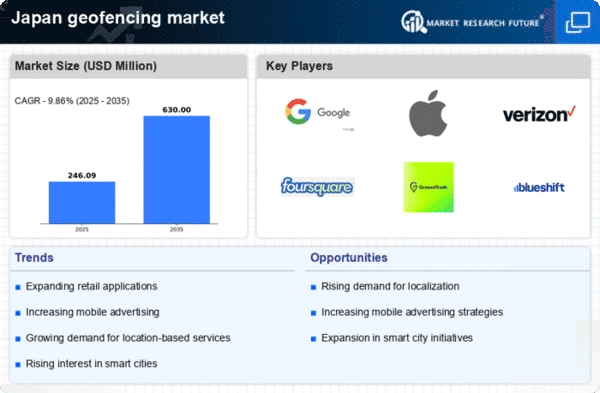
As per Market Research Future analysis, the Japan geofencing market Size was estimated at 224.0 USD Million in 2024. The Japan geofencing market is projected to grow from 246.09 USD Million in 2025 to 630.0 USD Million by 2035, exhibiting a compound annual growth rate (CAGR) of 9.8% during the forecast period 2025 - 2035

Key Market Trends & Highlights

The Japan geofencing market is experiencing robust growth driven by technological advancements and evolving consumer preferences.

  • The retail segment emerges as the largest contributor to the geofencing market, reflecting a shift towards personalized shopping experiences.
  • Integration with smart technologies is becoming increasingly prevalent, enhancing the functionality of geofencing applications.
  • Data privacy concerns are prompting companies to adopt more transparent practices in their geofencing strategies.
  • Key market drivers include the expansion of mobile advertising and the rising demand for enhanced customer engagement.

Market Size & Forecast

2024 Market Size 224.0 (USD Million)
2035 Market Size 630.0 (USD Million)
CAGR (2025 - 2035) 9.86%

Major Players

Google LLC (US), Apple Inc. (US), Verizon Communications Inc. (US), Foursquare Labs Inc. (US), GroundTruth Inc. (US), Blueshift (US), Geofeedia Inc. (US), Zebra Technologies Corporation (US)

Our Impact
Enabled $4.3B Revenue Impact for Fortune 500 and Leading Multinationals
Partnering with 2000+ Global Organizations Each Year
30K+ Citations by Top-Tier Firms in the Industry

Japan Geofencing Market Trends

The geofencing market in Japan is currently experiencing notable growth, driven by advancements in location-based technologies and increasing adoption across various sectors. Businesses are leveraging geofencing to enhance customer engagement, optimize marketing strategies, and improve operational efficiency. The integration of mobile applications with geofencing capabilities allows companies to deliver targeted promotions and notifications to consumers based on their real-time location. This trend appears to be particularly beneficial for retail and hospitality sectors, where personalized marketing can significantly influence consumer behavior. Moreover, the regulatory environment in Japan is evolving to support the expansion of geofencing technologies. Government initiatives aimed at promoting digital transformation and smart city developments are likely to create a conducive atmosphere for innovation in this field. As organizations continue to recognize the value of location intelligence, the geofencing market is poised for further expansion. The increasing focus on data privacy and security may also shape the future landscape, as businesses strive to balance effective marketing with consumer trust and compliance with regulations.

Increased Adoption in Retail

Retailers in Japan are increasingly utilizing geofencing to enhance customer experiences. By sending location-based promotions and notifications, businesses can engage consumers more effectively, driving foot traffic and sales.

Integration with Smart Technologies

The integration of geofencing with smart technologies, such as IoT devices, is becoming more prevalent. This synergy allows for real-time data collection and analysis, enabling businesses to make informed decisions based on consumer behavior.

Focus on Data Privacy

As the geofencing market expands, there is a growing emphasis on data privacy and security. Companies are implementing measures to ensure compliance with regulations, which may influence how geofencing solutions are developed and deployed.

Japan Geofencing Market Drivers

Advancements in IoT Technology

The rapid advancements in Internet of Things (IoT) technology are shaping the geofencing market in Japan. As IoT devices become more prevalent, the ability to collect and analyze location data in real-time is enhancing the effectiveness of geofencing applications. In 2025, the IoT market in Japan is projected to exceed $20 billion, indicating a strong foundation for the integration of geofencing solutions. This growth suggests that businesses are increasingly adopting IoT-enabled geofencing technologies to streamline operations and improve customer experiences. The geofencing market is poised to benefit from this trend, as organizations leverage IoT data to create more dynamic and responsive geofencing applications that cater to the evolving needs of consumers.

Expansion of Mobile Advertising

The rise of mobile advertising is a crucial driver for the geofencing market in Japan. As mobile device penetration continues to increase, businesses are leveraging geofencing technology to target consumers with location-based advertisements. In 2025, mobile advertising spending in Japan is projected to reach approximately $5 billion, indicating a growing reliance on mobile platforms for marketing strategies. This trend suggests that companies are increasingly recognizing the value of geofencing as a tool to enhance customer engagement and drive sales. By delivering personalized promotions to users within specific geographic boundaries, businesses can improve conversion rates and foster brand loyalty. The geofencing market is thus positioned to benefit from this shift towards mobile-centric advertising, as more organizations seek to implement location-aware campaigns that resonate with their target audiences.

Growth of Location-Based Services

The proliferation of location-based services (LBS) is significantly influencing the geofencing market in Japan. With the increasing availability of GPS-enabled devices, consumers are becoming more accustomed to services that utilize their location data. In 2025, the LBS market in Japan is expected to grow at a CAGR of 15%, reflecting a robust demand for applications that provide real-time information based on geographic location. This growth is likely to drive the adoption of geofencing technology, as businesses seek to enhance their service offerings through location-aware functionalities. The geofencing market stands to gain from this trend, as companies integrate geofencing capabilities into their LBS applications, enabling them to deliver tailored experiences to users and optimize operational efficiencies.

Increased Focus on Retail Analytics

The growing focus on retail analytics is a significant driver for the geofencing market in Japan. Retailers are increasingly utilizing data analytics to understand consumer behavior and optimize their marketing strategies. In 2025, the retail analytics market in Japan is expected to reach approximately $1.5 billion, highlighting the importance of data-driven decision-making in the retail sector. This trend indicates that businesses are likely to adopt geofencing technology to gather insights on foot traffic and customer interactions within specific locations. The geofencing market is thus positioned to thrive as retailers seek to enhance their analytical capabilities, enabling them to make informed decisions that drive sales and improve customer experiences.

Rising Demand for Enhanced Customer Engagement

The increasing emphasis on customer engagement is a pivotal driver for the geofencing market in Japan. Businesses are recognizing the importance of creating personalized experiences to retain customers and foster loyalty. In 2025, it is estimated that companies investing in customer engagement strategies will allocate around 30% of their marketing budgets to technologies like geofencing. This investment reflects a broader trend towards utilizing data-driven insights to enhance customer interactions. The geofencing market is likely to thrive as organizations implement geofencing solutions to send targeted notifications and promotions to customers based on their real-time location. This approach not only improves customer satisfaction but also drives sales, as businesses can effectively reach consumers at the right moment.


Market Segment Insights

By Application: Retail (Largest) vs. Transportation and Logistics (Fastest-Growing)

In the Japan geofencing market, the application segment is primarily dominated by retail, which commands a significant share due to the increasing integration of digital advertising and location-based services. Other sectors like transportation and logistics, healthcare, real estate, and automotive are noticeable contributors, but they hold comparatively smaller segments. Transportation and logistics have been gaining traction, turning heads as businesses recognize the value of geofencing in optimizing routes and enhancing operational efficiency. Looking ahead, the growth trends in this segment are largely driven by technological advancements and the rising demand for personalized marketing strategies. As companies in healthcare and automotive sectors begin to adopt geofencing solutions for patient engagement and smart vehicle features respectively, the overall market is expected to witness considerable expansion. Additionally, heightened consumer expectations for tailored experiences will push retailers to invest further in innovative geofencing applications.

Retail (Dominant) vs. Healthcare (Emerging)

Retail remains the dominant application in the Japan geofencing market, leveraging location data to enhance consumer engagement through targeted promotions and real-time notifications. The sector benefits from high consumer footfall and the growing reliance on smartphones for shopping, allowing retailers to refine their marketing strategies effectively. On the other hand, healthcare emerges as an innovative segment with increasing adoption of geofencing technologies for patient monitoring and care management. This sector's focus on improving patient experiences through location-based alerts and reminders positions it as a forward-thinking player in the market. As healthcare institutions recognize the potential of geofencing, we can expect its share to steadily rise in the coming years.

By Technology: GPS (Largest) vs. Beacons (Fastest-Growing)

In the Japan geofencing market, the technology segment reveals a competitive landscape with GPS commanding the largest share due to its established infrastructure and wide usage in location-based services. RFID and Cellular technologies are also significant, contributing to the overall market dynamics, yet they trail behind GPS. Beacons, while representing a smaller segment currently, are rapidly gaining traction, capturing the interest of various industries looking to leverage proximity marketing. Growth trends continue to favor Beacons as they offer enhanced customer engagement and targeting capabilities. The increasing sophistication of mobile applications and the rise of smart devices further fuel this segment's expansion. Innovations in Bluetooth technology coupled with consumer demand for location-aware services are driving Beacons to become the fastest-growing technology in the market, positioning them as a key player in the future landscape of geofencing solutions.

Technology: GPS (Dominant) vs. Beacons (Emerging)

GPS has established a dominant position in the Japan geofencing market, largely attributed to its robust reliability and accuracy in location tracking. It is widely adopted across various sectors including logistics, retail, and transportation. In contrast, Beacons are an emerging technology that uses low-energy Bluetooth signals to engage customers in close proximity, making them ideal for retail environments. As businesses look to enhance customer experiences through targeted promotions and location-based services, Beacons are poised to revolutionize marketing strategies. The flexibility and cost-effectiveness of these devices are appealing to businesses aiming for a competitive edge in the evolving market.

By End Use: Consumer (Largest) vs. Enterprise (Fastest-Growing)

In the Japan geofencing market, the consumer segment represents the largest share, capturing significant interest from various retail and mobile applications. Enterprises also contribute notably, with their adoption reflecting increasing investment in location-based technologies. Government usage currently remains comparatively lower but is gradually expanding due to a push for smart city initiatives and public safety measures. Growth trends indicate robust expansion within the consumer sector, driven by the rising popularity of location-based mobile advertising and personalized marketing strategies. Meanwhile, the enterprise segment's growth is fueled by wireless technologies and the need for enhanced operational efficiency. The trends suggest a competitive landscape where continuous technological advancements will shape future demands.

Consumer (Dominant) vs. Enterprise (Emerging)

The consumer segment in the Japan geofencing market represents a dominant force, primarily characterized by its widespread application in retail and marketing. Businesses engage in innovative strategies to attract customers through targeted advertisements based on real-time location data. This segment thrives on consumer behavior analysis and the increasing popularity of smartphone penetration. On the other hand, the enterprise segment is emerging as a crucial area, marked by its potential to optimize fleet management, logistics, and workforce monitoring, enhancing operational processes. Both segments display distinct characteristics: while the consumer segment seeks to drive sales through immediate consumer interaction, the enterprise segment focuses on long-term efficiency and cost savings, showing a strong propensity for technological adoption.

By Deployment Mode: Cloud (Largest) vs. On-Premises (Fastest-Growing)

In the Japan geofencing market, the deployment mode is predominantly influenced by the rising adoption of cloud-based solutions. The Cloud segment dominates the landscape, capturing the majority of market share due to its scalability and flexibility, which appeals to businesses seeking to enhance operational efficiency. Conversely, the On-Premises segment holds a smaller share but is witnessing significant interest from enterprises with stringent data security requirements, positioning it as a notable player in this dynamic landscape. Looking towards future growth, the Cloud deployment mode is expected to continue its expansion, driven by technological advancements and the increasing demand for integrated solutions. Meanwhile, the On-Premises segment is emerging as the fastest-growing option as organizations prioritize security and control over their data. As more companies migrate towards hybrid solutions, the interdependence of these segments will play a critical role in shaping the overall market trajectory.

Cloud (Dominant) vs. On-Premises (Emerging)

The Cloud deployment mode stands out as the dominant force in the Japan geofencing market, offering unparalleled advantages such as ease of access, reduced maintenance costs, and the ability to easily scale resources according to business needs. Its appeal to businesses of all sizes drives the continuous adoption of cloud solutions, ensuring a steady growth trajectory. On the other hand, the On-Premises segment is emerging as a key player, catering to organizations that prioritize control and security of their data assets. This segment is quickly gaining traction, particularly among industries with stringent compliance mandates, thus creating a balanced ecosystem where businesses can choose their preferred deployment strategy based on individual requirements.

Get more detailed insights about Japan Geofencing Market

Key Players and Competitive Insights

The geofencing market in Japan is characterized by a dynamic competitive landscape, driven by rapid technological advancements and increasing demand for location-based services. Major players such as Google LLC (US), Apple Inc. (US), and Verizon Communications Inc. (US) are at the forefront, leveraging their extensive technological capabilities and vast user bases. Google LLC (US) focuses on enhancing its geolocation services through continuous innovation, while Apple Inc. (US) emphasizes privacy and user experience in its geofencing applications. Verizon Communications Inc. (US) is strategically expanding its 5G network, which is expected to bolster geofencing capabilities, particularly in urban areas. Collectively, these strategies contribute to a competitive environment that is increasingly centered around technological differentiation and user-centric solutions.In terms of business tactics, companies are increasingly localizing their operations to better cater to the Japanese market. This includes optimizing supply chains to ensure timely delivery of services and products. The competitive structure of the geofencing market appears moderately fragmented, with several key players vying for market share. However, the influence of major companies is substantial, as they set industry standards and drive innovation, thereby shaping the overall market dynamics.

In October Google LLC (US) announced the launch of a new geofencing feature integrated into its Google Maps platform, aimed at enhancing real-time location tracking for businesses. This strategic move is significant as it not only strengthens Google’s position in the geofencing market but also provides businesses with advanced tools to engage customers more effectively. The integration of this feature is likely to attract more businesses to utilize Google’s services, thereby increasing its market share.

In September Apple Inc. (US) unveiled a partnership with a leading Japanese retail chain to implement advanced geofencing technology in their stores. This collaboration is pivotal as it allows Apple to showcase its commitment to enhancing customer experiences through personalized marketing strategies. By leveraging geofencing, the retail chain can send targeted promotions to customers' devices when they are in proximity to the store, potentially increasing foot traffic and sales.

In November Verizon Communications Inc. (US) revealed plans to expand its 5G network coverage in Japan, specifically targeting urban areas where geofencing applications are most prevalent. This expansion is crucial as it enhances the reliability and speed of geofencing services, enabling businesses to utilize real-time data more effectively. The move is expected to position Verizon as a leader in providing robust geofencing solutions, particularly in densely populated regions.

As of November current trends in the geofencing market indicate a strong emphasis on digitalization, sustainability, and the integration of artificial intelligence (AI) into location-based services. Strategic alliances among key players are increasingly shaping the competitive landscape, fostering innovation and enhancing service offerings. Looking ahead, it is anticipated that competitive differentiation will evolve, with a shift from price-based competition to a focus on technological innovation, reliability of supply chains, and enhanced customer experiences. This transition underscores the importance of adaptability and forward-thinking strategies in maintaining a competitive edge in the geofencing market.

Key Companies in the Japan Geofencing Market include

Industry Developments

Recent developments in the Japan Geofencing Market have shown significant growth, particularly in sectors such as retail and transportation. Companies like Geollect and Zenrin are actively enhancing their geolocation services to integrate with various smart city initiatives across Japan, driven by the government's push for digital transformation in urban management. 

In August 2023, AirMap expanded its services in Japan, focusing on drone navigation and management, which directly ties into geofencing applications for regulatory compliance and safety management. Furthermore, the collaboration between Xactly and Foursquare aims to improve location-based analytics for businesses, enhancing customer engagement strategies. As for mergers and acquisitions, no recent publicly known mergers or acquisitions related to the specified companies in the Japan Geofencing Market have been recorded. 

However, market analysts highlight a growing interest in partnerships to leverage advanced technologies, including Artificial Intelligence and machine learning, which are becoming pivotal for enhancing accuracy in geofencing solutions. The Japan Geofencing Market continues to see technological advancements, with key players innovating to meet the demands of evolving consumer behaviors and regulatory frameworks.

Future Outlook

Japan Geofencing Market Future Outlook

The Geofencing Market in Japan is projected to grow at a 9.86% CAGR from 2025 to 2035, driven by advancements in mobile technology and increased demand for location-based services.

New opportunities lie in:

  • Integration of AI-driven analytics for targeted marketing campaigns.
  • Development of customizable geofencing solutions for retail environments.
  • Expansion of geofencing applications in logistics and supply chain management.

By 2035, the geofencing market is expected to achieve substantial growth and innovation.

Market Segmentation

Japan Geofencing Market End Use Outlook

  • Consumer
  • Enterprise
  • Government

Japan Geofencing Market Technology Outlook

  • GPS
  • RFID
  • Beacons
  • Cellular
  • Wi-Fi

Japan Geofencing Market Application Outlook

  • Retail
  • Transportation and Logistics
  • Healthcare
  • Real Estate
  • Automotive

Japan Geofencing Market Deployment Mode Outlook

  • Cloud
  • On-Premises

Report Scope

MARKET SIZE 2024 224.0(USD Million)
MARKET SIZE 2025 246.09(USD Million)
MARKET SIZE 2035 630.0(USD Million)
COMPOUND ANNUAL GROWTH RATE (CAGR) 9.86% (2025 - 2035)
REPORT COVERAGE Revenue Forecast, Competitive Landscape, Growth Factors, and Trends
BASE YEAR 2024
Market Forecast Period 2025 - 2035
Historical Data 2019 - 2024
Market Forecast Units USD Million
Key Companies Profiled Google LLC (US), Apple Inc. (US), Verizon Communications Inc. (US), Foursquare Labs Inc. (US), GroundTruth Inc. (US), Blueshift (US), Geofeedia Inc. (US), Zebra Technologies Corporation (US)
Segments Covered Application, Technology, End Use, Deployment Mode
Key Market Opportunities Integration of advanced analytics and AI in geofencing solutions enhances targeted marketing strategies.
Key Market Dynamics Rising demand for location-based services drives innovation and competition in the geofencing market.
Countries Covered Japan
Leave a Comment

FAQs

What is the expected market size of the Japan Geofencing Market in 2024?

The Japan Geofencing Market is expected to be valued at 224.0 USD Million in 2024.

What will the market size reach by 2035?

By 2035, the Japan Geofencing Market is projected to grow to 756.0 USD Million.

What is the projected CAGR for the Japan Geofencing Market from 2025 to 2035?

The expected CAGR for the Japan Geofencing Market from 2025 to 2035 is 11.693%.

Which application segment will dominate the Japan Geofencing Market by 2035?

The Automotive application segment is expected to dominate with a valuation of 216.0 USD Million by 2035.

How much is the Retail application segment expected to be valued at in 2035?

The Retail application segment is projected to reach 175.0 USD Million in 2035.

What will the Transportation segment's market value be by 2035?

The Transportation segment is anticipated to have a market value of 140.0 USD Million by 2035.

What is the expected market value for the Healthcare application segment in 2035?

The Healthcare application segment is expected to be valued at 120.0 USD Million in 2035.

Who are the major players in the Japan Geofencing Market?

Key players in the market include Xactly, Geogram, and Zenrin among others.

How much is the Real Estate segment expected to grow by 2035?

The Real Estate segment is projected to grow to 105.0 USD Million by 2035.

What challenges may affect the growth of the Japan Geofencing Market?

Challenges such as privacy concerns and technological integration may impact market growth.

Download Free Sample

Kindly complete the form below to receive a free sample of this Report

Compare Licence

×
Features License Type
Single User Multiuser License Enterprise User
Price $4,950 $5,950 $7,250
Maximum User Access Limit 1 User Upto 10 Users Unrestricted Access Throughout the Organization
Free Customization
Direct Access to Analyst
Deliverable Format
Platform Access
Discount on Next Purchase 10% 15% 15%
Printable Versions