×
Request Free Sample ×

Kindly complete the form below to receive a free sample of this Report

* Please use a valid business email

Leading companies partner with us for data-driven Insights

clients tt-cursor
Hero Background

Germany Geofencing Market

ID: MRFR/ICT/56283-HCR
200 Pages
Aarti Dhapte
February 2026

Germany Geofencing Market Research Report By Application (Retail, Transportation, Healthcare, Real Estate, Automotive), By Technology (GPS, RFID, Beacons, Cellular, Wi-Fi), By End Use (Consumer, Enterprise, Government) and By Deployment Mode (Cloud, On-Premises)- Forecast to 2035

Share:
Download PDF ×

We do not share your information with anyone. However, we may send you emails based on your report interest from time to time. You may contact us at any time to opt-out.

Germany Geofencing Market Infographic
Purchase Options

Germany Geofencing Market Summary

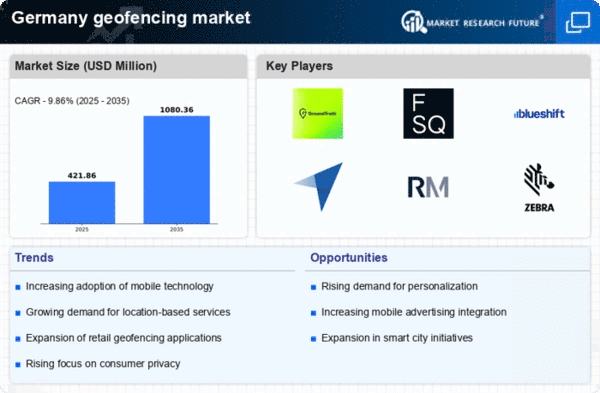
As per Market Research Future analysis, the Germany geofencing market Size was estimated at 384.0 USD Million in 2024. The Germany geofencing market is projected to grow from 421.86 USD Million in 2025 to 1080.36 USD Million by 2035, exhibiting a compound annual growth rate (CAGR) of 9.8% during the forecast period 2025 - 2035

Key Market Trends & Highlights

The Germany geofencing market is experiencing robust growth driven by technological advancements and evolving consumer preferences.

  • The retail segment represents the largest share of the geofencing market in Germany, reflecting a strong trend towards location-based marketing.
  • Integration with IoT devices is emerging as a key trend, enhancing the capabilities of geofencing applications across various sectors.
  • Data privacy concerns are increasingly influencing geofencing strategies, prompting businesses to adopt more transparent practices.
  • The rising demand for location-based marketing and advancements in mobile technology are significant drivers propelling market growth.

Market Size & Forecast

2024 Market Size 384.0 (USD Million)
2035 Market Size 1080.36 (USD Million)
CAGR (2025 - 2035) 9.86%

Major Players

GroundTruth (US), Foursquare (US), Blueshift (US), Geofeedia (US), Reveal Mobile (US), Zebra Technologies (US), Gimbal (US), Mapbox (US)

Our Impact
Enabled $4.3B Revenue Impact for Fortune 500 and Leading Multinationals
Partnering with 2000+ Global Organizations Each Year
30K+ Citations by Top-Tier Firms in the Industry

Germany Geofencing Market Trends

The geofencing market in Germany is currently experiencing notable growth, driven by advancements in location-based technologies and increasing adoption across various sectors. Businesses are leveraging geofencing to enhance customer engagement, optimize marketing strategies, and improve operational efficiency. The integration of mobile applications with geofencing capabilities allows companies to deliver targeted promotions and notifications to consumers based on their real-time location. This trend appears to be particularly beneficial for retail and hospitality sectors, where personalized marketing can significantly influence consumer behavior. Moreover, the regulatory environment in Germany supports the development of geofencing technologies, with a focus on data privacy and security. As consumers become more aware of their data rights, companies are adapting their geofencing strategies to ensure compliance with local regulations. This adaptation not only fosters consumer trust but also encourages innovation in the geofencing market. The future of this market seems promising, with potential expansions into new industries and applications, such as smart cities and autonomous vehicles, which could further drive demand for geofencing solutions.

Increased Adoption in Retail

Retailers in Germany are increasingly utilizing geofencing to enhance customer experiences. By sending location-based offers and promotions, businesses can attract foot traffic and boost sales. This trend indicates a shift towards more personalized marketing strategies that cater to individual consumer preferences.

Integration with IoT Devices

The integration of geofencing with Internet of Things (IoT) devices is becoming more prevalent. This synergy allows for real-time data collection and analysis, enabling businesses to make informed decisions. Such advancements may lead to improved operational efficiencies and enhanced customer interactions.

Focus on Data Privacy

As data privacy concerns grow, companies in the geofencing market are prioritizing compliance with regulations. This focus on safeguarding consumer information not only builds trust but also drives innovation in geofencing solutions, ensuring that businesses can effectively engage customers while respecting their privacy.

Germany Geofencing Market Drivers

Advancements in Mobile Technology

Technological advancements in mobile devices are significantly influencing the geofencing market in Germany. With the proliferation of smartphones equipped with GPS capabilities, businesses are now able to implement geofencing solutions more effectively. The increasing penetration of mobile internet, which is projected to reach 95% by the end of 2025, further facilitates the adoption of geofencing technologies. This trend allows companies to engage customers in real-time, providing them with relevant offers based on their location. As mobile technology continues to evolve, the geofencing market is likely to benefit from enhanced functionalities and improved user experiences, making it an attractive option for businesses aiming to optimize their marketing strategies.

Increased Focus on Customer Experience

In the competitive landscape of the German market, there is an increasing emphasis on enhancing customer experience, which is driving the geofencing market. Companies are recognizing that personalized interactions can significantly influence customer loyalty and retention. By utilizing geofencing technology, businesses can tailor their marketing efforts to individual preferences and behaviors, thereby creating a more engaging shopping experience. In 2025, it is anticipated that businesses investing in customer experience initiatives will see a return on investment of up to 30%. This focus on customer-centric strategies is likely to propel the growth of the geofencing market, as organizations seek to differentiate themselves in a crowded marketplace.

Regulatory Support for Digital Innovation

The German government is actively promoting digital innovation, which is positively impacting the geofencing market. Initiatives aimed at fostering technological advancements and supporting startups are creating a conducive environment for the growth of geofencing solutions. The government's commitment to enhancing digital infrastructure, including investments in 5G networks, is expected to facilitate the deployment of geofencing technologies across various sectors. As regulatory frameworks evolve to support data-driven innovations, businesses are likely to adopt geofencing solutions more readily. This supportive regulatory landscape is indicative of a promising future for the geofencing market, as it encourages companies to explore new opportunities and enhance their service offerings.

Growth of E-Commerce and Delivery Services

The rise of e-commerce and delivery services in Germany is a significant driver for the geofencing market. As online shopping becomes increasingly popular, businesses are seeking innovative ways to enhance customer experience and streamline operations. Geofencing technology enables retailers to send notifications to customers when they are near a store or to provide real-time updates on delivery status. In 2025, the e-commerce sector in Germany is expected to generate revenues exceeding €100 billion, with a substantial portion attributed to the integration of geofencing solutions. This trend indicates that the geofencing market is likely to expand as companies leverage location-based services to improve customer satisfaction and operational efficiency.

Rising Demand for Location-Based Marketing

The geofencing market in Germany is experiencing a notable surge in demand for location-based marketing strategies. Businesses are increasingly recognizing the potential of geofencing to enhance customer engagement and drive sales. In 2025, it is estimated that the market for location-based services will reach approximately €1.5 billion, reflecting a growth rate of around 20% annually. This trend is largely driven by the need for personalized marketing approaches that resonate with consumers. As companies leverage geofencing technology to deliver targeted promotions and advertisements, the overall effectiveness of marketing campaigns is likely to improve, thereby solidifying the role of geofencing in the marketing landscape. The geofencing market is thus poised for substantial growth as businesses seek innovative ways to connect with their customers.


Market Segment Insights

By Application: Retail (Largest) vs. Healthcare (Fastest-Growing)

The application segment in the Germany geofencing market showcases a diverse distribution among its various categories. Retail holds the largest share, leveraging geofencing technology to enhance customer engagement and drive in-store traffic. Meanwhile, segments such as Transportation and Logistics and Real Estate also contribute significantly, reflecting the broad applicability of geofencing solutions across industries. Growth trends reveal that the Healthcare sector is the fastest-growing segment, driven by the increasing demand for location-based services in patient management and emergency response systems. The rise of mobile health applications is further bolstering the adoption of geofencing in this sector. Retail continues to innovate, using geofencing for personalized marketing strategies, while Transportation and Logistics capitalize on efficiency improvements through real-time location tracking and management.

Retail: Dominant vs. Healthcare: Emerging

Retail remains the dominant application in the Germany geofencing market, utilizing location-based services to maximize customer engagement and optimize advertising strategies. Retailers deploy geofencing to create targeted promotions, ensuring that potential customers receive real-time incentives as they approach their stores. In contrast, the Healthcare segment is emerging rapidly, with geofencing technology being integrated into numerous health initiatives. It enables local notifications for health services, aids in tracking patient movements, and facilitates improved emergency response systems. As both sectors evolve, Retail's established strategies are complemented by Healthcare's innovative approaches, creating a dynamic interplay in the adoption of geofencing technologies.

By Technology: GPS (Largest) vs. RFID (Fastest-Growing)

The Germany geofencing market showcases a diverse range of technologies, with GPS holding the largest share due to its established reliability and widespread adoption across various industries. RFID follows closely but is rapidly gaining traction as businesses look for enhanced tracking capabilities and inventory management solutions. Beacons, Cellular, and Wi-Fi technologies, while present, represent smaller segments but contribute to the overall flexibility of geofencing applications in urban environments. Growth trends indicate a shift towards integration of multiple technologies to leverage their unique strengths. The demand for real-time location services and enhanced user engagement drives the adoption of RFID as the fastest-growing segment. Companies are investing in research to advance these technologies, focusing on improving accuracy and reducing costs, leading to a more competitive landscape in the coming years.

Technology: GPS (Dominant) vs. RFID (Emerging)

GPS technology continues to dominate the Germany geofencing market, providing robust location data and reliable tracking for various applications. Its legacy in navigation and transportation makes it indispensable for businesses looking to optimize logistics and customer engagement. Conversely, RFID is emerging as an innovative solution that offers enhanced efficiency, particularly in retail and supply chain management. With the ability to track items in real-time and reduce manual inventory checks, RFID is positioning itself as a crucial player for businesses wanting to leverage data for smarter operational decisions. This competitive dynamic fuels the development of hybrid systems that utilize the strengths of both GPS and RFID.

By End Use: Enterprise (Largest) vs. Consumer (Fastest-Growing)

In the Germany geofencing market, the Enterprise segment holds a significant portion of market share, indicating its established presence among businesses seeking location-based marketing and analytics. Meanwhile, the Consumer segment is emerging rapidly, propelled by an increasing demand for personalized advertising and location-specific services that cater to individual user preferences. The growth trends for these segments reveal a fascinating dynamic. The Enterprise segment is driven by investments in advanced geofencing technologies and applications across various industries, enhancing operational efficiency. Conversely, the Consumer segment is fueled by the rising use of smartphones and mobile applications, enabling brands to engage users in real-time, thus creating a robust growth trajectory that shows no signs of slowing down.

Enterprise: Dominant vs. Consumer: Emerging

The Enterprise segment in the Germany geofencing market is characterized by its robust infrastructure and strategic adoption of geolocation technologies tailored for businesses. Enterprises leverage geofencing for targeted marketing, customer engagement, and operational improvements. With significant investments in advanced analytics and mobile technologies, this segment remains dominant. On the other hand, the Consumer segment is quickly gaining traction, marked by a growing preference for personalized experiences and app-based interactions. This segment is increasingly recognized for its potential to enhance customer experiences through timely offers and interactions based on users' locations. As consumers become more attuned to location-based services, the Consumer segment is positioning itself as a key player, pushing the boundaries of what geofencing can accomplish.

By Deployment Mode: Cloud (Largest) vs. On-Premises (Fastest-Growing)

In the Germany geofencing market, the deployment mode segment is primarily dominated by the Cloud model, which enjoys a substantial market share. The convenience and scalability offered by Cloud-based solutions have made them the preferred choice for many businesses. On-Premises solutions, while holding a smaller share, are rapidly gaining traction due to their enhanced security features and control over data, appealing to businesses with specific compliance requirements. Growth trends in this segment indicate a significant shift towards Cloud solutions as more organizations recognize the benefits of flexibility and reduced IT overhead. However, the On-Premises segment is emerging as the fastest-growing due to increased investment in local infrastructure and the necessity for data protection. Companies are now looking for hybrid solutions, combining both modes to leverage the strengths of each deployment method, catering to diverse business needs.

Cloud (Dominant) vs. On-Premises (Emerging)

The Cloud deployment mode stands as the dominant force in the Germany geofencing market, attributed to its ability to deliver accessibility and a wide range of integrated services. Businesses benefit from lower upfront costs and the potential for immediate scalability, making it an attractive option for firms aiming to enhance operational efficiency. On the other hand, the On-Premises deployment is emerging as a crucial alternative, particularly for organizations prioritizing data privacy and security. Such businesses often require tailored solutions that allow for complete control over their data assets, driving interest towards this mode. Despite currently being smaller in market share, the growth of On-Premises solutions is accelerated by increased regulatory pressures and the demand for customized infrastructure.

Get more detailed insights about Germany Geofencing Market

Key Players and Competitive Insights

The geofencing market exhibits a dynamic competitive landscape characterized by rapid technological advancements and increasing adoption across various sectors. Key growth drivers include the rising demand for location-based services, enhanced customer engagement strategies, and the proliferation of mobile devices. Major players such as GroundTruth (US), Foursquare (US), and Zebra Technologies (US) are strategically positioned to leverage these trends. GroundTruth (US) focuses on innovative data analytics to enhance location intelligence, while Foursquare (US) emphasizes partnerships to expand its geolocation capabilities. Zebra Technologies (US) is integrating geofencing solutions into its supply chain management systems, thereby enhancing operational efficiency. Collectively, these strategies contribute to a competitive environment that is increasingly reliant on technological innovation and strategic partnerships.In terms of business tactics, companies are localizing their offerings to better cater to regional markets, optimizing supply chains to enhance service delivery, and investing in advanced analytics. The market structure appears moderately fragmented, with several players vying for market share. However, the influence of key players is substantial, as they set benchmarks for technological advancements and customer engagement practices that smaller firms often strive to emulate.

In October GroundTruth (US) announced a partnership with a leading retail chain to implement a new geofencing solution aimed at enhancing in-store customer experiences. This strategic move is significant as it not only expands GroundTruth's market reach but also demonstrates the growing importance of personalized marketing strategies in retail. By leveraging geofencing technology, the retail chain can deliver targeted promotions to customers based on their proximity to stores, thereby driving foot traffic and sales.

In September Foursquare (US) launched an upgraded version of its geolocation platform, incorporating advanced AI capabilities to improve location accuracy and user engagement. This development is crucial as it positions Foursquare at the forefront of technological innovation in the geofencing market. The integration of AI allows for more precise targeting and analytics, which can significantly enhance the effectiveness of marketing campaigns for businesses utilizing the platform.

In August Zebra Technologies (US) unveiled a new geofencing feature within its supply chain management software, aimed at optimizing logistics and inventory management. This strategic enhancement is indicative of the growing trend towards integrating geofencing technology into operational frameworks. By utilizing geofencing, Zebra Technologies can provide real-time insights into inventory levels and streamline supply chain processes, thereby improving overall efficiency and reducing costs.

As of November current competitive trends in the geofencing market are heavily influenced by digitalization, sustainability initiatives, and the integration of AI technologies. Strategic alliances are increasingly shaping the landscape, as companies recognize the value of collaboration in enhancing their service offerings. Looking ahead, competitive differentiation is likely to evolve from traditional price-based competition towards a focus on innovation, technological advancements, and supply chain reliability. This shift underscores the necessity for companies to invest in cutting-edge solutions that not only meet customer demands but also anticipate future market trends.

Key Companies in the Germany Geofencing Market include

Industry Developments

Recent developments in the Germany Geofencing Market highlight the increasing adoption of location-based services and mobile marketing solutions, reflecting a strong push towards digital transformation. Companies like HERE Technologies and Bludot are actively expanding their geofencing capabilities, with HERE Technologies integrating advanced mapping solutions to enhance user engagement in urban areas. 

In terms of growth, the market has seen rising valuations due to heightened demand for personalized marketing strategies, notably driven by Facebook and Google, as they enhance their advertising frameworks targeting consumers in real-time. Notably, in July 2023, Foursquare reportedly acquired a localized data firm, bolstering its geolocation services in Germany, further exemplifying strategic mergers in this sector. 

Additionally, Zebra Technologies launched a new geofencing solution aimed at improving supply chain efficiency in German logistics, demonstrating an intersection of industries leveraging geofencing technology. Recent trends indicate that from 2021 to 2023, the investments in this market have surged, driven by advancements in artificial intelligence and the Internet of Things, paving the way for innovative applications across retail and transportation sectors in Germany.

Future Outlook

Germany Geofencing Market Future Outlook

The Geofencing Market in Germany is projected to grow at a 9.86% CAGR from 2025 to 2035, driven by advancements in mobile technology and increased demand for location-based services.

New opportunities lie in:

  • Integration of AI-driven analytics for targeted marketing campaigns.
  • Development of customizable geofencing solutions for retail environments.
  • Expansion of geofencing applications in logistics and supply chain management.

By 2035, the geofencing market is expected to be robust, driven by innovative applications and strategic partnerships.

Market Segmentation

Germany Geofencing Market End Use Outlook

  • Consumer
  • Enterprise
  • Government

Germany Geofencing Market Technology Outlook

  • GPS
  • RFID
  • Beacons
  • Cellular
  • Wi-Fi

Germany Geofencing Market Application Outlook

  • Retail
  • Transportation and Logistics
  • Healthcare
  • Real Estate
  • Automotive

Germany Geofencing Market Deployment Mode Outlook

  • Cloud
  • On-Premises

Report Scope

MARKET SIZE 2024 384.0(USD Million)
MARKET SIZE 2025 421.86(USD Million)
MARKET SIZE 2035 1080.36(USD Million)
COMPOUND ANNUAL GROWTH RATE (CAGR) 9.86% (2025 - 2035)
REPORT COVERAGE Revenue Forecast, Competitive Landscape, Growth Factors, and Trends
BASE YEAR 2024
Market Forecast Period 2025 - 2035
Historical Data 2019 - 2024
Market Forecast Units USD Million
Key Companies Profiled GroundTruth (US), Foursquare (US), Blueshift (US), Geofeedia (US), Reveal Mobile (US), Zebra Technologies (US), Gimbal (US), Mapbox (US)
Segments Covered Application, Technology, End Use, Deployment Mode
Key Market Opportunities Integration of advanced analytics and AI in geofencing solutions enhances targeted marketing strategies.
Key Market Dynamics Rising demand for location-based services drives innovation and competition in the geofencing market.
Countries Covered Germany
Leave a Comment

FAQs

What is the projected market size of the Germany Geofencing Market by 2035?

The Germany Geofencing Market is projected to reach a value of 792.0 million USD by the year 2035.

What is the expected CAGR for the Germany Geofencing Market from 2025 to 2035?

The expected CAGR for the Germany Geofencing Market from 2025 to 2035 is 10.813%.

What was the market size of the retail application segment in the Germany Geofencing Market for 2024?

The market size of the retail application segment in the Germany Geofencing Market was valued at 85.0 million USD in 2024.

What are the projected market values for the transportation application segment by 2035?

The transportation application segment of the Germany Geofencing Market is expected to reach 190.0 million USD by 2035.

Who are the key players in the Germany Geofencing Market?

Notable players in the Germany Geofencing Market include Skyhook, HERE Technologies, Facebook, Google, and Verizon.

What is the expected market value of the automotive application segment by 2035?

The automotive application segment of the Germany Geofencing Market is anticipated to be valued at 86.0 million USD by 2035.

What market value is expected for the healthcare application in the Germany Geofencing Market by 2035?

The healthcare application segment in the Germany Geofencing Market is projected to reach a value of 110.0 million USD by 2035.

What was the size of the real estate application segment in 2024?

The real estate application segment of the Germany Geofencing Market was valued at 38.0 million USD in 2024.

What growth opportunities exist in the Germany Geofencing Market?

The Germany Geofencing Market presents growth opportunities driven by increasing adoption in retail and healthcare applications.

How is the transportation application segment expected to grow from 2024 to 2035?

The transportation application segment is expected to grow substantially, increasing from 60.0 million USD in 2024 to 190.0 million USD by 2035.

Download Free Sample

Kindly complete the form below to receive a free sample of this Report

Compare Licence

×
Features License Type
Single User Multiuser License Enterprise User
Price $4,950 $5,950 $7,250
Maximum User Access Limit 1 User Upto 10 Users Unrestricted Access Throughout the Organization
Free Customization
Direct Access to Analyst
Deliverable Format
Platform Access
Discount on Next Purchase 10% 15% 15%
Printable Versions