×
Request Free Sample ×

Kindly complete the form below to receive a free sample of this Report

* Please use a valid business email

Leading companies partner with us for data-driven Insights

clients tt-cursor
Hero Background

Germany Embedded Graphical User Interface Development Software Market

ID: MRFR/ICT/58021-HCR
200 Pages
Aarti Dhapte
February 2026

Germany Embedded Graphical User Interface (GUI) Development Software Market Research Report By Component (Software, Services), By Organization Size (SMEs, Large Enterprises), and By Industry Vertical (Healthcare & Medical, Industrial, Automotive, Consumer electronics, BFSI, Others)- Forecast to 2035

Share:
Download PDF ×

We do not share your information with anyone. However, we may send you emails based on your report interest from time to time. You may contact us at any time to opt-out.

Germany Embedded Graphical User Interface Development Software Market Infographic
Purchase Options

Germany Embedded Graphical User Interface Development Software Market Summary

As per analysis, the Germany embedded graphical user interface development software market is projected to grow from USD 11.99 Million in 2024 to USD 132.95 Million by 2035, exhibiting a compound annual growth rate (CAGR) of 24.45% during the forecast period (2025 - 2035).

Key Market Trends & Highlights

The Germany embedded graphical user interface development software market is poised for growth driven by technological advancements and evolving consumer needs.

  • The integration of Artificial Intelligence is becoming increasingly prevalent in the development of embedded graphical user interfaces.
  • Cross-platform compatibility is gaining traction, particularly in the consumer electronics segment, which remains the largest market.
  • Security features are receiving heightened emphasis, especially in the automotive sector, which is the fastest-growing segment.
  • Rising demand for IoT solutions and advancements in user experience design are key drivers propelling market expansion.

Market Size & Forecast

2024 Market Size 11.99 (USD Million)
2035 Market Size 132.95 (USD Million)
CAGR (2025 - 2035) 24.45%

Major Players

Siemens AG (DE), SAP SE (DE), STMicroelectronics (FR), NXP Semiconductors (NL), Infineon Technologies AG (DE), Texas Instruments (US), Microchip Technology Inc. (US), Renesas Electronics Corporation (JP), Analog Devices, Inc. (US)

Our Impact
Enabled $4.3B Revenue Impact for Fortune 500 and Leading Multinationals
Partnering with 2000+ Global Organizations Each Year
30K+ Citations by Top-Tier Firms in the Industry

Germany Embedded Graphical User Interface Development Software Market Trends

The germany embedded graphical user interface development software market is currently experiencing a dynamic evolution, driven by advancements in technology and increasing demand for sophisticated user interfaces in various applications. As industries such as automotive, consumer electronics, and industrial automation continue to integrate embedded systems, the need for intuitive and responsive graphical user interfaces has become paramount. This trend is further fueled by the growing emphasis on user experience, prompting developers to create more engaging and visually appealing interfaces. Additionally, the rise of Internet of Things (IoT) devices has led to a surge in the requirement for seamless interaction between hardware and software, thereby enhancing the relevance of embedded GUI development tools in the market. Moreover, the regulatory landscape in Germany, which emphasizes safety and usability, plays a crucial role in shaping the market dynamics. Companies are increasingly focusing on compliance with stringent standards, which necessitates the adoption of advanced development tools that facilitate the creation of reliable and user-friendly interfaces. This focus on quality and compliance not only enhances product offerings but also fosters innovation within the sector. As the market continues to mature, it appears that collaboration between software developers and hardware manufacturers will be essential in driving future growth and ensuring that the evolving needs of consumers are met effectively.

Integration of Artificial Intelligence

The incorporation of artificial intelligence into embedded graphical user interface development is becoming increasingly prevalent. This trend suggests that developers are leveraging AI to enhance user interactions, enabling systems to learn from user behavior and adapt accordingly. Such advancements may lead to more personalized experiences, thereby improving overall user satisfaction.

Focus on Cross-Platform Compatibility

There is a growing emphasis on cross-platform compatibility within the germany embedded graphical user interface development software market. Developers are striving to create interfaces that function seamlessly across various devices and operating systems. This trend indicates a shift towards more versatile solutions that cater to a broader audience, enhancing accessibility and usability.

Emphasis on Security Features

As cyber threats continue to evolve, there is an increasing focus on integrating robust security features within embedded graphical user interfaces. This trend highlights the necessity for developers to prioritize security in their design processes, ensuring that user data is protected and that interfaces are resilient against potential vulnerabilities.

Germany Embedded Graphical User Interface Development Software Market Drivers

Rising Demand for IoT Solutions

The increasing adoption of Internet of Things (IoT) technologies in Germany is driving the growth of the Germany embedded graphical user interface development software market. As industries such as automotive, healthcare, and manufacturing integrate IoT devices, the need for intuitive and responsive graphical user interfaces becomes paramount. According to recent data, the IoT market in Germany is projected to reach over 100 billion euros by 2026, indicating a robust demand for software solutions that facilitate user interaction with these devices. This trend suggests that companies specializing in embedded GUI development will likely experience heightened demand as they cater to the evolving needs of IoT applications, thereby shaping the future landscape of the germany embedded graphical user interface development software market.

Government Initiatives and Funding

The German government has been actively promoting digitalization across various sectors, which significantly impacts the Germany embedded graphical user interface development software market. Initiatives such as the Digital Strategy 2025 aim to enhance the digital infrastructure and support innovation in technology. Funding programs for startups and established companies focusing on software development are also prevalent, providing financial backing for projects that enhance user interfaces in embedded systems. This governmental support not only fosters innovation but also encourages collaboration between academia and industry, potentially leading to advancements in GUI technologies. As a result, the market is likely to benefit from increased investment and research, propelling the growth of the germany embedded graphical user interface development software market.

Advancements in User Experience Design

The emphasis on user experience (UX) design is becoming increasingly critical in the Germany embedded graphical user interface development software market. As consumers demand more engaging and user-friendly interfaces, companies are investing in advanced design methodologies and tools. The market for UX design in Germany is expected to grow significantly, with a focus on creating seamless interactions across various devices. This trend indicates that software developers must prioritize UX in their embedded GUI solutions to remain competitive. Furthermore, the integration of user feedback into the design process is likely to enhance product quality and user satisfaction, thereby influencing the overall success of the germany embedded graphical user interface development software market.

Growth of Automotive Software Development

The automotive sector in Germany is undergoing a transformation, with a strong focus on software development for embedded systems. As vehicles become more connected and autonomous, the demand for sophisticated graphical user interfaces is surging. The automotive software market is projected to grow substantially, with estimates suggesting it could reach 30 billion euros by 2026. This growth is likely to drive innovation in the Germany embedded graphical user interface development software market, as companies strive to create interfaces that enhance driver and passenger experiences. The collaboration between automotive manufacturers and software developers is expected to yield advanced GUI solutions that cater to the unique requirements of modern vehicles, thereby shaping the future of the industry.

Increased Focus on Security and Compliance

As digital transformation accelerates, the importance of security in software development is becoming more pronounced in the Germany embedded graphical user interface development software market. With rising concerns over data privacy and cybersecurity threats, companies are compelled to implement robust security measures in their GUI solutions. The German government has established stringent regulations regarding data protection, which necessitates compliance from software developers. This focus on security not only protects user data but also enhances trust in embedded systems. Consequently, companies that prioritize security in their GUI development processes are likely to gain a competitive edge in the market. The emphasis on compliance and security is expected to shape the strategies of businesses operating within the germany embedded graphical user interface development software market.


Market Segment Insights

By Application: Consumer Electronics (Largest) vs. Automotive (Fastest-Growing)

In the Germany embedded graphical user interface development software market, Consumer Electronics holds a substantial portion of the market share, driven by the increasing demand for user-friendly interfaces in smartphones and smart devices. The segment is characterized by innovations that cater to enhanced consumer experiences, spurring competition among software developers. On the other hand, the Automotive sector is emerging as a significant player, benefitting from the rise in electric vehicles and automated driving technologies. The demand for advanced graphical user interfaces in vehicles is rapidly increasing, contributing to the segment's growth.

Consumer Electronics: Dominant vs. Automotive: Emerging

The Consumer Electronics segment remains the dominant force in the Germany embedded graphical user interface development software market, characterized by rapid technological advancements and a focus on user experience. This segment includes a variety of devices such as smartphones, tablets, and smart appliances, all of which require sophisticated, interactive interfaces. In contrast, the Automotive segment, while still emerging, showcases remarkable growth potential, driven by innovations in electric and autonomous vehicles. Here, the focus is on developing intuitive interfaces that enhance driver interaction and safety features. As both segments evolve, their unique demands drive competition and innovation in the graphical user interface software market.

By End Use: Large Enterprises (Largest) vs. Small and Medium Enterprises (Fastest-Growing)

In the German embedded graphical user interface development software market, the distribution of market share among end users highlights a significant dominance of large enterprises. These organizations leverage sophisticated GUIs for industrial applications and complex software solutions, leading to a substantial market share. In contrast, small and medium enterprises are rapidly catching up due to their increasing need for customized solutions and agility in development, making them a fast-growing segment in this landscape. Additionally, startups are emerging as innovative players, focusing on niche markets and developing unique GUIs that cater to specific user needs, albeit with a smaller share compared to larger entities.

Large Enterprises: Dominant vs. Small and Medium Enterprises: Emerging

In the context of the German embedded graphical user interface development software market, large enterprises are recognized as the dominant segment. They possess considerable resources and capabilities, allowing them to invest in advanced embedded systems that require robust GUI solutions. These companies typically offer extensive functionalities tailored for various industrial applications. Conversely, small and medium enterprises, identified as the emerging segment, display a growing appetite for innovative GUI solutions. With their emphasis on customization and flexibility, they are rapidly adopting and integrating GUI development software to enhance their offerings. This increasing shift towards tailored solutions positions them well for significant growth in the coming years, particularly as they seek to optimize user experiences and streamline engineering processes.

By Deployment Model: On-Premises (Largest) vs. Cloud-Based (Fastest-Growing)

In the Germany embedded graphical user interface development software market, the deployment model segment showcases a diverse array of solutions, with 'On-Premises' leading in market share. This model appeals to organizations prioritizing data security and control, allowing them to maintain their software ecosystems internally. Conversely, 'Cloud-Based' solutions are gaining traction, appealing to businesses seeking scalability and flexibility, which reflects a growing trend towards digital transformation in development processes. As companies increasingly recognize the benefits of agile and remote work environments, the Cloud-Based model is emerging as the fastest-growing segment. This shift is primarily attributed to the ease of collaboration and lower upfront costs associated with cloud solutions. Moreover, the hybrid model is also gaining ground as a versatile option that combines the strengths of both on-premises and cloud-based deployments, addressing varied preferences across the industry.

On-Premises (Dominant) vs. Hybrid (Emerging)

The On-Premises deployment is currently the dominant model in the Germany embedded graphical user interface development software market, favored for its enhanced control and security features, essential for industries with stringent compliance standards. Organizations utilizing this model benefit from full ownership of their infrastructure and immediate access to software capabilities without external dependencies. In contrast, the Hybrid deployment model is rapidly emerging, offering a balanced approach by integrating both on-premises and cloud-based solutions. This flexibility allows organizations to optimize their resources and adapt to evolving demands, making it an appealing choice for businesses that require both control over sensitive data and the agility associated with cloud services.

By User Type: Professional Developers (Largest) vs. Design Engineers (Fastest-Growing)

In the Germany embedded graphical user interface development software market, Professional Developers hold the largest share of the user type segment, driven by their extensive experience and institutional adoption of sophisticated software tools. They dominate the market landscape due to the increasing demand for embedded systems across various industries, including automotive and consumer electronics, where reliability and performance are paramount. In contrast, Design Engineers, although currently smaller in market share, are rapidly gaining traction as they embrace innovative design solutions to enhance product usability and performance in newer applications.

User Type: Professional Developers (Dominant) vs. Design Engineers (Emerging)

Professional Developers are the backbone of the embedded graphical user interface development software market in Germany, leveraging extensive programming skills and knowledge of complex software architectures. Their role is crucial as they adapt conventional development practices to meet rigorous industry standards while ensuring the integration of cutting-edge technologies. Meanwhile, Design Engineers are emerging as a significant force, focusing on user-centered design and rapid prototyping. Their agility in adapting to market trends and consumer needs positions them for growth, particularly as industries prioritize user experience within embedded systems.

By Technology: Touchscreen (Largest) vs. Voice Recognition (Fastest-Growing)

In the Germany embedded graphical user interface development software market, Touchscreen technology dominates, capturing the largest share among the various interaction modalities. It has been favored due to its intuitive design and widespread adoption across consumer electronics, automotive, and industrial applications. Voice Recognition, while smaller in terms of current market share, is rapidly gaining traction as an effective means of user interaction, especially in smart devices and hands-free applications.

Technology: Touchscreen (Dominant) vs. Voice Recognition (Emerging)

Touchscreen technology stands out as the dominant force in the Germany embedded graphical user interface development software market, characterized by its ease of use, responsiveness, and integration across diverse platforms. Its applications range from smartphones to industrial control systems, appealing to a broad user base. In contrast, Voice Recognition is emerging as a significant player, driven by advancements in artificial intelligence and natural language processing. This technology is particularly appealing in smart homes and automotive interfaces, promoting accessibility and convenience, thus creating a dynamic shift in user interaction preferences.

Get more detailed insights about Germany Embedded Graphical User Interface Development Software Market

Key Players and Competitive Insights

The embedded graphical user interface development software market in Germany is characterized by a dynamic competitive landscape, driven by rapid technological advancements and increasing demand for sophisticated user interfaces in various applications. Key players such as Siemens AG (DE), SAP SE (DE), and Infineon Technologies AG (DE) are strategically positioned to leverage their extensive expertise in engineering and software development. Siemens AG (DE) focuses on innovation and digital transformation, aiming to integrate advanced technologies into its offerings. Meanwhile, SAP SE (DE) emphasizes partnerships and collaborations to enhance its software capabilities, particularly in the realm of enterprise solutions. Infineon Technologies AG (DE) is also investing heavily in R&D to develop cutting-edge solutions that cater to the evolving needs of the market, collectively shaping a competitive environment that prioritizes technological advancement and customer-centric solutions.

In terms of business tactics, companies are increasingly localizing manufacturing and optimizing supply chains to enhance efficiency and responsiveness to market demands. The market structure appears moderately fragmented, with several key players exerting influence over various segments. This fragmentation allows for a diverse range of offerings, yet the collective strength of major companies like Siemens AG (DE) and SAP SE (DE) suggests a competitive environment where innovation and strategic partnerships are paramount.

In December 2025, Siemens AG (DE) announced a strategic partnership with a leading software firm to enhance its embedded GUI solutions, aiming to integrate AI capabilities into its products. This move is likely to bolster Siemens' position in the market by providing advanced functionalities that meet the growing demand for intelligent user interfaces. The partnership underscores the importance of collaboration in driving innovation and responding to customer needs in a rapidly evolving technological landscape.

In November 2025, SAP SE (DE) launched a new version of its embedded GUI development platform, which incorporates user feedback and advanced analytics features. This release is significant as it reflects SAP's commitment to continuous improvement and responsiveness to market trends. By enhancing user experience and functionality, SAP SE (DE) aims to solidify its competitive edge and attract a broader customer base.

In October 2025, Infineon Technologies AG (DE) unveiled a new suite of tools designed for developers of embedded systems, focusing on security and performance optimization. This initiative is crucial as it addresses the increasing concerns around cybersecurity in embedded systems, positioning Infineon as a leader in providing secure solutions. The emphasis on security is likely to resonate well with customers, enhancing trust and reliability in Infineon's offerings.

As of January 2026, current competitive trends in the market include a strong focus on digitalization, sustainability, and the integration of AI technologies. Strategic alliances are increasingly shaping the landscape, enabling companies to pool resources and expertise to drive innovation. The shift from price-based competition to a focus on technological differentiation and supply chain reliability is evident, suggesting that future competitive dynamics will hinge on the ability to innovate and deliver high-quality, reliable solutions.

Key Companies in the Germany Embedded Graphical User Interface Development Software Market include

Industry Developments

With the introduction of Qt Creator 16.0 in March 2025, The Qt Company increased efficiency for German OEMs developing embedded user interface systems by introducing a new Figma-to-Qt design-to-code plugin, integrated Qt AI Assistant, and broad cross-language support for Kotlin, Swift, Python, and Rust.

Qt introduced Qt for MCUs using Infineon TRAVEO T2G microcontrollers in January 2024, offering 50% quicker time-to-market and 5× memory efficiency, according to developers. Siemens (Mentor Graphics), which combines EDA with integrated HMI technologies designed for manufacturing and automation clients, keeps incorporating its GUI solutions into industrial workflows.German OEMs of consumer electronics frequently leverage Apple's robust embedded device support through Xcode and SDK upgrades. In late 2024, Adobe improved its XD and Illustrator tools to better assist integrated GUI prototyping in automotive and industrial applications.

In 2023–2024, Green Hills Software, which is still working on its INTEGRITY RTOS and GUI suite, teamed up with German auto and avionics integrators to offer safe, real-time HMI systems. These advancements are part of a strong regional wave of embedded GUI innovation, with an emphasis on cross-platform frameworks, AI-enhanced toolchains, and embedded HMI applications tailored to certain industries.

Germany Embedded Graphical User Interface (GUI)

Future Outlook

Germany Embedded Graphical User Interface Development Software Market Future Outlook

The Germany embedded graphical user interface development software market is poised for growth at 24.45% CAGR from 2025 to 2035, driven by technological advancements and increasing demand for automation.

New opportunities lie in:

  • Integration of AI-driven design tools for enhanced user experience.
  • Development of cross-platform solutions to capture diverse market segments.
  • Partnerships with IoT manufacturers to create tailored GUI solutions.

By 2035, the market is expected to solidify its position as a leader in innovative GUI development.

Market Segmentation

Germany Embedded Graphical User Interface Development Software Market End Use Outlook

  • Small and Medium Enterprises
  • Large Enterprises
  • Startups

Germany Embedded Graphical User Interface Development Software Market User Type Outlook

  • Professional Developers
  • Hobbyists
  • Design Engineers

Germany Embedded Graphical User Interface Development Software Market Technology Outlook

  • Touchscreen
  • Voice Recognition
  • Gesture Control

Germany Embedded Graphical User Interface Development Software Market Application Outlook

  • Consumer Electronics
  • Automotive
  • Industrial Automation
  • Medical Devices
  • Smart Home

Germany Embedded Graphical User Interface Development Software Market Deployment Model Outlook

  • On-Premises
  • Cloud-Based
  • Hybrid

Report Scope

MARKET SIZE 202411.99(USD Million)
MARKET SIZE 202515.25(USD Million)
MARKET SIZE 2035132.95(USD Million)
COMPOUND ANNUAL GROWTH RATE (CAGR)24.45% (2024 - 2035)
REPORT COVERAGERevenue Forecast, Competitive Landscape, Growth Factors, and Trends
BASE YEAR2024
Market Forecast Period2025 - 2035
Historical Data2019 - 2024
Market Forecast UnitsUSD Million
Key Companies ProfiledSiemens AG (DE), SAP SE (DE), STMicroelectronics (FR), NXP Semiconductors (NL), Infineon Technologies AG (DE), Texas Instruments (US), Microchip Technology Inc. (US), Renesas Electronics Corporation (JP), Analog Devices, Inc. (US)
Segments CoveredApplication, End Use, Deployment Model, User Type, Technology
Key Market OpportunitiesGrowing demand for intuitive interfaces in automotive and industrial automation sectors drives innovation in the germany embedded graphical user interface development software market.
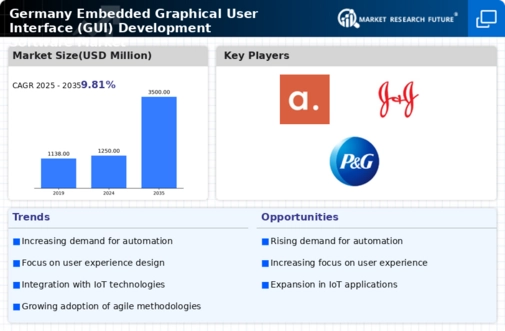
Key Market DynamicsRising demand for intuitive interfaces drives innovation in Germany's embedded graphical user interface development software market.
Countries CoveredGermany
Leave a Comment

FAQs

What is the current market valuation of the Germany embedded graphical user interface development software market?

As of 2024, the market valuation was 11.99 USD Million.

What is the projected market valuation for the Germany embedded graphical user interface development software market by 2035?

The market is expected to reach a valuation of 132.95 USD Million by 2035.

What is the expected compound annual growth rate (CAGR) for the market during the forecast period 2025 - 2035?

The expected CAGR for the market during the forecast period 2025 - 2035 is 24.45%.

Who are the key players in the Germany embedded graphical user interface development software market?

Key players include Siemens AG, SAP SE, STMicroelectronics, NXP Semiconductors, and Infineon Technologies AG.

Which application segments are driving the market growth in Germany?

The application segments include Consumer Electronics, Automotive, Industrial Automation, Medical Devices, and Smart Home.

What is the market size for the Automotive application segment in 2024?

The Automotive application segment was valued at 40.0 USD Million in 2024.

How do deployment models impact the market for embedded graphical user interface development software?

The market is segmented into On-Premises, Cloud-Based, and Hybrid models, with Cloud-Based expected to grow significantly.

What is the market valuation for large enterprises in the Germany embedded graphical user interface development software market?

In 2024, the market valuation for large enterprises was 66.48 USD Million.

Which user types are contributing to the market growth in Germany?

User types include Professional Developers, Hobbyists, and Design Engineers, with Professional Developers leading the market.

What technologies are being utilized in the Germany embedded graphical user interface development software market?

Technologies include Touchscreen, Voice Recognition, and Gesture Control, with Touchscreen being the most prominent.

Download Free Sample

Kindly complete the form below to receive a free sample of this Report

Compare Licence

×
Features License Type
Single User Multiuser License Enterprise User
Price $4,950 $5,950 $7,250
Maximum User Access Limit 1 User Upto 10 Users Unrestricted Access Throughout the Organization
Free Customization
Direct Access to Analyst
Deliverable Format
Platform Access
Discount on Next Purchase 10% 15% 15%
Printable Versions







