×
Request Free Sample ×

Kindly complete the form below to receive a free sample of this Report

* Please use a valid business email

Leading companies partner with us for data-driven Insights

clients tt-cursor
Hero Background

Japan Data Center Interconnect Market

ID: MRFR/ICT/60403-HCR
200 Pages
Aarti Dhapte
February 2026

Japan Data Center Interconnect Market Size, Share and Research Report: By Type (Service, Software, Hardware), By Application (Workload & Data Storage Mobility, Real-Time Disaster Recovery & Business Continuity, Shared Data & Resources/Server High-Availability Clusters) and By End Users (Enterprise, CSPs, CNPs/ICPs, Government, Others)- Industry Forecast to 2035

Share:
Download PDF ×

We do not share your information with anyone. However, we may send you emails based on your report interest from time to time. You may contact us at any time to opt-out.

Japan Data Center Interconnect Market Infographic
Purchase Options

Japan Data Center Interconnect Market Summary

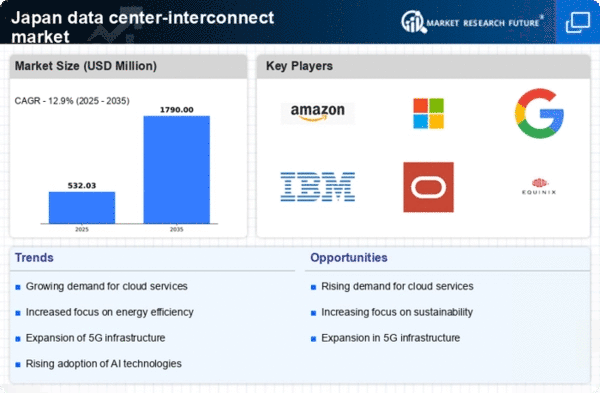
As per Market Research Future analysis, the Japan data center-interconnect market size was estimated at 471.24 USD Million in 2024. The Japan data center-interconnect market is projected to grow from 532.03 USD Million in 2025 to 1790.0 USD Million by 2035, exhibiting a compound annual growth rate (CAGR) of 12% during the forecast period 2025 - 2035

Key Market Trends & Highlights

The Japan The Japan data center-interconnect market is poised for substantial growth. This growth is driven by technological advancements and increasing demand for connectivity.

  • The market experiences rising demand for high-speed connectivity, particularly in the largest segment of cloud services.
  • Advancements in optical networking technologies are enhancing data transmission capabilities across the fastest-growing segment of telecommunications.
  • A strong focus on sustainability and energy efficiency is shaping operational strategies within the data center sector.
  • Key market drivers include increased data traffic and the emergence of 5G technology, which are significantly influencing market dynamics.

Market Size & Forecast

2024 Market Size 471.24 (USD Million)
2035 Market Size 1790.0 (USD Million)
CAGR (2025 - 2035) 12.9%

Major Players

Amazon (US), Microsoft (US), Google (US), IBM (US), Oracle (US), Equinix (US), Digital Realty (US), Alibaba (CN), NTT (JP)

Our Impact
Enabled $4.3B Revenue Impact for Fortune 500 and Leading Multinationals
Partnering with 2000+ Global Organizations Each Year
30K+ Citations by Top-Tier Firms in the Industry

Japan Data Center Interconnect Market Trends

The data center-interconnect market is currently experiencing notable growth. This growth is driven by the increasing demand for high-speed connectivity and the expansion of cloud services. In Japan, the proliferation of data centers has led to a heightened focus on interconnectivity solutions that facilitate efficient data transfer between facilities. This trend is further supported by advancements in optical networking technologies, which enhance bandwidth capabilities and reduce latency. As organizations increasingly rely on data-driven strategies, the need for robust interconnect solutions becomes paramount, fostering a competitive landscape among service providers. Moreover, the regulatory environment in Japan appears to be evolving, with government initiatives aimed at promoting digital infrastructure development. This includes investments in fiber optic networks and incentives for companies to adopt innovative interconnect technologies. The emphasis on sustainability and energy efficiency is also influencing the market, as businesses seek to minimize their carbon footprint while maintaining operational efficiency. Overall, the data center-interconnect market is poised for continued expansion, reflecting the dynamic nature of Japan's digital economy and the growing importance of seamless connectivity in an increasingly interconnected world.

Rising Demand for High-Speed Connectivity

The need for faster data transfer rates is driving the data center-interconnect market. As businesses in Japan adopt cloud computing and big data analytics, the demand for high-speed connections between data centers is intensifying. This trend is likely to lead to increased investments in advanced networking technologies.

Advancements in Optical Networking Technologies

Innovations in optical networking are transforming the data center-interconnect market. Technologies such as wavelength division multiplexing (WDM) are enhancing bandwidth and reducing latency. These advancements are crucial for supporting the growing data traffic generated by enterprises in Japan.

Focus on Sustainability and Energy Efficiency

Sustainability is becoming a key consideration in the data center-interconnect market. Companies are increasingly prioritizing energy-efficient solutions to reduce their environmental impact. This trend is likely to shape the development of interconnect technologies that align with Japan's commitment to sustainability.

Japan Data Center Interconnect Market Drivers

Increased Data Traffic

The data center-interconnect market in Japan is experiencing a surge in data traffic, driven by the proliferation of cloud computing and digital services. As businesses increasingly rely on data-intensive applications, the demand for robust interconnect solutions has escalated. Reports indicate that data traffic in Japan is projected to grow at a CAGR of 25% over the next five years. This growth necessitates advanced interconnect technologies to ensure seamless data transfer between data centers. Consequently, service providers are investing heavily in high-capacity fiber optic networks to accommodate this demand. The increased data traffic enhances the need for efficient interconnect solutions. It also propels innovation within the data center-interconnect market, as companies strive to optimize their infrastructure to handle the growing load.

Emergence of 5G Technology

The rollout of 5G technology in Japan is poised to have a transformative effect on the data center-interconnect market. With its promise of ultra-low latency and high-speed connectivity, 5G is expected to drive new applications and services that require efficient data transfer between data centers. The anticipated increase in connected devices and IoT applications will further amplify the demand for interconnect solutions. Industry analysts suggest that the integration of 5G networks with existing data center infrastructures will necessitate advanced interconnect technologies to manage the increased data flow. This convergence of 5G and data center interconnectivity is likely to create new opportunities for service providers, as they seek to enhance their offerings and meet the evolving needs of businesses in Japan.

Rising Cybersecurity Concerns

As cyber threats continue to evolve, the data center-interconnect market in Japan is witnessing a heightened focus on cybersecurity. Organizations are increasingly aware of the vulnerabilities associated with data transfer between interconnected data centers, prompting them to seek robust security measures. This trend is leading to the development of advanced interconnect solutions that incorporate security features, such as encryption and secure access protocols. The growing emphasis on data protection is likely to drive investment in secure interconnect technologies, as businesses aim to safeguard their sensitive information. Furthermore, regulatory requirements regarding data privacy and protection are compelling organizations to enhance their cybersecurity posture, thereby influencing the data center-interconnect market. As a result, the market is expected to evolve to meet these security demands, fostering innovation in secure interconnect solutions.

Government Initiatives and Regulations

The Japanese government is actively promoting the development of digital infrastructure, which significantly impacts the data center-interconnect market. Initiatives aimed at enhancing connectivity and supporting the digital economy are being implemented, including investments in broadband expansion and regulatory frameworks that encourage competition among service providers. These government efforts are expected to stimulate growth in the data center-interconnect market, as they create a conducive environment for innovation and investment. Furthermore, regulations that mandate data localization and security compliance are driving organizations to establish interconnected data centers within Japan, thereby increasing the demand for interconnect solutions. As a result, the data center-interconnect market is likely to benefit from these supportive government policies, fostering a more robust digital ecosystem.

Growing Focus on Hybrid Cloud Solutions

The shift towards hybrid cloud solutions is significantly influencing the data center-interconnect market in Japan. Organizations are increasingly adopting hybrid models to leverage the benefits of both public and private clouds, which necessitates efficient interconnect solutions to ensure seamless data movement. This trend is supported by a growing recognition of the need for flexibility, scalability, and cost-effectiveness in IT infrastructure. As businesses seek to optimize their operations, the demand for interconnect technologies that facilitate hybrid cloud environments is expected to rise. Reports indicate that the hybrid cloud market in Japan is projected to grow by 30% over the next few years, further driving the need for advanced interconnect solutions. Consequently, the data center-interconnect market is likely to see increased investment and innovation to support this evolving landscape.


Market Segment Insights

By Type: Service (Largest) vs. Software (Fastest-Growing)

The market share distribution among service, software, and hardware in the Japan data center-interconnect market reflects a highly competitive landscape. Currently, the service segment holds the largest share, driven by the increasing demand for reliable and efficient interconnection solutions. Software, while smaller in share, is demonstrating significant traction due to its capacity to enhance operational efficiency and integration across platforms. Hardware complements both segments, providing the necessary infrastructure to support growing digital initiatives. In terms of growth trends, the software segment is the fastest-growing value, fueled by advancements in automation and cloud services. Businesses in Japan are increasingly adopting software solutions to streamline operations, reduce costs, and improve connectivity. The hardware segment is also seeing steady growth as companies upgrade existing infrastructure to accommodate rising data traffic and enhance reliability, ultimately driving the overall market forward.

Service (Dominant) vs. Software (Emerging)

In the Japan data center-interconnect market, the service segment is currently dominant, characterized by comprehensive offerings that include managed services and connectivity solutions. This segment has established itself as crucial to fulfilling the complex interconnection needs of enterprises. Meanwhile, the software segment is emerging with innovative solutions that facilitate better management of interconnections and integration of various platforms. This growth is primarily attributed to the continuous technological advancements aimed at improving service delivery. As companies shift towards more integrated solutions, the interplay between service and software will likely define market dynamics, with each influencing the other in terms of growth and customer adoption.

By Application: Workload & Data Storage Mobility (Largest) vs. Real-Time Disaster Recovery & Business Continuity (Fastest-Growing)

In the Japan data center-interconnect market, the application segment is predominantly led by Workload & Data Storage Mobility, which commands a significant market share. This segment benefits from the increasing demand for efficient data management and high-speed data transfer solutions among various sectors. Meanwhile, Real-Time Disaster Recovery & Business Continuity is emerging as a critical area due to its growing recognition among enterprises for maintaining operational resilience against unforeseen disruptions. The growth trends in this market segment are being driven by the increasing reliance on cloud-based services and the need for robust data protection measures. Businesses are swiftly adopting solutions that enhance data mobility while ensuring seamless access to information during disaster recovery scenarios. As organizations become more data-driven, investments in Shared Data & Resources/Server High-Availability Clusters are also growing, laying the groundwork for future advancements in interconnected data solutions.

Workload & Data Storage Mobility (Dominant) vs. Shared Data & Resources/Server High-Availability Clusters (Emerging)

Workload & Data Storage Mobility is currently the dominant segment in the Japan data center-interconnect market, capitalizing on the shift towards cloud computing and big data analytics. This category allows businesses to efficiently manage, transfer, and store large volumes of data across interconnected data centers, enhancing overall operational agility. On the other hand, Shared Data & Resources/Server High-Availability Clusters represent an emerging trend, focusing on maximizing resource utilization and minimizing downtime. These configurations are becoming essential as organizations aim for more resilient architectures that can support critical applications without interruptions. As the digital landscape evolves, both segments exhibit unique characteristics that are pivotal in shaping future strategies for data center interconnectivity.

By End-Users: Enterprise (Largest) vs. CSPs (Fastest-Growing)

The Japan data center-interconnect market exhibits a distinctive distribution of market share among various end-users. Enterprises currently hold the largest share, driven by the increasing need for data management and cloud services. Meanwhile, Cloud Service Providers (CSPs) are gaining traction quickly, leveraging advancements in technology and growing demands for cloud-based solutions to expand their footprint in the market. Growth trends for these segments reveal exciting dynamics. CSPs are emerging as the fastest-growing segment due to the shift towards cloud computing and the increasing demand for data centers that can support high-speed connectivity. Enterprises, while dominant, are also adapting by enhancing their digital infrastructure, resulting in robust demand for data interconnection services. The government sector is steadily increasing its presence but lags behind private enterprises and CSPs in terms of growth.

Enterprise: Dominant vs. CSPs: Emerging

The Enterprise segment stands out as a dominant force within the Japan data center-interconnect market, characterized by substantial investments in digital transformation and a strong emphasis on data security. Enterprises are adopting robust interconnection solutions to facilitate seamless communication and data flow, ensuring efficiency in operations. On the other hand, CSPs represent an emerging segment with rapid growth fueled by the rising adoption of cloud services across various industries. CSPs offer scalable and flexible solutions that appeal to businesses seeking innovative ways to manage their data needs. As both segments continue to evolve, their unique characteristics will play a crucial role in shaping the overall landscape of the market.

Get more detailed insights about Japan Data Center Interconnect Market

Key Players and Competitive Insights

The data center-interconnect market in Japan is characterized by a dynamic competitive landscape, driven by rapid technological advancements and increasing demand for high-speed connectivity. Major players such as Amazon (US), Microsoft (US), and NTT (JP) are strategically positioned to leverage their extensive infrastructure and innovative capabilities. Amazon (US) focuses on expanding its cloud services, while Microsoft (US) emphasizes partnerships to enhance its data center offerings. NTT (JP) is committed to regional expansion and digital transformation, which collectively shapes a competitive environment that is increasingly reliant on innovation and strategic collaborations.Key business tactics within this market include localizing manufacturing and optimizing supply chains to enhance operational efficiency. The competitive structure appears moderately fragmented, with several key players exerting influence over market dynamics. This fragmentation allows for a diverse range of services and solutions, catering to various customer needs while fostering healthy competition among the leading firms.

In October Amazon (US) announced the launch of a new data center in Tokyo, aimed at bolstering its cloud infrastructure and enhancing service delivery in the region. This strategic move is significant as it not only expands Amazon's operational footprint but also reinforces its commitment to meeting the growing demand for cloud services in Japan. The establishment of this facility is likely to enhance connectivity options for businesses, thereby strengthening Amazon's competitive position.

In September Microsoft (US) unveiled a partnership with a local telecommunications provider to enhance its data center interconnect capabilities in Japan. This collaboration is pivotal as it allows Microsoft to leverage local expertise and infrastructure, thereby improving service reliability and performance. Such partnerships are indicative of a broader trend where global players seek to integrate more closely with regional firms to optimize their offerings.

In August NTT (JP) launched a new initiative focused on sustainability within its data center operations, aiming to reduce energy consumption by 30% by 2030. This initiative reflects a growing trend towards environmentally responsible practices in the data center sector. NTT's commitment to sustainability not only enhances its brand reputation but also positions it favorably among increasingly eco-conscious consumers and businesses.

As of November current trends in the data center-interconnect market include a strong emphasis on digitalization, sustainability, and the integration of AI technologies. Strategic alliances are becoming increasingly important, as they enable companies to pool resources and expertise to address complex challenges. Looking ahead, competitive differentiation is likely to evolve, shifting from traditional price-based competition to a focus on innovation, technological advancements, and supply chain reliability. This transition underscores the necessity for companies to adapt and innovate continuously in order to maintain a competitive edge.

Key Companies in the Japan Data Center Interconnect Market include

Industry Developments

The Japan Data Center Interconnect Market is currently experiencing significant developments, characterized by advancements in technology and shifting demands. Key players such as Mitsubishi Electric, NEC Corporation, and NTT Communications are investing heavily in the expansion of their interconnect capabilities. In June 2023, Fujitsu announced a partnership with Google Cloud to enhance data connectivity solutions, aligning with the increasing need for robust cloud services. 

Additionally, in July 2023, SoftBank Corp collaborated with Oracle Corporation to develop an advanced interconnection system aimed at improving data transfer speeds and reliability. The market has shown a valuation growth due to the rising data consumption and cloud adoption, notably attributed to the pandemic's impact on digital transformation. Over the past two to three years, Japan's data center infrastructure has modernized significantly, with KDDI Corporation and Rakuten Mobile ramping up investments to accommodate higher bandwidth requirements. 

The trend towards mergers and acquisitions continues, with NTT Communications acquiring additional data centers to consolidate its market position, reflecting the growing competitive landscape within the sector. Japan's continued focus on technological innovation suggests a dynamic future for the data center interconnect industry.

Future Outlook

Japan Data Center Interconnect Market Future Outlook

The data center-interconnect market in Japan is poised for growth at 12.9% CAGR from 2025 to 2035, driven by increasing data traffic and cloud adoption.

New opportunities lie in:

  • Development of high-capacity optical fiber networks
  • Integration of AI-driven network management solutions
  • Expansion of interconnect services for edge computing facilities

By 2035, the market is expected to achieve substantial growth and innovation.

Market Segmentation

Japan Data Center Interconnect Market Type Outlook

  • Service
  • Software
  • Hardware

Japan Data Center Interconnect Market End-Users Outlook

  • Enterprise
  • CSPs
  • CNPs/ICPs
  • Government
  • Others

Japan Data Center Interconnect Market Application Outlook

  • Workload & Data Storage Mobility
  • Real-Time Disaster Recovery & Business Continuity
  • Shared Data & Resources/Server High-Availability Clusters

Report Scope

MARKET SIZE 2024 471.24(USD Million)
MARKET SIZE 2025 532.03(USD Million)
MARKET SIZE 2035 1790.0(USD Million)
COMPOUND ANNUAL GROWTH RATE (CAGR) 12.9% (2025 - 2035)
REPORT COVERAGE Revenue Forecast, Competitive Landscape, Growth Factors, and Trends
BASE YEAR 2024
Market Forecast Period 2025 - 2035
Historical Data 2019 - 2024
Market Forecast Units USD Million
Key Companies Profiled Amazon (US), Microsoft (US), Google (US), IBM (US), Oracle (US), Equinix (US), Digital Realty (US), Alibaba (CN), NTT (JP)
Segments Covered Type, Application, End-Users
Key Market Opportunities Adoption of advanced optical technologies enhances connectivity in the data center-interconnect market.
Key Market Dynamics Rising demand for high-speed connectivity drives innovation in data center-interconnect solutions across Japan's competitive landscape.
Countries Covered Japan
Leave a Comment

FAQs

What is the expected market size of the Japan Data Center Interconnect Market in 2024?

The Japan Data Center Interconnect Market is expected to be valued at 444.31 million USD in 2024.

What will the market valuation be in 2035?

By 2035, the Japan Data Center Interconnect Market is anticipated to reach approximately 1702.05 million USD.

What is the expected compound annual growth rate (CAGR) for the Japan Data Center Interconnect Market from 2025 to 2035?

The expected CAGR for the Japan Data Center Interconnect Market from 2025 to 2035 is 12.986 percent.

Who are the major players in the Japan Data Center Interconnect Market?

Key players in the market include Mitsubishi Electric, Global Switch, Digital Realty, and Microsoft, among others.

How is the Japan Data Center Interconnect Market segmented by type?

The market is segmented into three primary types: Service, Software, and Hardware.

What is the market value for the Service segment in 2024?

The Service segment of the Japan Data Center Interconnect Market is valued at 177.73 million USD in 2024.

What is the expected market size for the Software segment in 2035?

The Software segment is expected to grow to 478.03 million USD by the year 2035.

What is the market value for the Hardware segment in 2024?

In 2024, the Hardware segment of the Japan Data Center Interconnect Market is valued at 144.01 million USD.

What growth drivers are influencing the Japan Data Center Interconnect Market?

The market is driven by increasing data consumption and the rising demand for cloud services.

Are there any challenges facing the Japan Data Center Interconnect Market?

Challenges include high competition and the need for continuous technological advancements to meet consumer demands.

Download Free Sample

Kindly complete the form below to receive a free sample of this Report

Compare Licence

×
Features License Type
Single User Multiuser License Enterprise User
Price $4,950 $5,950 $7,250
Maximum User Access Limit 1 User Upto 10 Users Unrestricted Access Throughout the Organization
Free Customization
Direct Access to Analyst
Deliverable Format
Platform Access
Discount on Next Purchase 10% 15% 15%
Printable Versions