×
Request Free Sample ×

Kindly complete the form below to receive a free sample of this Report

* Please use a valid business email

Leading companies partner with us for data-driven Insights

clients tt-cursor
Hero Background

Japan Cutting Equipment Market

ID: MRFR/Equip/46811-HCR
128 Pages
Snehal Singh
February 2026

Japan Cutting Equipment Market Research Report By Cutting Technology (Plasma, Laser, Waterjet, Carbon- arc) andBy End User (Automotive, Metal Fabrication, Construction, Aerospace and Defense, Shipbuilding, Others)- Forecast to 2035

Share:
Download PDF ×

We do not share your information with anyone. However, we may send you emails based on your report interest from time to time. You may contact us at any time to opt-out.

Japan Cutting Equipment Market Infographic
Purchase Options

Japan Cutting Equipment Market Summary

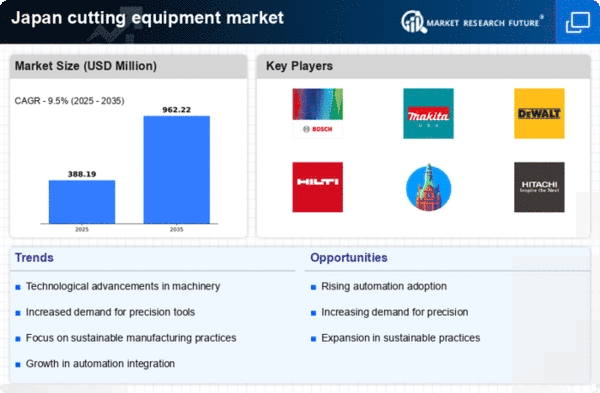
As per Market Research Future analysis, the Japan cutting equipment market size was estimated at 354.51 USD Million in 2024. The Japan cutting equipment market is projected to grow from 388.19 USD Million in 2025 to 962.22 USD Million by 2035, exhibiting a compound annual growth rate (CAGR) of 9% during the forecast period 2025 - 2035

Key Market Trends & Highlights

The Japan cutting equipment market is experiencing a transformative shift driven by technological advancements and sustainability initiatives.

  • Technological advancements are reshaping the cutting equipment landscape, enhancing efficiency and precision.
  • The largest segment in the market is precision cutting tools, while the fastest-growing segment is smart cutting technologies.
  • Sustainability initiatives are increasingly influencing purchasing decisions, with a focus on eco-friendly materials and processes.
  • Rising demand for precision engineering and the growth of automation in manufacturing are key drivers propelling market expansion.

Market Size & Forecast

2024 Market Size 354.51 (USD Million)
2035 Market Size 962.22 (USD Million)
CAGR (2025 - 2035) 9.5%

Major Players

Bosch (DE), Makita (JP), DeWalt (US), Hilti (LI), Milwaukee (US), Hitachi (JP), Festool (DE), Koki Holdings (JP)

Our Impact
Enabled $4.3B Revenue Impact for Fortune 500 and Leading Multinationals
Partnering with 2000+ Global Organizations Each Year
30K+ Citations by Top-Tier Firms in the Industry

Japan Cutting Equipment Market Trends

The cutting equipment market is currently experiencing a dynamic evolution, driven by advancements in technology and increasing demand across various sectors. The integration of automation and smart technologies into cutting tools is reshaping the landscape, enhancing precision and efficiency. Industries such as manufacturing, construction, and automotive are particularly influenced by these innovations, as they seek to improve productivity and reduce operational costs. Furthermore, the emphasis on sustainability is prompting manufacturers to develop eco-friendly cutting solutions, which aligns with Japan's commitment to environmental conservation. This shift not only addresses regulatory requirements but also caters to the growing consumer preference for sustainable products. In addition, the cutting equipment market is witnessing a trend towards customization and flexibility. As businesses strive to meet specific client needs, the demand for tailored cutting solutions is on the rise. This trend is further supported by the increasing adoption of Industry 4.0 practices, which promote interconnected systems and data-driven decision-making. Consequently, manufacturers are investing in research and development to create innovative products that can adapt to diverse applications. Overall, the cutting equipment market is poised for continued growth, driven by technological advancements and evolving consumer preferences.

Technological Advancements

The cutting equipment market is significantly influenced by ongoing technological advancements. Innovations such as laser cutting, waterjet cutting, and CNC machining are enhancing precision and efficiency. These technologies enable manufacturers to produce intricate designs with minimal waste, thereby improving overall productivity.

Sustainability Initiatives

There is a growing emphasis on sustainability within the cutting equipment market. Manufacturers are increasingly focusing on eco-friendly materials and processes to reduce environmental impact. This trend aligns with Japan's broader commitment to sustainability and is likely to attract environmentally conscious consumers.

Customization and Flexibility

The demand for customized cutting solutions is rising as businesses seek to meet specific client requirements. This trend is driven by the need for flexibility in production processes, allowing manufacturers to adapt their equipment to various applications and enhance overall operational efficiency.

Japan Cutting Equipment Market Drivers

Increased Focus on Safety Standards

Safety regulations play a crucial role in shaping the cutting equipment market in Japan. As industries prioritize worker safety, there is a growing demand for cutting tools that comply with stringent safety standards. Manufacturers are increasingly investing in equipment that incorporates safety features, such as automatic shut-off mechanisms and ergonomic designs. This trend is expected to drive market growth, as compliance with safety regulations becomes a key factor in purchasing decisions. In 2025, it is anticipated that safety-compliant cutting equipment will account for approximately 25% of the market, reflecting the industry's commitment to ensuring a safe working environment.

Expansion of the Construction Sector

The construction sector in Japan is witnessing robust growth, which directly impacts the cutting equipment market. With ongoing infrastructure projects and urban development initiatives, the demand for cutting tools used in construction applications is expected to rise. In 2025, the construction industry is projected to contribute approximately 30% to the overall demand for cutting equipment. This expansion is driven by the need for efficient cutting solutions that can handle various materials, including metals and composites. As construction projects become more complex, the cutting equipment market is likely to adapt by offering innovative solutions tailored to meet these evolving requirements.

Growth of Automation in Manufacturing

The integration of automation technologies within manufacturing processes significantly influences the cutting equipment market in Japan. As industries adopt automated solutions to enhance productivity, the demand for advanced cutting equipment that can seamlessly integrate with robotic systems is on the rise. In 2025, it is estimated that automated cutting solutions will represent around 40% of the market. This shift towards automation not only streamlines operations but also minimizes human error, thereby improving overall efficiency. Consequently, manufacturers are increasingly investing in cutting equipment that supports automation, indicating a transformative phase for the industry.

Emergence of Smart Cutting Technologies

The advent of smart cutting technologies is revolutionizing the cutting equipment market in Japan. Innovations such as IoT-enabled cutting tools and data analytics are enhancing operational efficiency and enabling predictive maintenance. These technologies allow manufacturers to monitor equipment performance in real-time, reducing downtime and optimizing production processes. In 2025, smart cutting solutions are projected to capture around 20% of the market share. As industries increasingly recognize the benefits of smart technologies, investments in cutting equipment that incorporates these advancements are likely to grow, indicating a shift towards more intelligent manufacturing practices.

Rising Demand for Precision Engineering

The cutting equipment market experiences a notable surge in demand for precision engineering applications. Industries such as automotive, aerospace, and electronics increasingly require high-accuracy cutting tools to meet stringent quality standards. This trend is driven by the need for enhanced product performance and reliability. In 2025, the precision cutting tools segment is projected to account for approximately 35% of the overall market share. As manufacturers strive to improve operational efficiency, investments in advanced cutting technologies are likely to rise, further propelling the cutting equipment market. The emphasis on precision not only enhances product quality but also reduces waste, aligning with the industry's goals for sustainability.


Market Segment Insights

By Cutting Technology: Laser (Largest) vs. Plasma (Fastest-Growing)

In the Japan cutting equipment market, Laser cutting technology holds the largest share, favored for its precision and versatility. It is widely adopted in industries such as automotive and electronics, contributing significantly to the overall market dynamics. Conversely, Plasma cutting has emerged as the fastest-growing segment due to its cost-effectiveness and efficiency in cutting thicker materials, appealing to sectors like construction and manufacturing. Growth trends indicate a shift towards more advanced and automated cutting technologies, driven by the increasing demand for precision and efficiency in industrial processes. The rise of smart manufacturing and Industry 4.0 initiatives further propels the adoption of these technologies. As companies seek to optimize production and reduce operational costs, the cutting technology segment is poised for significant advancements and market expansion.

Technology: Laser (Dominant) vs. Plasma (Emerging)

Laser cutting technology dominates the market owing to its unparalleled precision and ability to cut various materials with minimal waste. Its versatility allows for intricate designs and applications across multiple sectors, reinforcing its position as a leading choice among manufacturers. On the other hand, Plasma cutting technology is rapidly gaining traction as an emerging alternative, primarily due to its speed and efficiency in handling thick metals, making it a favored option in fabrication and repair industries. As demand grows for robust solutions that balance cost and performance, Plasma technology's market share is expected to rise significantly, positioning it as a compelling choice for many cutting applications.

By End User: Metal Fabrication (Largest) vs. Automotive (Fastest-Growing)

The Japan cutting equipment market exhibits considerable diversity across its end-user segments, with metal fabrication commanding the largest share. This segment thrives on the continuous demand for precise cutting tools used in a variety of applications, including construction and heavy industries. On the other hand, automotive is witnessing rapid growth, driven by advancements in electric vehicle manufacturing and increasing investments in automation technology. Growth trends in the Japan cutting equipment market are significantly influenced by technological innovations and sustainability practices. As industries seek efficiency and eco-friendly solutions, demand for cutting-edge equipment in automotive and aerospace sectors is expected to rise. The push towards automation and smart manufacturing further propels the adoption of cutting technologies, revealing a promising outlook for both established and emerging end-user segments.

Metal Fabrication: Dominant vs. Automotive: Emerging

Metal fabrication remains the dominant segment in the Japan cutting equipment market, underpinned by its extensive application across various industries. This segment leverages advanced cutting technologies to enhance precision and productivity, catering to the demands of both small workshops and large manufacturing plants. Key players are continuously innovating to improve tool efficiency and reduce downtime. In contrast, the automotive segment is emerging strongly, fueled by the shift towards electric vehicles and autonomous driving technologies. With increased automation in production processes, the demand for high-performance cutting equipment in automotive manufacturing is set to grow, highlighting a significant opportunity for manufacturers to innovate and adapt to evolving industry needs.

Get more detailed insights about Japan Cutting Equipment Market

Key Players and Competitive Insights

The cutting equipment market in Japan is characterized by a dynamic competitive landscape, driven by technological advancements and increasing demand for precision tools across various sectors. Key players such as Bosch (DE), Makita (JP), and DeWalt (US) are strategically positioned to leverage innovation and regional expansion. Bosch (DE) focuses on integrating smart technology into its cutting tools, enhancing user experience and operational efficiency. Meanwhile, Makita (JP) emphasizes sustainability in its product development, aligning with global trends towards eco-friendly solutions. DeWalt (US) is actively pursuing partnerships to expand its market reach, particularly in the construction and manufacturing sectors, thereby shaping a competitive environment that prioritizes innovation and customer-centric solutions.
In terms of business tactics, companies are increasingly localizing manufacturing to reduce lead times and optimize supply chains. The market structure appears moderately fragmented, with several key players exerting influence while also allowing for niche competitors to thrive. This fragmentation fosters a competitive atmosphere where innovation and quality are paramount, as companies strive to differentiate themselves in a crowded marketplace.
In October 2025, Bosch (DE) announced the launch of a new line of battery-powered cutting tools designed for professional use, which integrates advanced AI features for enhanced precision. This strategic move not only reinforces Bosch's commitment to innovation but also positions the company to capture a larger share of the growing market for cordless tools, appealing to a tech-savvy customer base. The introduction of AI capabilities is likely to set a new standard in the industry, compelling competitors to enhance their offerings.
In September 2025, Makita (JP) unveiled its latest eco-friendly cutting equipment, which utilizes sustainable materials and energy-efficient technologies. This initiative reflects Makita's strategic focus on sustainability, catering to an increasingly environmentally conscious consumer base. By prioritizing eco-friendly practices, Makita not only enhances its brand image but also aligns with regulatory trends favoring sustainable manufacturing, potentially gaining a competitive edge in the market.
In August 2025, DeWalt (US) entered into a strategic partnership with a leading construction firm to co-develop cutting tools tailored for specific applications in the construction industry. This collaboration is indicative of DeWalt's strategy to deepen its market penetration and respond to the unique needs of its customers. Such partnerships may enhance product relevance and drive sales, as they allow for the development of specialized tools that meet industry demands.
As of November 2025, current competitive trends in the cutting equipment market are increasingly defined by digitalization, sustainability, and the integration of AI technologies. Strategic alliances are becoming more prevalent, enabling companies to pool resources and expertise to innovate more effectively. Looking ahead, competitive differentiation is likely to evolve from traditional price-based competition to a focus on technological innovation, supply chain reliability, and sustainable practices. This shift suggests that companies that prioritize these aspects will be better positioned to thrive in an ever-evolving market landscape.

Key Companies in the Japan Cutting Equipment Market include

Industry Developments

Recent developments in the Japan Cutting Equipment Market have highlighted significant advancements and shifts in company strategies. In September 2023, Hitachi announced plans for expanding its manufacturing capabilities, focusing on efficient, sustainable cutting equipment solutions. Concurrently, Bosch has launched a new line of precision cutting tools aimed at enhancing productivity in automotive and construction sectors, responding to increasing demand from local industries. The past couple of years have seen notable movements such as Aisin Seiki acquiring a stake in Fuji Kiko in April 2022, aiming to bolster innovative cutting technologies. 

The market valuation of companies like Makita and Koki Holdings has steadily increased, attributed to rising demand for high-performance equipment, particularly in the growing sectors of electric vehicles and automation. Furthermore, Daikin reported a strategic partnership with Mitsubishi Electric in March 2023 to jointly develop energy-efficient cutting technologies. 

Japan's strict manufacturing standards and emphasis on quality assurance continue to propel the Cutting Equipment Market forward, with many firms investing in Research and Development to enhance competitiveness and meet evolving consumer needs. As these companies adapt to technological advancements, the market landscape remains dynamic and increasingly integrated with automation and artificial intelligence solutions.

Future Outlook

Japan Cutting Equipment Market Future Outlook

The Cutting Equipment Market in Japan is projected to grow at a 9.5% CAGR from 2025 to 2035, driven by technological advancements and increasing industrial automation.

New opportunities lie in:

  • Development of advanced CNC cutting systems for precision applications.
  • Expansion into eco-friendly cutting technologies to meet regulatory demands.
  • Integration of IoT solutions for real-time monitoring and predictive maintenance.

By 2035, the cutting equipment market is expected to achieve substantial growth and innovation.

Market Segmentation

Japan Cutting Equipment Market End User Outlook

  • Automotive
  • Metal Fabrication
  • Construction
  • Aerospace and Defense
  • Shipbuilding
  • Others

Japan Cutting Equipment Market Cutting Technology Outlook

  • Plasma
  • Laser
  • Waterjet
  • Carbon-arc

Report Scope

MARKET SIZE 2024 354.51(USD Million)
MARKET SIZE 2025 388.19(USD Million)
MARKET SIZE 2035 962.22(USD Million)
COMPOUND ANNUAL GROWTH RATE (CAGR) 9.5% (2025 - 2035)
REPORT COVERAGE Revenue Forecast, Competitive Landscape, Growth Factors, and Trends
BASE YEAR 2024
Market Forecast Period 2025 - 2035
Historical Data 2019 - 2024
Market Forecast Units USD Million
Key Companies Profiled Bosch (DE), Makita (JP), DeWalt (US), Hilti (LI), Milwaukee (US), Hitachi (JP), Festool (DE), Koki Holdings (JP)
Segments Covered Cutting Technology, End User
Key Market Opportunities Adoption of advanced automation technologies enhances efficiency in the cutting equipment market.
Key Market Dynamics Technological advancements drive innovation in cutting equipment, enhancing efficiency and precision in manufacturing processes.
Countries Covered Japan
Leave a Comment

FAQs

What is the expected market size of the Japan Cutting Equipment Market in 2024?

The Japan Cutting Equipment Market is expected to be valued at approximately 472.8 USD Million in 2024.

What will be the projected market size of the Japan Cutting Equipment Market by 2035?

By 2035, the Japan Cutting Equipment Market is projected to reach around 1064.3 USD Million.

What is the expected CAGR for the Japan Cutting Equipment Market from 2025 to 2035?

The expected CAGR for the Japan Cutting Equipment Market from 2025 to 2035 is 7.655%.

Which cutting technology segment is expected to have the highest market value in 2035?

The Laser cutting technology segment is expected to have the highest market value at around 360.0 USD Million in 2035.

What is the market value of the Plasma cutting technology segment in 2024?

The Plasma cutting technology segment is valued at approximately 120.0 USD Million in 2024.

Who are some key players in the Japan Cutting Equipment Market?

Key players in the Japan Cutting Equipment Market include companies like Toyota Industries Corporation, Hikoki, and Hitachi.

What is the market value of the Waterjet cutting technology segment in 2035?

The Waterjet cutting technology segment is expected to reach a market value of about 250.0 USD Million in 2035.

What is the anticipated market size for Carbon-arc cutting technology in 2024?

The Carbon-arc cutting technology segment is anticipated to be valued at around 102.8 USD Million in 2024.

How does the market for cutting equipment in Japan align with global trends?

The Japan Cutting Equipment Market is growing steadily, reflecting the global trend towards advanced cutting technologies and is influenced by technological advancements.

What challenges does the Japan Cutting Equipment Market currently face?

The Japan Cutting Equipment Market faces challenges such as stiff competition among key players and the need for continuous innovation to meet diverse customer demands.

Download Free Sample

Kindly complete the form below to receive a free sample of this Report

Compare Licence

×
Features License Type
Single User Multiuser License Enterprise User
Price $4,950 $5,950 $7,250
Maximum User Access Limit 1 User Upto 10 Users Unrestricted Access Throughout the Organization
Free Customization
Direct Access to Analyst
Deliverable Format
Platform Access
Discount on Next Purchase 10% 15% 15%
Printable Versions